
Structure from Motion Computer Vision CSE P 576
![Levenberg-Marquardt Iterative non-linear least squares [Press’ 92] • Linearize measurement equations • Substitute into](https://slidetodoc.com/presentation_image_h2/145ae2d41f616909e2abd48345b3d7f6/image-12.jpg "Levenberg-Marquardt Iterative non-linear least squares [Press’ 92] • Linearize measurement equations • Substitute into")
![Levenberg-Marquardt Iterative non-linear least squares [Press’ 92] • Solve for minimum Hessian: error: CSE](https://slidetodoc.com/presentation_image_h2/145ae2d41f616909e2abd48345b3d7f6/image-13.jpg "Levenberg-Marquardt Iterative non-linear least squares [Press’ 92] • Solve for minimum Hessian: error: CSE")
![Multi-plane calibration Use several images of planar target held at unknown orientations [Zhang 99]](https://slidetodoc.com/presentation_image_h2/145ae2d41f616909e2abd48345b3d7f6/image-19.jpg "Multi-plane calibration Use several images of planar target held at unknown orientations [Zhang 99]")
![Pose estimation Previous initialization techniques: • vanishing points [Caprile 90] • planar pattern [Zhang](https://slidetodoc.com/presentation_image_h2/145ae2d41f616909e2abd48345b3d7f6/image-23.jpg "Pose estimation Previous initialization techniques: • vanishing points [Caprile 90] • planar pattern [Zhang")
![Essential matrix Co-planarity constraint: x’ ≈ R x + t [t] x’ ≈ [t]](https://slidetodoc.com/presentation_image_h2/145ae2d41f616909e2abd48345b3d7f6/image-33.jpg "Essential matrix Co-planarity constraint: x’ ≈ R x + t [t] x’ ≈ [t]")
![Levenberg-Marquardt Iterative non-linear least squares [Press’ 92] • Linearize measurement equations • Substitute into](https://slidetodoc.com/presentation_image_h2/145ae2d41f616909e2abd48345b3d7f6/image-37.jpg "Levenberg-Marquardt Iterative non-linear least squares [Press’ 92] • Linearize measurement equations • Substitute into")
![Levenberg-Marquardt Iterative non-linear least squares [Press’ 92] • Solve for minimum Hessian: error: CSE](https://slidetodoc.com/presentation_image_h2/145ae2d41f616909e2abd48345b3d7f6/image-38.jpg "Levenberg-Marquardt Iterative non-linear least squares [Press’ 92] • Solve for minimum Hessian: error: CSE")
- Slides: 40
Structure from Motion Computer Vision CSE P 576, Spring 2011 Richard Szeliski Microsoft Research
Today’s lecture Geometric camera calibration • camera matrix (Direct Linear Transform) • non-linear least squares • separating intrinsics and extrinsics • focal length and optic center CSE 576, Spring 2008 Structure from Motion 2
Today’s lecture Structure from Motion • triangulation and pose • two-frame methods • factorization • bundle adjustment • robust statistics Photo Tourism CSE 576, Spring 2008 Structure from Motion 3
Camera Calibration
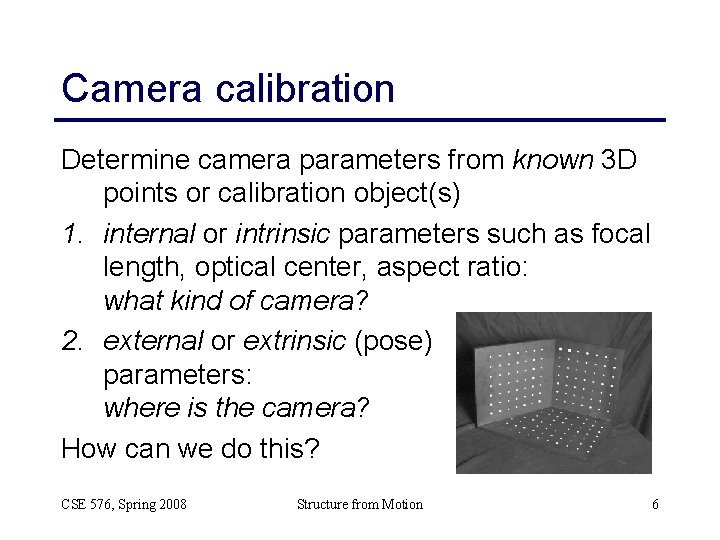
Camera calibration Determine camera parameters from known 3 D points or calibration object(s) 1. internal or intrinsic parameters such as focal length, optical center, aspect ratio: what kind of camera? 2. external or extrinsic (pose) parameters: where is the camera? How can we do this? CSE 576, Spring 2008 Structure from Motion 6
Camera calibration – approaches Possible approaches: 1. linear regression (least squares) 2. non-linear optimization 3. vanishing points 4. multiple planar patterns 5. panoramas (rotational motion) CSE 576, Spring 2008 Structure from Motion 7
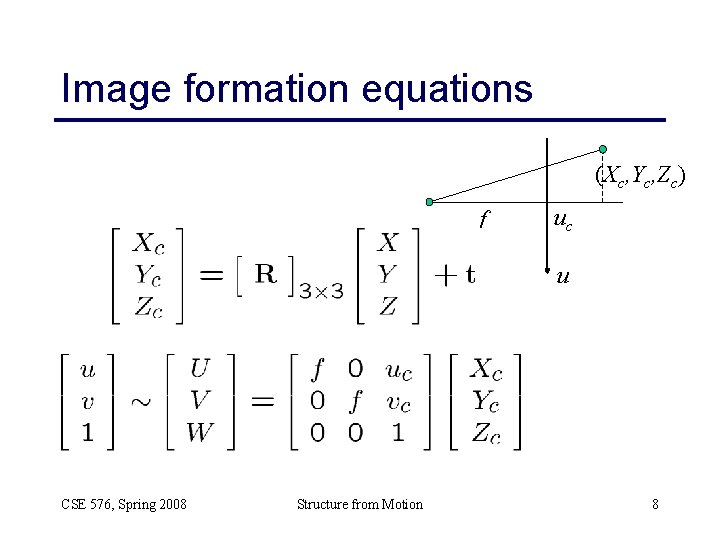
Image formation equations (Xc, Yc, Zc) f uc u CSE 576, Spring 2008 Structure from Motion 8
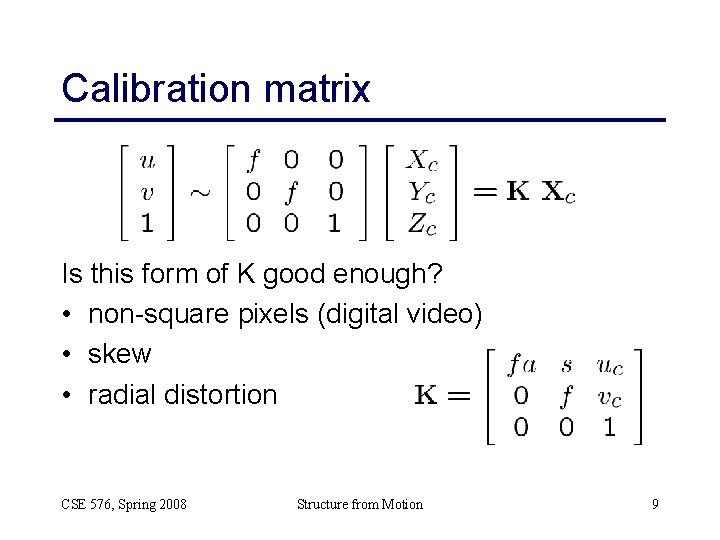
Calibration matrix Is this form of K good enough? • non-square pixels (digital video) • skew • radial distortion CSE 576, Spring 2008 Structure from Motion 9
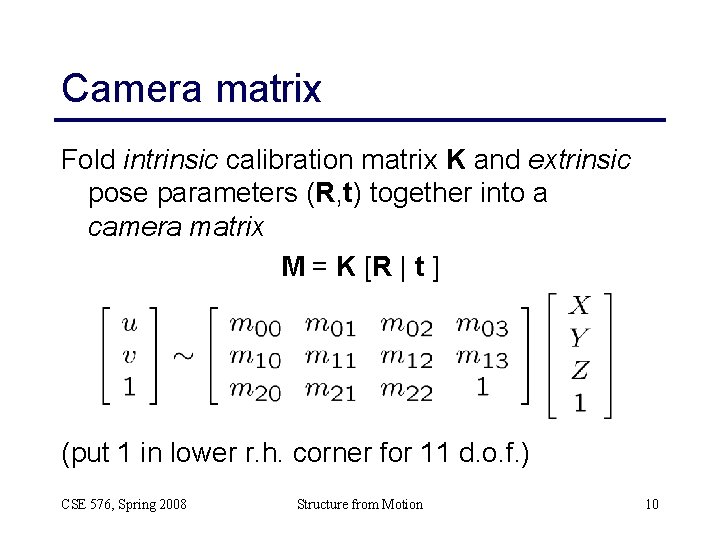
Camera matrix Fold intrinsic calibration matrix K and extrinsic pose parameters (R, t) together into a camera matrix M = K [R | t ] (put 1 in lower r. h. corner for 11 d. o. f. ) CSE 576, Spring 2008 Structure from Motion 10
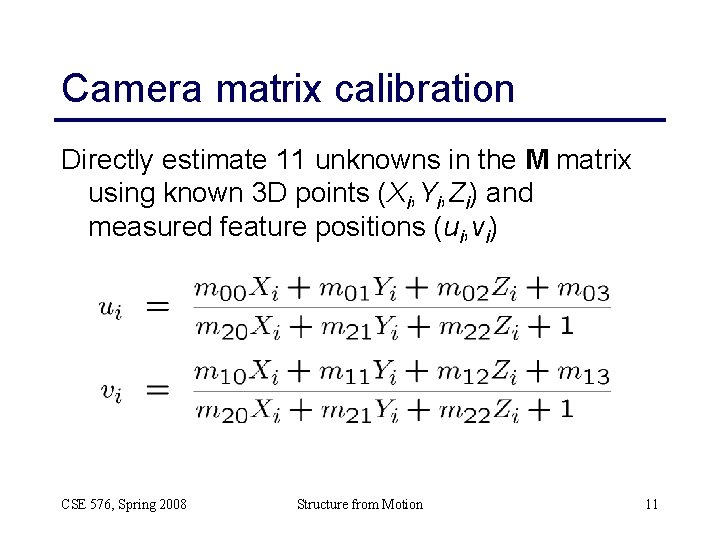
Camera matrix calibration Directly estimate 11 unknowns in the M matrix using known 3 D points (Xi, Yi, Zi) and measured feature positions (ui, vi) CSE 576, Spring 2008 Structure from Motion 11
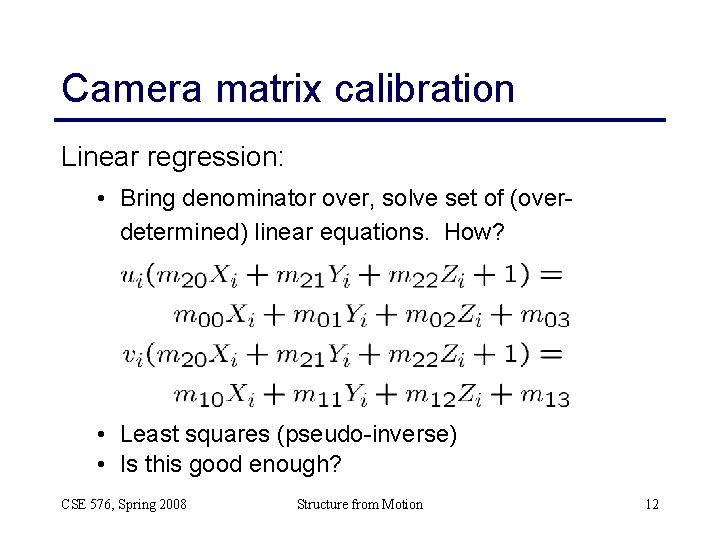
Camera matrix calibration Linear regression: • Bring denominator over, solve set of (overdetermined) linear equations. How? • Least squares (pseudo-inverse) • Is this good enough? CSE 576, Spring 2008 Structure from Motion 12
Levenberg-Marquardt Iterative non-linear least squares [Press’ 92] • Linearize measurement equations • Substitute into log-likelihood equation: quadratic cost function in Dm CSE 576, Spring 2008 Structure from Motion 15
Levenberg-Marquardt Iterative non-linear least squares [Press’ 92] • Solve for minimum Hessian: error: CSE 576, Spring 2008 Structure from Motion 16
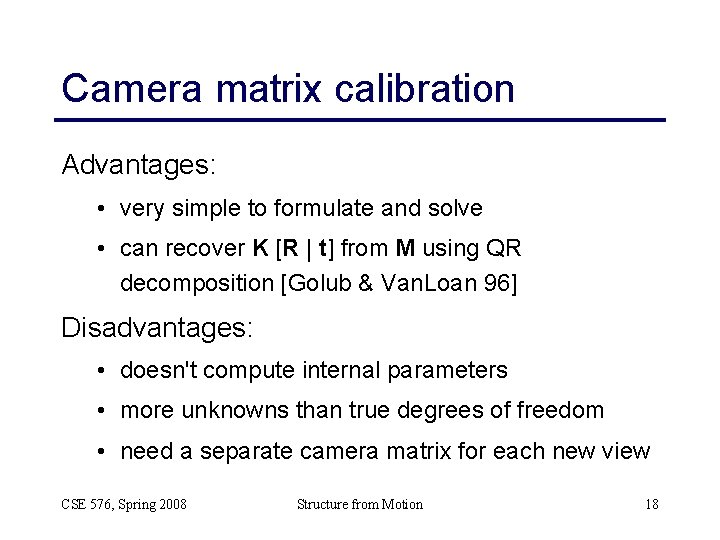
Camera matrix calibration Advantages: • very simple to formulate and solve • can recover K [R | t] from M using QR decomposition [Golub & Van. Loan 96] Disadvantages: • doesn't compute internal parameters • more unknowns than true degrees of freedom • need a separate camera matrix for each new view CSE 576, Spring 2008 Structure from Motion 18
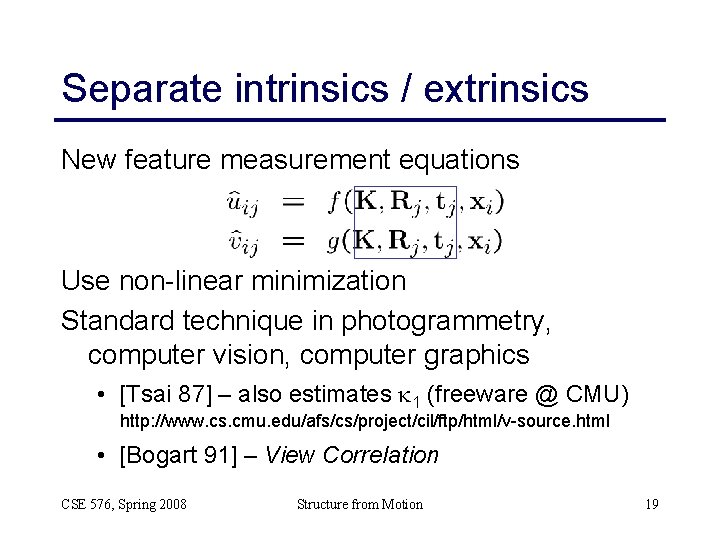
Separate intrinsics / extrinsics New feature measurement equations Use non-linear minimization Standard technique in photogrammetry, computer vision, computer graphics • [Tsai 87] – also estimates k 1 (freeware @ CMU) http: //www. cs. cmu. edu/afs/cs/project/cil/ftp/html/v-source. html • [Bogart 91] – View Correlation CSE 576, Spring 2008 Structure from Motion 19
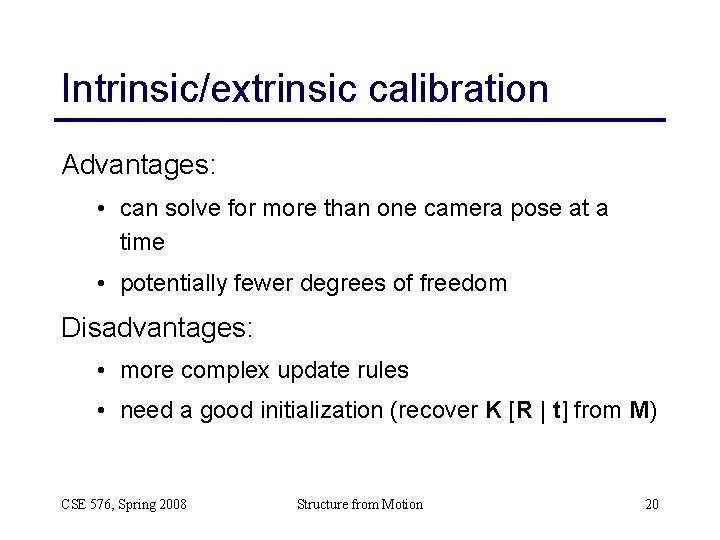
Intrinsic/extrinsic calibration Advantages: • can solve for more than one camera pose at a time • potentially fewer degrees of freedom Disadvantages: • more complex update rules • need a good initialization (recover K [R | t] from M) CSE 576, Spring 2008 Structure from Motion 20
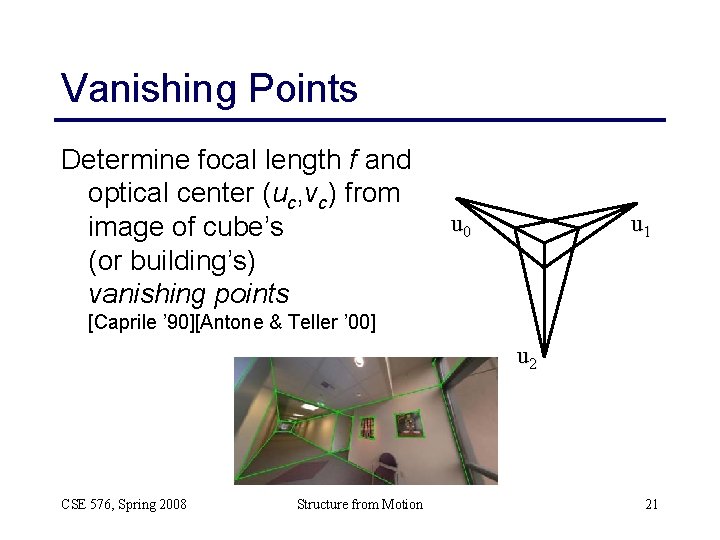
Vanishing Points Determine focal length f and optical center (uc, vc) from image of cube’s (or building’s) vanishing points u 0 u 1 [Caprile ’ 90][Antone & Teller ’ 00] u 2 CSE 576, Spring 2008 Structure from Motion 21
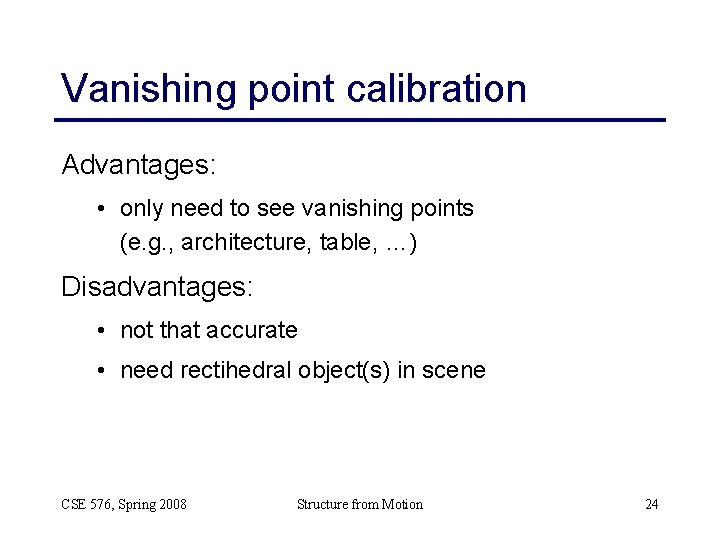
Vanishing point calibration Advantages: • only need to see vanishing points (e. g. , architecture, table, …) Disadvantages: • not that accurate • need rectihedral object(s) in scene CSE 576, Spring 2008 Structure from Motion 24
Multi-plane calibration Use several images of planar target held at unknown orientations [Zhang 99] • Compute plane homographies • Solve for K-TK-1 from Hk’s – 1 plane if only f unknown – 2 planes if (f, uc, vc) unknown – 3+ planes for full K • Code available from Zhang and Open. CV CSE 576, Spring 2008 Structure from Motion 29
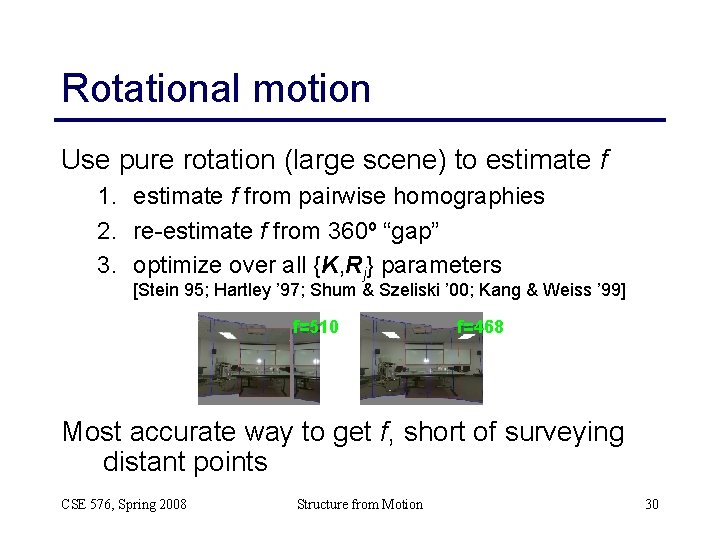
Rotational motion Use pure rotation (large scene) to estimate f 1. estimate f from pairwise homographies 2. re-estimate f from 360º “gap” 3. optimize over all {K, Rj} parameters [Stein 95; Hartley ’ 97; Shum & Szeliski ’ 00; Kang & Weiss ’ 99] f=510 f=468 Most accurate way to get f, short of surveying distant points CSE 576, Spring 2008 Structure from Motion 30
Pose estimation and triangulation
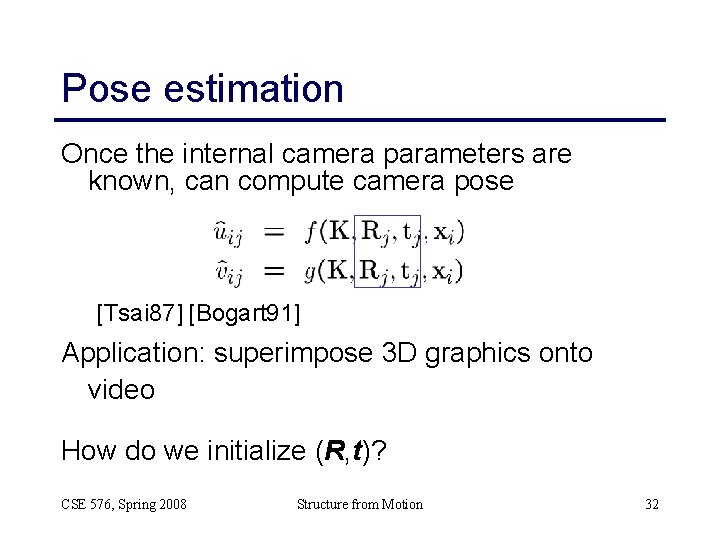
Pose estimation Once the internal camera parameters are known, can compute camera pose [Tsai 87] [Bogart 91] Application: superimpose 3 D graphics onto video How do we initialize (R, t)? CSE 576, Spring 2008 Structure from Motion 32
Pose estimation Previous initialization techniques: • vanishing points [Caprile 90] • planar pattern [Zhang 99] Other possibilities • Through-the-Lens Camera Control [Gleicher 92]: differential update • 3+ point “linear methods”: [De. Menthon 95][Quan 99][Ameller 00] CSE 576, Spring 2008 Structure from Motion 33
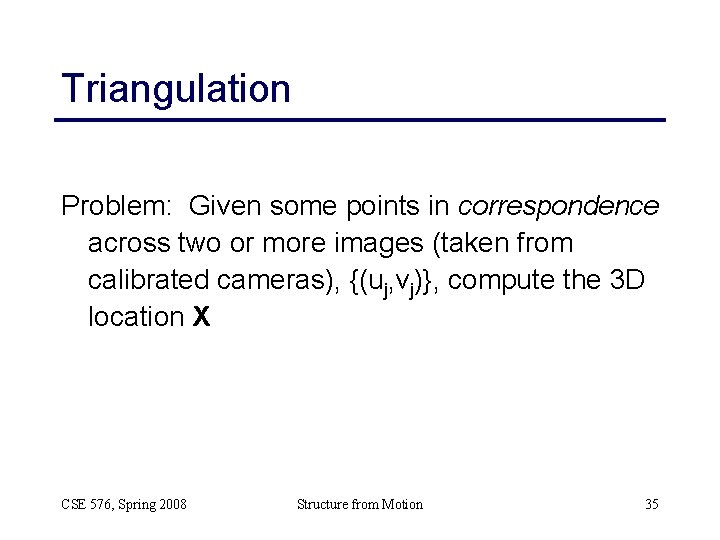
Triangulation Problem: Given some points in correspondence across two or more images (taken from calibrated cameras), {(uj, vj)}, compute the 3 D location X CSE 576, Spring 2008 Structure from Motion 35
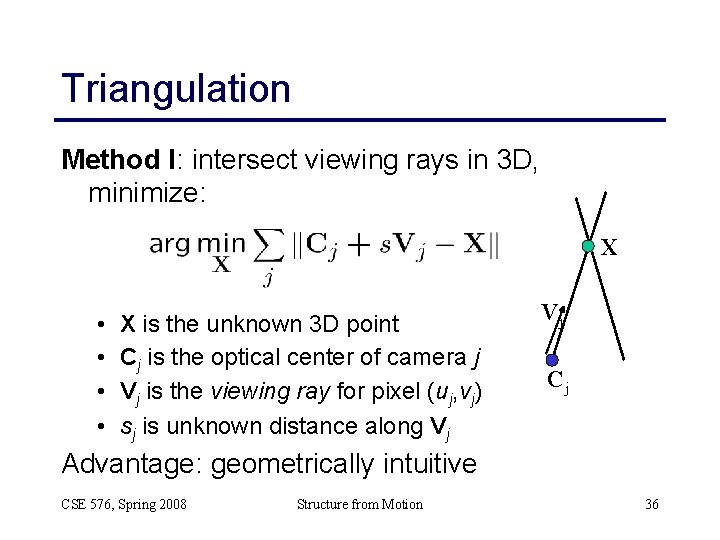
Triangulation Method I: intersect viewing rays in 3 D, minimize: X • • X is the unknown 3 D point Cj is the optical center of camera j Vj is the viewing ray for pixel (uj, vj) sj is unknown distance along Vj Vj Cj Advantage: geometrically intuitive CSE 576, Spring 2008 Structure from Motion 36
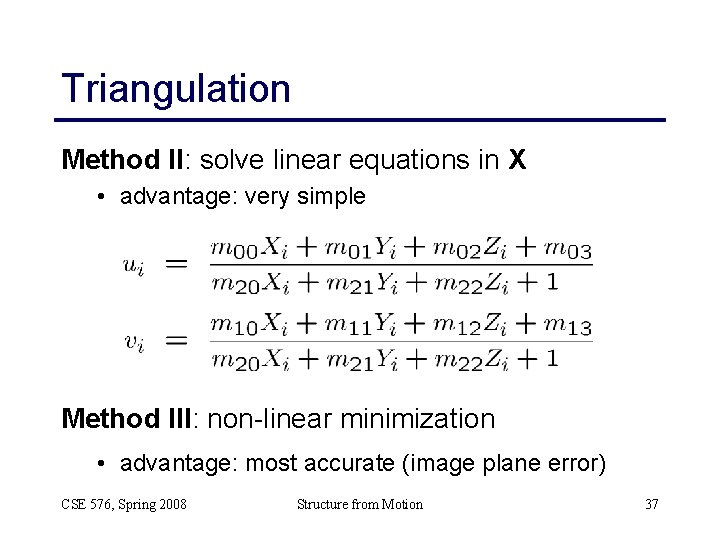
Triangulation Method II: solve linear equations in X • advantage: very simple Method III: non-linear minimization • advantage: most accurate (image plane error) CSE 576, Spring 2008 Structure from Motion 37
Structure from Motion
Today’s lecture Structure from Motion • two-frame methods • factorization • bundle adjustment • robust statistics CSE 576, Spring 2008 Structure from Motion 39
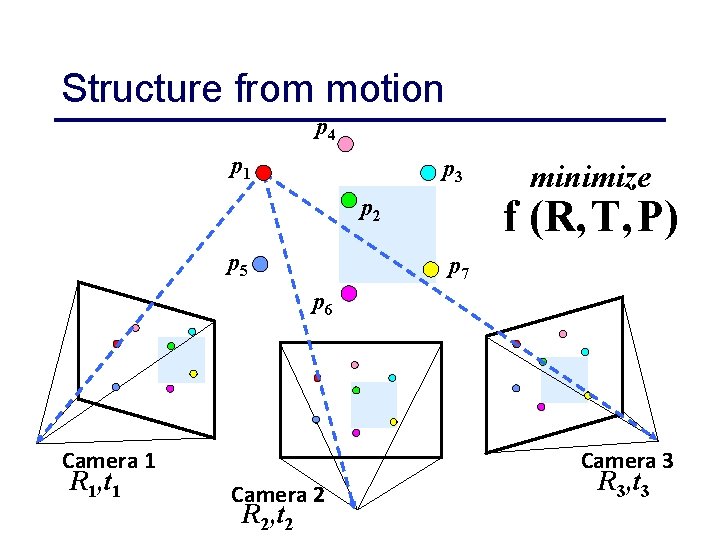
Structure from motion p 4 p 1 p 3 f (R, T, P) p 2 p 5 minimize p 7 p 6 Camera 1 R 1, t 1 Camera 3 Camera 2 R 2, t 2 R 3, t 3
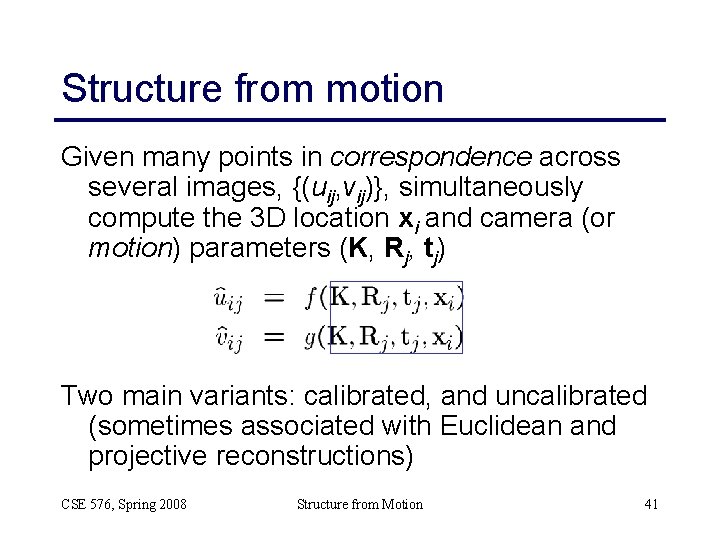
Structure from motion Given many points in correspondence across several images, {(uij, vij)}, simultaneously compute the 3 D location xi and camera (or motion) parameters (K, Rj, tj) Two main variants: calibrated, and uncalibrated (sometimes associated with Euclidean and projective reconstructions) CSE 576, Spring 2008 Structure from Motion 41
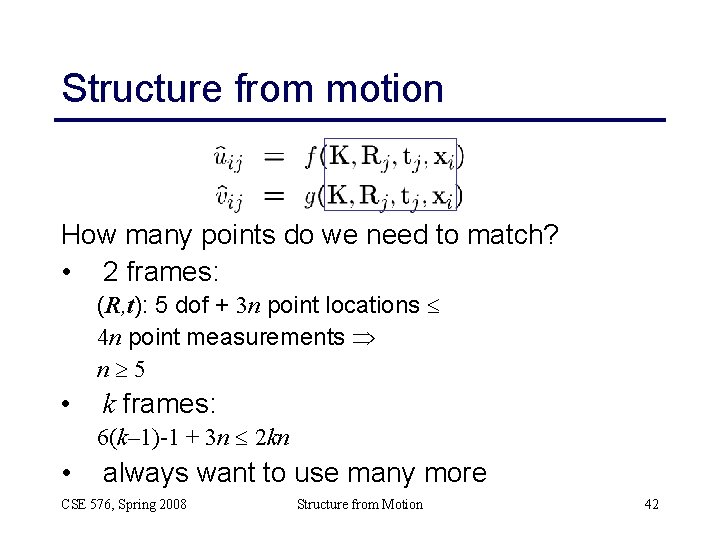
Structure from motion How many points do we need to match? • 2 frames: (R, t): 5 dof + 3 n point locations 4 n point measurements n 5 • k frames: 6(k– 1)-1 + 3 n 2 kn • always want to use many more CSE 576, Spring 2008 Structure from Motion 42
Two-frame methods Two main variants: 1. Calibrated: “Essential matrix” E use ray directions (xi, xi’ ) 2. Uncalibrated: “Fundamental matrix” F [Hartley & Zisserman 2000] CSE 576, Spring 2008 Structure from Motion 43
Essential matrix Co-planarity constraint: x’ ≈ R x + t [t] x’ ≈ [t] R x x’T [t] x’ ≈ x’ T [t] R x x’ T E x = 0 with E =[t] R • • • Solve for E using least squares (SVD) t is the least singular vector of E R obtained from the other two sing. vectors CSE 576, Spring 2008 Structure from Motion 44
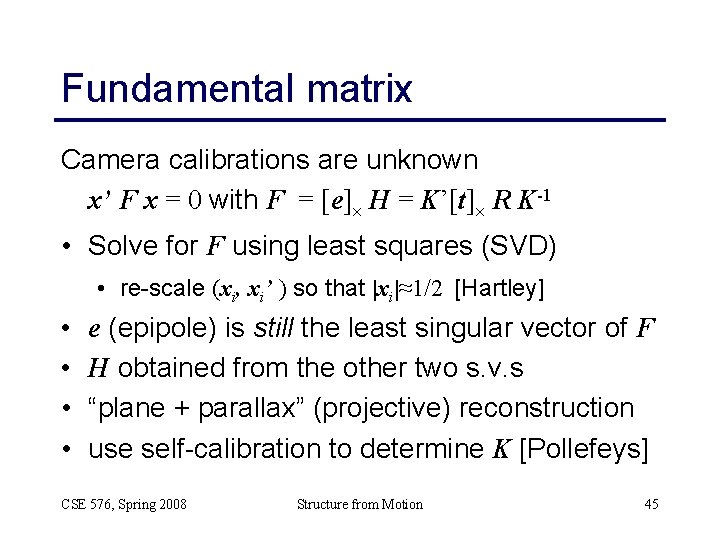
Fundamental matrix Camera calibrations are unknown x’ F x = 0 with F = [e] H = K’[t] R K-1 • Solve for F using least squares (SVD) • re-scale (xi, xi’ ) so that |xi|≈1/2 [Hartley] • • e (epipole) is still the least singular vector of F H obtained from the other two s. v. s “plane + parallax” (projective) reconstruction use self-calibration to determine K [Pollefeys] CSE 576, Spring 2008 Structure from Motion 45
Multi-frame Structure from Motion
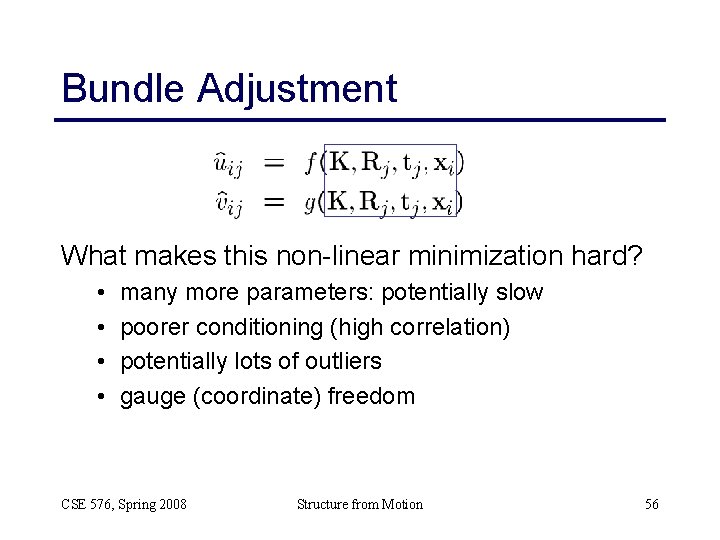
Bundle Adjustment What makes this non-linear minimization hard? • • many more parameters: potentially slow poorer conditioning (high correlation) potentially lots of outliers gauge (coordinate) freedom CSE 576, Spring 2008 Structure from Motion 56
Levenberg-Marquardt Iterative non-linear least squares [Press’ 92] • Linearize measurement equations • Substitute into log-likelihood equation: quadratic cost function in Dm CSE 576, Spring 2008 Structure from Motion 57
Levenberg-Marquardt Iterative non-linear least squares [Press’ 92] • Solve for minimum Hessian: error: CSE 576, Spring 2008 Structure from Motion 58
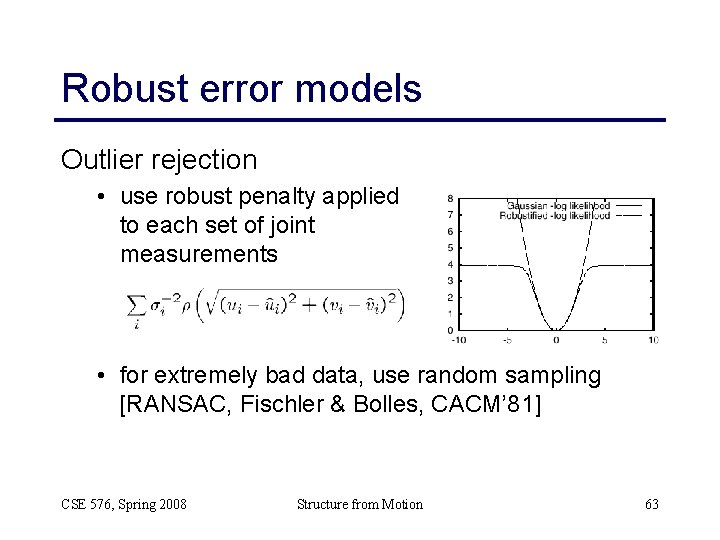
Robust error models Outlier rejection • use robust penalty applied to each set of joint measurements • for extremely bad data, use random sampling [RANSAC, Fischler & Bolles, CACM’ 81] CSE 576, Spring 2008 Structure from Motion 63
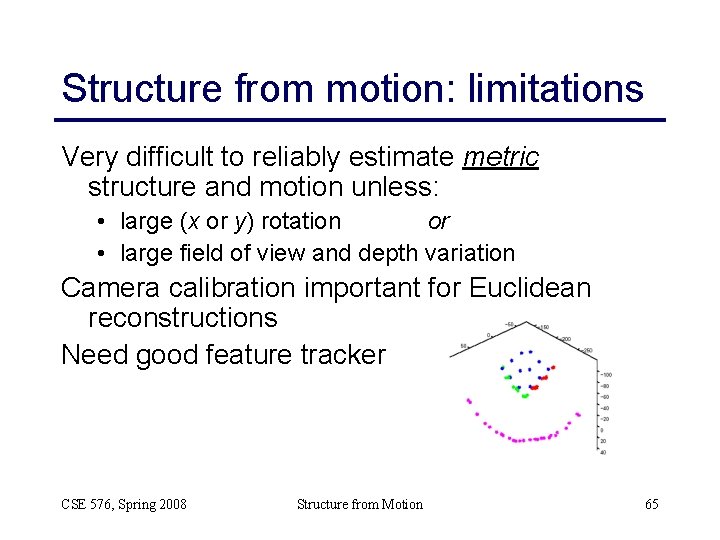
Structure from motion: limitations Very difficult to reliably estimate metric structure and motion unless: • large (x or y) rotation or • large field of view and depth variation Camera calibration important for Euclidean reconstructions Need good feature tracker CSE 576, Spring 2008 Structure from Motion 65