
Structure from Motion Computer Vision CSE 576 Spring
![Levenberg-Marquardt Iterative non-linear least squares [Press’ 92] • Linearize measurement equations • Substitute into](https://slidetodoc.com/presentation_image_h2/8ede0d194138bf98bf88b486a8069269/image-12.jpg "Levenberg-Marquardt Iterative non-linear least squares [Press’ 92] • Linearize measurement equations • Substitute into")
![Levenberg-Marquardt Iterative non-linear least squares [Press’ 92] • Solve for minimum Hessian: error: CSE](https://slidetodoc.com/presentation_image_h2/8ede0d194138bf98bf88b486a8069269/image-13.jpg "Levenberg-Marquardt Iterative non-linear least squares [Press’ 92] • Solve for minimum Hessian: error: CSE")
![Multi-plane calibration Use several images of planar target held at unknown orientations [Zhang 99]](https://slidetodoc.com/presentation_image_h2/8ede0d194138bf98bf88b486a8069269/image-20.jpg "Multi-plane calibration Use several images of planar target held at unknown orientations [Zhang 99]")
![Pose estimation Previous initialization techniques: • vanishing points [Caprile 90] • planar pattern [Zhang](https://slidetodoc.com/presentation_image_h2/8ede0d194138bf98bf88b486a8069269/image-24.jpg "Pose estimation Previous initialization techniques: • vanishing points [Caprile 90] • planar pattern [Zhang")
![Essential matrix Co-planarity constraint: x’ ≈ R x + t [t] x’ ≈ [t]](https://slidetodoc.com/presentation_image_h2/8ede0d194138bf98bf88b486a8069269/image-33.jpg "Essential matrix Co-planarity constraint: x’ ≈ R x + t [t] x’ ≈ [t]")
![Factorization [Tomasi & Kanade, IJCV 92] CSE 576, Spring 2008 Structure from Motion](https://slidetodoc.com/presentation_image_h2/8ede0d194138bf98bf88b486a8069269/image-36.jpg "Factorization [Tomasi & Kanade, IJCV 92] CSE 576, Spring 2008 Structure from Motion")
![Structure [from] Motion Given a set of feature tracks, estimate the 3 D structure](https://slidetodoc.com/presentation_image_h2/8ede0d194138bf98bf88b486a8069269/image-37.jpg "Structure [from] Motion Given a set of feature tracks, estimate the 3 D structure")
![Structure [from] Motion Given a set of feature tracks, estimate the 3 D structure](https://slidetodoc.com/presentation_image_h2/8ede0d194138bf98bf88b486a8069269/image-38.jpg "Structure [from] Motion Given a set of feature tracks, estimate the 3 D structure")
![Levenberg-Marquardt Iterative non-linear least squares [Press’ 92] • Linearize measurement equations • Substitute into](https://slidetodoc.com/presentation_image_h2/8ede0d194138bf98bf88b486a8069269/image-44.jpg "Levenberg-Marquardt Iterative non-linear least squares [Press’ 92] • Linearize measurement equations • Substitute into")
![Levenberg-Marquardt Iterative non-linear least squares [Press’ 92] • Solve for minimum Hessian: error: CSE](https://slidetodoc.com/presentation_image_h2/8ede0d194138bf98bf88b486a8069269/image-45.jpg "Levenberg-Marquardt Iterative non-linear least squares [Press’ 92] • Solve for minimum Hessian: error: CSE")


- Slides: 56
Structure from Motion Computer Vision CSE 576, Spring 2008 Richard Szeliski CSE 576, Spring 2008 Structure from Motion
Today’s lecture Geometric camera calibration • camera matrix (Direct Linear Transform) • non-linear least squares • separating intrinsics and extrinsics • focal length and optic center CSE 576, Spring 2008 Structure from Motion 2
Today’s lecture Structure from Motion • triangulation and pose • two-frame methods • factorization • bundle adjustment • robust statistics Photo Tourism CSE 576, Spring 2008 Structure from Motion 3
Camera Calibration CSE 576, Spring 2008 Structure from Motion
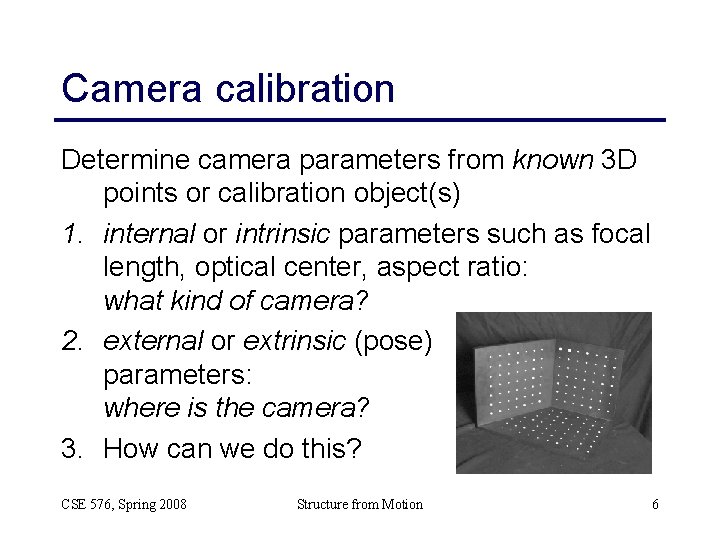
Camera calibration Determine camera parameters from known 3 D points or calibration object(s) 1. internal or intrinsic parameters such as focal length, optical center, aspect ratio: what kind of camera? 2. external or extrinsic (pose) parameters: where is the camera? 3. How can we do this? CSE 576, Spring 2008 Structure from Motion 6
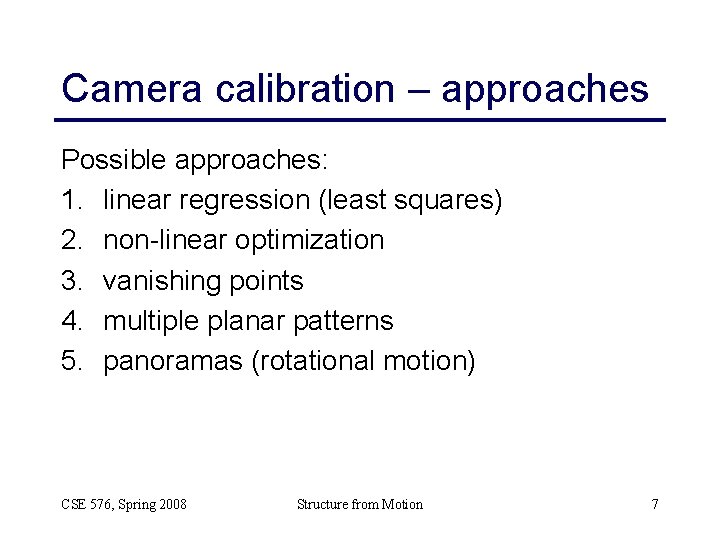
Camera calibration – approaches Possible approaches: 1. linear regression (least squares) 2. non-linear optimization 3. vanishing points 4. multiple planar patterns 5. panoramas (rotational motion) CSE 576, Spring 2008 Structure from Motion 7
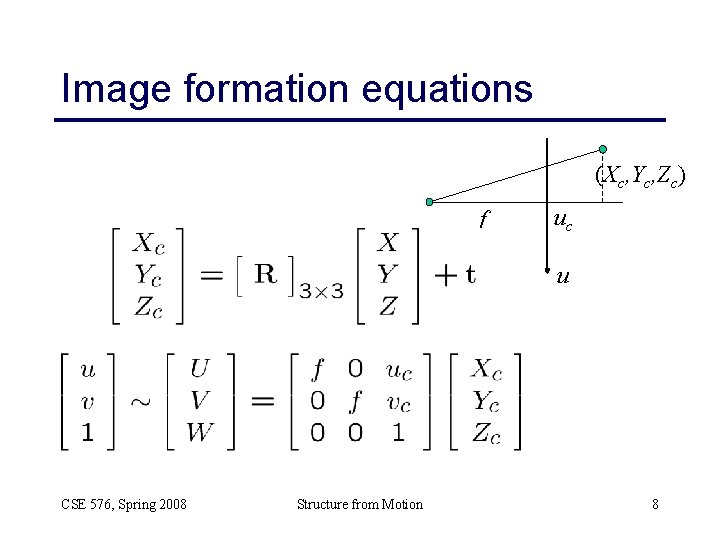
Image formation equations (Xc, Yc, Zc) f uc u CSE 576, Spring 2008 Structure from Motion 8
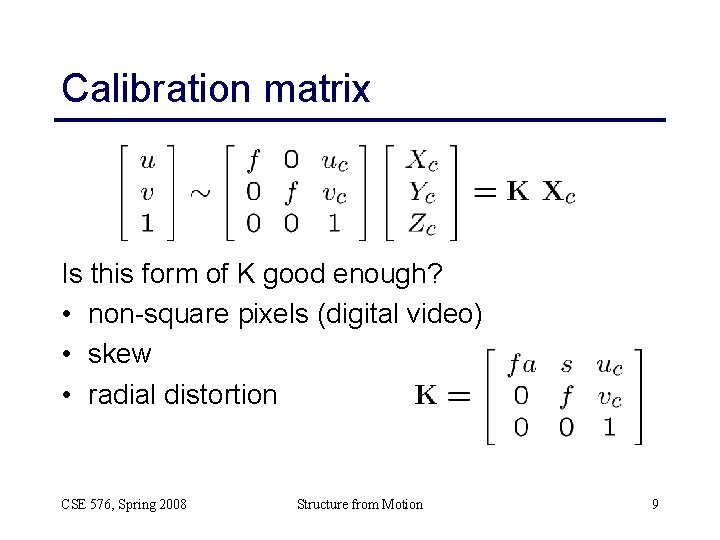
Calibration matrix Is this form of K good enough? • non-square pixels (digital video) • skew • radial distortion CSE 576, Spring 2008 Structure from Motion 9
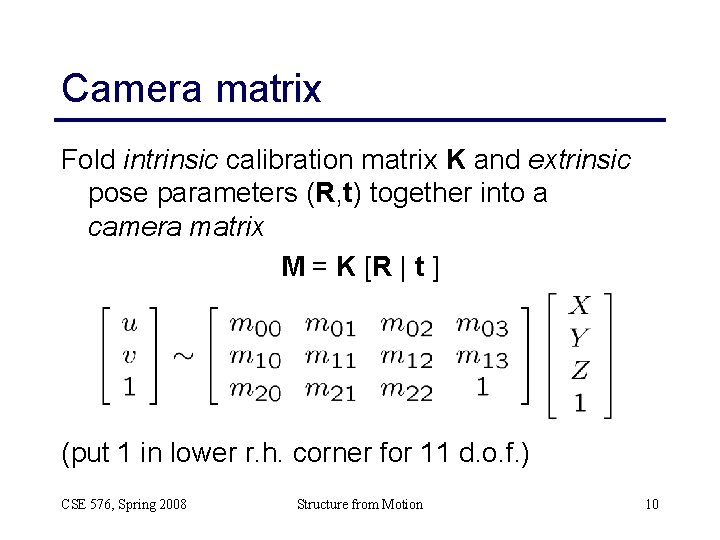
Camera matrix Fold intrinsic calibration matrix K and extrinsic pose parameters (R, t) together into a camera matrix M = K [R | t ] (put 1 in lower r. h. corner for 11 d. o. f. ) CSE 576, Spring 2008 Structure from Motion 10
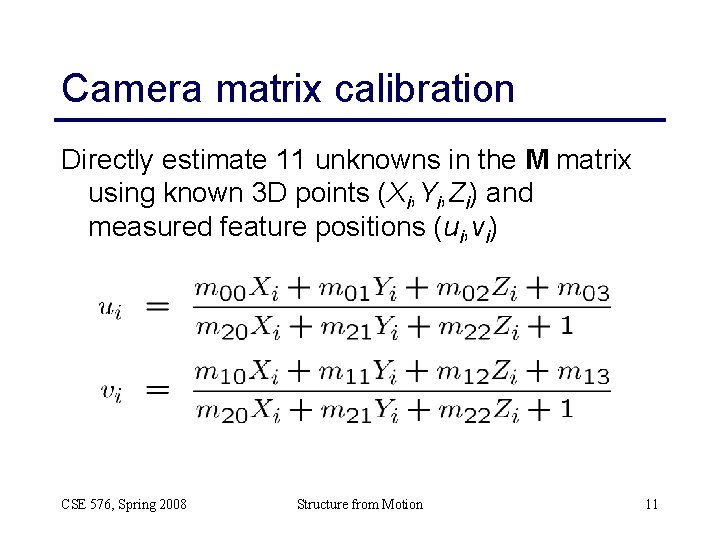
Camera matrix calibration Directly estimate 11 unknowns in the M matrix using known 3 D points (Xi, Yi, Zi) and measured feature positions (ui, vi) CSE 576, Spring 2008 Structure from Motion 11
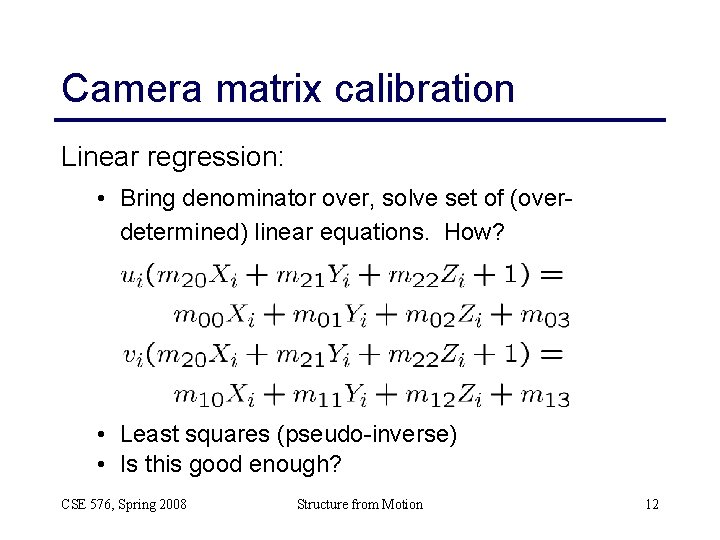
Camera matrix calibration Linear regression: • Bring denominator over, solve set of (overdetermined) linear equations. How? • Least squares (pseudo-inverse) • Is this good enough? CSE 576, Spring 2008 Structure from Motion 12
Levenberg-Marquardt Iterative non-linear least squares [Press’ 92] • Linearize measurement equations • Substitute into log-likelihood equation: quadratic cost function in Dm CSE 576, Spring 2008 Structure from Motion 15
Levenberg-Marquardt Iterative non-linear least squares [Press’ 92] • Solve for minimum Hessian: error: CSE 576, Spring 2008 Structure from Motion 16
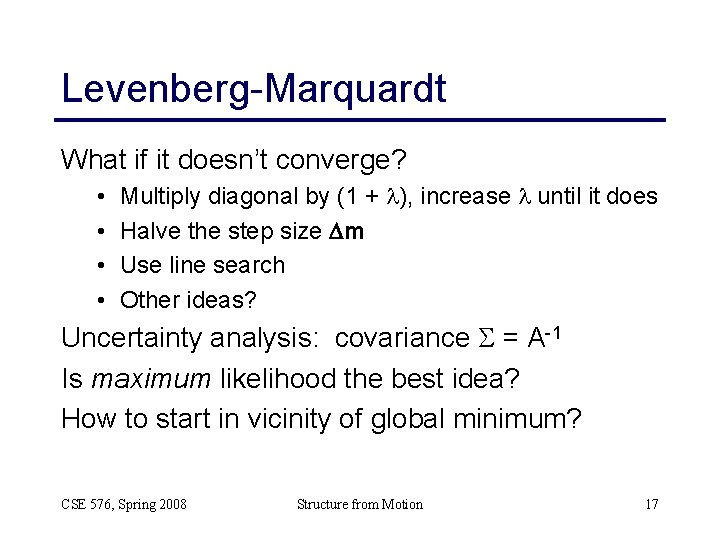
Levenberg-Marquardt What if it doesn’t converge? • • Multiply diagonal by (1 + l), increase l until it does Halve the step size Dm Use line search Other ideas? Uncertainty analysis: covariance S = A-1 Is maximum likelihood the best idea? How to start in vicinity of global minimum? CSE 576, Spring 2008 Structure from Motion 17
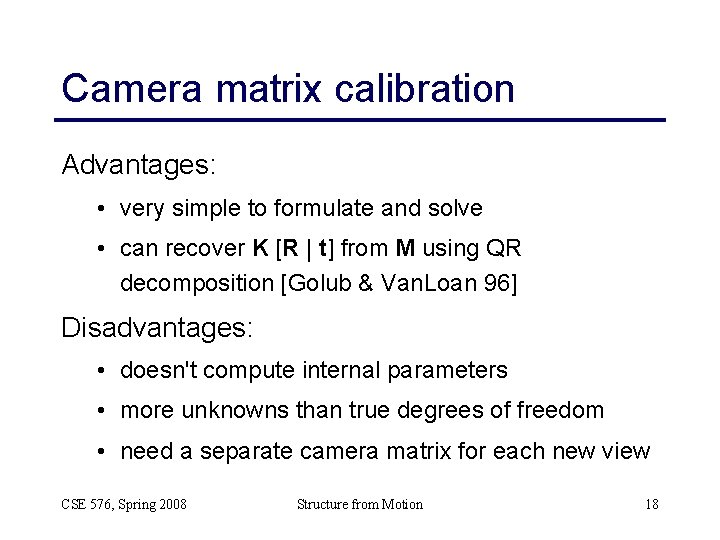
Camera matrix calibration Advantages: • very simple to formulate and solve • can recover K [R | t] from M using QR decomposition [Golub & Van. Loan 96] Disadvantages: • doesn't compute internal parameters • more unknowns than true degrees of freedom • need a separate camera matrix for each new view CSE 576, Spring 2008 Structure from Motion 18
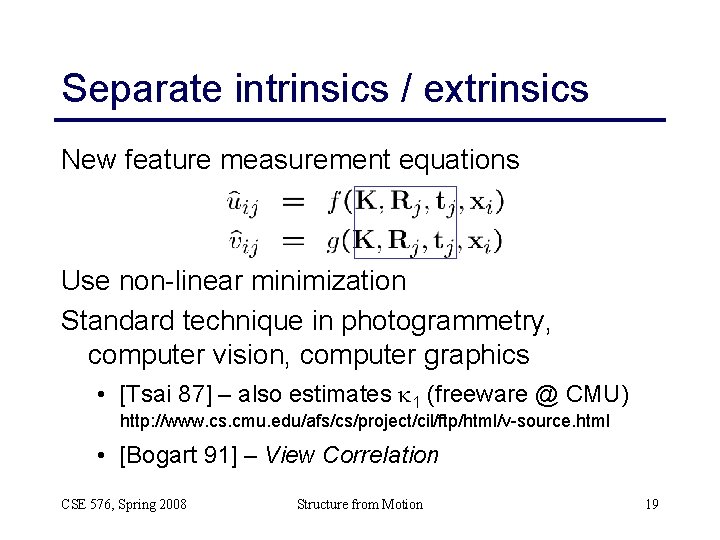
Separate intrinsics / extrinsics New feature measurement equations Use non-linear minimization Standard technique in photogrammetry, computer vision, computer graphics • [Tsai 87] – also estimates k 1 (freeware @ CMU) http: //www. cs. cmu. edu/afs/cs/project/cil/ftp/html/v-source. html • [Bogart 91] – View Correlation CSE 576, Spring 2008 Structure from Motion 19
Intrinsic/extrinsic calibration Advantages: • can solve for more than one camera pose at a time • potentially fewer degrees of freedom Disadvantages: • more complex update rules • need a good initialization (recover K [R | t] from M) CSE 576, Spring 2008 Structure from Motion 20
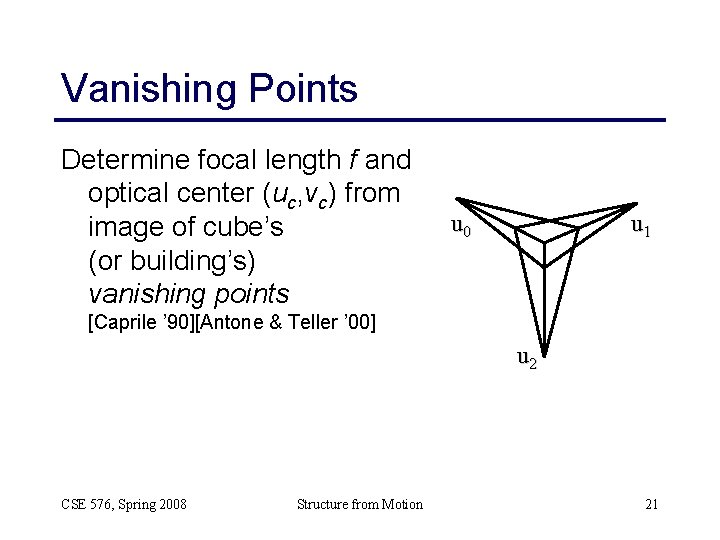
Vanishing Points Determine focal length f and optical center (uc, vc) from image of cube’s (or building’s) vanishing points u 0 u 1 [Caprile ’ 90][Antone & Teller ’ 00] u 2 CSE 576, Spring 2008 Structure from Motion 21
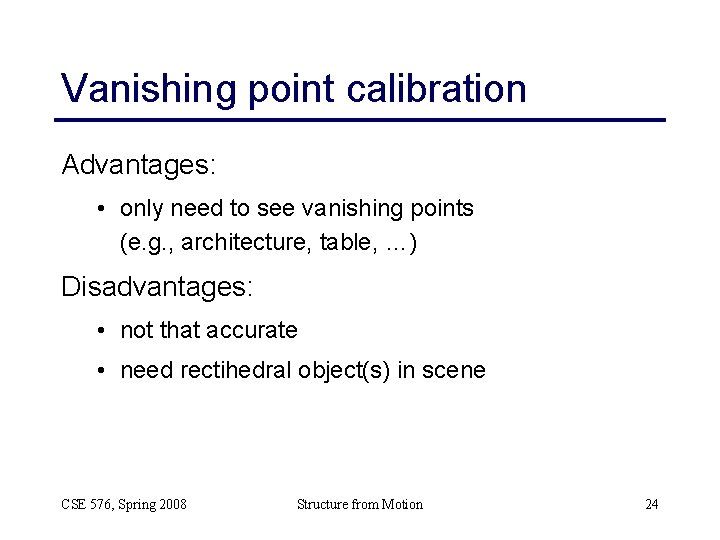
Vanishing point calibration Advantages: • only need to see vanishing points (e. g. , architecture, table, …) Disadvantages: • not that accurate • need rectihedral object(s) in scene CSE 576, Spring 2008 Structure from Motion 24
Multi-plane calibration Use several images of planar target held at unknown orientations [Zhang 99] • Compute plane homographies • Solve for K-TK-1 from Hk’s – 1 plane if only f unknown – 2 planes if (f, uc, vc) unknown – 3+ planes for full K • Code available from Zhang and Open. CV CSE 576, Spring 2008 Structure from Motion 29
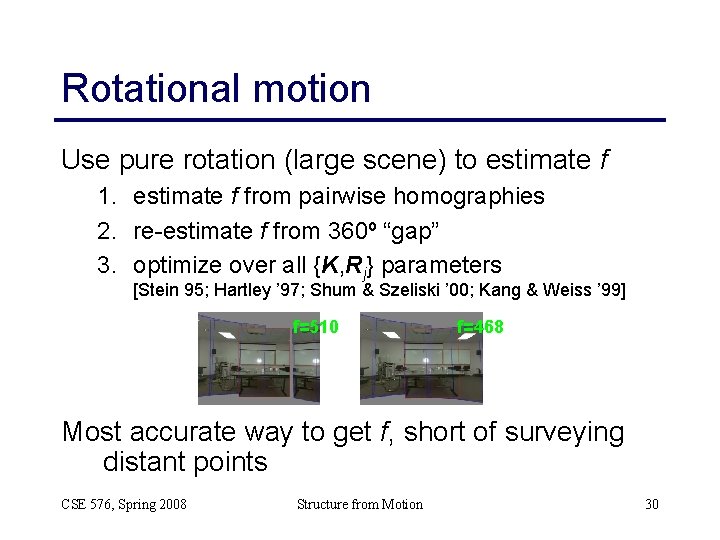
Rotational motion Use pure rotation (large scene) to estimate f 1. estimate f from pairwise homographies 2. re-estimate f from 360º “gap” 3. optimize over all {K, Rj} parameters [Stein 95; Hartley ’ 97; Shum & Szeliski ’ 00; Kang & Weiss ’ 99] f=510 f=468 Most accurate way to get f, short of surveying distant points CSE 576, Spring 2008 Structure from Motion 30
Pose estimation and triangulation CSE 576, Spring 2008 Structure from Motion
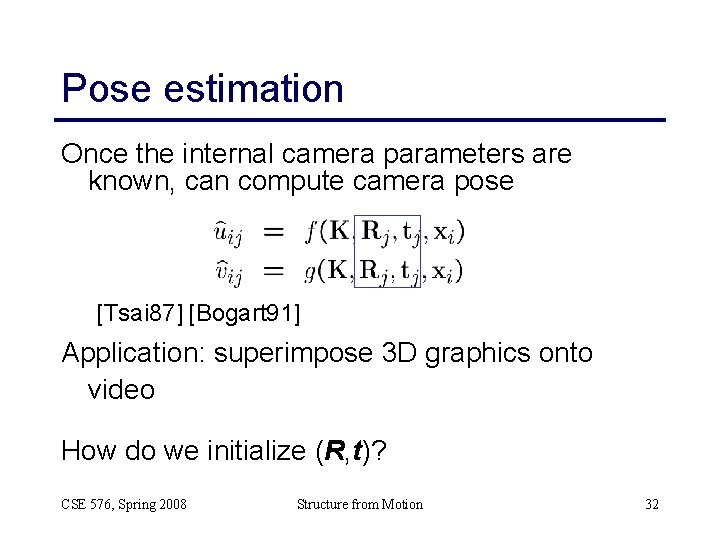
Pose estimation Once the internal camera parameters are known, can compute camera pose [Tsai 87] [Bogart 91] Application: superimpose 3 D graphics onto video How do we initialize (R, t)? CSE 576, Spring 2008 Structure from Motion 32
Pose estimation Previous initialization techniques: • vanishing points [Caprile 90] • planar pattern [Zhang 99] Other possibilities • Through-the-Lens Camera Control [Gleicher 92]: differential update • 3+ point “linear methods”: [De. Menthon 95][Quan 99][Ameller 00] CSE 576, Spring 2008 Structure from Motion 33
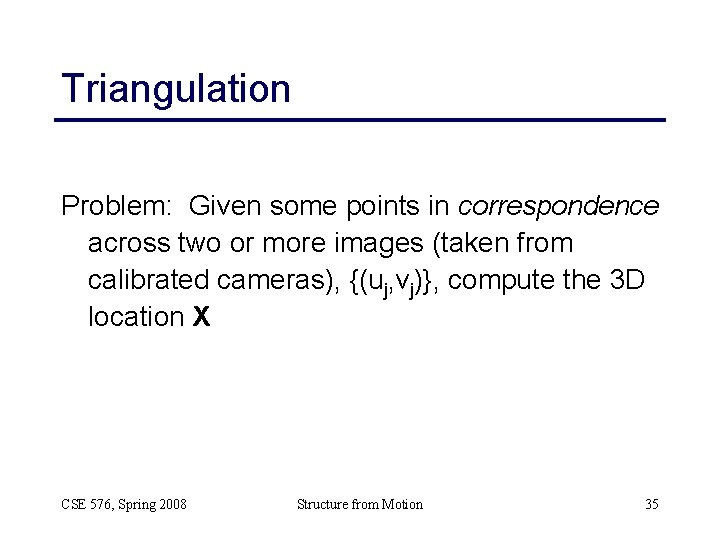
Triangulation Problem: Given some points in correspondence across two or more images (taken from calibrated cameras), {(uj, vj)}, compute the 3 D location X CSE 576, Spring 2008 Structure from Motion 35
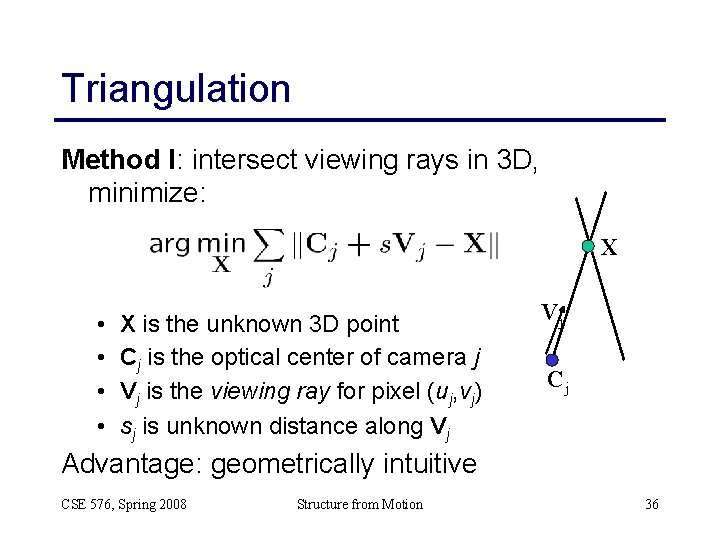
Triangulation Method I: intersect viewing rays in 3 D, minimize: X • • X is the unknown 3 D point Cj is the optical center of camera j Vj is the viewing ray for pixel (uj, vj) sj is unknown distance along Vj Vj Cj Advantage: geometrically intuitive CSE 576, Spring 2008 Structure from Motion 36
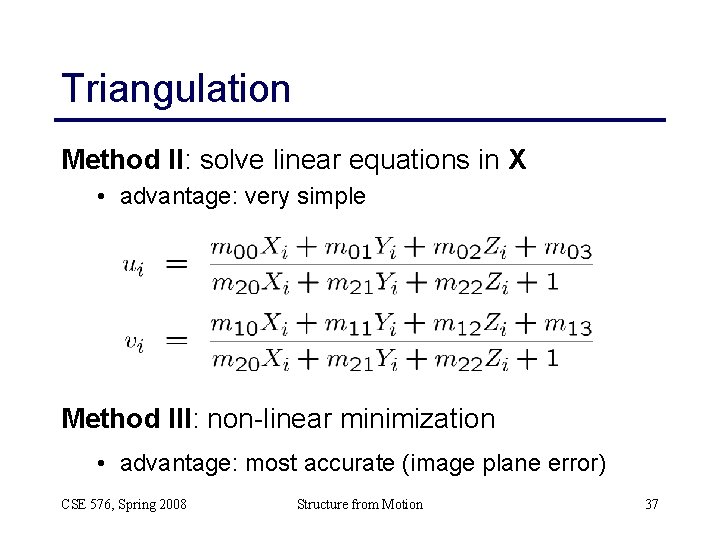
Triangulation Method II: solve linear equations in X • advantage: very simple Method III: non-linear minimization • advantage: most accurate (image plane error) CSE 576, Spring 2008 Structure from Motion 37
Structure from Motion CSE 576, Spring 2008 Structure from Motion
Today’s lecture Structure from Motion • two-frame methods • factorization • bundle adjustment • robust statistics CSE 576, Spring 2008 Structure from Motion 39
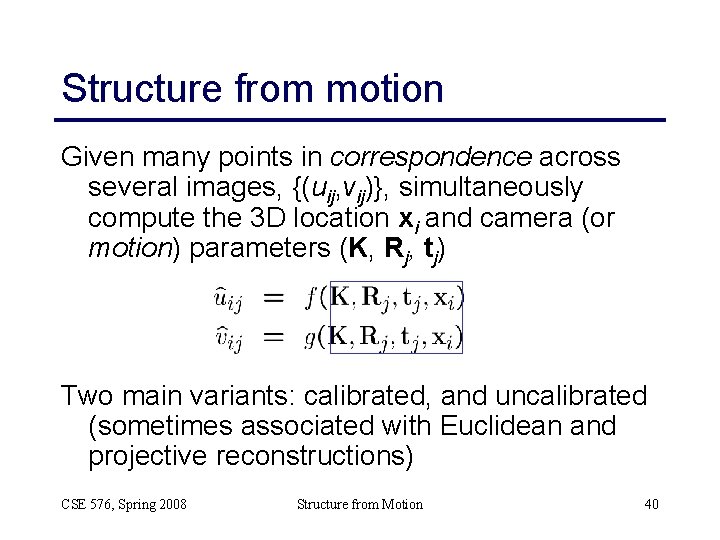
Structure from motion Given many points in correspondence across several images, {(uij, vij)}, simultaneously compute the 3 D location xi and camera (or motion) parameters (K, Rj, tj) Two main variants: calibrated, and uncalibrated (sometimes associated with Euclidean and projective reconstructions) CSE 576, Spring 2008 Structure from Motion 40
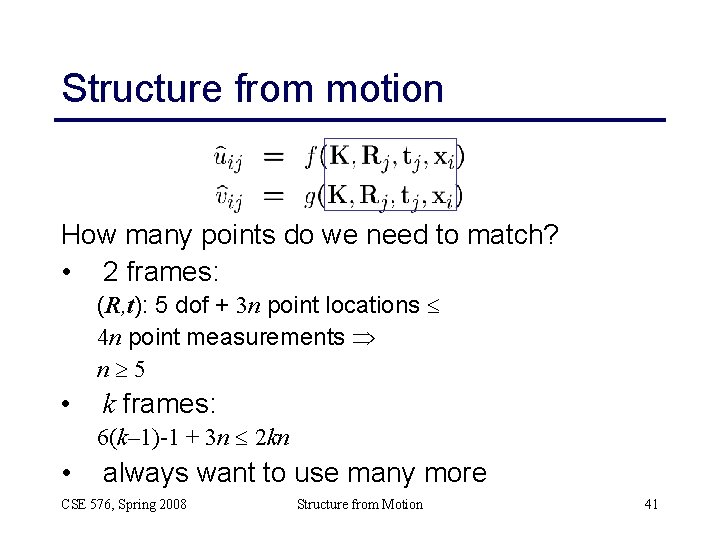
Structure from motion How many points do we need to match? • 2 frames: (R, t): 5 dof + 3 n point locations 4 n point measurements n 5 • k frames: 6(k– 1)-1 + 3 n 2 kn • always want to use many more CSE 576, Spring 2008 Structure from Motion 41
Two-frame methods Two main variants: 1. Calibrated: “Essential matrix” E use ray directions (xi, xi’ ) 2. Uncalibrated: “Fundamental matrix” F [Hartley & Zisserman 2000] CSE 576, Spring 2008 Structure from Motion 42
Essential matrix Co-planarity constraint: x’ ≈ R x + t [t] x’ ≈ [t] R x x’T [t] x’ ≈ x’ T [t] R x x’ T E x = 0 with E =[t] R • • • Solve for E using least squares (SVD) t is the least singular vector of E R obtained from the other two sing. vectors CSE 576, Spring 2008 Structure from Motion 43
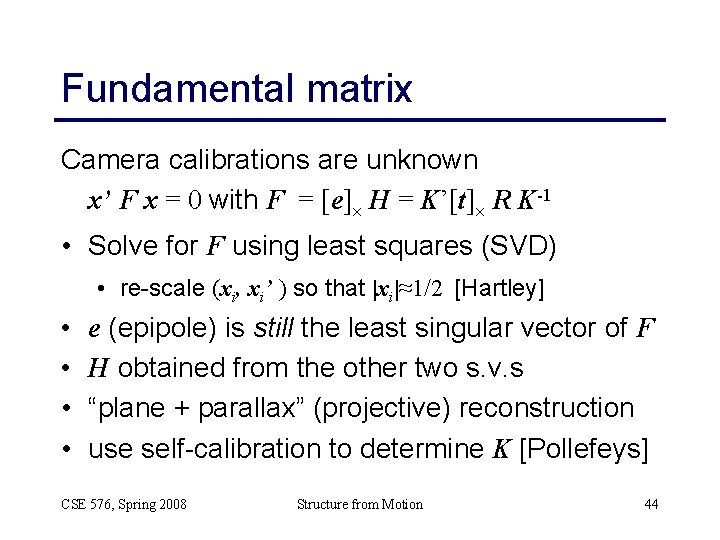
Fundamental matrix Camera calibrations are unknown x’ F x = 0 with F = [e] H = K’[t] R K-1 • Solve for F using least squares (SVD) • re-scale (xi, xi’ ) so that |xi|≈1/2 [Hartley] • • e (epipole) is still the least singular vector of F H obtained from the other two s. v. s “plane + parallax” (projective) reconstruction use self-calibration to determine K [Pollefeys] CSE 576, Spring 2008 Structure from Motion 44
Multi-frame Structure from Motion CSE 576, Spring 2008 Structure from Motion
Factorization [Tomasi & Kanade, IJCV 92] CSE 576, Spring 2008 Structure from Motion
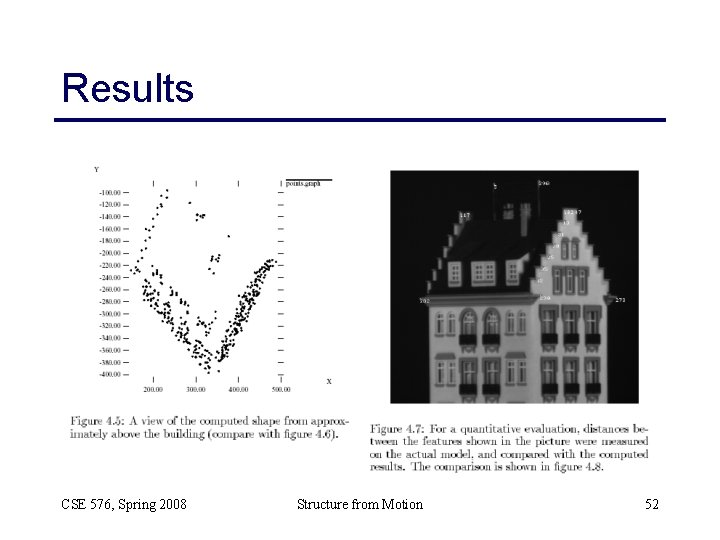
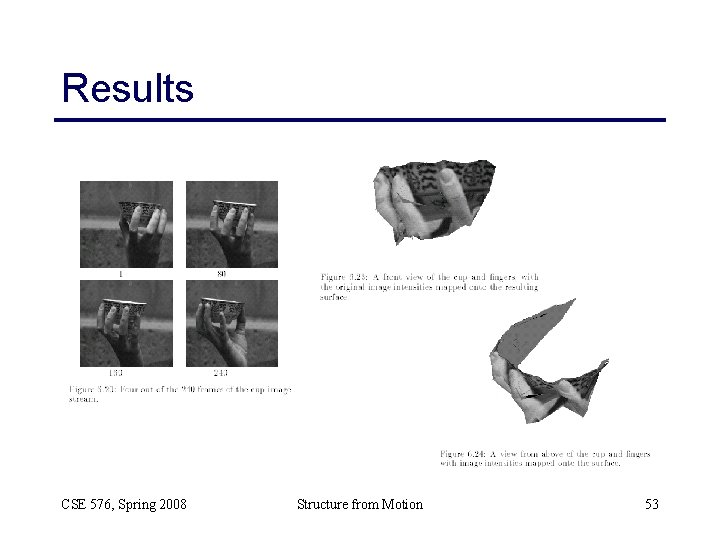
Structure [from] Motion Given a set of feature tracks, estimate the 3 D structure and 3 D (camera) motion. Assumption: orthographic projection CSE 576, Spring 2008 Structure from Motion 48
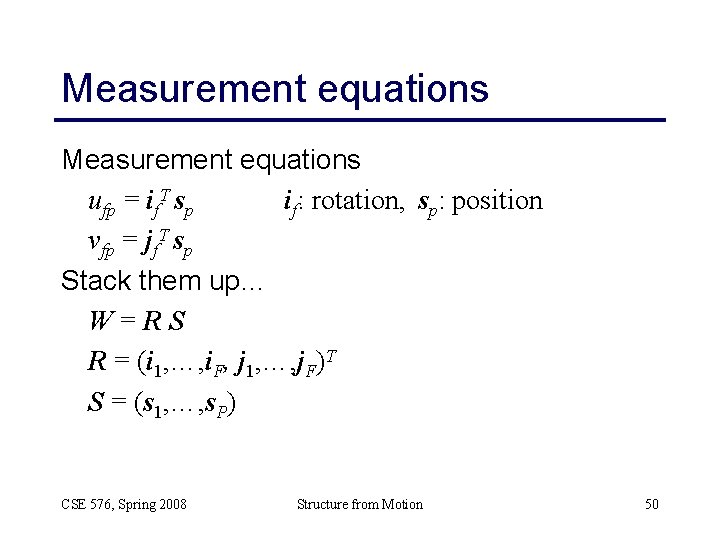
Structure [from] Motion Given a set of feature tracks, estimate the 3 D structure and 3 D (camera) motion. Assumption: orthographic projection Tracks: (ufp, vfp), f: frame, p: point Subtract out mean 2 D position… ufp = if. T sp if: rotation, sp: position vfp = jf. T sp CSE 576, Spring 2008 Structure from Motion 49
Measurement equations ufp = if. T sp if: rotation, sp: position vfp = jf. T sp Stack them up… W=RS R = (i 1, …, i. F, j 1, …, j. F)T S = (s 1, …, s. P) CSE 576, Spring 2008 Structure from Motion 50
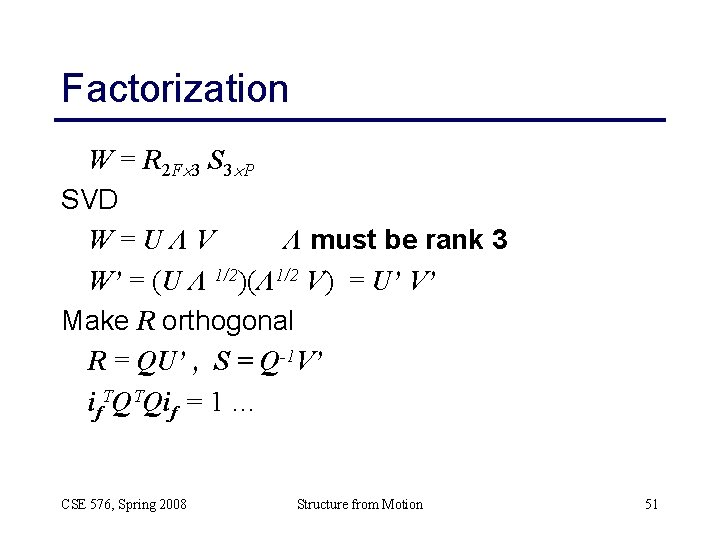
Factorization W = R 2 F 3 S 3 P SVD W=UΛV Λ must be rank 3 W’ = (U Λ 1/2)(Λ 1/2 V) = U’ V’ Make R orthogonal R = QU’ , S = Q-1 V’ if. TQTQif = 1 … CSE 576, Spring 2008 Structure from Motion 51
Results CSE 576, Spring 2008 Structure from Motion 52
Results CSE 576, Spring 2008 Structure from Motion 53
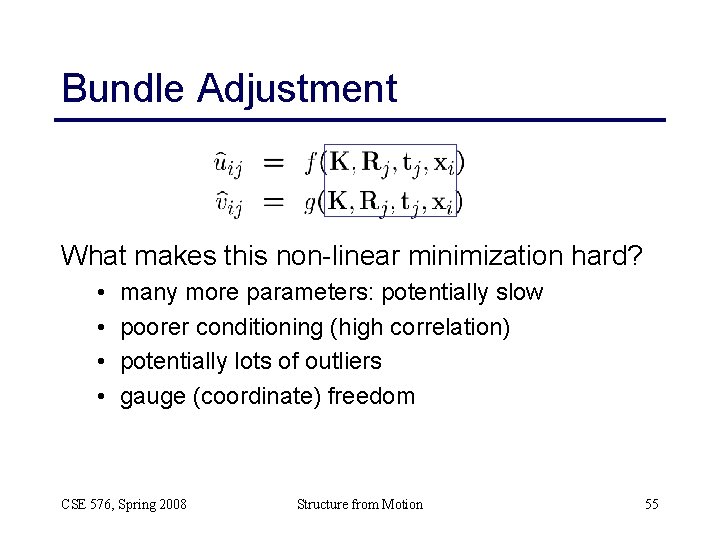
Bundle Adjustment What makes this non-linear minimization hard? • • many more parameters: potentially slow poorer conditioning (high correlation) potentially lots of outliers gauge (coordinate) freedom CSE 576, Spring 2008 Structure from Motion 55
Levenberg-Marquardt Iterative non-linear least squares [Press’ 92] • Linearize measurement equations • Substitute into log-likelihood equation: quadratic cost function in Dm CSE 576, Spring 2008 Structure from Motion 56
Levenberg-Marquardt Iterative non-linear least squares [Press’ 92] • Solve for minimum Hessian: error: CSE 576, Spring 2008 Structure from Motion 57
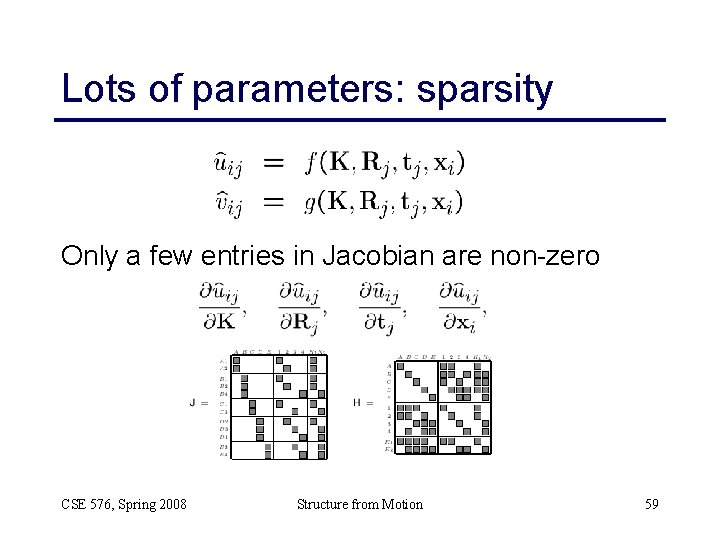
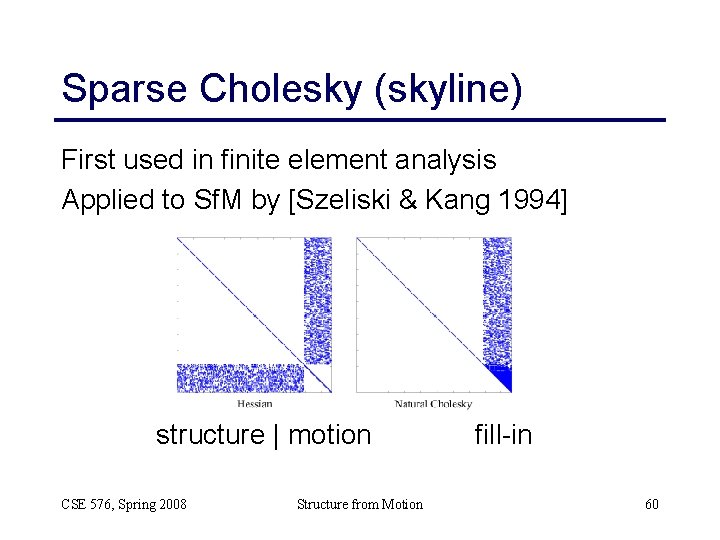
Lots of parameters: sparsity Only a few entries in Jacobian are non-zero CSE 576, Spring 2008 Structure from Motion 59
Sparse Cholesky (skyline) First used in finite element analysis Applied to Sf. M by [Szeliski & Kang 1994] structure | motion CSE 576, Spring 2008 Structure from Motion fill-in 60
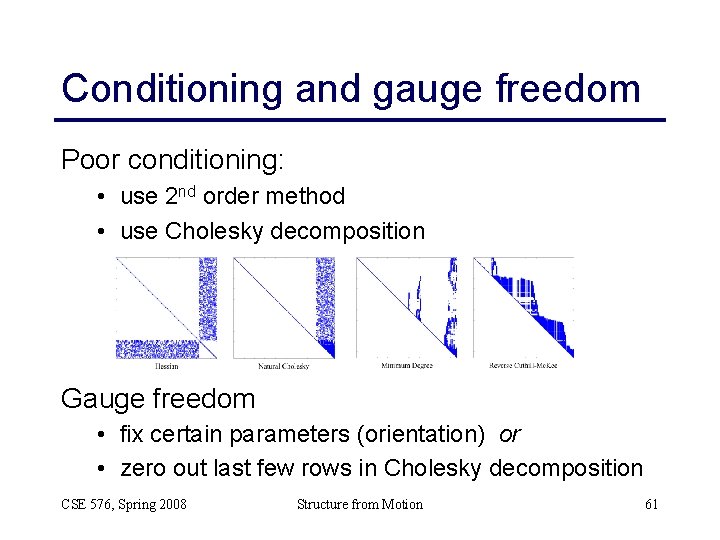
Conditioning and gauge freedom Poor conditioning: • use 2 nd order method • use Cholesky decomposition Gauge freedom • fix certain parameters (orientation) or • zero out last few rows in Cholesky decomposition CSE 576, Spring 2008 Structure from Motion 61
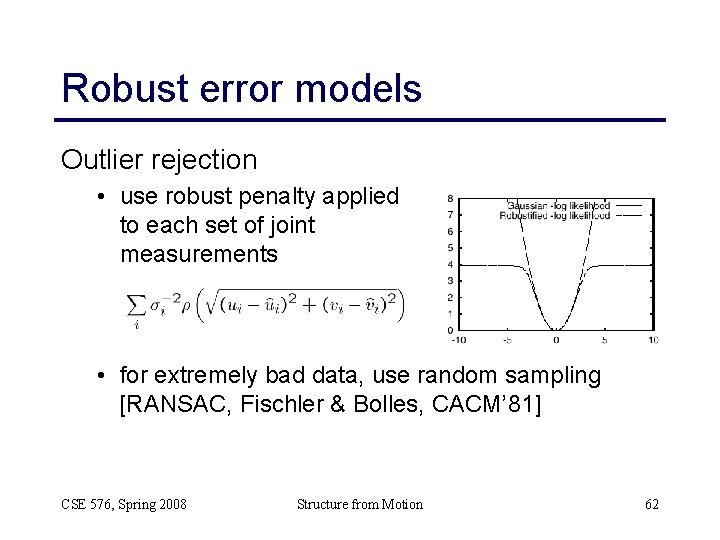
Robust error models Outlier rejection • use robust penalty applied to each set of joint measurements • for extremely bad data, use random sampling [RANSAC, Fischler & Bolles, CACM’ 81] CSE 576, Spring 2008 Structure from Motion 62
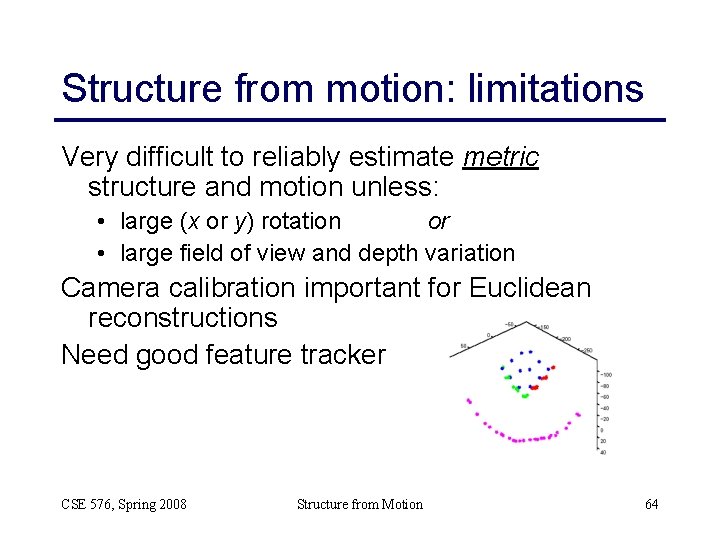
Structure from motion: limitations Very difficult to reliably estimate metric structure and motion unless: • large (x or y) rotation or • large field of view and depth variation Camera calibration important for Euclidean reconstructions Need good feature tracker CSE 576, Spring 2008 Structure from Motion 64
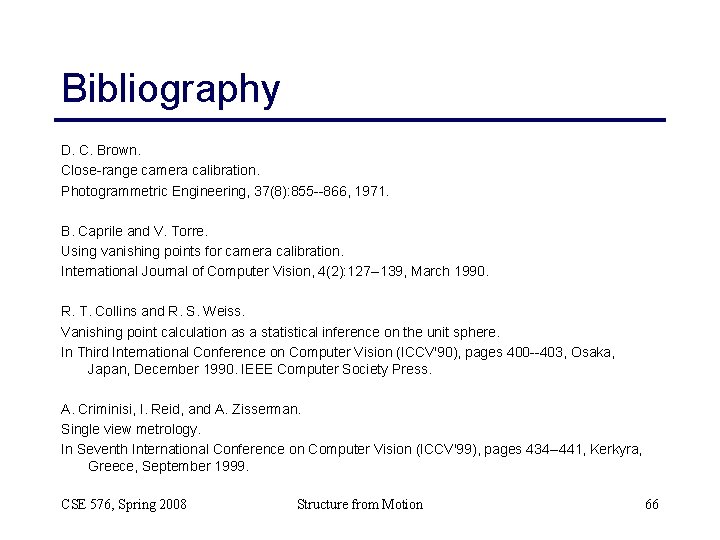
Bibliography M. -A. Ameller, B. Triggs, and L. Quan. Camera pose revisited -- new linear algorithms. http: //www. inrialpes. fr/movi/people/Triggs/home. html, 2000. M. Antone and S. Teller. Recovering relative camera rotations in urban scenes. In IEEE Computer Society Conference on Computer Vision and Pattern Recognition (CVPR'2000), volume 2, pages 282 --289, Hilton Head Island, June 2000. S. Becker and V. M. Bove. Semiautomatic {3 -D model extraction from uncalibrated 2 -d camera views. In SPIE Vol. 2410, Visual Data Exploration and Analysis {II, pages 447 --461, San Jose, CA, February 1995. Society of Photo-Optical Instrumentation Engineers. R. G. Bogart. View correlation. In J. Arvo, editor, Graphics Gems II, pages 181 --190. Academic Press, Boston, 1991. CSE 576, Spring 2008 Structure from Motion 65
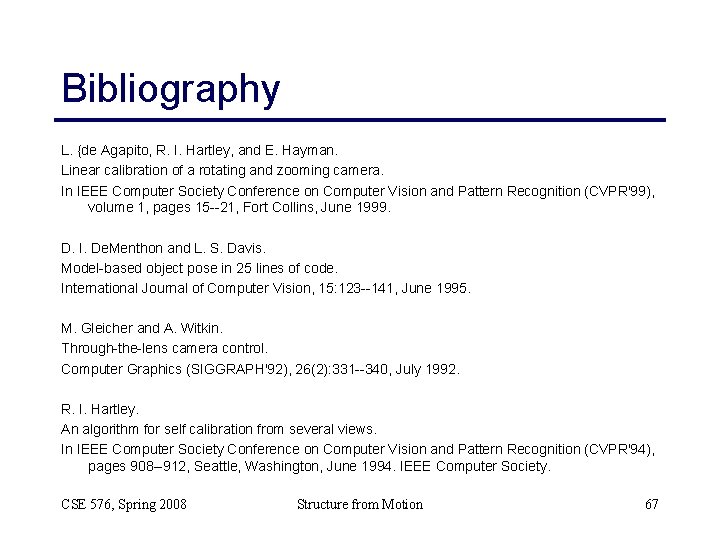
Bibliography D. C. Brown. Close-range camera calibration. Photogrammetric Engineering, 37(8): 855 --866, 1971. B. Caprile and V. Torre. Using vanishing points for camera calibration. International Journal of Computer Vision, 4(2): 127 --139, March 1990. R. T. Collins and R. S. Weiss. Vanishing point calculation as a statistical inference on the unit sphere. In Third International Conference on Computer Vision (ICCV'90), pages 400 --403, Osaka, Japan, December 1990. IEEE Computer Society Press. A. Criminisi, I. Reid, and A. Zisserman. Single view metrology. In Seventh International Conference on Computer Vision (ICCV'99), pages 434 --441, Kerkyra, Greece, September 1999. CSE 576, Spring 2008 Structure from Motion 66
Bibliography L. {de Agapito, R. I. Hartley, and E. Hayman. Linear calibration of a rotating and zooming camera. In IEEE Computer Society Conference on Computer Vision and Pattern Recognition (CVPR'99), volume 1, pages 15 --21, Fort Collins, June 1999. D. I. De. Menthon and L. S. Davis. Model-based object pose in 25 lines of code. International Journal of Computer Vision, 15: 123 --141, June 1995. M. Gleicher and A. Witkin. Through-the-lens camera control. Computer Graphics (SIGGRAPH'92), 26(2): 331 --340, July 1992. R. I. Hartley. An algorithm for self calibration from several views. In IEEE Computer Society Conference on Computer Vision and Pattern Recognition (CVPR'94), pages 908 --912, Seattle, Washington, June 1994. IEEE Computer Society. CSE 576, Spring 2008 Structure from Motion 67
Bibliography R. I. Hartley. Self-calibration of stationary cameras. International Journal of Computer Vision, 22(1): 5 --23, 1997. R. I. Hartley, E. Hayman, L. {de Agapito, and I. Reid. Camera calibration and the search for infinity. In IEEE Computer Society Conference on Computer Vision and Pattern Recognition (CVPR'2000), volume 1, pages 510 --517, Hilton Head Island, June 2000. R. I. Hartley. and A. Zisserman. Multiple View Geometry. Cambridge University Press, 2000. B. K. P. Horn. Closed-form solution of absolute orientation using unit quaternions. Journal of the Optical Society of America A, 4(4): 629 --642, 1987. CSE 576, Spring 2008 Structure from Motion 68
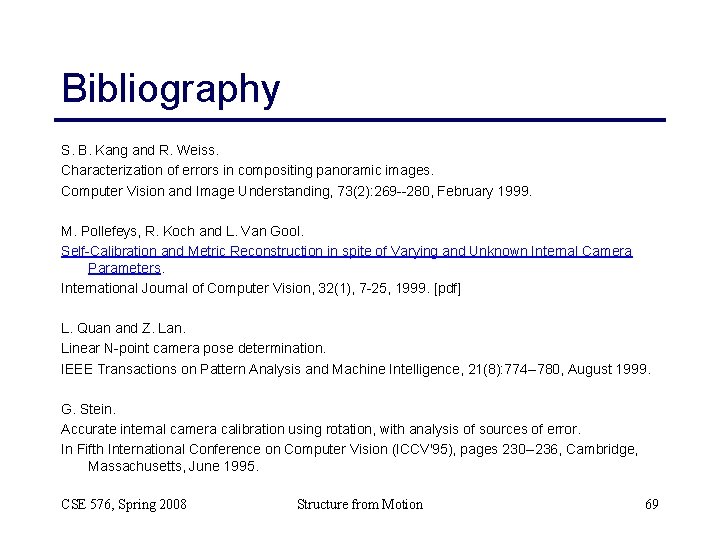
Bibliography S. B. Kang and R. Weiss. Characterization of errors in compositing panoramic images. Computer Vision and Image Understanding, 73(2): 269 --280, February 1999. M. Pollefeys, R. Koch and L. Van Gool. Self-Calibration and Metric Reconstruction in spite of Varying and Unknown Internal Camera Parameters. International Journal of Computer Vision, 32(1), 7 -25, 1999. [pdf] L. Quan and Z. Lan. Linear N-point camera pose determination. IEEE Transactions on Pattern Analysis and Machine Intelligence, 21(8): 774 --780, August 1999. G. Stein. Accurate internal camera calibration using rotation, with analysis of sources of error. In Fifth International Conference on Computer Vision (ICCV'95), pages 230 --236, Cambridge, Massachusetts, June 1995. CSE 576, Spring 2008 Structure from Motion 69
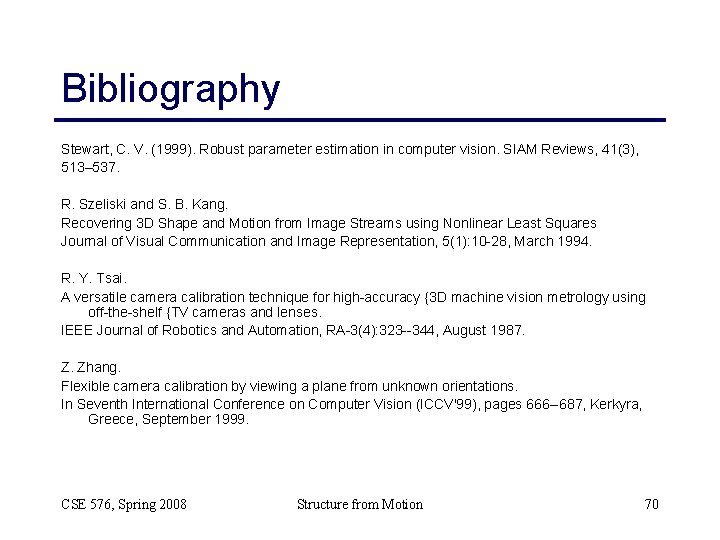
Bibliography Stewart, C. V. (1999). Robust parameter estimation in computer vision. SIAM Reviews, 41(3), 513– 537. R. Szeliski and S. B. Kang. Recovering 3 D Shape and Motion from Image Streams using Nonlinear Least Squares Journal of Visual Communication and Image Representation, 5(1): 10 -28, March 1994. R. Y. Tsai. A versatile camera calibration technique for high-accuracy {3 D machine vision metrology using off-the-shelf {TV cameras and lenses. IEEE Journal of Robotics and Automation, RA-3(4): 323 --344, August 1987. Z. Zhang. Flexible camera calibration by viewing a plane from unknown orientations. In Seventh International Conference on Computer Vision (ICCV'99), pages 666 --687, Kerkyra, Greece, September 1999. CSE 576, Spring 2008 Structure from Motion 70