
Structure and Properties of Matter Electron Configuration Unit

![Electron Configuration Answer: • [Ar] 4 s 2 3 d 10 Explanation: • Zinc](https://slidetodoc.com/presentation_image_h2/ca6cbd52ebd4f9a37b2e69ab9c99147e/image-46.jpg "Electron Configuration Answer: • [Ar] 4 s 2 3 d 10 Explanation: • Zinc")
![Electron Configuration Answer: • [Ne] 3 s 2 3 p 1 Explanation: • Aluminium](https://slidetodoc.com/presentation_image_h2/ca6cbd52ebd4f9a37b2e69ab9c99147e/image-48.jpg "Electron Configuration Answer: • [Ne] 3 s 2 3 p 1 Explanation: • Aluminium")
- Slides: 56
Structure and Properties of Matter Electron Configuration Unit 1 - Lesson 6 a-e
Electron Configuration • • • Learning Objectives: Describe how electrons are arranged in the atom for the first 20 elements Draw simple atomic diagrams showing the 2, 8, 18 rule Name and identify the four types of orbitals as s, p, d and f Describe how electrons occupy orbitals according to the Aufbau and pauli exclusion principles Describe how electrons occupy orbitals according to Hund’s Rule Draw orbital diagrams Decode orbital notation Identify elements based on orbital notation Use shorthand orbital notation Write orbital notation for ions Identify exceptions to general orbital notation
Electron Configuration Key Vocabulary: Atomic number, Aufbau Principle, d-orbital, electron configuration, Electron orbital diagram, energy level, f-orbital, Hund’s Rule, orbital notation, p-orbital, Pauli Exclusion Principle, valence electron, s-orbital, sub-level,
Electron Configuration The Atomic Number Revisited: • The atomic number tells us the number of protons an atom possesses. In a neutral atom, the number of protons and electrons are equal. Therefore, the atomic number tells us the number of electrons an atom has. For example, Carbon has an atomic number of 6 and will, therefore, have six protons and six electrons.
Electron Configuration Electron Arrangement: • The arrangement of the electrons in an atom is called its electron arrangement. Electrons occupy certain energy levels around the nucleus and only have a particular energy value, not a range of values. Electrons in atoms will occupy lower energy levels before they can occupy higher levels. The higher the energy level that an electron occupies, the more energy it possesses and the greater its distance from the nucleus. Each energy level has a limit to the number of electrons it can hold at any one time.
Electron Configuration in the First 20 • The first level holds a maximum of two electrons • The second and third levels each hold a maximum of eight electrons • The fourth level holds the remaining electrons. • Elements which have more than 20 protons are able to hold a maximum of 18 electrons in their third level.
Electron Configuration
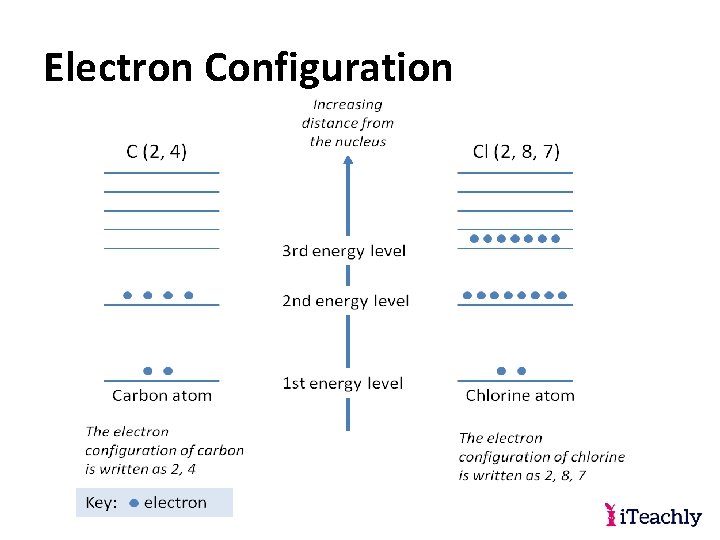
Electron Configuration Writing Electron Configurations: • The arrangement of electrons in the first twenty elements can be written using the rules above and commas to separate each energy level. For example, carbon has 6 electrons, 2 of these electrons will occupy the first energy level and the other 4 will occupy the second level. Therefore, carbon is written as 2, 4.
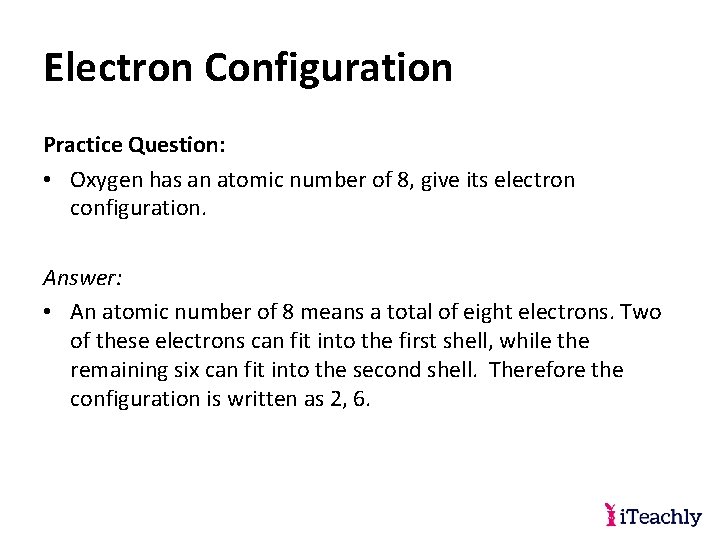
Electron Configuration Practice Question: • Oxygen has an atomic number of 8, give its electron configuration.
Electron Configuration Practice Question: • Oxygen has an atomic number of 8, give its electron configuration. Answer: • An atomic number of 8 means a total of eight electrons. Two of these electrons can fit into the first shell, while the remaining six can fit into the second shell. Therefore the configuration is written as 2, 6.
Electron Configuration • Sodium has the atomic number 11, give its electron configuration.
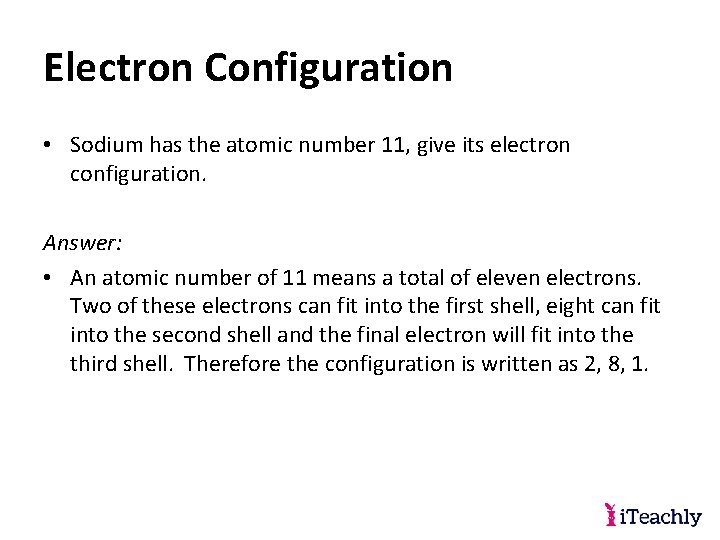
Electron Configuration • Sodium has the atomic number 11, give its electron configuration. Answer: • An atomic number of 11 means a total of eleven electrons. Two of these electrons can fit into the first shell, eight can fit into the second shell and the final electron will fit into the third shell. Therefore the configuration is written as 2, 8, 1.
Electron Configuration • Calcium has the atomic number 20, give its electron configuration.
Electron Configuration • Calcium has the atomic number 20, give its electron configuration. Answer: • An atomic number of 20 means twenty electrons. Two of these electrons can fit into the first shell, eight can fit into the second shell, a further eight occupy the third shell and the final two electrons will fit into the fourth shell. Therefore the configuration is written as 2, 8, 8, 2.
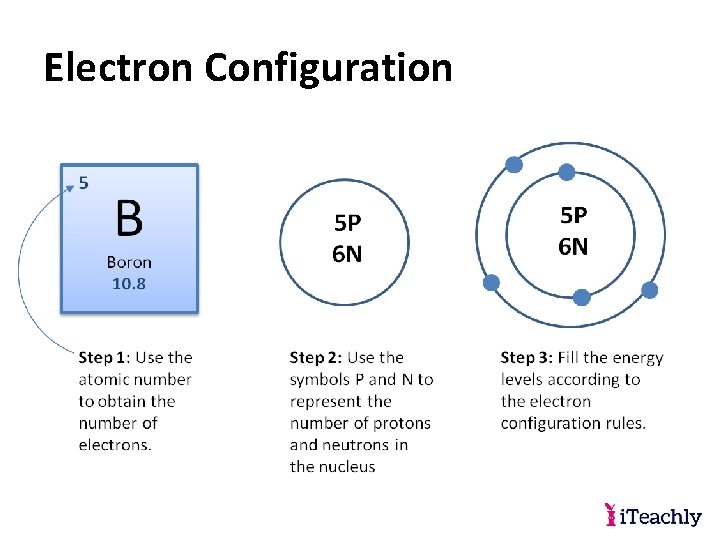
Electron Configuration Drawing Electron Configuration Diagrams • In some instances, you may be required to draw the structure of one of the first twenty atoms. In this case, knowing the electron configuration rules above for the first twenty elements and how to draw an atom is necessary. The diagrams below show the steps to drawing electron configuration diagrams. Note these diagrams do not take into consideration the different shaped orbitals that atoms possess.
Electron Configuration
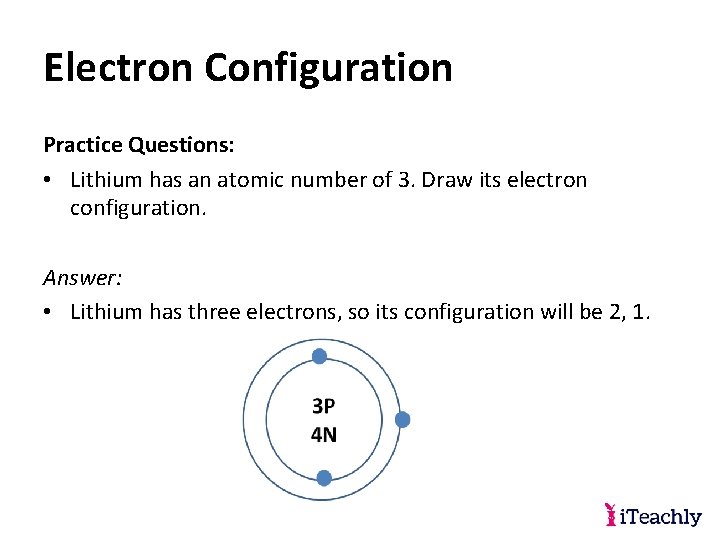
Electron Configuration Practice Questions: 1. Lithium has an atomic number of 3. Draw its electron configuration.
Electron Configuration Practice Questions: • Lithium has an atomic number of 3. Draw its electron configuration. Answer: • Lithium has three electrons, so its configuration will be 2, 1.
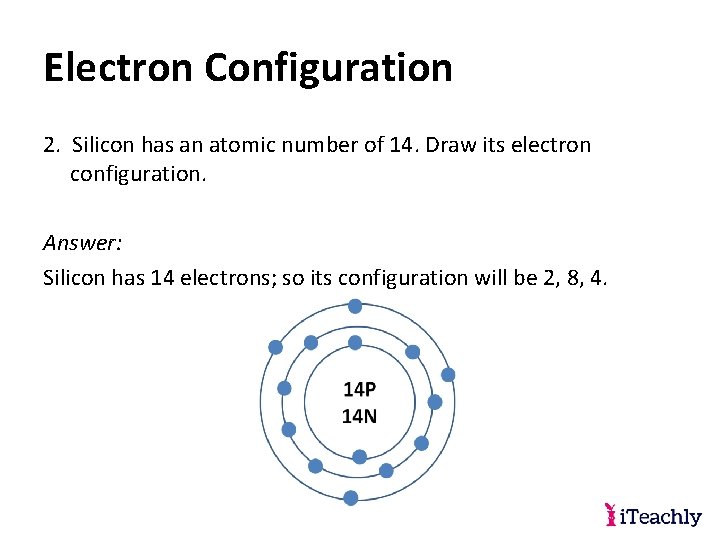
Electron Configuration 2. Silicon has an atomic number of 14. Draw its electron configuration. Answer: Silicon has 14 electrons; so its configuration will be 2, 8, 4.
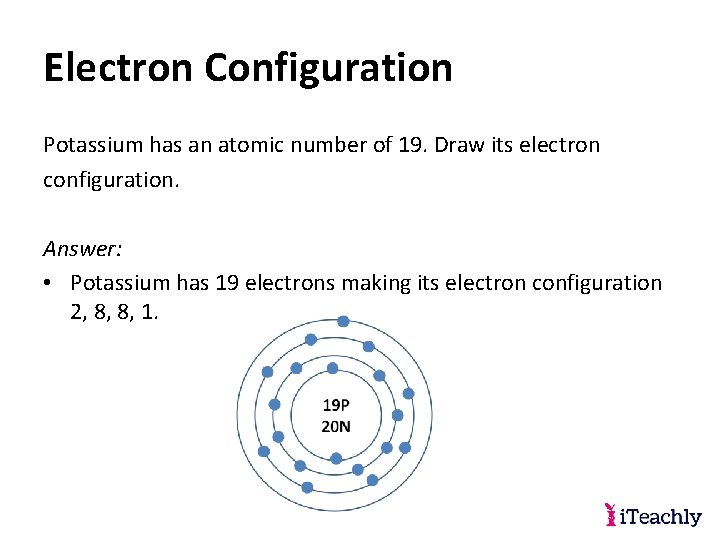
Electron Configuration Potassium has an atomic number of 19. Draw its electron configuration. Answer: • Potassium has 19 electrons making its electron configuration 2, 8, 8, 1.
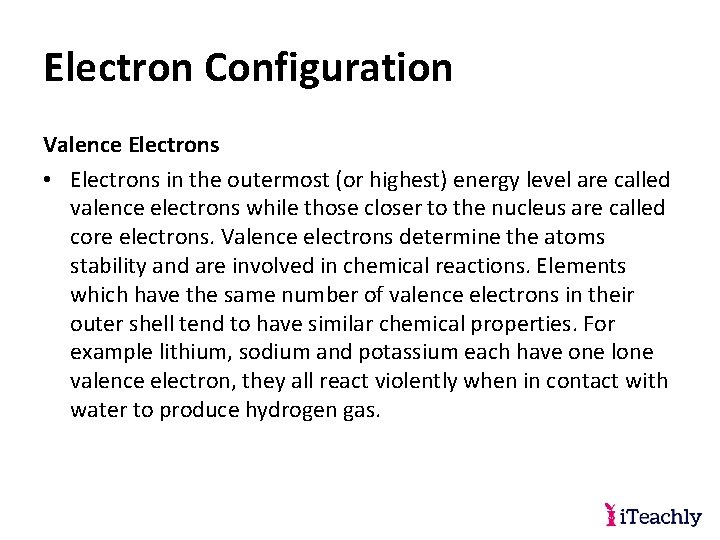
Electron Configuration Valence Electrons • Electrons in the outermost (or highest) energy level are called valence electrons while those closer to the nucleus are called core electrons. Valence electrons determine the atoms stability and are involved in chemical reactions. Elements which have the same number of valence electrons in their outer shell tend to have similar chemical properties. For example lithium, sodium and potassium each have one lone valence electron, they all react violently when in contact with water to produce hydrogen gas.
Electron Configuration Valence Electrons • The number of valence electrons an atom has dictates its behaviour in a chemical reaction and its reactivity. For example, sodium (Na) has one valence electron which is given away in a chemical reaction. By contrast, chlorine (Cl) has seven valence electrons and requires one more to fill its valence shell. Therefore, chlorine takes an electron in a chemical reaction. Some atoms such as neon (Ne) and argon (Ar) have full valence shells are considered inert or stable. This means that they are do not give or take electrons in a chemical reaction.
Electron Configuration Electron Orbitals • The 2, 8, 8, 18 rule is a very simplistic view of electron configuration and doesn’t give the full picture when it comes to electron configuration. While it works for the first 20 elements, in order to look at other atoms higher than atomic number 20, we need to look closer at the types of orbitals in each electron shell in more detail. Orbitals represent the space around the nucleus of an atom of which there is the greatest chance of locating an electron. Orbitals make up subshells, which make up electron shells (these are numbered 14).
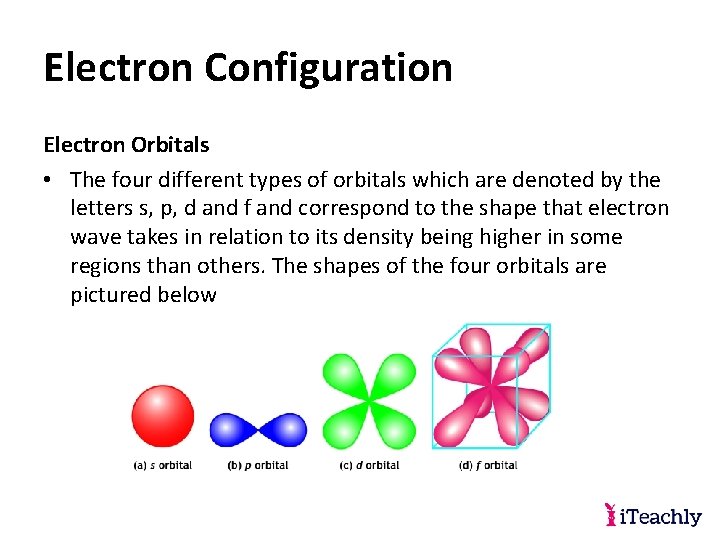
Electron Configuration Electron Orbitals • The four different types of orbitals which are denoted by the letters s, p, d and f and correspond to the shape that electron wave takes in relation to its density being higher in some regions than others. The shapes of the four orbitals are pictured below
Electron Configuration Electron Orbitals • The s-orbital is spherical in shape. The p-orbital is a 3 dimensional dumb-bell shape. Its 3 orbitals exist in different planes (called x, y and z) and are right angles to one another. The d-orbital has four lobes, while the f-orbital is the most complex of the four has eight lobes.
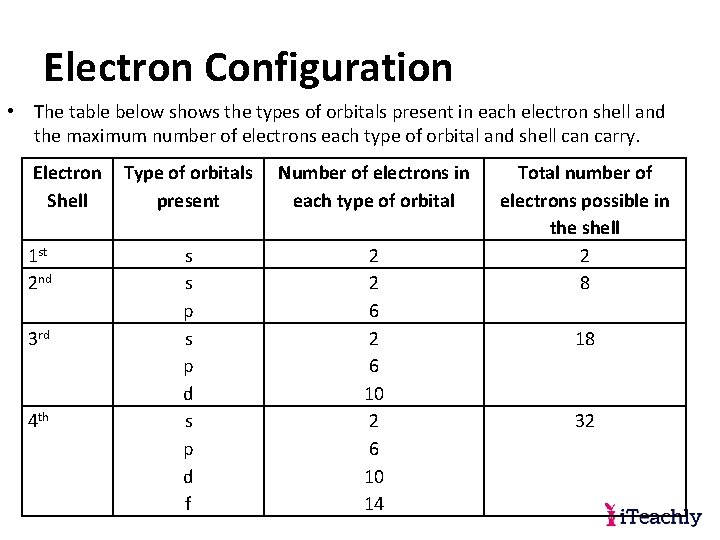
Electron Configuration • The table below shows the types of orbitals present in each electron shell and the maximum number of electrons each type of orbital and shell can carry. Electron Shell 1 st 2 nd 3 rd 4 th Type of orbitals present Number of electrons in each type of orbital s s p d f 2 2 6 10 14 Total number of electrons possible in the shell 2 8 18 32
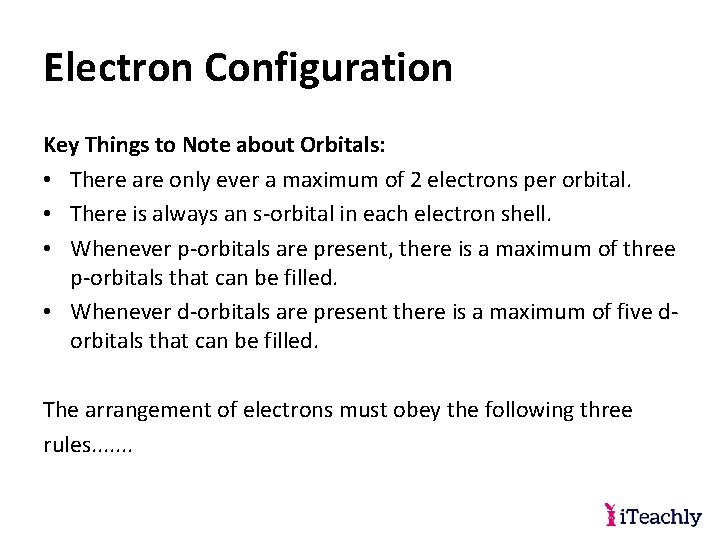
Electron Configuration Key Things to Note about Orbitals: • There are only ever a maximum of 2 electrons per orbital. • There is always an s-orbital in each electron shell. • Whenever p-orbitals are present, there is a maximum of three p-orbitals that can be filled. • Whenever d-orbitals are present there is a maximum of five dorbitals that can be filled. The arrangement of electrons must obey the following three rules. . . .
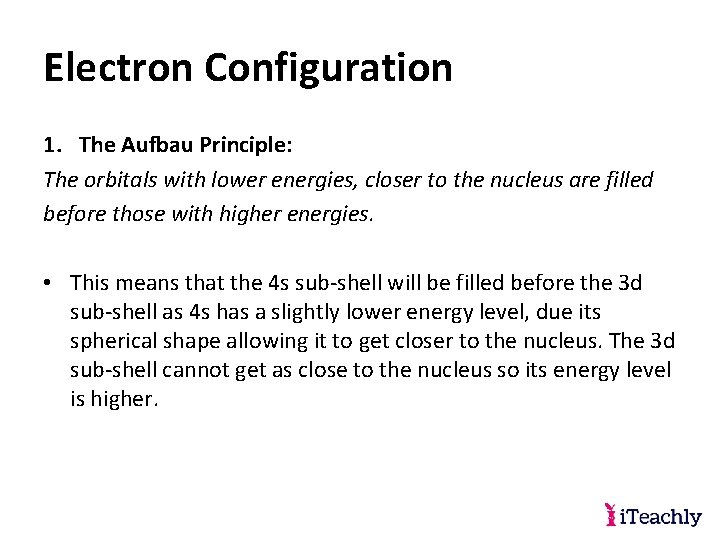
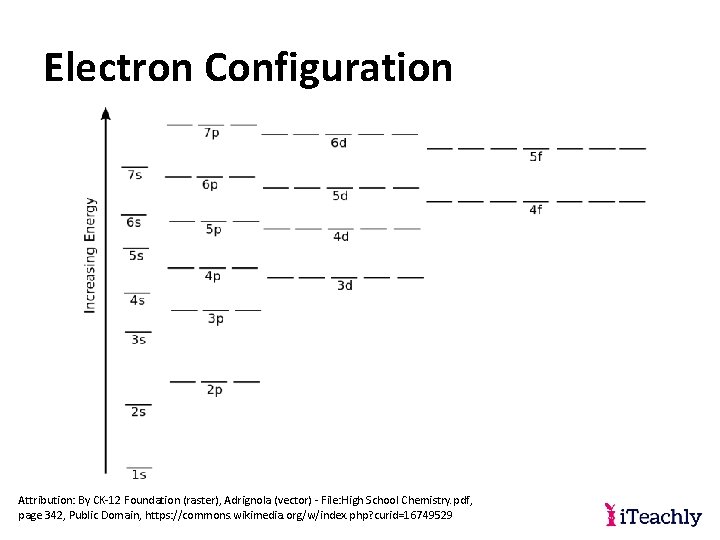
Electron Configuration 1. The Aufbau Principle: The orbitals with lower energies, closer to the nucleus are filled before those with higher energies. • This means that the 4 s sub-shell will be filled before the 3 d sub-shell as 4 s has a slightly lower energy level, due its spherical shape allowing it to get closer to the nucleus. The 3 d sub-shell cannot get as close to the nucleus so its energy level is higher.
Electron Configuration Attribution: By CK-12 Foundation (raster), Adrignola (vector) - File: High School Chemistry. pdf, page 342, Public Domain, https: //commons. wikimedia. org/w/index. php? curid=16749529
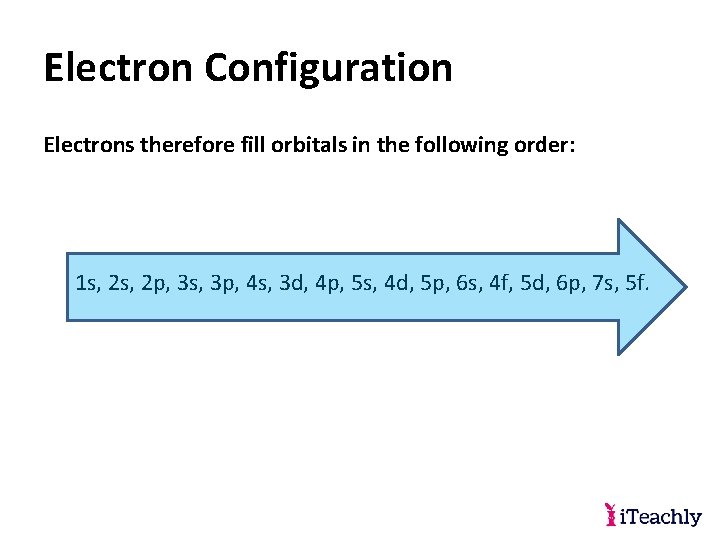
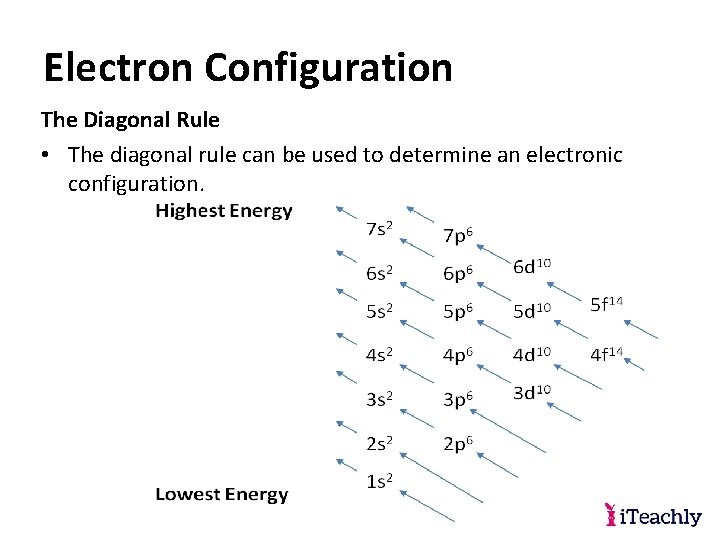
Electron Configuration Electrons therefore fill orbitals in the following order: 1 s, 2 p, 3 s, 3 p, 4 s, 3 d, 4 p, 5 s, 4 d, 5 p, 6 s, 4 f, 5 d, 6 p, 7 s, 5 f.
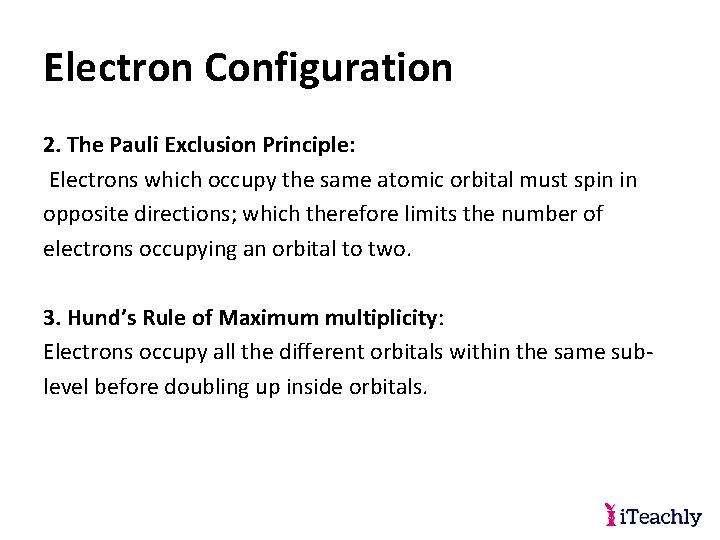
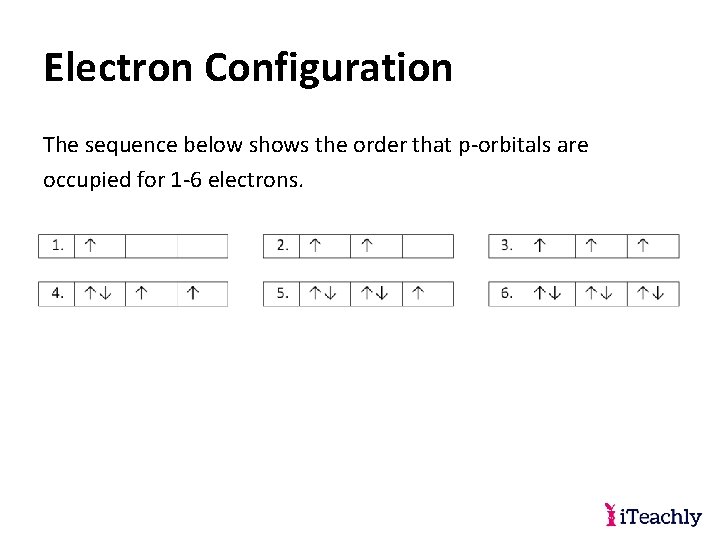
Electron Configuration 2. The Pauli Exclusion Principle: Electrons which occupy the same atomic orbital must spin in opposite directions; which therefore limits the number of electrons occupying an orbital to two. 3. Hund’s Rule of Maximum multiplicity: Electrons occupy all the different orbitals within the same sublevel before doubling up inside orbitals.
Electron Configuration The sequence below shows the order that p-orbitals are occupied for 1 -6 electrons.
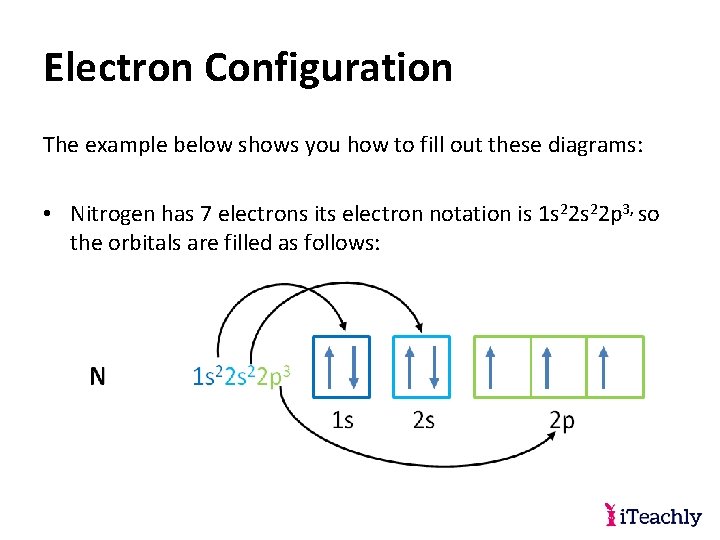
Electron Configuration Orbital Diagrams • Orbital diagrams are a pictorial way to describe the arrangement of the electrons in an atom. The orbitals are arranged from lowest to highest energy level, with arrows to indicate electrons with the opposite spin occupying the orbitals.
Electron Configuration The example below shows you how to fill out these diagrams: • Nitrogen has 7 electrons its electron notation is 1 s 22 p 3, so the orbitals are filled as follows:
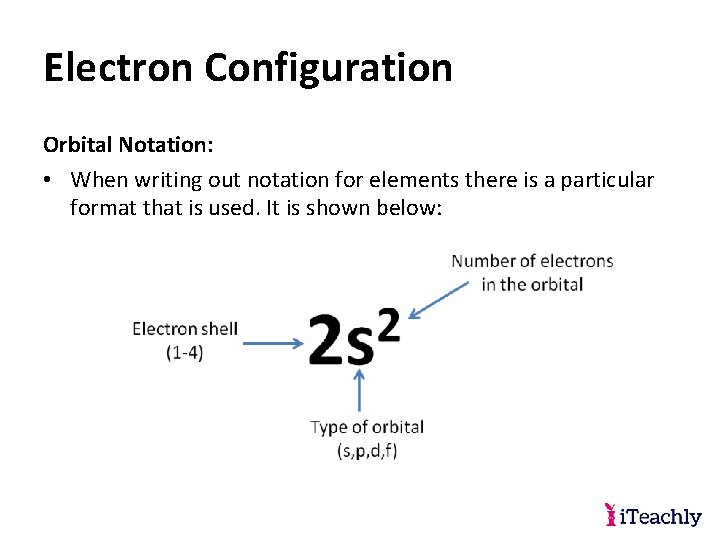
Electron Configuration Orbital Notation: • When writing out notation for elements there is a particular format that is used. It is shown below:
Electron Configuration How to write electron orbital notation: • To write out the electron configuration you need to determine the number of electrons using the periodic table and fill up each orbital in order, starting with 1 s, until you run out of electrons. • The steps are as follows. .
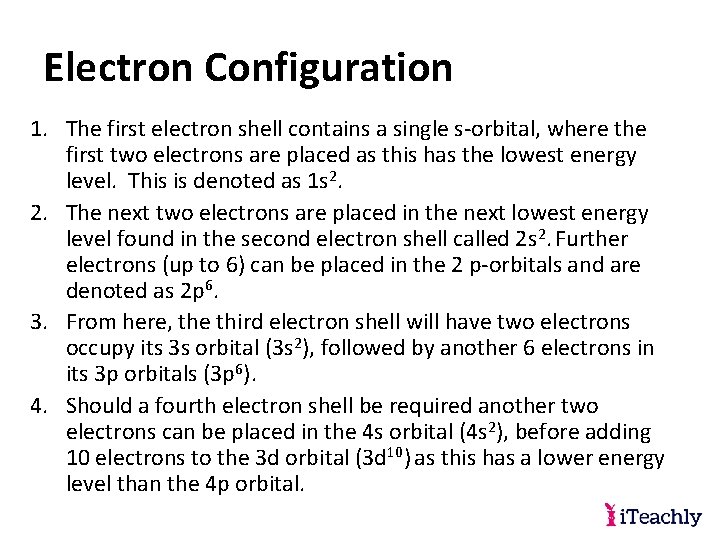
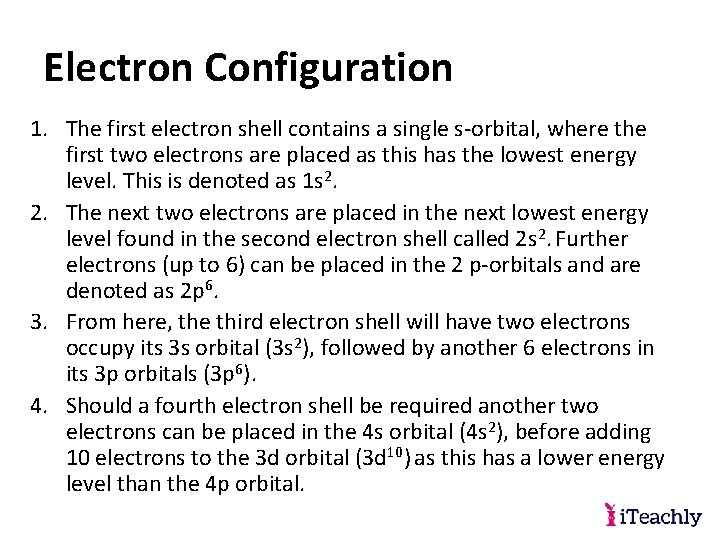
Electron Configuration 1. The first electron shell contains a single s-orbital, where the first two electrons are placed as this has the lowest energy level. This is denoted as 1 s 2. 2. The next two electrons are placed in the next lowest energy level found in the second electron shell called 2 s 2. Further electrons (up to 6) can be placed in the 2 p-orbitals and are denoted as 2 p 6. 3. From here, the third electron shell will have two electrons occupy its 3 s orbital (3 s 2), followed by another 6 electrons in its 3 p orbitals (3 p 6). 4. Should a fourth electron shell be required another two electrons can be placed in the 4 s orbital (4 s 2), before adding 10 electrons to the 3 d orbital (3 d 10) as this has a lower energy level than the 4 p orbital.
Electron Configuration 1. The first electron shell contains a single s-orbital, where the first two electrons are placed as this has the lowest energy level. This is denoted as 1 s 2. 2. The next two electrons are placed in the next lowest energy level found in the second electron shell called 2 s 2. Further electrons (up to 6) can be placed in the 2 p-orbitals and are denoted as 2 p 6. 3. From here, the third electron shell will have two electrons occupy its 3 s orbital (3 s 2), followed by another 6 electrons in its 3 p orbitals (3 p 6). 4. Should a fourth electron shell be required another two electrons can be placed in the 4 s orbital (4 s 2), before adding 10 electrons to the 3 d orbital (3 d 10) as this has a lower energy level than the 4 p orbital.
Electron Configuration The Diagonal Rule • The diagonal rule can be used to determine an electronic configuration.
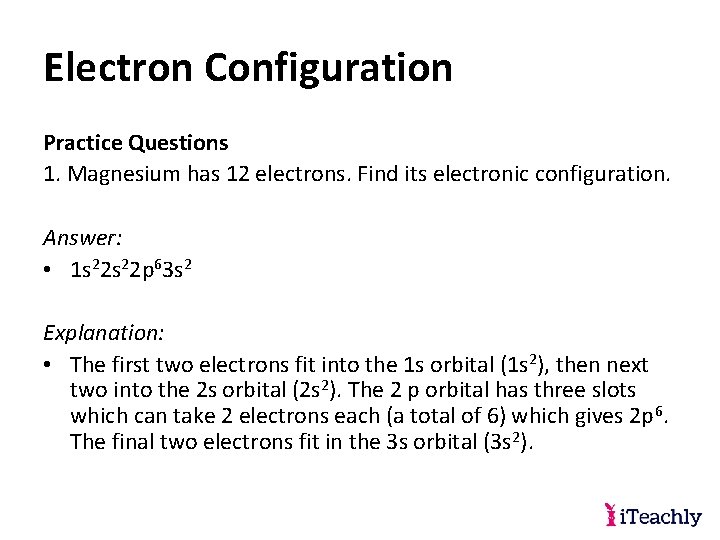
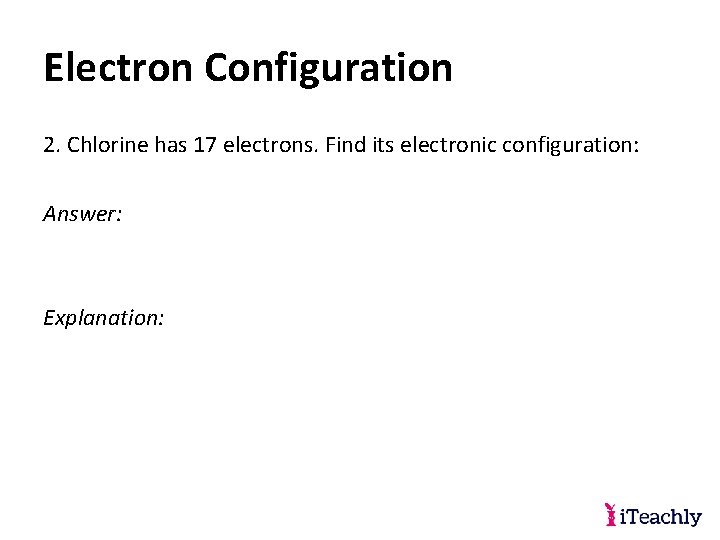
Electron Configuration Practice Questions 1. Magnesium has 12 electrons. Find its electronic configuration. Answer: Explanation:
Electron Configuration Practice Questions 1. Magnesium has 12 electrons. Find its electronic configuration. Answer: • 1 s 22 p 63 s 2 Explanation: • The first two electrons fit into the 1 s orbital (1 s 2), then next two into the 2 s orbital (2 s 2). The 2 p orbital has three slots which can take 2 electrons each (a total of 6) which gives 2 p 6. The final two electrons fit in the 3 s orbital (3 s 2).
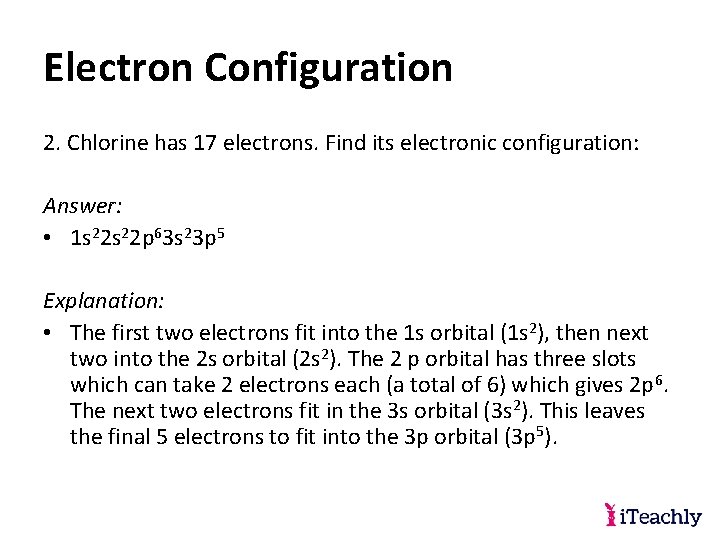
Electron Configuration 2. Chlorine has 17 electrons. Find its electronic configuration: Answer: Explanation:
Electron Configuration 2. Chlorine has 17 electrons. Find its electronic configuration: Answer: • 1 s 22 p 63 s 23 p 5 Explanation: • The first two electrons fit into the 1 s orbital (1 s 2), then next two into the 2 s orbital (2 s 2). The 2 p orbital has three slots which can take 2 electrons each (a total of 6) which gives 2 p 6. The next two electrons fit in the 3 s orbital (3 s 2). This leaves the final 5 electrons to fit into the 3 p orbital (3 p 5).
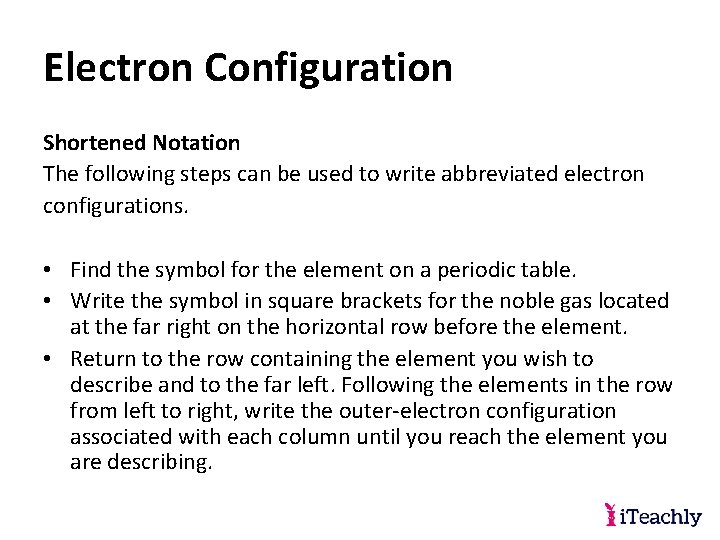
Electron Configuration Shortened Notation The following steps can be used to write abbreviated electron configurations. • Find the symbol for the element on a periodic table. • Write the symbol in square brackets for the noble gas located at the far right on the horizontal row before the element. • Return to the row containing the element you wish to describe and to the far left. Following the elements in the row from left to right, write the outer-electron configuration associated with each column until you reach the element you are describing.
Electron Configuration Practice Questions: 1. Give the shortened notation for Zinc. Answer: Explanation:
Electron Configuration Answer: • [Ar] 4 s 2 3 d 10 Explanation: • Zinc has the symbol Zn and is atomic number 30 on the periodic table. • For zinc, move up to the third period and across to the noble gas Ar (Argon). This describes the first 18 electrons of a zinc atom, as is written as [Ar]. • For zinc, we need to describe from the 19 th through to the 30 th electrons. The atomic numbers 19 and 20 are in the fourth row of the s block, therefore the 19 th and 20 th electrons for each zinc atom are written as 4 s 2. • The atomic numbers 21 through to 30 are in the first row of the d block, so the 21 st to the 30 th electrons for each zinc atom completely fill the 3 d sublevel. • Zinc, therefore, has the abbreviated configuration: [Ar] 4 s 2 3 d 10
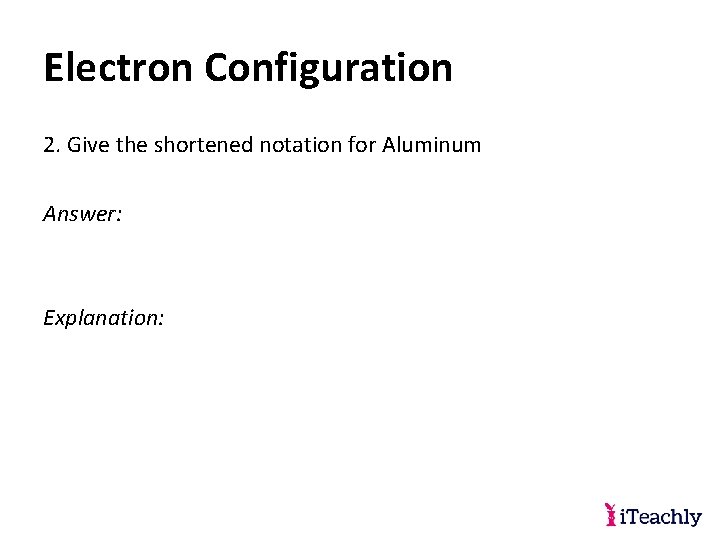
Electron Configuration 2. Give the shortened notation for Aluminum Answer: Explanation:
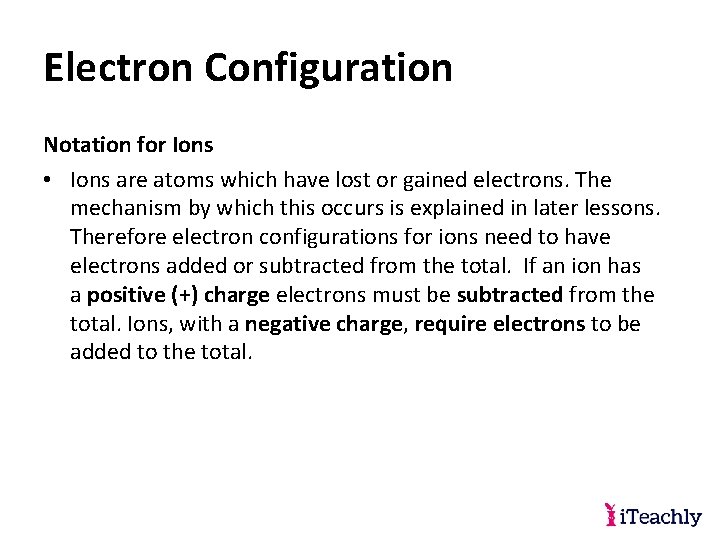
Electron Configuration Answer: • [Ne] 3 s 2 3 p 1 Explanation: • Aluminium has an atomic number of 13 on the periodic table, on the 3 rd row. • The noble gas prior to Aluminum is Neon with an atomic number of 10. So there are three electrons that need to be described between Neon and Aluminum. The first two will fit into the 3 s 2 sub-shell and the final electron will fit into the 3 p sub-shell. • Therefore the answer is [Ne] 3 s 2 3 p 1
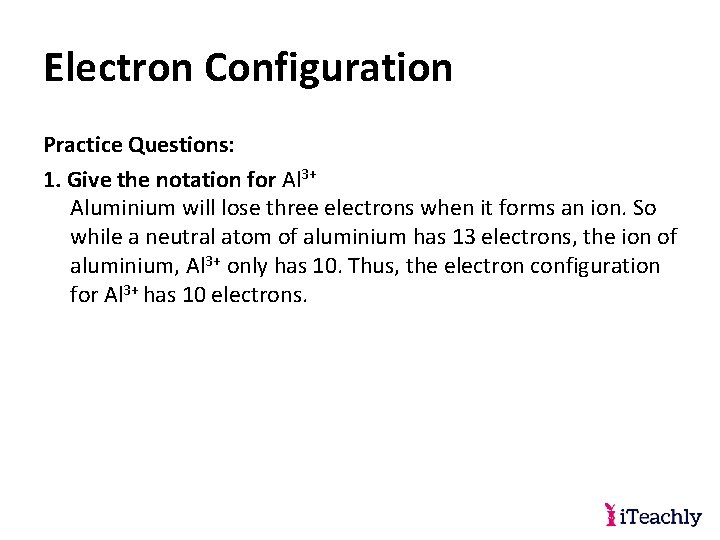
Electron Configuration Notation for Ions • Ions are atoms which have lost or gained electrons. The mechanism by which this occurs is explained in later lessons. Therefore electron configurations for ions need to have electrons added or subtracted from the total. If an ion has a positive (+) charge electrons must be subtracted from the total. Ions, with a negative charge, require electrons to be added to the total.
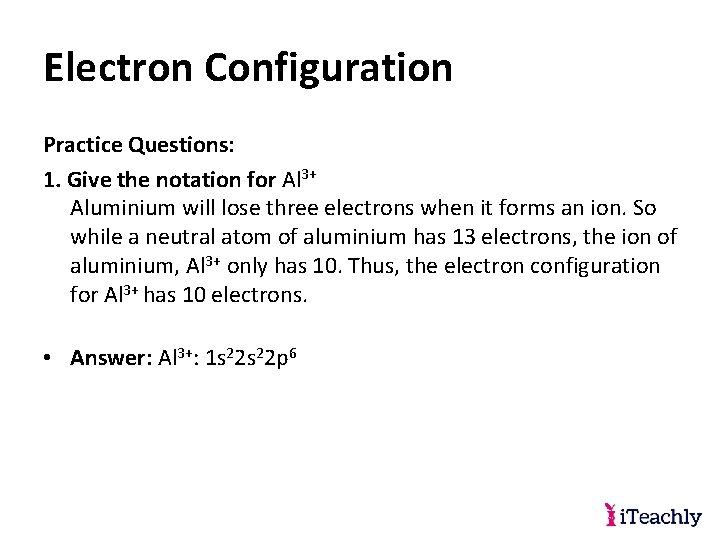
Electron Configuration Practice Questions: 1. Give the notation for Al 3+ Aluminium will lose three electrons when it forms an ion. So while a neutral atom of aluminium has 13 electrons, the ion of aluminium, Al 3+ only has 10. Thus, the electron configuration for Al 3+ has 10 electrons.
Electron Configuration Practice Questions: 1. Give the notation for Al 3+ Aluminium will lose three electrons when it forms an ion. So while a neutral atom of aluminium has 13 electrons, the ion of aluminium, Al 3+ only has 10. Thus, the electron configuration for Al 3+ has 10 electrons. • Answer: Al 3+: 1 s 22 p 6
Electron Configuration 2. Give the notation for S 2 Sulfur will gain two electrons when it forms an ion. A neutral atom of sulfur has 16 electrons; however, sulfur in its ionic form, S 2 -, has gained two additional electrons. Therefore, the electron configuration is written for 18 electrons.
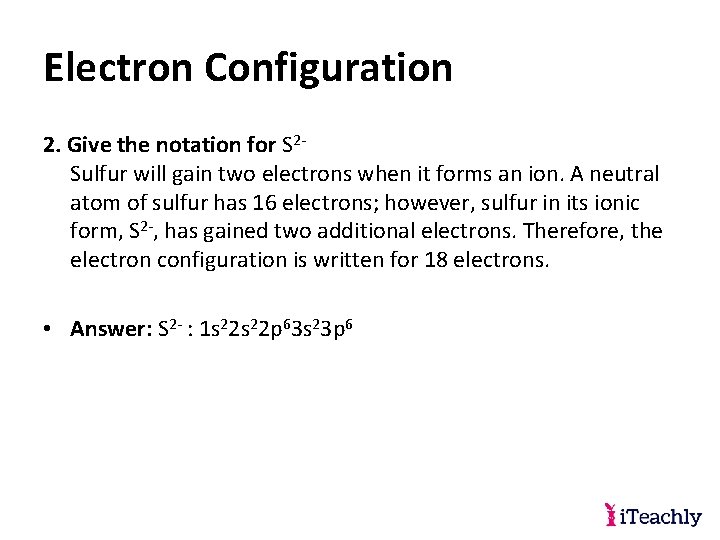
Electron Configuration 2. Give the notation for S 2 Sulfur will gain two electrons when it forms an ion. A neutral atom of sulfur has 16 electrons; however, sulfur in its ionic form, S 2 -, has gained two additional electrons. Therefore, the electron configuration is written for 18 electrons. • Answer: S 2 - : 1 s 22 p 63 s 23 p 6
Electron Configuration Exceptions to the rule • Chromium and copper are the two main exceptions to rules for electron configurations. In these cases, a completely full (3 d 10) or half full (3 d 5) d sub-level is more stable than a partially-filled d sub-level, so an electron from the 4 s orbital is excited and rises to one of the 3 d orbitals to fill it.
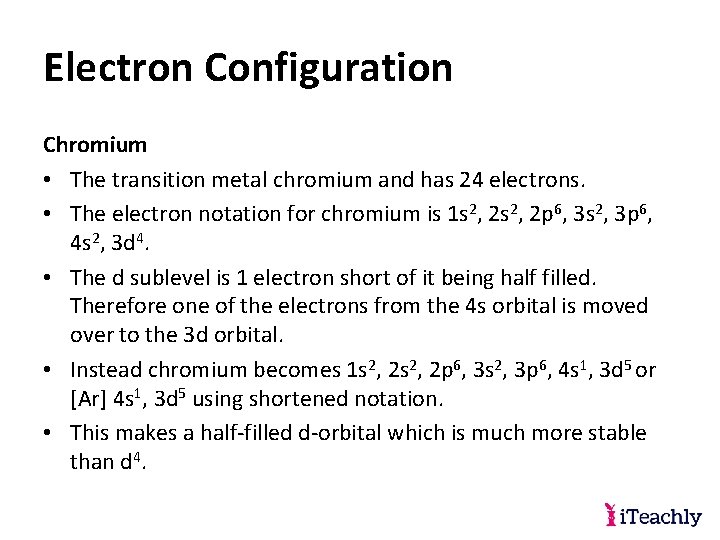
Electron Configuration Chromium • The transition metal chromium and has 24 electrons. • The electron notation for chromium is 1 s 2, 2 p 6, 3 s 2, 3 p 6, 4 s 2, 3 d 4. • The d sublevel is 1 electron short of it being half filled. Therefore one of the electrons from the 4 s orbital is moved over to the 3 d orbital. • Instead chromium becomes 1 s 2, 2 p 6, 3 s 2, 3 p 6, 4 s 1, 3 d 5 or [Ar] 4 s 1, 3 d 5 using shortened notation. • This makes a half-filled d-orbital which is much more stable than d 4.
Electron Configuration Copper • The other exception is copper with a notation of 1 s 2, 2 p 6, 3 s 2, 3 p 6, 4 s 2, 3 d 9. • Once again, an electron from the 4 s is moved over to the 3 d orbital completely filling the d sublevel making it stable. • So, copper therefore becomes 1 s 2, 2 p 6, 3 s 2, 3 p 6, 4 s 1, 3 d 10 or [Ar] 4 s 1, 3 d 10.