
STRUCTURE AND FUNCTIONS OF NEURON Debashree Sinha STRUCTURE
STRUCTURE AND FUNCTIONS OF NEURON Debashree Sinha
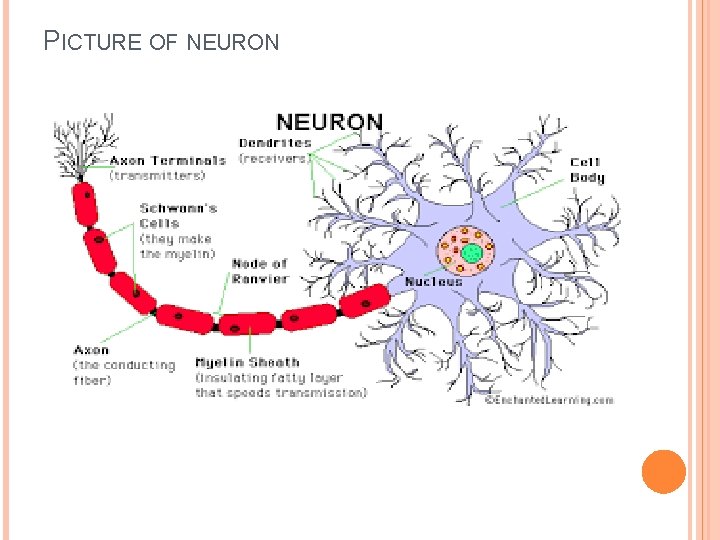
STRUCTURE Nerve cells or neurons are the structural and functional units of the nervous system. It consists of three major parts namely, cell body, dendrites, axon. Cell Body: It is irregular in shape or polyhedral. It contains cytoplasm and certain granular bodies called Nissl's granules which contain a group of ribosomes for protein synthesis. Dendrites: Dendrites are short fibres which branch repeatedly and protrude out of the cell body. They transmit electrical impulse towards the cyton. Axon: They are long fibres arising from the cell body with a branched distal end. It terminates in a synaptic knob. It is filled with neurotransmitters.
PARTS OF AXON: a. Axoplasm: It is the cytoplasm of an axon. b. Myelin sheath: It is made up of many layers of Schwann cells. c. Neurilemma: The outermost layer of Schwann cells. d. Nodes of Ranvier: These are gaps left by a myelin sheath. Function: The neurons are responsible for the conduction and transmission of the nerve impulses. The stimulus is received and carried by the sensory neurons, analysed and detected by the CNS. The response is given with the help of the motor neurons.
PICTURE OF NEURON
At the ultrastructure level, a nerve cell, like any other type of animal cell, contains different types of organelles that keep them alive and allow them to remain functional. These include such cell organelles as a nucleus, nucleolus, E. R, golgi apparatus and the mitochondria among others. The different types of organelles play different roles which contribute to the proper functioning of the neuron. For instance, whereas the DNA contained in the nucleus contains genetic material that controls all characteristics of the cell, the cytoskeleton (which consists of a tubular structure) helps maintain the shape of the neuron as well as the transportation of substances like proteins.
Anatomically, a nerve cell consists of several parts mentioned above. While different types of nerve cells make up the nervous system, they all contain these primary structures: Cell body (Soma): The soma is the cell body of the nerve cell that contains the nucleus. Compared to the other sections of the cell, the cell body is larger and may appear spherical under the microscope. A series of branch-like structures known as dendrites arise from the cell body. Apart from connecting the dendrites and axons, which allows for nerve impulses to be transmitted from one cell to another, the soma is also the site of protein synthesis (proteins are synthesized within Nissl body of the rough E. R in the cell body of the neuron).
The cell body/soma is also known as the perikaryon. The cell body is the metabolic center of the cell consisting of energy producing systems and where macromolecules are synthesized to keep the cell alive, maintain its structure and allow it to function appropriately. Cell organelles of the nerve cell contains different types of organelles that are involved in such functions as growth, energy production and the synthesis of proteins among others.
There are different types of cell bodies depending on the neuron. These include: Bipolar - are located in the middle and have a single axon and dendrite on either end Pseudounipolar - connected to the axon and dendrite by a tubular projection - as such, it is not directly connected to the two. The axon also splits into two branches at its end Unipolar - The cell body here is located on one end and has a single axon. Unlike the other cells, unipolar cells lack dendrites. Multipolar - This is the type of cell body that is commonly depicted in many books. Arising from the cell body are dendrites (branched) while the axon extends from one side of the cell body
DENDRITES Dendrites are the tree-like branched structures that arise from the nerve cell body. Depending on the cell, dendrites may extend significantly resembling a highly branched tree. Apart from the main dendrite branches, dendrites may contain additional protrusions known as dendrite spines. These small membranous protrusions receive input from the axon of another cell and thus play an important role in the transmission of nerve impulses by increasing the overall surface area.
As expansion of the cell body, dendrites and dendrite spines also contain cytoplasm and different types of organelles. In particular, dendrite spines contain a variety of microtubules and some neurofilaments that contribute to the changes observed in their shape. Dendrites receive electrical impulses from axons of other nerve cells which in turn accumulate in the soma before being sent to the axon hillock.
The axon hillock is a specialized region from which the axon extends. As such, it is the area at which the axon is attached to the cell body. Unlike the cell body and dendrites, the Axon Hillock lacks many cell organelles. However, it contains various elements of the cytoskeleton as well as a few of the organelles that are transported to the axon from the cell body. Initial segment - this is the region between the Axon and Hillock and the front part of the myelin sheath. This region is said to be the area for the initiation of action potential. The Axon Hillock is cone-shaped.
THE AXON The axon is a single elongated structure that extends from the Axon Hillock. Compared to dendrites, the axon is straighter in appearance and has a smoother surface. In addition, compared to dendrites which tend to be highly branched, each neuron has a single axon that extends and branches at its end. While it lacks many of the organelles found in the cell body, the axon contains microtubules (along the length of the axon) and specialized, insulating substances known as myelin on its surface that boost the transmission of nerve impulses. The branched end of the axon is known as the axon collaterales.
The spaces/gaps between the Schwann cells are known as the nodes of Ranvier and they serve to propagate electrical signals along the axon. Myelin sheath is made up of cells (Schwann cells) wrapping themselves around the axon. In the Central Nervous System, this action is performed by the oligodendrocyte cells.
NERVE ENDING/ AXON TERMINAL This is the distal part of the axon that comes in contact with other cells. Because this part of the axon is largely involved in the release of the neurotransmitter, it contains a large number of mitochondria that produce the energy required to facilitate the process.
Although nerves are functionally classified into three main groups (sensory, motor and intermediate neurons) they are all involved in the transmission of information which in turn ensures the appropriate response. They are involved in the signal reception, integration of the incoming signal as well as the communication of the signal. Here, the different parts of the cells (cell body, dendrites, axons etc) play different roles which in turn allow the cell as a whole to effectively carry out its functions:
Receptive functions of a neuron - Neurons come into contact with other cells at sites known as synapses. This is the site at which the nerve endings of the cells come in contact allowing for successful communication. In this case, neurons play a receptive function by receiving information that originated from the stimuli. It is this receptive function of the neurons that ensures the effective transmission of information and consequently the appropriate response to stimuli.
Integrative function of a neuron - The integrative function occurs in the dendrites (receptive components) as well as the cell body of the neuron. For the most part, it involves the summing up of excitatory and inhibitory responses (this being integration of incoming signals) in order to determine whether certain information should be transmitted.
Impulse initiation - For a majority of the neurons, nerve impulses are initiated when the membrane potential of the neuron is sufficiently depolarized and reach a certain threshold. This allows some of the neurons to initiate impulses and thus information to specific targets. Not all neurons are capable of impulse initiation. Transmission - Transmission from one neuron to another is either electrical or chemical. In electrical transmission, a neuron is influenced by another through passive electrical means. In chemical transmission, it's the potential change in one of the neurons that results in the release of a chemical neurotransmitter which in turn diffuses another neuron.
A BRIEF SUMMARY OF THE THREE MAIN TYPES OF NEURONS IN THE BODY: Sensory Neurons - These are the type of neurons that are activated by external physical or chemical stimuli. This, therefore, involves sensory activation of any of the five senses (feel, smell, sound, sight, hear). The stimuli may be physical or chemical. A majority of the sensory neurons have been shown to be pseudounipolar (described above) - As such, their axons split into two at the end.
Motor Neurons - Motor neurons are the type of neurons in the spinal cord that connects the organs, muscles and different types of glands in the body. As such, they function to transmit impulses from the Central Nervous System to the organs, glands, and muscles. This, in turn, controls the movement of different types of muscles as well as the activity of organs and glands in the body. Motor neurons are composed of multipolar neurons. There are two types of motor neurons. These include the lower motor neurons (from the spinal cord to the muscle) and the upper motor neurons that travel between the spinal cord and the brain.
Intermediate neurons - These are the type of neurons that connect the motor neurons to the sensory neurons thus allowing for signals to be transmitted between the two. Like motor neurons, this system is composed of multipolar neurons.
- Slides: 21