
Structure and Function of macromolecules SC 912 L

- Slides: 47
Structure and Function of macromolecules SC. 912. L. 18. 1 Describe the basic molecular structure and primary function of the four macromolecules CARBOHYDRATES PROTEINS LIPIDS NUCLEIC ACIDS
MACROMOLECULES • Living things including cells, depend on a variety of biochemical processes for their survival. • Most biochemical processes that take place within cells make use of macromolecules (large molecules) • Large molecules that form when smaller compounds are joined together by chemicals bonds are known as macromolecules.
Kinds of macromolecules 1. 2. 3. 4. Carbohydrates Proteins Lipids Nucleic acids � All these macromolecules are organic compounds. (contain Carbon) � Organic compounds contain chemical bonds between carbon and hydrogen atoms.
Organic Compounds 4 �Compounds that contain CARBON are called organic �Macromolecules are large organic molecules copyright cmassengale
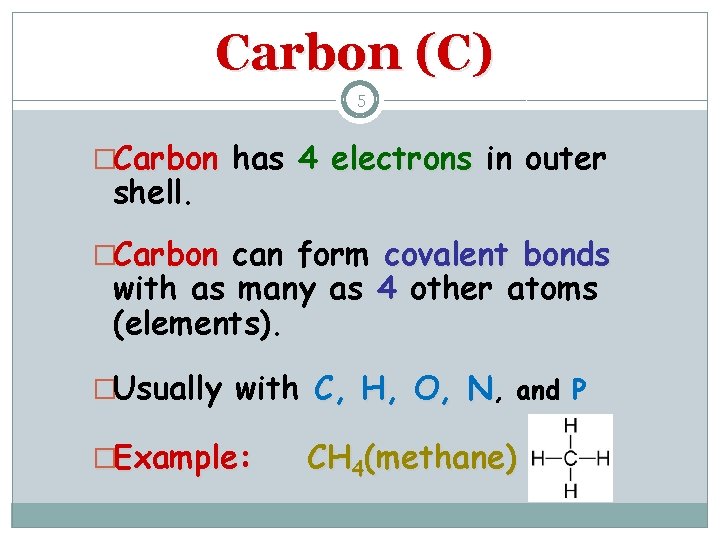
Carbon (C) 5 �Carbon has 4 electrons in outer shell. �Carbon can form covalent bonds with as many as 4 other atoms (elements). �Usually with C, H, O, N, and P �Example: CH 4(methane)
Macromolecules 6 �Large organic molecules. �Also called POLYMERS �Made up of smaller “building blocks” called MONOMERS �Examples: 1. Carbohydrates 2. Lipids 3. Proteins 4. Nucleic acids (DNA and RNA)
Question: 7 How Are Macromolecules Formed? copyright cmassengale
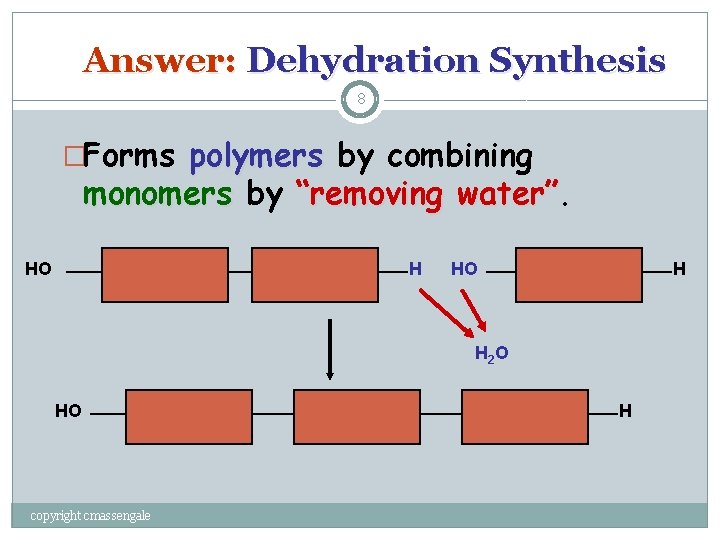
Answer: Dehydration Synthesis 8 �Forms polymers by combining monomers by “removing water” HO H H 2 O HO copyright cmassengale H
Question: 9 How are Macromolecules separated or digested? copyright cmassengale
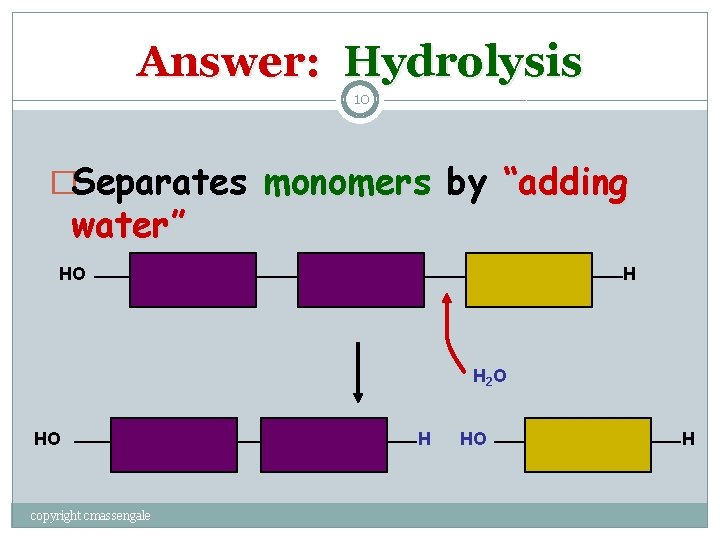
Answer: Hydrolysis 10 �Separates monomers by “adding water” HO H H 2 O HO copyright cmassengale H HO H
Carbohydrates 11 �Small sugar molecules to large sugar molecules �Saccharide means “sugar” �Examples: A. B. C. copyright cmassengale monosaccharide disaccharide polysaccharide
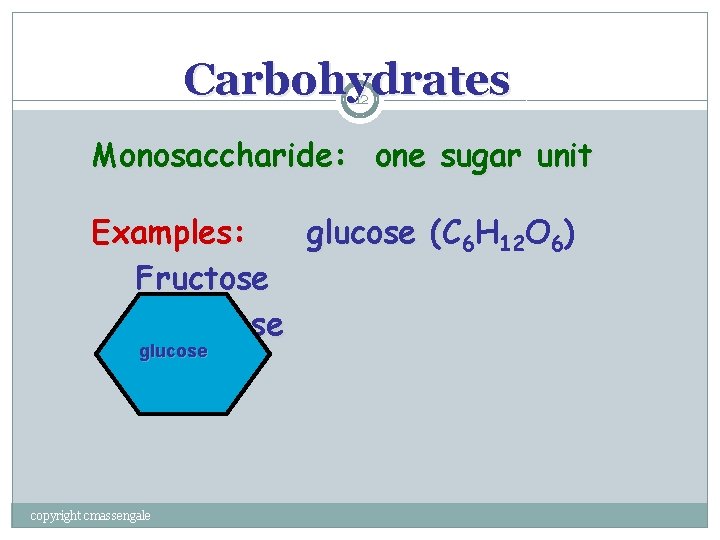
Carbohydrates 12 Monosaccharide: one sugar unit Examples: glucose (C ( 6 H 12 O 6) Fructose Galactose glucose copyright cmassengale
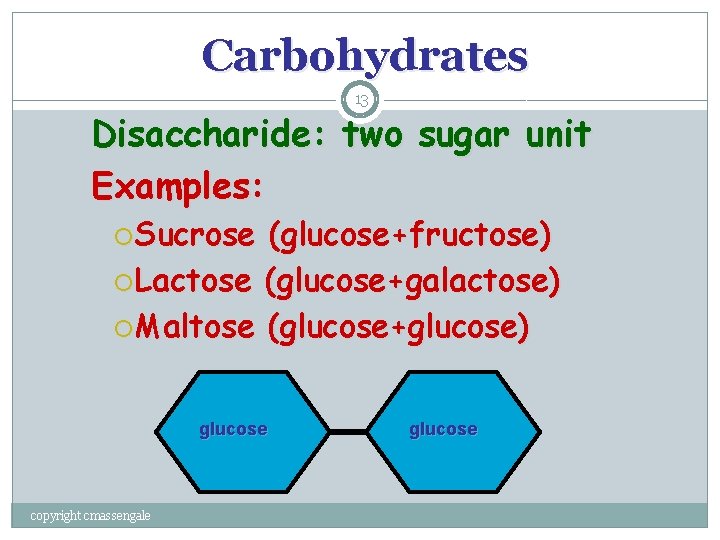
Carbohydrates 13 Disaccharide: two sugar unit Examples: Sucrose (glucose+fructose) Lactose (glucose+galactose) Maltose (glucose+glucose) glucose copyright cmassengale glucose
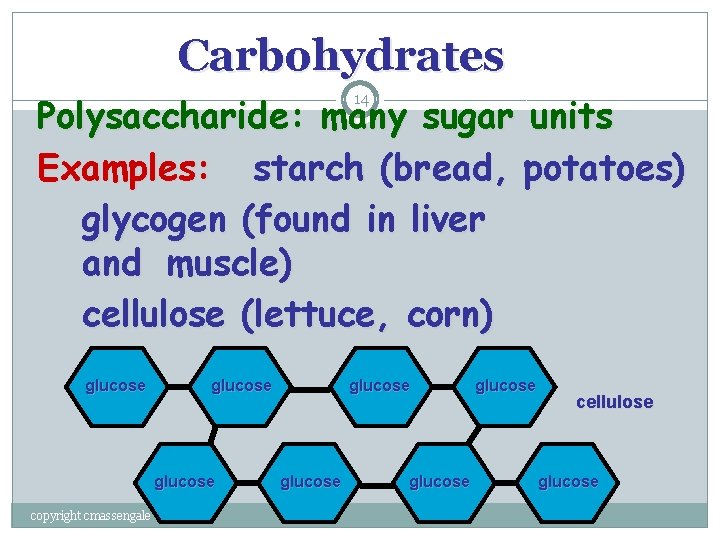
Carbohydrates Polysaccharide: many sugar units Examples: starch (bread, potatoes) glycogen (found in liver and muscle) cellulose (lettuce, corn) 14 glucose copyright cmassengale glucose cellulose glucose
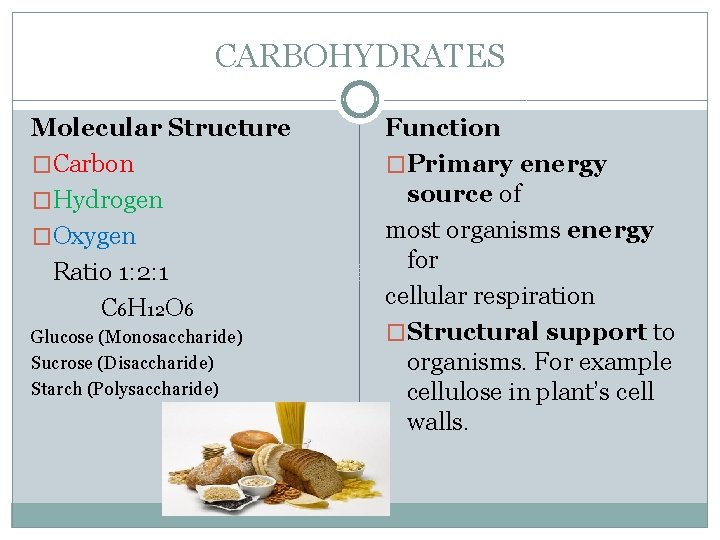
CARBOHYDRATES Molecular Structure �Carbon �Hydrogen �Oxygen Ratio 1: 2: 1 C 6 H 12 O 6 Glucose (Monosaccharide) Sucrose (Disaccharide) Starch (Polysaccharide) Function �Primary energy source of most organisms energy for cellular respiration �Structural support to organisms. For example cellulose in plant’s cell walls.
�Each carbohydrate molecule contains many carbon bonds. �Organisms get energy by breaking these Bonds. Carbohydrates provide QUICK Energy, but the energy is USED UP QUICKLY (shortterm energy)
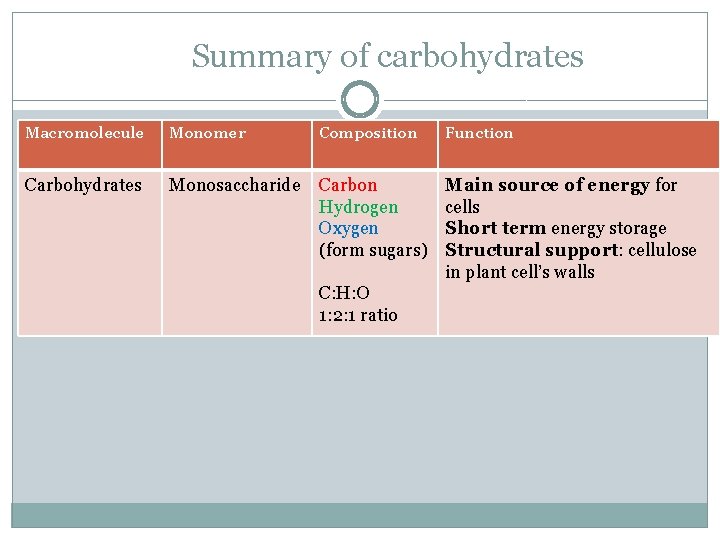
Summary of carbohydrates Macromolecule Monomer Composition Function Carbohydrates Monosaccharide Carbon Hydrogen Oxygen (form sugars) Main source of energy for cells Short term energy storage Structural support: cellulose in plant cell’s walls C: H: O 1: 2: 1 ratio
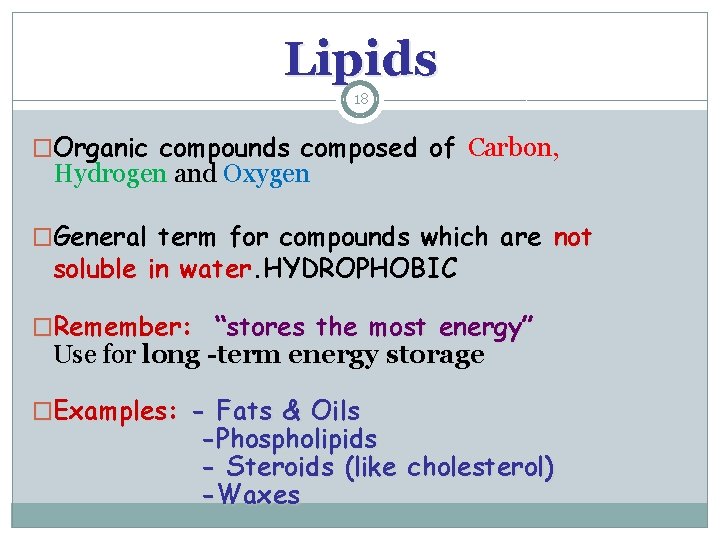
Lipids 18 �Organic compounds composed of Carbon, Hydrogen and Oxygen �General term for compounds which are not soluble in water. HYDROPHOBIC water �Remember: “stores the most energy” Use for long -term energy storage �Examples: - Fats & Oils -Phospholipids - Steroids (like cholesterol) -Waxes
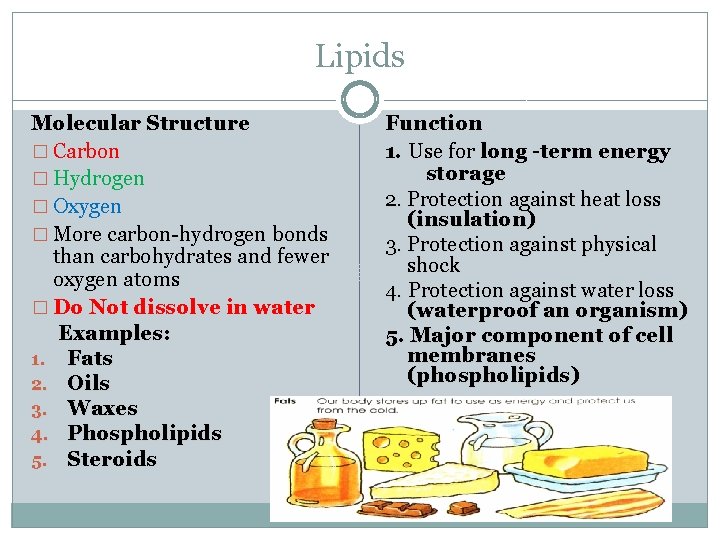
Lipids Molecular Structure � Carbon � Hydrogen � Oxygen � More carbon-hydrogen bonds than carbohydrates and fewer oxygen atoms � Do Not dissolve in water Examples: 1. Fats 2. Oils 3. Waxes 4. Phospholipids 5. Steroids Function 1. Use for long -term energy storage 2. Protection against heat loss (insulation) 3. Protection against physical shock 4. Protection against water loss (waterproof an organism) 5. Major component of cell membranes (phospholipids)
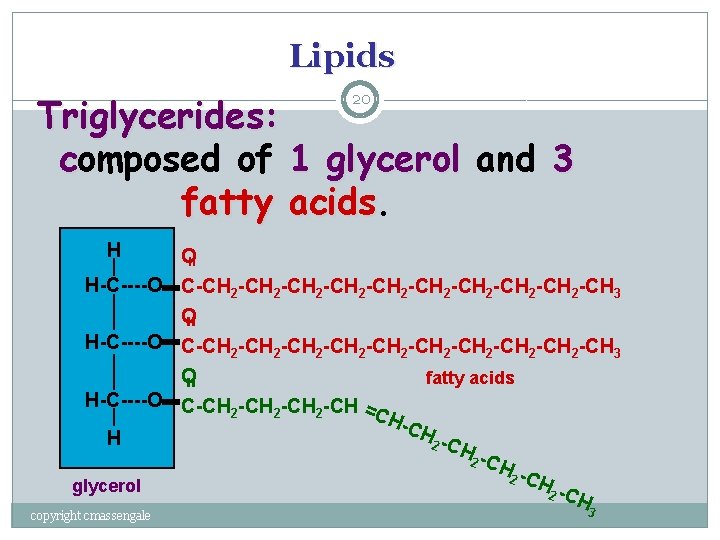
Lipids Triglycerides: composed of 1 glycerol and 3 fatty acids 20 H = O H-C----O C-CH 2 -CH 2 -CH 2 -CH 2 -CH 2 -CH 3 O fatty acids H-C----O C-CH -CH = 2 2 2 CH -CH H 2 -C H 2 C Hglycerol 2 C H = copyright cmassengale 3
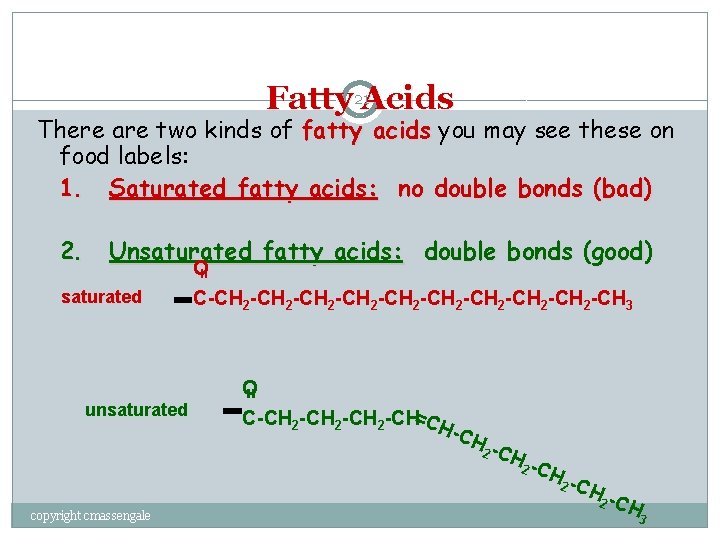
Fatty 21 Acids There are two kinds of fatty acids you may see these on food labels: 1. Saturated fatty acids: no double bonds (bad) 2. Unsaturated fatty acids: double bonds (good) = O C-CH 2 -CH 2 -CH 2 -CH 3 saturated = O C-CH 2 -CH=CH unsaturated -CH 2 -C copyright cmassengale H 2 C H 3
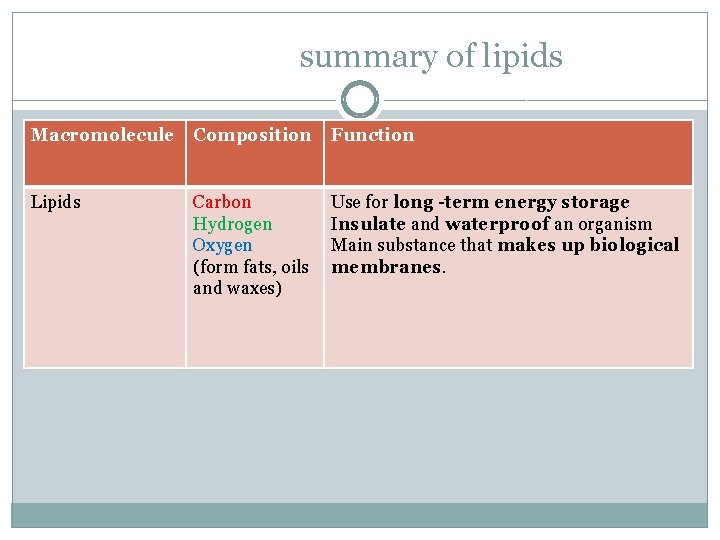
summary of lipids Macromolecule Composition Function Lipids Carbon Hydrogen Oxygen (form fats, oils and waxes) Use for long -term energy storage Insulate and waterproof an organism Main substance that makes up biological membranes.
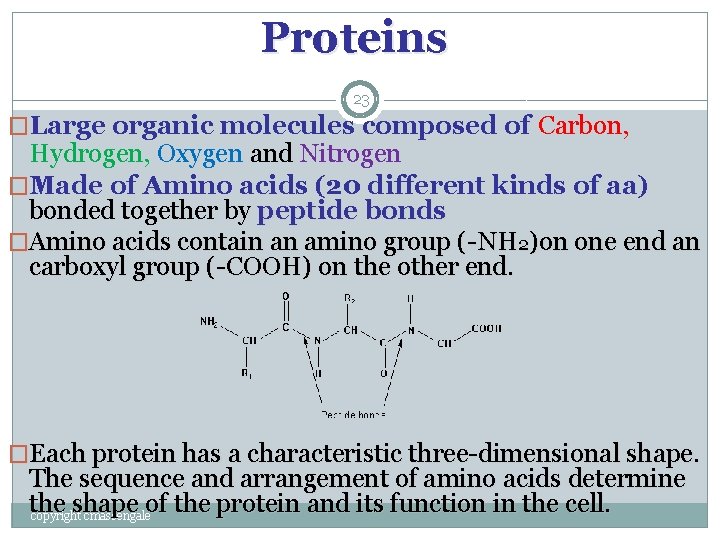
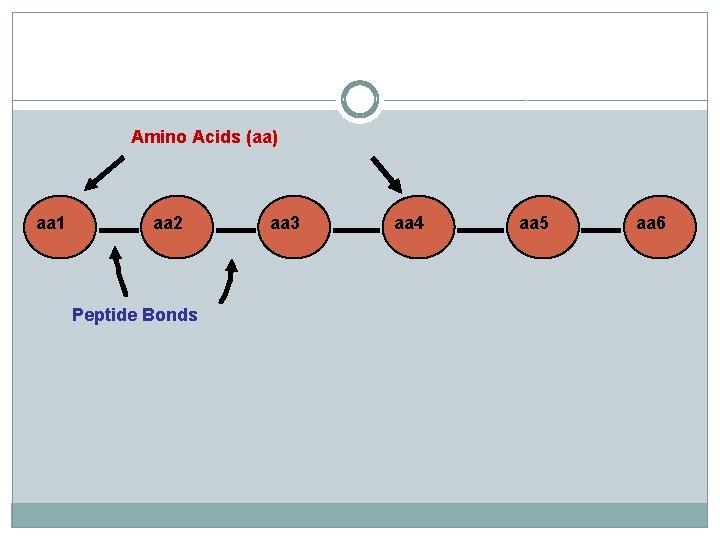
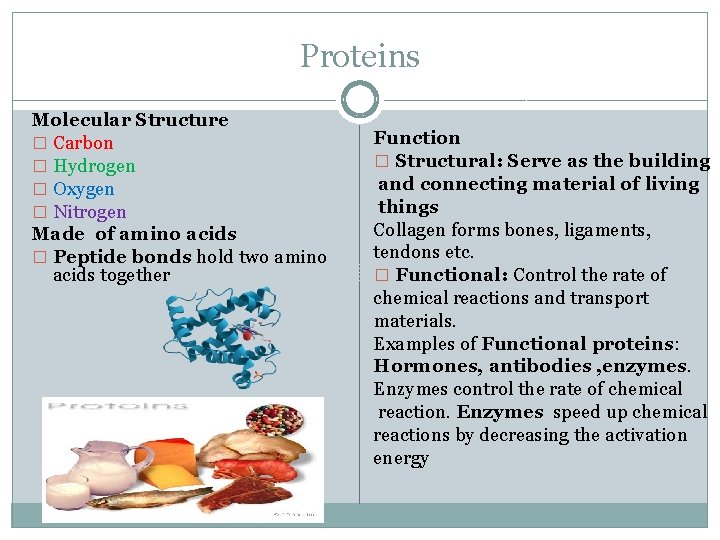
Proteins 23 �Large organic molecules composed of Carbon, Hydrogen, Oxygen and Nitrogen �Made of Amino acids (20 different kinds of aa) bonded together by peptide bonds �Amino acids contain an amino group (-NH 2)on one end an carboxyl group (-COOH) on the other end. �Each protein has a characteristic three-dimensional shape. The sequence and arrangement of amino acids determine the shape of the protein and its function in the cell. copyright cmassengale
Amino Acids (aa) aa 1 aa 2 Peptide Bonds aa 3 aa 4 aa 5 aa 6
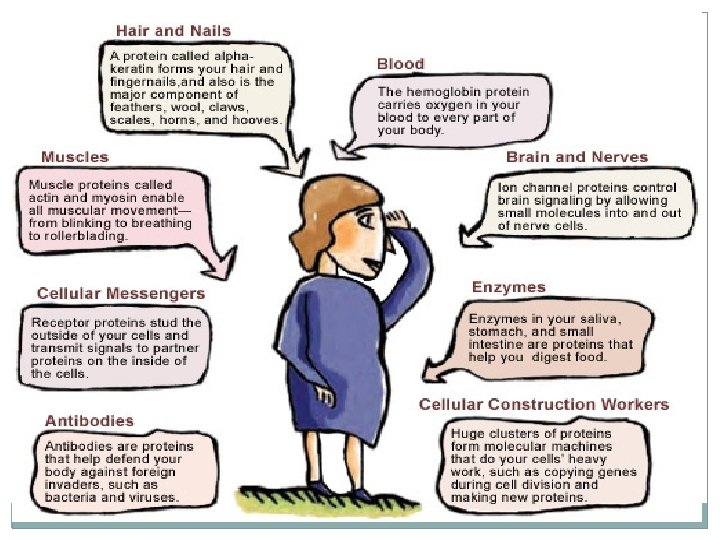
Proteins Molecular Structure � Carbon � Hydrogen � Oxygen � Nitrogen Made of amino acids � Peptide bonds hold two amino acids together Function � Structural: Serve as the building and connecting material of living things Collagen forms bones, ligaments, tendons etc. � Functional: Control the rate of chemical reactions and transport materials. Examples of Functional proteins: Hormones, antibodies , enzymes. Enzymes control the rate of chemical reaction. Enzymes speed up chemical reactions by decreasing the activation energy
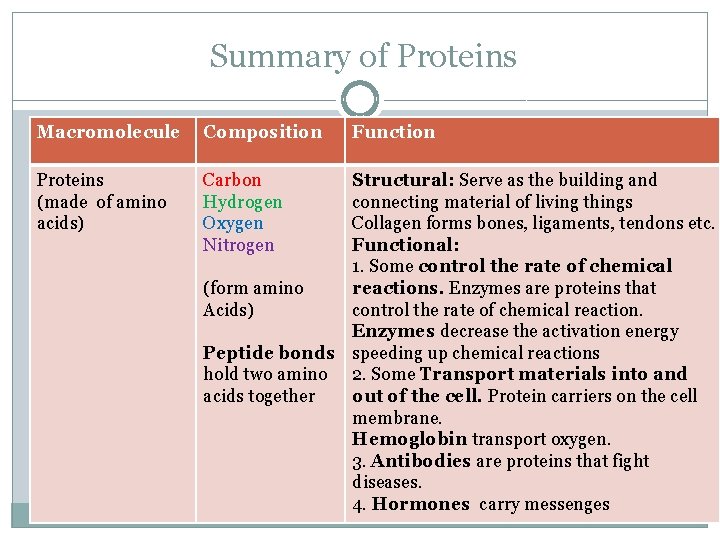
Summary of Proteins Macromolecule Composition Proteins (made of amino acids) Carbon Hydrogen Oxygen Nitrogen Function Structural: Serve as the building and connecting material of living things Collagen forms bones, ligaments, tendons etc. Functional: 1. Some control the rate of chemical (form amino reactions. Enzymes are proteins that Acids) control the rate of chemical reaction. Enzymes decrease the activation energy Peptide bonds speeding up chemical reactions hold two amino 2. Some Transport materials into and acids together out of the cell. Protein carriers on the cell membrane. Hemoglobin transport oxygen. 3. Antibodies are proteins that fight diseases. 4. Hormones carry messenges
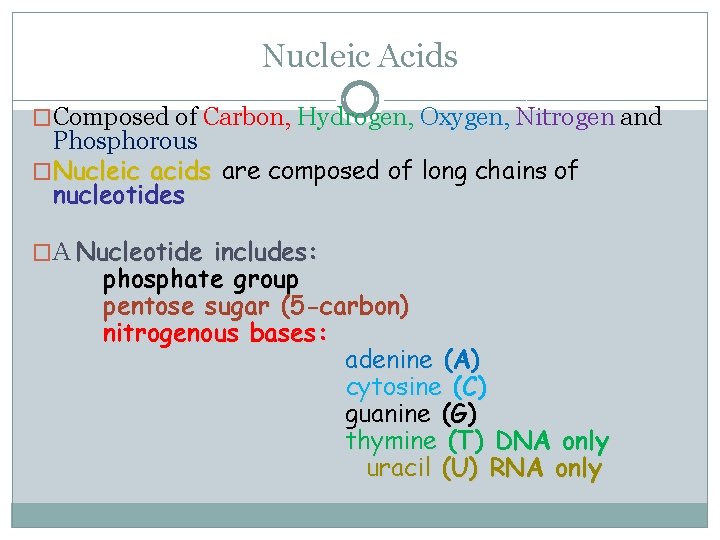
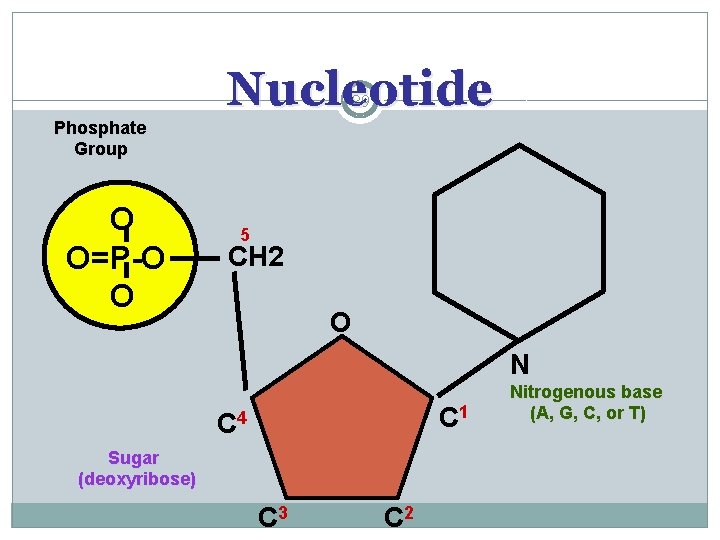
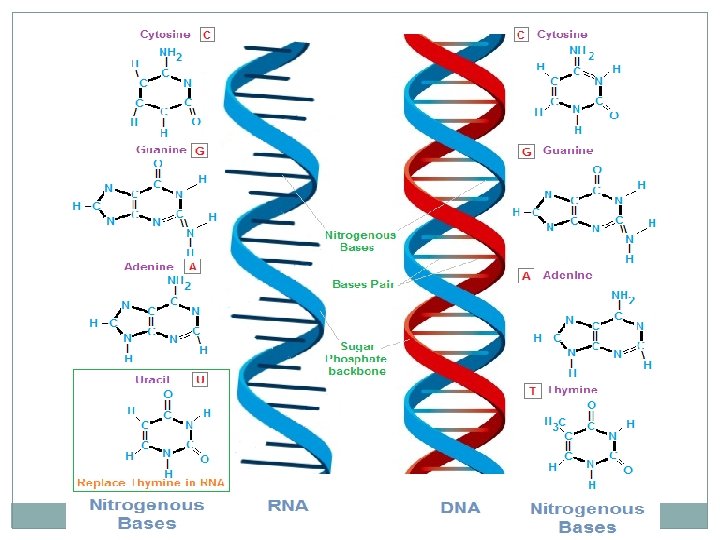
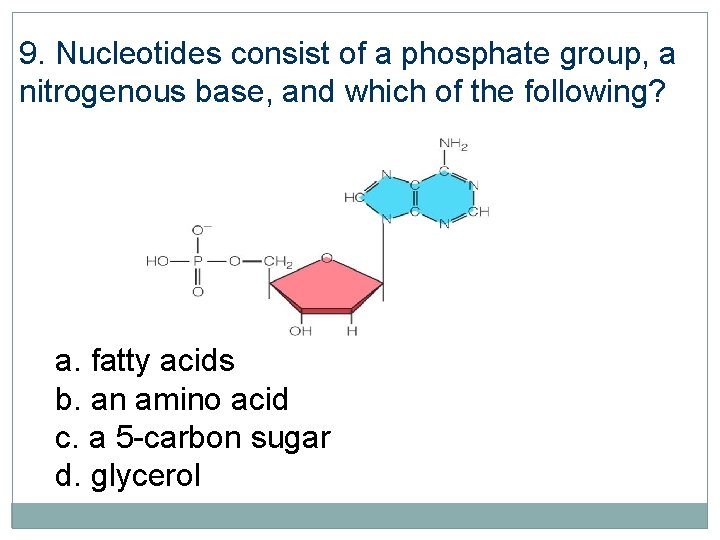
Nucleic Acids �Composed of Carbon, Hydrogen, Oxygen, Nitrogen and Phosphorous �Nucleic acids are composed of long chains of nucleotides �A Nucleotide includes: phosphate group pentose sugar (5 -carbon) nitrogenous bases: adenine (A) cytosine (C) guanine (G) thymine (T) DNA only uracil (U) RNA only
Nucleotide 29 Phosphate Group O O=P-O O 5 CH 2 O N C 1 C 4 Sugar (deoxyribose) C 3 C 2 Nitrogenous base (A, G, C, or T)
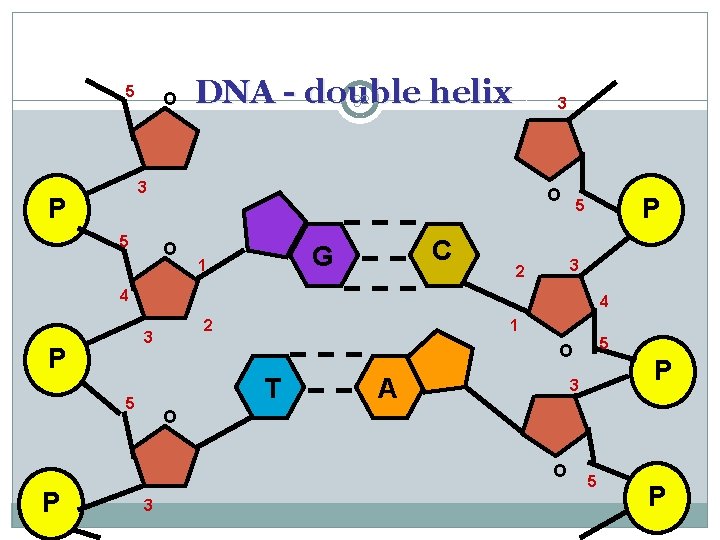
Nucleic acids 30 �Two types: a. Deoxyribonucleic acid (DNAdouble helix) b. Ribonucleic acid (RNA-single strand) �Nucleic acids are composed of long chains of nucleotides.
5 O DNA - double helix 32 3 3 P 5 O O C G 1 P 5 3 2 4 4 2 3 P 1 T 5 A P 3 O O P 5 O 3 5 P
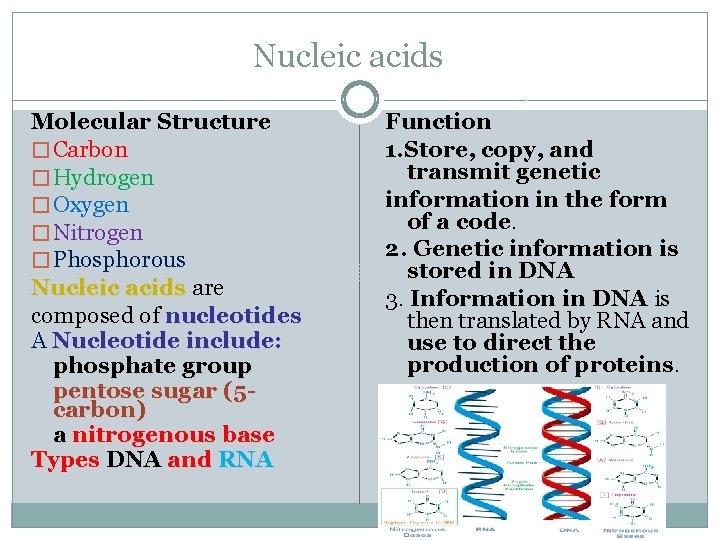
Nucleic acids Molecular Structure � Carbon � Hydrogen � Oxygen � Nitrogen � Phosphorous Nucleic acids are composed of nucleotides A Nucleotide include: phosphate group pentose sugar (5 carbon) a nitrogenous base Types DNA and RNA Function 1. Store, copy, and transmit genetic information in the form of a code. 2. Genetic information is stored in DNA 3. Information in DNA is then translated by RNA and use to direct the production of proteins.
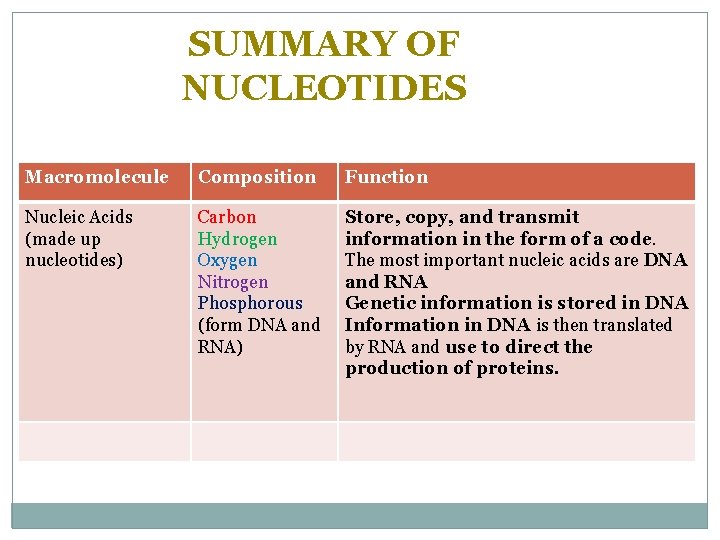
SUMMARY OF NUCLEOTIDES Macromolecule Composition Function Nucleic Acids (made up nucleotides) Carbon Hydrogen Oxygen Nitrogen Phosphorous (form DNA and RNA) Store, copy, and transmit information in the form of a code. The most important nucleic acids are DNA and RNA Genetic information is stored in DNA Information in DNA is then translated by RNA and use to direct the production of proteins.
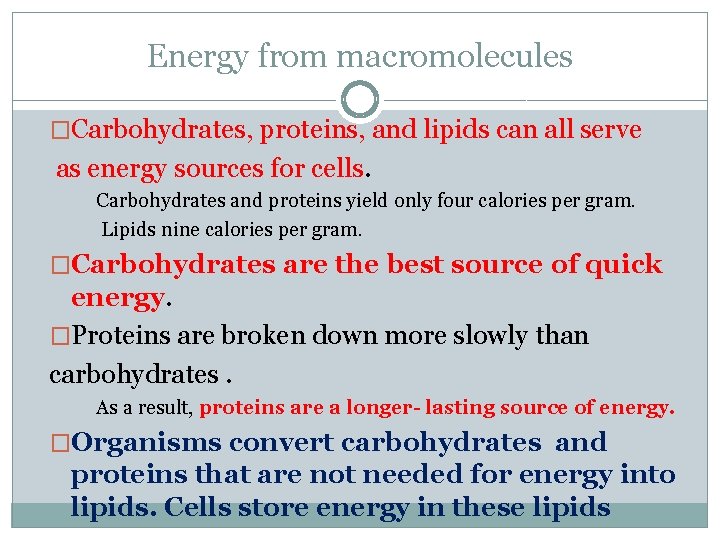
Energy from macromolecules �Carbohydrates, proteins, and lipids can all serve as energy sources for cells. Carbohydrates and proteins yield only four calories per gram. Lipids nine calories per gram. �Carbohydrates are the best source of quick energy. �Proteins are broken down more slowly than carbohydrates. As a result, proteins are a longer- lasting source of energy. �Organisms convert carbohydrates and proteins that are not needed for energy into lipids. Cells store energy in these lipids
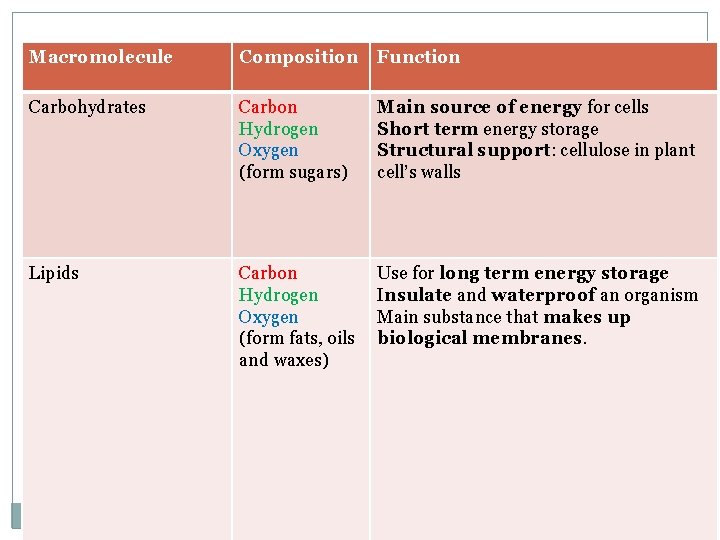
Macromolecule Composition Function Carbohydrates Carbon Hydrogen Oxygen (form sugars) Main source of energy for cells Short term energy storage Structural support: cellulose in plant cell’s walls Lipids Carbon Hydrogen Oxygen (form fats, oils and waxes) Use for long term energy storage Insulate and waterproof an organism Main substance that makes up biological membranes.
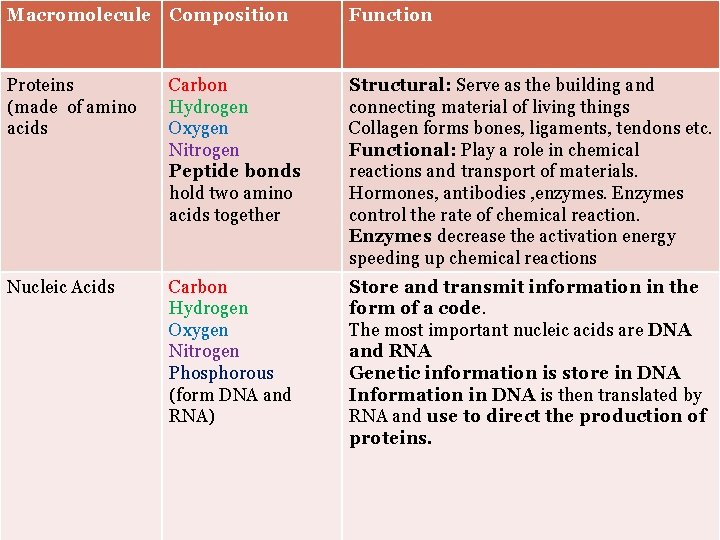
Macromolecule Composition Function Proteins (made of amino acids Carbon Hydrogen Oxygen Nitrogen Peptide bonds hold two amino acids together Structural: Serve as the building and connecting material of living things Collagen forms bones, ligaments, tendons etc. Functional: Play a role in chemical reactions and transport of materials. Hormones, antibodies , enzymes. Enzymes control the rate of chemical reaction. Enzymes decrease the activation energy speeding up chemical reactions Nucleic Acids Carbon Hydrogen Oxygen Nitrogen Phosphorous (form DNA and RNA) Store and transmit information in the form of a code. The most important nucleic acids are DNA and RNA Genetic information is store in DNA Information in DNA is then translated by RNA and use to direct the production of proteins.
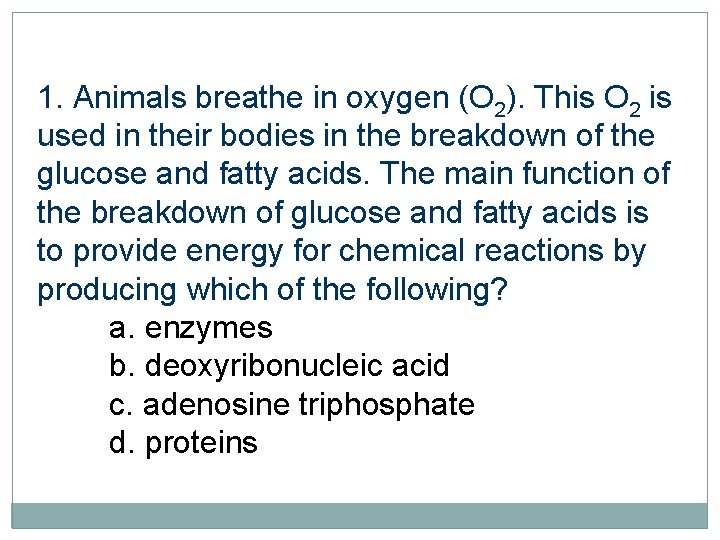
1. Animals breathe in oxygen (O 2). This O 2 is used in their bodies in the breakdown of the glucose and fatty acids. The main function of the breakdown of glucose and fatty acids is to provide energy for chemical reactions by producing which of the following? a. enzymes b. deoxyribonucleic acid c. adenosine triphosphate d. proteins
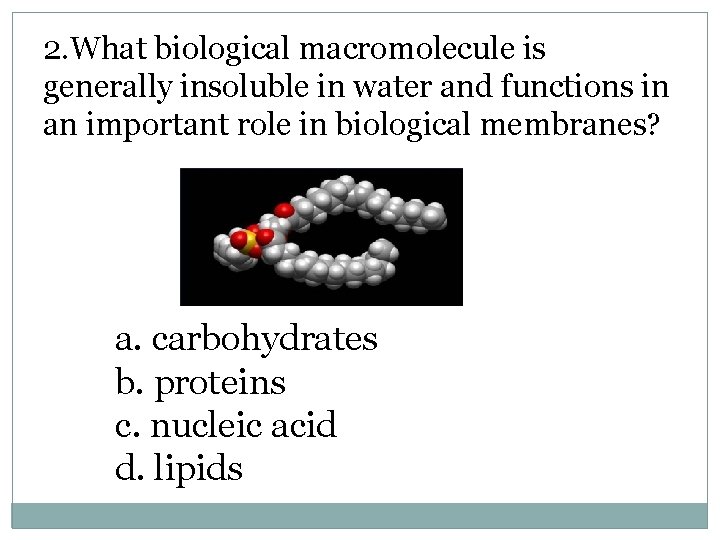
2. What biological macromolecule is generally insoluble in water and functions in an important role in biological membranes? a. carbohydrates b. proteins c. nucleic acid d. lipids
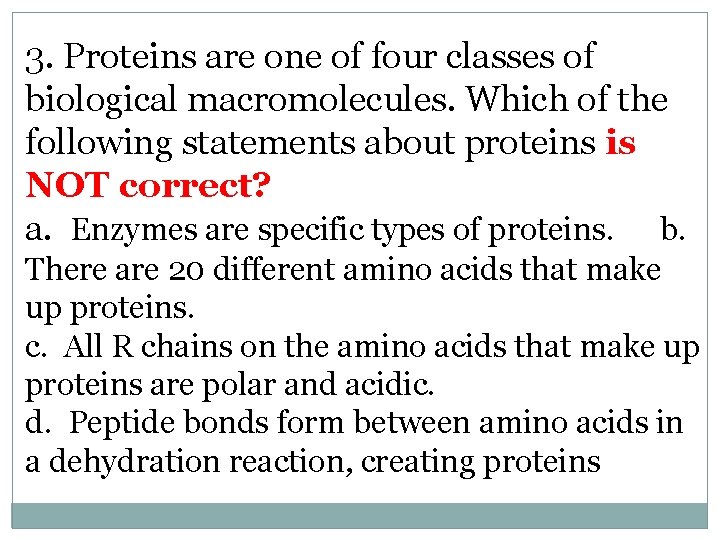
3. Proteins are one of four classes of biological macromolecules. Which of the following statements about proteins is NOT correct? a. Enzymes are specific types of proteins. b. There are 20 different amino acids that make up proteins. c. All R chains on the amino acids that make up proteins are polar and acidic. d. Peptide bonds form between amino acids in a dehydration reaction, creating proteins
4. Both lipids & carbohydrates are important in the cell because both a. b. c. d. provide insulation. store energy. contain nitrogen. contain cell walls
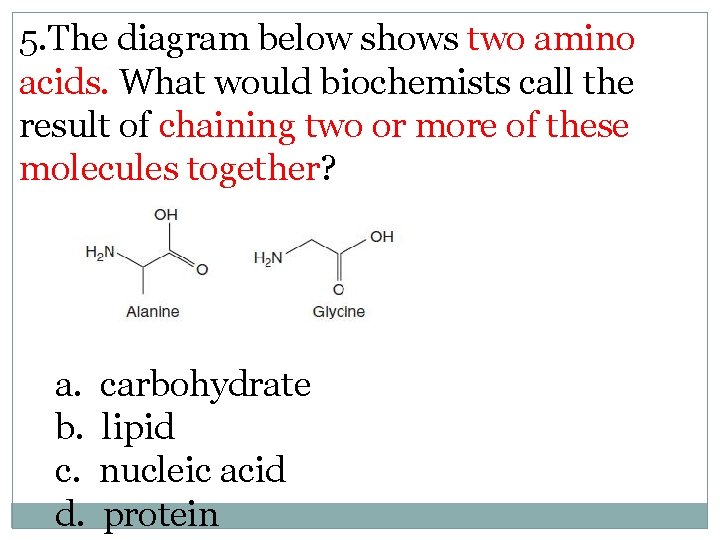
5. The diagram below shows two amino acids. What would biochemists call the result of chaining two or more of these molecules together? a. b. c. d. carbohydrate lipid nucleic acid protein
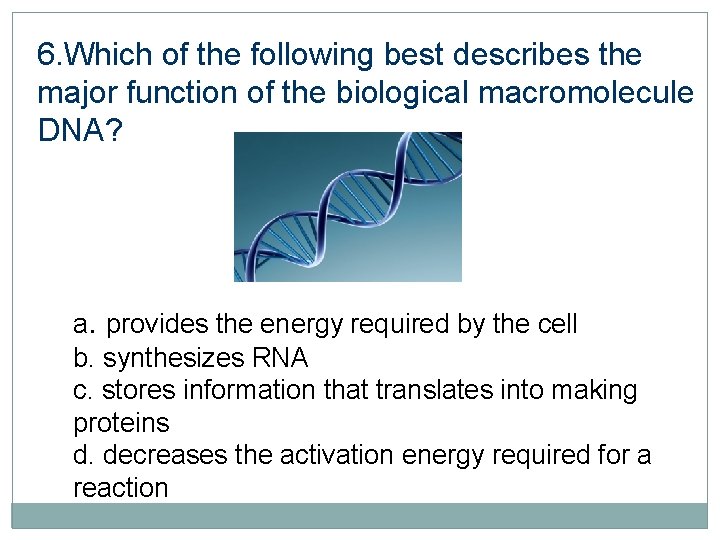
6. Which of the following best describes the major function of the biological macromolecule DNA? a. provides the energy required by the cell b. synthesizes RNA c. stores information that translates into making proteins d. decreases the activation energy required for a reaction
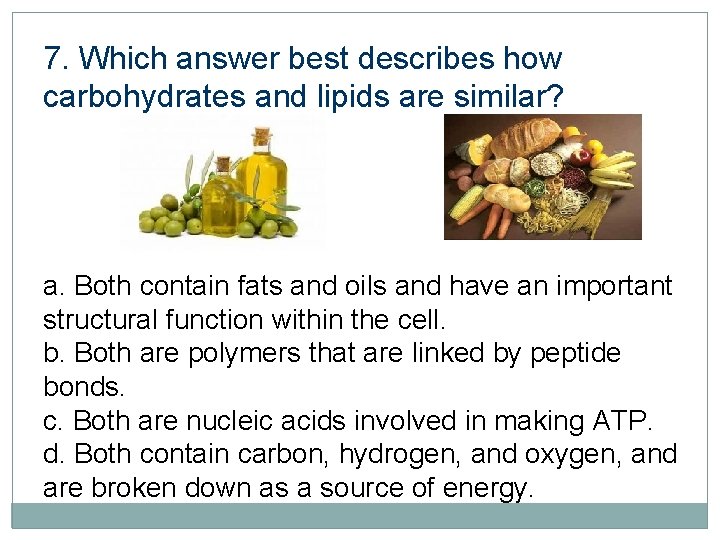
7. Which answer best describes how carbohydrates and lipids are similar? a. Both contain fats and oils and have an important structural function within the cell. b. Both are polymers that are linked by peptide bonds. c. Both are nucleic acids involved in making ATP. d. Both contain carbon, hydrogen, and oxygen, and are broken down as a source of energy.
8. Which biological molecule transports substances, speeds up reactions, makes hormones, and provides structural support? a. carbohydrates b. proteins c. deoxyribonucleic acid d. adenosine triphosphate
9. Nucleotides consist of a phosphate group, a nitrogenous base, and which of the following? a. fatty acids b. an amino acid c. a 5 -carbon sugar d. glycerol