
Structure and Function of DNA Replication and Protein







- Slides: 23
Structure and Function of DNA Replication and Protein Synthesis
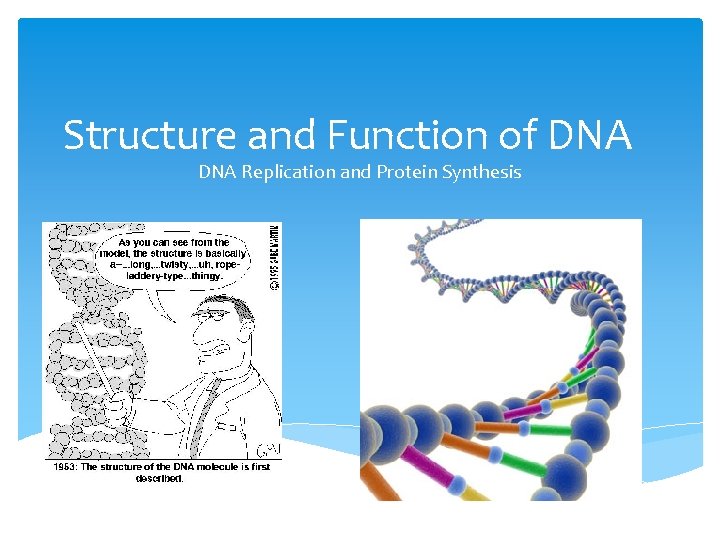
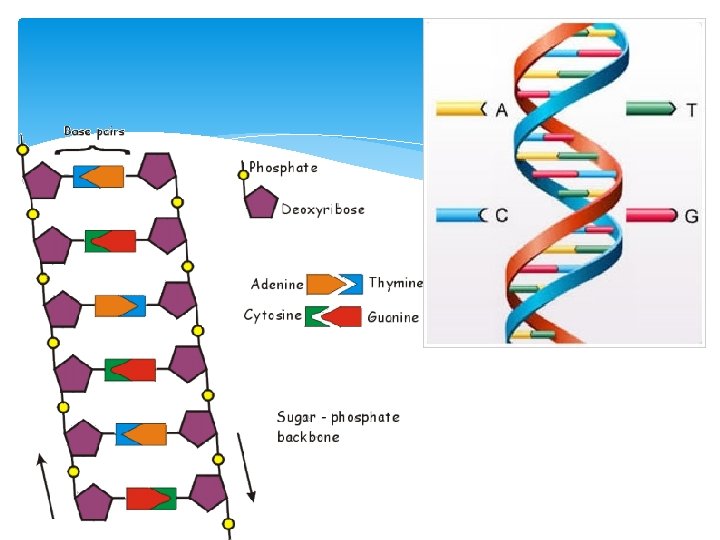
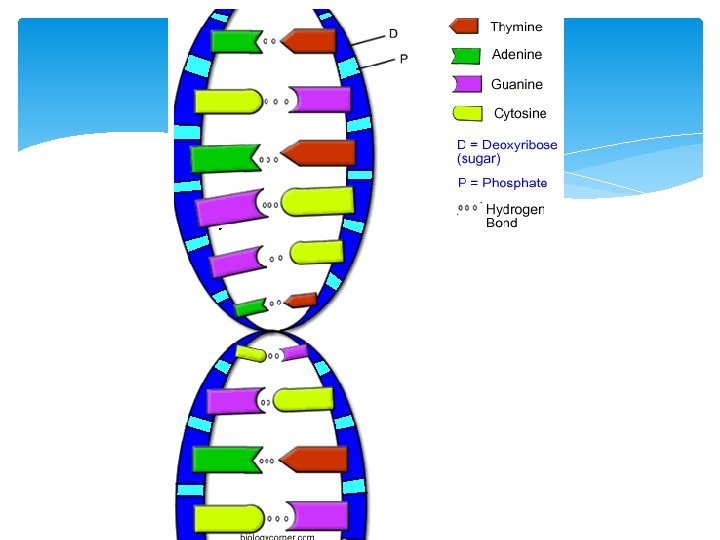
DNA Structure Double Helix in Shape- two stands wound around one another. Composed of subunits called nucleotides Parts of a Nucleotide 5 Carbon Sugar- Deoxyribose Phosphate Group Nitrogen Base (4 Flavors) Adenine, guanine, cytosine, and thymine (A, T, C, G)
Nucleotides of a DNA Molecule
Watson and Crick Credited with Double Helix Model Spiral staircase or twisted ladder Maurice Williams and Rosalind Franklin worked with them also.
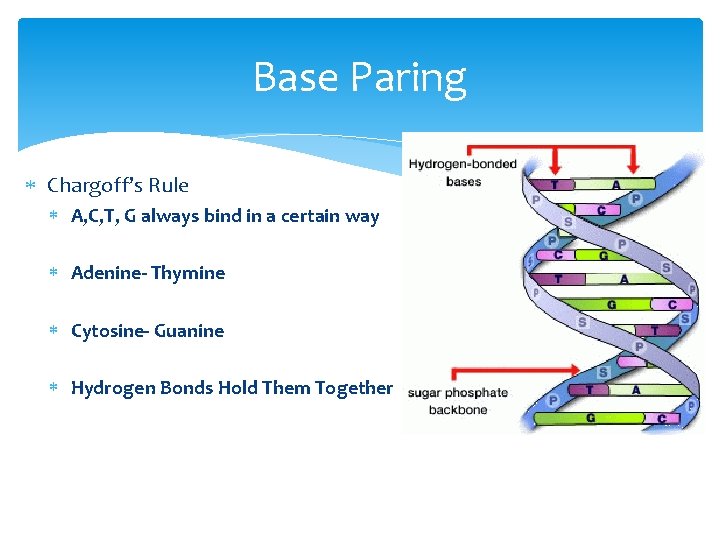
Base Paring Chargoff’s Rule A, C, T, G always bind in a certain way Adenine- Thymine Cytosine- Guanine Hydrogen Bonds Hold Them Together
Function of DNA stores all of the genetic information for the cell. If it located in the nucleus but can also be found in the mitochondria and the chloroplast. Serves as the blueprint for making proteins.
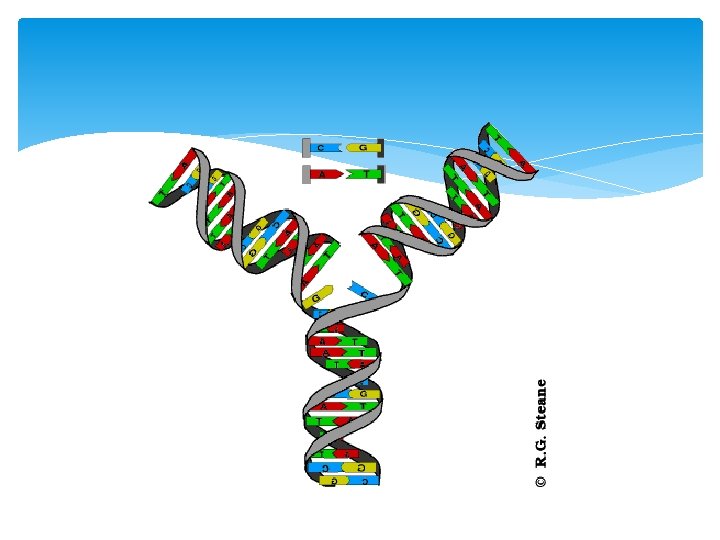
DNA Replication Copying DNA to make an exact copy (in nucleus) DNA strand unwinds and separates Enzymes help new DNA chains form by using nucleotides floating around the nucleus. Produces two new exact copies of the original DNA strand. Occurs during S phase if interphase Remember A-T and C-G !!!
Replication Practice 1. CTC GGG ATA CTG GGG CGT 2. ATG GCG CGT CAT TAC 3. GTG CGT CAT CCC AAA TTT 4. TAC CAT ATC GTA CGT GTA 5. AAT TTA TAT CTC GTG CCC
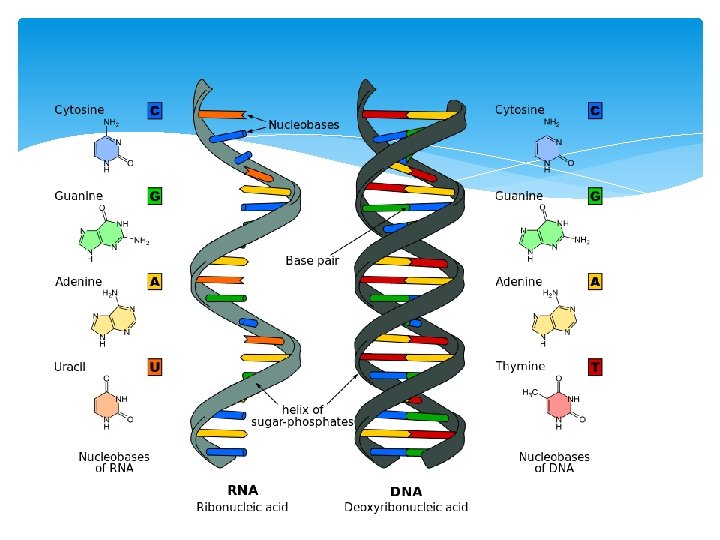
Part II: RNA Ribonucleic Acid Structure of RNA Made of nucleotides Sugar-Ribose Uracil Replaces Thymine and Pairs with Adenine Single Strand not double Smaller than DNA
Types of RNA m. RNA- messenger RNA Carries RNA info from nucleus to cytoplasm t. RNA- transfer RNA Picks up amino acids r. RNA- ribosomal RNA Makes up the ribosomes where proteins are made.
DNA VS. RNA
Transcription DNA RNA Occurs in the nucleus When the cell needs a protein is transcribes a certain part of DNA into RNA is then the directions to make the proteins.
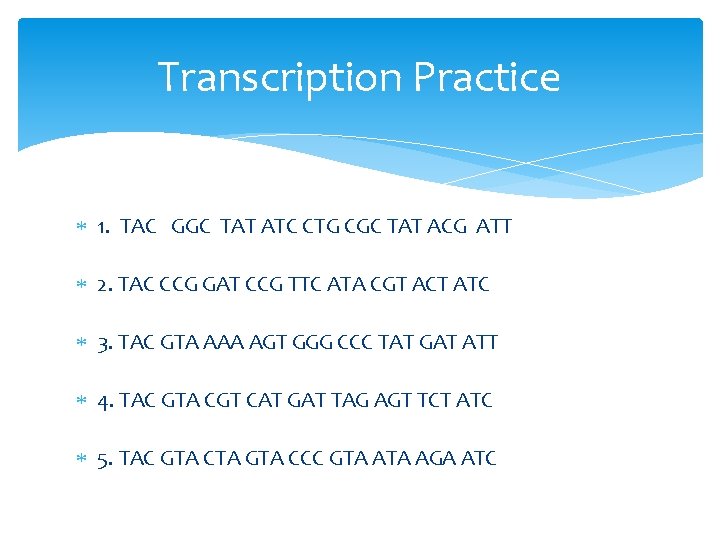
Transcription Practice 1. TAC GGC TAT ATC CTG CGC TAT ACG ATT 2. TAC CCG GAT CCG TTC ATA CGT ACT ATC 3. TAC GTA AAA AGT GGG CCC TAT GAT ATT 4. TAC GTA CGT CAT GAT TAG AGT TCT ATC 5. TAC GTA CTA GTA CCC GTA AGA ATC
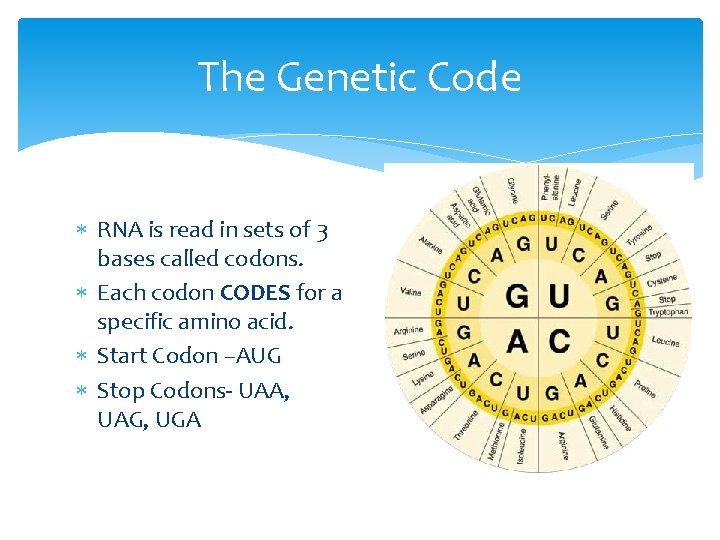
The Genetic Code RNA is read in sets of 3 bases called codons. Each codon CODES for a specific amino acid. Start Codon –AUG Stop Codons- UAA, UAG, UGA
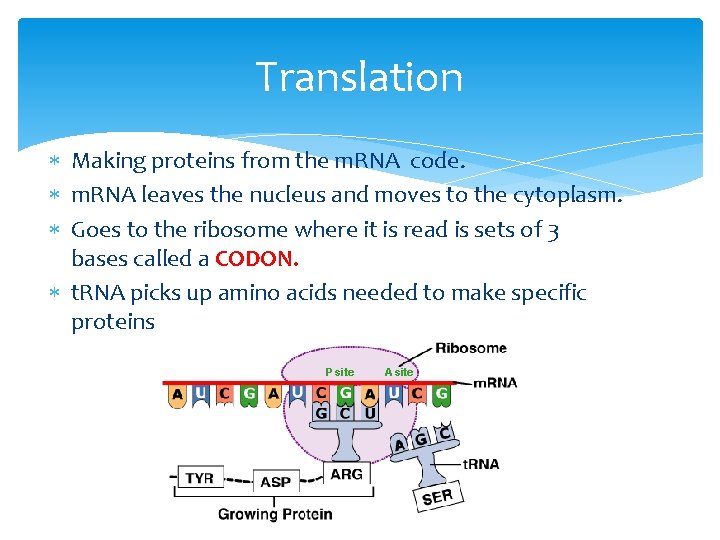
Translation Making proteins from the m. RNA code. m. RNA leaves the nucleus and moves to the cytoplasm. Goes to the ribosome where it is read is sets of 3 bases called a CODON. t. RNA picks up amino acids needed to make specific proteins
Protein Synthesis Structure of Proteins Polymers made of amino acids bonded by peptide bonds. Specific sequence of amino acids makes each protein. There are 20 different amino acids used to make proteins.
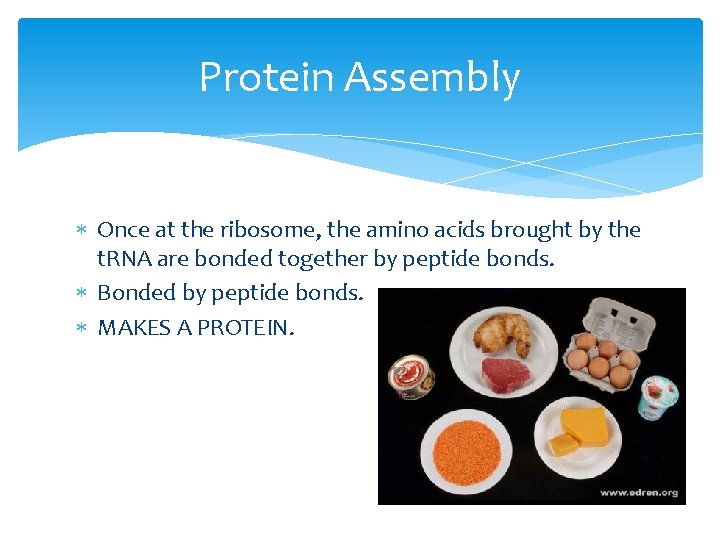
Protein Assembly Once at the ribosome, the amino acids brought by the t. RNA are bonded together by peptide bonds. Bonded by peptide bonds. MAKES A PROTEIN.
SUMMARY PROCESS REPLICATION TRANSCRIPTION TRANSLATION MOLECULES LOCATION
Translation Practice Transcribe and Translate the following sequences. 1. DNA- TAC GGT ACT TAG AGA TTT AAA ATT RNA AA 2. DNA- TAC GTG GGG TTT ACT TCA CAT TTC GAG RNA AA