
Structuralist approaches Lessons 2 and 3 A model
- Slides: 18
Structuralist approaches Lessons 2 and 3
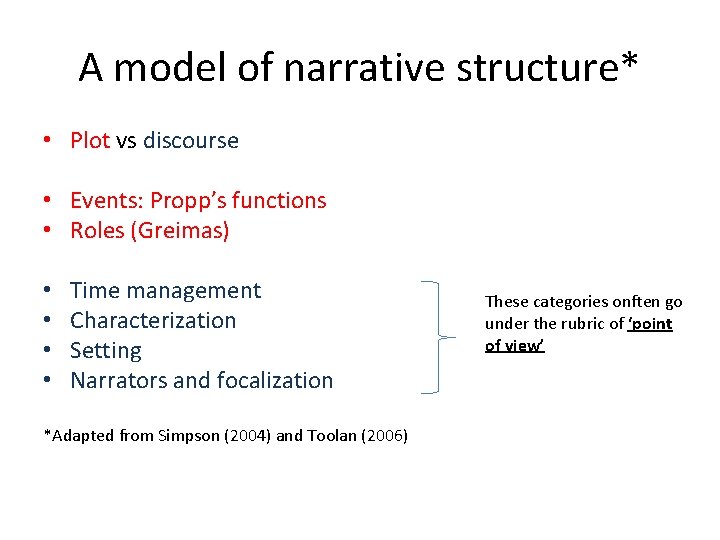
A model of narrative structure* • Plot vs discourse • Events: Propp’s functions • Roles (Greimas) • • Time management Characterization Setting Narrators and focalization *Adapted from Simpson (2004) and Toolan (2006) These categories onften go under the rubric of ‘point of view’
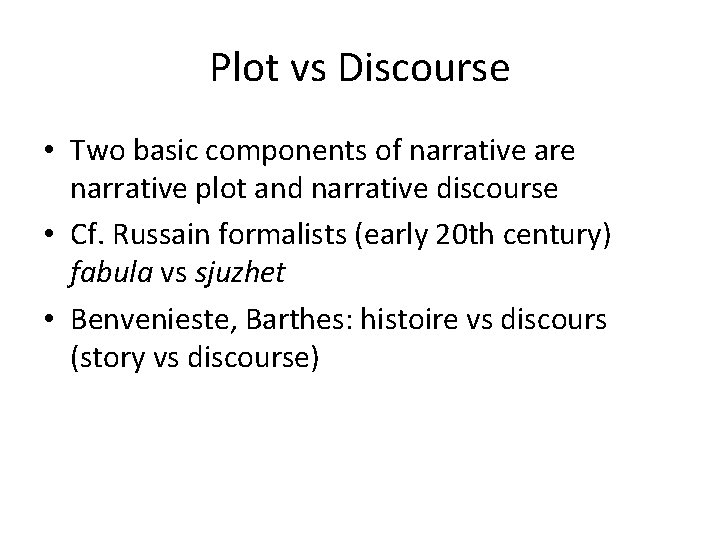
Plot vs Discourse • Two basic components of narrative are narrative plot and narrative discourse • Cf. Russain formalists (early 20 th century) fabula vs sjuzhet • Benvenieste, Barthes: histoire vs discours (story vs discourse)
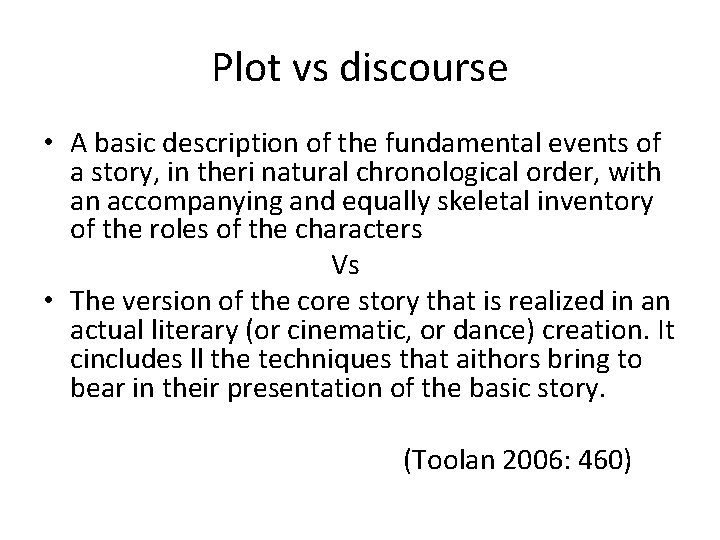
Plot vs discourse • A basic description of the fundamental events of a story, in theri natural chronological order, with an accompanying and equally skeletal inventory of the roles of the characters Vs • The version of the core story that is realized in an actual literary (or cinematic, or dance) creation. It cincludes ll the techniques that aithors bring to bear in their presentation of the basic story. (Toolan 2006: 460)
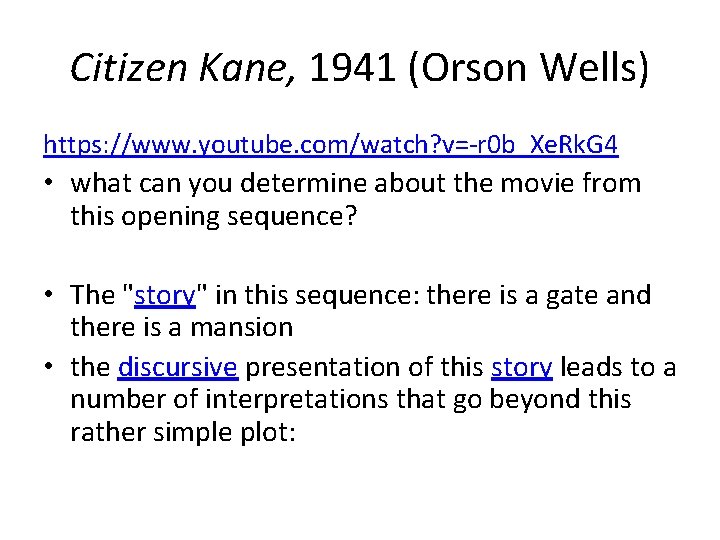
Citizen Kane, 1941 (Orson Wells) https: //www. youtube. com/watch? v=-r 0 b_Xe. Rk. G 4 • what can you determine about the movie from this opening sequence? • The "story" in this sequence: there is a gate and there is a mansion • the discursive presentation of this story leads to a number of interpretations that go beyond this rather simple plot:
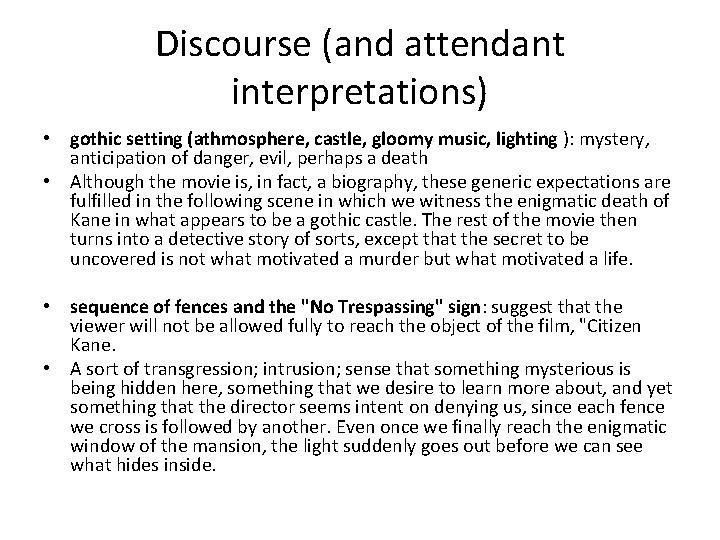
Discourse (and attendant interpretations) • gothic setting (athmosphere, castle, gloomy music, lighting ): mystery, anticipation of danger, evil, perhaps a death • Although the movie is, in fact, a biography, these generic expectations are fulfilled in the following scene in which we witness the enigmatic death of Kane in what appears to be a gothic castle. The rest of the movie then turns into a detective story of sorts, except that the secret to be uncovered is not what motivated a murder but what motivated a life. • sequence of fences and the "No Trespassing" sign: suggest that the viewer will not be allowed fully to reach the object of the film, "Citizen Kane. • A sort of transgression; intrusion; sense that something mysterious is being hidden here, something that we desire to learn more about, and yet something that the director seems intent on denying us, since each fence we cross is followed by another. Even once we finally reach the enigmatic window of the mansion, the light suddenly goes out before we can see what hides inside.
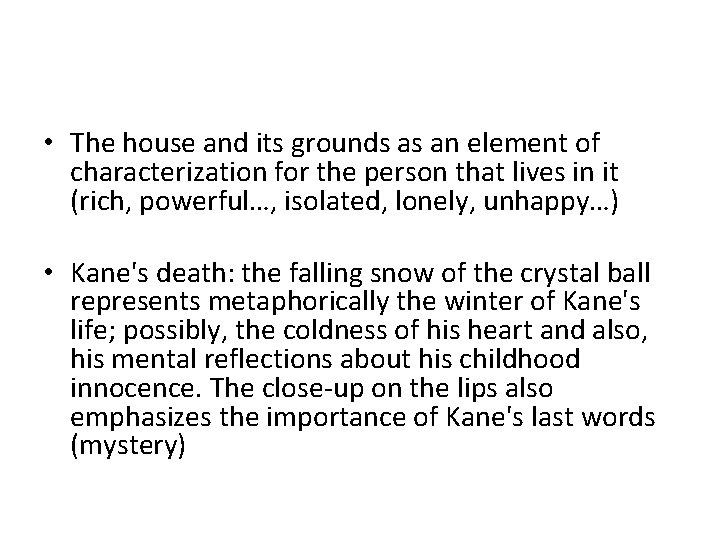
• The house and its grounds as an element of characterization for the person that lives in it (rich, powerful…, isolated, lonely, unhappy…) • Kane's death: the falling snow of the crystal ball represents metaphorically the winter of Kane's life; possibly, the coldness of his heart and also, his mental reflections about his childhood innocence. The close-up on the lips also emphasizes the importance of Kane's last words (mystery)
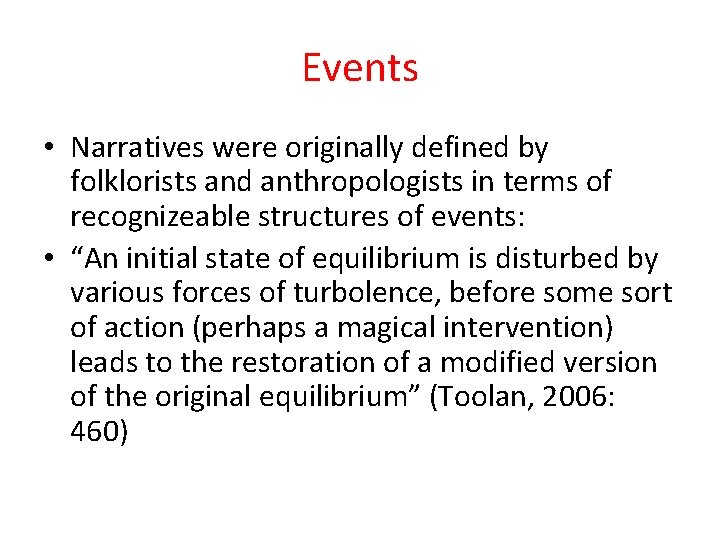
Events • Narratives were originally defined by folklorists and anthropologists in terms of recognizeable structures of events: • “An initial state of equilibrium is disturbed by various forces of turbolence, before some sort of action (perhaps a magical intervention) leads to the restoration of a modified version of the original equilibrium” (Toolan, 2006: 460)
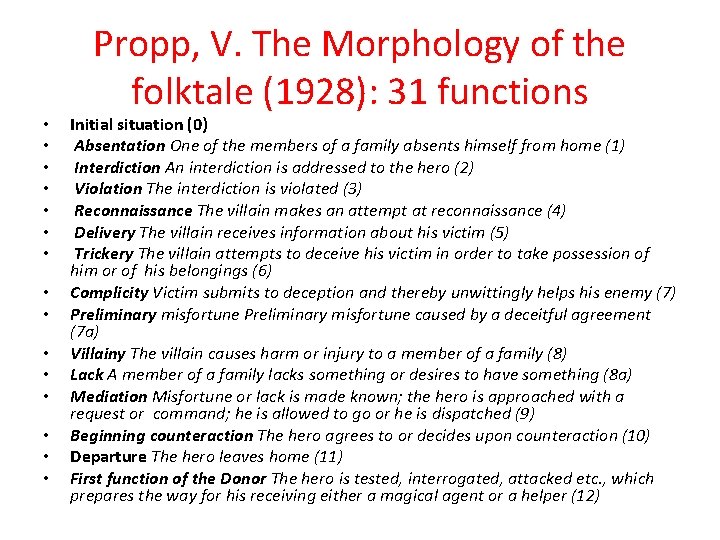
• • • • Propp, V. The Morphology of the folktale (1928): 31 functions Initial situation (0) Absentation One of the members of a family absents himself from home (1) Interdiction An interdiction is addressed to the hero (2) Violation The interdiction is violated (3) Reconnaissance The villain makes an attempt at reconnaissance (4) Delivery The villain receives information about his victim (5) Trickery The villain attempts to deceive his victim in order to take possession of him or of his belongings (6) Complicity Victim submits to deception and thereby unwittingly helps his enemy (7) Preliminary misfortune caused by a deceitful agreement (7 a) Villainy The villain causes harm or injury to a member of a family (8) Lack A member of a family lacks something or desires to have something (8 a) Mediation Misfortune or lack is made known; the hero is approached with a request or command; he is allowed to go or he is dispatched (9) Beginning counteraction The hero agrees to or decides upon counteraction (10) Departure The hero leaves home (11) First function of the Donor The hero is tested, interrogated, attacked etc. , which prepares the way for his receiving either a magical agent or a helper (12)
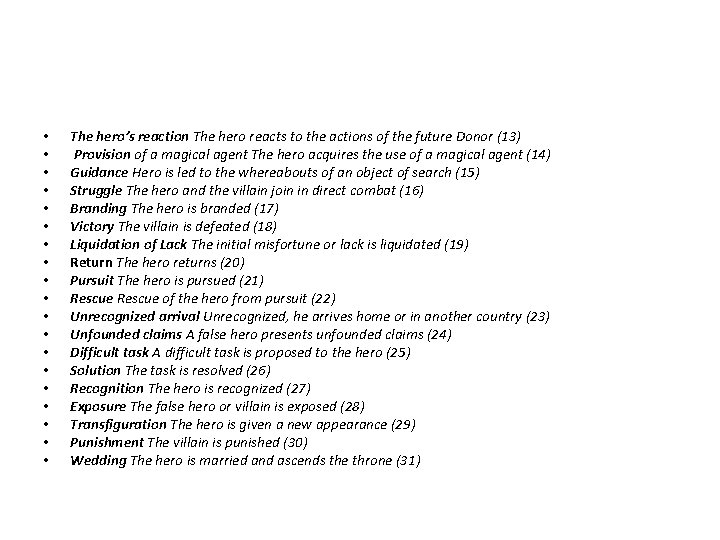
• • • • • The hero’s reaction The hero reacts to the actions of the future Donor (13) Provision of a magical agent The hero acquires the use of a magical agent (14) Guidance Hero is led to the whereabouts of an object of search (15) Struggle The hero and the villain join in direct combat (16) Branding The hero is branded (17) Victory The villain is defeated (18) Liquidation of Lack The initial misfortune or lack is liquidated (19) Return The hero returns (20) Pursuit The hero is pursued (21) Rescue of the hero from pursuit (22) Unrecognized arrival Unrecognized, he arrives home or in another country (23) Unfounded claims A false hero presents unfounded claims (24) Difficult task A difficult task is proposed to the hero (25) Solution The task is resolved (26) Recognition The hero is recognized (27) Exposure The false hero or villain is exposed (28) Transfiguration The hero is given a new appearance (29) Punishment The villain is punished (30) Wedding The hero is married and ascends the throne (31)
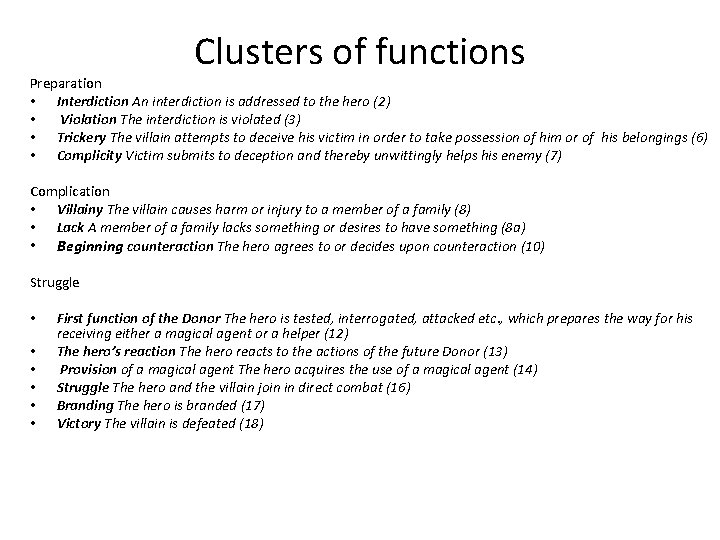
Clusters of functions Preparation • Interdiction An interdiction is addressed to the hero (2) • Violation The interdiction is violated (3) • Trickery The villain attempts to deceive his victim in order to take possession of him or of his belongings (6) • Complicity Victim submits to deception and thereby unwittingly helps his enemy (7) Complication • Villainy The villain causes harm or injury to a member of a family (8) • Lack A member of a family lacks something or desires to have something (8 a) • Beginning counteraction The hero agrees to or decides upon counteraction (10) Struggle • • • First function of the Donor The hero is tested, interrogated, attacked etc. , which prepares the way for his receiving either a magical agent or a helper (12) The hero’s reaction The hero reacts to the actions of the future Donor (13) Provision of a magical agent The hero acquires the use of a magical agent (14) Struggle The hero and the villain join in direct combat (16) Branding The hero is branded (17) Victory The villain is defeated (18)
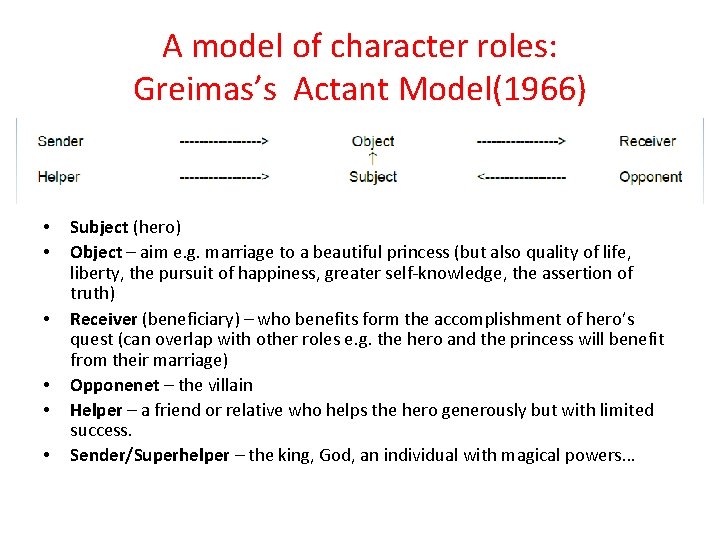
A model of character roles: Greimas’s Actant Model(1966) • • • Subject (hero) Object – aim e. g. marriage to a beautiful princess (but also quality of life, liberty, the pursuit of happiness, greater self-knowledge, the assertion of truth) Receiver (beneficiary) – who benefits form the accomplishment of hero’s quest (can overlap with other roles e. g. the hero and the princess will benefit from their marriage) Opponenet – the villain Helper – a friend or relative who helps the hero generously but with limited success. Sender/Superhelper – the king, God, an individual with magical powers…
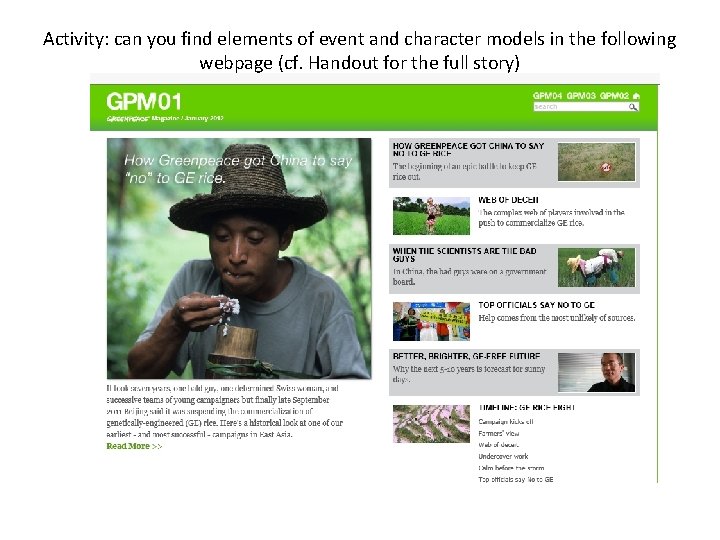
Activity: can you find elements of event and character models in the following webpage (cf. Handout for the full story)
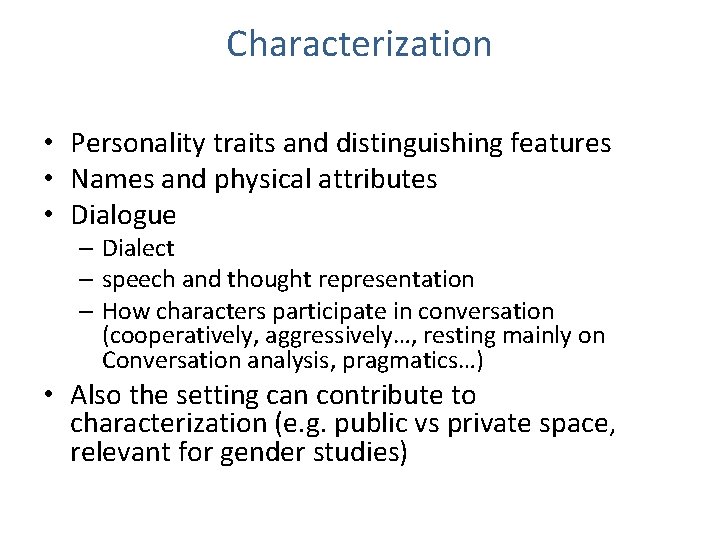
Characterization • Personality traits and distinguishing features • Names and physical attributes • Dialogue – Dialect – speech and thought representation – How characters participate in conversation (cooperatively, aggressively…, resting mainly on Conversation analysis, pragmatics…) • Also the setting can contribute to characterization (e. g. public vs private space, relevant for gender studies)
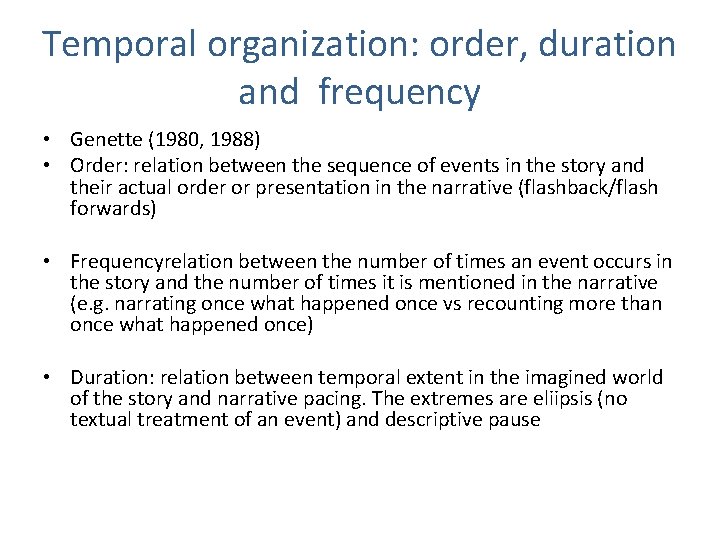
Temporal organization: order, duration and frequency • Genette (1980, 1988) • Order: relation between the sequence of events in the story and their actual order or presentation in the narrative (flashback/flash forwards) • Frequencyrelation between the number of times an event occurs in the story and the number of times it is mentioned in the narrative (e. g. narrating once what happened once vs recounting more than once what happened once) • Duration: relation between temporal extent in the imagined world of the story and narrative pacing. The extremes are eliipsis (no textual treatment of an event) and descriptive pause
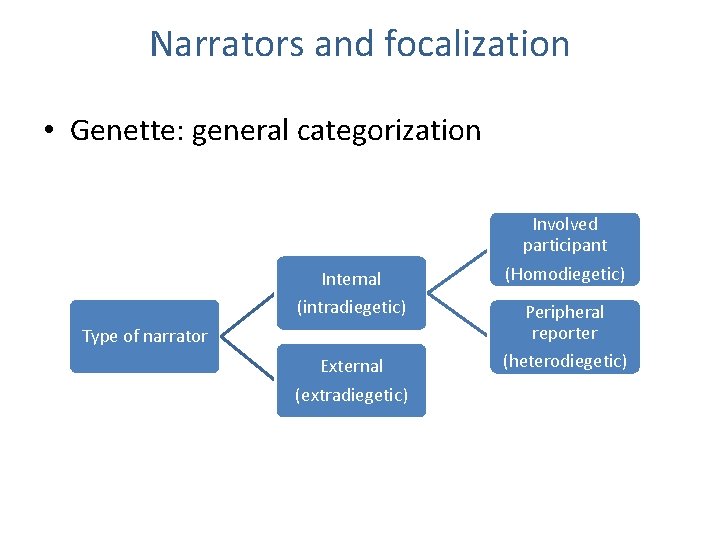
Narrators and focalization • Genette: general categorization Involved participant Internal (intradiegetic) (Homodiegetic) External (extradiegetic) (heterodiegetic) Type of narrator Peripheral reporter
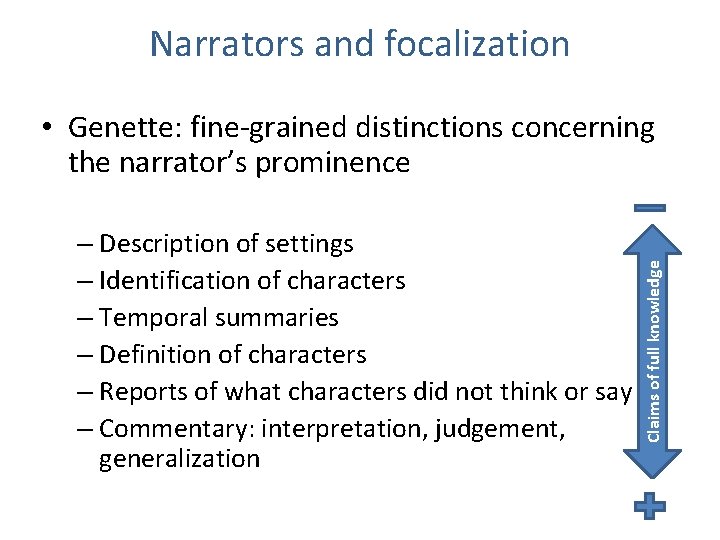
Narrators and focalization – Description of settings – Identification of characters – Temporal summaries – Definition of characters – Reports of what characters did not think or say – Commentary: interpretation, judgement, generalization Claims of full knowledge • Genette: fine-grained distinctions concerning the narrator’s prominence
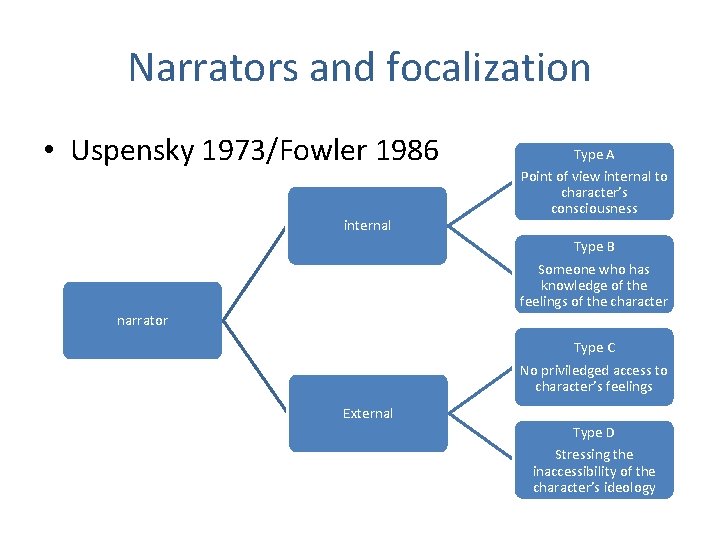
Narrators and focalization • Uspensky 1973/Fowler 1986 internal Type A Point of view internal to character’s consciousness Type B Someone who has knowledge of the feelings of the character narrator Type C No priviledged access to character’s feelings External Type D Stressing the inaccessibility of the character’s ideology