
Structuralism Semiotics 2014 S Literary Research Methodology Outline

![Form vs. Structcure Form and Content are inseparable Structure produces meanings (e. g. [b]](https://slidetodoc.com/presentation_image_h2/b370442e25cd4cce8662163cfddbd41b/image-51.jpg "Form vs. Structcure Form and Content are inseparable Structure produces meanings (e. g. [b]")
- Slides: 79
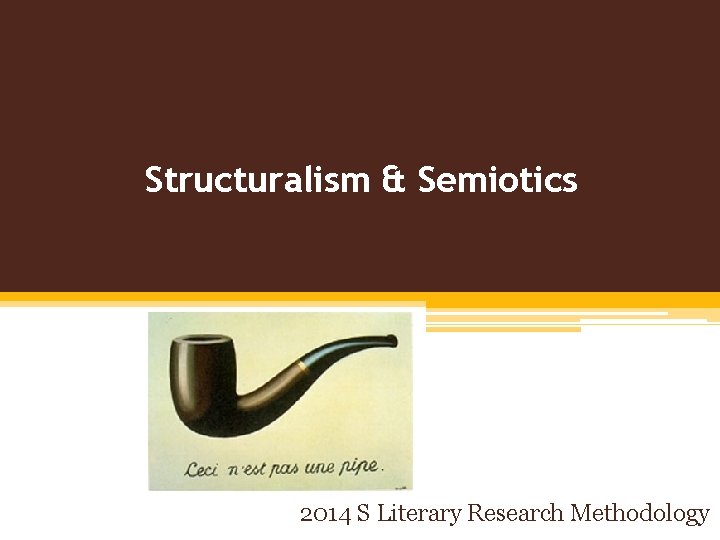
Structuralism & Semiotics 2014 S Literary Research Methodology
Outline • Prelude: From Formalism/New Criticism to Structuralism (Basics pp. 35 -; Beginning chap 1) • Structuralism: General Introduction • Founding Theories: De Saussure, • Theorist (1) V. Propp • Semiotics: Theorist (1) Roman Jacobson; (2) Roland Barthes • Examples • Discussion: Differences from New Criticism? Strengths and Weaknesses?
Prelude: From Formalism/New Criticism to Structuralism
Russian Formalism • Russia 1910 s ~ 1930 s • Main Points: ▫ studying literature as science, ▫ Analyzing its distinctness or literariness, ▫ e. g. poetic language = ordinary language “defamiliarized” (Basics 34) ▫ Examples of defamiliarization and familiarization? ▫ Is there any “essential” feature of poetry?
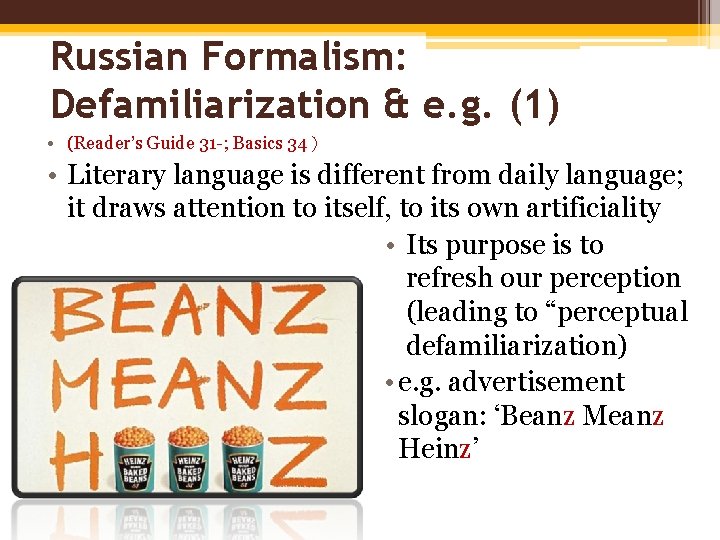
Russian Formalism: Defamiliarization & e. g. (1) • (Reader’s Guide 31 -; Basics 34) • Literary language is different from daily language; it draws attention to itself, to its own artificiality • Its purpose is to refresh our perception (leading to “perceptual defamiliarization) • e. g. advertisement slogan: ‘Beanz Meanz Heinz’ 。
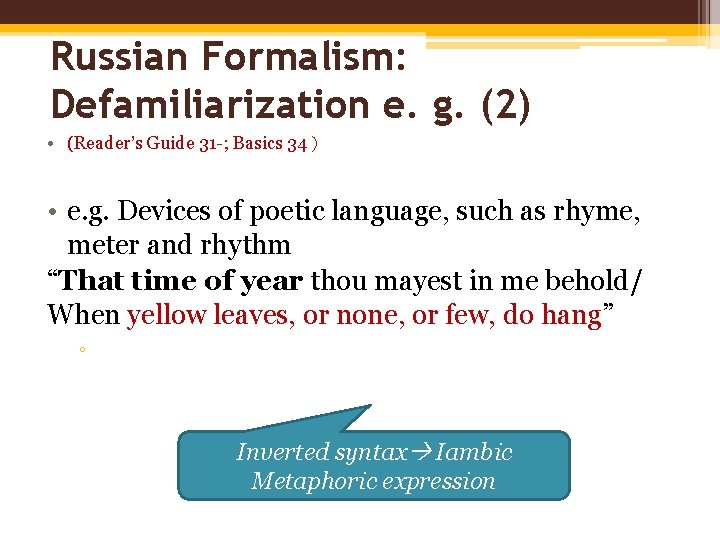
Russian Formalism: Defamiliarization e. g. (2) • (Reader’s Guide 31 -; Basics 34) • e. g. Devices of poetic language, such as rhyme, meter and rhythm “That time of year thou mayest in me behold/ When yellow leaves, or none, or few, do hang” 。 Inverted syntax Iambic Metaphoric expression
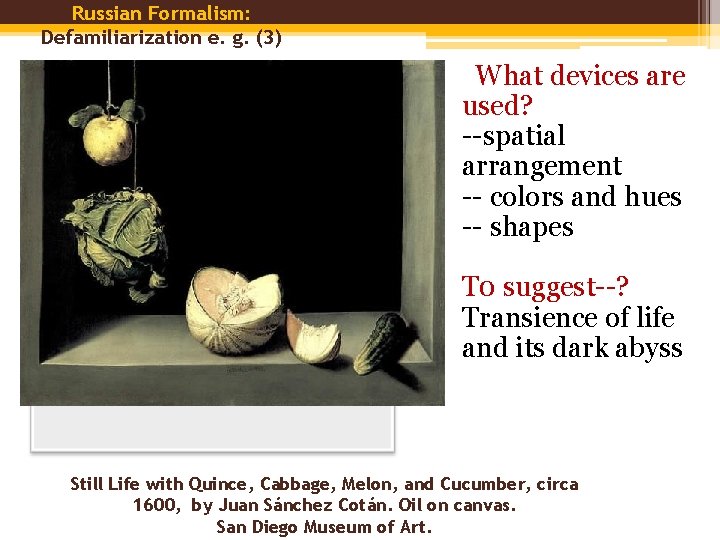
Russian Formalism: Defamiliarization e. g. (3) What devices are used? --spatial arrangement -- colors and hues -- shapes T 0 suggest--? Transience of life and its dark abyss Still Life with Quince, Cabbage, Melon, and Cucumber, circa 1600, by Juan Sánchez Cotán. Oil on canvas. San Diego Museum of Art.
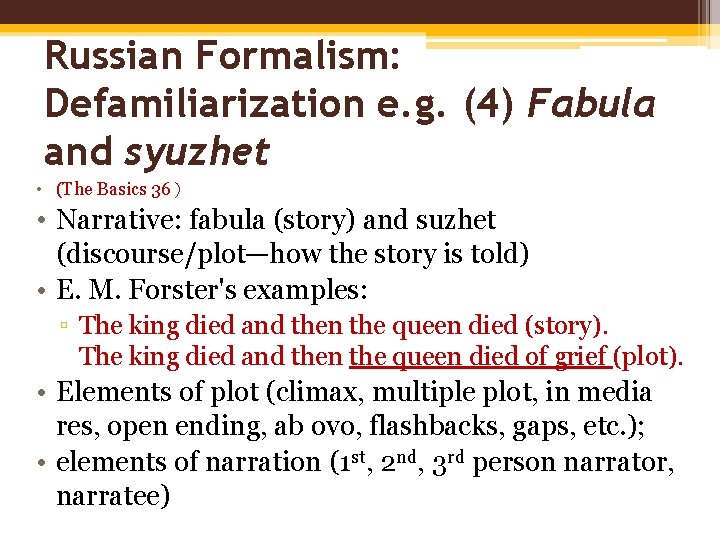
Russian Formalism: Defamiliarization e. g. (4) Fabula and syuzhet • (The Basics 36) • Narrative: fabula (story) and suzhet (discourse/plot—how the story is told) • E. M. Forster's examples: ▫ The king died and then the queen died (story). The king died and then the queen died of grief (plot). • Elements of plot (climax, multiple plot, in media res, open ending, ab ovo, flashbacks, gaps, etc. ); • elements of narration (1 st, 2 nd, 3 rd person narrator, narratee)
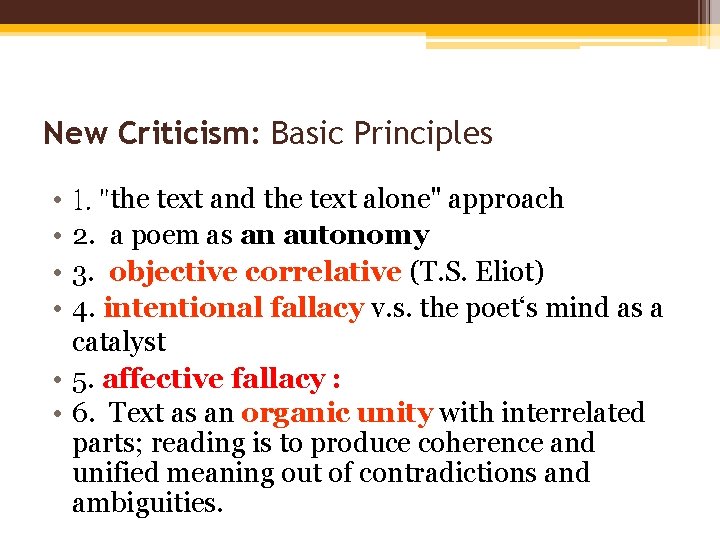
New Criticism: Basic Principles • • 1. "the text and the text alone" approach 2. a poem as an autonomy 3. objective correlative (T. S. Eliot) 4. intentional fallacy v. s. the poet‘s mind as a catalyst • 5. affective fallacy : • 6. Text as an organic unity with interrelated parts; reading is to produce coherence and unified meaning out of contradictions and ambiguities.
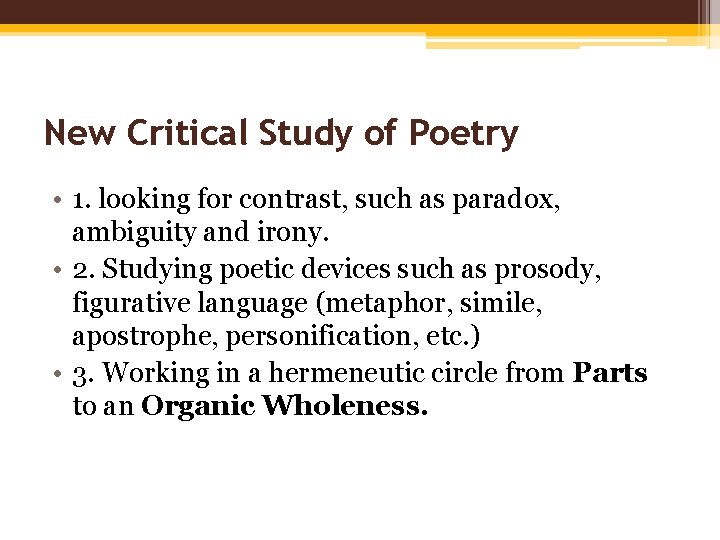
New Critical Study of Poetry • 1. looking for contrast, such as paradox, ambiguity and irony. • 2. Studying poetic devices such as prosody, figurative language (metaphor, simile, apostrophe, personification, etc. ) • 3. Working in a hermeneutic circle from Parts to an Organic Wholeness.
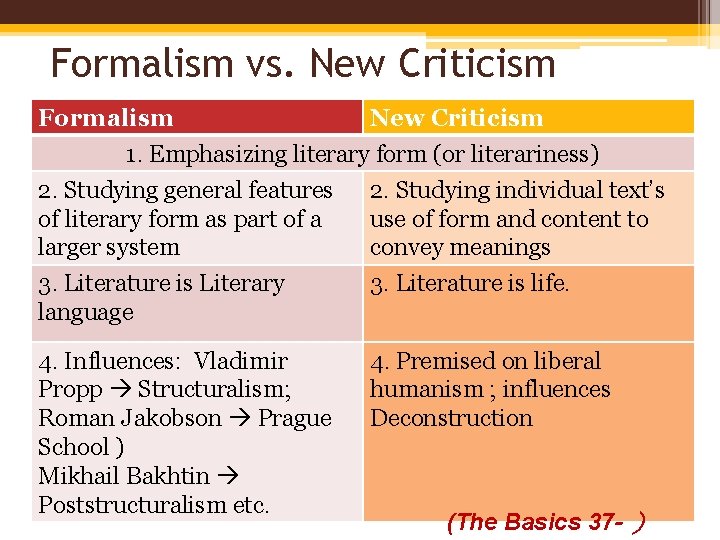
Formalism vs. New Criticism Formalism New Criticism 1. Emphasizing literary form (or literariness) 2. Studying general features of literary form as part of a larger system 2. Studying individual text’s use of form and content to convey meanings 3. Literature is Literary language 3. Literature is life. 4. Influences: Vladimir Propp Structuralism; Roman Jakobson Prague School ) Mikhail Bakhtin Poststructuralism etc. 4. Premised on liberal humanism ; influences Deconstruction (The Basics 37 - )
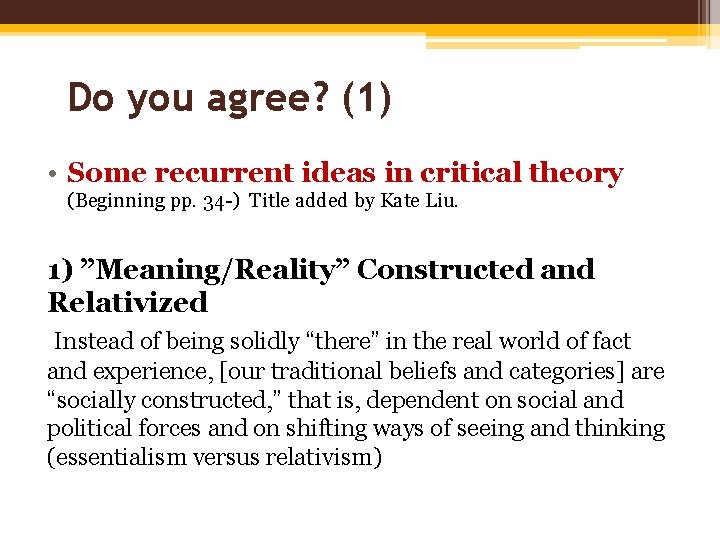
Do you agree? (1) • Some recurrent ideas in critical theory (Beginning pp. 34 -) Title added by Kate Liu. 1) ”Meaning/Reality” Constructed and Relativized Instead of being solidly “there” in the real world of fact and experience, [our traditional beliefs and categories] are “socially constructed, ” that is, dependent on social and political forces and on shifting ways of seeing and thinking (essentialism versus relativism)
Do you know why? (2) • --”ideological mooring” The notion of disinterested enquiry is untenable and often fraudulent. • --”Language Speaks us. ” a belief that language itself conditions, limits, and predetermines what we see. All reality is constructed through language, so that nothing is simply “there” in an unproblematical way— everything is a linguistic/textual construct.
Do you know why? (3) • -- “meaning as a process of signification”: meaning is jointly created by writers, editors/publishers, and readers and that all meanings are contextual, that there can never be one definitive (fixed and reliable) reading/interpretation of a text. • --Logo and canon de-centralized ” …challenging notion that there is a stable category of great or classic books…, or the notion that there is a human nature that transcends all experience and all situations and transcends all of the particularities of race, gender, and class. Such concepts of human nature have tended to be Eurocentric androcentric.
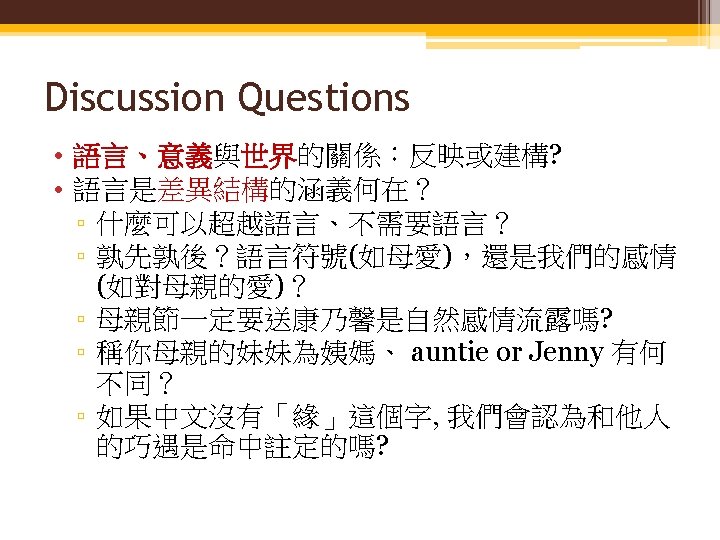
Does language reflect, reveal or construct/produce reality? Structuralism: Introduction 1. Structuralism--Basic Concepts 2. Structuralist Reading of Narratives 3. Semiotics and "The Myth Today"
--Realistic, Language as a transparent container or mirror (post)structuralist Language as signs
Structuralism: Introduction 1. How does language produce meanings? 2. Structuralist Approach (1): basic pattern and binary opposition ¬ How is structure different from form? How is New Criticism
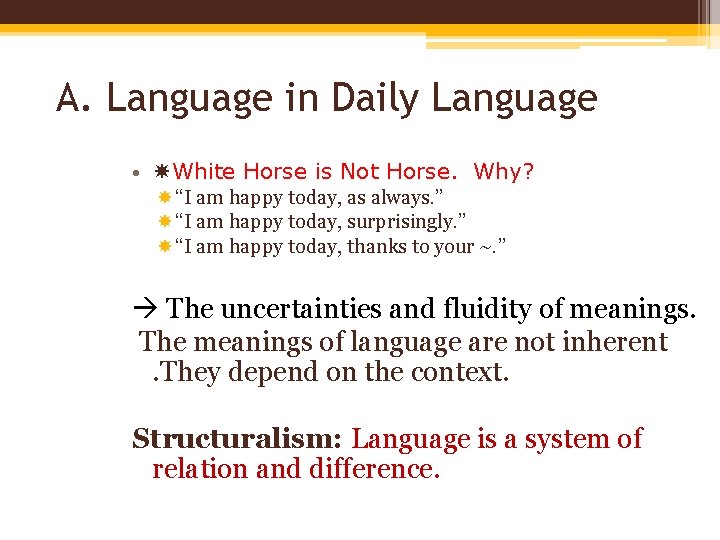
A. Language in Daily Language • White Horse is Not Horse. Why? “I am happy today, as always. ” “I am happy today, surprisingly. ” “I am happy today, thanks to your ~. ” The uncertainties and fluidity of meanings. The meanings of language are not inherent. They depend on the context. Structuralism: Language is a system of relation and difference.
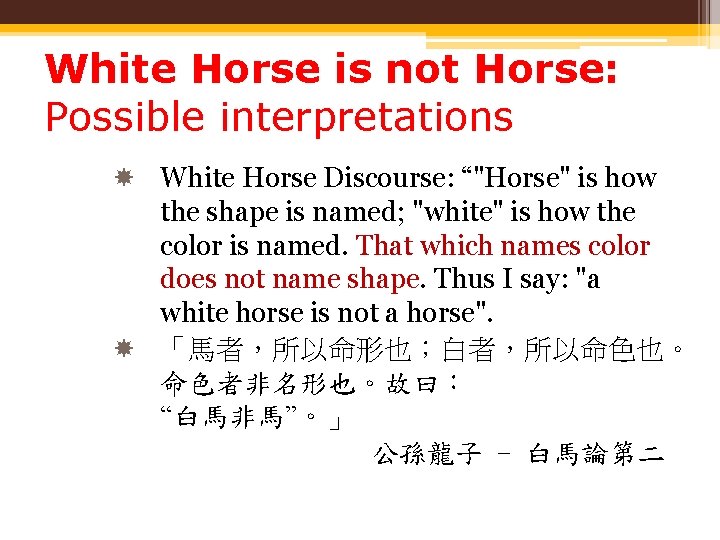
White Horse is not Horse: Possible interpretations White Horse Discourse: “"Horse" is how the shape is named; "white" is how the color is named. That which names color does not name shape. Thus I say: "a white horse is not a horse". 「馬者,所以命形也;白者,所以命色也。 命色者非名形也。故曰: “白馬非馬”。」 公孫龍子 - 白馬論第二
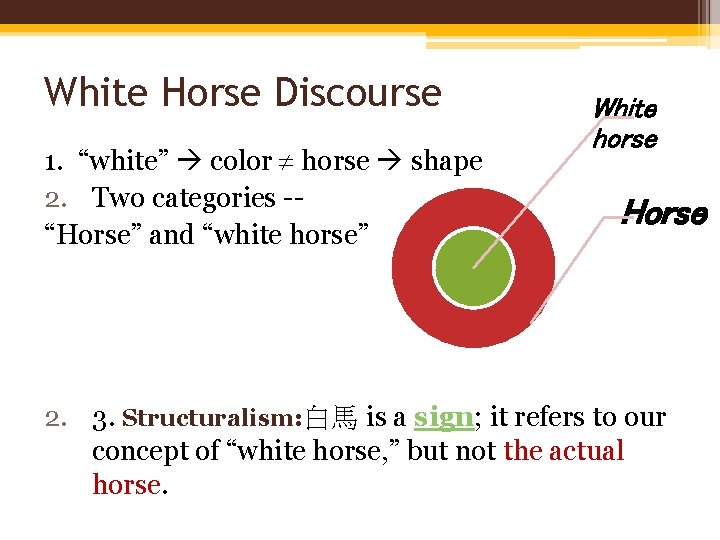
White Horse Discourse 1. “white” color horse shape 2. Two categories -“Horse” and “white horse” White horse Horse 2. 3. Structuralism: 白馬 is a sign; it refers to our concept of “white horse, ” but not the actual horse.
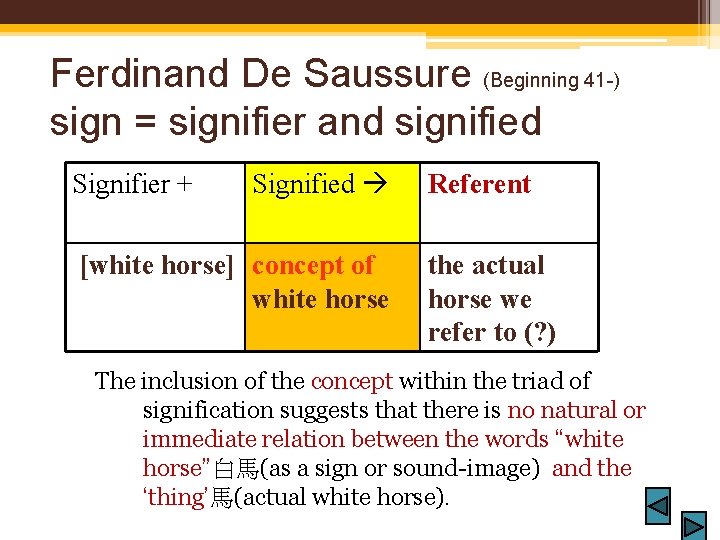
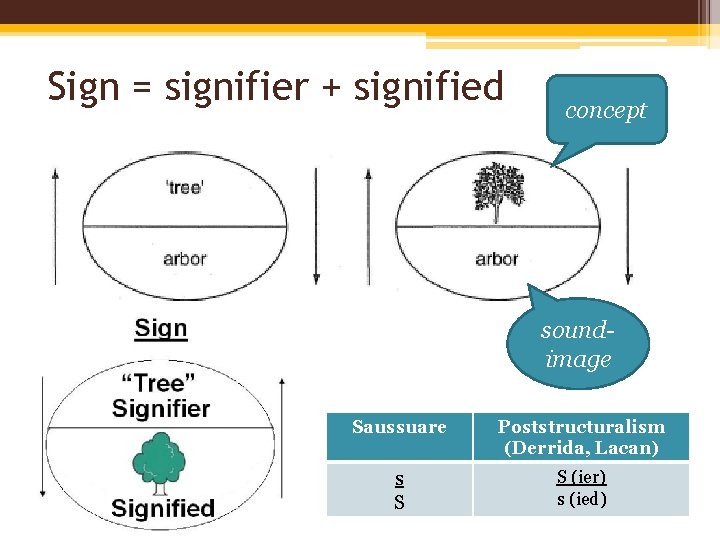
Ferdinand De Saussure (Beginning 41 -) sign = signifier and signified Signifier + Signified [white horse] concept of white horse Referent the actual horse we refer to (? ) The inclusion of the concept within the triad of signification suggests that there is no natural or immediate relation between the words “white horse”白馬(as a sign or sound-image) and the ‘thing’馬(actual white horse).
Sign = signifier + signified concept • soundimage Saussuare Poststructuralism (Derrida, Lacan) s S S (ier) s (ied)
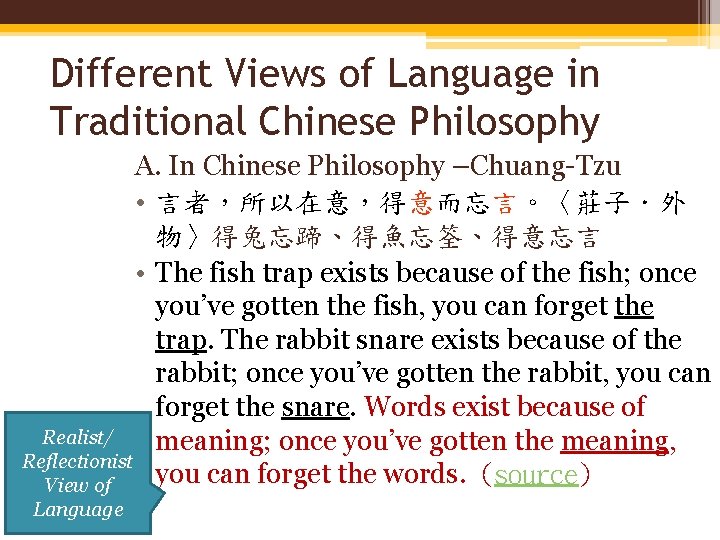
Different Views of Language in Traditional Chinese Philosophy A. In Chinese Philosophy –Chuang-Tzu • 言者,所以在意,得意而忘言。〈莊子.外 物〉得兔忘蹄、得魚忘筌、得意忘言 • The fish trap exists because of the fish; once you’ve gotten the fish, you can forget the trap. The rabbit snare exists because of the rabbit; once you’ve gotten the rabbit, you can forget the snare. Words exist because of Realist/ meaning; once you’ve gotten the meaning, Reflectionist you can forget the words. (source) View of Language
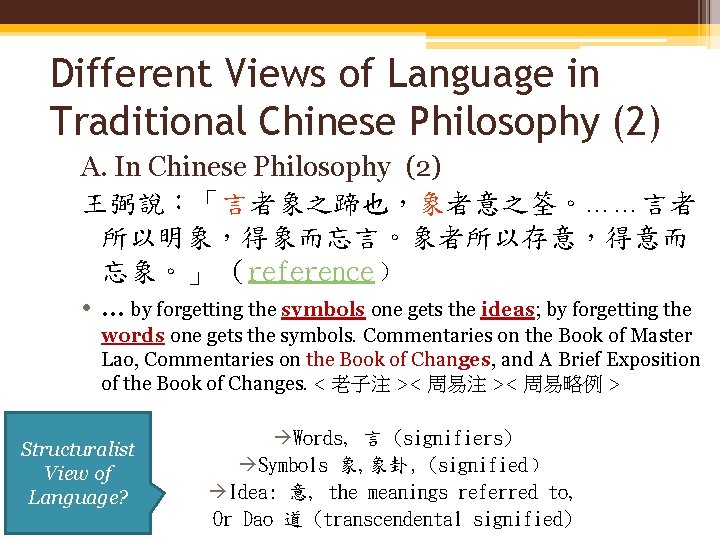
Different Views of Language in Traditional Chinese Philosophy (2) A. In Chinese Philosophy (2) 王弼說:「言者象之蹄也,象者意之筌。……言者 所以明象,得象而忘言。象者所以存意,得意而 忘象。」 (reference﹚ • … by forgetting the symbols one gets the ideas; by forgetting the words one gets the symbols. Commentaries on the Book of Master Lao, Commentaries on the Book of Changes, and A Brief Exposition of the Book of Changes. < 老子注 >< 周易略例 > Structuralist View of Language? Words, 言 (signifiers) Symbols 象, 象卦﹐(signified﹚ Idea: 意, the meanings referred to, Or Dao 道 (transcendental signified)
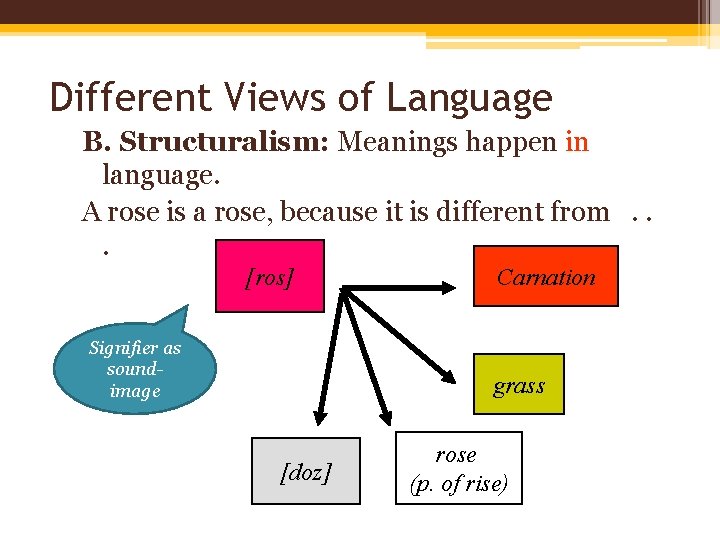
Different Views of Language B. Structuralism: Meanings happen in language. A rose is a rose, because it is different from. . . [ros] Signifier as soundimage Carnation grass [doz] rose (p. of rise)
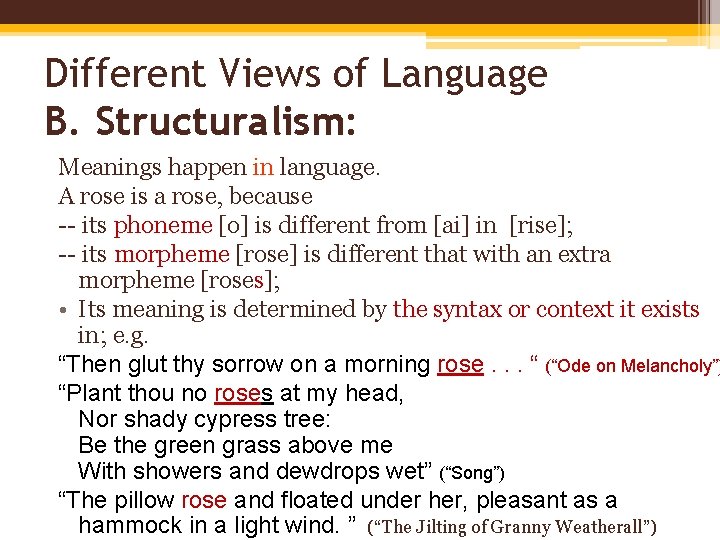
Different Views of Language B. Structuralism: Meanings happen in language. A rose is a rose, because -- its phoneme [o] is different from [ai] in [rise]; -- its morpheme [rose] is different that with an extra morpheme [roses]; • Its meaning is determined by the syntax or context it exists in; e. g. “Then glut thy sorrow on a morning rose. . . “ (“Ode on Melancholy”) “Plant thou no roses at my head, Nor shady cypress tree: Be the green grass above me With showers and dewdrops wet” (“Song”) “The pillow rose and floated under her, pleasant as a hammock in a light wind. ” (“The Jilting of Granny Weatherall”)
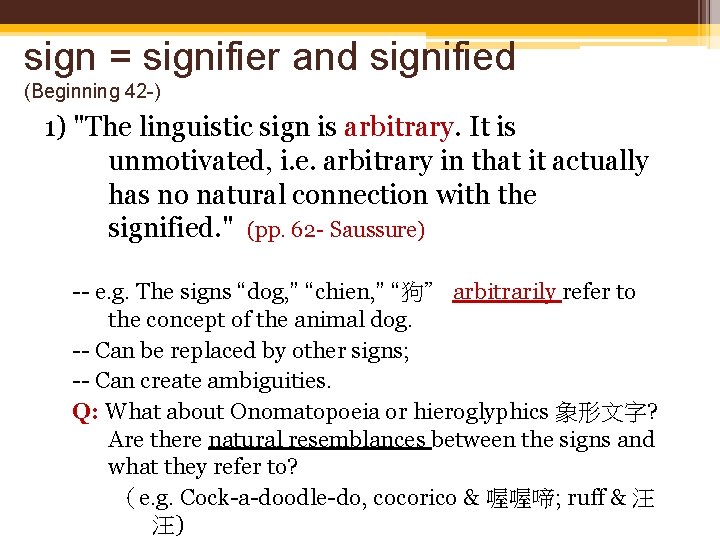
sign = signifier and signified (Beginning 42 -) 1) "The linguistic sign is arbitrary. It is unmotivated, i. e. arbitrary in that it actually has no natural connection with the signified. " (pp. 62 - Saussure) -- e. g. The signs “dog, ” “chien, ” “狗” arbitrarily refer to the concept of the animal dog. -- Can be replaced by other signs; -- Can create ambiguities. Q: What about Onomatopoeia or hieroglyphics 象形文字? Are there natural resemblances between the signs and what they refer to? (e. g. Cock-a-doodle-do, cocorico & 喔喔啼; ruff & 汪 汪)
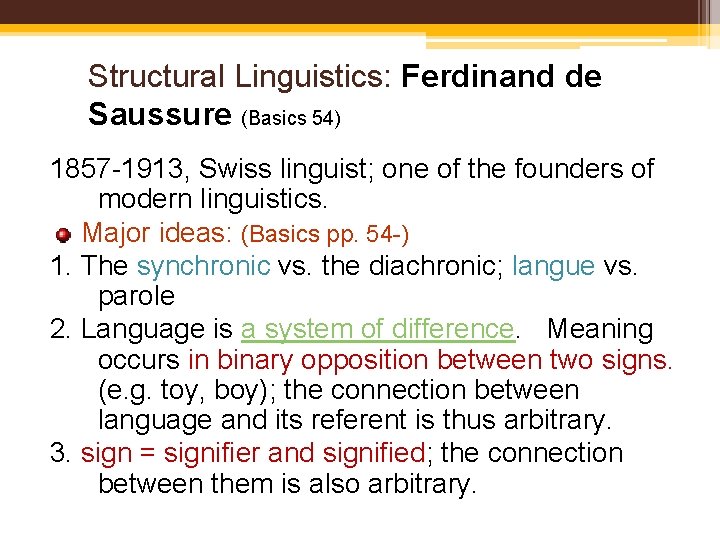
Structural Linguistics: Ferdinand de Saussure (Basics 54) 1857 -1913, Swiss linguist; one of the founders of modern linguistics. Major ideas: (Basics pp. 54 -) 1. The synchronic vs. the diachronic; langue vs. parole 2. Language is a system of difference. Meaning occurs in binary opposition between two signs. (e. g. toy, boy); the connection between language and its referent is thus arbitrary. 3. sign = signifier and signified; the connection between them is also arbitrary.
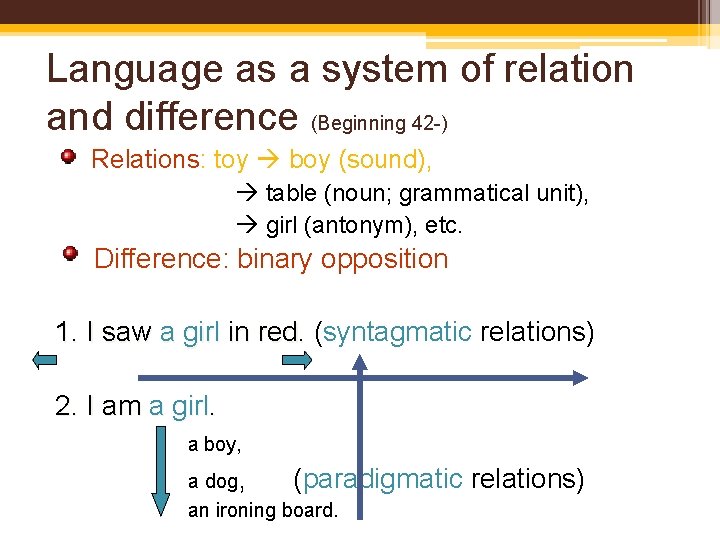
Language as a system of relation and difference (Beginning 42 -) Relations: toy boy (sound), table (noun; grammatical unit), girl (antonym), etc. Difference: binary opposition 1. I saw a girl in red. (syntagmatic relations) 2. I am a girl. a boy, a dog, (paradigmatic an ironing board. relations)
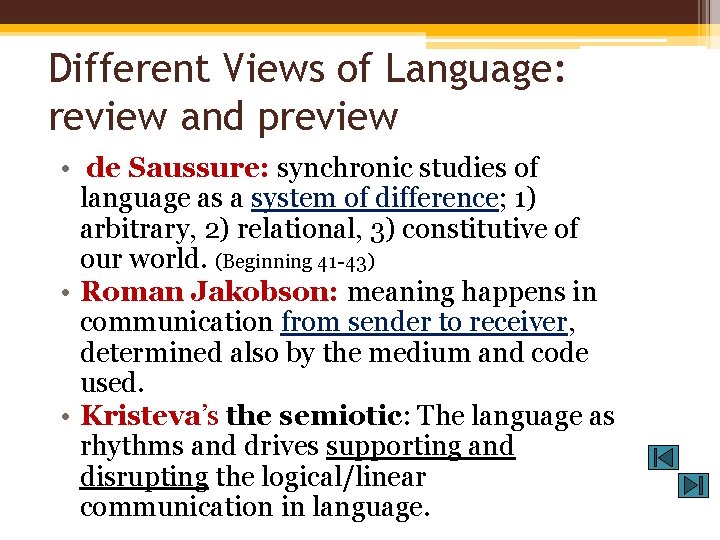
Different Views of Language: review and preview • de Saussure: synchronic studies of language as a system of difference; 1) arbitrary, 2) relational, 3) constitutive of our world. (Beginning 41 -43) • Roman Jakobson: meaning happens in communication from sender to receiver, determined also by the medium and code used. • Kristeva’s the semiotic: The language as rhythms and drives supporting and disrupting the logical/linear communication in language.
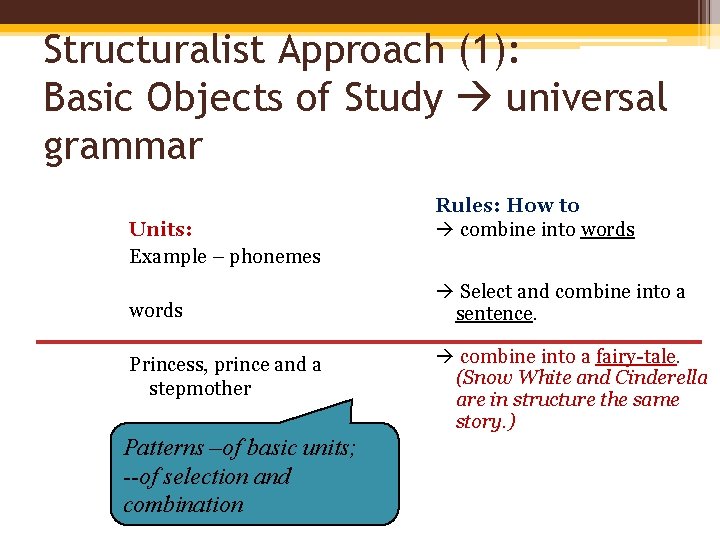
Structuralist Approach (1): Basic Objects of Study universal grammar Units: Example – phonemes words Princess, prince and a stepmother Patterns –of basic units; --of selection and combination Rules: How to combine into words Select and combine into a sentence. combine into a fairy-tale. (Snow White and Cinderella are in structure the same story. )
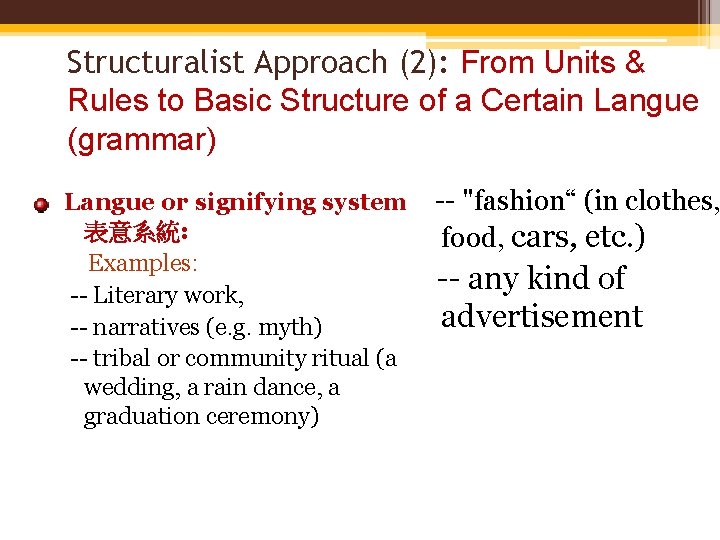
Structuralist Approach (2): From Units & Rules to Basic Structure of a Certain Langue (grammar) Langue or signifying system 表意系統: Examples: -- Literary work, -- narratives (e. g. myth) -- tribal or community ritual (a wedding, a rain dance, a graduation ceremony) -- "fashion“ (in clothes, food, cars, etc. ) -- any kind of advertisement
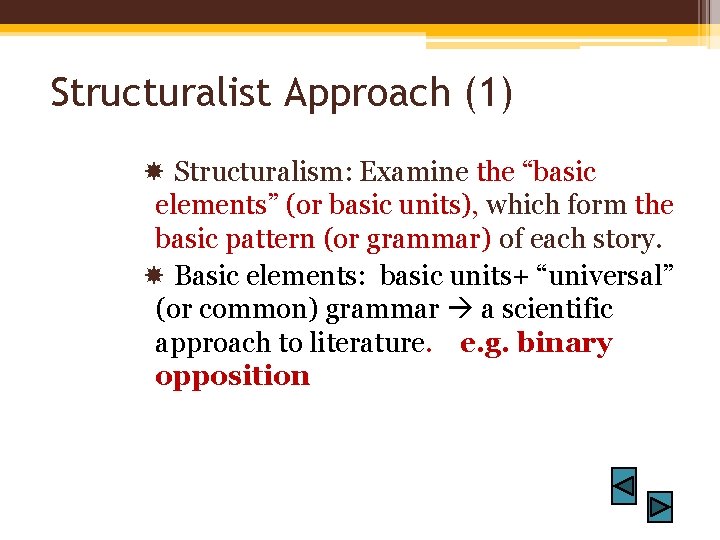
Structuralist Approach (1) Structuralism: Examine the “basic elements” (or basic units), which form the basic pattern (or grammar) of each story. Basic elements: basic units+ “universal” (or common) grammar a scientific approach to literature. e. g. binary opposition
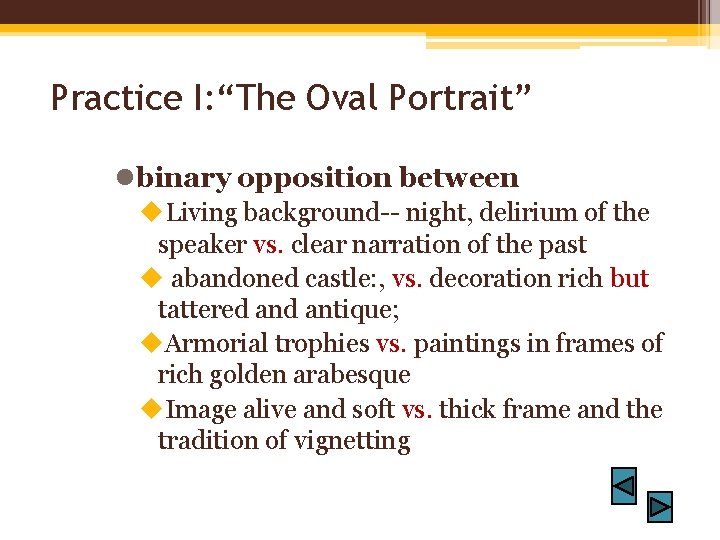
Practice I: “The Oval Portrait” lbinary opposition between u. Living background-- night, delirium of the speaker vs. clear narration of the past u abandoned castle: , vs. decoration rich but tattered antique; u. Armorial trophies vs. paintings in frames of rich golden arabesque u. Image alive and soft vs. thick frame and the tradition of vignetting
Practice I: “The Oval Portrait” • Questions—What do these binary opposition mean? • -- oppositions between art and life, two kinds of killing, two kinds of marriage?
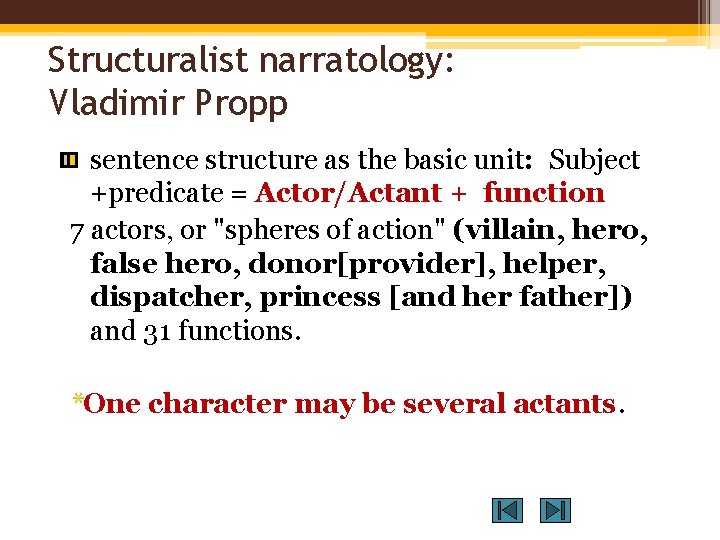
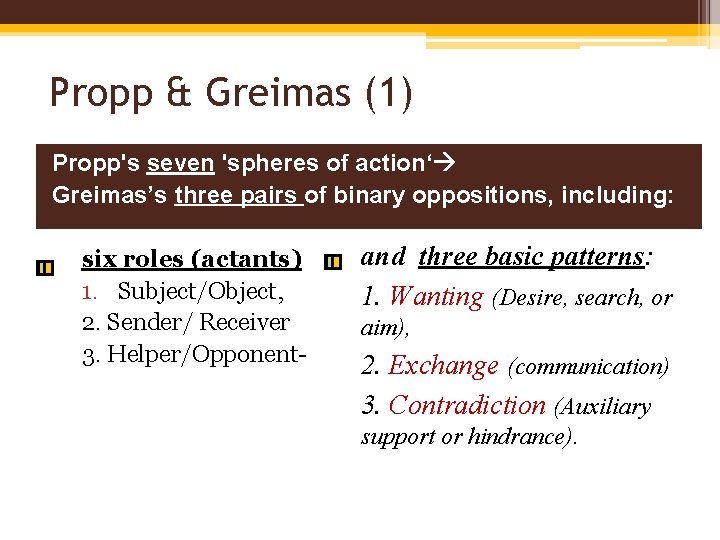
Structuralist narratology: Vladimir Propp sentence structure as the basic unit: Subject +predicate = Actor/Actant + function 7 actors, or "spheres of action" (villain, hero, false hero, donor[provider], helper, dispatcher, princess [and her father]) and 31 functions. *One character may be several actants.
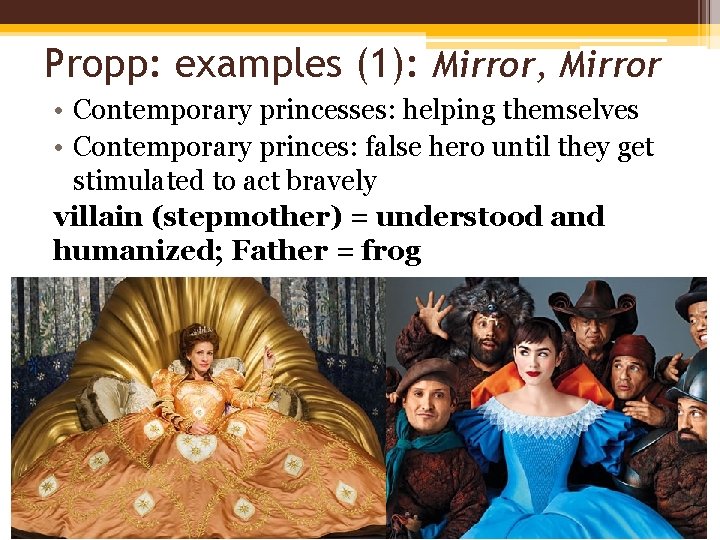
Propp: examples (1): Mirror, Mirror • Contemporary princesses: helping themselves • Contemporary princes: false hero until they get stimulated to act bravely villain (stepmother) = understood and humanized; Father = frog
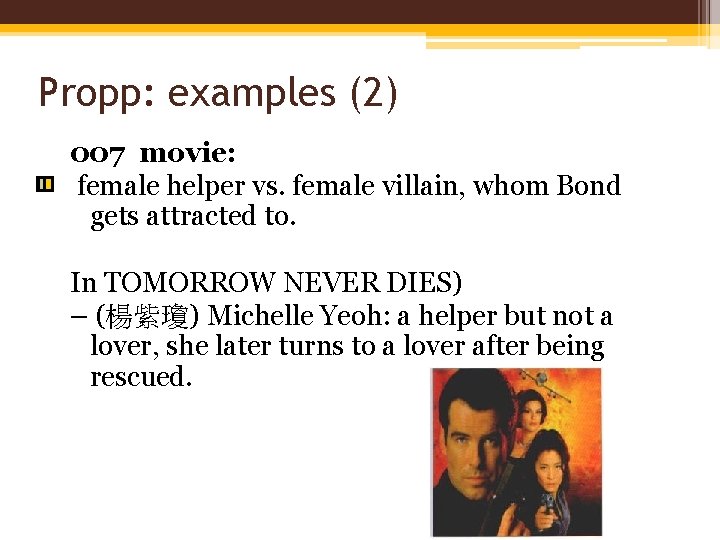
Propp: examples (2) 007 movie: female helper vs. female villain, whom Bond gets attracted to. In TOMORROW NEVER DIES)) – (楊紫瓊) Michelle Yeoh: a helper but not a lover, she later turns to a lover after being rescued.
Propp & Greimas (1) Propp's seven 'spheres of action‘ Greimas’s three pairs of binary oppositions, including: six roles (actants) 1. Subject/Object, 2. Sender/ Receiver 3. Helper/Opponent- and three basic patterns: 1. Wanting (Desire, search, or aim), 2. Exchange (communication) 3. Contradiction (Auxiliary support or hindrance).
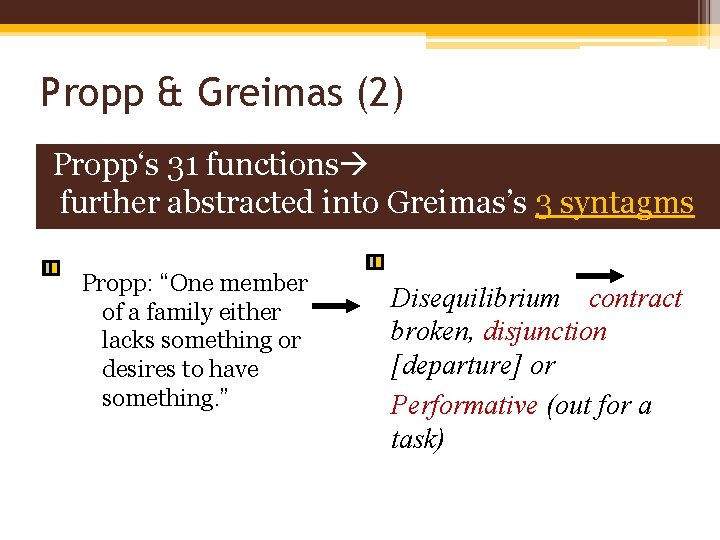
Propp & Greimas (2) Propp‘s 31 functions further abstracted into Greimas’s 3 syntagms Propp: “One member of a family either lacks something or desires to have something. ” Disequilibrium contract broken, disjunction [departure] or Performative (out for a task)
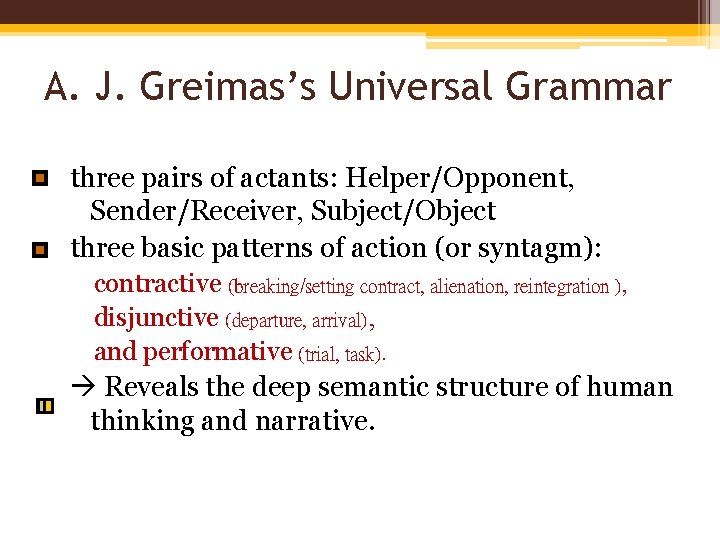
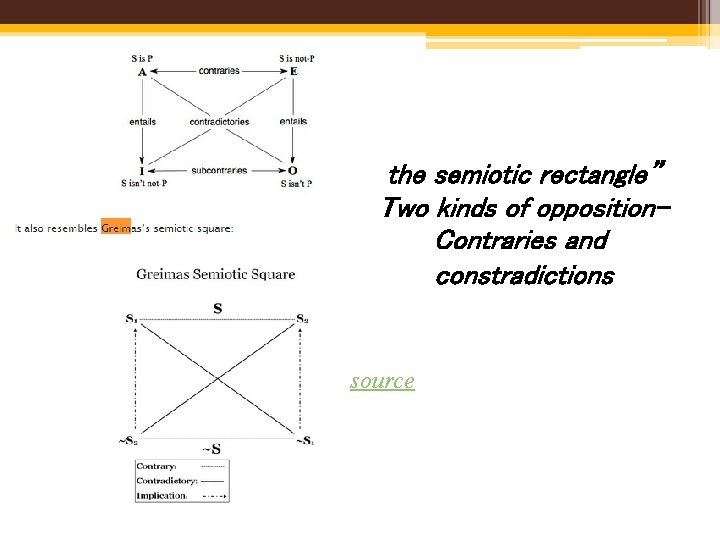
A. J. Greimas’s Universal Grammar three pairs of actants: Helper/Opponent, Sender/Receiver, Subject/Object three basic patterns of action (or syntagm): contractive (breaking/setting contract, alienation, reintegration ), disjunctive (departure, arrival), and performative (trial, task). Reveals the deep semantic structure of human thinking and narrative.
the semiotic rectangle” Two kinds of opposition. Contraries and constradictions source
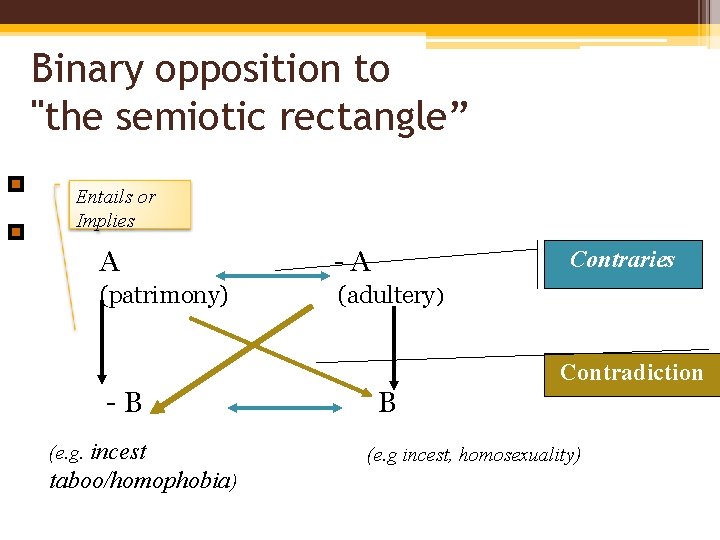
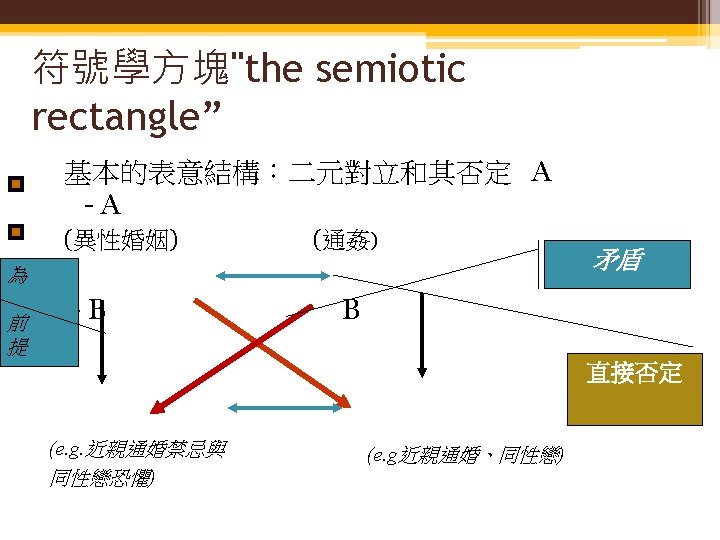
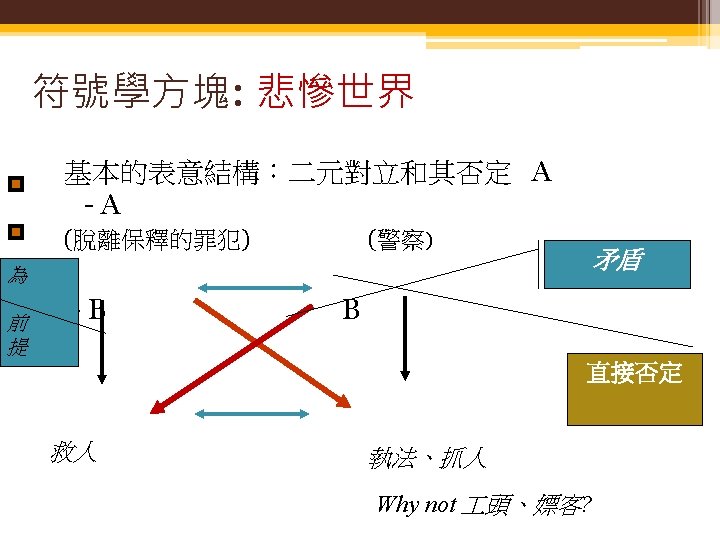
Binary opposition to "the semiotic rectangle” Entails or Implies A -A (patrimony) (adultery) Contraries Contradiction -B (e. g. incest taboo/homophobia) B (e. g incest, homosexuality)
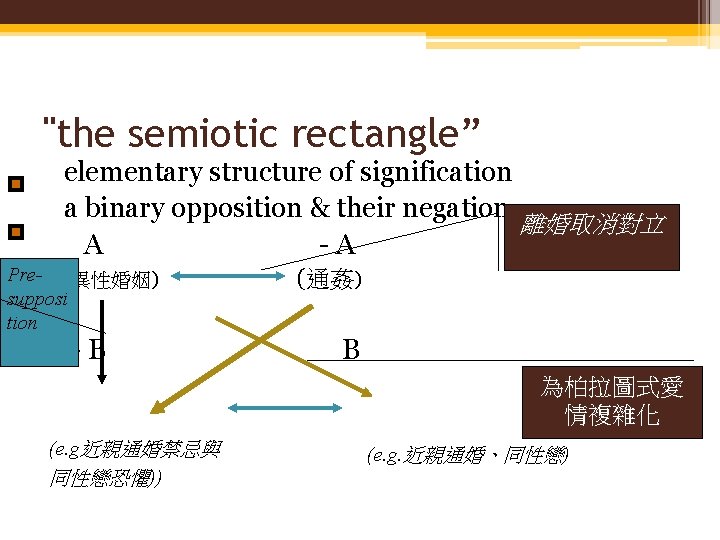
"the semiotic rectangle” elementary structure of signification a binary opposition & their negation 離婚取消對立 A -A Pre- (異性婚姻) supposi tion -B (通姦) B 為柏拉圖式愛 情複雜化 (e. g近親通婚禁忌與 同性戀恐懼)) (e. g. 近親通婚、同性戀)
Structuralist Methodologies: suggestions • 1. Usually interesting analysis happens when the characters break these categories or confuse them. 2. You can set up your own categories (of actants and functions). 3. This kind of structuralist analysis is more useful on popular cultural products or shorter texts than novels—though the latter is not an impossible choice.
Issues for Discussion • Do we always think in terms of binaries, or two pairs of binaries? • What else do we do after finding out the patterns?
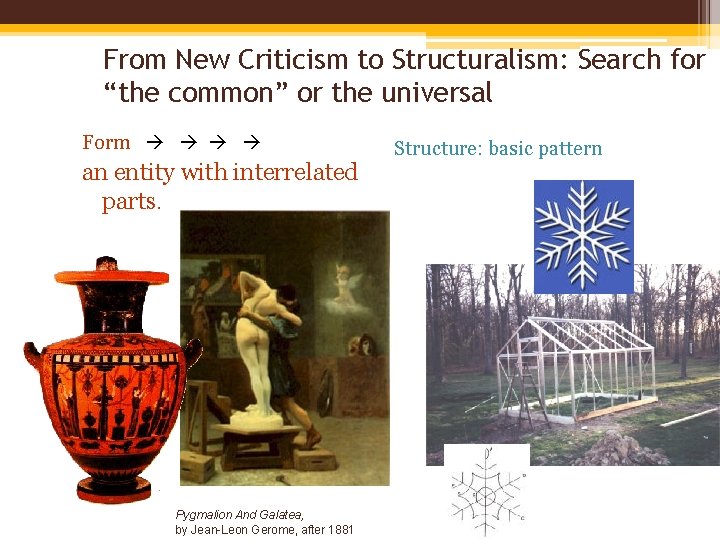
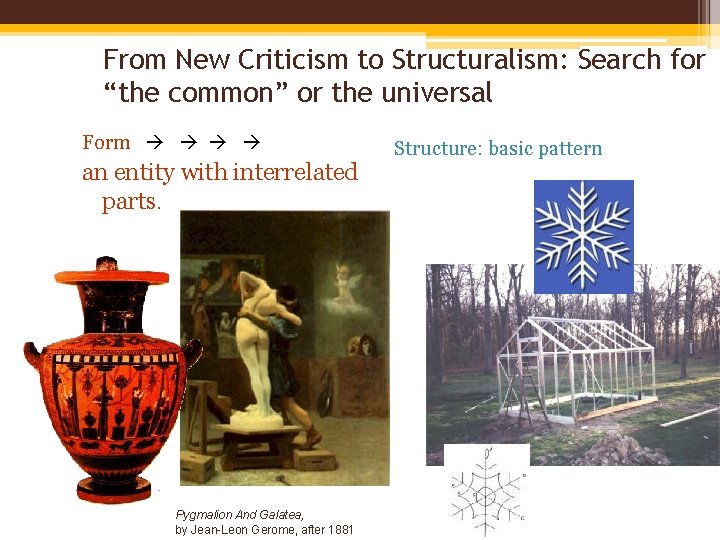
From New Criticism to Structuralism: Search for “the common” or the universal Form an entity with interrelated parts. Pygmalion And Galatea, by Jean-Leon Gerome, after 1881 Structure: basic pattern
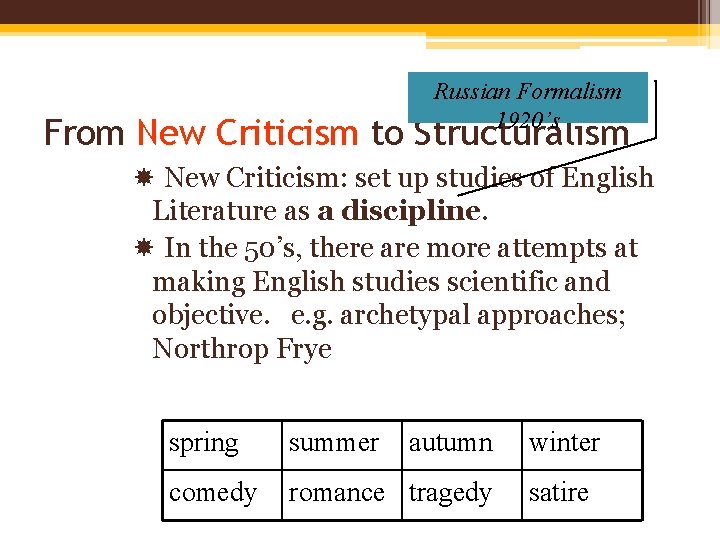
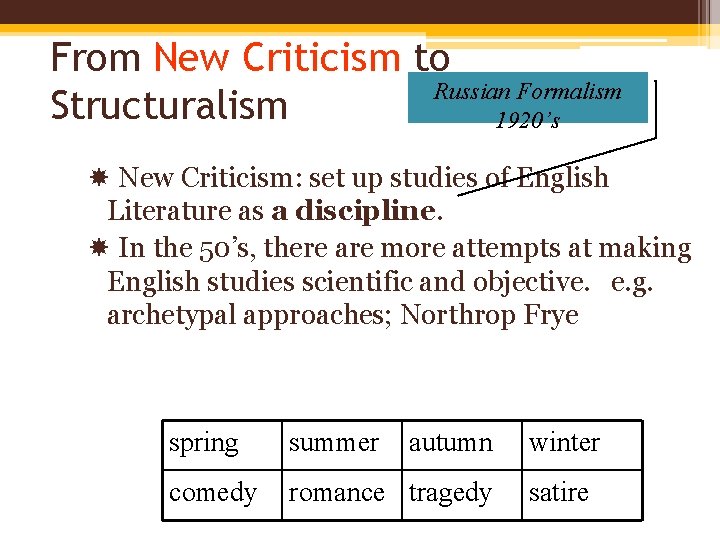
Russian Formalism 1920’s From New Criticism to Structuralism New Criticism: set up studies of English Literature as a discipline. In the 50’s, there are more attempts at making English studies scientific and objective. e. g. archetypal approaches; Northrop Frye spring summer autumn comedy romance tragedy winter satire
Form vs. Structcure Form and Content are inseparable Structure produces meanings (e. g. [b] vs. [p]; syntagm=subject + predicate; Binary opposition = the raw and the cooked, etc. )
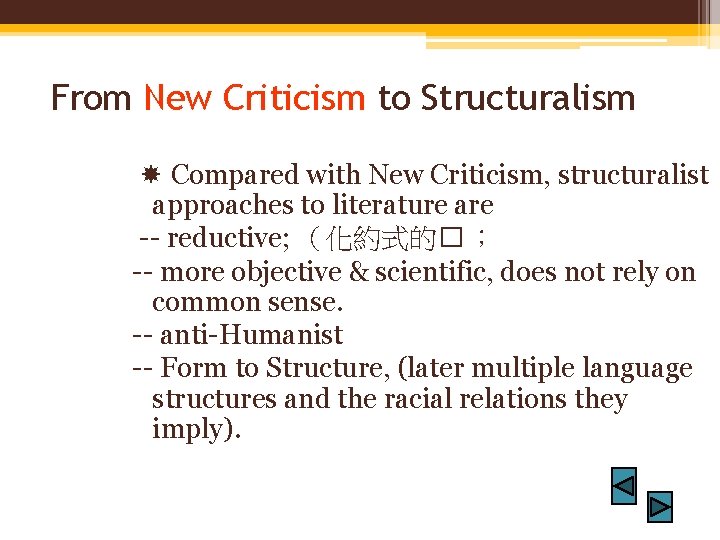
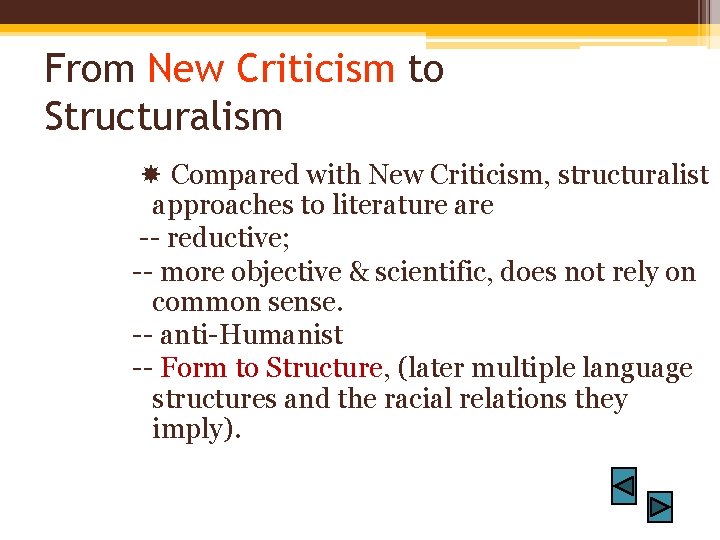
From New Criticism to Structuralism Compared with New Criticism, structuralist approaches to literature are -- reductive; (化約式的� ; -- more objective & scientific, does not rely on common sense. -- anti-Humanist -- Form to Structure, (later multiple language structures and the racial relations they imply).
Semiotics: The Science & Cultural Interpretations of Signs
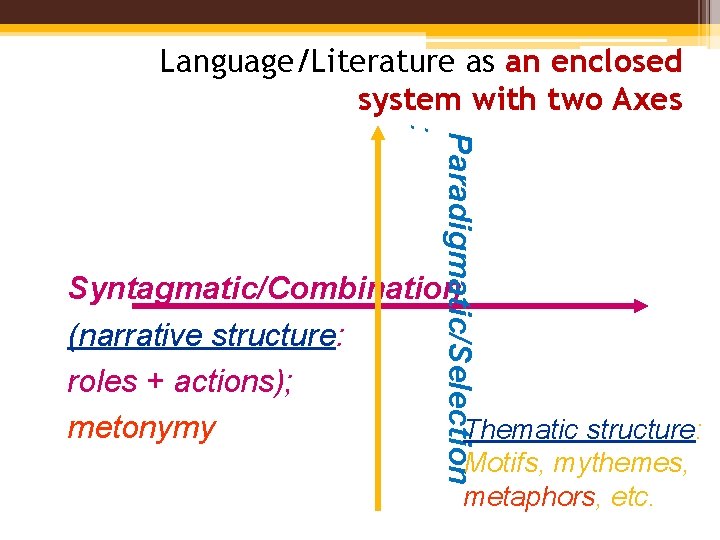
Language/Literature as an enclosed system with two Axes : Paradigmatic/Selection Syntagmatic/Combination (narrative structure: roles + actions); metonymy Thematic structure: Motifs, mythemes, metaphors, etc.
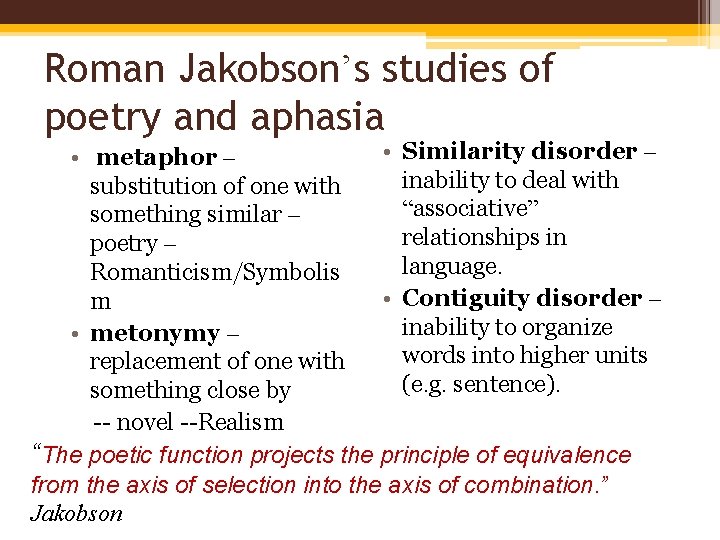
Roman Jakobson’s studies of poetry and aphasia • Similarity disorder – • metaphor – inability to deal with substitution of one with “associative” something similar – relationships in poetry – language. Romanticism/Symbolis • Contiguity disorder – m inability to organize • metonymy – words into higher units replacement of one with (e. g. sentence). something close by -- novel --Realism “The poetic function projects the principle of equivalence from the axis of selection into the axis of combination. ” Jakobson
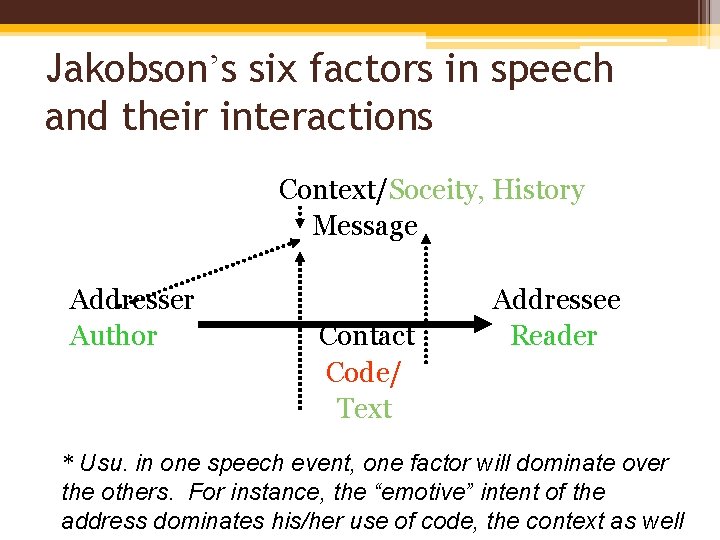
Jakobson’s six factors in speech and their interactions Context/Soceity, History Message Addresser Author Contact Code/ Text Addressee Reader * Usu. in one speech event, one factor will dominate over the others. For instance, the “emotive” intent of the address dominates his/her use of code, the context as well
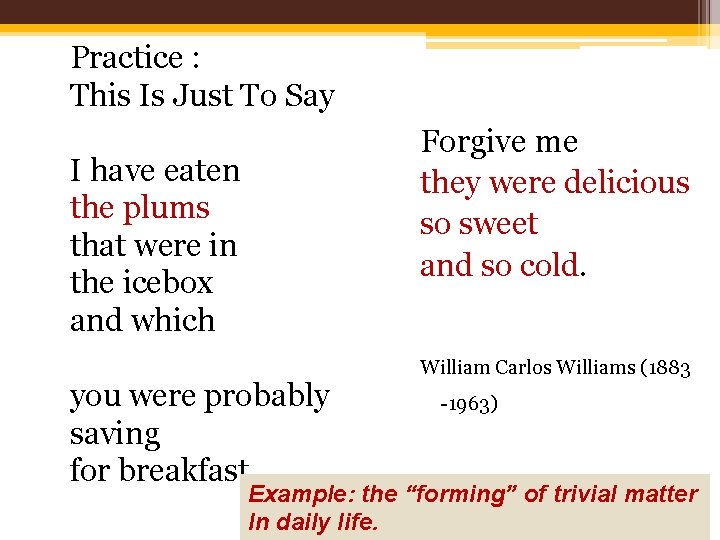
Practice : This Is Just To Say Forgive me they were delicious so sweet and so cold. I have eaten the plums that were in the icebox and which you were probably saving for breakfast William Carlos Williams (1883 -1963) Example: the “forming” of trivial matter In daily life.
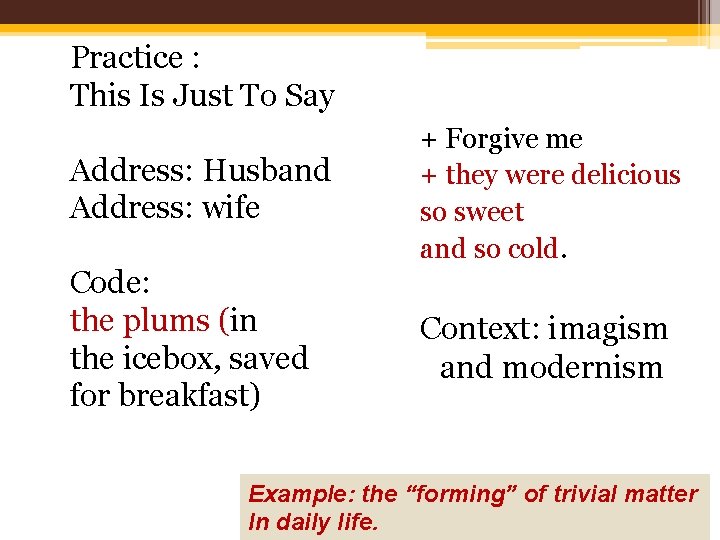
Practice : This Is Just To Say Address: Husband Address: wife + Forgive me + they were delicious so sweet and so cold. Code: the plums (in the icebox, saved for breakfast) Context: imagism and modernism Example: the “forming” of trivial matter In daily life.
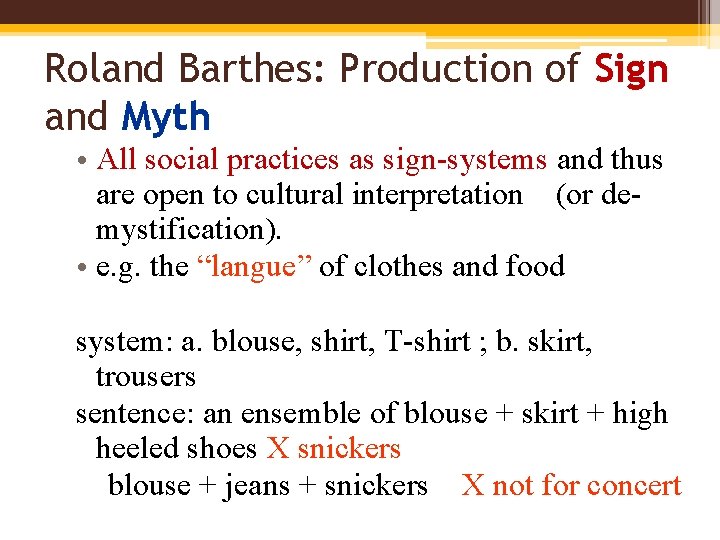
Roland Barthes: Production of Sign and Myth • All social practices as sign-systems and thus are open to cultural interpretation (or demystification). • e. g. the “langue” of clothes and food system: a. blouse, shirt, T-shirt ; b. skirt, trousers sentence: an ensemble of blouse + skirt + high heeled shoes X snickers blouse + jeans + snickers X not for concert
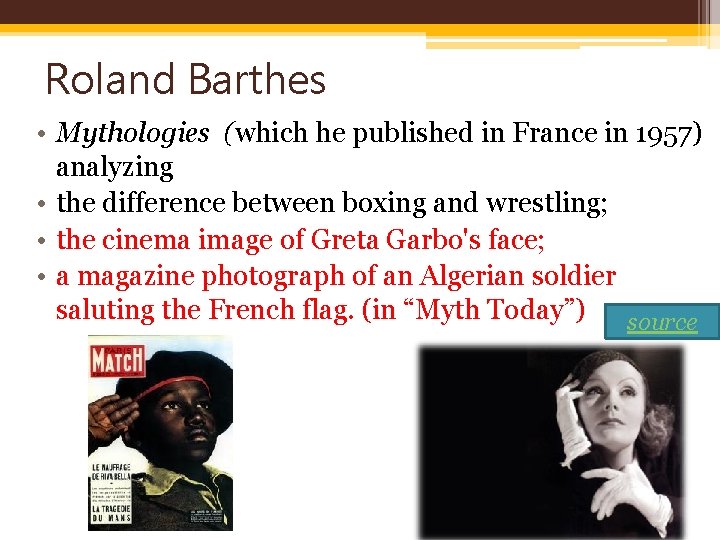
Roland Barthes • Mythologies (which he published in France in 1957) analyzing • the difference between boxing and wrestling; • the cinema image of Greta Garbo's face; • a magazine photograph of an Algerian soldier saluting the French flag. (in “Myth Today”) source
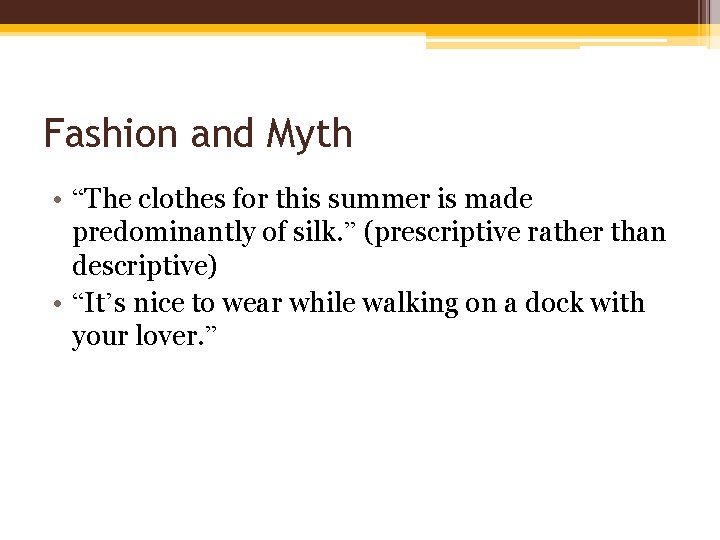
Fashion and Myth • “The clothes for this summer is made predominantly of silk. ” (prescriptive rather than descriptive) • “It’s nice to wear while walking on a dock with your lover. ”
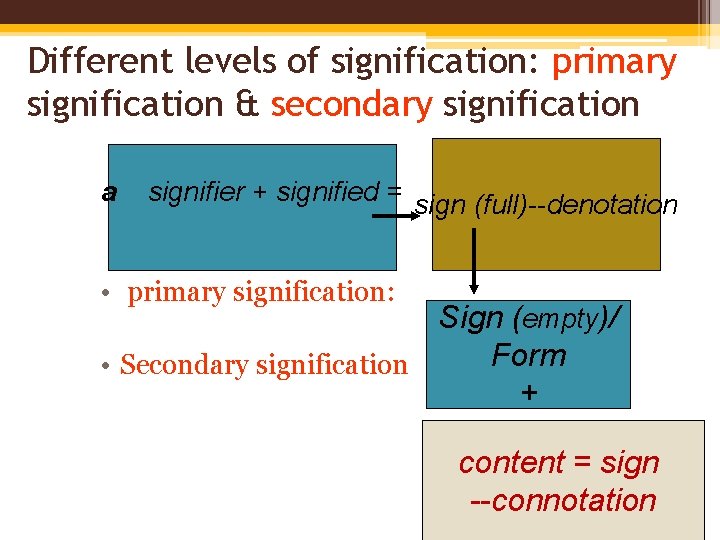
Different levels of signification: primary signification & secondary signification a signifier + signified = sign (full)--denotation • primary signification: Sign (empty)/ Form • Secondary signification + content = sign --connotation
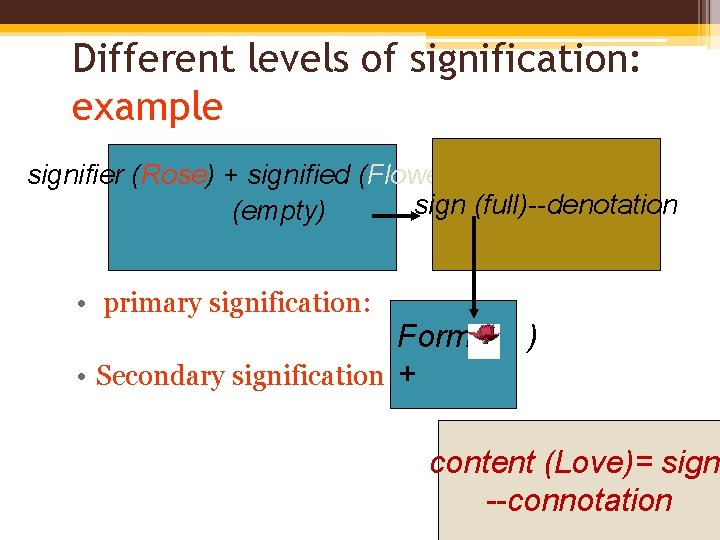
Different levels of signification: example signifier (Rose) + signified (Flower)= sign (full)--denotation (empty) • primary signification: Form( • Secondary signification + ) content (Love)= sign --connotation
“Myth Today” • a second-order semiological system regression • from meaning to form, • from the linguistic sign to the mythical signifier. . the form does not suppress the meaning, it only impoverishes it, it puts it at a distance. . .
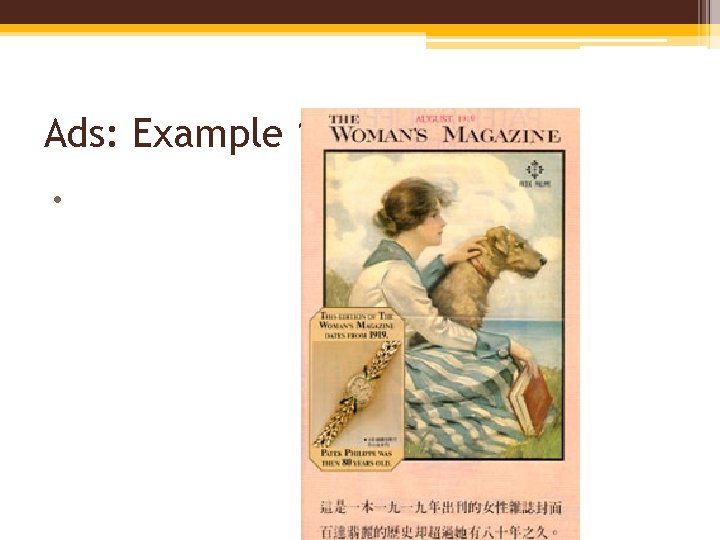
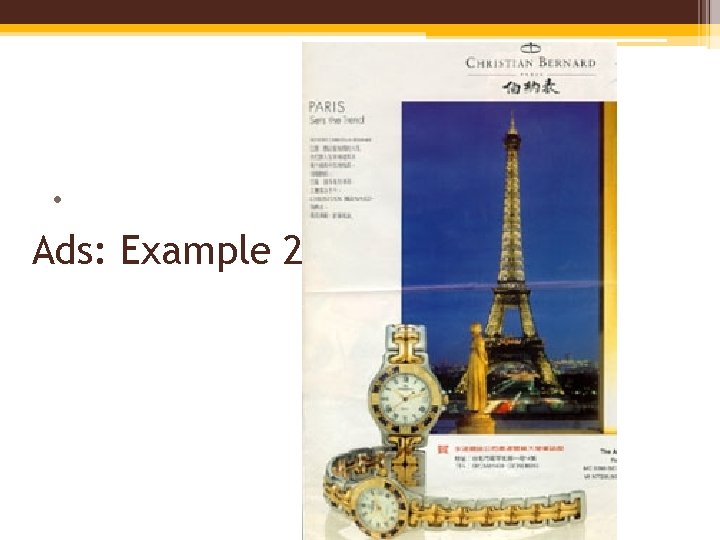
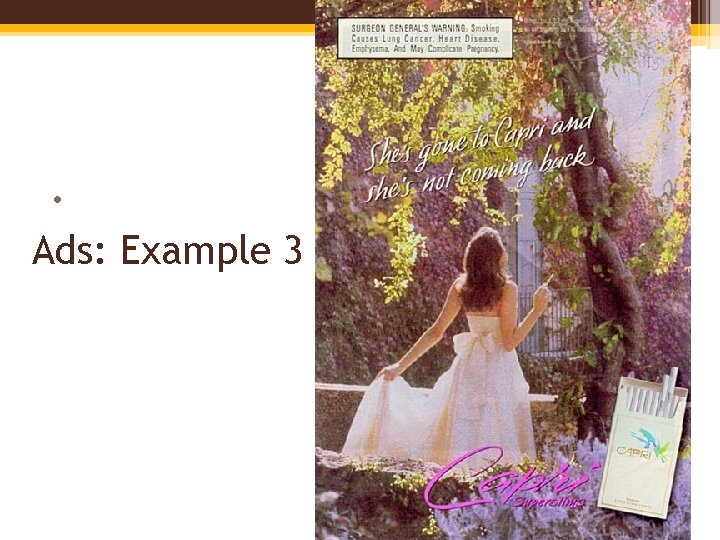
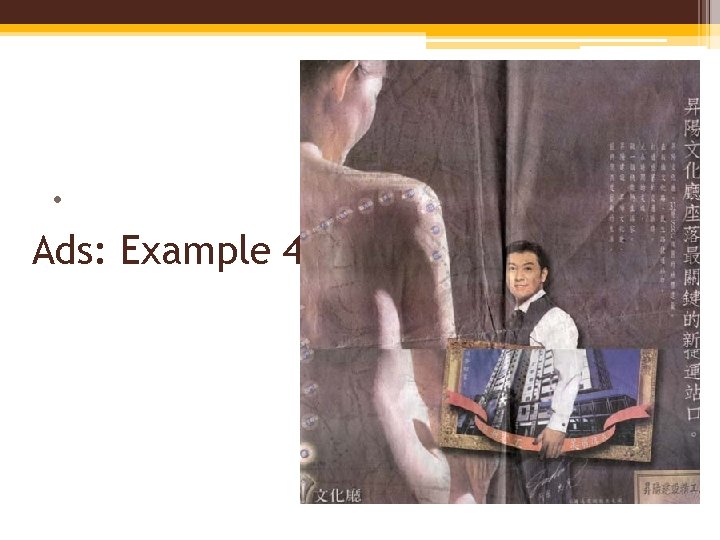
elements of an ad. • 1. the slogan (or copy) • 2. the visual image--with the slogan, it implies a story • 3. supplementary --color, design == where the product, the words are placed ▫ ▫ colour, size and position, texture celebrity endorsement
Ads: Example 1 •
• Ads: Example 2
• Ads: Example 3
• Ads: Example 4
Ads’ languages -- from Ways of Seeing • The romantic use of nature (leaves, trees, water) to create a place where innocence can be found. • The posed taken up to denote stereotypes of women: serene mothers (madonna), free wheeling secretary (actress, king's mistress), perfect hostess (spectator-owner's wife), sexobject (Venus, nymph surprised), etc. • The special sexual emphasis given to women's legs.
Ads’ languages -- from Ways of Seeing (2) • The materials particularly used to indicate luxury: engraved metal, furs, polished leather, etc. • The physical stance of men conveying wealth and virility. • The equation of drinking and success. • The man as knight (horseman) become motorist.
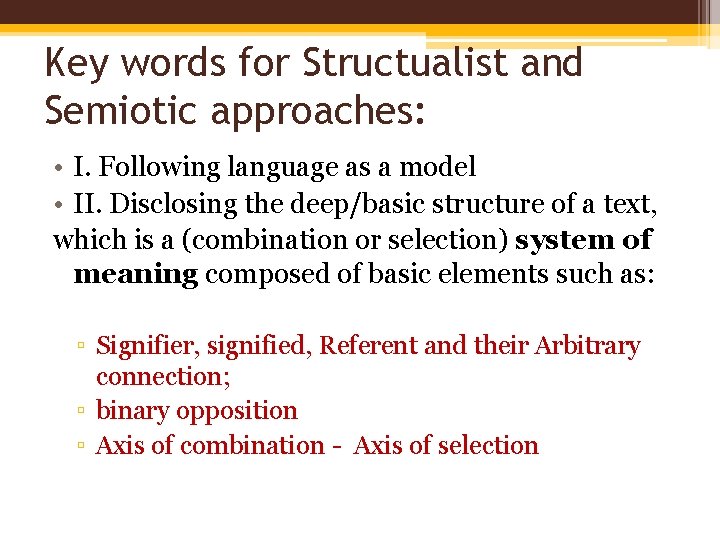
Key words for Structualist and Semiotic approaches: • I. Following language as a model • II. Disclosing the deep/basic structure of a text, which is a (combination or selection) system of meaning composed of basic elements such as: ▫ Signifier, signified, Referent and their Arbitrary connection; ▫ binary opposition ▫ Axis of combination - Axis of selection
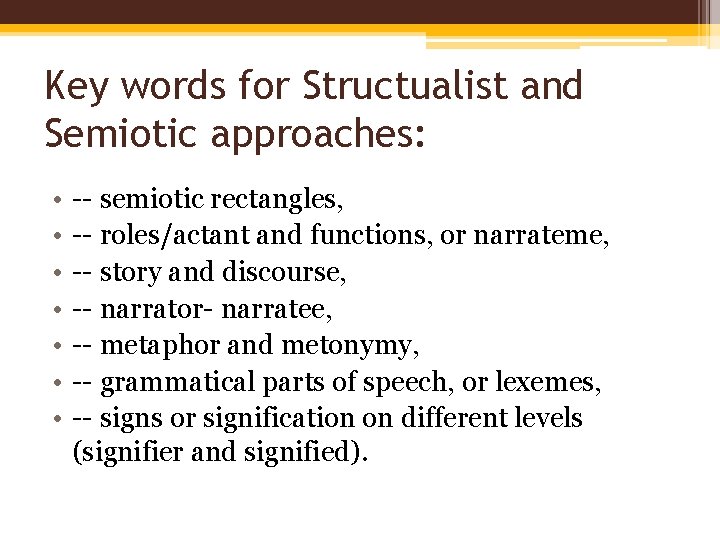
Key words for Structualist and Semiotic approaches: • • -- semiotic rectangles, -- roles/actant and functions, or narrateme, -- story and discourse, -- narrator- narratee, -- metaphor and metonymy, -- grammatical parts of speech, or lexemes, -- signs or signification on different levels (signifier and signified).
From New Criticism to Structuralism Compared with New Criticism, structuralist approaches to literature are -- reductive; -- more objective & scientific, does not rely on common sense. -- anti-Humanist -- Form to Structure, (later multiple language structures and the racial relations they imply).
From New Criticism to Structuralism: Search for “the common” or the universal Form an entity with interrelated parts. Pygmalion And Galatea, by Jean-Leon Gerome, after 1881 Structure: basic pattern
From New Criticism to Russian Formalism Structuralism 1920’s New Criticism: set up studies of English Literature as a discipline. In the 50’s, there are more attempts at making English studies scientific and objective. e. g. archetypal approaches; Northrop Frye spring summer autumn comedy romance tragedy winter satire
Questions: • Reductive? Disregarding meaning, textual complexities, or the author’s intention? • De-centering, dehumanizing? • Do we really think in terms of binaries?
• How is our social existence modeled after language as a system of relations? ▫ ▫ From work to text (textuality); From identity to system of relations; From myth to ideology; “Myth -- the complex system of images and beliefs which a society constructs in order to sustain and authenticate its sense of being. ” ▫ From structuralism/semiotics to marxism