
Structural Staining Method Capsule staining 8 TH LAB
![Structural Staining Method (Capsule staining) [8 TH LAB. ] 1](https://slidetodoc.com/presentation_image_h/981378b0b018d65e760febd5075ae06a/image-1.jpg "Structural Staining Method (Capsule staining) [8 TH LAB. ] 1")
Structural Staining Method (Capsule staining) [8 TH LAB. ] 1
Many bacteria, including both grampositive and gram-negative, may be surrounded by an outer polysaccharidecontaining layer termed the glycocalyx. • When the composition of this layer is tightly bound and remains attached to cells, it is referred to as a capsule. • More loosely bound layers are termed slime layer. 2
Capsules are usually composed of polysaccharides; however they may also contain polyalcohols and polyamines. The capsule of Bacillus anthracis is composed of polymers of amino acids. 3
Bacterial capsules are non-ionic, so neither acidic nor basic stains will adhere to their surfaces. Therefore, the best ways to visualize a capsule we must use acidic stain to color the background a basic dye to stain the actual cell. This makes capsule appear clear around the cell. 4
Capsule differs among bacteria in: 1. Thickness. 2. Organization. 3. Chemical composition. 5
Capsules are considered protective structures. Various functions have been attributed to capsules including. 1. Protection from desiccation and. 2. Adherence to surfaces and other bacteria contributing to biofilm formation ex. Streptococcus mutans. 6
3. Capsules also often play a role in pathogenicity acting as virulence factors (K antigens) to protect cells from phagocytosis and/or complementmediated killing. Important plant pathogens such as strains of Pseudomonas, Rhizobium, and Erwinia require capsules for pathogenicity. 7
Notes: The medium in which the culture is grown as well as the temperature at which it is grown and the age of the culture will affect capsule formation. 1. Older cultures are more likely to exhibit capsule production. When performing a capsule stain on your unknown, be sure the culture you take your sample from is at least five days old. 2. Be very careful when preparing the smear or capsule or slime will be lost. Do not shake the media; slime layers can be shaken off with vigorous shaking of the tube. 8
3. Capsules are seen better at the edges of the slide, so scan the slide for a “good bacterial smear” (hard to keep capsule intact). 4. Do not heat fix because there will be shrinkage. 5. Vigorous washing may dislodge the cells. 9
Bacterial species that have capsule: 1. Klebsiella pneumoniae. 2. Streptococcus pneumoniae. 3. Streptococcus mutans. 4. Streptococcus pyogenes. 5. Haemophilus influenzae. 6. Bacillus anthracis. 7. Bacillus megaterium. 10
Procedure: 1. Place a single drop of Nigrosine on a clean microscope slide, adjacent to the edge. 2. Using a flamed loop, take some K. pneumoniae colonies from plate and mix it into the drop of stain. 3. Place the end of another clean slide at an angle to the end of the slide and spread out the drop out into a film. 11
4. Allow the film to air dry. 5. Saturate the slide with crystal violet for 1 minute. 6. Rinse the slide gently with water. 7. Allow the slide to air dry. Observe the slide under the microscope. 12
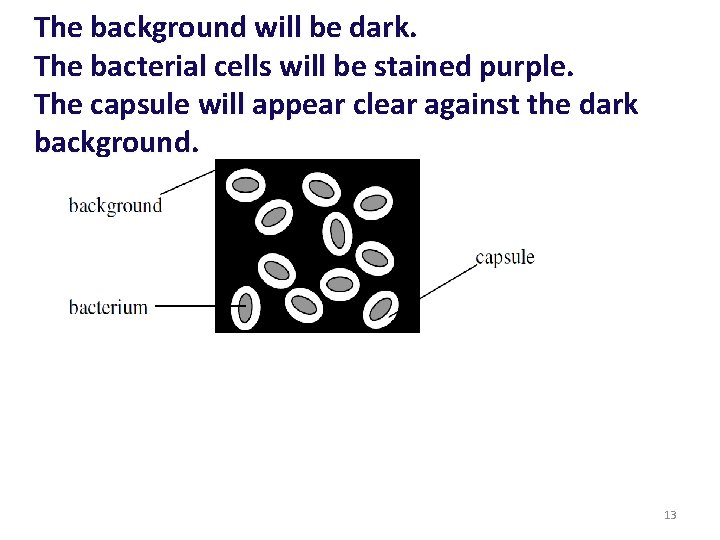
The background will be dark. The bacterial cells will be stained purple. The capsule will appear clear against the dark background. 13
- Slides: 13