
Structural Reliability Aspects in Design of Wind Turbines
Structural Reliability Aspects in Design of Wind Turbines John Dalsgaard Sørensen Aalborg University & Risø National Laboratory Denmark • • • Introduction Failure modes & stochastic models Reliability analysis & optimal reliability level Operation & maintenance Summary The Rackwitz Symposium - November 24, 2006 1
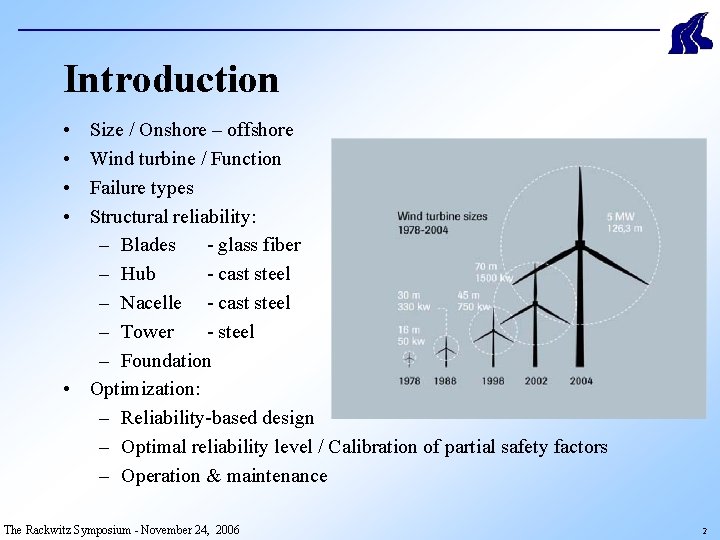
Introduction • • Size / Onshore – offshore Wind turbine / Function Failure types Structural reliability: – Blades - glass fiber – Hub - cast steel – Nacelle - cast steel – Tower - steel – Foundation • Optimization: – Reliability-based design – Optimal reliability level / Calibration of partial safety factors – Operation & maintenance The Rackwitz Symposium - November 24, 2006 2
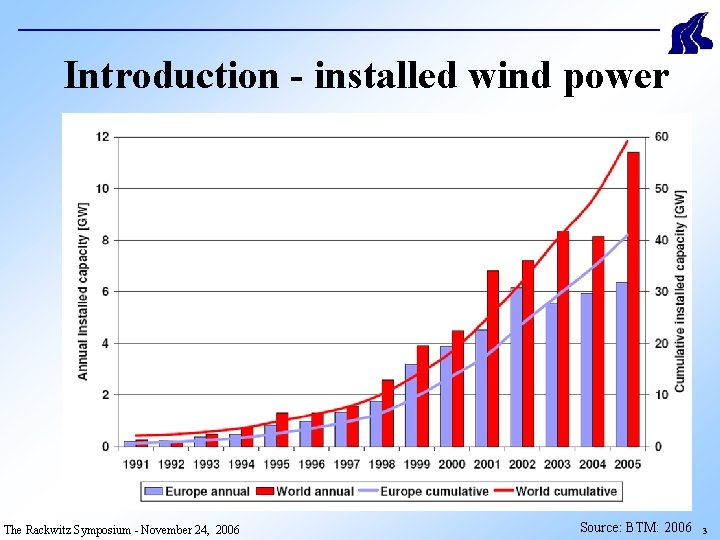
Introduction - installed wind power The Rackwitz Symposium - November 24, 2006 Source: BTM: 2006 3
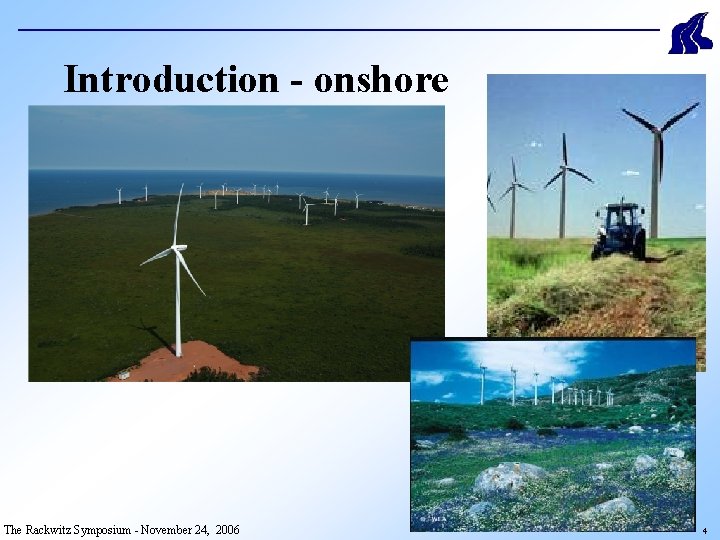
Introduction - onshore The Rackwitz Symposium - November 24, 2006 4
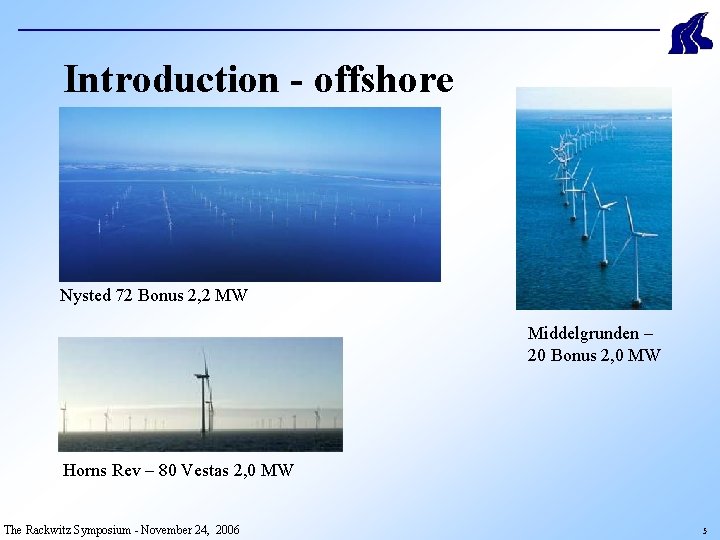
Introduction - offshore Nysted 72 Bonus 2, 2 MW Middelgrunden – 20 Bonus 2, 0 MW Horns Rev – 80 Vestas 2, 0 MW The Rackwitz Symposium - November 24, 2006 5
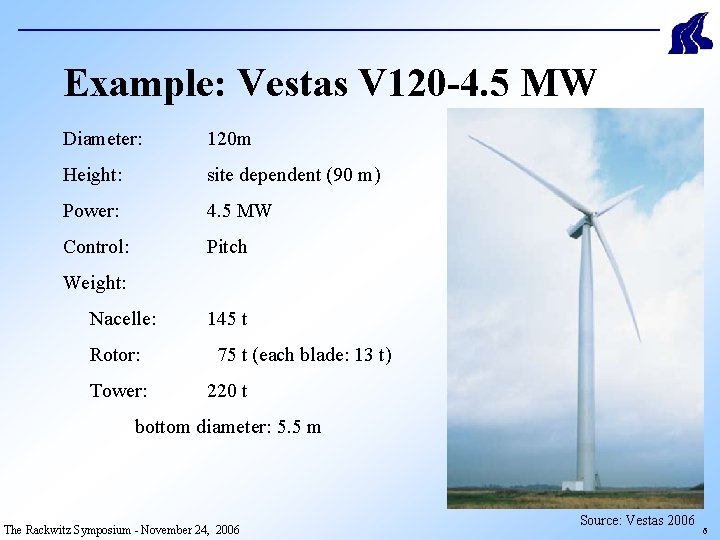
Example: Vestas V 120 -4. 5 MW Diameter: 120 m Height: site dependent (90 m) Power: 4. 5 MW Control: Pitch Weight: Nacelle: Rotor: Tower: 145 t 75 t (each blade: 13 t) 220 t bottom diameter: 5. 5 m The Rackwitz Symposium - November 24, 2006 Source: Vestas 2006 6
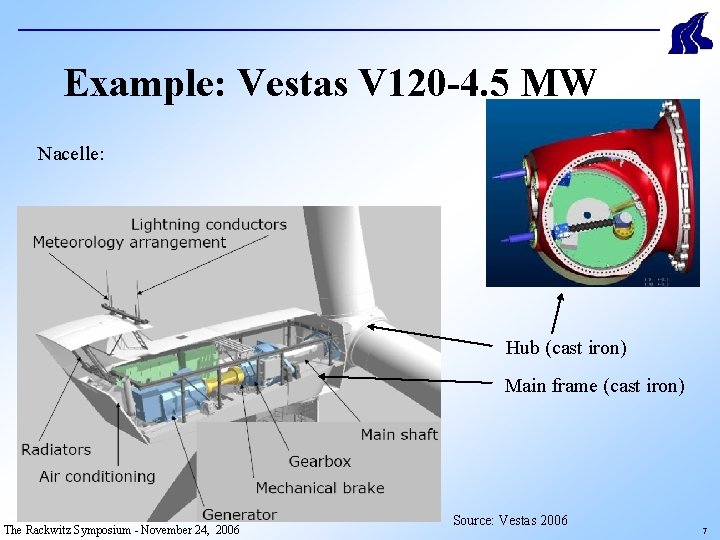
Example: Vestas V 120 -4. 5 MW Nacelle: Hub (cast iron) Main frame (cast iron) The Rackwitz Symposium - November 24, 2006 Source: Vestas 2006 7
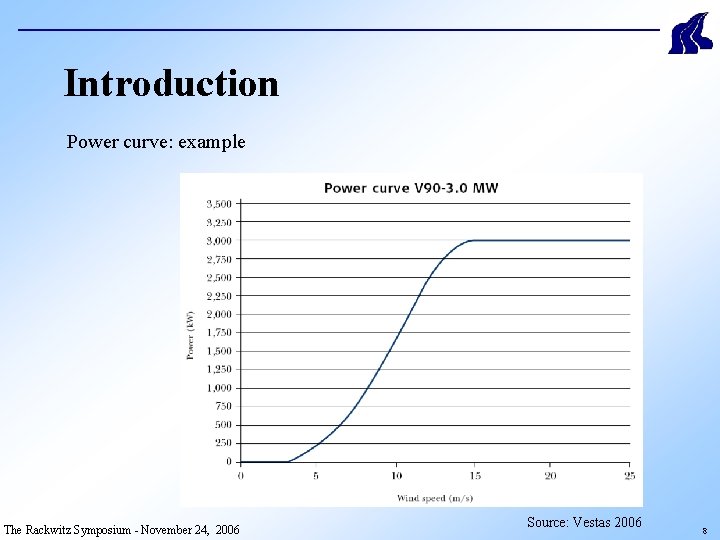
Introduction Power curve: example The Rackwitz Symposium - November 24, 2006 Source: Vestas 2006 8
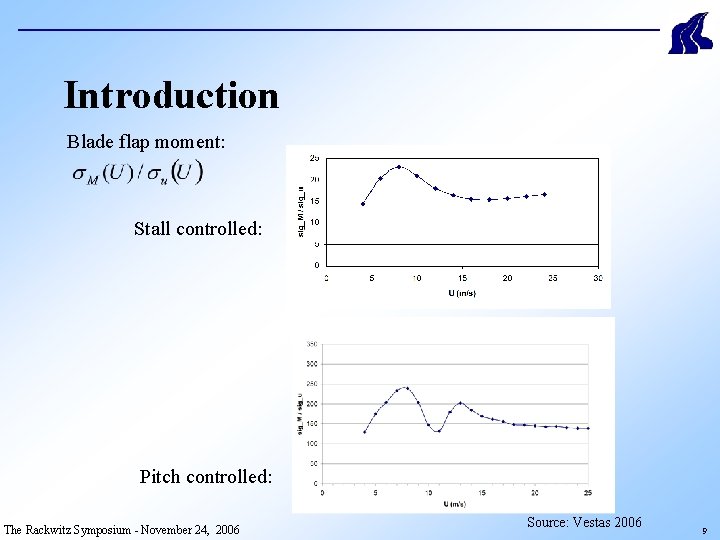
Introduction Blade flap moment: Stall controlled: Pitch controlled: The Rackwitz Symposium - November 24, 2006 Source: Vestas 2006 9
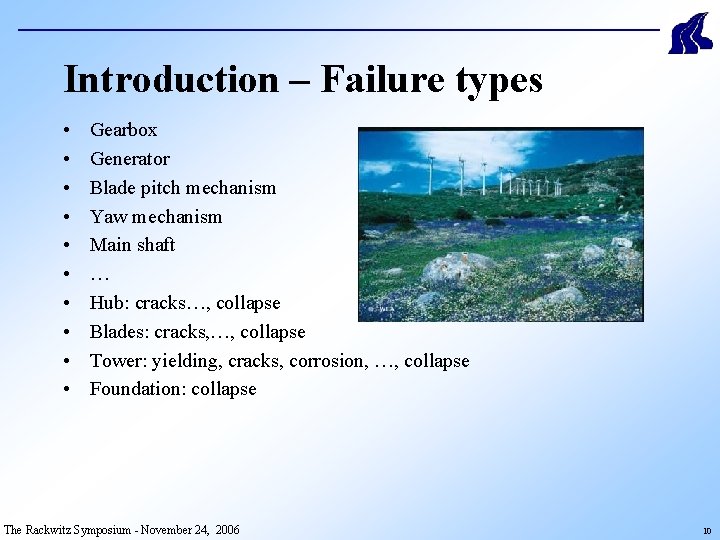
Introduction – Failure types • • • Gearbox Generator Blade pitch mechanism Yaw mechanism Main shaft … Hub: cracks…, collapse Blades: cracks, …, collapse Tower: yielding, cracks, corrosion, …, collapse Foundation: collapse The Rackwitz Symposium - November 24, 2006 10
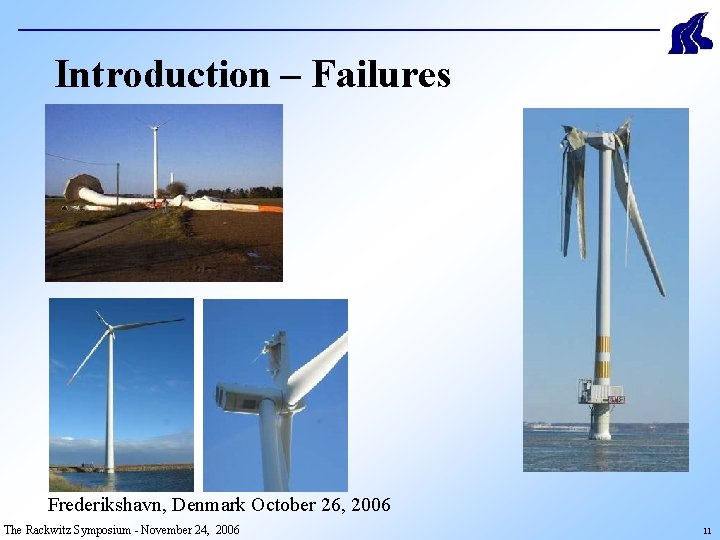
Introduction – Failures Frederikshavn, Denmark October 26, 2006 The Rackwitz Symposium - November 24, 2006 11
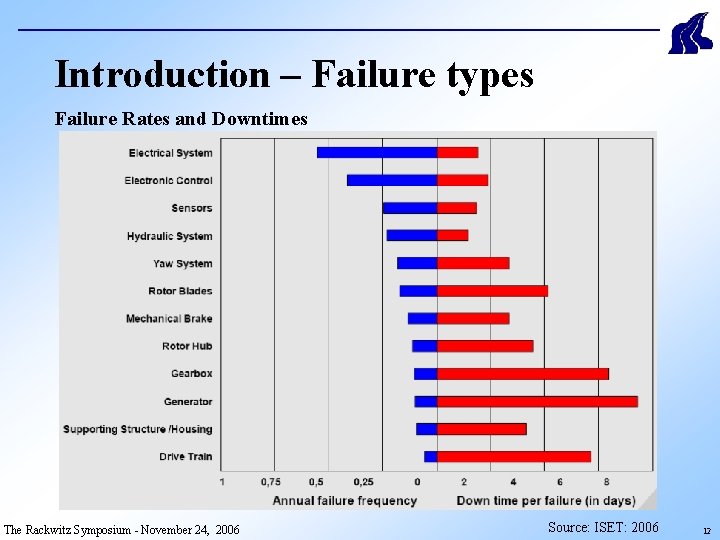
Introduction – Failure types Failure Rates and Downtimes The Rackwitz Symposium - November 24, 2006 Source: ISET: 2006 12
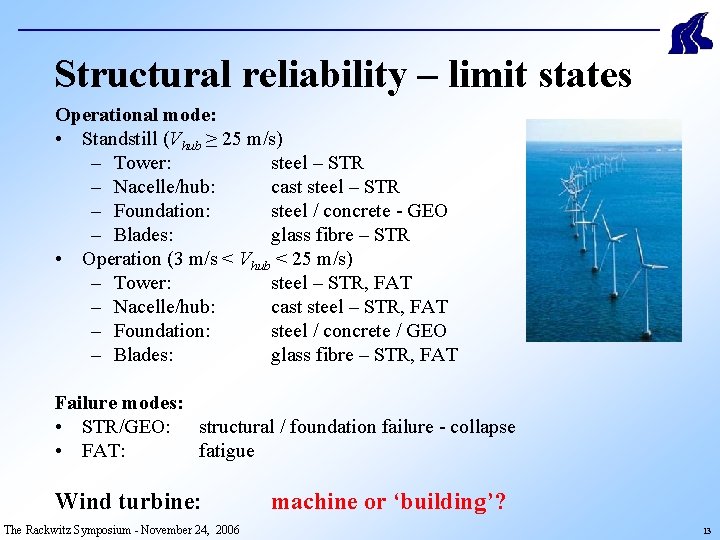
Structural reliability – limit states Operational mode: • Standstill (Vhub ≥ 25 m/s) – Tower: steel – STR – Nacelle/hub: cast steel – STR – Foundation: steel / concrete - GEO – Blades: glass fibre – STR • Operation (3 m/s < Vhub < 25 m/s) – Tower: steel – STR, FAT – Nacelle/hub: cast steel – STR, FAT – Foundation: steel / concrete / GEO – Blades: glass fibre – STR, FAT Failure modes: • STR/GEO: structural / foundation failure - collapse • FAT: fatigue Wind turbine: The Rackwitz Symposium - November 24, 2006 machine or ‘building’? 13
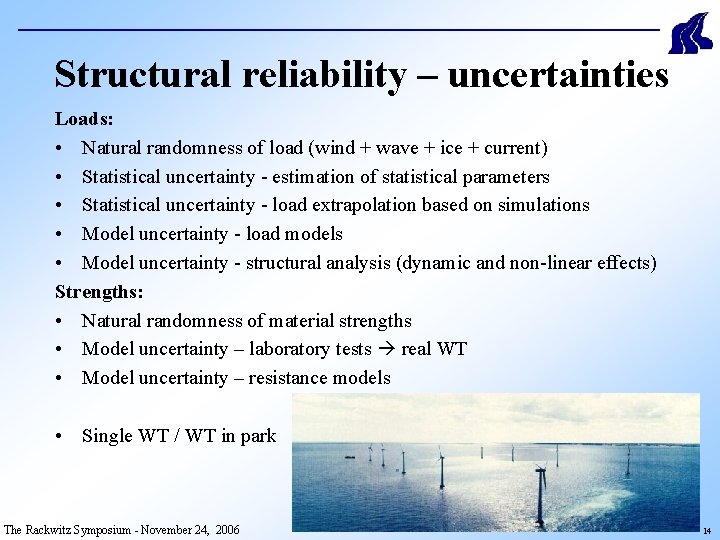
Structural reliability – uncertainties Loads: • Natural randomness of load (wind + wave + ice + current) • Statistical uncertainty - estimation of statistical parameters • Statistical uncertainty - load extrapolation based on simulations • Model uncertainty - load models • Model uncertainty - structural analysis (dynamic and non-linear effects) Strengths: • Natural randomness of material strengths • Model uncertainty – laboratory tests real WT • Model uncertainty – resistance models • Single WT / WT in park The Rackwitz Symposium - November 24, 2006 14
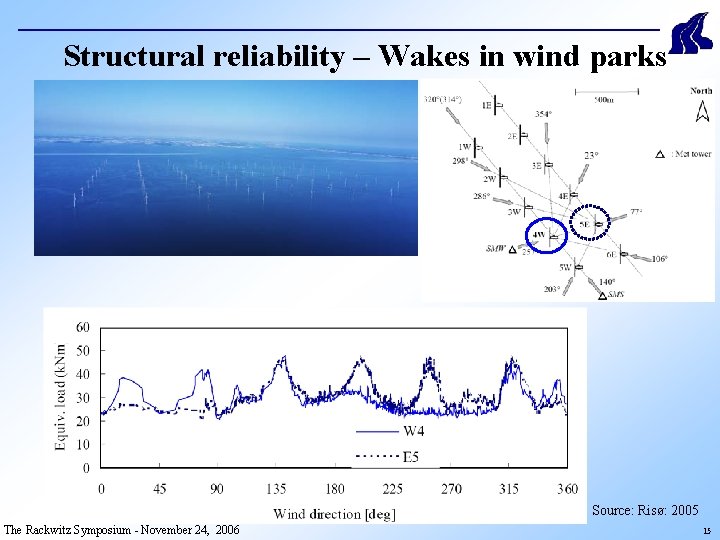
Structural reliability – Wakes in wind parks Source: Risø: 2005 The Rackwitz Symposium - November 24, 2006 15
Structural reliability – Wakes in wind parks ULS combinations: • Standstill: wind velocity at hub height exceeds 25 m/s → wind turbine parked – Wind load = annual extreme wind load • Operation: wind turbine is in operation and produces electricity – Wind velocity is ≤ 25 m/s at hub height – Maximum wind load: – dependent on the control system and maximum turbulence intensity – often less than 25 m/s – based on simulation of limited number of response realisations and extrapolation – dependent on single / park WT (turbulence) The Rackwitz Symposium - November 24, 2006 16
Stochastic model Load effect E depends on: • • Mean wind speed V Turbulence σ1 Wind shear Change in wind direction during gust Control system fault Loss of electrical network Normal shut down Emergency shut down The Rackwitz Symposium - November 24, 2006 • Control system 17
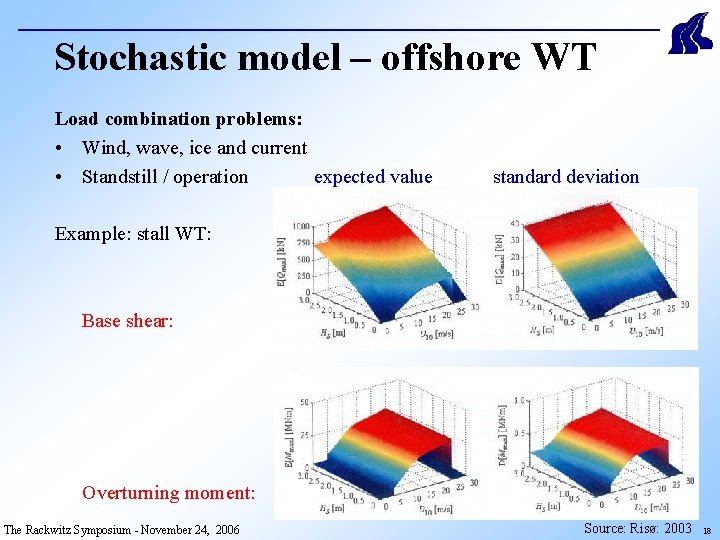
Stochastic model – offshore WT Load combination problems: • Wind, wave, ice and current • Standstill / operation expected value standard deviation Example: stall WT: Base shear: Overturning moment: The Rackwitz Symposium - November 24, 2006 Source: Risø: 2003 18
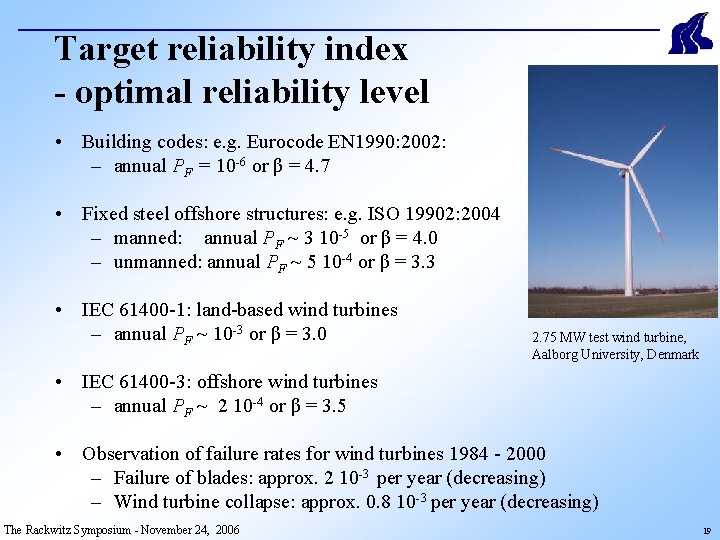
Target reliability index - optimal reliability level • Building codes: e. g. Eurocode EN 1990: 2002: – annual PF = 10 -6 or β = 4. 7 • Fixed steel offshore structures: e. g. ISO 19902: 2004 – manned: annual PF ~ 3 10 -5 or β = 4. 0 – unmanned: annual PF ~ 5 10 -4 or β = 3. 3 • IEC 61400 -1: land-based wind turbines – annual PF ~ 10 -3 or β = 3. 0 2. 75 MW test wind turbine, Aalborg University, Denmark • IEC 61400 -3: offshore wind turbines – annual PF ~ 2 10 -4 or β = 3. 5 • Observation of failure rates for wind turbines 1984 - 2000 – Failure of blades: approx. 2 10 -3 per year (decreasing) – Wind turbine collapse: approx. 0. 8 10 -3 per year (decreasing) The Rackwitz Symposium - November 24, 2006 19
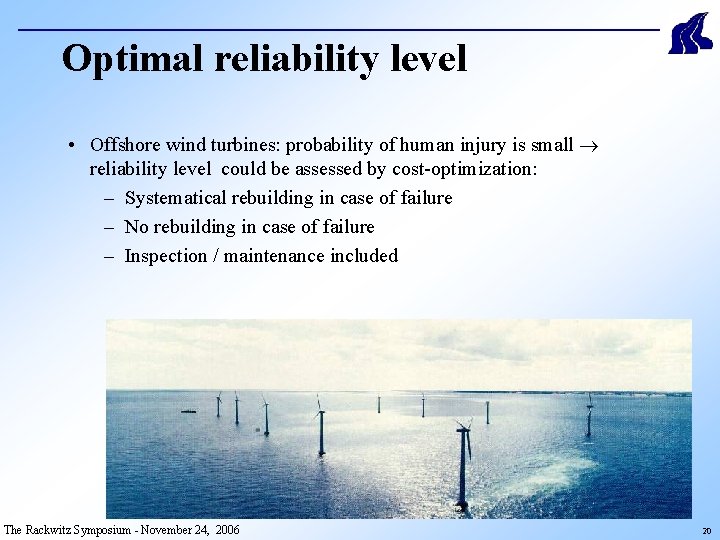
Optimal reliability level • Offshore wind turbines: probability of human injury is small reliability level could be assessed by cost-optimization: – Systematical rebuilding in case of failure – No rebuilding in case of failure – Inspection / maintenance included The Rackwitz Symposium - November 24, 2006 20
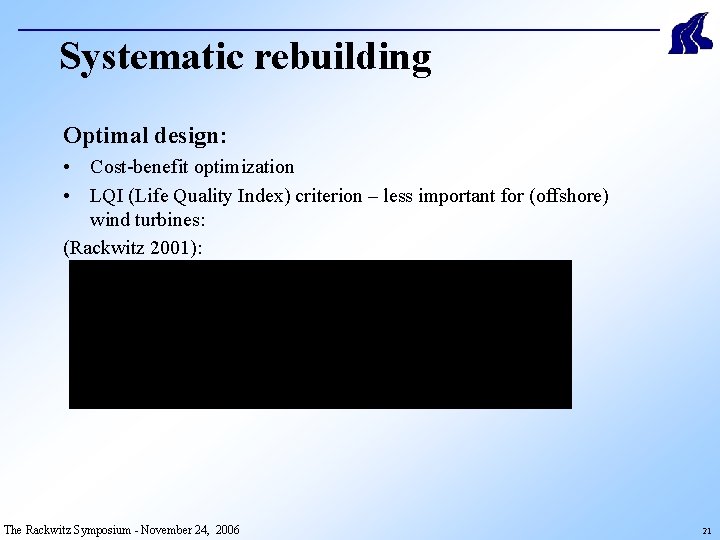
Systematic rebuilding Optimal design: • Cost-benefit optimization • LQI (Life Quality Index) criterion – less important for (offshore) wind turbines: (Rackwitz 2001): The Rackwitz Symposium - November 24, 2006 21
Example – offshore wind turbine with monopile foundation Wind turbine: • 2 MW offshore pitch controlled wind turbine with monopile foundation • Tower height h = 63 m Limit states: • Yielding • Local buckling • Fatigue The Rackwitz Symposium - November 24, 2006 22
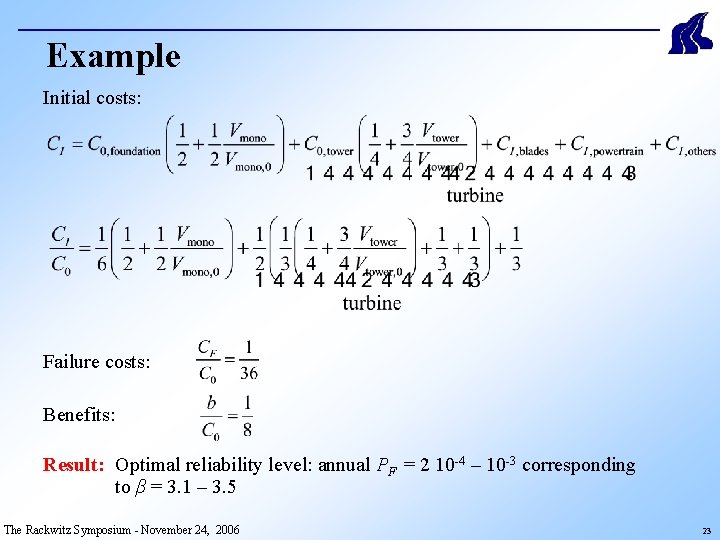
Example Initial costs: Failure costs: Benefits: Result: Optimal reliability level: annual PF = 2 10 -4 – 10 -3 corresponding to β = 3. 1 – 3. 5 The Rackwitz Symposium - November 24, 2006 23
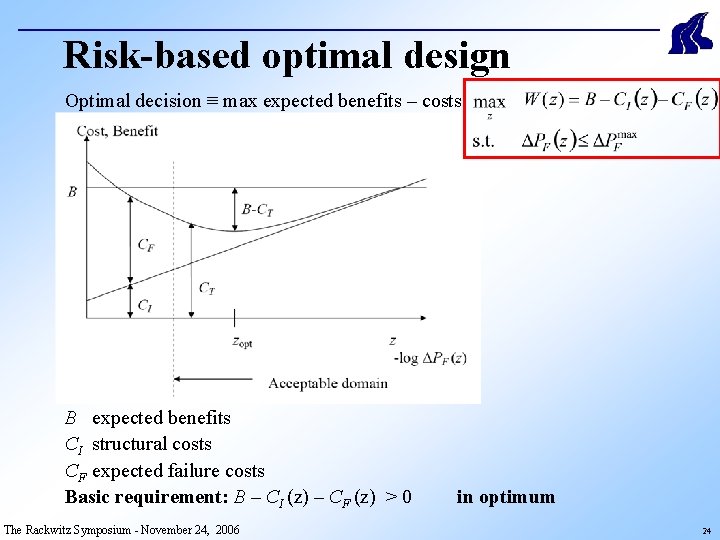
Risk-based optimal design Optimal decision ≡ max expected benefits – costs: B expected benefits CI structural costs CF expected failure costs Basic requirement: B – CI (z) – CF (z) > 0 The Rackwitz Symposium - November 24, 2006 in optimum 24
Probabilistic design of wind turbines 1. Stochastic models for loads, strengths and computational models 2. Reliability analysis of WT limit states (standstill/operation – single/park) 3. Optimal reliability level 4. Direct probabilistic design – use of test results / measurements 5. Reliability-based adjustment of partial factors based on test results 6. Operation & maintenance The Rackwitz Symposium - November 24, 2006 25
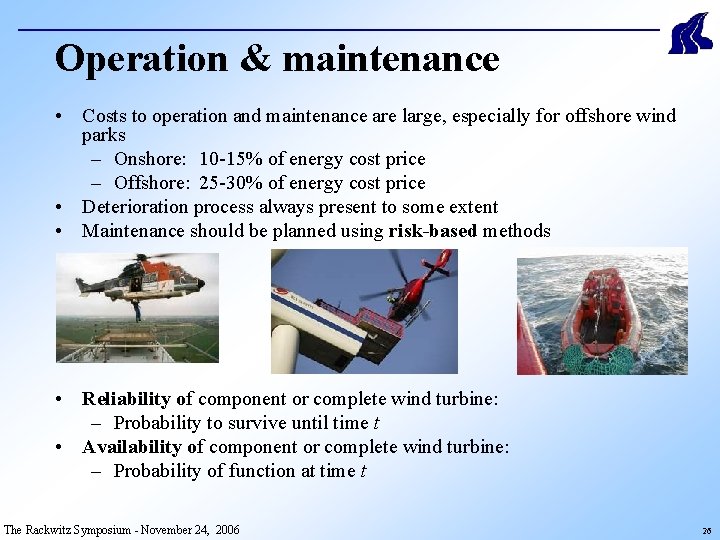
Operation & maintenance • Costs to operation and maintenance are large, especially for offshore wind parks – Onshore: 10 -15% of energy cost price – Offshore: 25 -30% of energy cost price • Deterioration process always present to some extent • Maintenance should be planned using risk-based methods • Reliability of component or complete wind turbine: – Probability to survive until time t • Availability of component or complete wind turbine: – Probability of function at time t The Rackwitz Symposium - November 24, 2006 26
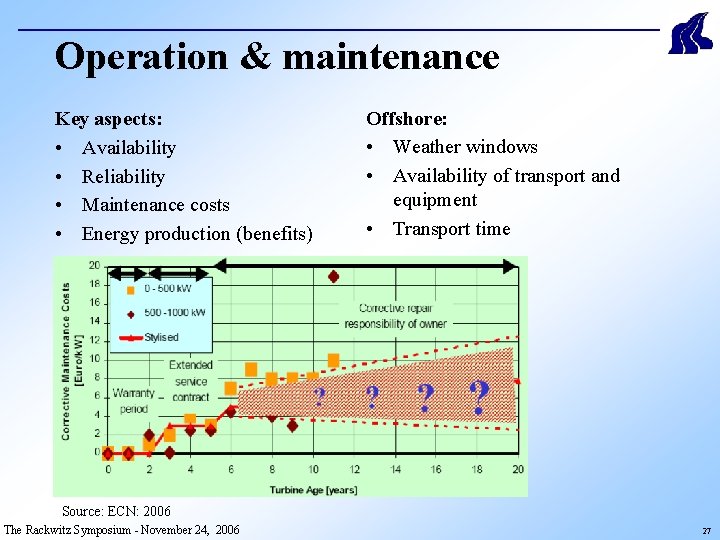
Operation & maintenance Key aspects: • Availability • Reliability • Maintenance costs • Energy production (benefits) Offshore: • Weather windows • Availability of transport and equipment • Transport time Source: ECN: 2006 The Rackwitz Symposium - November 24, 2006 27
Operation & maintenance • Unplanned (corrective): exchange / repair of failed components (Condition Monitoring) cost: 0, 005 – 0, 010 €/k. Wh • Planned (preventive): cost: 0, 003 – 0, 009 €/k. Wh – Scheme: inspections, and evt. repair after predefined scheme – Conditioned: monitor condition of system and decide next on evt. repair based on degree of deterioration → based on pre-posterior Bayesian decision model The Rackwitz Symposium - November 24, 2006 28
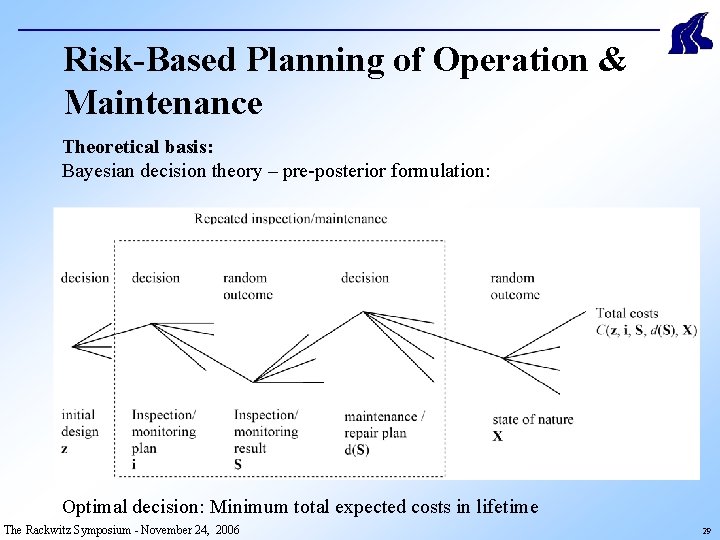
Risk-Based Planning of Operation & Maintenance Theoretical basis: Bayesian decision theory – pre-posterior formulation: Optimal decision: Minimum total expected costs in lifetime The Rackwitz Symposium - November 24, 2006 29
Operation & maintenance Time scale for decisions: • Short: minutes – Operation: ex: stop wind turbine if price is too low • Use uncertainty on wind forecasts and price development in decision • Medium: days – Maintenance: ex: Start maintenance operation on offshore wind turbine • Use uncertainty on weather windows (wave height and wind speed) • Long: month/years – Preventive maintenance – Inspection and monitoring planning • Gear boxes, generators, fatigue critical structural details – … The Rackwitz Symposium - November 24, 2006 30
Summary • Wind turbines: building (standstill) / machine (operation & accidental modes) • Reliability level: lower than civil engineering structures • Design approach: – At present: • LRFD based codes – Future: • direct probabilistic design? • inclusion of test / condition monitoring results on a probabilistic basis • Inspection & maintenance: very important – At present: • mainly based on experience – Future: • risk based – lifetime cost-benefit analyses The Rackwitz Symposium - November 24, 2006 31
- Slides: 31