
Structural Patterns concerned with how classes and objects
Structural Patterns • concerned with how classes and objects are composed to form larger structures ü Adapter • interface converter ü Bridge • decouple abstraction from its implementation ü Composite • compose objects into tree structures, treating all nodes uniformly ü Decorator • attach additional responsibilities dynamically – Façade • provide a unified interface to a subsystem – Flyweight • using sharing to support a large number of fine-grained objects efficiently – Proxy • provide a surrogate for another object to control access 10 - Structural CSC 407 1
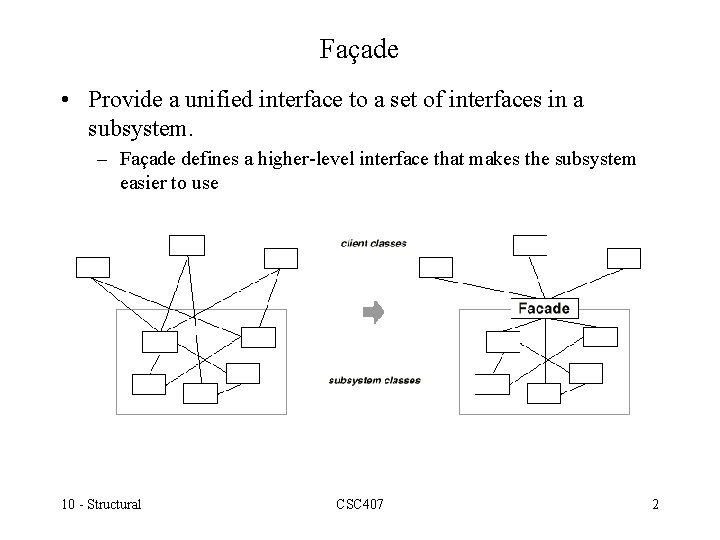
Façade • Provide a unified interface to a set of interfaces in a subsystem. – Façade defines a higher-level interface that makes the subsystem easier to use 10 - Structural CSC 407 2
Façade 10 - Structural CSC 407 3
Applicability • you want a simple interface to a complex subsystem – Subsystems often get more complex as they evolve • this makes the subsystem more reusable and easier to customize, • but it also becomes harder to use for clients that don't need to customize it – A façade can provide a simple default view of the subsystem that is good enough for most clients • Only clients needing more customizability will need to look beyond the façade • there are many dependencies between clients and the implementation classes of an abstraction – Introduce a façade to decouple the subsystem from clients and other subsystems • you want to layer your subsystems – Use a façade to define an entry point to each subsystem level 10 - Structural CSC 407 4
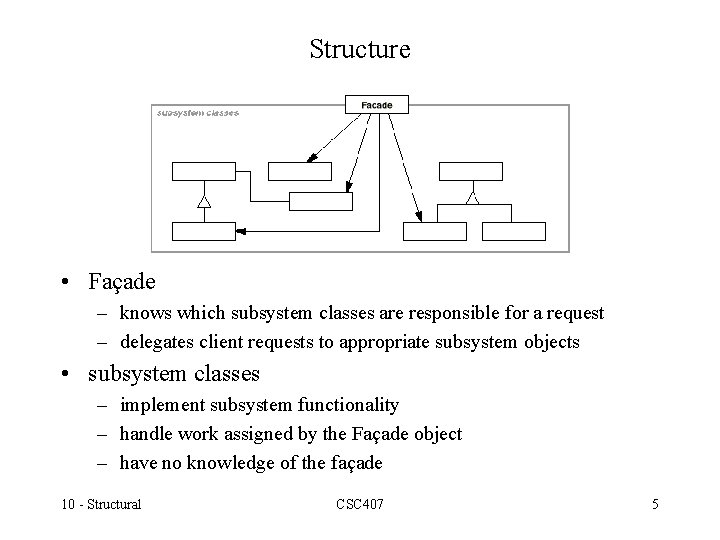
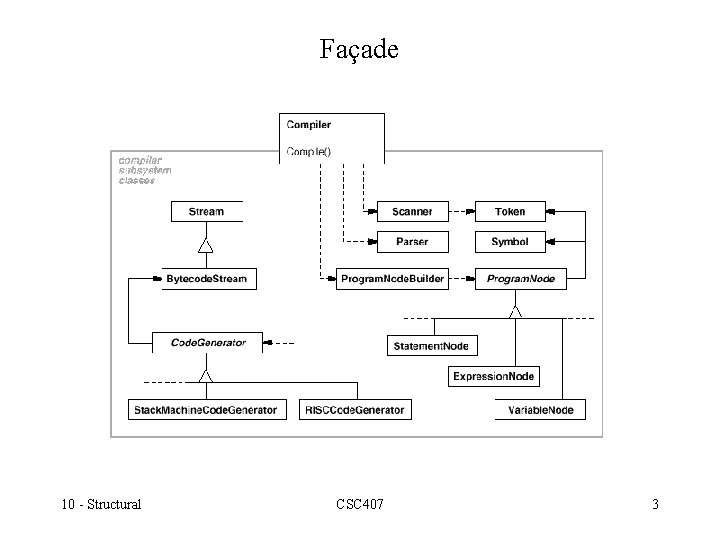
Structure • Façade – knows which subsystem classes are responsible for a request – delegates client requests to appropriate subsystem objects • subsystem classes – implement subsystem functionality – handle work assigned by the Façade object – have no knowledge of the façade 10 - Structural CSC 407 5
Consequences • shields clients from subsystem components – reduces the # of objects clients see • • easier to use subsystem promotes weak coupling between the subsystem and its client – can vary the components of a subsystem without affecting clients – reduces compilation dependencies • doesn't prevent applications from using subsystem classes if they need to. – you can choose between ease of use and generality 10 - Structural CSC 407 6
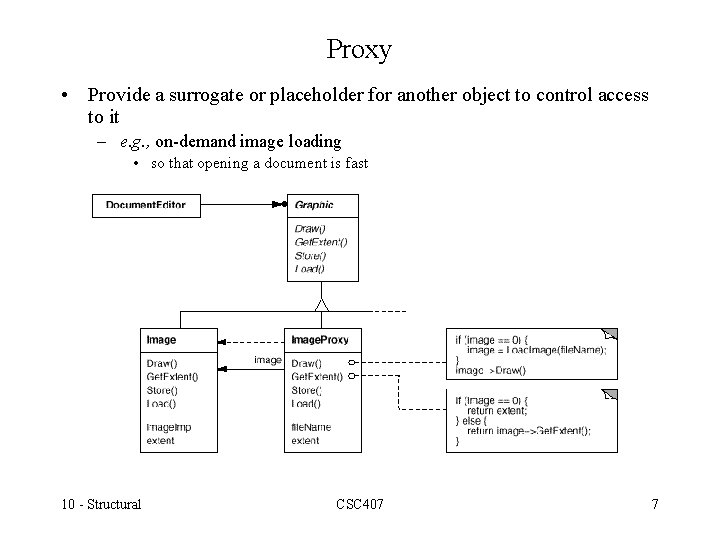
Proxy • Provide a surrogate or placeholder for another object to control access to it – e. g. , on-demand image loading • so that opening a document is fast 10 - Structural CSC 407 7
Applicability • whenever there is a need for a more versatile or sophisticated reference to an object than a simple pointer – A remote proxy provides a local representative for an object in a different address space – A virtual proxy creates expensive objects on demand – A protection proxy controls access to the original object. – Protection proxies are useful when objects should have different access rights – A smart reference is a replacement for a bare pointer that performs additional actions when an object is accessed • • • counting the number of references to the real object (smart pointer) loading a persistent object into memory when it's first referenced checking that the real object is locked before it's accessed to ensure that no other object can change it – COW (copy-on-write) 10 - Structural CSC 407 8
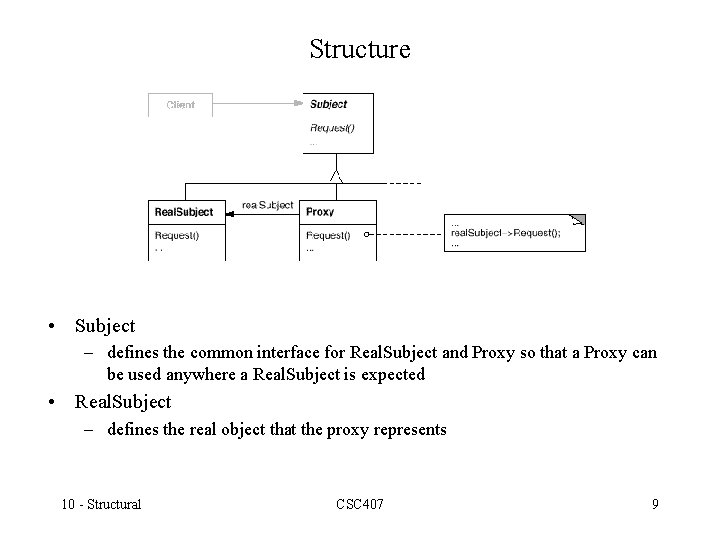
Structure • Subject – defines the common interface for Real. Subject and Proxy so that a Proxy can be used anywhere a Real. Subject is expected • Real. Subject – defines the real object that the proxy represents 10 - Structural CSC 407 9

Structure • Proxy – maintains a reference that lets the proxy access the real subject – provides an interface identical to Subject's so that a proxy can by substituted for the real subject – controls access to the real subject and may be responsible for creating and deleting it • remote proxies are responsible for encoding a request and its arguments and for sending the encoded request to the real subject in a different address space • virtual proxies may cache additional information about the real subject so that they can postpone accessing it • protection proxies check that the caller has the access permissions required to perform a request 10 - Structural CSC 407 10

Flyweight • Use sharing to support large numbers of fine-grained objects efficiently 10 - Structural CSC 407 11
Applicability • Use when: – – An application uses a large number of objects Storage costs are high because of the sheer quantity of objects Most object state can be made extrinsic Many groups of objects may be replaced by relatively few shared objects once extrinsic state is removed – The application doesn't depend on object identity • Since flyweight objects may be shared, identity tests will return true for conceptually distinct objects 10 - Structural CSC 407 12
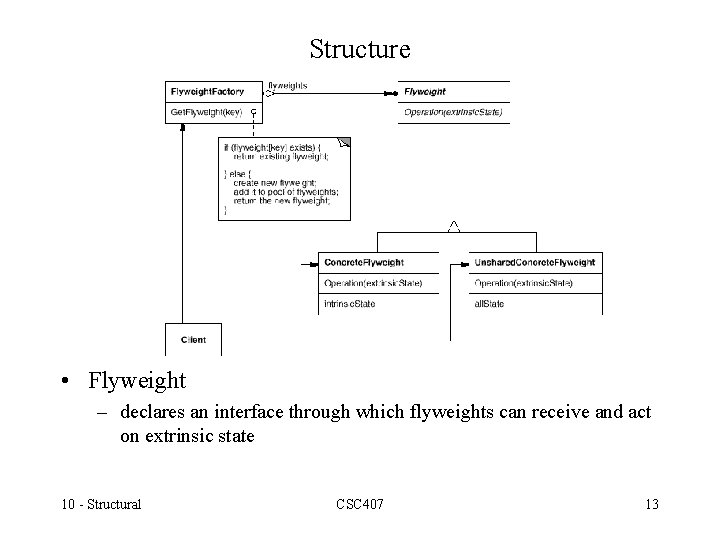
Structure • Flyweight – declares an interface through which flyweights can receive and act on extrinsic state 10 - Structural CSC 407 13
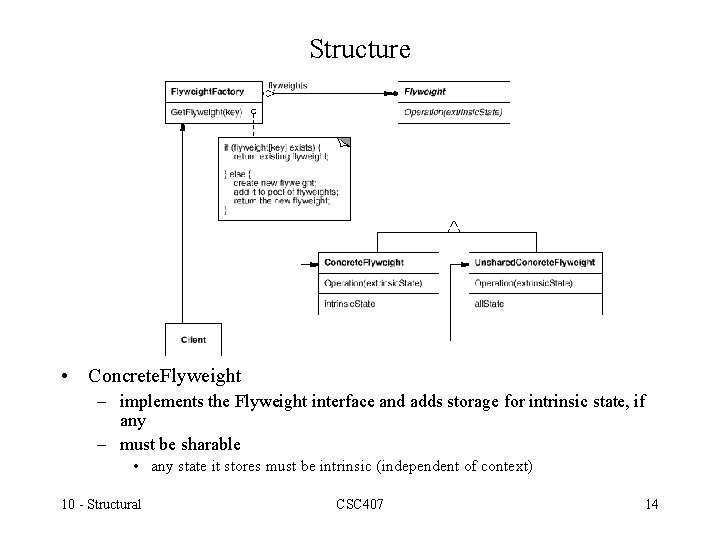
Structure • Concrete. Flyweight – implements the Flyweight interface and adds storage for intrinsic state, if any – must be sharable • any state it stores must be intrinsic (independent of context) 10 - Structural CSC 407 14
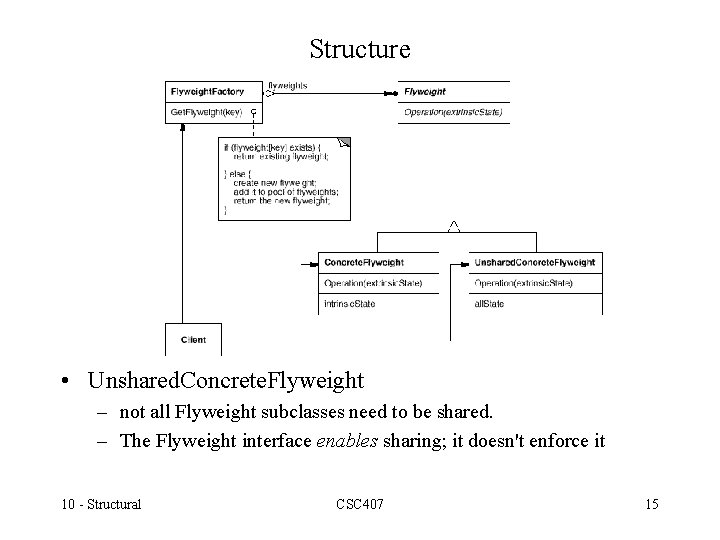
Structure • Unshared. Concrete. Flyweight – not all Flyweight subclasses need to be shared. – The Flyweight interface enables sharing; it doesn't enforce it 10 - Structural CSC 407 15
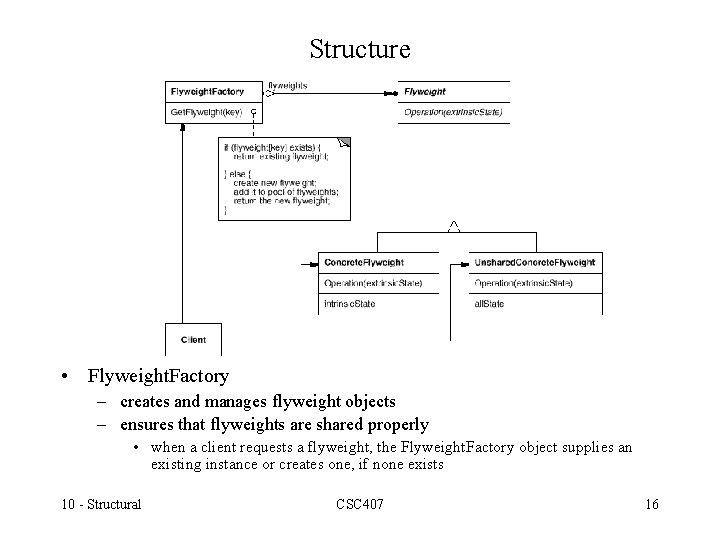
Structure • Flyweight. Factory – creates and manages flyweight objects – ensures that flyweights are shared properly • when a client requests a flyweight, the Flyweight. Factory object supplies an existing instance or creates one, if none exists 10 - Structural CSC 407 16
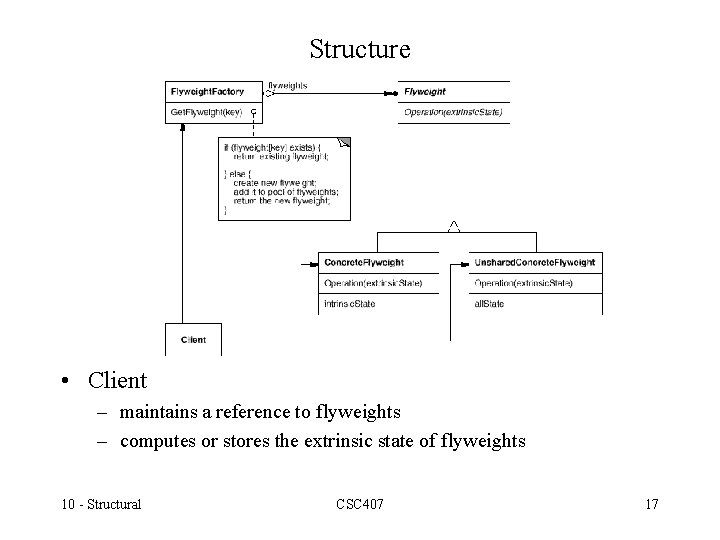
Structure • Client – maintains a reference to flyweights – computes or stores the extrinsic state of flyweights 10 - Structural CSC 407 17
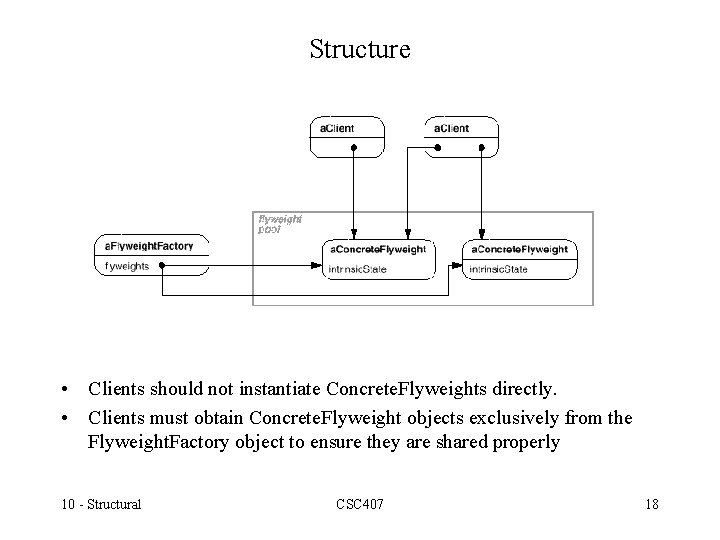
Structure • Clients should not instantiate Concrete. Flyweights directly. • Clients must obtain Concrete. Flyweight objects exclusively from the Flyweight. Factory object to ensure they are shared properly 10 - Structural CSC 407 18
Consequences • Flyweights introduce run-time costs associated with transferring, finding, and/or computing extrinsic state. • Costs are offset by space savings – (which also save run-time costs) – depends on • the reduction in the total number of instances that comes from sharing • the amount of intrinsic state per object • whether extrinsic state is computed or stored • Often coupled with Composite to represent a hierarchical structure as a graph with shared leaf nodes – flyweight leaf nodes cannot store a pointer to their parent – parent pointer is passed to the flyweight as part of its extrinsic state • profound effect on object collaboration 10 - Structural CSC 407 19
Implementation • Extrinsic State e. g. , Document editor – character font, type style, and colour. – store a map that keeps track of runs of characters with the same typographic attributes • Shared Objects – Flyweight. Factory can use an associative array to find existing instances. – need reference counting for garbage collection 10 - Structural CSC 407 20
- Slides: 20