
Structural Parameters in Coma Legacy Survey Leiden AstroWISE
- Slides: 25
Structural Parameters in Coma Legacy Survey Leiden Astro-WISE meeting 2008 April 1 Marc Balcells (IAC) 1
Topics 1. Coma ACS structural analysis plan 2. Results to date 1. Sextractor photometric errors: realistic estimates 2. Structural parameter errors 1. Comparison GALFIT vs GIM 2 D • Usefulness of Astro-WISE 2
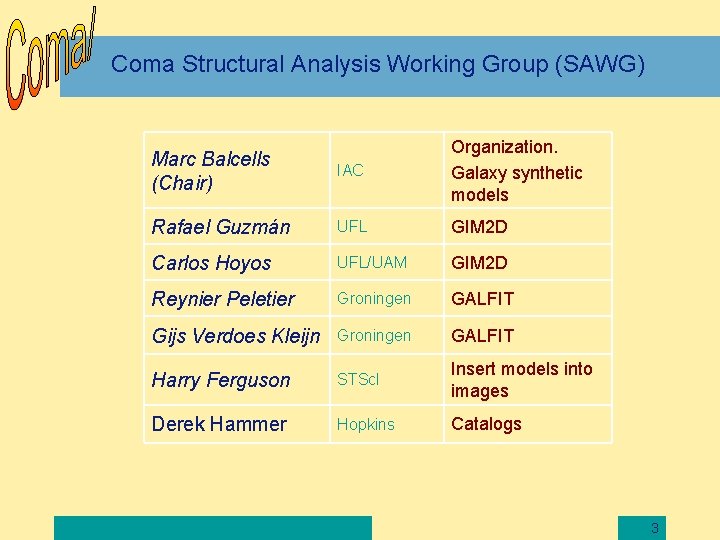
Coma Structural Analysis Working Group (SAWG) Marc Balcells (Chair) IAC Organization. Galaxy synthetic models Rafael Guzmán UFL GIM 2 D Carlos Hoyos UFL/UAM GIM 2 D Reynier Peletier Groningen GALFIT Gijs Verdoes Kleijn Groningen GALFIT Harry Ferguson STSc. I Insert models into images Derek Hammer Hopkins Catalogs 3
SAWG mission Provide photometry and structural parameters of given catalogs • Input: catalogs provided by Catalogs Team • SAWG contribution to catalog generation: 1. Subtracting bright galaxies 2. Detection efficiency. Spurious sources. Photometric errors. • Output: catalog of photometry and structural parameters 4
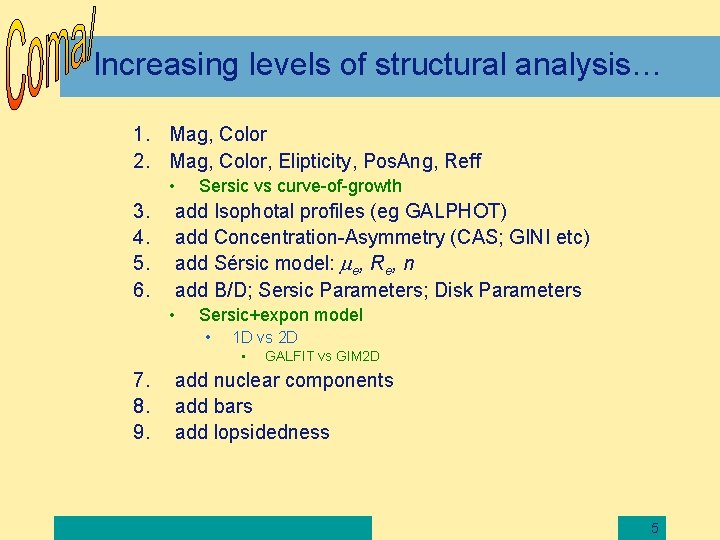
Increasing levels of structural analysis… 1. Mag, Color 2. Mag, Color, Elipticity, Pos. Ang, Reff • 3. 4. 5. 6. Sersic vs curve-of-growth add Isophotal profiles (eg GALPHOT) add Concentration-Asymmetry (CAS; GINI etc) add Sérsic model: e, Re, n add B/D; Sersic Parameters; Disk Parameters • Sersic+expon model • 1 D vs 2 D • 7. 8. 9. GALFIT vs GIM 2 D add nuclear components add bars add lopsidedness 5
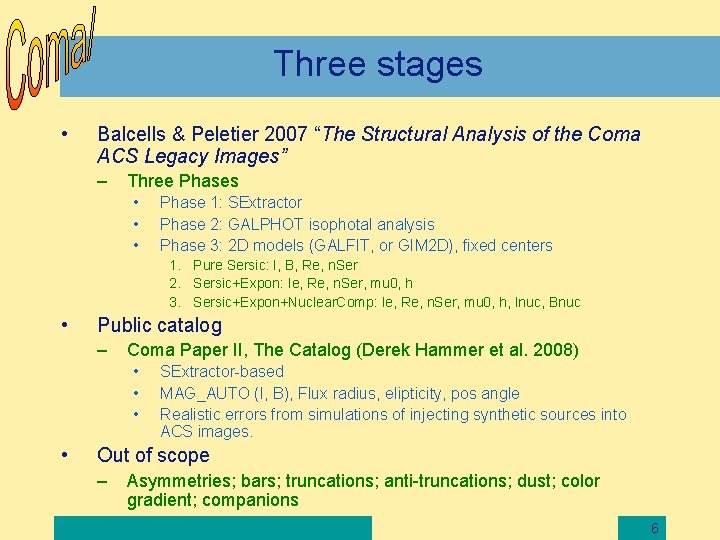
Three stages • Balcells & Peletier 2007 “The Structural Analysis of the Coma ACS Legacy Images” – Three Phases • • • Phase 1: SExtractor Phase 2: GALPHOT isophotal analysis Phase 3: 2 D models (GALFIT, or GIM 2 D), fixed centers 1. Pure Sersic: I, B, Re, n. Ser 2. Sersic+Expon: Ie, Re, n. Ser, mu 0, h 3. Sersic+Expon+Nuclear. Comp: Ie, Re, n. Ser, mu 0, h, Inuc, Bnuc • Public catalog – Coma Paper II, The Catalog (Derek Hammer et al. 2008) • • SExtractor-based MAG_AUTO (I, B), Flux radius, elipticity, pos angle Realistic errors from simulations of injecting synthetic sources into ACS images. Out of scope – Asymmetries; bars; truncations; anti-truncations; dust; color gradient; companions 6
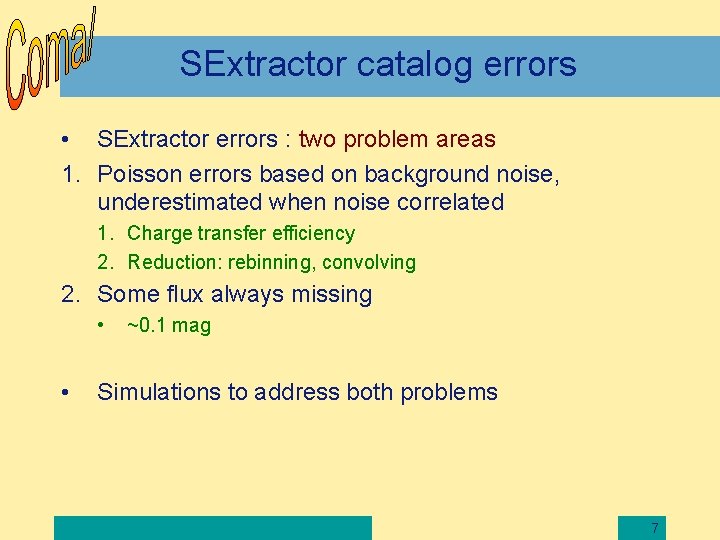
SExtractor catalog errors • SExtractor errors : two problem areas 1. Poisson errors based on background noise, underestimated when noise correlated 1. Charge transfer efficiency 2. Reduction: rebinning, convolving 2. Some flux always missing • • ~0. 1 mag Simulations to address both problems 7
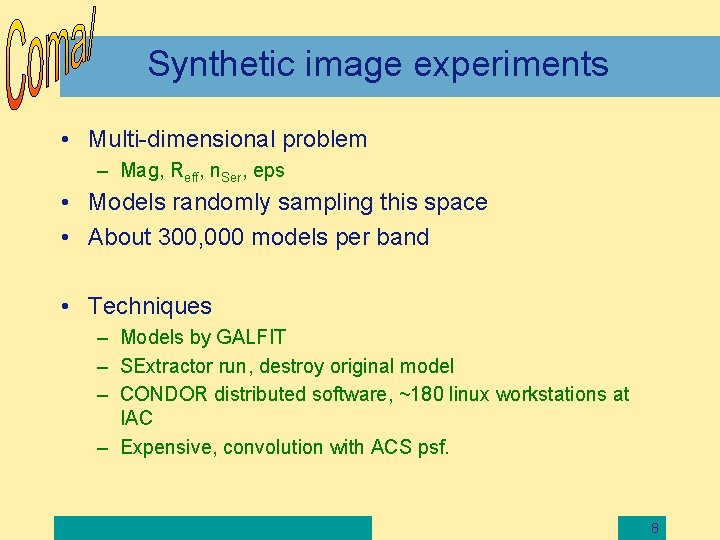
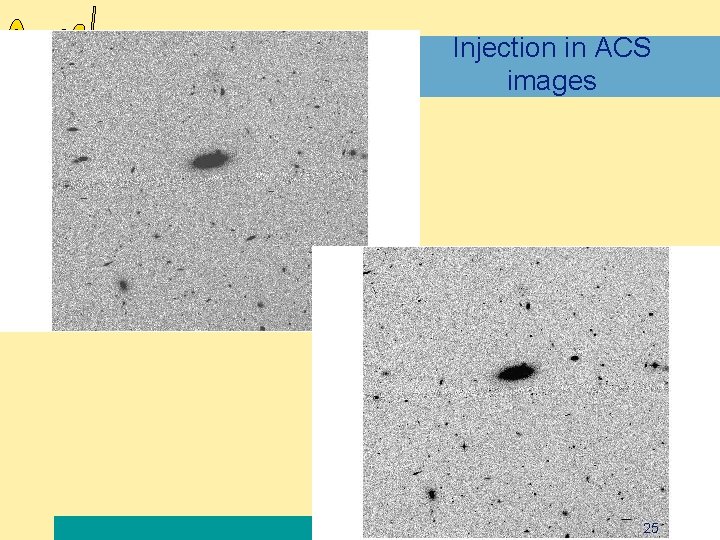
Synthetic image experiments • Multi-dimensional problem – Mag, Reff, n. Ser, eps • Models randomly sampling this space • About 300, 000 models per band • Techniques – Models by GALFIT – SExtractor run, destroy original model – CONDOR distributed software, ~180 linux workstations at IAC – Expensive, convolution with ACS psf. 8
Wings of stellar PSFs: King (1971) 9
Missing flux - PSF convolution • PSF extended wings • About 0. 05 mag • May be added as an aperture correction • Does not show up in simulations if model PSF is truncated to ~4 -5 FWHM 10
Missing flux - SExtractor truncation eps < 0. 4 eps > • Often argued that sky overestimated, subtracts too much light from galaxy – Can happen, can be cured • The basic SExtractor problem is truncation n. Ser > 2. 5 n. Ser < 2. 5 11
SExtractor cuts at 2. 5 R 1 12
eps < 0. 4 > 0. 4 eps Solution: compute flux outside 2. 5 R 1 n. Ser > 2. 5 n. Ser < 2. 5 eps < 0. 4 > 0. 4 eps n. Ser > 2. 5 • • Offsets disappear errors at faint mu are symmetric n. Ser < 2. 5 13
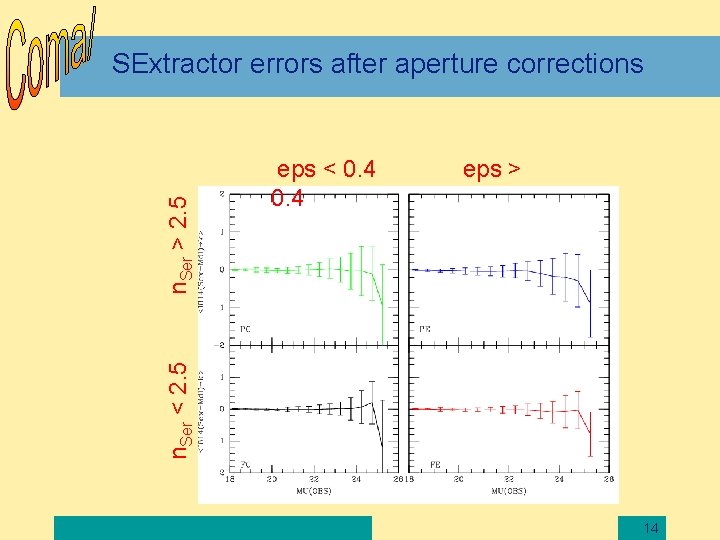
eps < 0. 4 eps > n. Ser < 2. 5 n. Ser > 2. 5 SExtractor errors after aperture corrections 14
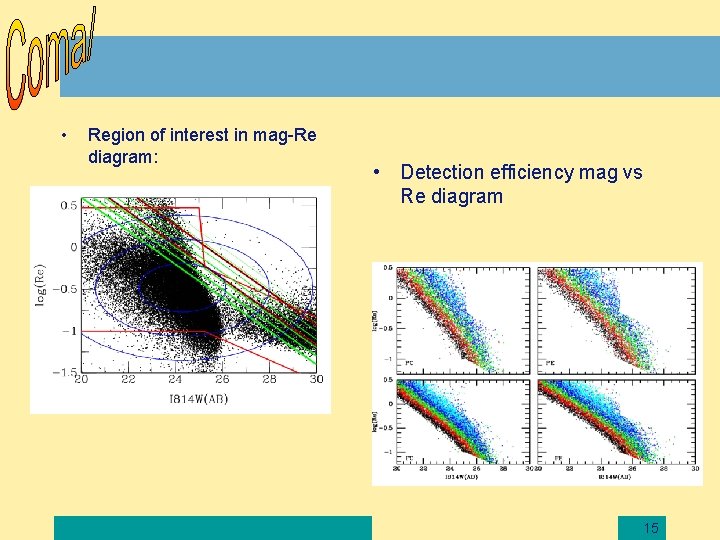
• Region of interest in mag-Re diagram: • Detection efficiency mag vs Re diagram 15
Choosing a code for 2 D structural modeling • Two codes optimized for automatic fitting – GIM 2 D (Simard et al 2003) – GALFIT (Peng et al. 2002) • A recent comparison – Haussler et al 2007 (astro-ph/0704. 2601) GEMS team • Conclude: – both codes deemed good – Devil is in the details - devil is in the sky! – Issue with companions / masking nearby objects / fitting simultaneously • Us: our own tests. First step has been with exactly same models as in GEMS paper. 16
Experiments with GEMS models • Two images from GEMS – Disk 0001 (expon profiles) – Bulge 0001 (de. V profiles) • Sextractor (Hoyos) • GALFIT (Verdoes, Peletier) • GIM 2 D (Hoyos, Guzman) 17
Our conclusions • We reproduce conclusions of Haussler et al (2007) • GIM 2 D can be better than reported by Haussler et al. at the expense of more manual intervention – But GIM 2 D is an automatic code • GALFIT advantage is that it can fit more than two components – Sersic, Expon, Nuclear source 18
Astro-WISE • Used by Groningen team • Could other teams have done their simulations using Astro-WISE? ? – Eg Carlos Hoyos, from Madrid, fitting Gim 2 D – Me: provide IRAF scripts to generate 1000’s bulge-disk models into Coma ACS images in astro-WISE 19
Is use of Astro-WISE desirable … • … for entire Coma-ACS team? • YES… • Pros – – Making processes more systematic, Pre-plan steps Quality control History, memory of previous steps • Difficulties – Find your way especially as you come into the system • Wishes – Be able to operate on the data stored in Astro-WISE with or own codes 20
Astro-WISE for newcomers… • … like me and most in the Coma Survey • People coming from outside: – Want to get their thing done • Without having to read (much) documentation • The all-familiar IRAF case… • You can flat-field, copy and display an image the first day. • You only need a very skeletal knowledge to start: – tasks – epar task 21
CONclusions • Clearly a very powerful system • Think more on user interface 22
Astro-WISE • Astro-WISE might benefit from taking care of this level: the skeletal level of knowledge that allows the novice user to get something done – Once we know how to get something done, we will progressively learn the inner workings. • Another example: look at my laptop – Underneath the smooth performance, lots of C++, classes, dictionaries – The user needs not know ANY of that. • Mac OSX, a model of user interface – The user only thinks his own language – Apple, a long tradition of intuitive User Interface 23
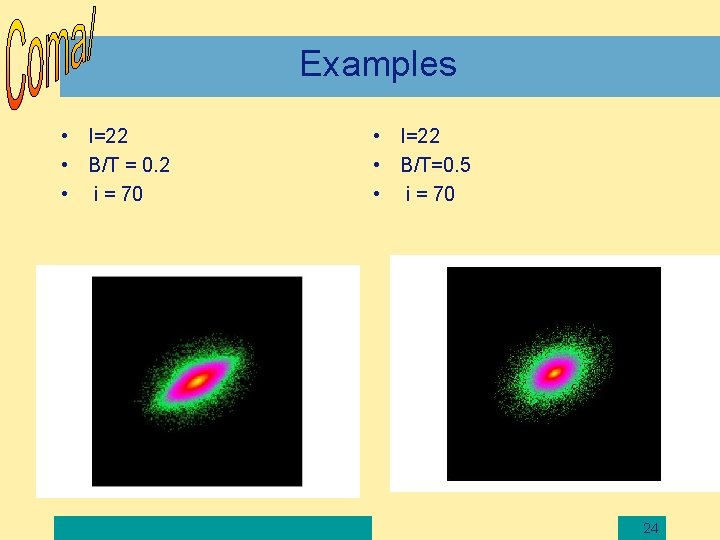
Examples • I=22 • B/T = 0. 2 • i = 70 • I=22 • B/T=0. 5 • i = 70 24
Injection in ACS images 25