
Structural Materials RD for ITER Test Blanket Modules
Structural Materials R&D for ITER Test Blanket Modules R. J Kurtz 1 and S. J. Zinkle 2 1 Pacific Northwest National Laboratory 2 Oak Ridge National Laboratory ITER-TBM Meeting August 10 -12, 2005 Idaho Falls, ID U. S. Department of Energy Pacific Northwest National Laboratory
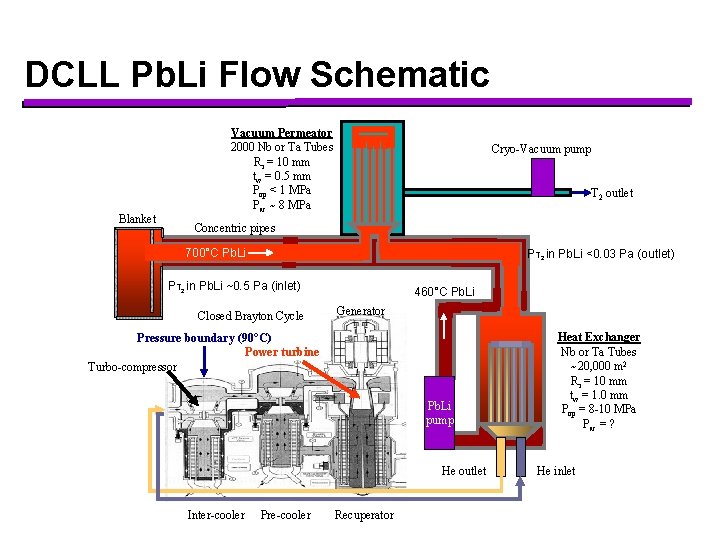
DCLL Pb. Li Flow Schematic Blanket Vacuum Permeator 2000 Nb or Ta Tubes Ri = 10 mm tw = 0. 5 mm Pop < 1 MPa Pac ~ 8 MPa Cryo-Vacuum pump T 2 outlet Concentric pipes 700°C Pb. Li PT 2 in Pb. Li <0. 03 Pa (outlet) PT 2 in Pb. Li ~0. 5 Pa (inlet) Closed Brayton Cycle 460°C Pb. Li Generator Pressure boundary (90°C) Power turbine Turbo-compressor Pb. Li pump He outlet Inter-cooler Pre-cooler Recuperator Heat Exchanger Nb or Ta Tubes ~20, 000 m 2 Ri = 10 mm tw = 1. 0 mm Pop = 8 -10 MPa Pac = ? He inlet
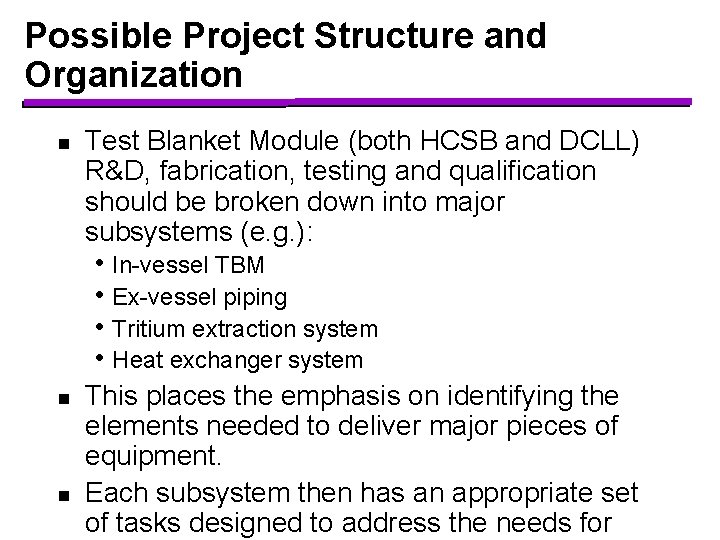
Possible Project Structure and Organization n Test Blanket Module (both HCSB and DCLL) R&D, fabrication, testing and qualification should be broken down into major subsystems (e. g. ): • In-vessel TBM • Ex-vessel piping • Tritium extraction system • Heat exchanger system n n This places the emphasis on identifying the elements needed to deliver major pieces of equipment. Each subsystem then has an appropriate set of tasks designed to address the needs for
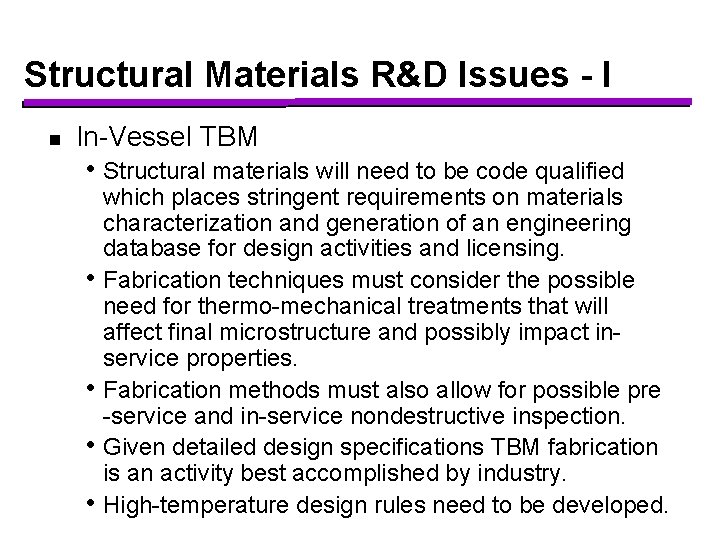
Structural Materials R&D Issues - I n In-Vessel TBM • Structural materials will need to be code qualified • • which places stringent requirements on materials characterization and generation of an engineering database for design activities and licensing. Fabrication techniques must consider the possible need for thermo-mechanical treatments that will affect final microstructure and possibly impact inservice properties. Fabrication methods must also allow for possible pre -service and in-service nondestructive inspection. Given detailed design specifications TBM fabrication is an activity best accomplished by industry. High-temperature design rules need to be developed.
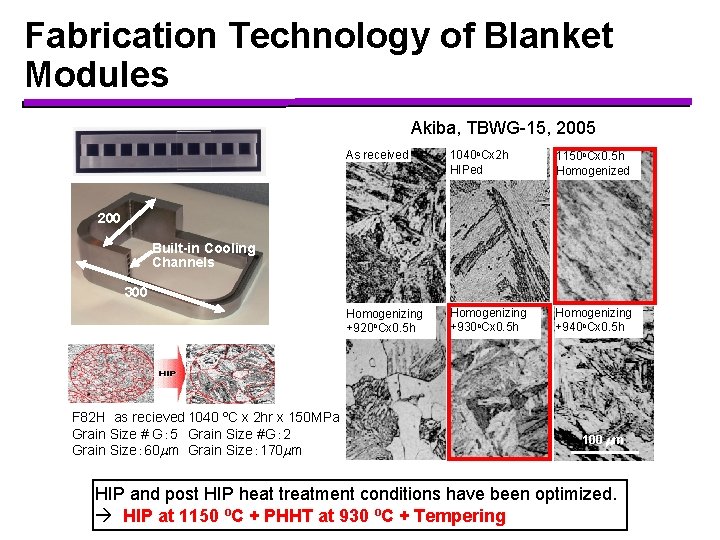
Fabrication Technology of Blanket Modules Akiba, TBWG-15, 2005 As received 1040 o. Cx 2 h HIPed 1150 o. Cx 0. 5 h Homogenized Homogenizing +920 o. Cx 0. 5 h Homogenizing +930 o. Cx 0. 5 h Homogenizing +940 o. Cx 0. 5 h 200 Built-in Cooling Channels 300 F 82 H as recieved 1040 ºC x 2 hr x 150 MPa Grain Size # G: 5 Grain Size #G: 2 Grain Size: 60 mm Grain Size: 170 mm 100 mm HIP and post HIP heat treatment conditions have been optimized. HIP at 1150 ºC + PHHT at 930 ºC + Tempering
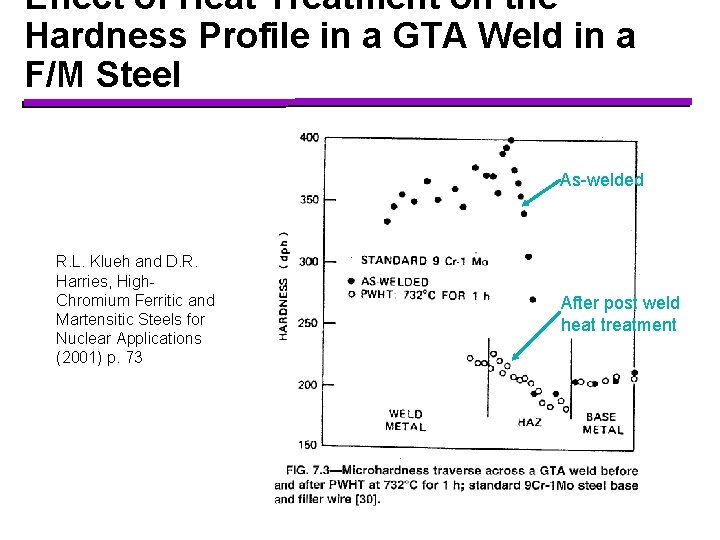
Effect of Heat Treatment on the Hardness Profile in a GTA Weld in a F/M Steel As-welded R. L. Klueh and D. R. Harries, High. Chromium Ferritic and Martensitic Steels for Nuclear Applications (2001) p. 73 After post weld heat treatment
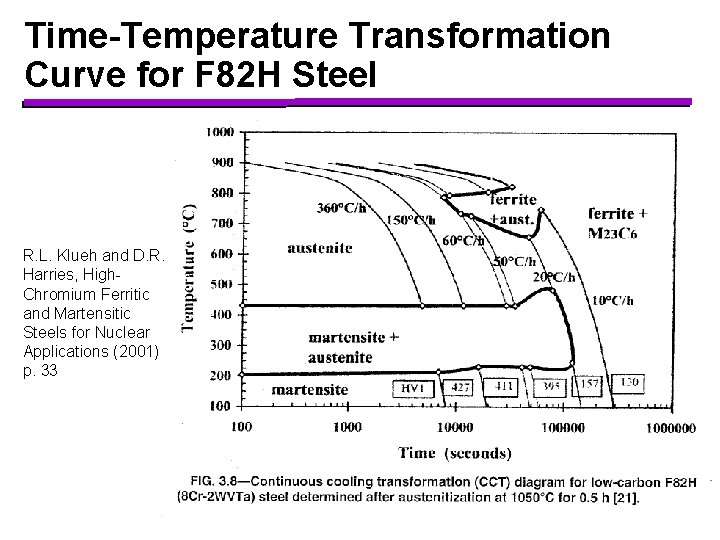
Time-Temperature Transformation Curve for F 82 H Steel R. L. Klueh and D. R. Harries, High. Chromium Ferritic and Martensitic Steels for Nuclear Applications (2001) p. 33
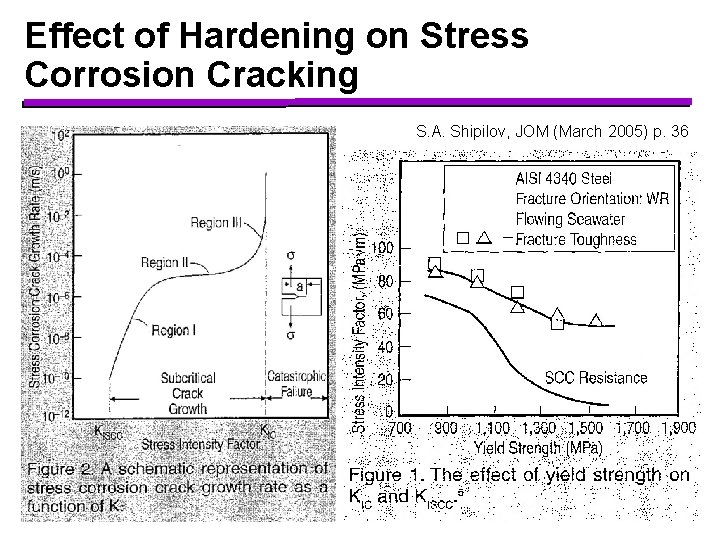
Effect of Hardening on Stress Corrosion Cracking S. A. Shipilov, JOM (March 2005) p. 36
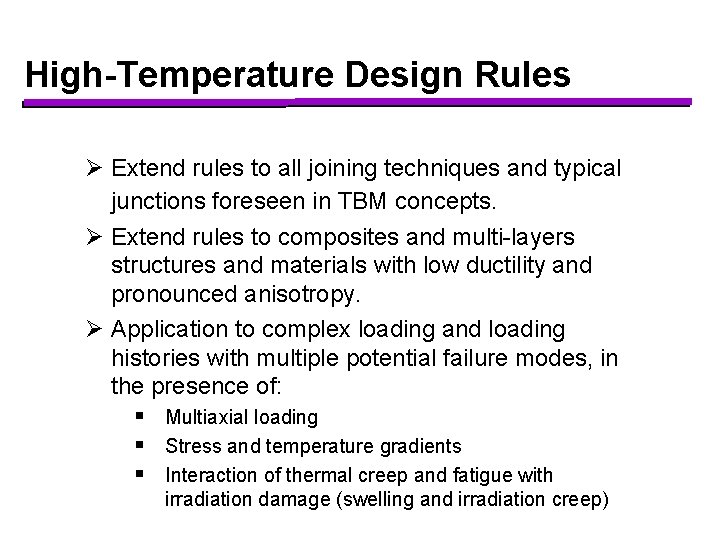
High-Temperature Design Rules Ø Extend rules to all joining techniques and typical junctions foreseen in TBM concepts. Ø Extend rules to composites and multi-layers structures and materials with low ductility and pronounced anisotropy. Ø Application to complex loading and loading histories with multiple potential failure modes, in the presence of: § Multiaxial loading § Stress and temperature gradients § Interaction of thermal creep and fatigue with irradiation damage (swelling and irradiation creep)
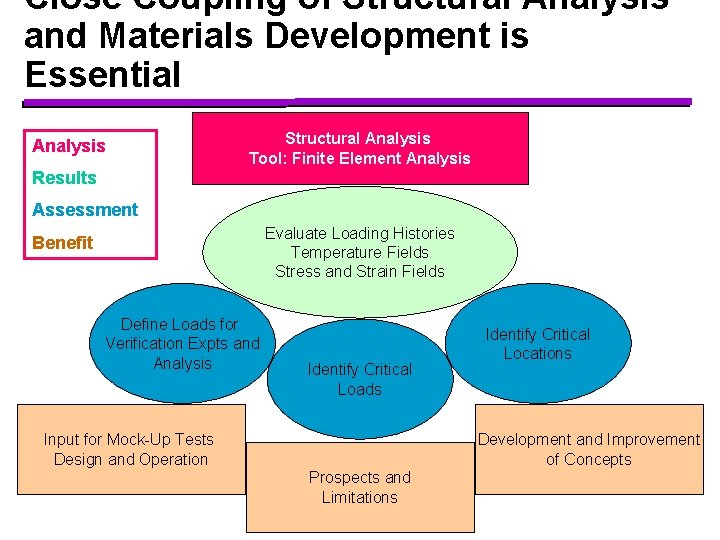
Close Coupling of Structural Analysis and Materials Development is Essential Analysis Structural Analysis Tool: Finite Element Analysis Results Assessment Evaluate Loading Histories Temperature Fields Stress and Strain Fields Benefit Define Loads for Verification Expts and Analysis Identify Critical Loads Input for Mock-Up Tests Design and Operation Identify Critical Locations Development and Improvement of Concepts Prospects and Limitations
Structural Materials R&D Issues - II n In-Vessel TBM • For ITER the choice of structural material is limited to • • F 82 H and Eurofer since the U. S. needs to take advantage of the large international database on these steels. Development of joining technology of Be to ferritic steel (structural materials issue? ). Effects of radiation to ~3 dpa at 100 -550°C on the deformation and fracture properties of structural materials. The upcoming U. S. /Japan HFIR 15 J/16 J irradiation experiment provides a good approximation of the TBM irradiation conditions (300/400°C, 2. 5 -5 dpa). New heat of Eurofer to be included. The irradiation performance of specific manufacturing processes and joining techniques such as HIPped and diffusion bonded materials
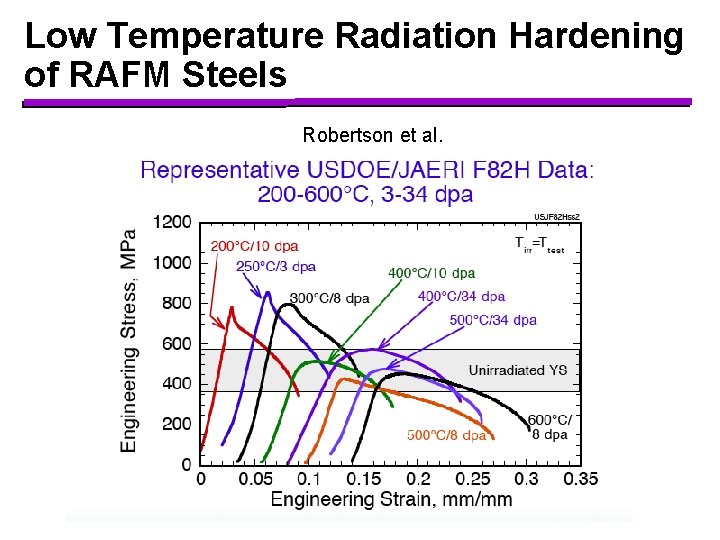
Low Temperature Radiation Hardening of RAFM Steels Robertson et al.
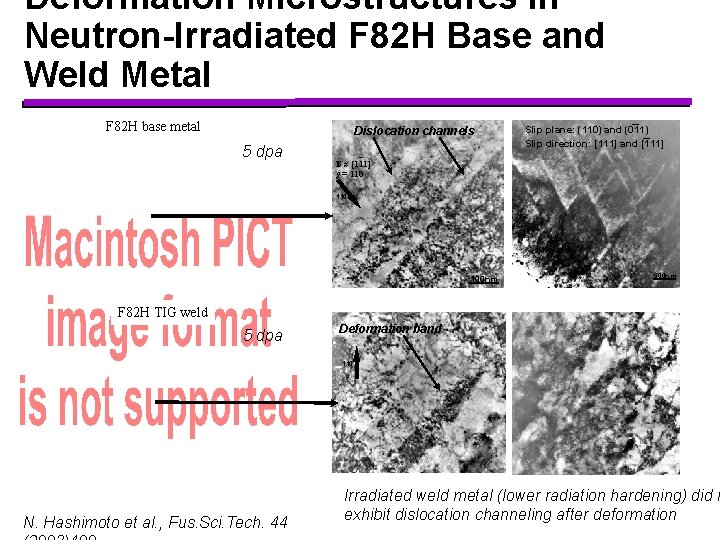
Deformation Microstructures in Neutron-Irradiated F 82 H Base and Weld Metal F 82 H base metal Dislocation channels 5 dpa Slip plane: (110) and (011) Slip direction: [111] and [111] B ≈ [111] g = 110 100 nm 500 nm F 82 H TIG weld 5 dpa Deformation band 110 N. Hashimoto et al. , Fus. Sci. Tech. 44 Irradiated weld metal (lower radiation hardening) did n exhibit dislocation channeling after deformation
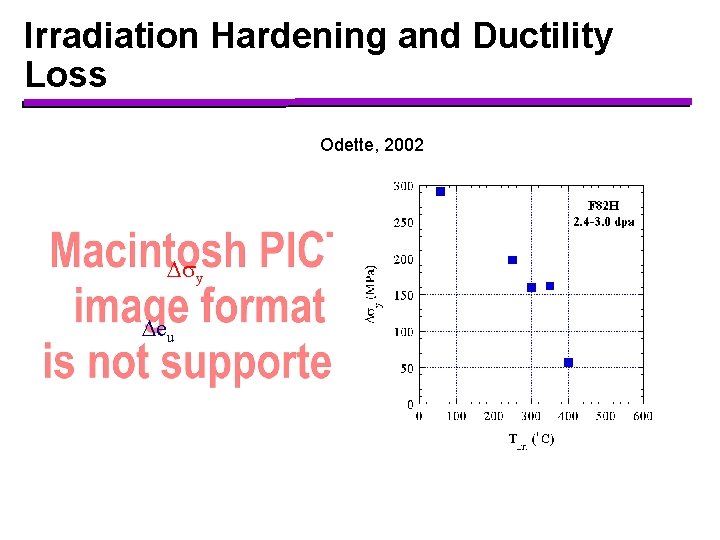
Irradiation Hardening and Ductility Loss Odette, 2002 Dsy Deu
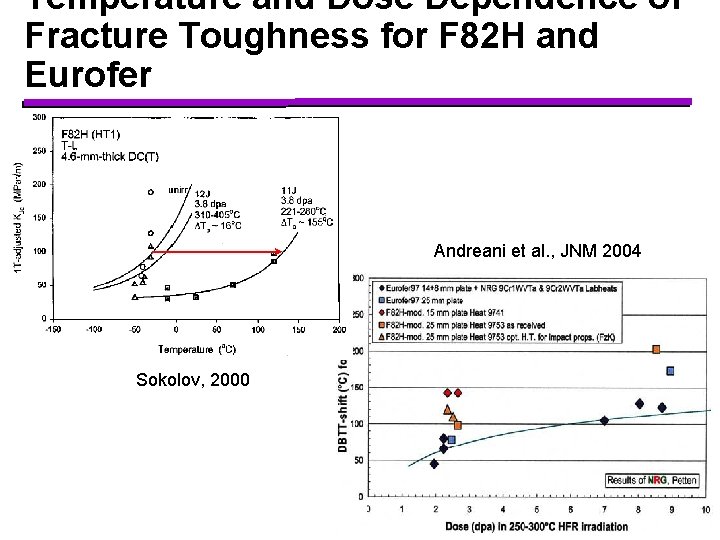
Temperature and Dose Dependence of Fracture Toughness for F 82 H and Eurofer Andreani et al. , JNM 2004 Sokolov, 2000
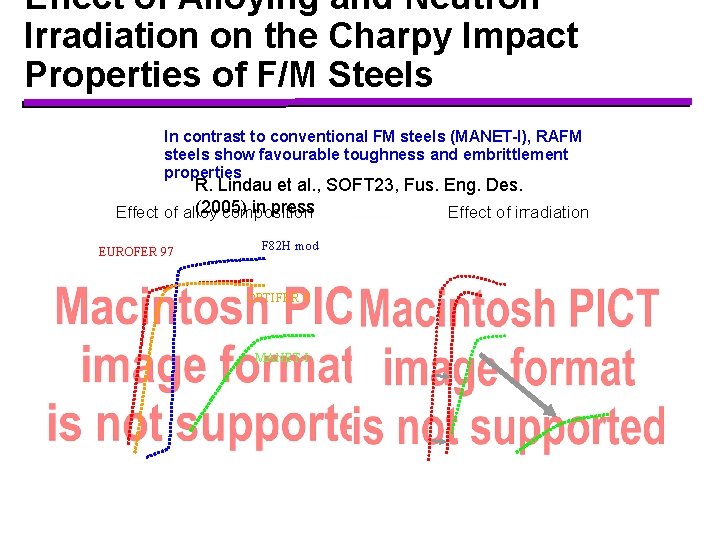
Effect of Alloying and Neutron Irradiation on the Charpy Impact Properties of F/M Steels In contrast to conventional FM steels (MANET-I), RAFM steels show favourable toughness and embrittlement properties R. Lindau et al. , SOFT 23, Fus. Eng. Des. (2005) in press Effect of irradiation Effect of alloy composition EUROFER 97 F 82 H mod OPTIFER V MANET-I
Structural Materials R&D Issues - III n Ex-Vessel Piping • Chemical compatibility of structural materials with • n Pb. Li to ~700°C. Aluminum bearing corrosion resistant alloys show promise of forming a protective alumina surface layer, lowering corrosion in Pb. Li. A critical need is to carry out tests in a Pb. Li loop with thermal gradients. Tritium Extraction System • To achieve high performance from DCLL concept • • • may require use of refractory metals. The acceptable inventory of gaseous impurities and the kinetics of impurity pickup control mechanical behavior of these metals. The partial pressure of oxygen must be <10 -10 torr to limit unacceptable oxygen ingress. The compatibility of refractory metals with flowing,
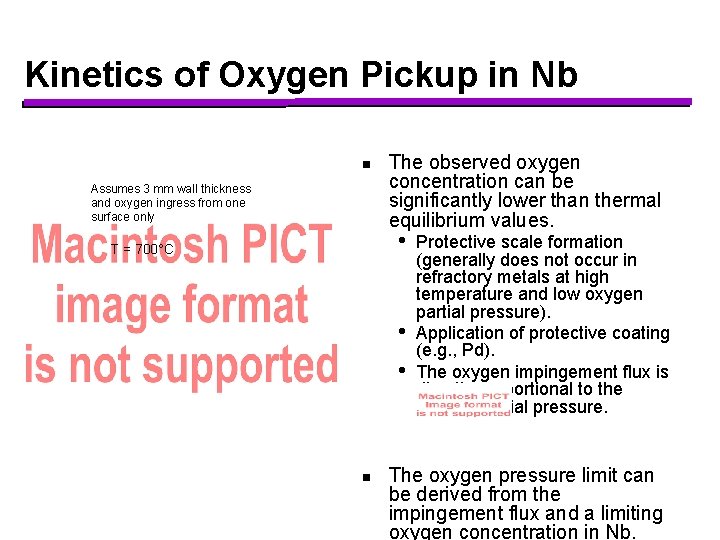
Kinetics of Oxygen Pickup in Nb n Assumes 3 mm wall thickness and oxygen ingress from one surface only The observed oxygen concentration can be significantly lower than thermal equilibrium values. • T = 700°C • • n Protective scale formation (generally does not occur in refractory metals at high temperature and low oxygen partial pressure). Application of protective coating (e. g. , Pd). The oxygen impingement flux is directly proportional to the oxygen partial pressure. The oxygen pressure limit can be derived from the impingement flux and a limiting oxygen concentration in Nb.
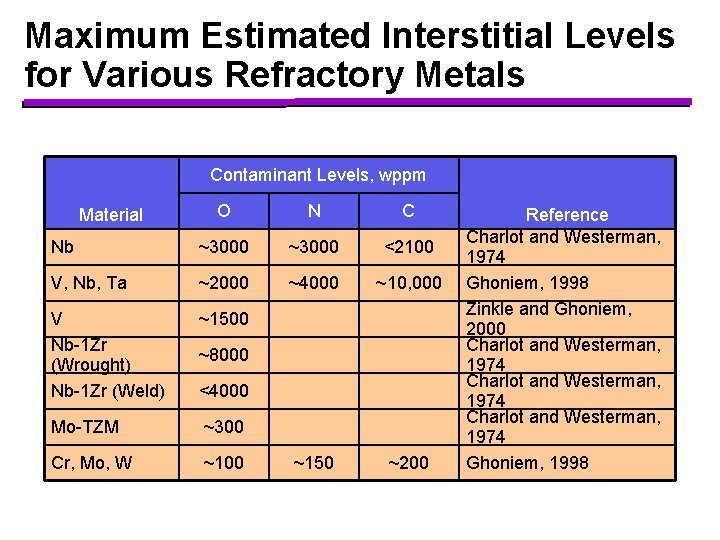
Maximum Estimated Interstitial Levels for Various Refractory Metals Contaminant Levels, wppm O N C Nb ~3000 <2100 V, Nb, Ta ~2000 ~4000 ~10, 000 V Nb-1 Zr (Wrought) Nb-1 Zr (Weld) ~1500 Mo-TZM ~300 Cr, Mo, W ~100 ~150 ~200 Material ~8000 <4000 Reference Charlot and Westerman, 1974 Ghoniem, 1998 Zinkle and Ghoniem, 2000 Charlot and Westerman, 1974 Ghoniem, 1998
Structural Materials R&D Issues - IV n Heat Exchanger System • Refractory metals are also under consideration for • • the heat exchanger system. Impurity inventory in the He coolant largely controls the rate of impurity pickup (other sources from adsorbed gases and in-leakage may be important). To avoid excessive impurity ingress the He coolant must be highly purified. The level of purification needed will be dictated by the mass of He relative to the mass of refractory metal tubing and component outgassing. Other factors such as fabricability, weldability, fracture toughness, cost and the potential for dissimilar metal corrosion (refractory to ferritic steel transition) needs be considered in evaluating the
Comments n n Will the lower performance DCLL TBM envisaged for ITER be sufficiently attractive to justify the expense for the U. S. to independently pursue this approach? The advantages of the lower performance DCLL option relative to other liquid breeder concepts being developed for ITER needs to be highlighted in the mission needs statement. Considerable R&D on refractory metals is needed to determine if the high-performance DCLL concept is viable. If the low-performance DCLL concept is sufficiently attractive then the most cost-effective approach for structural materials development is to make maximal use of ongoing work in the EU and Japan - provided the
- Slides: 21