
Structural Materials for Fusion Power Plants Part II
- Slides: 36
Structural Materials for Fusion Power Plants Part II: Multi-scale Modelling Radiation Effects Presented by J. L. Boutard 1 1 EFDA CSU-Garching 1 Stefan Kolmsperger Feb 2006 Power. Point. Template for EFDA
Fusion Euratom Programme: Modelling Radiation Effects in EUROFER • • • • Coordinated by S. Dudarev (UKAEA) Helsinki University: K. Nordlund, N. Juslin, C. Björkas VTT Finland: S. Tähtinen (VTT) Uppsala University: J. Wallenius, P. Olsson Riso National Lab: B. Singh UKAEA: S. Dudarev, D. Nguyen Manh, M. Lavrentiev SCK. CEN Mol: L. Malerba, D. Terentyev, M. Matijasevic, A. Almazouzi, P. Jaquet FZK: A. Moslang, M. Rieth, M. Klimenkov TU Bratislava : V. Slugen CRPP: R. Schaeublin, G. Lucas, A. Ramar CEA: F. Willaime, C. C. Fu, A. Barbu, L. Ventelon University Polytechnical Madrid: M. Perlado University Alicante: M. J. Caturla, C. Ortiz TU Karlsruhe: D. Weygand, M. Mrovec Fusion or Fission National Programmes: • UK: • France: P. Klaver Uni Belfast), S. Roberts & M. Jenkins (Uni Oxford) D. Rodney, J. Chaussidon Stefan Kolmsperger Feb 2006 Power. Point. Template for EFDA 2
Radiation Effects Modelling (1) Objectives of the EU Programme • To study the radiation effects in the EUROFER RAFM steel • • In the range of temperatures from RT to 550 0 C Up to high dose ~100 dpa In the presence of high concentrations of transmutation impurities (i. e. H, He) To Develop modelling tools and database capable of: • Correlation of results from: – – • • The present fission reactors & spallation sources The future intense fusion neutron source IFMIF Extrapolation to high fluences and He & H contents of fusion reactors To experimentally validate the models at the relevant scale M. Victoria, G. Martin and B. Singh, The Role of the Modelling Radiation Effects in metals in the EU Fusion Materials Long Term Program (2001) 3 Stefan Kolmsperger Feb 2006 Power. Point. Template for EFDA
Outline • • Radiation induced defects and He accumulation in Fe-(C) Phase Stability of Fe-Cr system, based on DFT Dynamical Properties of Dislocations in Fe and Fe-He Concluding remarks 4 Stefan Kolmsperger Feb 2006 Power. Point. Template for EFDA
Modelling Radiation-Induced Point Defect and He accumulation 5 Stefan Kolmsperger Feb 2006 Power. Point. Template for EFDA
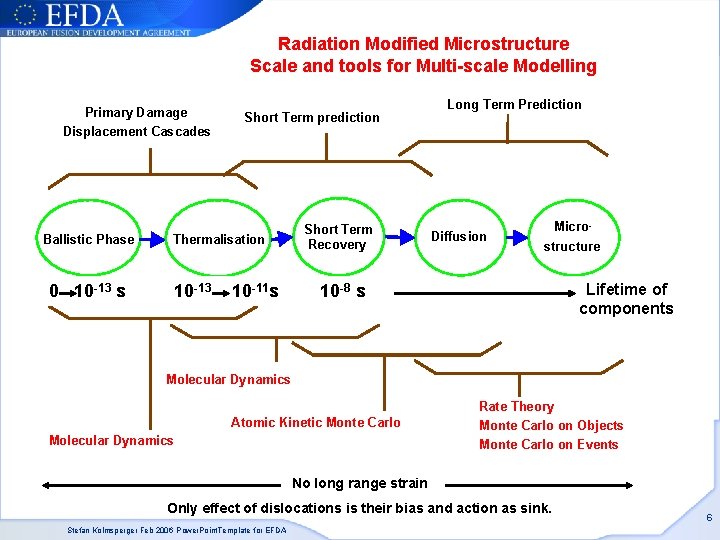
Radiation Modified Microstructure Scale and tools for Multi-scale Modelling Primary Damage Displacement Cascades Ballistic Phase Short Term prediction Thermalisation -15 -13 s s 0 1010 -13 -11 s 1010 10 -11 s Short Term Recovery 8 -8 10 s 10 - Long Term Prediction Diffusion Micro-structure Lifetime of components s Lifetime of Components Molecular Dynamics Atomic Kinetic Monte Carlo Molecular Dynamics Rate Theory Monte Carlo on Objects Monte Carlo on Events No long range strain Only effect of dislocations is their bias and action as sink. Stefan Kolmsperger Feb 2006 Power. Point. Template for EFDA 6
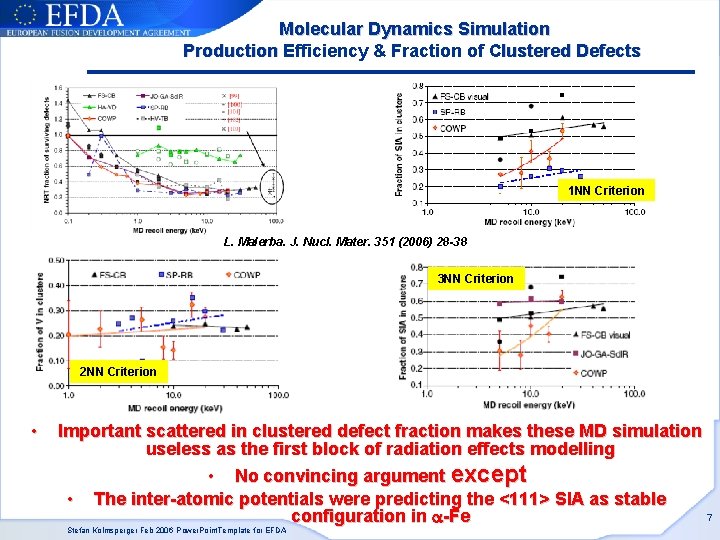
Molecular Dynamics Simulation Production Efficiency & Fraction of Clustered Defects 1 NN Criterion L. Malerba, J. Nucl. Mater. 351 (2006) 28 -38 3 NN Criterion 2 NN Criterion • Important scattered in clustered defect fraction makes these MD simulation useless as the first block of radiation effects modelling • No convincing argument except • The inter-atomic potentials were predicting the <111> SIA as stable 7 configuration in a-Fe Stefan Kolmsperger Feb 2006 Power. Point. Template for EFDA
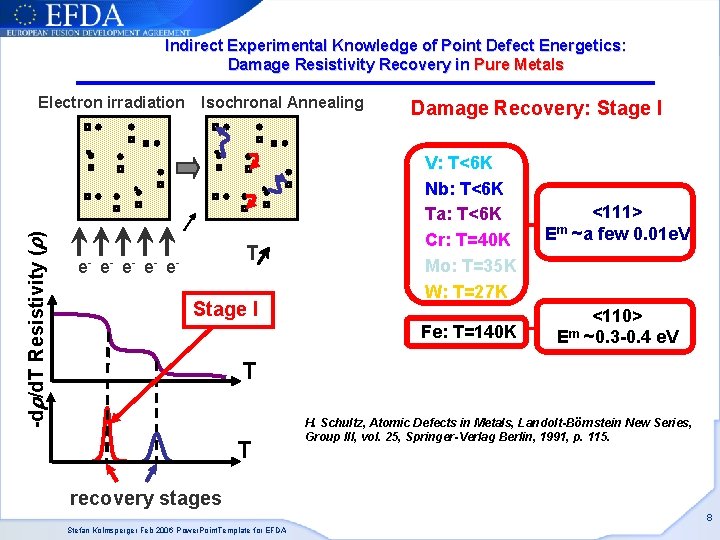
Indirect Experimental Knowledge of Point Defect Energetics: Damage Resistivity Recovery in Pure Metals -dr/d. T Resistivity (r) Electron irradiation Isochronal Annealing T e- e- e- Stage I Damage Recovery: Stage I V: T<6 K Nb: T<6 K Ta: T<6 K Cr: T=40 K Mo: T=35 K W: T=27 K <111> Em ~a few 0. 01 e. V Fe: T=140 K <110> Em ~0. 3 -0. 4 e. V T T H. Schultz, Atomic Defects in Metals, Landolt-Börnstein New Series, Group III, vol. 25, Springer-Verlag Berlin, 1991, p. 115. recovery stages 8 Stefan Kolmsperger Feb 2006 Power. Point. Template for EFDA
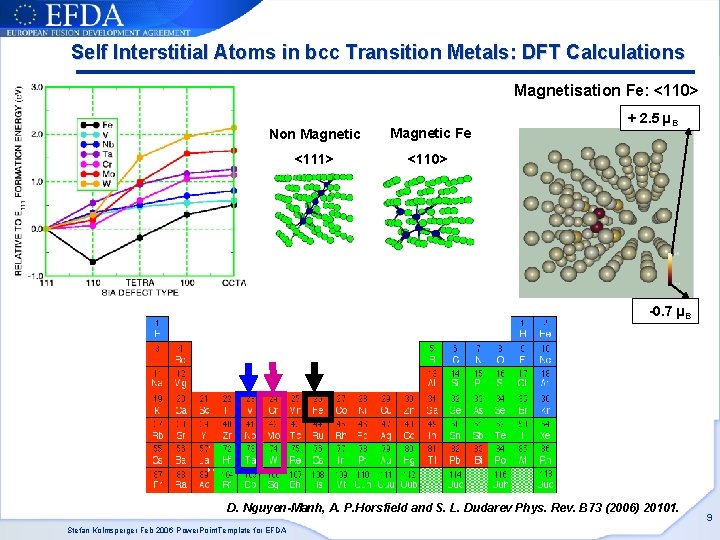
Self Interstitial Atoms in bcc Transition Metals: DFT Calculations Magnetisation Fe: <110> Non Magnetic Fe <111> <110> + 2. 5 µB -0. 7 µB D. Nguyen-Manh, A. P. Horsfield and S. L. Dudarev Phys. Rev. B 73 (2006) 20101. Stefan Kolmsperger Feb 2006 Power. Point. Template for EFDA 9
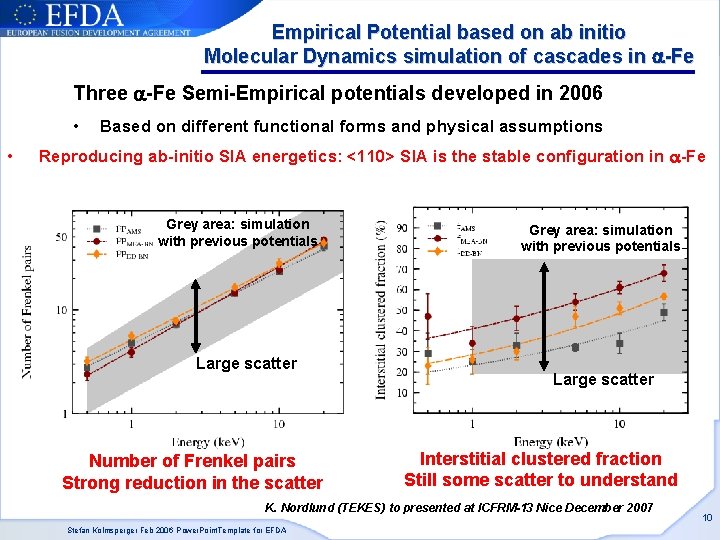
Empirical Potential based on ab initio Molecular Dynamics simulation of cascades in a-Fe Three a-Fe Semi-Empirical potentials developed in 2006 • • Based on different functional forms and physical assumptions Reproducing ab-initio SIA energetics: <110> SIA is the stable configuration in a-Fe Grey area: simulation with previous potentials Large scatter Number of Frenkel pairs Strong reduction in the scatter Grey area: simulation with previous potentials Large scatter Interstitial clustered fraction Still some scatter to understand K. Nordlund (TEKES) to presented at ICFRM-13 Nice December 2007 Stefan Kolmsperger Feb 2006 Power. Point. Template for EFDA 10
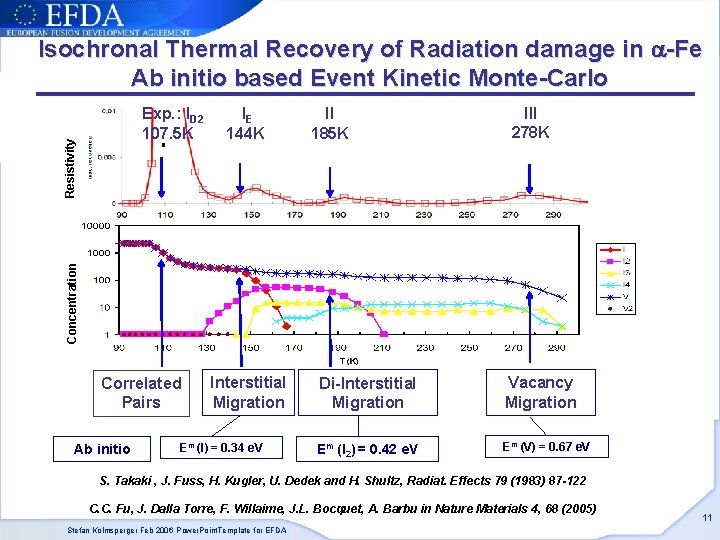
Isochronal Thermal Recovery of Radiation damage in a-Fe Ab initio based Event Kinetic Monte-Carlo IE 144 K II 185 K III 278 K Concentration Resistivity Exp. : ID 2 107. 5 K Correlated Pairs Ab initio Interstitial Migration Em (I) = 0. 34 e. V Di-Interstitial Migration Vacancy Migration Em (I 2) = 0. 42 e. V Em (V) = 0. 67 e. V S. Takaki , J. Fuss, H. Kugler, U. Dedek and H. Shultz, Radiat. Effects 79 (1983) 87 -122 C. C. Fu, J. Dalla Torre, F. Willaime, J. L. Bocquet, A. Barbu in Nature Materials 4, 68 (2005) Stefan Kolmsperger Feb 2006 Power. Point. Template for EFDA 11
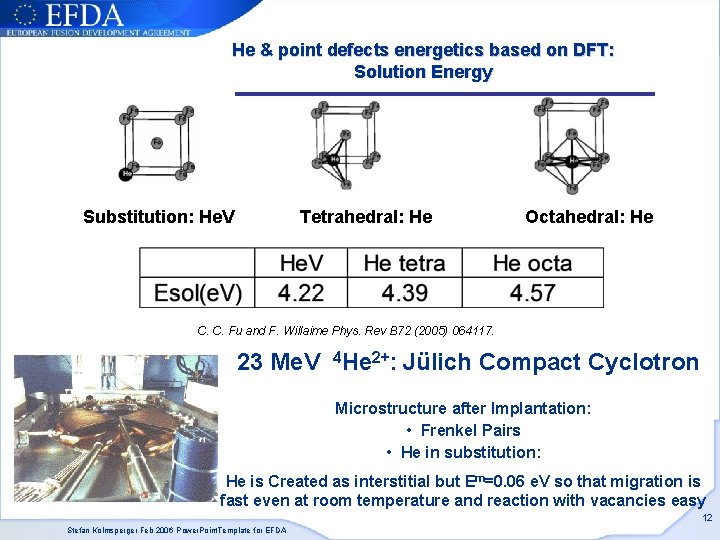
He & point defects energetics based on DFT: Solution Energy Substitution: He. V Tetrahedral: He Octahedral: He C. C. Fu and F. Willaime Phys. Rev B 72 (2005) 064117. 23 Me. V 4 He 2+: Jülich Compact Cyclotron Microstructure after Implantation: • Frenkel Pairs • He in substitution: He is Created as interstitial but Em=0. 06 e. V so that migration is fast even at room temperature and reaction with vacancies easy 12 Stefan Kolmsperger Feb 2006 Power. Point. Template for EFDA
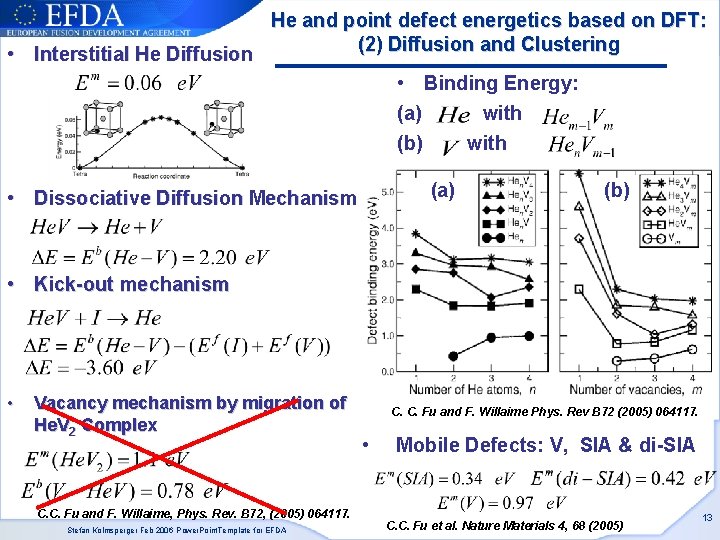
He and point defect energetics based on DFT: (2) Diffusion and Clustering • Interstitial He Diffusion • Binding Energy: (a) with (b) with (a) • Dissociative Diffusion Mechanism (b) • Kick-out mechanism • Vacancy mechanism by migration of He. V 2 Complex C. C. Fu and F. Willaime, Phys. Rev. B 72, (2005) 064117. Stefan Kolmsperger Feb 2006 Power. Point. Template for EFDA C. C. Fu and F. Willaime Phys. Rev B 72 (2005) 064117. • Mobile Defects: V, SIA & di-SIA C. C. Fu et al. Nature Materials 4, 68 (2005) 13
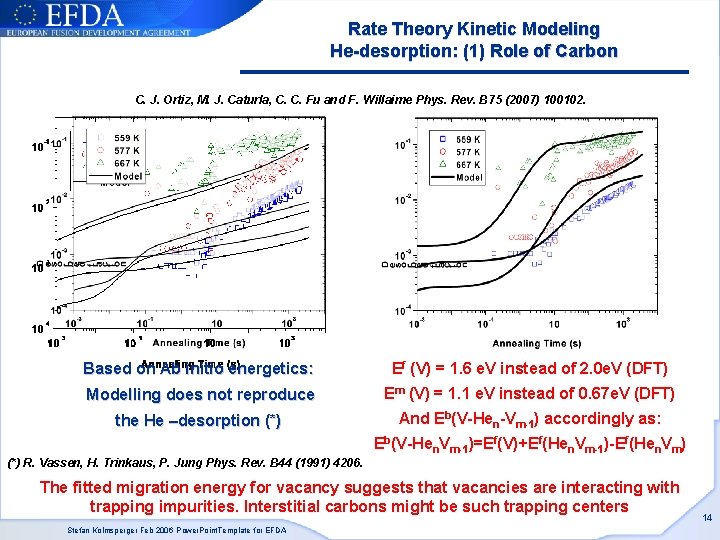
Rate Theory Kinetic Modeling He-desorption: (1) Role of Carbon C. J. Ortiz, M. J. Caturla, C. C. Fu and F. Willaime Phys. Rev. B 75 (2007) 100102. Based on Ab initio energetics: Ef (V) = 1. 6 e. V instead of 2. 0 e. V (DFT) Modelling does not reproduce Em (V) = 1. 1 e. V instead of 0. 67 e. V (DFT) the He –desorption (*) And Eb(V-Hen-Vm-1) accordingly as: Eb(V-Hen. Vm-1)=Ef(V)+Ef(Hen. Vm-1)-Ef(Hen. Vm) (*) R. Vassen, H. Trinkaus, P. Jung Phys. Rev. B 44 (1991) 4206. The fitted migration energy for vacancy suggests that vacancies are interacting with trapping impurities. Interstitial carbons might be such trapping centers Stefan Kolmsperger Feb 2006 Power. Point. Template for EFDA 14
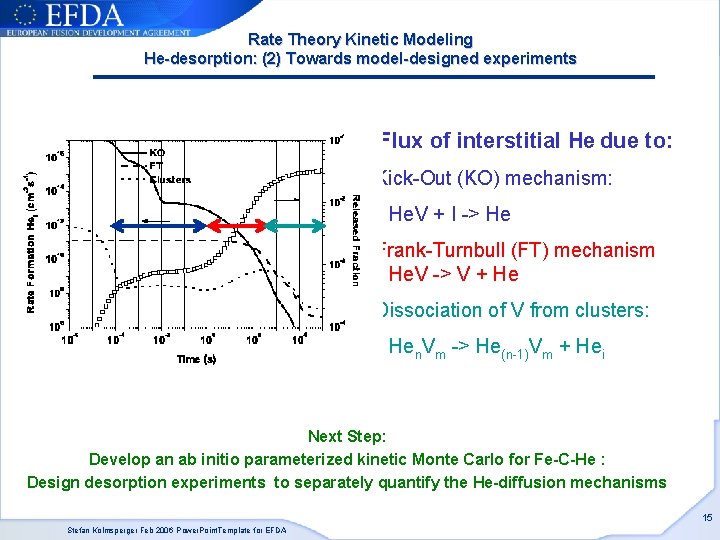
Rate Theory Kinetic Modeling He-desorption: (2) Towards model-designed experiments Flux of interstitial He due to: 1. Kick-Out (KO) mechanism: He. V + I -> He 2. Frank-Turnbull (FT) mechanism He. V -> V + He 3. Dissociation of V from clusters: Hen. Vm -> He(n-1)Vm + Hei Next Step: Develop an ab initio parameterized kinetic Monte Carlo for Fe-C-He : Design desorption experiments to separately quantify the He-diffusion mechanisms 15 Stefan Kolmsperger Feb 2006 Power. Point. Template for EFDA
Phase Stability based on DFT calculated Enthalpy of Atomic Configurations 16 Stefan Kolmsperger Feb 2006 Power. Point. Template for EFDA
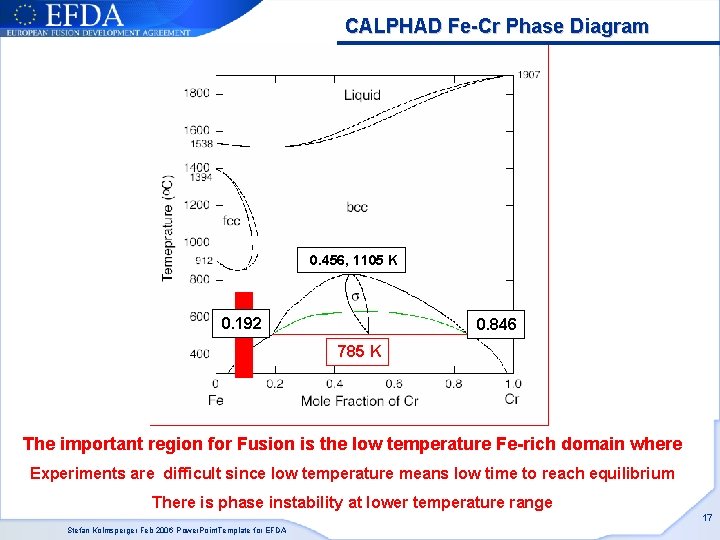
CALPHAD Fe-Cr Phase Diagram 0. 456, 1105 K 0. 192 0. 846 785 K The important region for Fusion is the low temperature Fe-rich domain where Experiments are difficult since low temperature means low time to reach equilibrium There is phase instability at lower temperature range 17 Stefan Kolmsperger Feb 2006 Power. Point. Template for EFDA
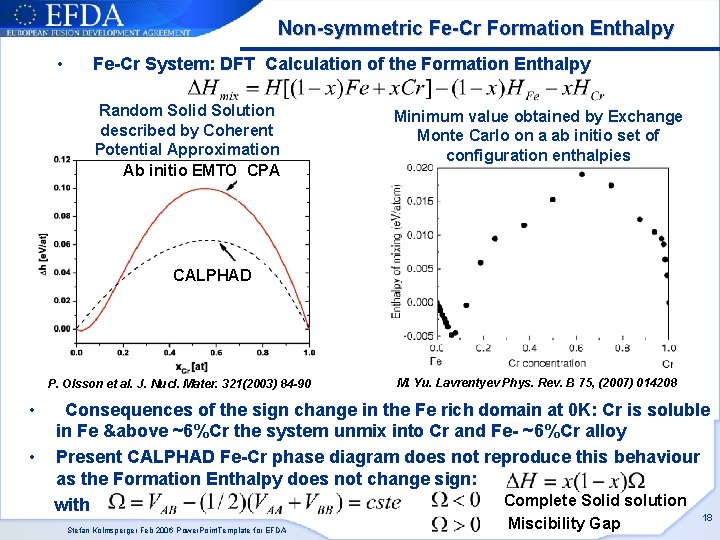
Non-symmetric Fe-Cr Formation Enthalpy • Fe-Cr System: DFT Calculation of the Formation Enthalpy Random Solid Solution described by Coherent Potential Approximation Ab initio EMTO CPA Minimum value obtained by Exchange Monte Carlo on a ab initio set of configuration enthalpies CALPHAD P. Olsson et al. J. Nucl. Mater. 321(2003) 84 -90 • • M. Yu. Lavrentyev Phys. Rev. B 75, (2007) 014208 Consequences of the sign change in the Fe rich domain at 0 K: Cr is soluble in Fe &above ~6%Cr the system unmix into Cr and Fe- ~6%Cr alloy Present CALPHAD Fe-Cr phase diagram does not reproduce this behaviour as the Formation Enthalpy does not change sign: Complete Solid solution with Stefan Kolmsperger Feb 2006 Power. Point. Template for EFDA Miscibility Gap 18
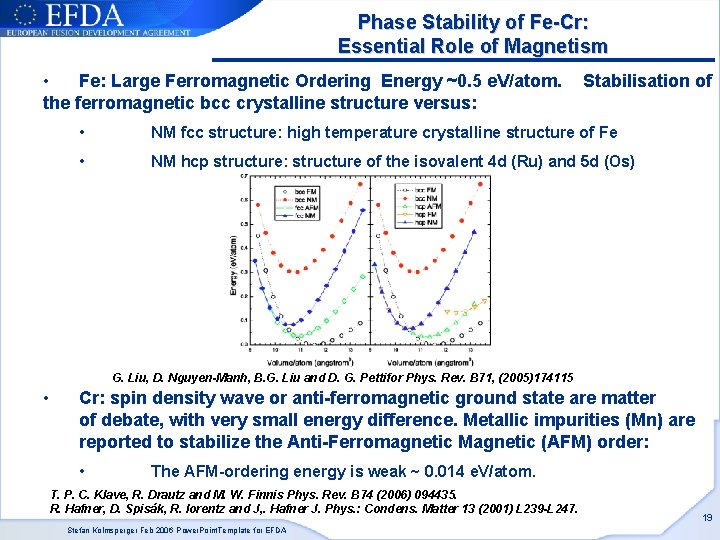
Phase Stability of Fe-Cr: Essential Role of Magnetism • Fe: Large Ferromagnetic Ordering Energy ~0. 5 e. V/atom. the ferromagnetic bcc crystalline structure versus: Stabilisation of • NM fcc structure: high temperature crystalline structure of Fe • NM hcp structure: structure of the isovalent 4 d (Ru) and 5 d (Os) G. Liu, D. Nguyen-Manh, B. G. Liu and D. G. Pettifor Phys. Rev. B 71, (2005)174115 • Cr: spin density wave or anti-ferromagnetic ground state are matter of debate, with very small energy difference. Metallic impurities (Mn) are reported to stabilize the Anti-Ferromagnetic Magnetic (AFM) order: • The AFM-ordering energy is weak ~ 0. 014 e. V/atom. T. P. C. Klave, R. Drautz and M. W. Finnis Phys. Rev. B 74 (2006) 094435. R. Hafner, D. Spisák, R. lorentz and J, . Hafner J. Phys. : Condens. Matter 13 (2001) L 239 -L 247. Stefan Kolmsperger Feb 2006 Power. Point. Template for EFDA 19
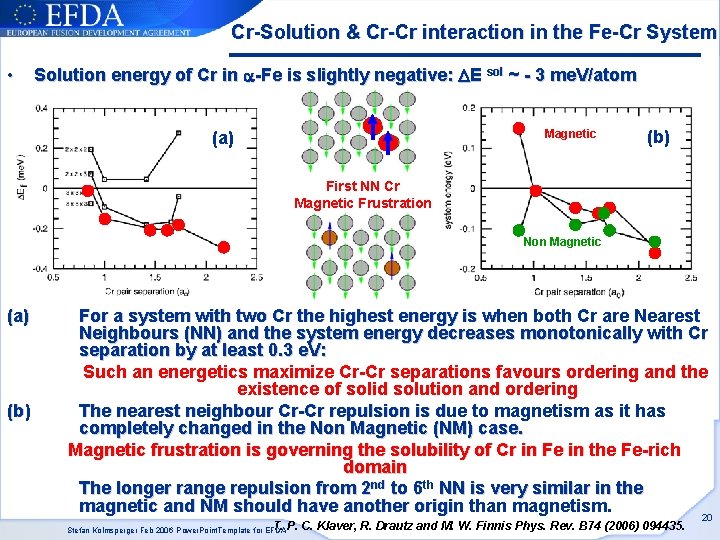
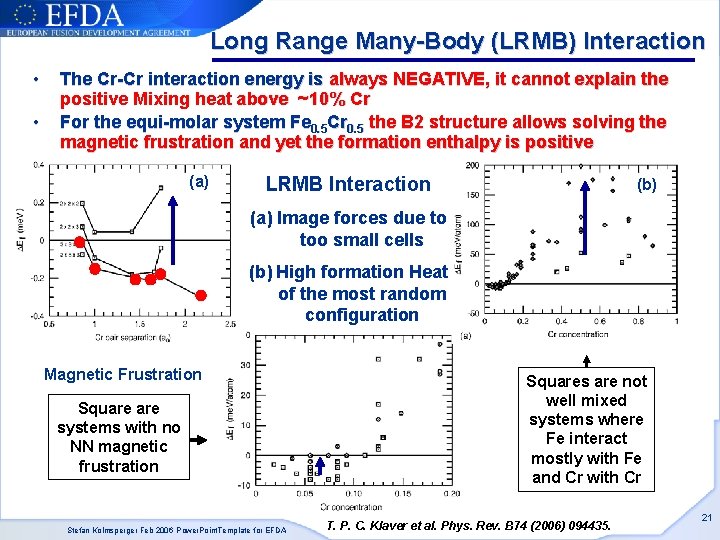
Cr-Solution & Cr-Cr interaction in the Fe-Cr System • Solution energy of Cr in a-Fe is slightly negative: DE sol ~ - 3 me. V/atom Magnetic (a) (b) First NN Cr Magnetic Frustration Non Magnetic (a) (b) For a system with two Cr the highest energy is when both Cr are Nearest Neighbours (NN) and the system energy decreases monotonically with Cr separation by at least 0. 3 e. V: Such an energetics maximize Cr-Cr separations favours ordering and the existence of solid solution and ordering The nearest neighbour Cr-Cr repulsion is due to magnetism as it has completely changed in the Non Magnetic (NM) case. Magnetic frustration is governing the solubility of Cr in Fe in the Fe-rich domain The longer range repulsion from 2 nd to 6 th NN is very similar in the magnetic and NM should have another origin than magnetism. T. P. Stefan Kolmsperger Feb 2006 Power. Point. Template for EFDA C. Klaver, R. Drautz and M. W. Finnis Phys. Rev. B 74 (2006) 094435. 20
Long Range Many-Body (LRMB) Interaction • • The Cr-Cr interaction energy is always NEGATIVE, it cannot explain the positive Mixing heat above ~10% Cr For the equi-molar system Fe 0. 5 Cr 0. 5 the B 2 structure allows solving the magnetic frustration and yet the formation enthalpy is positive (a) LRMB Interaction (b) (a) Image forces due to too small cells (b) High formation Heat of the most random configuration Magnetic Frustration Square systems with no NN magnetic frustration Stefan Kolmsperger Feb 2006 Power. Point. Template for EFDA Squares are not well mixed systems where Fe interact mostly with Fe and Cr with Cr T. P. C. Klaver et al. Phys. Rev. B 74 (2006) 094435. 21
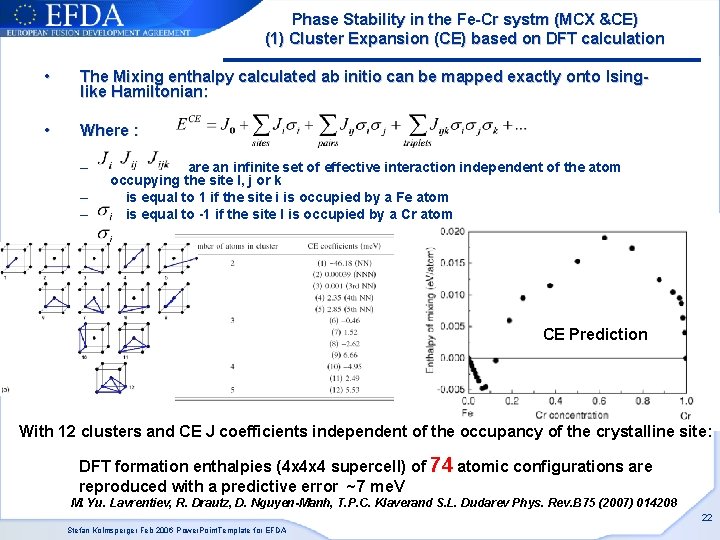
Phase Stability in the Fe-Cr systm (MCX &CE) (1) Cluster Expansion (CE) based on DFT calculation • The Mixing enthalpy calculated ab initio can be mapped exactly onto Isinglike Hamiltonian: • Where : – – – are an infinite set of effective interaction independent of the atom occupying the site I, j or k is equal to 1 if the site i is occupied by a Fe atom is equal to -1 if the site I is occupied by a Cr atom CE Prediction With 12 clusters and CE J coefficients independent of the occupancy of the crystalline site: DFT formation enthalpies (4 x 4 x 4 supercell) of 74 atomic configurations are reproduced with a predictive error ~7 me. V M. Yu. Lavrentiev, R. Drautz, D. Nguyen-Manh, T. P. C. Klaverand S. L. Dudarev Phys. Rev. B 75 (2007) 014208 22 Stefan Kolmsperger Feb 2006 Power. Point. Template for EFDA
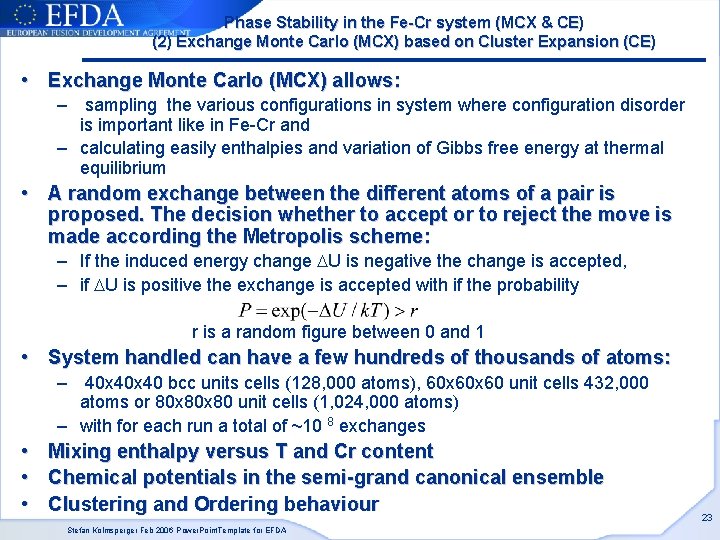
Phase Stability in the Fe-Cr system (MCX & CE) (2) Exchange Monte Carlo (MCX) based on Cluster Expansion (CE) • Exchange Monte Carlo (MCX) allows: – sampling the various configurations in system where configuration disorder is important like in Fe-Cr and – calculating easily enthalpies and variation of Gibbs free energy at thermal equilibrium • A random exchange between the different atoms of a pair is proposed. The decision whether to accept or to reject the move is made according the Metropolis scheme: – If the induced energy change DU is negative the change is accepted, – if DU is positive the exchange is accepted with if the probability r is a random figure between 0 and 1 • System handled can have a few hundreds of thousands of atoms: – 40 x 40 bcc units cells (128, 000 atoms), 60 x 60 unit cells 432, 000 atoms or 80 x 80 unit cells (1, 024, 000 atoms) – with for each run a total of ~10 8 exchanges • Mixing enthalpy versus T and Cr content • Chemical potentials in the semi-grand canonical ensemble • Clustering and Ordering behaviour Stefan Kolmsperger Feb 2006 Power. Point. Template for EFDA 23
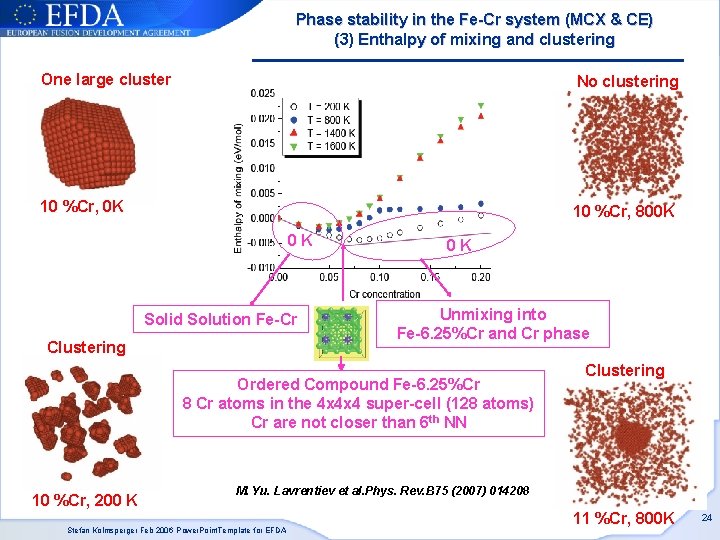
Phase stability in the Fe-Cr system (MCX & CE) (3) Enthalpy of mixing and clustering One large cluster No clustering 10 %Cr, 0 K 10 %Cr, 800 K 0 K Solid Solution Fe-Cr Clustering 0 K Unmixing into Fe-6. 25%Cr and Cr phase Ordered Compound Fe-6. 25%Cr 8 Cr atoms in the 4 x 4 x 4 super-cell (128 atoms) Cr are not closer than 6 th NN 10 %Cr, 200 K Clustering M. Yu. Lavrentiev et al. Phys. Rev. B 75 (2007) 014208 Stefan Kolmsperger Feb 2006 Power. Point. Template for EFDA 11 %Cr, 800 K 24
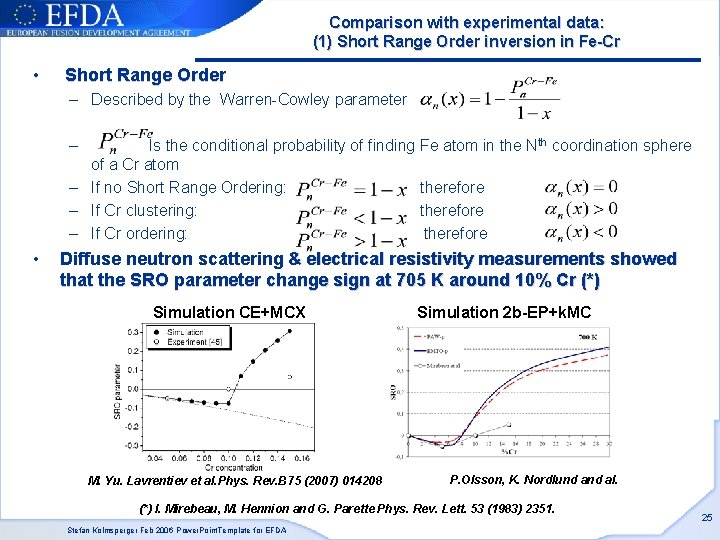
Comparison with experimental data: (1) Short Range Order inversion in Fe-Cr • Short Range Order – Described by the Warren-Cowley parameter – Is the conditional probability of finding Fe atom in the N th coordination sphere of a Cr atom – If no Short Range Ordering: therefore – If Cr clustering: therefore – If Cr ordering: therefore • Diffuse neutron scattering & electrical resistivity measurements showed that the SRO parameter change sign at 705 K around 10% Cr (*) Simulation CE+MCX M. Yu. Lavrentiev et al. Phys. Rev. B 75 (2007) 014208 Simulation 2 b-EP+k. MC P. Olsson, K. Nordlund al. (*) I. Mirebeau, M. Hennion and G. Parette Phys. Rev. Lett. 53 (1983) 2351. Stefan Kolmsperger Feb 2006 Power. Point. Template for EFDA 25
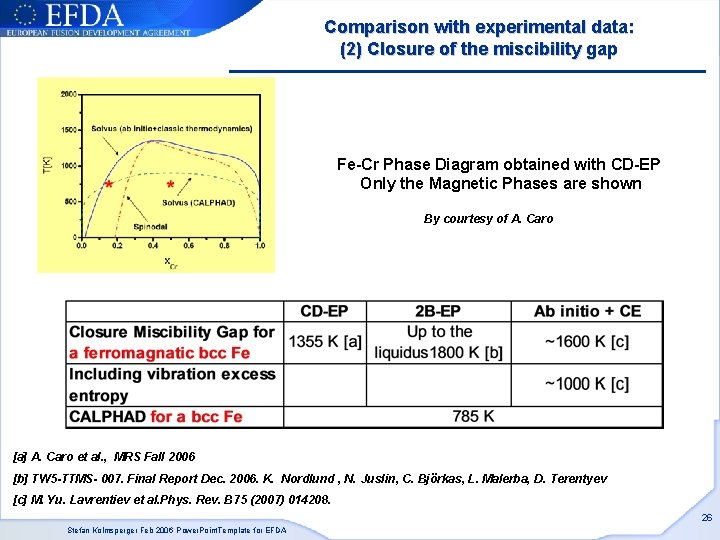
Comparison with experimental data: (2) Closure of the miscibility gap Fe-Cr Phase Diagram obtained with CD-EP Only the Magnetic Phases are shown By courtesy of A. Caro [a] A. Caro et al. , MRS Fall 2006 [b] TW 5 -TTMS- 007. Final Report Dec. 2006. K. Nordlund , N. Juslin, C. Björkas, L. Malerba, D. Terentyev [c] M. Yu. Lavrentiev et al. Phys. Rev. B 75 (2007) 014208. 26 Stefan Kolmsperger Feb 2006 Power. Point. Template for EFDA
Modelling Dynamical Properties of Dislocations 27 Stefan Kolmsperger Feb 2006 Power. Point. Template for EFDA
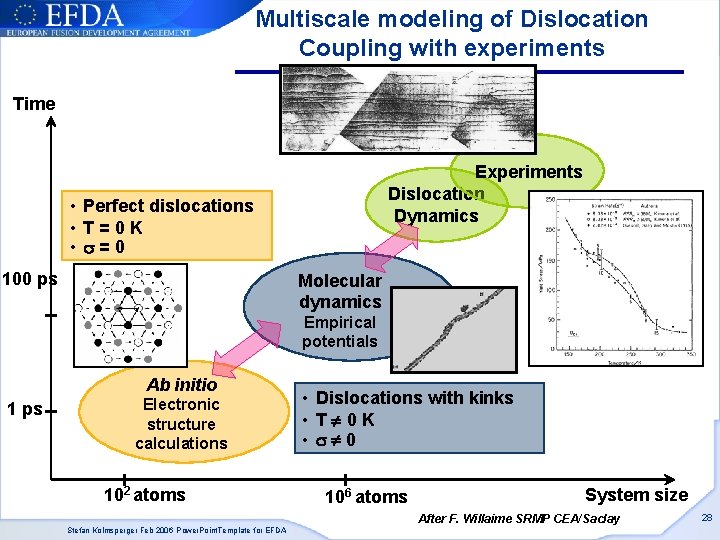
Multiscale modeling of Dislocation Coupling with experiments Time Experiments Dislocation Dynamics • Perfect dislocations • T=0 K • =0 100 ps Molecular dynamics Empirical potentials Ab initio 1 ps Electronic structure calculations 102 atoms Stefan Kolmsperger Feb 2006 Power. Point. Template for EFDA • Dislocations with kinks • T 0 K • 0 106 atoms System size After F. Willaime SRMP CEA/Saclay 28
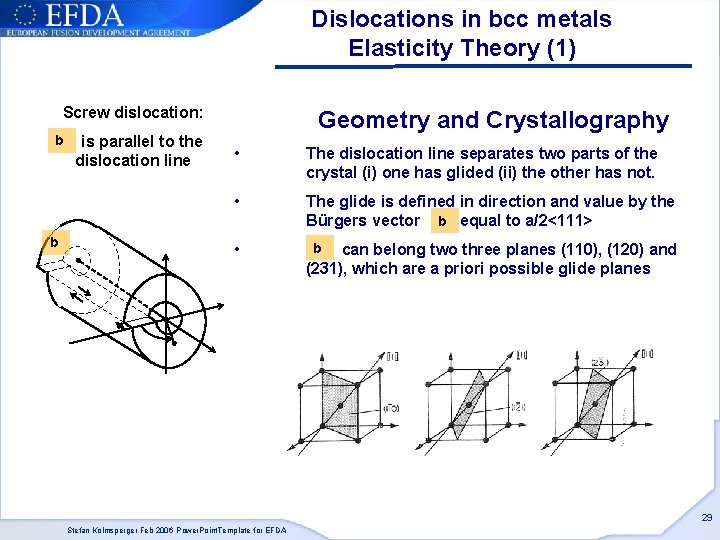
Dislocations in bcc metals Elasticity Theory (1) Screw dislocation: b b is parallel to the dislocation line Geometry and Crystallography • The dislocation line separates two parts of the crystal (i) one has glided (ii) the other has not. • The glide is defined in direction and value by the Bürgers vector b equal to a/2<111> • can belong two three planes (110), (120) and (231), which are a priori possible glide planes b 29 Stefan Kolmsperger Feb 2006 Power. Point. Template for EFDA
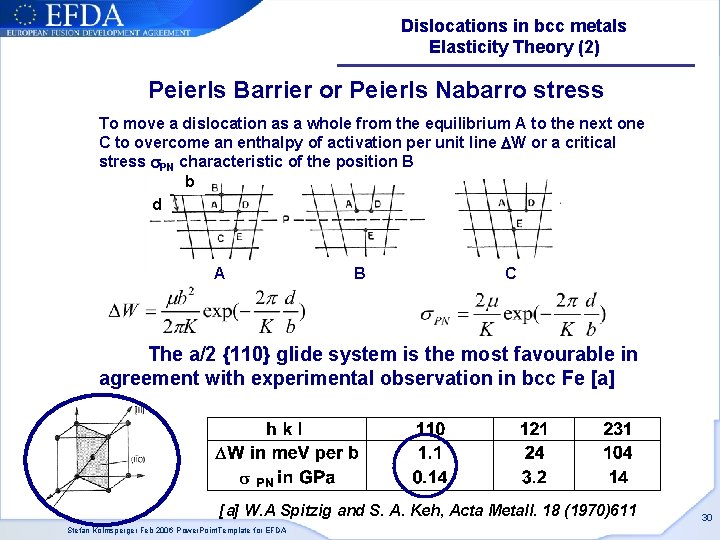
Dislocations in bcc metals Elasticity Theory (2) Peierls Barrier or Peierls Nabarro stress To move a dislocation as a whole from the equilibrium A to the next one C to overcome an enthalpy of activation per unit line DW or a critical stress PN characteristic of the position B b d A B C The a/2 {110} glide system is the most favourable in agreement with experimental observation in bcc Fe [a] W. A Spitzig and S. A. Keh, Acta Metall. 18 (1970)611 Stefan Kolmsperger Feb 2006 Power. Point. Template for EFDA 30
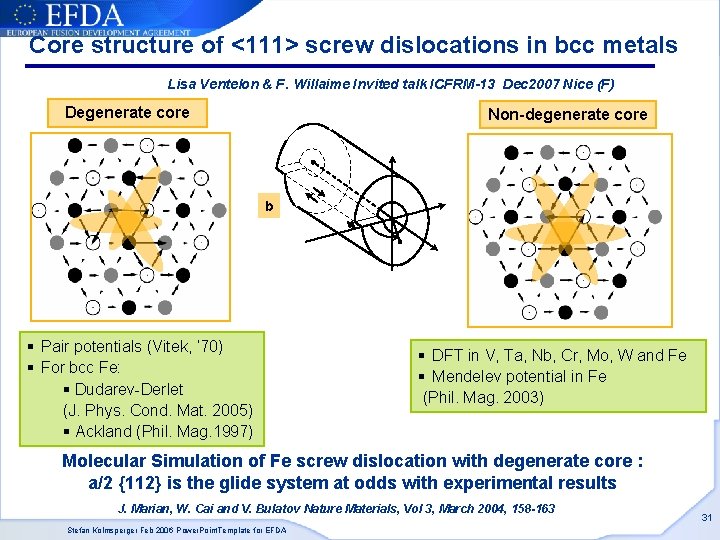
Core structure of <111> screw dislocations in bcc metals Lisa Ventelon & F. Willaime Invited talk ICFRM-13 Dec 2007 Nice (F) Degenerate core Non-degenerate core b § Pair potentials (Vitek, ‘ 70) § For bcc Fe: § Dudarev-Derlet (J. Phys. Cond. Mat. 2005) § Ackland (Phil. Mag. 1997) § DFT in V, Ta, Nb, Cr, Mo, W and Fe § Mendelev potential in Fe (Phil. Mag. 2003) Molecular Simulation of Fe screw dislocation with degenerate core : a/2 {112} is the glide system at odds with experimental results J. Marian, W. Cai and V. Bulatov Nature Materials, Vol 3, March 2004, 158 -163 Stefan Kolmsperger Feb 2006 Power. Point. Template for EFDA 31
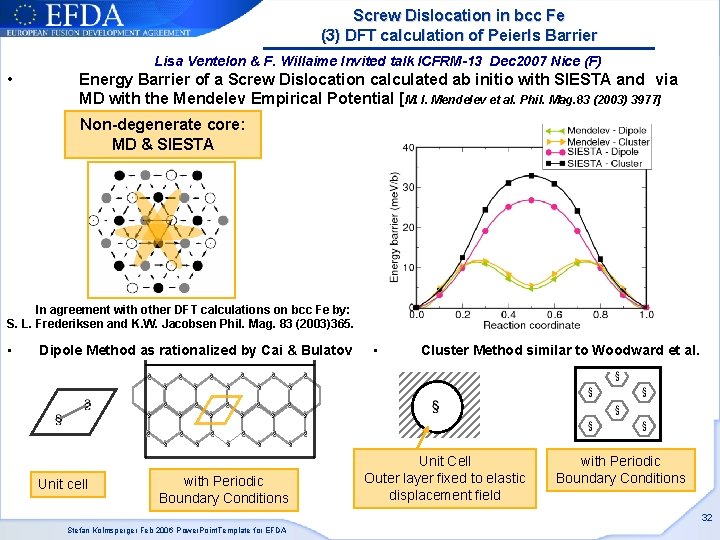
Screw Dislocation in bcc Fe (3) DFT calculation of Peierls Barrier Lisa Ventelon & F. Willaime Invited talk ICFRM-13 Dec 2007 Nice (F) • Energy Barrier of a Screw Dislocation calculated ab initio with SIESTA and via MD with the Mendelev Empirical Potential [M. I. Mendelev et al. Phil. Mag. 83 (2003) 3977] Non-degenerate core: MD & SIESTA In agreement with other DFT calculations on bcc Fe by: S. L. Frederiksen and K. W. Jacobsen Phil. Mag. 83 (2003)365. • Dipole Method as rationalized by Cai & Bulatov Unit cell with Periodic Boundary Conditions • Cluster Method similar to Woodward et al. Unit Cell Outer layer fixed to elastic displacement field with Periodic Boundary Conditions 32 Stefan Kolmsperger Feb 2006 Power. Point. Template for EFDA
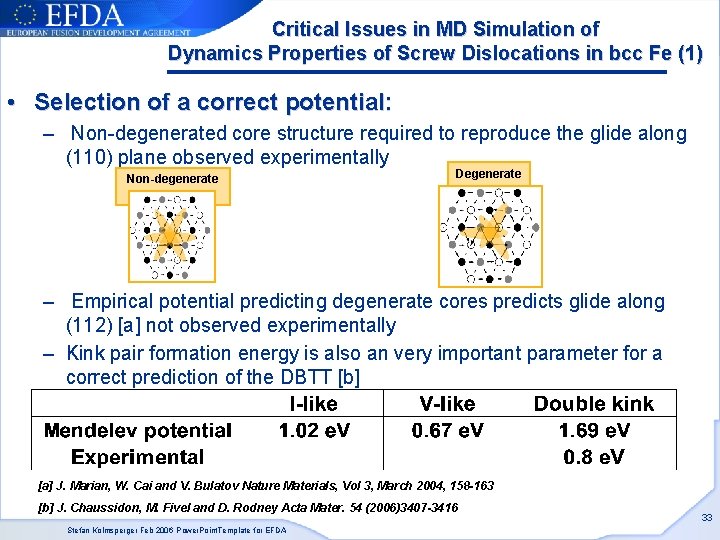
Critical Issues in MD Simulation of Dynamics Properties of Screw Dislocations in bcc Fe (1) • Selection of a correct potential: – Non-degenerated core structure required to reproduce the glide along (110) plane observed experimentally Non-degenerate core: Degenerate core – Empirical potential predicting degenerate cores predicts glide along (112) [a] not observed experimentally – Kink pair formation energy is also an very important parameter for a correct prediction of the DBTT [b] [a] J. Marian, W. Cai and V. Bulatov Nature Materials, Vol 3, March 2004, 158 -163 [b] J. Chaussidon, M. Fivel and D. Rodney Acta Mater. 54 (2006)3407 -3416 Stefan Kolmsperger Feb 2006 Power. Point. Template for EFDA 33
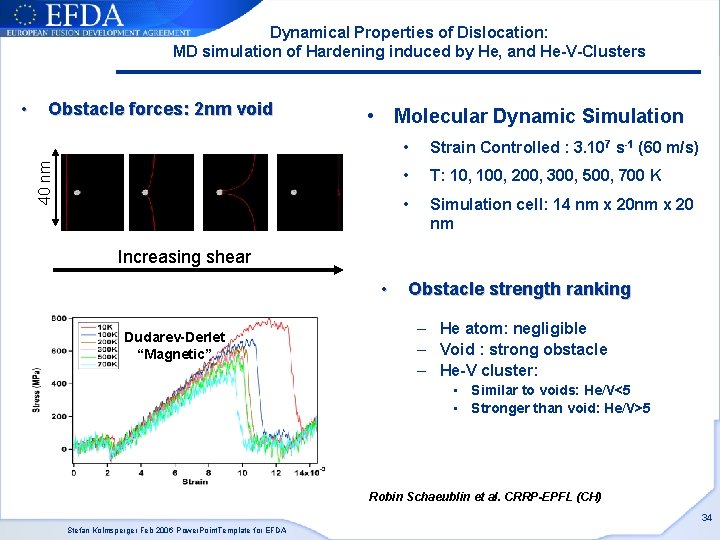
Dynamical Properties of Dislocation: MD simulation of Hardening induced by He, and He-V-Clusters Obstacle forces: 2 nm void • Molecular Dynamic Simulation 40 nm • • Strain Controlled : 3. 107 s-1 (60 m/s) • T: 10, 100, 200, 300, 500, 700 K • Simulation cell: 14 nm x 20 nm Increasing shear • Dudarev-Derlet “Magnetic” Obstacle strength ranking – He atom: negligible – Void : strong obstacle – He-V cluster: • Similar to voids: He/V<5 • Stronger than void: He/V>5 Robin Schaeublin et al. CRRP-EPFL (CH) 34 Stefan Kolmsperger Feb 2006 Power. Point. Template for EFDA
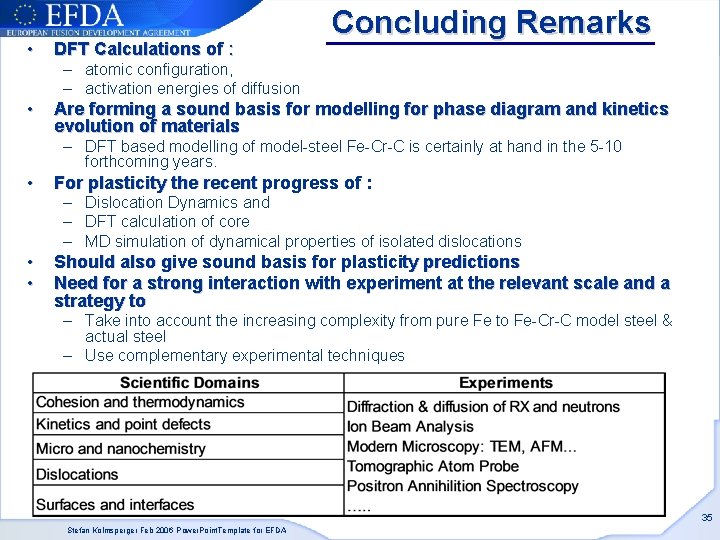
Concluding Remarks • DFT Calculations of : • Are forming a sound basis for modelling for phase diagram and kinetics evolution of materials – atomic configuration, – activation energies of diffusion – DFT based modelling of model-steel Fe-Cr-C is certainly at hand in the 5 -10 forthcoming years. • For plasticity the recent progress of : • • Should also give sound basis for plasticity predictions Need for a strong interaction with experiment at the relevant scale and a strategy to – Dislocation Dynamics and – DFT calculation of core – MD simulation of dynamical properties of isolated dislocations – Take into account the increasing complexity from pure Fe to Fe-Cr-C model steel & actual steel – Use complementary experimental techniques 35 Stefan Kolmsperger Feb 2006 Power. Point. Template for EFDA
Thank you for your Attention 36 Stefan Kolmsperger Feb 2006 Power. Point. Template for EFDA