
Structural Levels of Language Lecture 1 Ferdinand de
- Slides: 22
Structural Levels of Language Lecture 1
Ferdinand de Saussure Ø "Language is a system sui generis “ = a system where everything holds together Ø The division of language into different structural levels is made only for the sake of investigation. Ø We have to separate one linguistic fact from another in order to analyse it thoroughly.
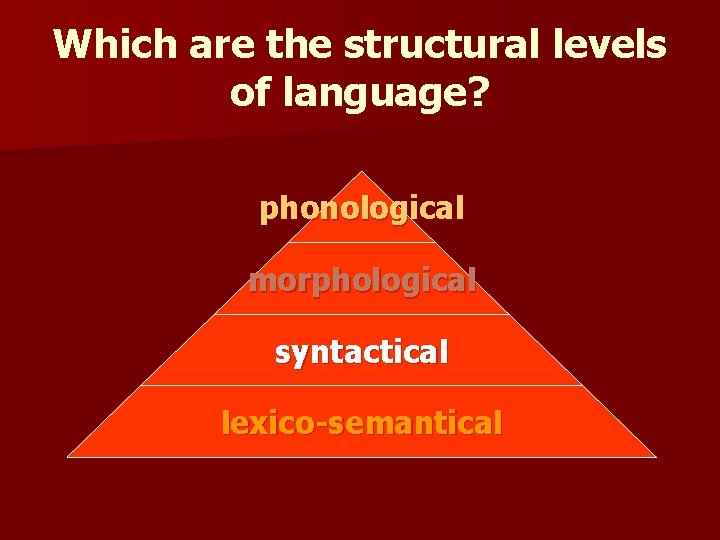
Which are the structural levels of language? phonological morphological syntactical lexico-semantical
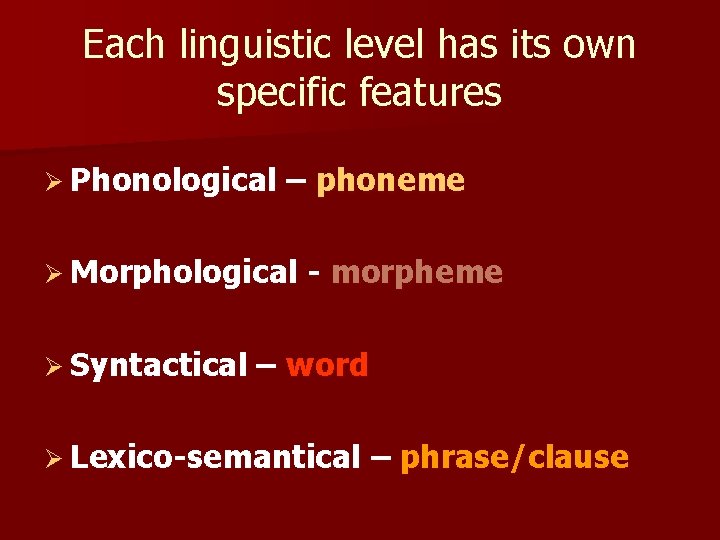
Each linguistic level has its own specific features Ø Phonological – phoneme Ø Morphological Ø Syntactical - morpheme – word Ø Lexico-semantical – phrase/clause
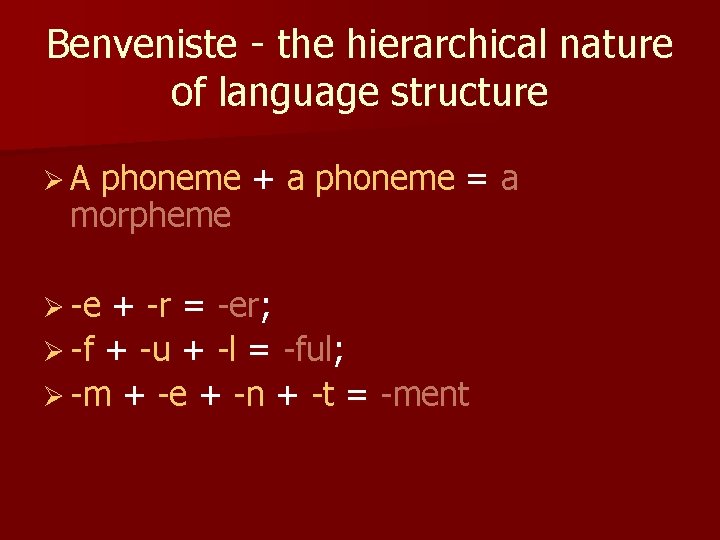
Benveniste - the hierarchical nature of language structure ØA phoneme + a phoneme = a morpheme Ø -e + -r = -er; Ø -f + -u + -l = -ful; Ø -m + -e + -n + -t = -ment
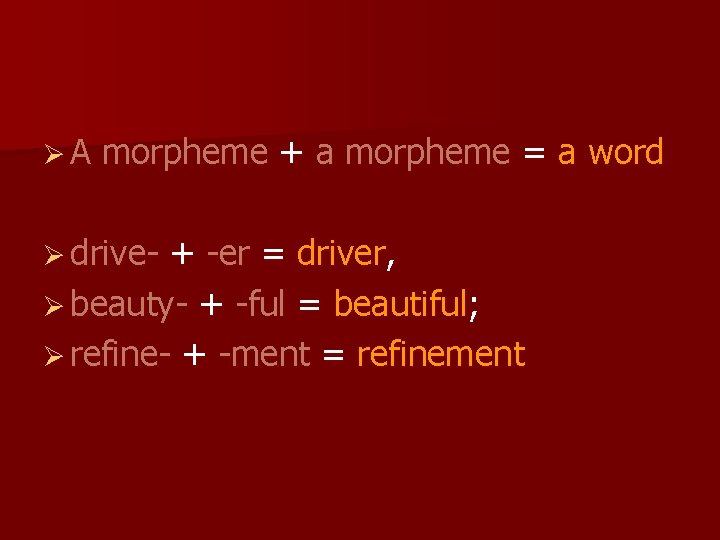
ØA morpheme + a morpheme = a word Ø drive- + -er = driver, Ø beauty- + -ful = beautiful; Ø refine- + -ment = refinement
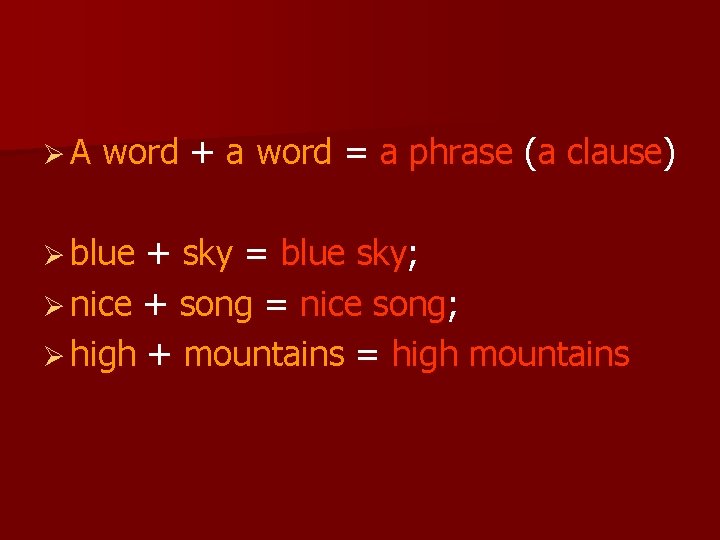
ØA word + a word = a phrase (a clause) Ø blue + sky = blue sky; Ø nice + song = nice song; Ø high + mountains = high mountains
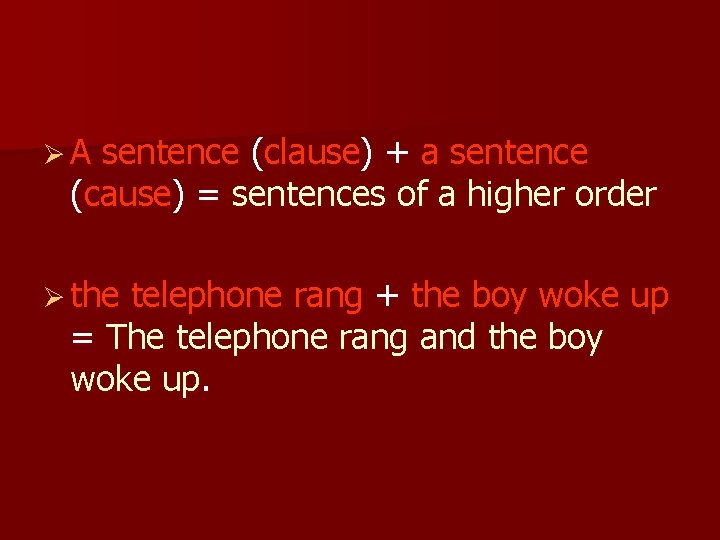
ØA sentence (clause) + a sentence (cause) = sentences of a higher order Ø the telephone rang + the boy woke up = The telephone rang and the boy woke up.
Phonemes, morphemes, words Ø It is not possible for an item of one level to combine with an item of another level Ø an item of one level can pass over and be integrated into another level Ø while preserving the qualities of the original level Ø it acquires the features of the level into which it has been integrated, abandoning the features it had in the previous level
Is it possible to have a morpheme made of only one phoneme? Ø Yes, in English, there are morphemes consisting only of one phoneme Ø Example – (-s ) marker: the -s marker for the plural of the nouns; the -s marker for 3 rd p. sg. ; the -s marker for the genitive case
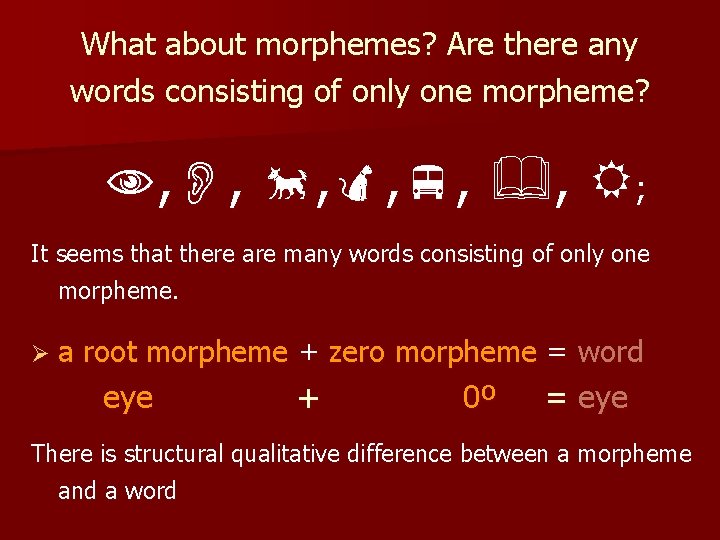
What about morphemes? Are there any words consisting of only one morpheme? , , , , ; It seems that there are many words consisting of only one morpheme. Øa root morpheme + zero morpheme = word eye + 0º = eye There is structural qualitative difference between a morpheme and a word
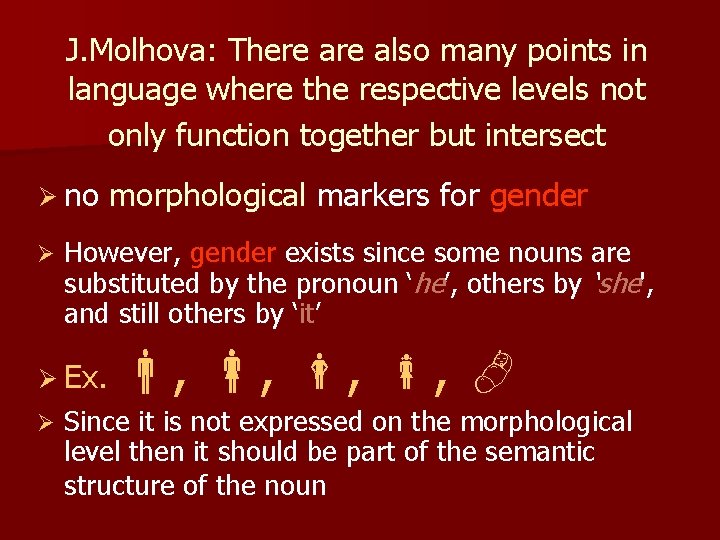
J. Molhova: There also many points in language where the respective levels not only function together but intersect Ø no Ø However, gender exists since some nouns are substituted by the pronoun ‘he’, others by ‘she', and still others by ‘it’ Ø Ex. Ø morphological markers for gender , , Since it is not expressed on the morphological level then it should be part of the semantic structure of the noun
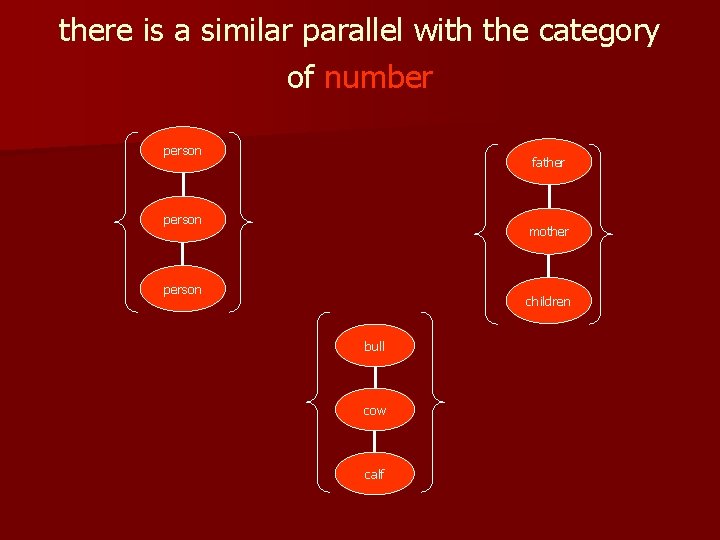
there is a similar parallel with the category of number person father person mother person children bull cow calf
people, family, cattle Ø Their form does not point to plurality Ø On the syntactic level they always require a verb in the plural Ø The element of plurality is somewhere in the noun Ø If it is not in the grammatical form then it must be in its semantic structure
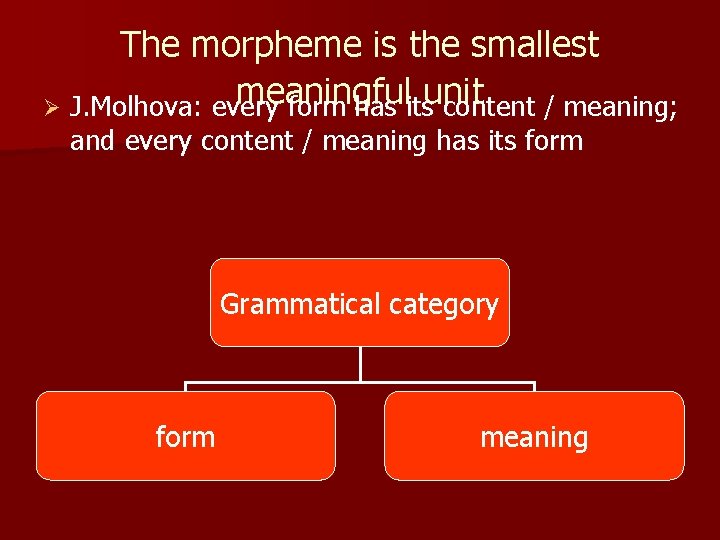
The morpheme is the smallest meaningful unit Ø J. Molhova: every form has its content / meaning; and every content / meaning has its form Grammatical category form meaning
the difference between a grammatical and a lexical item Ø table, - tables; cat - cats; girl- girls cat, girl the common forms singular of the nouns Ø tables, cats, girls the common plural forms of the nouns.
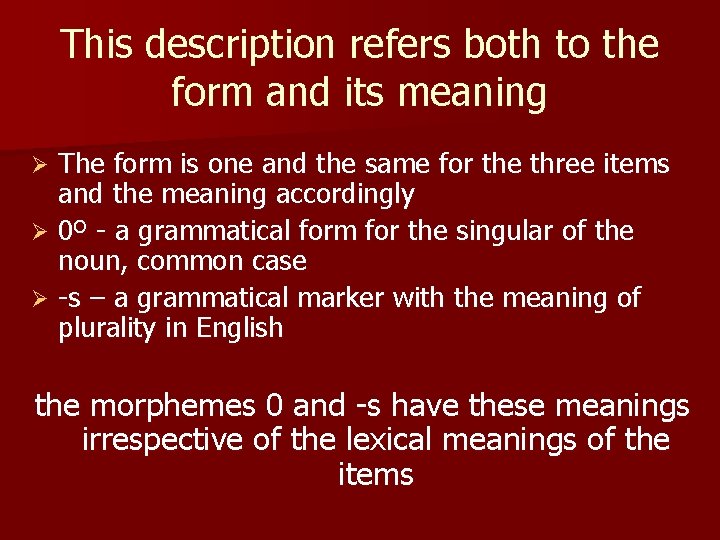
This description refers both to the form and its meaning The form is one and the same for the three items and the meaning accordingly Ø 0º - a grammatical form for the singular of the noun, common case Ø -s – a grammatical marker with the meaning of plurality in English Ø the morphemes 0 and -s have these meanings irrespective of the lexical meanings of the items
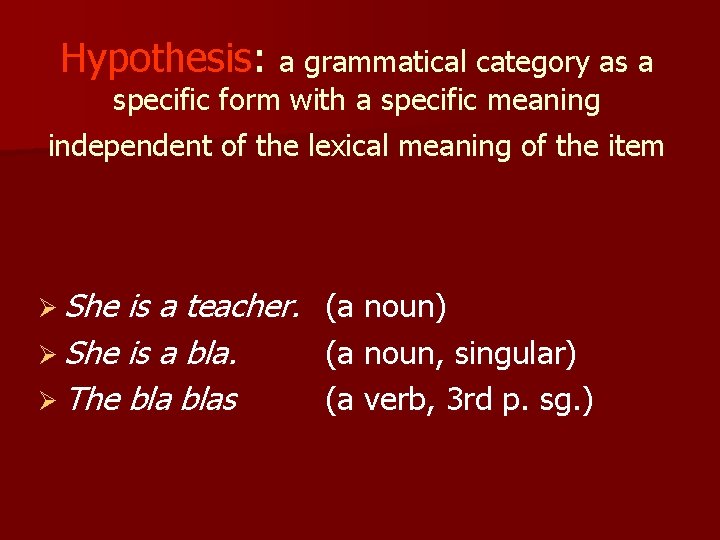
Hypothesis: a grammatical category as a specific form with a specific meaning independent of the lexical meaning of the item Ø She is a teacher. Ø She is a bla. Ø The blas (a noun) (a noun, singular) (a verb, 3 rd p. sg. )
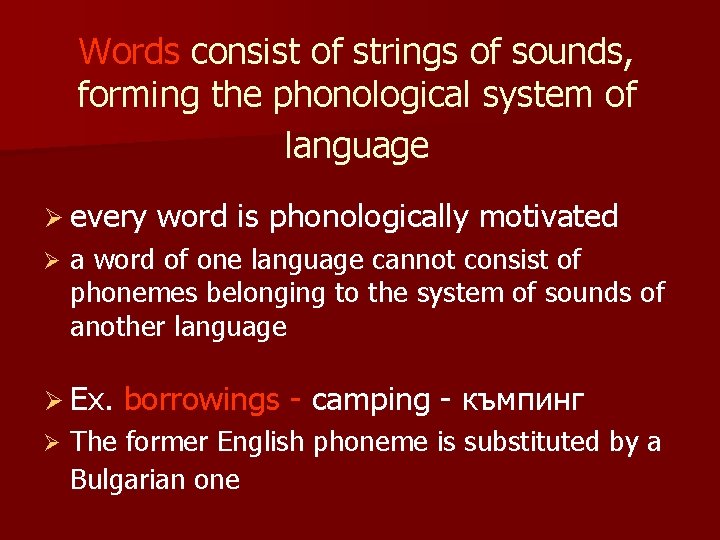
Words consist of strings of sounds, forming the phonological system of language Ø every Ø a word of one language cannot consist of phonemes belonging to the system of sounds of another language Ø Ex. Ø word is phonologically motivated borrowings - camping - къмпинг The former English phoneme is substituted by a Bulgarian one
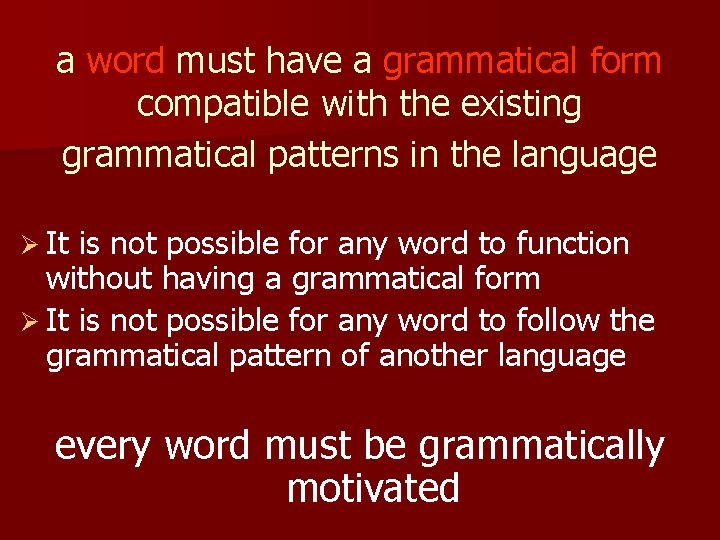
a word must have a grammatical form compatible with the existing grammatical patterns in the language Ø It is not possible for any word to function without having a grammatical form Ø It is not possible for any word to follow the grammatical pattern of another language every word must be grammatically motivated
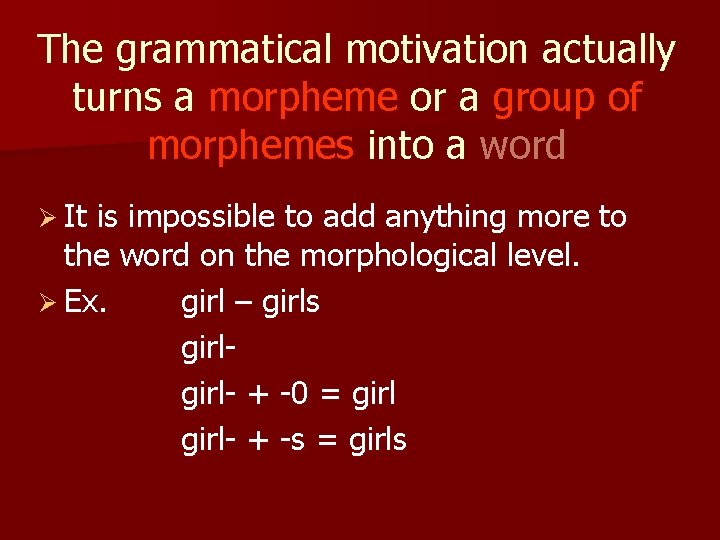
The grammatical motivation actually turns a morpheme or a group of morphemes into a word Ø It is impossible to add anything more to the word on the morphological level. Ø Ex. girl – girls girl- + -0 = girl- + -s = girls
Grammatical motivation can be considered as grammatical completeness For this reason one can discuss problems of meaning connected with the word with greater confidence than with the morpheme