
STRUCTURAL INJUSTICE AND THE POLITICS OF DIFFERENCE IRIS
- Slides: 19
STRUCTURAL INJUSTICE AND THE POLITICS OF DIFFERENCE IRIS M. YOUNG
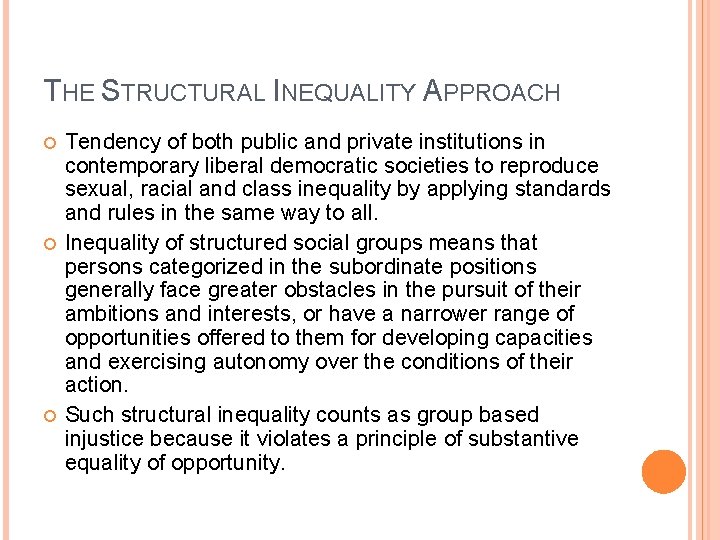
THE STRUCTURAL INEQUALITY APPROACH Tendency of both public and private institutions in contemporary liberal democratic societies to reproduce sexual, racial and class inequality by applying standards and rules in the same way to all. Inequality of structured social groups means that persons categorized in the subordinate positions generally face greater obstacles in the pursuit of their ambitions and interests, or have a narrower range of opportunities offered to them for developing capacities and exercising autonomy over the conditions of their action. Such structural inequality counts as group based injustice because it violates a principle of substantive equality of opportunity.
To remove unjust inequality it is necessary explicitly to recognize group difference and either compensate for disadvantage, revalue some attributes, positions, or actions, or take special steps to meet the needs of and empower members of disadvantaged groups.
A- DIFFERENCE BLINDNESS AND DISABILITY Under a merit principle, all who wish should have the opportunity to compete for the desirable positions, and those most qualified should win the competition. Positions of authority or expertise should be occupied by those persons who demonstrate excellence in particular skills and who best exhibit the performance expected of people in those positions. Everyone else is a loser in respect to those positions, and they suffer no injustice on that account
These people’s deficiencies are not their fault, of course. So a decent society will support their needs in spite of their inability to contribute significantly to social production. the division of labor and hegemonic norms constitute structural injustice for people with disabilities. Many people with disabilities unfairly suffer limitation on their opportunities for developing capacities, earning a living through satisfying work, having a rewarding social life, and living and autonomous adults.
difference blind liberalism can offer only very limited remedy for this injustice. It is no response to the person who moves in a wheelchair who tries to go to a courtroom accessible only by stairs that the state treats all citizens in the same way. It is no response to the blind engineer that this company uses the same computer equipment for all employees. The opportunities of people with disabilities can be made equal only if others specifically notice their differences, cease regarding them as unwanted deviance from accepted norms and unacceptable costs to efficient operations, and take affirmative measures to accommodate the specific capacities of individuals so that they can function at their best and with dignity.
The example of people with disabilities represents a clear case where difference blind treatment or policy is more likely to perpetuate than correct injustice. It is also a clear case where relevant social differences are constituted by the relation of some persons to hegemonic cultural norms and dominant definitions of efficiency, rather than by internal processes of mutual identification such as religion.
The structural inequality approach to a politics of difference focuses on these issues of inclusion and exclusion, and the availability or limitation of substantive opportunities for developing capacities and achieving well-being.
B. RACIAL INEQUALITY “Race” seems to be reconstituted as ethnicity in the societal cultural mode. Racism as structural processes that normalize body esthetic, determine that physical, dirty, or servile work is most appropriate for members of racialized groups, produces and reproduces segregation of members of racialized groups, and renders deviant the comportments and habits of these segregated persons in relation to dominant norms of respectability.
Racism attaches significance to bodily characteristics – skin color, hair type, facial features, and constructs hierarchies of standard or ideal body types against which others appear inferior, stigmatized, deviant, or abject. While chattel slavery was abolished a century and a half ago, racialized positions in the social division of labor remain. The least desirable work, the work with the lowest pay, least autonomy, and lowest status, is the hard physical work, the dirty work, and the servant work.
In the United States these are racialized forms of work, that is, work thought to belong to black and brown people primarily, and these increasingly are also foreigners. A similar process of racialization has occurred in Europe, where persons of Turkish, North African, South Asian, and Middle Eastern origin, in addition to persons of Southern African origin, are positioned as other and tend to be restricted to lower status positions in the social division of labor.
These structural relations of bodily affect, meanings and interests in the social division of labor, segregation, and normalization of dominant culture habitus, operate to limit the opportunities of many to learn and use satisfying skills in socially recognized setting, to accumulate income or wealth, or to attain to positions of power and prestige. A politics of difference argues that such liabilities to disadvantage cannot be overcome by race-blind principles of formal equality in employment, political party competition, and so on.
Where racialized structural inequality influences so many institutions and potentially stigmatizes and impoverishes so many people, a society that aims to redress such injustice must notice the processes of racial differentiation before it can correct them. Even when overt discriminatory practices are illegal and widely condemned, racialized structures are produced and reproduced in some of the most everyday interactions in civil society and workplace.
C. GENDER INEQUALITY In the last quarter-century there have been many changes in gendered norms of behavior and comportment expected of men and women, with a great deal more freedom of choice in taste and selfpresentation available to members of both sexes than in the past. Many women nevertheless suffer adverse consequences when they deviate from a normalized, implicitly male, body that does not menstruate, is not pregnant, does not breastfeed. In these respects at least, the female body retains a monstrous aspect in the societal imagination.
Public institutions which claim to include women equally too often fail to accommodate to the needs of menstruating, pregnant, and breastfeeding women. This sometimes discourages them from participation in these institutions.
The social differences produced by a gender division of labor, however, are more fundamental for gendered structural inequalities to which institutions and practices aiming at justice toward women should attend. Although there have been huge changes in attitudes about the capacities of men and women, and most formal barriers to women’s pursuit of occupations and activities have been removed, in at least one respect change has been slow and minor. A structured social division of labor remains in which women do most of the unpaid care work in the family, and most people of both sexes assume that primary responsibility for care of children, other family members, and housecleaning falls primarily to women.
Most employers institutionalize an assumption that occupants of a good job – one that earns enough to support a family at a decent level of well-being and with a decent pension, vacation time, and job security – can devote himself or herself primarily to that job. Workers whose family responsibility impinge on or conflict with employer expectations are deviants, and they are likely to be sanctioned for trying to combine real work and family responsibility. The structural inequality approach to a politics of difference considers the problems of injustice to which it responds as arising from processes of the division of labor, social segregation, and a lack of fit between hegemonic norms and interpreted bodies. Under such circumstances of structural inequality, truly equalizing opportunities requires attending to such structural normalizing differences.
II. SOCIETAL CULTURE APPROACH “societal culture” from Will Kymlicka On the societal culture model, the question of the politics of difference is this: given that a political society consists of two or more societal cultures, what does justice require in the way of their mutual accommodation to one another’s practices and forms of cultural expression, and to what extent can and should a liberal society give public recognition to these cultural diversities?
The societal culture approach to a politics of difference, by contrast, understands a culture as a substantive, coherent, bounded entity. a societal culture refers to the entirety of shared understandings and way of life of a community or people who take themselves as distinct from other communities or peoples. The societal culture approach is important because it offers vision and principle to respond to dominative nationalist impulses. We can live together in common political institutions and still maintain institutions by which we distinguish ourselves as peoples or cultures with distinct practices and traditions. Acting on such a vision can and should reduce ethnic and nationalist violence. The structural inequality approach is important because it highlights the depth and systematicity of inequality, and shows that inequality before the law is not sufficient to remedy this inequality. It calls attention to relations and of exploitation, marginalization, normalization that keep many people in subordinate positions.