
Structural graph parameters PART 1 TREEWIDTH Bart M
Structural graph parameters PART 1: TREEWIDTH Bart M. P. Jansen Networks Training Week 2017 January 31 st – February 2 nd 2017, Doorn, Netherlands
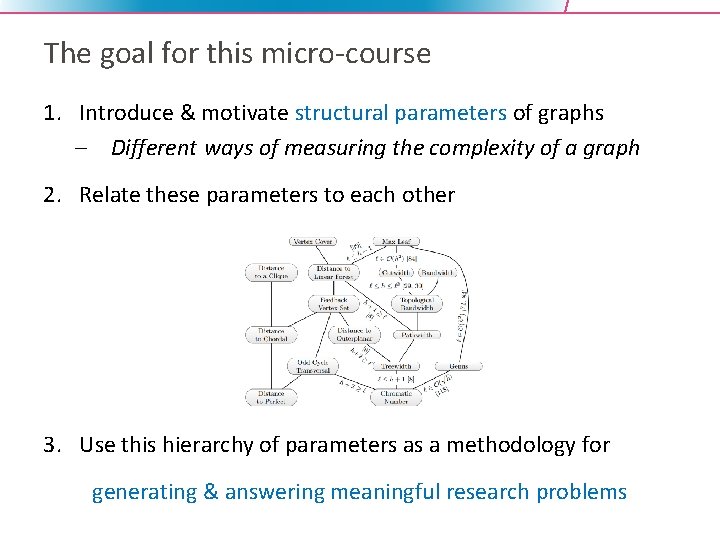
The goal for this micro-course 1. Introduce & motivate structural parameters of graphs – Different ways of measuring the complexity of a graph 2. Relate these parameters to each other 3. Use this hierarchy of parameters as a methodology for generating & answering meaningful research problems

The plan for this micro-course Tuesday: Introduction to graph parameters & exploring treewidth Wednesday: More parameters & relations between them Thursday: Applications to combinatorics & algorithmics 3

To get all noses in the same direction • 4

Co n nu test mb an er t 3 A BEAUTY CONTEST FOR GRAPHS complexity 5

A complexity contest for graphs – Judge #1 Number of cycles 0 8 6 31 6 3

A complexity contest for graphs – Judge #2 Vertex-deletion distance to acyclic 0 4 1 2 7 1
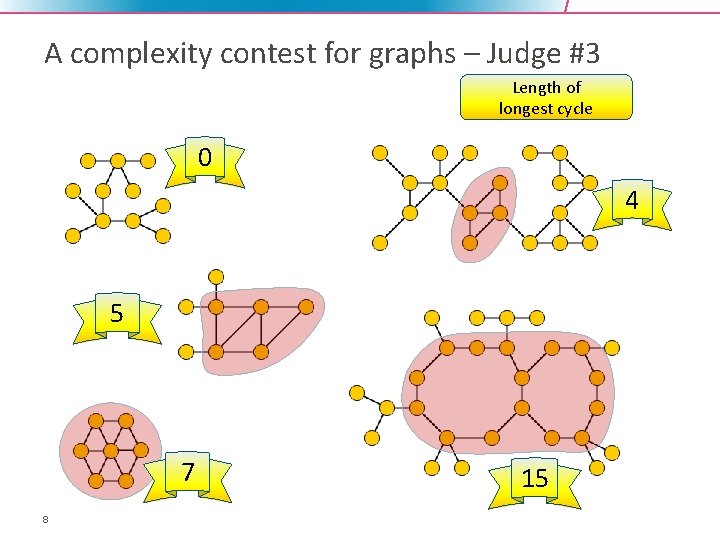
A complexity contest for graphs – Judge #3 Length of longest cycle 0 4 5 7 8 15

Measuring graph complexity Number of cycles Vertex-deletion distance to acyclic Length of longest cycle Feedback vertex number Circumference These are graph parameters: functions assigning integers to abstract graphs These 3 parameters give value 0 to all trees Which parameter captures graph complexity in a useful way? 9
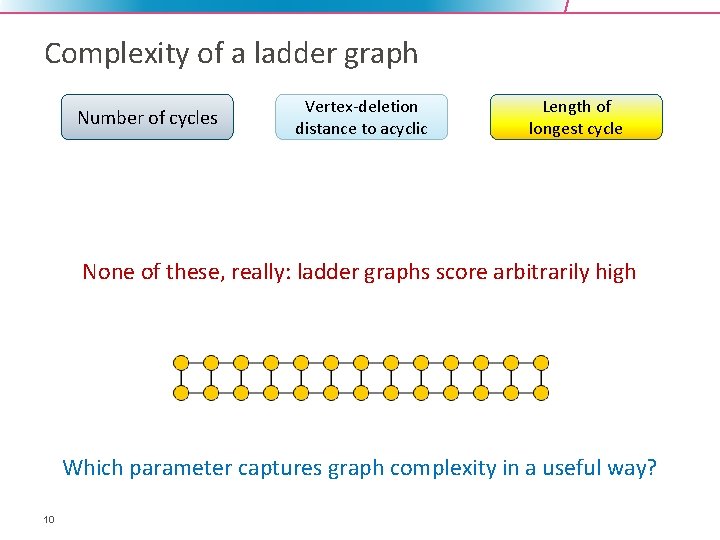
Complexity of a ladder graph Number of cycles Vertex-deletion distance to acyclic Length of longest cycle None of these, really: ladder graphs score arbitrarily high Which parameter captures graph complexity in a useful way? 10

TREEWIDTH 11

History The treewidth of a graph is a useful graph complexity parameter Intuitively: measures how treelike the graph is Rediscovered by Robertson & Seymour (1984) Discovered by Bertelé & Brioschi (1972) 1970 1975 Rediscovered by Halin (1976) 12 1980 1985 1990 … became so popular it never has to be rediscovered again

Definition of treewidth • 13
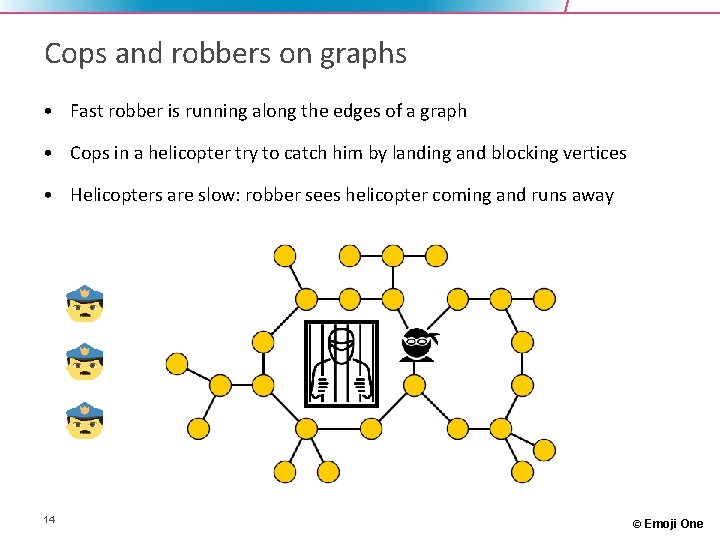
Cops and robbers on graphs • Fast robber is running along the edges of a graph • Cops in a helicopter try to catch him by landing and blocking vertices • Helicopters are slow: robber sees helicopter coming and runs away 14 © Emoji One
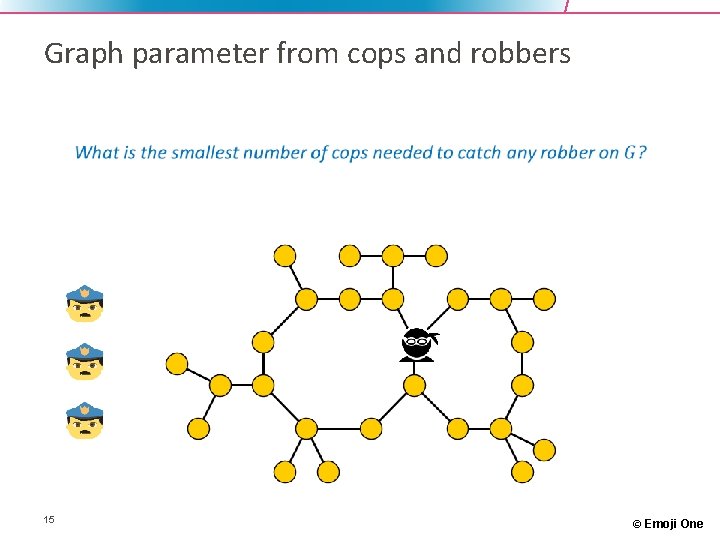
Graph parameter from cops and robbers • 15 © Emoji One
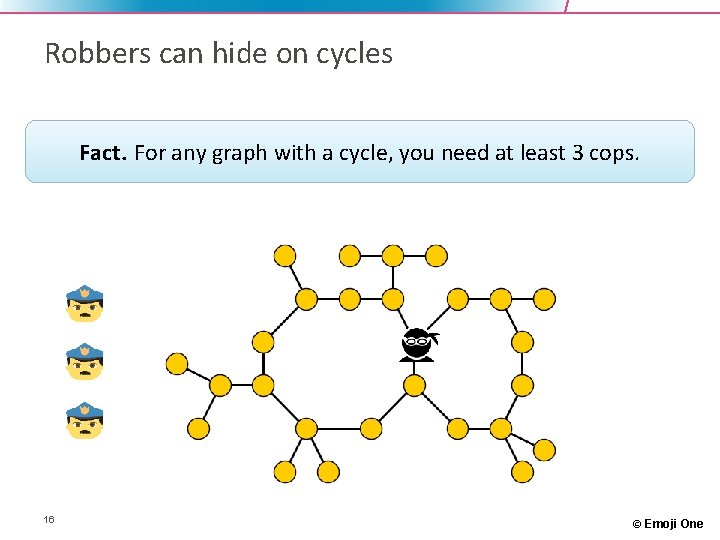
Robbers can hide on cycles Fact. For any graph with a cycle, you need at least 3 cops. 16 © Emoji One
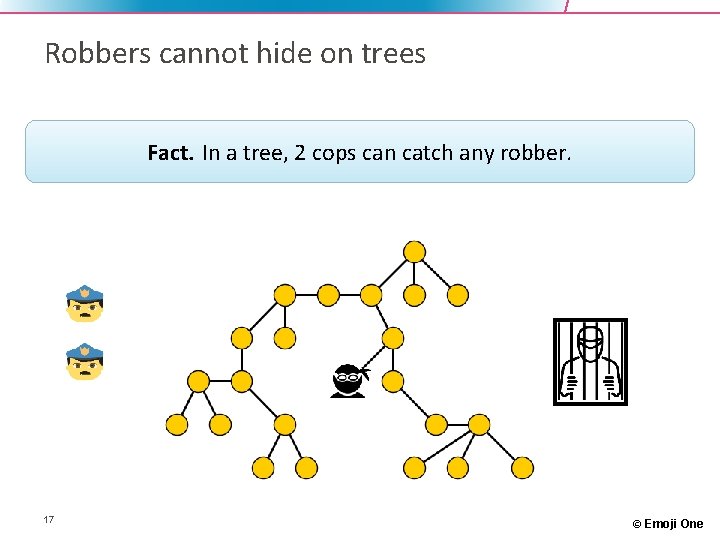
Robbers cannot hide on trees Fact. In a tree, 2 cops can catch any robber. 17 © Emoji One
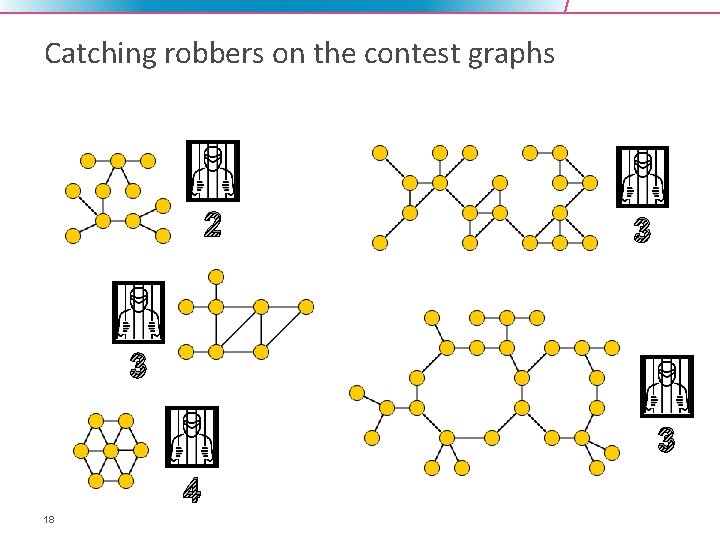
Catching robbers on the contest graphs 2 3 3 3 4 18
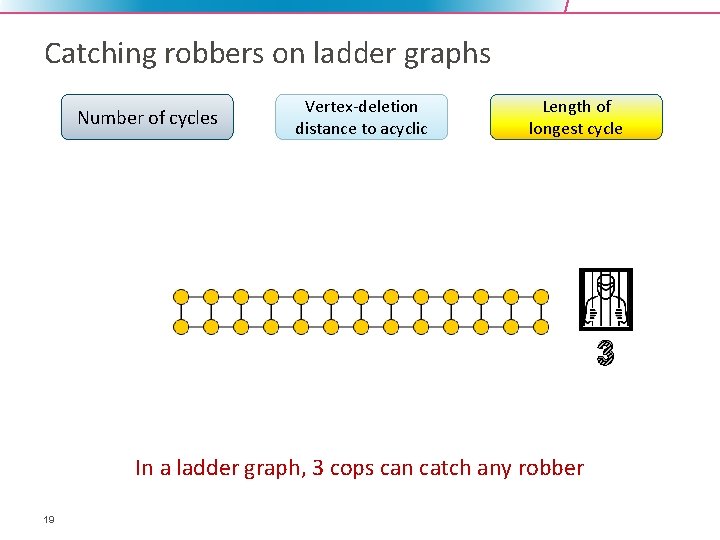
Catching robbers on ladder graphs Number of cycles Vertex-deletion distance to acyclic Length of longest cycle 3 In a ladder graph, 3 cops can catch any robber 19
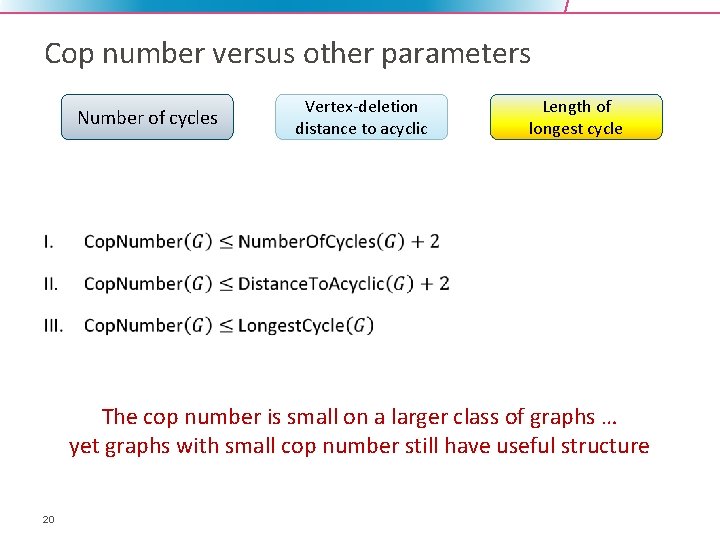
Cop number versus other parameters Number of cycles Vertex-deletion distance to acyclic Length of longest cycle The cop number is small on a larger class of graphs … yet graphs with small cop number still have useful structure 20
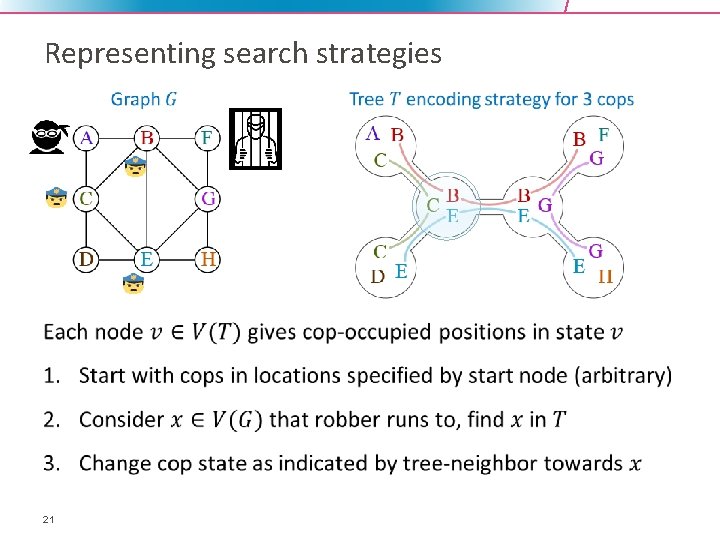
Representing search strategies • 21
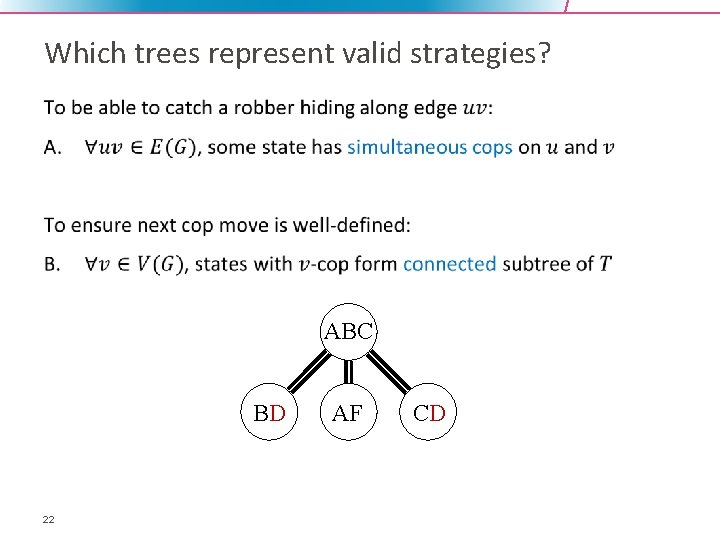
Which trees represent valid strategies? • ABC BD 22 AF CD
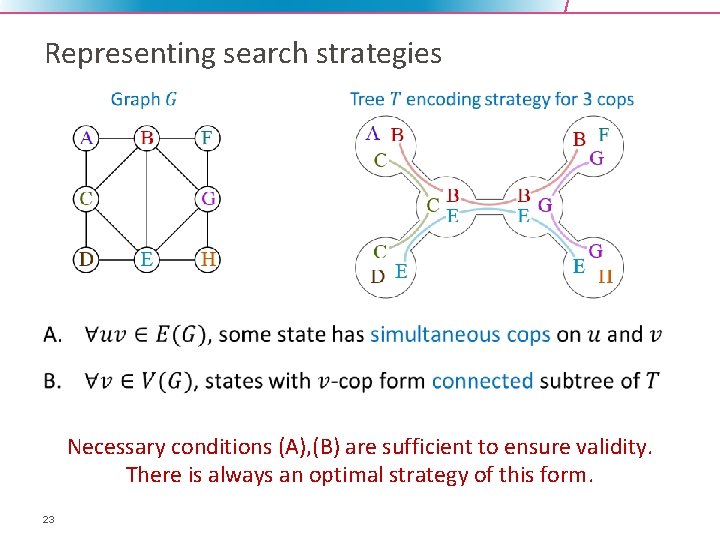
Representing search strategies • Necessary conditions (A), (B) are sufficient to ensure validity. There is always an optimal strategy of this form. 23

Tree decompositions • 24

Treewidth • 25
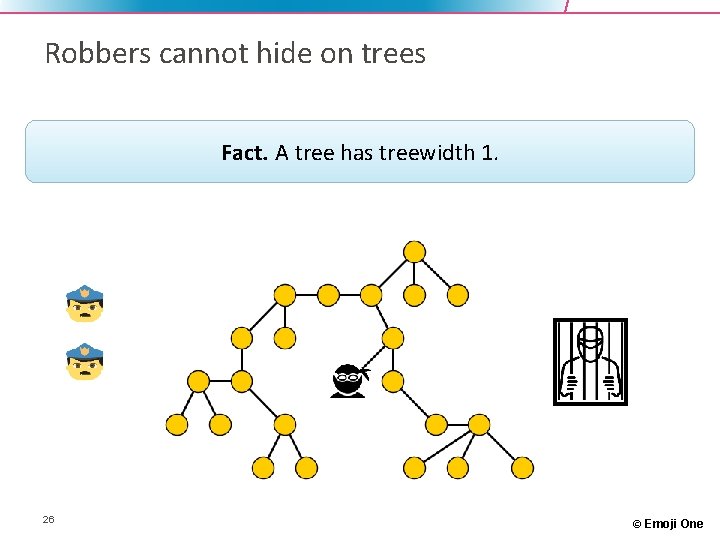
Robbers cannot hide on trees Fact. A tree has treewidth 1. 26 © Emoji One
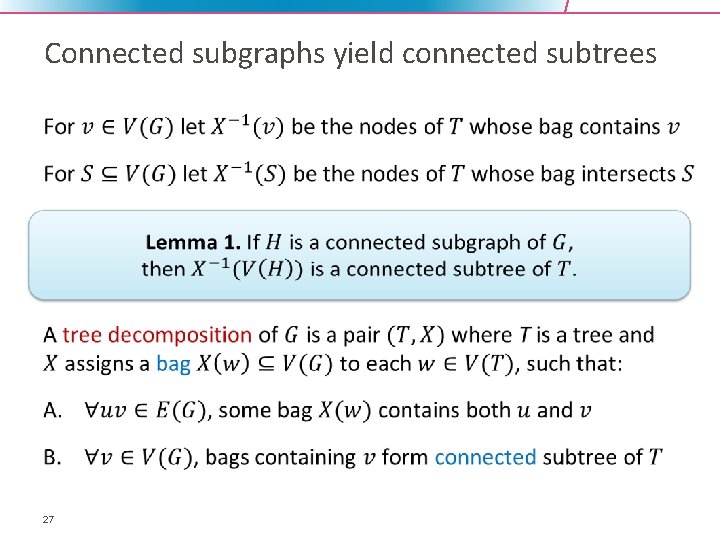
Connected subgraphs yield connected subtrees • 27
PROPERTIES OF TREEWIDTH 28
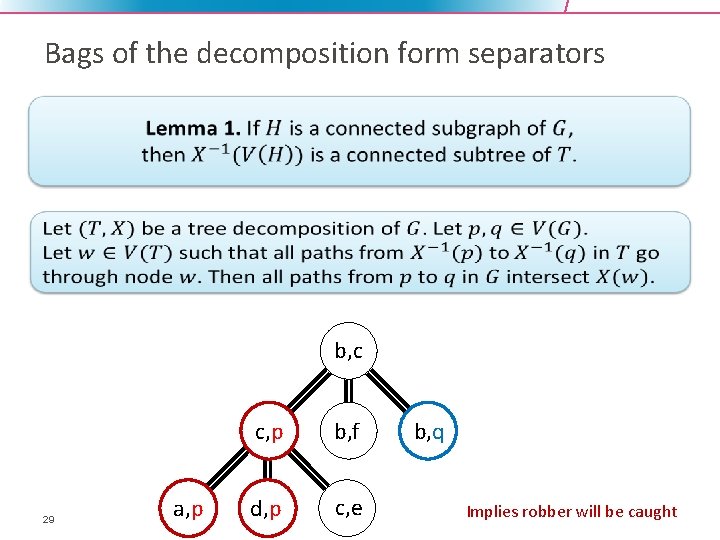
Bags of the decomposition form separators b, c 29 a, p c, p b, f d, p c, e b, q Implies robber will be caught

The treewidth of a grid • 30
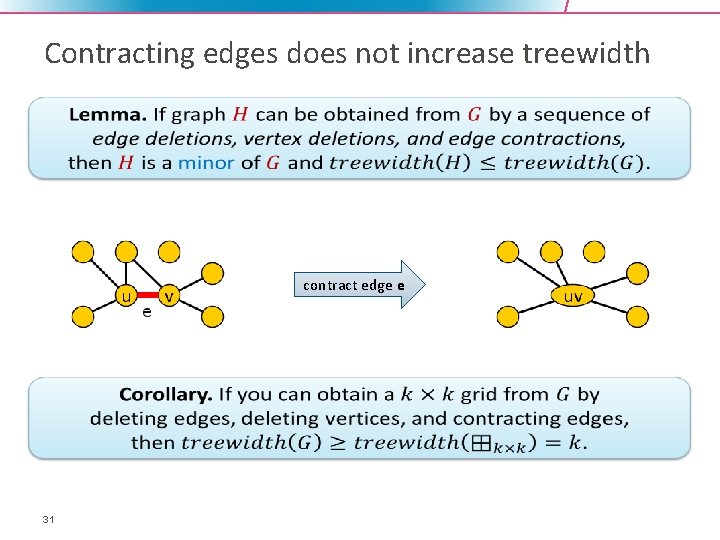
Contracting edges does not increase treewidth contract edge e 31
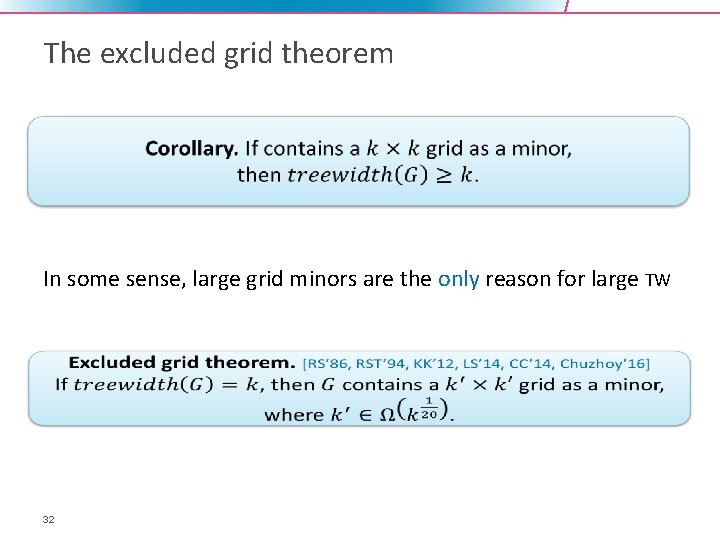
The excluded grid theorem In some sense, large grid minors are the only reason for large TW 32

Balanced separators from tree decompositions • 33

EXERCISES ON TREEWIDTH 34
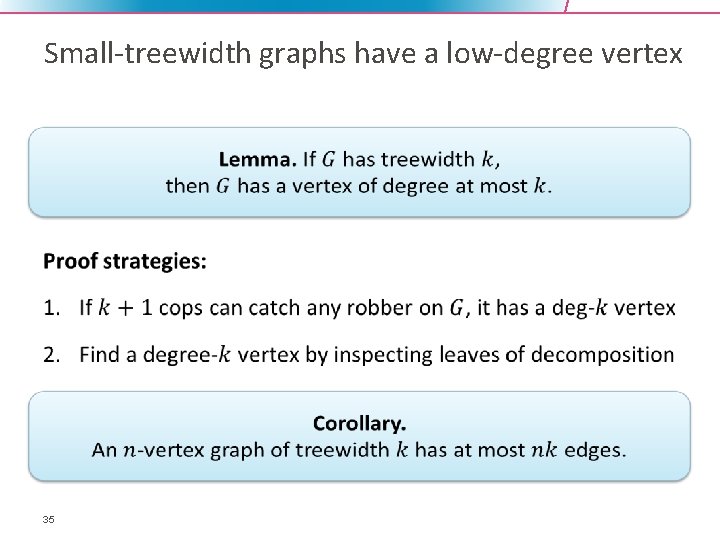
Small-treewidth graphs have a low-degree vertex • 35
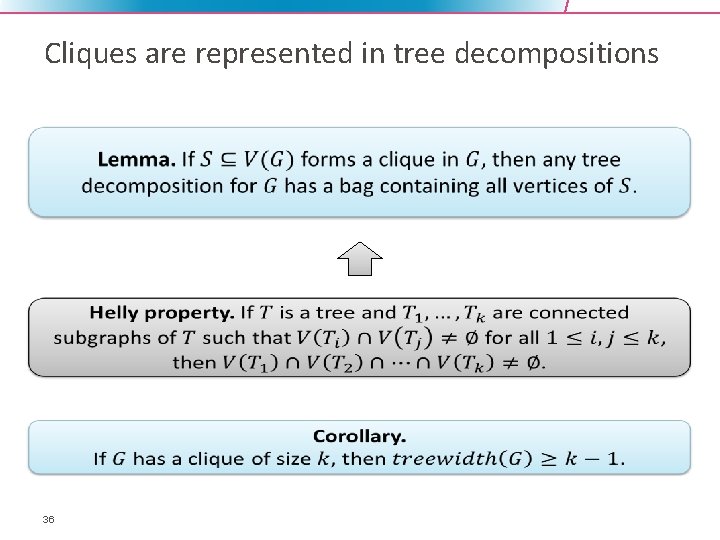
Cliques are represented in tree decompositions 36

TREEWIDTH OF RANDOM GRAPHS 37
![Random geometric graphs • 38 [Li & Müller, ‘ 15]](http://slidetodoc.com/presentation_image_h/20ce1164695bfdf46e857ca3688540a8/image-38.jpg "Random geometric graphs • 38 [Li & Müller, ‘ 15]")
Random geometric graphs • 38 [Li & Müller, ‘ 15]
![Random Erdös-Rényi graphs • [Lee, Oum, ‘ 12] 39](http://slidetodoc.com/presentation_image_h/20ce1164695bfdf46e857ca3688540a8/image-39.jpg "Random Erdös-Rényi graphs • [Lee, Oum, ‘ 12] 39")
Random Erdös-Rényi graphs • [Lee, Oum, ‘ 12] 39

CLOSING REMARKS 40
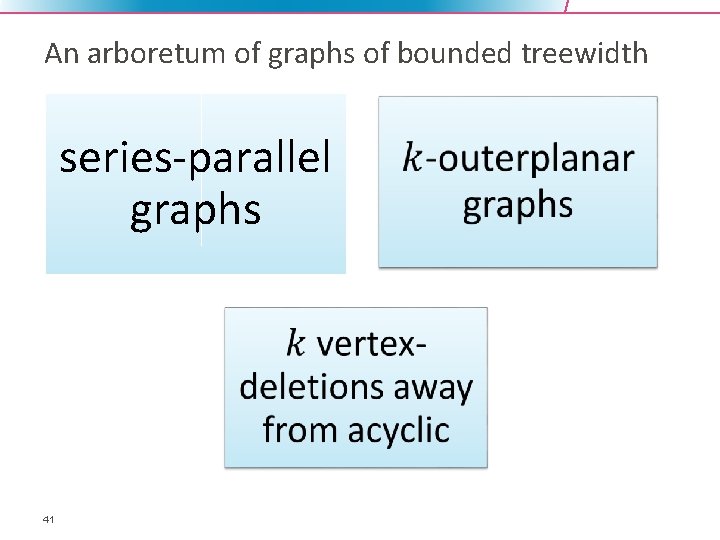
An arboretum of graphs of bounded treewidth series-parallel graphs 41
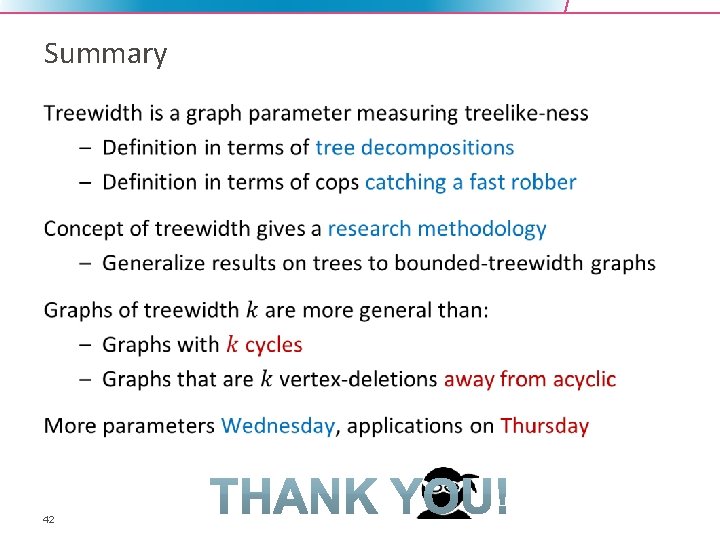
Summary • 42
- Slides: 42