
Structural Domains in Proteins PHAR 201Bioinformatics I Philip
Structural Domains in Proteins PHAR 201/Bioinformatics I Philip E. Bourne Department of Pharmacology, UCSD pbourne@ucsd. edu Thanks to Stella Veretnik PHAR 201 Lecture 15 2012
Agenda What is a 3 D domain? Why are domains important? Example manual methods Example automated methods Comparison of manual vs. automated methods • How we might do better • • • PHAR 201 Lecture 15 2012
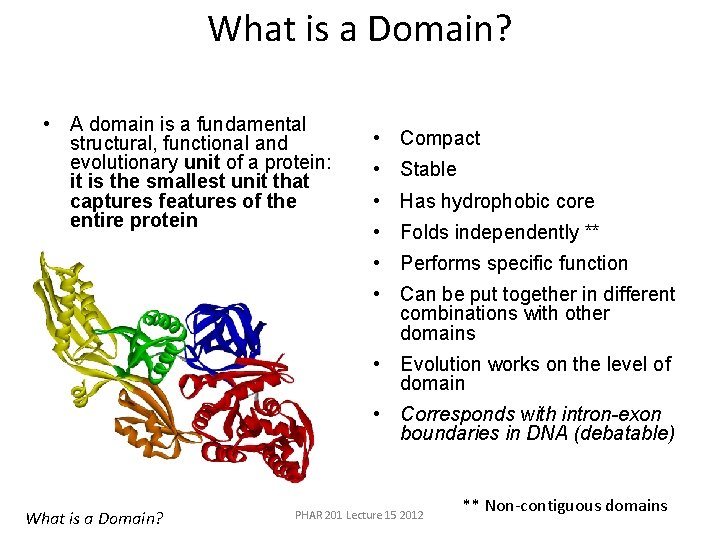
What is a Domain? • A domain is a fundamental structural, functional and evolutionary unit of a protein: it is the smallest unit that captures features of the entire protein • Compact • Stable • Has hydrophobic core • Folds independently ** • Performs specific function • Can be put together in different combinations with other domains • Evolution works on the level of domain • Corresponds with intron-exon boundaries in DNA (debatable) What is a Domain? PHAR 201 Lecture 15 2012 ** Non-contiguous domains
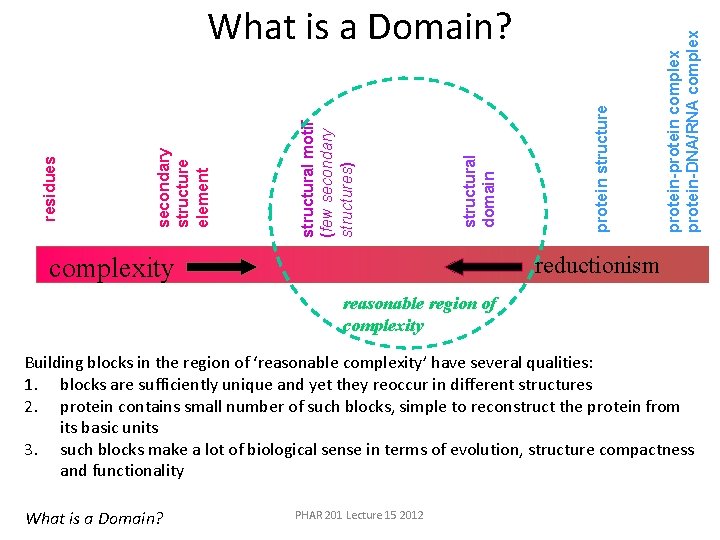
protein-protein complex protein-DNA/RNA complex protein structure structural domain structural motif (few secondary structures) secondary structure element residues What is a Domain? reductionism complexity reasonable region of complexity Building blocks in the region of ‘reasonable complexity’ have several qualities: 1. blocks are sufficiently unique and yet they reoccur in different structures 2. protein contains small number of such blocks, simple to reconstruct the protein from its basic units 3. such blocks make a lot of biological sense in terms of evolution, structure compactness and functionality What is a Domain? PHAR 201 Lecture 15 2012
Why are Domains Important? • Analysis of protein structure begins with its decomposition into basic structural units • Comparison of protein sequences often is confined to the region of the sequence, these regions often correspond to structural domains • Prediction of protein function is based on protein domains • Structural classifications are constructed using domains as building blocks Why are Domains Important? PHAR 201 Lecture 15 2012
Can we unambiguously and consistently identify domains in structures? • One way of answering this question is by comparing methods • Methods fall into two categories: – Manual – Author, SCOP, CATH – Automatic – e. g. Domain. Parser, PDP, PU, NCPI Characterizing Domain Assignment Methods PHAR 201 Lecture 15 2012
Manual Methods for Domain Assignment • SCOP : Structural Classification Of Proteins is a manually curated database; orders structures hierarchically into Classes, Folds, Superfamilies and Families according to their evolutionary, structural and functional relationships. Domains are defined as largest reoccurring units in the structure. • CATH : hierarchical classification of protein domain structures. Clusters proteins at four major levels Class (C), Architecture (A), Topology (T), Homologous superfamily (H). Uses both manual and automated methods (DETECTIVE, PUU, DOMAK and SSAP). Domains have to form a structurally compact and sensible unit. • AUTHORS : assigned by the authors of the solved structure. Authors of the structure tend to promote small structural regions to the status of domain if they carry specific functions. Details on Manual Methods PHAR 201 Lecture 15 2012
Examples where there is no agreement among manual methods Disagreement Among Manual Methods PHAR 201 Lecture 15 2012
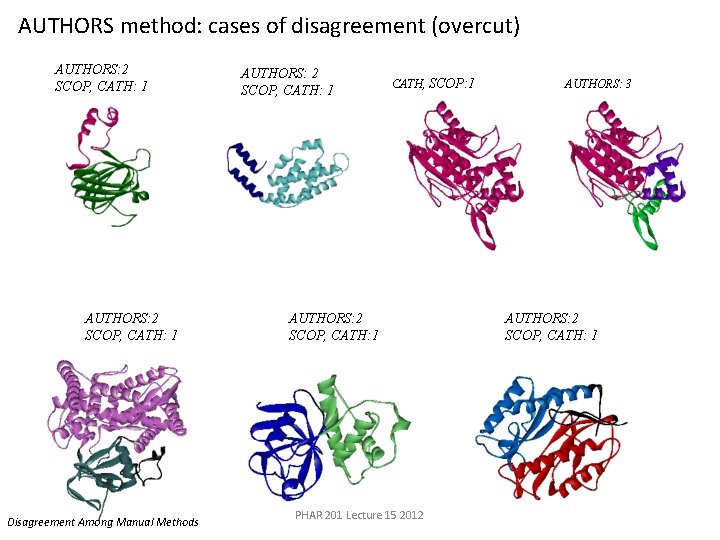
1 caub 1 pcpa/1 pcpl AUTHORS method: cases of disagreement (overcut) AUTHORS: 2 SCOP, CATH: 1 2 hpd AUTHORS: 2 SCOP, CATH: 1 Disagreement Among Manual Methods AUTHORS: 2 SCOP, CATH: 1 1 tahb CATH, SCOP: 1 1 ppn AUTHORS: 2 SCOP, CATH: 1 PHAR 201 Lecture 15 2012 AUTHORS: 3 1 mat AUTHORS: 2 SCOP, CATH: 1
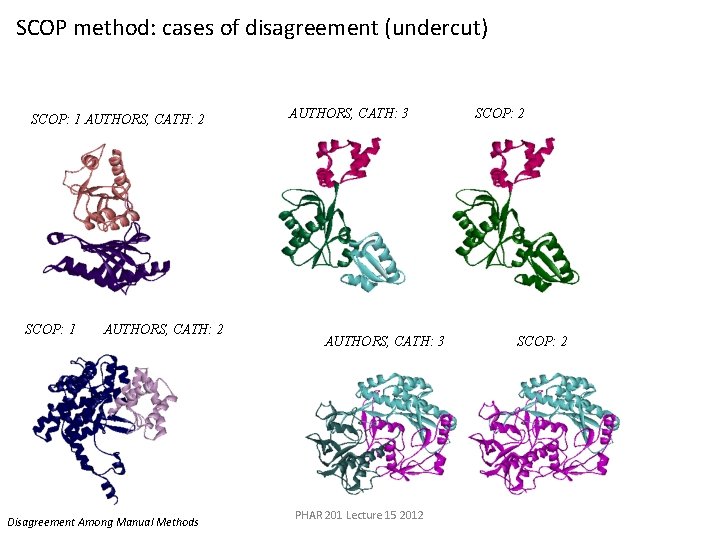
5 fbpa 1 bpb SCOP method: cases of disagreement (undercut) SCOP: 1 AUTHORS, CATH: 2 SCOP: 12 cts. AUTHORS, CATH: 2 Disagreement Among Manual Methods AUTHORS, CATH: 3 PHAR 201 Lecture 15 2012 SCOP: 2 1 gal SCOP: 2
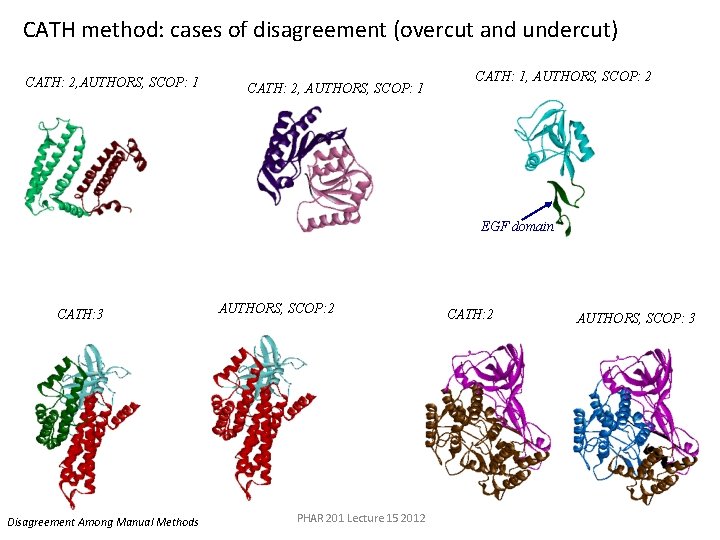
1 prcl 2 hhm 1 esl CATH method: cases of disagreement (overcut and undercut) CATH: 2, AUTHORS, SCOP: 1 CATH: 1, AUTHORS, SCOP: 2 EGF domain 3 mdda CATH: 3 Disagreement Among Manual Methods 1 lla AUTHORS, SCOP: 2 PHAR 201 Lecture 15 2012 CATH: 2 AUTHORS, SCOP: 3
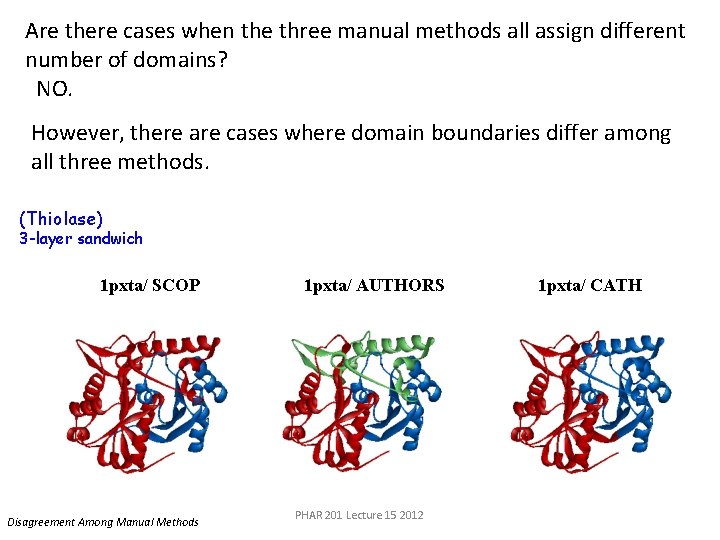
Are there cases when the three manual methods all assign different number of domains? NO. However, there are cases where domain boundaries differ among all three methods. (Thiolase) 3 -layer sandwich 1 pxta/ SCOP Disagreement Among Manual Methods 1 pxta/ AUTHORS PHAR 201 Lecture 15 2012 1 pxta/ CATH
Why are there disagreements among manual methods as to how to partition protein into domains? • Multiple aspects contribute to the concept of structural domains: – evolutionary aspect (recurrence of domain in different contexts) – structural aspect (compactness/independent folding of domain) – functional aspect (ability to carry function). Disagreement Among Manual Methods PHAR 201 Lecture 15 2012
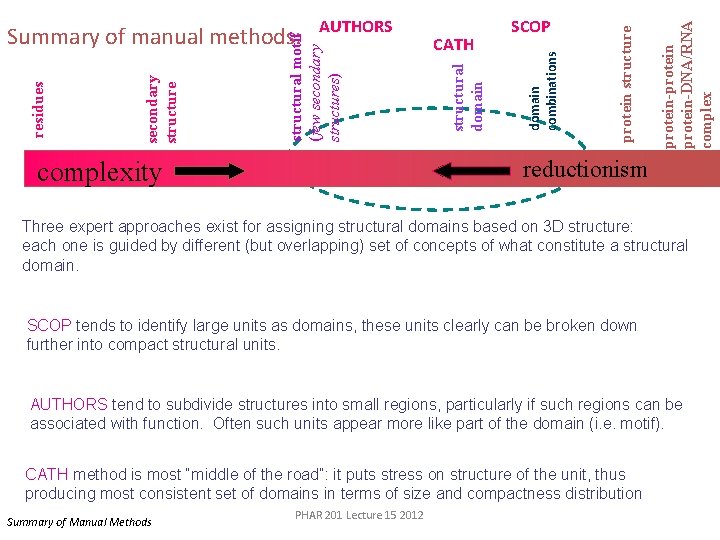
protein-protein-DNA/RNA complex protein structure SCOP domain combinations CATH structural domain AUTHORS structural motif (few secondary structures) secondary structure residues Summary of manual methods: reductionism complexity Three expert approaches exist for assigning structural domains based on 3 D structure: each one is guided by different (but overlapping) set of concepts of what constitute a structural domain. SCOP tends to identify large units as domains, these units clearly can be broken down further into compact structural units. AUTHORS tend to subdivide structures into small regions, particularly if such regions can be associated with function. Often such units appear more like part of the domain (i. e. motif). CATH method is most “middle of the road”: it puts stress on structure of the unit, thus producing most consistent set of domains in terms of size and compactness distribution Summary of Manual Methods PHAR 201 Lecture 15 2012
Automatic Methods for Domain Assignment PHAR 201 Lecture 15 2012
Why we need automatic methods for domain assignments? • Fast annotation of new structures: Manual methods such as SCOP and CATH are chronically behind in the assignments – compounding problem • Consistent domain assignment: In principle automatic domain assignments should be consistent as all the rules as pre-set and there is no human intervention at any step of the process (some assignments will be consistently wrong, however) Details on Automatic Methods PHAR 201 Lecture 15 2012
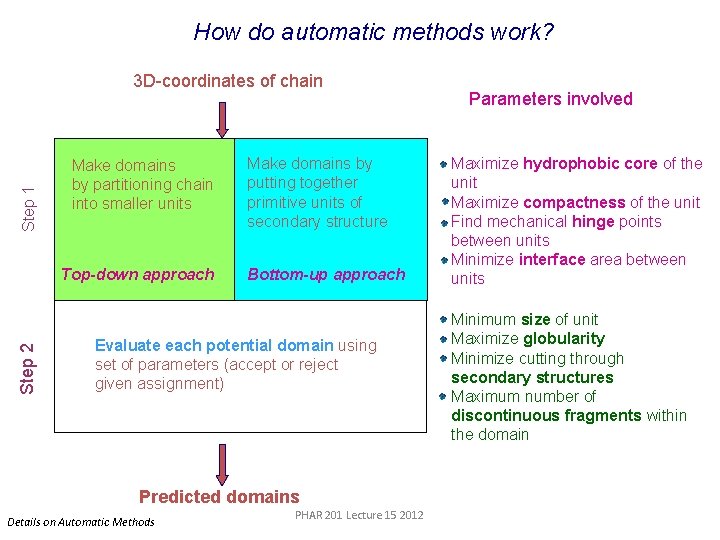
How do automatic methods work? Step 1 3 D-coordinates of chain Make domains by partitioning chain into smaller units Step 2 Top-down approach Make domains by putting together primitive units of secondary structure Bottom-up approach Evaluate each potential domain using set of parameters (accept or reject given assignment) Predicted domains Details on Automatic Methods PHAR 201 Lecture 15 2012 Parameters involved Maximize hydrophobic core of the unit Maximize compactness of the unit Find mechanical hinge points between units Minimize interface area between units Minimum size of unit Maximize globularity Minimize cutting through secondary structures Maximum number of discontinuous fragments within the domain
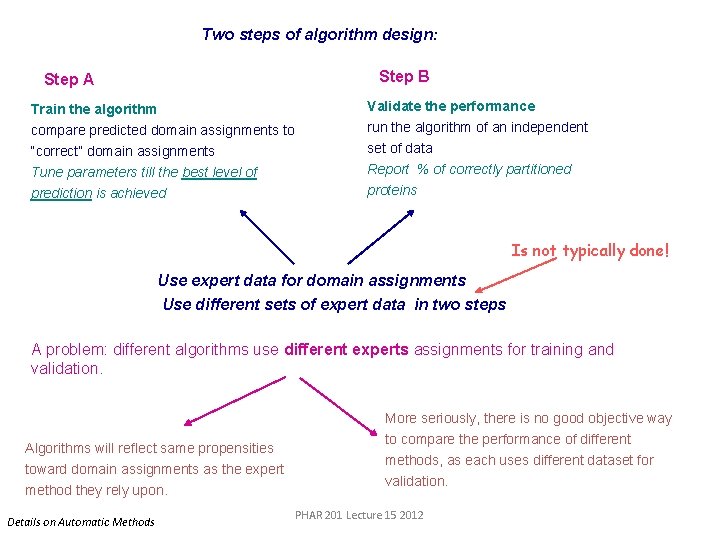
Two steps of algorithm design: Step B Step A Train the algorithm Validate the performance compare predicted domain assignments to “correct” domain assignments run the algorithm of an independent set of data Tune parameters till the best level of prediction is achieved Report % of correctly partitioned proteins Is not typically done! Use expert data for domain assignments Use different sets of expert data in two steps A problem: different algorithms use different experts assignments for training and validation. More seriously, there is no good objective way Algorithms will reflect same propensities toward domain assignments as the expert method they rely upon. Details on Automatic Methods to compare the performance of different methods, as each uses different dataset for validation. PHAR 201 Lecture 15 2012
Relative Performance of Automated Methods using a Consensus Benchmark Dataset Four most recent/available methods were used in analysis: PDP, Domain. Parser, PUU and method by NCBI. Details on Automatic Methods – Relative Performance PHAR 201 Lecture 15 2012
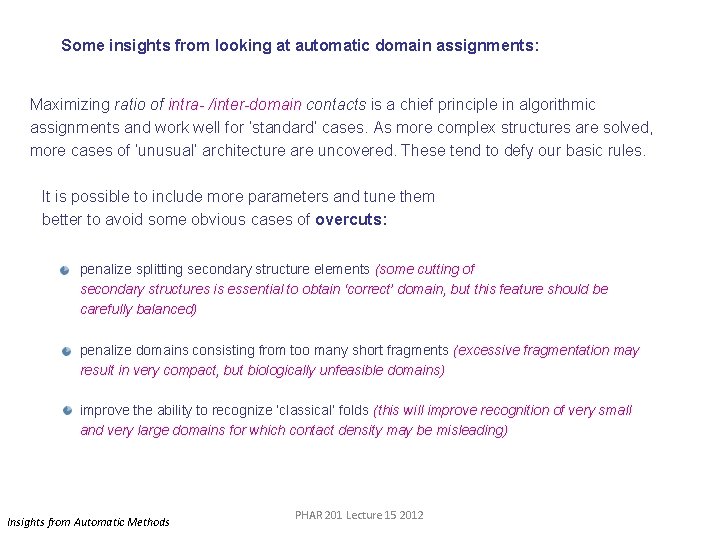
Some insights from looking at automatic domain assignments: Maximizing ratio of intra- /inter-domain contacts is a chief principle in algorithmic assignments and work well for ‘standard’ cases. As more complex structures are solved, more cases of ‘unusual’ architecture are uncovered. These tend to defy our basic rules. It is possible to include more parameters and tune them better to avoid some obvious cases of overcuts: penalize splitting secondary structure elements (some cutting of secondary structures is essential to obtain ‘correct’ domain, but this feature should be carefully balanced) penalize domains consisting from too many short fragments (excessive fragmentation may result in very compact, but biologically unfeasible domains) improve the ability to recognize ‘classical’ folds (this will improve recognition of very small and very large domains for which contact density may be misleading) Insights from Automatic Methods PHAR 201 Lecture 15 2012
It is very difficult to improve the cases of undercut, as they are result of significant interactions within domain interface. Our observations indicate that majority of the undercut cases involves b-class domains: b-sheets and b-stands cause significant interactions not only within domain but also between residues of the adjacent domains. This phenomenon tricks most automatic methods (but not experts!). In order to be able to conceptualize when it is justified to separate structural region with significant interactions into separate domains we need to: better understanding domain –domain interfaces include of additional information, such as sequence alignments and recurrence of architectures Typically algorithms partition structure in a similar way, it is how far the structure is partitioned that differs among methods. An ideal output from an algorithm would give several structure partitions at different level of refinement (less domains -> more domains or gross partitioning -> fine partitioning). Couple of algorithms of that nature appeared so far… Insights from Automatic Methods PHAR 201 Lecture 15 2012
Example of One Automated Method in Detail: Domain. Parser PHAR 201 Lecture 15 2012
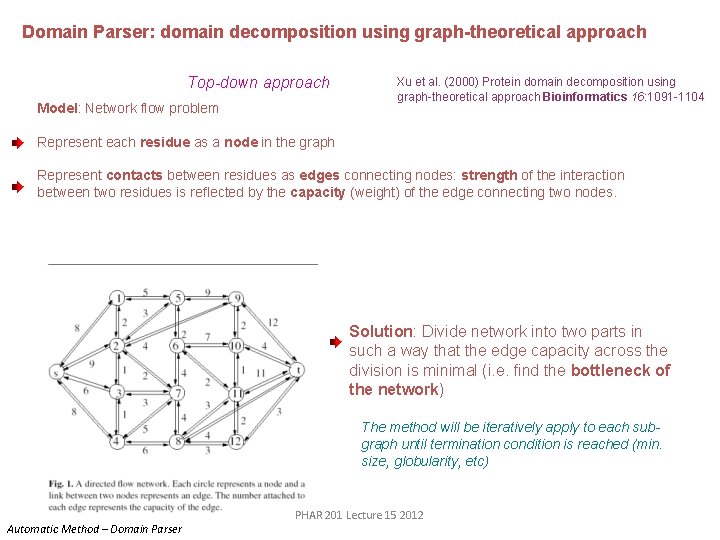
Domain Parser: domain decomposition using graph-theoretical approach Top-down approach Model: Network flow problem Xu et al. (2000) Protein domain decomposition using graph-theoretical approach Bioinformatics 16: 1091 -1104 Represent each residue as a node in the graph Represent contacts between residues as edges connecting nodes: strength of the interaction between two residues is reflected by the capacity (weight) of the edge connecting two nodes. Solution: Divide network into two parts in such a way that the edge capacity across the division is minimal (i. e. find the bottleneck of the network) The method will be iteratively apply to each subgraph until termination condition is reached (min. size, globularity, etc) Automatic Method – Domain Parser PHAR 201 Lecture 15 2012
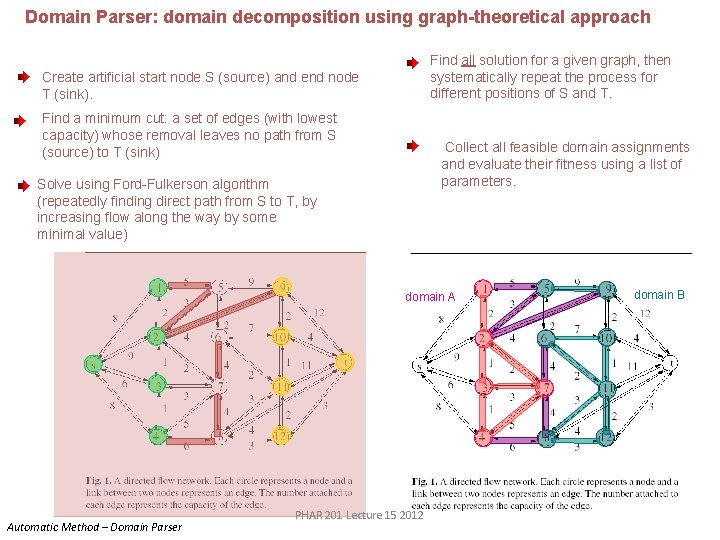
Domain Parser: domain decomposition using graph-theoretical approach Find all solution for a given graph, then systematically repeat the process for different positions of S and T. Create artificial start node S (source) and end node T (sink). Find a minimum cut: a set of edges (with lowest capacity) whose removal leaves no path from S (source) to T (sink) Collect all feasible domain assignments and evaluate their fitness using a list of parameters. Solve using Ford-Fulkerson algorithm (repeatedly finding direct path from S to T, by increasing flow along the way by some minimal value) domain A Automatic Method – Domain Parser PHAR 201 Lecture 15 2012 domain B
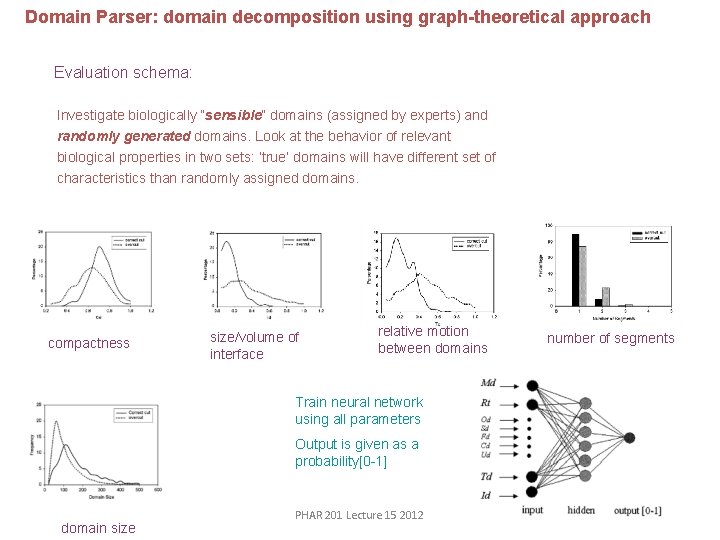
Domain Parser: domain decomposition using graph-theoretical approach Evaluation schema: Investigate biologically “sensible” domains (assigned by experts) and randomly generated domains. Look at the behavior of relevant biological properties in two sets: ‘true’ domains will have different set of characteristics than randomly assigned domains. compactness size/volume of interface relative motion between domains Train neural network using all parameters Output is given as a probability[0 -1] domain size PHAR 201 Lecture 15 2012 number of segments
Comparison of Automated vs. Manual Methods PHAR 201 Lecture 15 2012
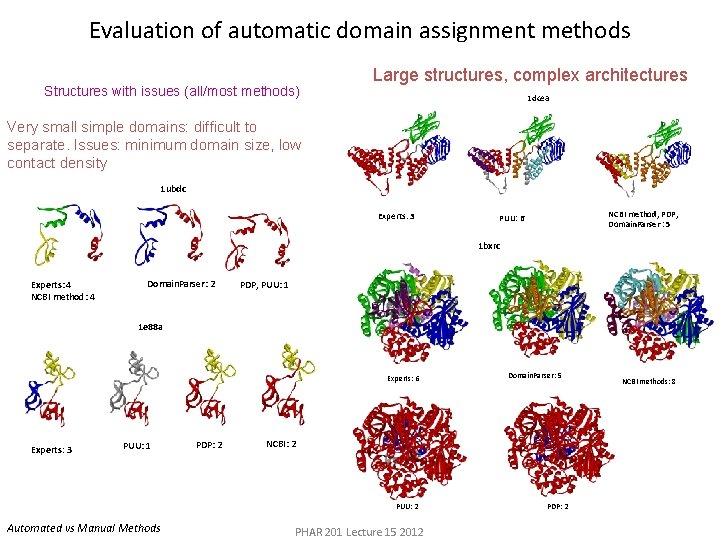
Evaluation of automatic domain assignment methods Structures with issues (all/most methods) Large structures, complex architectures 1 dcea Very small simple domains: difficult to separate. Issues: minimum domain size, low contact density 1 ubdc Experts: 3 NCBI method, PDP, Domain. Parser : 5 PUU: 6 1 bxrc Experts: 4 NCBI method: 4 Domain. Parser: 2 PDP, PUU: 1 1 e 88 a Experts: 6 Experts: 3 PUU: 1 PDP: 2 NCBI: 2 PUU: 2 Automated vs Manual Methods Domain. Parser: 5 PHAR 201 Lecture 15 2012 PDP: 2 NCBI methods: 8
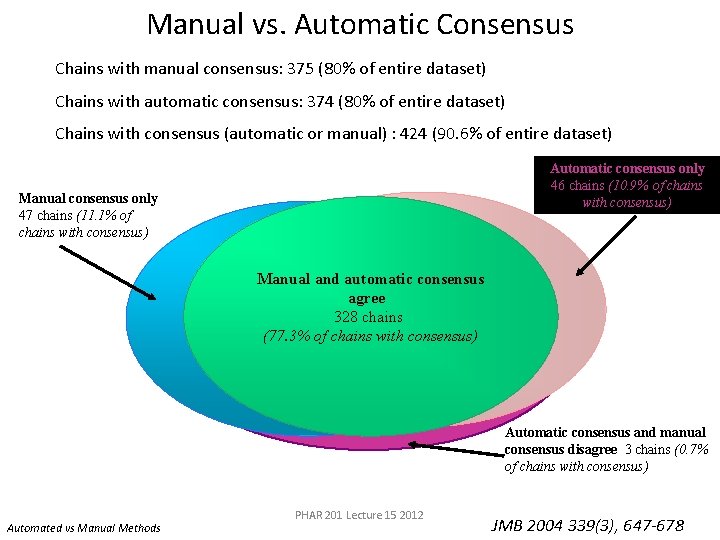
Manual vs. Automatic Consensus Chains with manual consensus: 375 (80% of entire dataset) Chains with automatic consensus: 374 (80% of entire dataset) Chains with consensus (automatic or manual) : 424 (90. 6% of entire dataset) Automatic consensus only 46 chains (10. 9% of chains with consensus) Manual consensus only 47 chains (11. 1% of chains with consensus) Manual and automatic consensus agree 328 chains (77. 3% of chains with consensus) Automatic consensus and manual consensus disagree 3 chains (0. 7% of chains with consensus) Automated vs Manual Methods PHAR 201 Lecture 15 2012 JMB 2004 339(3), 647 -678
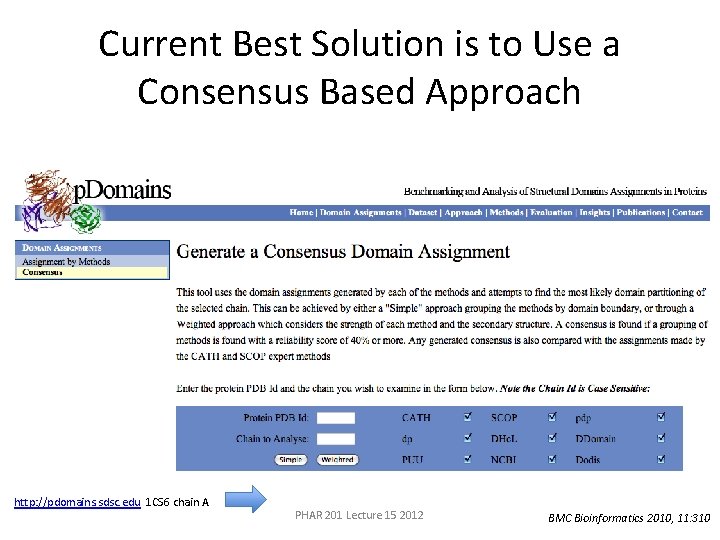
Current Best Solution is to Use a Consensus Based Approach http: //pdomains. sdsc. edu 1 CS 6 chain A PHAR 201 Lecture 15 2012 BMC Bioinformatics 2010, 11: 310
- Slides: 29