
STRUCTURAL DESIGN TIMELINE AND SUMMARY Design Optimization Timeline
- Slides: 10
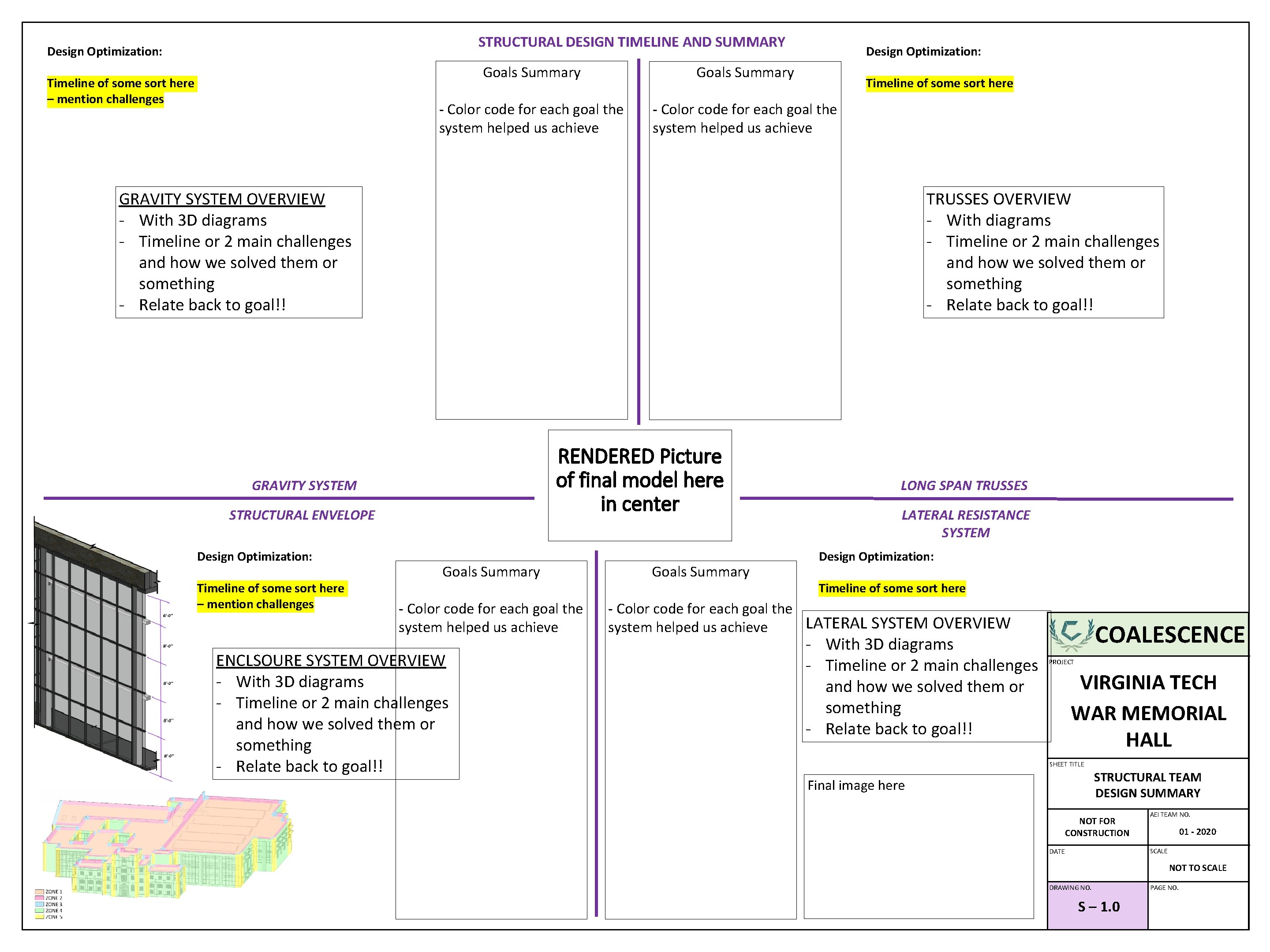
STRUCTURAL DESIGN TIMELINE AND SUMMARY Design Optimization: Timeline of some sort here – mention challenges Design Optimization: Goals Summary - Color code for each goal the system helped us achieve Timeline of some sort here GRAVITY SYSTEM OVERVIEW - With 3 D diagrams - Timeline or 2 main challenges and how we solved them or something - Relate back to goal!! TRUSSES OVERVIEW - With diagrams - Timeline or 2 main challenges and how we solved them or something - Relate back to goal!! RENDERED Picture of final model here in center GRAVITY SYSTEM STRUCTURAL ENVELOPE Design Optimization: Timeline of some sort here – mention challenges Goals Summary - Color code for each goal the system helped us achieve ENCLSOURE SYSTEM OVERVIEW - With 3 D diagrams - Timeline or 2 main challenges and how we solved them or something - Relate back to goal!! Goals Summary LONG SPAN TRUSSES LATERAL RESISTANCE SYSTEM Design Optimization: Timeline of some sort here - Color code for each goal the LATERAL SYSTEM OVERVIEW system helped us achieve - With 3 D diagrams - Timeline or 2 main challenges and how we solved them or something - Relate back to goal!! COALESCENCE PROJECT VIRGINIA TECH WAR MEMORIAL HALL SHEET TITLE STRUCTURAL TEAM DESIGN SUMMARY Final image here NOT FOR CONSTRUCTION AEI TEAM NO. 01 - 2020 SCALE DATE NOT TO SCALE DRAWING NO. S – 1. 0 PAGE NO.
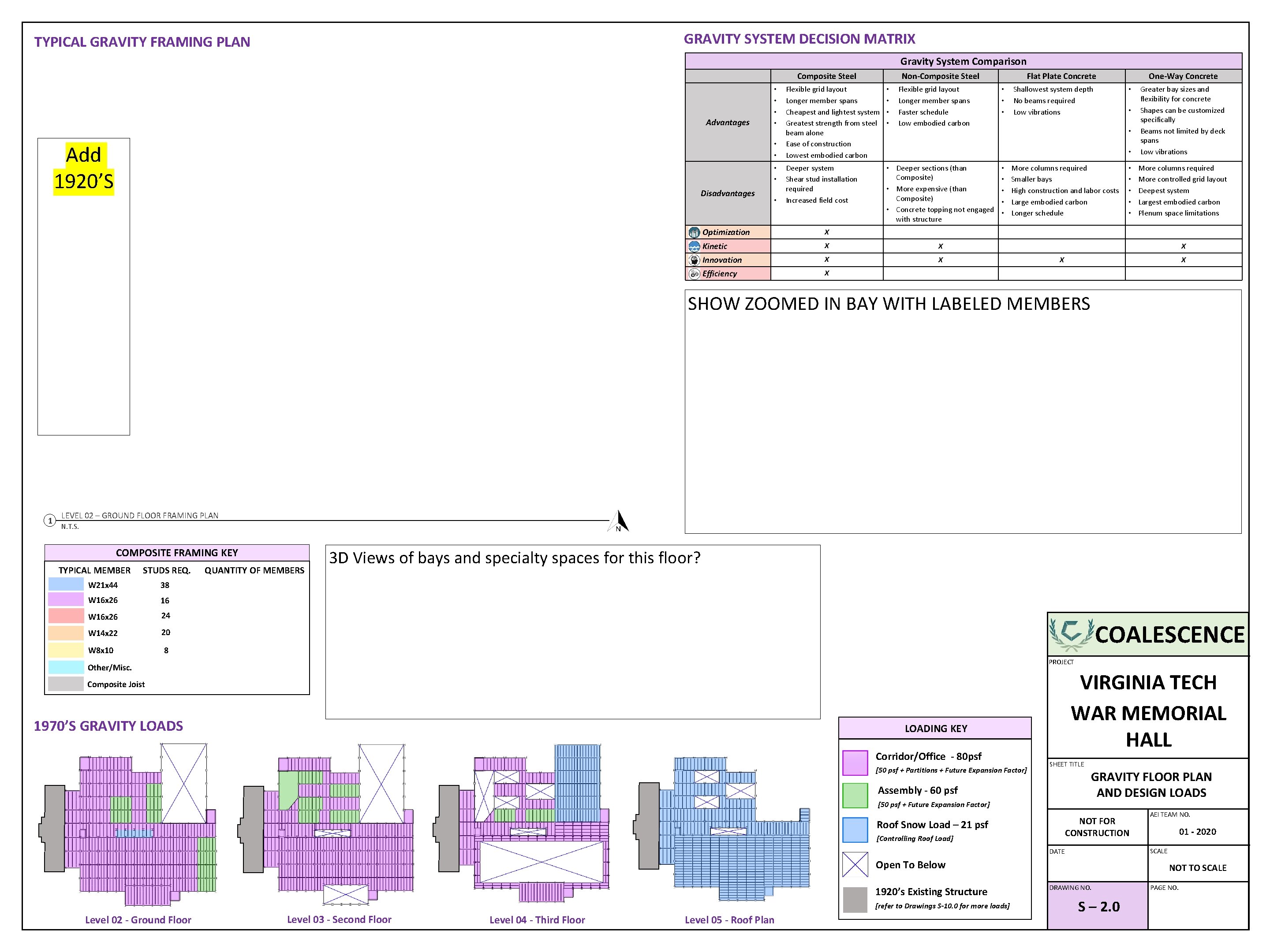
GRAVITY SYSTEM DECISION MATRIX TYPICAL GRAVITY FRAMING PLAN Gravity System Comparison Composite Steel Advantages • • • Add 1920’S • • Disadvantages • Non-Composite Steel Flexible grid layout Longer member spans Cheapest and lightest system Greatest strength from steel beam alone Ease of construction Lowest embodied carbon • • Flexible grid layout Longer member spans Faster schedule Low embodied carbon Deeper system Shear stud installation required Increased field cost • Deeper sections (than Composite) • More expensive (than Composite) • Concrete topping not engaged with structure Optimization X Kinetic X X Innovation X X Efficiency X Flat Plate Concrete • • • Shallowest system depth No beams required Low vibrations One-Way Concrete • Greater bay sizes and flexibility for concrete Shapes can be customized specifically Beams not limited by deck spans Low vibrations • • • More columns required More controlled grid layout Deepest system Largest embodied carbon Plenum space limitations • • More columns required Smaller bays High construction and labor costs Large embodied carbon Longer schedule X X X SHOW ZOOMED IN BAY WITH LABELED MEMBERS 1 LEVEL 02 – GROUND FLOOR FRAMING PLAN N. T. S. COMPOSITE FRAMING KEY TYPICAL MEMBER STUDS REQ. W 21 x 44 38 W 16 x 26 16 W 16 x 26 24 W 14 x 22 20 W 8 x 10 8 QUANTITY OF MEMBERS 3 D Views of bays and specialty spaces for this floor? COALESCENCE PROJECT Other/Misc. VIRGINIA TECH WAR MEMORIAL HALL Composite Joist 1970’S GRAVITY LOADS LOADING KEY Corridor/Office - 80 psf [50 psf + Partitions + Future Expansion Factor] SHEET TITLE Assembly - 60 psf [50 psf + Future Expansion Factor] GRAVITY FLOOR PLAN AND DESIGN LOADS NOT FOR CONSTRUCTION Roof Snow Load – 21 psf [Controlling Roof Load] Open To Below [refer to Drawings S-10. 0 for more loads] Level 02 - Ground Floor Level 03 - Second Floor Level 04 - Third Floor Level 05 - Roof Plan 01 - 2020 SCALE DATE 1920’s Existing Structure AEI TEAM NO. NOT TO SCALE DRAWING NO. S – 2. 0 PAGE NO.
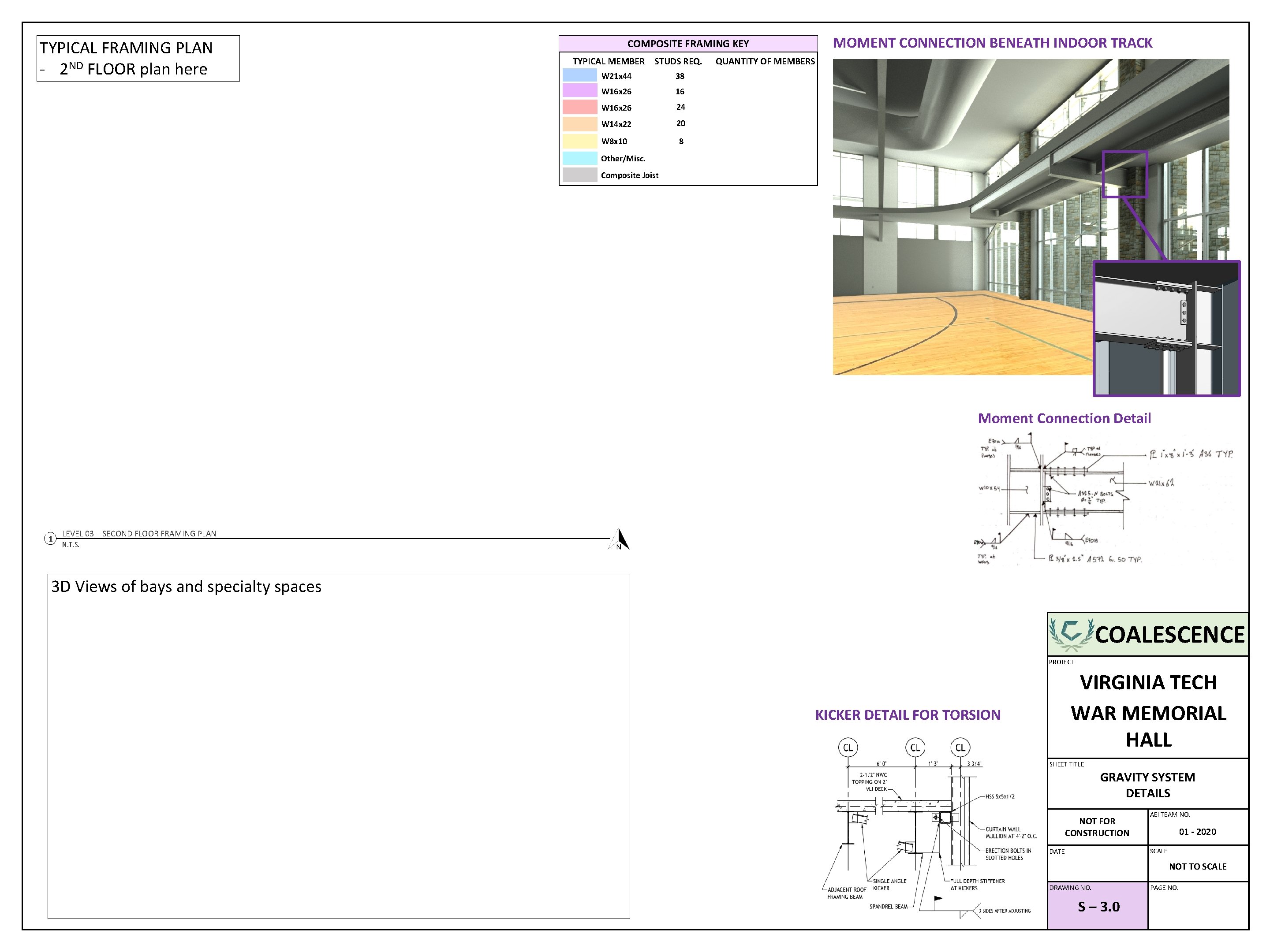
TYPICAL FRAMING PLAN - 2 ND FLOOR plan here COMPOSITE FRAMING KEY TYPICAL MEMBER STUDS REQ. W 21 x 44 38 W 16 x 26 16 W 16 x 26 24 W 14 x 22 20 W 8 x 10 8 MOMENT CONNECTION BENEATH INDOOR TRACK QUANTITY OF MEMBERS Other/Misc. Composite Joist Moment Connection Detail 1 LEVEL 03 – SECOND FLOOR FRAMING PLAN N. T. S. 3 D Views of bays and specialty spaces COALESCENCE PROJECT VIRGINIA TECH WAR MEMORIAL HALL KICKER DETAIL FOR TORSION SHEET TITLE GRAVITY SYSTEM DETAILS NOT FOR CONSTRUCTION AEI TEAM NO. 01 - 2020 SCALE DATE NOT TO SCALE DRAWING NO. S – 3. 0 PAGE NO.
Roof plan and column table/graphic Design to Capacity ratio graphic – for GRAVITY COALESCENCE PROJECT VIRGINIA TECH WAR MEMORIAL HALL SHEET TITLE LONG SPAN TRUSS DETAILS NOT FOR CONSTRUCTION AEI TEAM NO. 01 - 2020 SCALE DATE NOT TO SCALE DRAWING NO. S– 4. 0 PAGE NO.
Truss Stuff - utilization scale w/ members colored - grasshopper iterations – chart showing optimized solution - final design stuff Design to Capacity ratio graphic – for TRUSSES COALESCENCE PROJECT VIRGINIA TECH WAR MEMORIAL HALL SHEET TITLE LONG SPAN TRUSS DETAILS NOT FOR CONSTRUCTION AEI TEAM NO. 01 - 2020 SCALE DATE NOT TO SCALE DRAWING NO. S – 5. 0 PAGE NO.
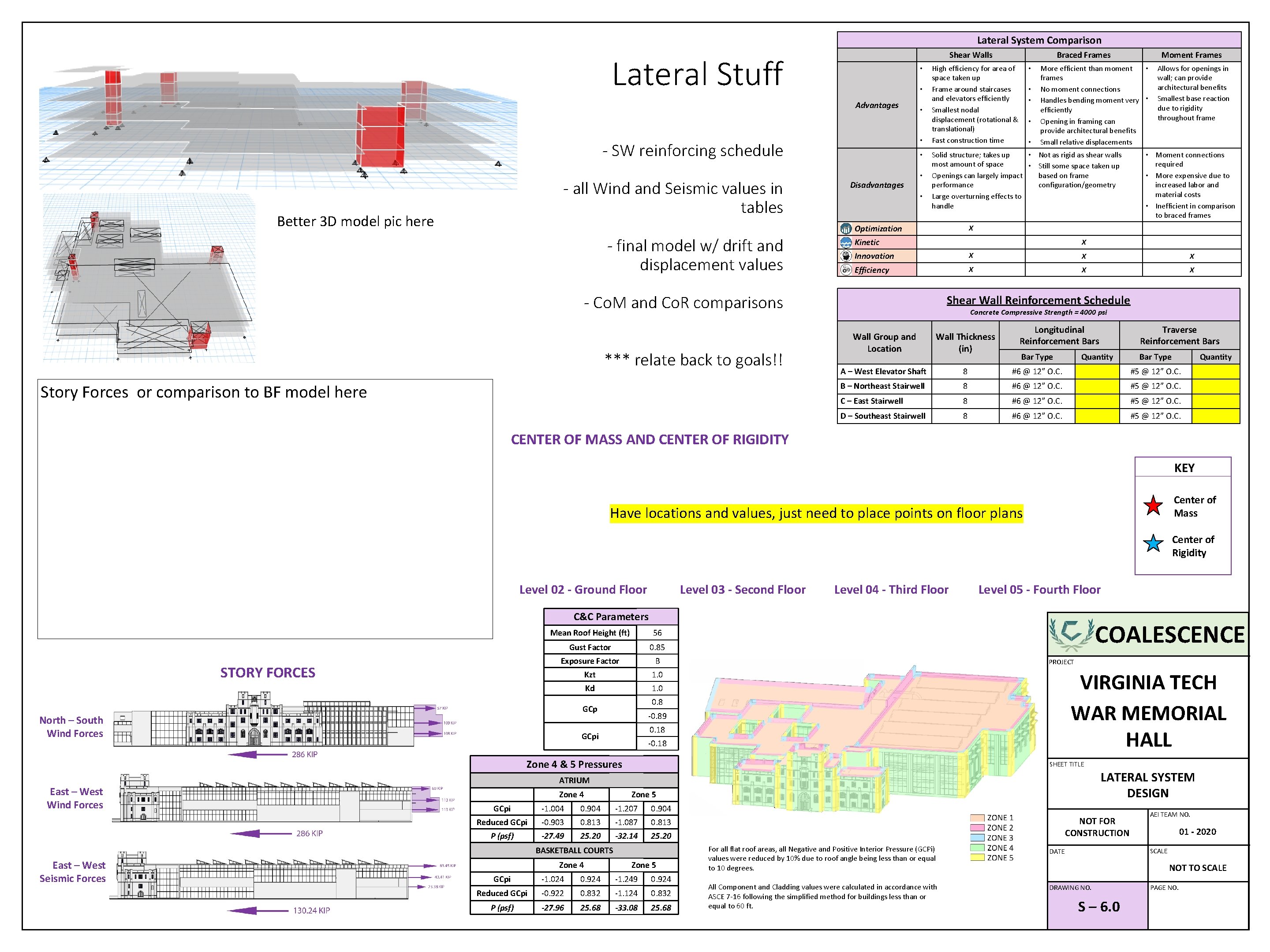
Lateral System Comparison Shear Walls Lateral Stuff • • Advantages • - SW reinforcing schedule - all Wind and Seismic values in tables Better 3 D model pic here • • Disadvantages • • High efficiency for area of space taken up Frame around staircases and elevators efficiently Smallest nodal displacement (rotational & translational) Fast construction time Story Forces or comparison to BF model here • • Moment Frames More efficient than moment • frames No moment connections Handles bending moment very • efficiently Opening in framing can provide architectural benefits Small relative displacements Allows for openings in wall; can provide architectural benefits Smallest base reaction due to rigidity throughout frame • Moment connections required • More expensive due to increased labor and material costs • Inefficient in comparison to braced frames X Kinetic X Innovation X X X Efficiency X X X - Co. M and Co. R comparisons *** relate back to goals!! • Solid structure; takes up • Not as rigid as shear walls most amount of space • Still some space taken up Openings can largely impact based on frame performance configuration/geometry Large overturning effects to handle Optimization - final model w/ drift and displacement values Braced Frames Shear Wall Reinforcement Schedule Concrete Compressive Strength = 4000 psi Longitudinal Reinforcement Bars Traverse Reinforcement Bars Bar Type Wall Group and Location Wall Thickness (in) A – West Elevator Shaft 8 #6 @ 12” O. C. #5 @ 12” O. C. B – Northeast Stairwell 8 #6 @ 12” O. C. #5 @ 12” O. C. C – East Stairwell 8 #6 @ 12” O. C. #5 @ 12” O. C. D – Southeast Stairwell 8 #6 @ 12” O. C. #5 @ 12” O. C. Quantity CENTER OF MASS AND CENTER OF RIGIDITY KEY Center of Mass Have locations and values, just need to place points on floor plans Center of Rigidity Level 02 - Ground Floor Level 03 - Second Floor Level 04 - Third Floor Level 05 - Fourth Floor C&C Parameters STORY FORCES Mean Roof Height (ft) 56 Gust Factor 0. 85 Exposure Factor B Kzt 1. 0 Kd 1. 0 PROJECT VIRGINIA TECH WAR MEMORIAL HALL 0. 8 GCp North – South Wind Forces COALESCENCE -0. 89 0. 18 GCpi -0. 18 Zone 4 & 5 Pressures East – West Wind Forces SHEET TITLE Zone 4 Zone 5 GCpi -1. 004 0. 904 -1. 207 0. 904 Reduced GCpi -0. 903 0. 813 -1. 087 0. 813 P (psf) -27. 49 25. 20 -32. 14 25. 20 BASKETBALL COURTS East – West Seismic Forces LATERAL SYSTEM DESIGN ATRIUM Zone 4 Zone 5 GCpi -1. 024 0. 924 -1. 249 0. 924 Reduced GCpi -0. 922 0. 832 -1. 124 0. 832 P (psf) -27. 96 25. 68 -33. 08 25. 68 NOT FOR CONSTRUCTION For all flat roof areas, all Negative and Positive Interior Pressure (GCPi) values were reduced by 10% due to roof angle being less than or equal to 10 degrees. DATE All Component and Cladding values were calculated in accordance with ASCE 7 -16 following the simplified method for buildings less than or equal to 60 ft. DRAWING NO. AEI TEAM NO. 01 - 2020 SCALE NOT TO SCALE S – 6. 0 PAGE NO.
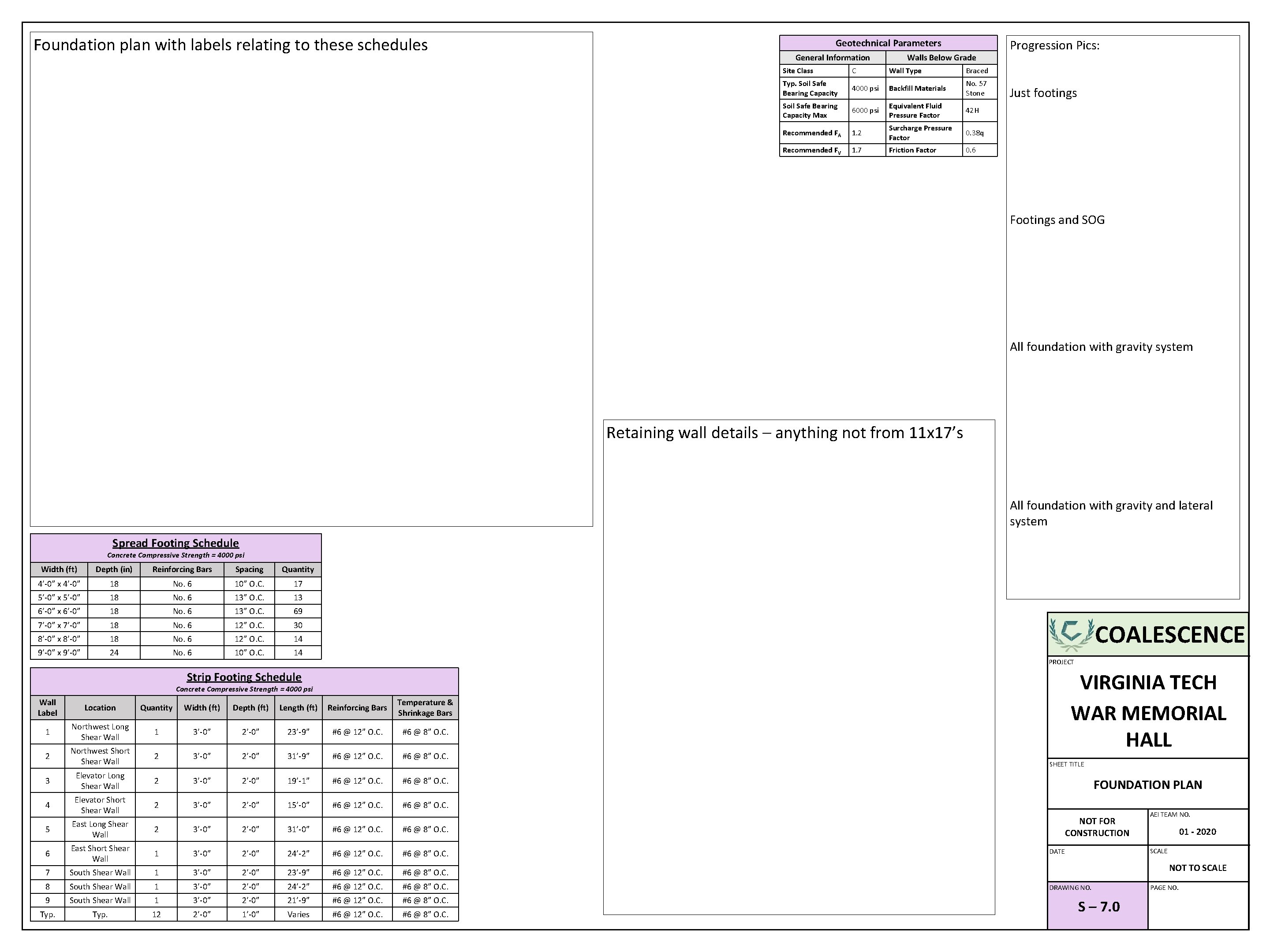
Foundation plan with labels relating to these schedules Geotechnical Parameters General Information Walls Below Grade Site Class C Wall Type Braced Typ. Soil Safe Bearing Capacity 4000 psi Backfill Materials No. 57 Stone Soil Safe Bearing Capacity Max 6000 psi Equivalent Fluid Pressure Factor 42 H Recommended FA 1. 2 Surcharge Pressure Factor 0. 38 q Recommended FV 1. 7 Friction Factor 0. 6 Progression Pics: Just footings Footings and SOG All foundation with gravity system Retaining wall details – anything not from 11 x 17’s All foundation with gravity and lateral system Spread Footing Schedule Concrete Compressive Strength = 4000 psi Width (ft) Depth (in) Reinforcing Bars Spacing Quantity 4’-0” x 4’-0” 18 No. 6 10” O. C. 17 5’-0” x 5’-0” 18 No. 6 13” O. C. 13 6’-0” x 6’-0” 18 No. 6 13” O. C. 69 7’-0” x 7’-0” 18 No. 6 12” O. C. 30 8’-0” x 8’-0” 18 No. 6 12” O. C. 14 9’-0” x 9’-0” 24 No. 6 10” O. C. 14 COALESCENCE PROJECT VIRGINIA TECH WAR MEMORIAL HALL Strip Footing Schedule Concrete Compressive Strength = 4000 psi Wall Label Location Quantity Width (ft) Depth (ft) Length (ft) Reinforcing Bars Temperature & Shrinkage Bars 1 Northwest Long Shear Wall 1 3’-0” 23’-9” #6 @ 12” O. C. #6 @ 8” O. C. 2 Northwest Short Shear Wall 2 3’-0” 2’-0” 31’-9” #6 @ 12” O. C. #6 @ 8” O. C. 3 Elevator Long Shear Wall 2 3’-0” 2’-0” 19’-1” #6 @ 12” O. C. #6 @ 8” O. C. 4 Elevator Short Shear Wall 2 3’-0” 2’-0” 15’-0” #6 @ 12” O. C. #6 @ 8” O. C. 5 East Long Shear Wall 2 3’-0” 2’-0” 31’-0” #6 @ 12” O. C. #6 @ 8” O. C. 6 East Short Shear Wall 1 3’-0” 24’-2” #6 @ 12” O. C. #6 @ 8” O. C. 7 South Shear Wall 1 3’-0” 23’-9” #6 @ 12” O. C. #6 @ 8” O. C. 8 South Shear Wall 1 3’-0” 24’-2” #6 @ 12” O. C. #6 @ 8” O. C. 9 South Shear Wall 1 3’-0” 21’-9” #6 @ 12” O. C. #6 @ 8” O. C. Typ. 12 2’-0” 1’-0” Varies #6 @ 12” O. C. #6 @ 8” O. C. SHEET TITLE FOUNDATION PLAN NOT FOR CONSTRUCTION AEI TEAM NO. 01 - 2020 SCALE DATE NOT TO SCALE DRAWING NO. S – 7. 0 PAGE NO.
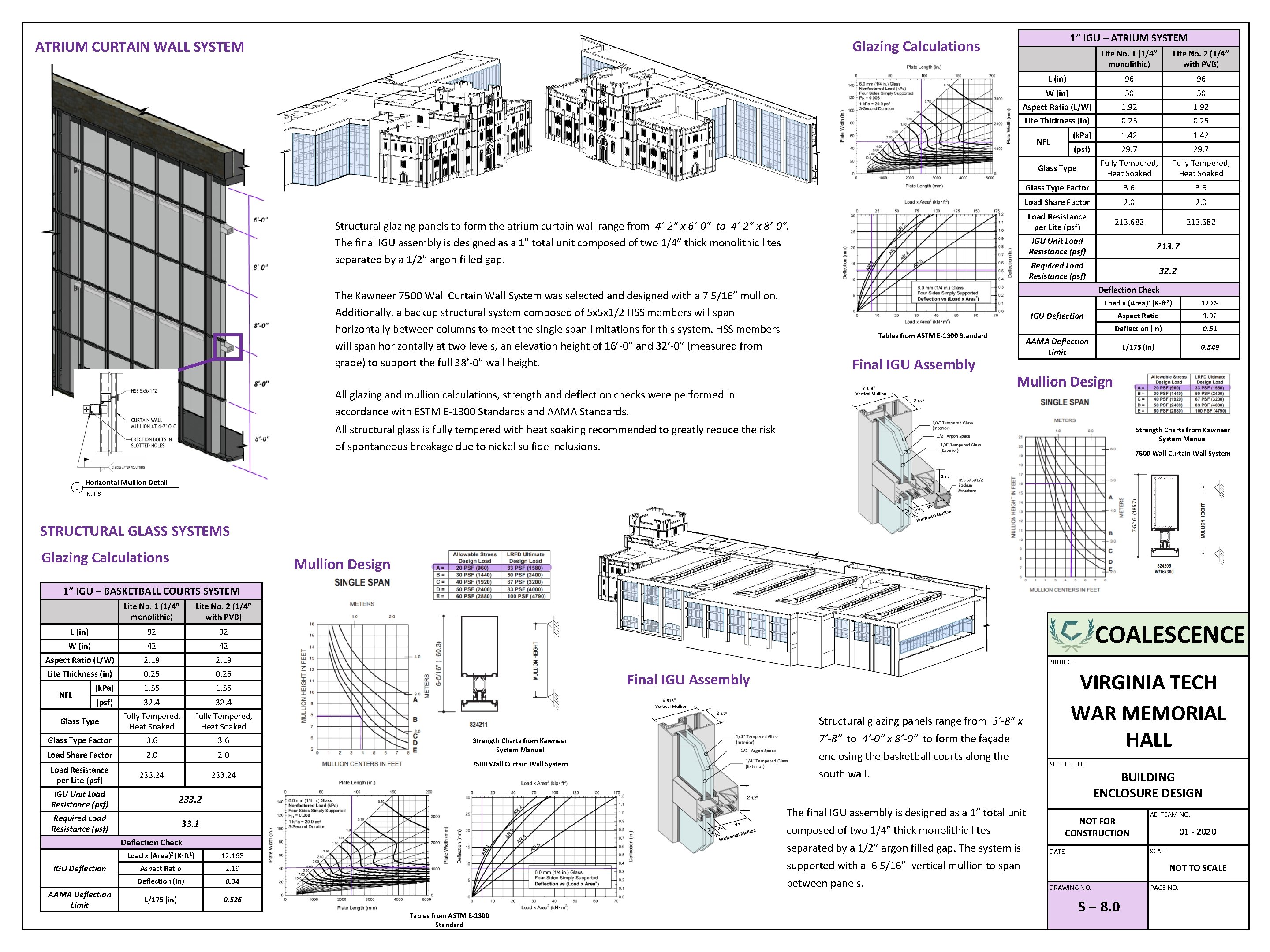
1” IGU – ATRIUM SYSTEM Glazing Calculations ATRIUM CURTAIN WALL SYSTEM Lite No. 1 (1/4” monolithic) Lite No. 2 (1/4” with PVB) L (in) 96 96 W (in) 50 50 Aspect Ratio (L/W) 1. 92 Lite Thickness (in) 0. 25 (k. Pa) 1. 42 (psf) 29. 7 Glass Type Fully Tempered, Heat Soaked Glass Type Factor 3. 6 Load Share Factor 2. 0 Load Resistance per Lite (psf) 213. 682 NFL Structural glazing panels to form the atrium curtain wall range from 4’-2” x 6’-0” to 4’-2” x 8’-0”. The final IGU assembly is designed as a 1” total unit composed of two 1/4” thick monolithic lites separated by a 1/2” argon filled gap. The Kawneer 7500 Wall Curtain Wall System was selected and designed with a 7 5/16” mullion. Additionally, a backup structural system composed of 5 x 5 x 1/2 HSS members will span horizontally between columns to meet the single span limitations for this system. HSS members will span horizontally at two levels, an elevation height of 16’-0” and 32’-0” (measured from grade) to support the full 38’-0” wall height. IGU Unit Load Resistance (psf) 213. 7 Required Load Resistance (psf) 32. 2 Deflection Check Load x (Area)2 (K-ft 2) 17. 89 Aspect Ratio 1. 92 Deflection (in) 0. 51 L/175 (in) 0. 549 IGU Deflection Tables from ASTM E-1300 Standard Final IGU Assembly All glazing and mullion calculations, strength and deflection checks were performed in accordance with ESTM E-1300 Standards and AAMA Standards. AAMA Deflection Limit Mullion Design All structural glass is fully tempered with heat soaking recommended to greatly reduce the risk of spontaneous breakage due to nickel sulfide inclusions. 1 Strength Charts from Kawneer System Manual 7500 Wall Curtain Wall System Horizontal Mullion Detail N. T. S STRUCTURAL GLASS SYSTEMS Glazing Calculations Mullion Design 1” IGU – BASKETBALL COURTS SYSTEM Lite No. 1 (1/4” monolithic) Lite No. 2 (1/4” with PVB) L (in) 92 92 W (in) 42 42 Aspect Ratio (L/W) 2. 19 Lite Thickness (in) 0. 25 (k. Pa) 1. 55 (psf) 32. 4 Glass Type Fully Tempered, Heat Soaked Glass Type Factor 3. 6 Load Share Factor 2. 0 Load Resistance per Lite (psf) 233. 24 NFL IGU Unit Load Resistance (psf) COALESCENCE PROJECT Structural glazing panels range from 3’-8” x Strength Charts from Kawneer System Manual 7500 Wall Curtain Wall System enclosing the basketball courts along the south wall. SHEET TITLE BUILDING ENCLOSURE DESIGN The final IGU assembly is designed as a 1” total unit 33. 1 NOT FOR CONSTRUCTION composed of two 1/4” thick monolithic lites Deflection Check AAMA Deflection Limit 7’-8” to 4’-0” x 8’-0” to form the façade 233. 2 Required Load Resistance (psf) IGU Deflection VIRGINIA TECH WAR MEMORIAL HALL Final IGU Assembly separated by a 1/2” argon filled gap. The system is Load x (Area)2 (K-ft 2) 12. 168 Aspect Ratio 2. 19 supported with a 6 5/16” vertical mullion to span Deflection (in) 0. 34 between panels. L/175 (in) 0. 526 Tables from ASTM E-1300 Standard AEI TEAM NO. 01 - 2020 SCALE DATE NOT TO SCALE DRAWING NO. S – 8. 0 PAGE NO.
SUSTAINABILITY ANALYSIS Embodied Carbon Study Life-Cycle Analysis Vibration analysis Sustainability/carbon emission stuff - Talk about embodied carbon material study Talk about life-cycle stuff (Marie) Grand Staircase design with interior rendering/view of atrium space and stairs Slab curved edge system COALESCENCE PROJECT VIRGINIA TECH WAR MEMORIAL HALL SHEET TITLE ATRIUM DESIGN AND VIBRATION ANALYSIS NOT FOR CONSTRUCTION AEI TEAM NO. 01 - 2020 SCALE DATE NOT TO SCALE DRAWING NO. S – 9. 0 PAGE NO.
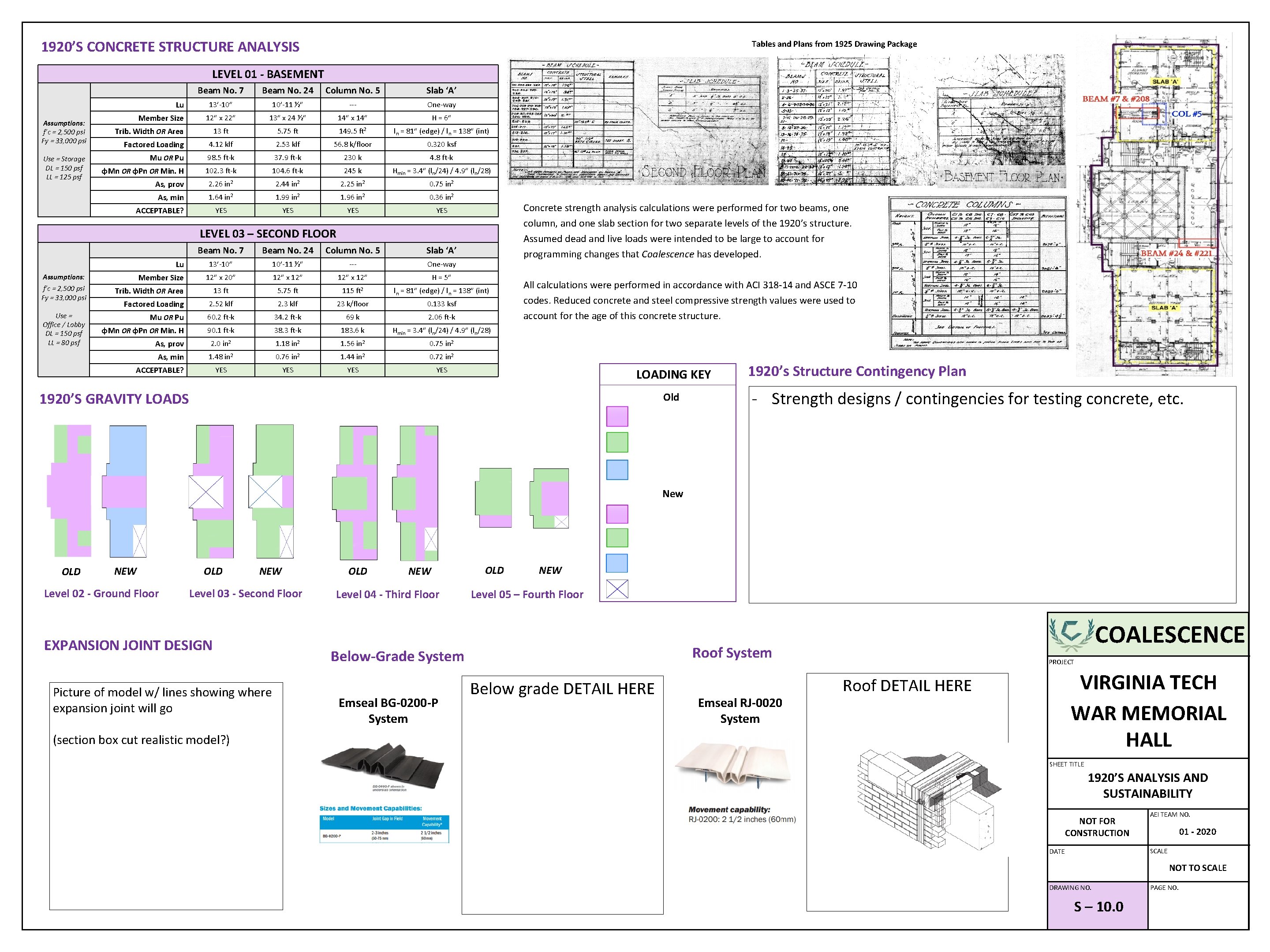
1920’S CONCRETE STRUCTURE ANALYSIS Tables and Plans from 1925 Drawing Package LEVEL 01 - BASEMENT Beam No. 7 Beam No. 24 Column No. 5 Slab ‘A’ 13’-10” 10’-11 ½” --- One-way 12” x 22” 13” x 24 ½” 14” x 14” H = 6” 13 ft 5. 75 ft 149. 5 ft 2 ln = 81” (edge) / ln = 138” (int) Factored Loading 4. 12 klf 2. 53 klf 56. 8 k/floor 0. 320 ksf Mu OR Pu 98. 5 ft-k 37. 9 ft-k 230 k 4. 8 ft-k ɸMn OR ɸPn OR Min. H 102. 3 ft-k 104. 6 ft-k 245 k Hmin = 3. 4” (ln/24) / 4. 9” (ln/28) As, prov 2. 26 in 2 2. 44 in 2 2. 25 in 2 0. 75 in 2 As, min 1. 64 in 2 1. 99 in 2 1. 96 in 2 0. 36 in 2 YES YES Lu Assumptions: f’c = 2, 500 psi Fy = 33, 000 psi Use = Storage DL = 150 psf LL = 125 psf Member Size Trib. Width OR Area ACCEPTABLE? Concrete strength analysis calculations were performed for two beams, one column, and one slab section for two separate levels of the 1920’s structure. Assumed dead and live loads were intended to be large to account for programming changes that Coalescence has developed. LEVEL 03 – SECOND FLOOR Lu Beam No. 7 Beam No. 24 Column No. 5 Slab ‘A’ 13’-10” 10’-11 ½” --- One-way 12” x 20” 12” x 12” H = 5” 13 ft 5. 75 ft 115 ft 2 ln = 81” (edge) / ln = 138” (int) Assumptions: Member Size f’c = 2, 500 psi Fy = 33, 000 psi Trib. Width OR Area Factored Loading 2. 52 klf 2. 3 klf 23 k/floor 0. 133 ksf Use = Office / Lobby DL = 150 psf LL = 80 psf Mu OR Pu 60. 2 ft-k 34. 2 ft-k 69 k 2. 06 ft-k ɸMn OR ɸPn OR Min. H 90. 1 ft-k 38. 3 ft-k 183. 6 k Hmin = 3. 4” (ln/24) / 4. 9” (ln/28) As, prov 2. 0 in 2 1. 18 in 2 1. 56 in 2 0. 75 in 2 As, min 1. 48 in 2 0. 76 in 2 1. 44 in 2 0. 72 in 2 YES YES ACCEPTABLE? All calculations were performed in accordance with ACI 318 -14 and ASCE 7 -10 codes. Reduced concrete and steel compressive strength values were used to account for the age of this concrete structure. LOADING KEY 1920’S GRAVITY LOADS Old 1920’s Structure Contingency Plan - Strength designs / contingencies for testing concrete, etc. New OLD NEW Level 02 - Ground Floor OLD NEW Level 03 - Second Floor EXPANSION JOINT DESIGN Picture of model w/ lines showing where expansion joint will go OLD NEW Level 04 - Third Floor OLD NEW Level 05 – Fourth Floor Roof System Below-Grade System Emseal BG-0200 -P System COALESCENCE Below grade DETAIL HERE Emseal RJ-0020 System PROJECT VIRGINIA TECH WAR MEMORIAL HALL Roof DETAIL HERE (section box cut realistic model? ) SHEET TITLE 1920’S ANALYSIS AND SUSTAINABILITY NOT FOR CONSTRUCTION AEI TEAM NO. 01 - 2020 SCALE DATE NOT TO SCALE DRAWING NO. S – 10. 0 PAGE NO.