
Structural Design of a Residential Tower in Nablus
Structural Design of a Residential Tower in Nablus By Asem Bashar Abdullah Hasan Dirar Al Qadah Nedal Ayman Bibi Under supervision of: Ms. C. Ibrahim Arman Spring 2018
Project I: v Introduction: Project description, codes, materials, loads. v Preliminary design: Slab, beams, columns, walls. v 3 D modeling: 3 D models, evaluation, verifications. Project II: v Design: Slab, beams, columns, walls, Foundation. v Drawings: Fully detailed drawings. 2
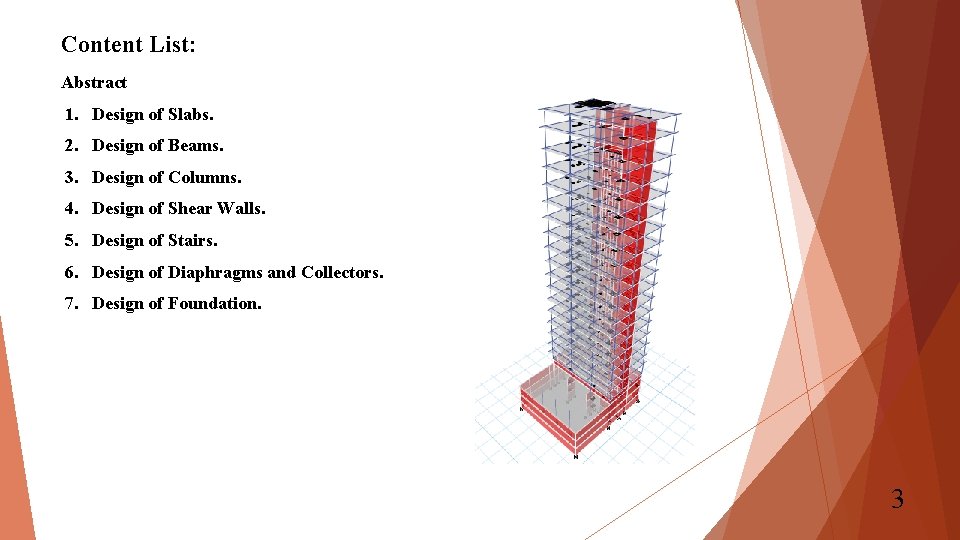
Content List: Abstract 1. Design of Slabs. 2. Design of Beams. 3. Design of Columns. 4. Design of Shear Walls. 5. Design of Stairs. 6. Design of Diaphragms and Collectors. 7. Design of Foundation. 3
Abstract 4
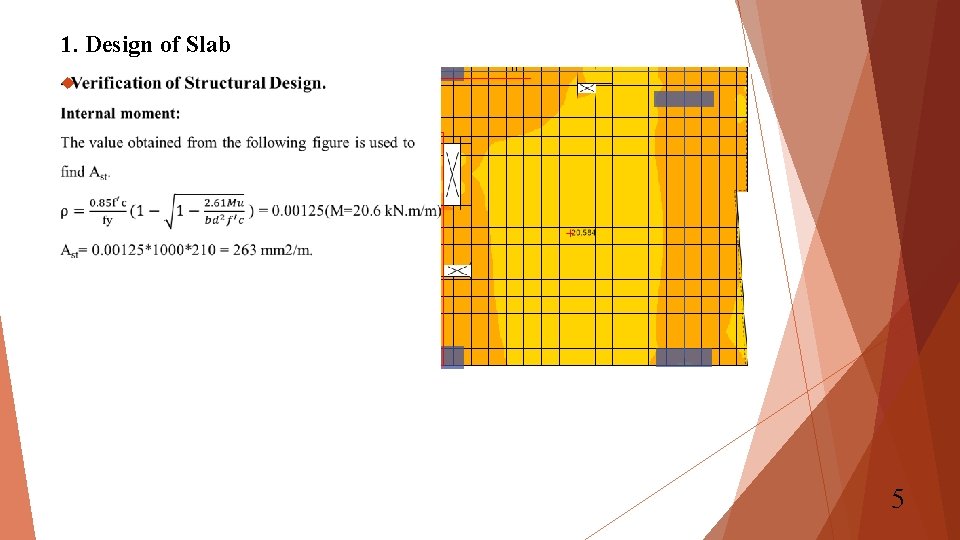
1. Design of Slab 5
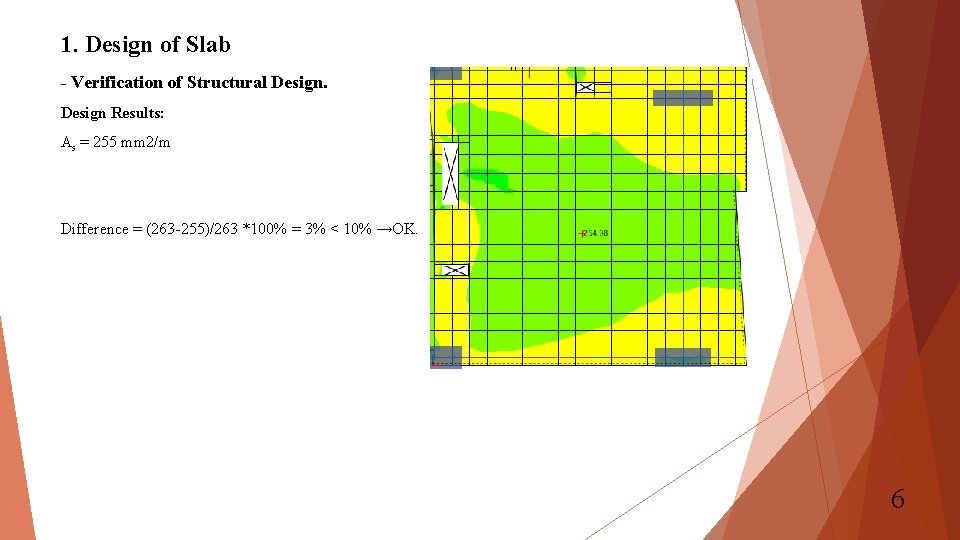
1. Design of Slab - Verification of Structural Design Results: As = 255 mm 2/m Difference = (263 -255)/263 *100% = 3% < 10% →OK. 6
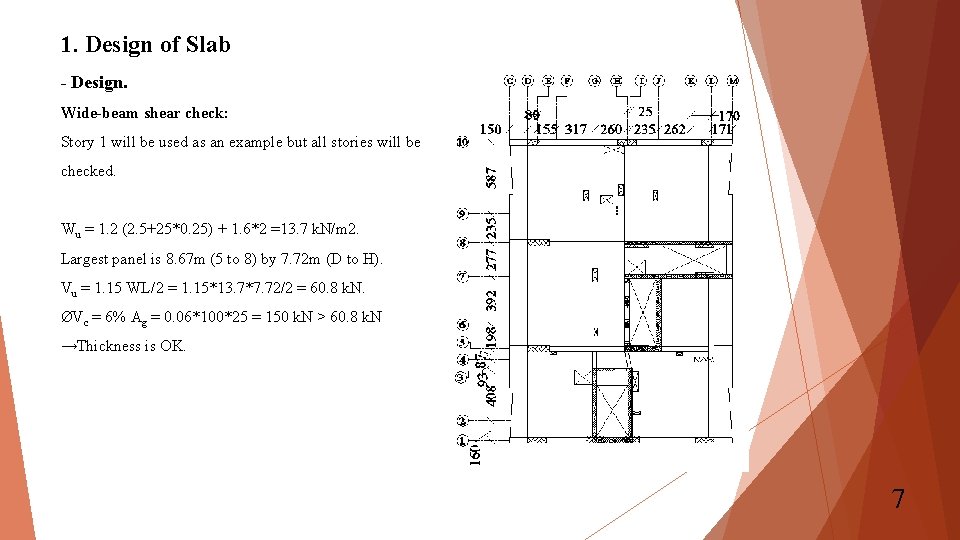
1. Design of Slab - Design. Wide-beam shear check: Story 1 will be used as an example but all stories will be checked. Wu = 1. 2 (2. 5+25*0. 25) + 1. 6*2 =13. 7 k. N/m 2. Largest panel is 8. 67 m (5 to 8) by 7. 72 m (D to H). Vu = 1. 15 WL/2 = 1. 15*13. 7*7. 72/2 = 60. 8 k. N. ØVc = 6% Ag = 0. 06*100*25 = 150 k. N > 60. 8 k. N →Thickness is OK. 7
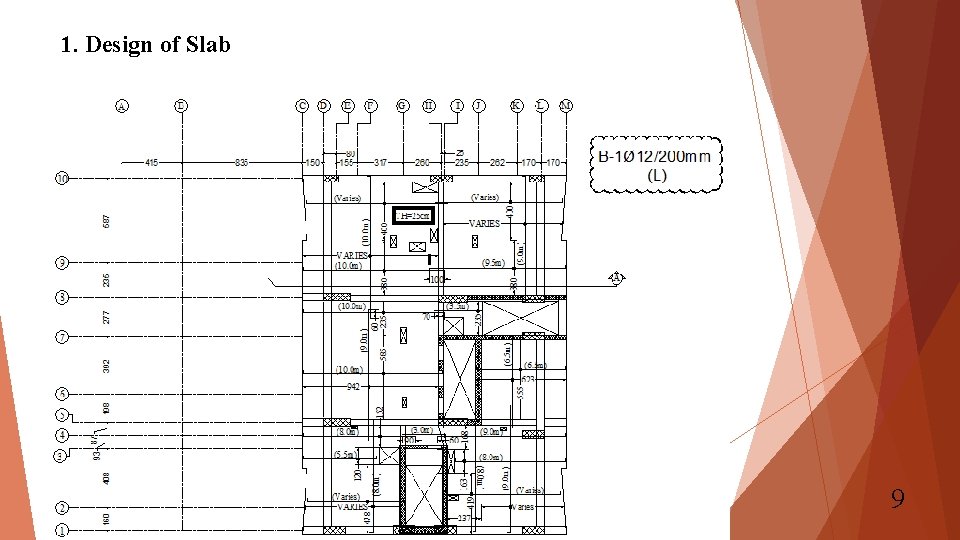
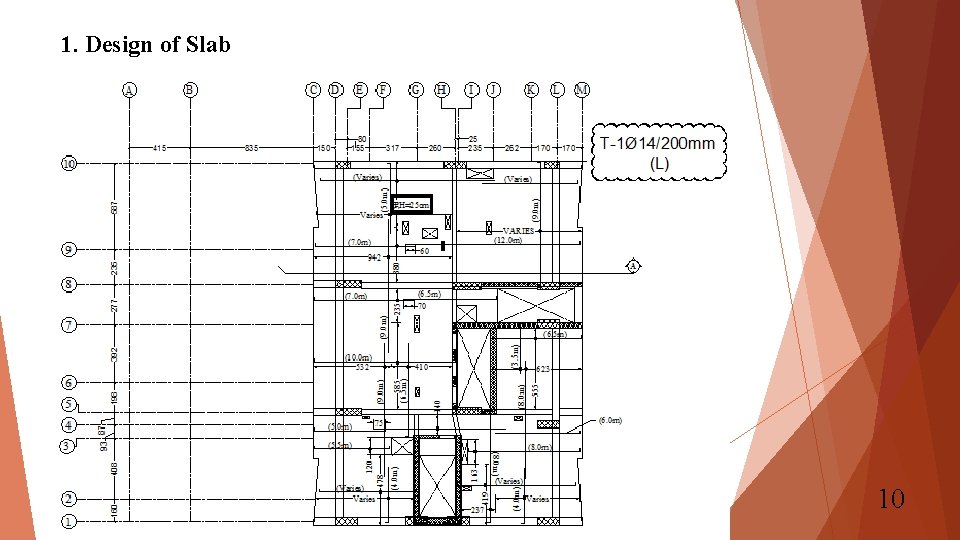
1. Design of Slab - Design. Flexural Design: Ø All four models will be compared to produce a final result with maximum values. Ø Results near openings will be ignored since they tend to be exaggerated and openings will be designed separately. As, min = 0. 0018*1000*250 = 450 mm 2/m. Top mesh: 1Ø 14/200 mm → 770 mm 2/m. Bottom mesh: 1Ø 12/200 mm → 565 mm 2/m. As additional to previously mentioned top and bottom meshes will be checked for each slab to produce final drawings of additional reinforcement. 8
1. Design of Slab 9
1. Design of Slab 10
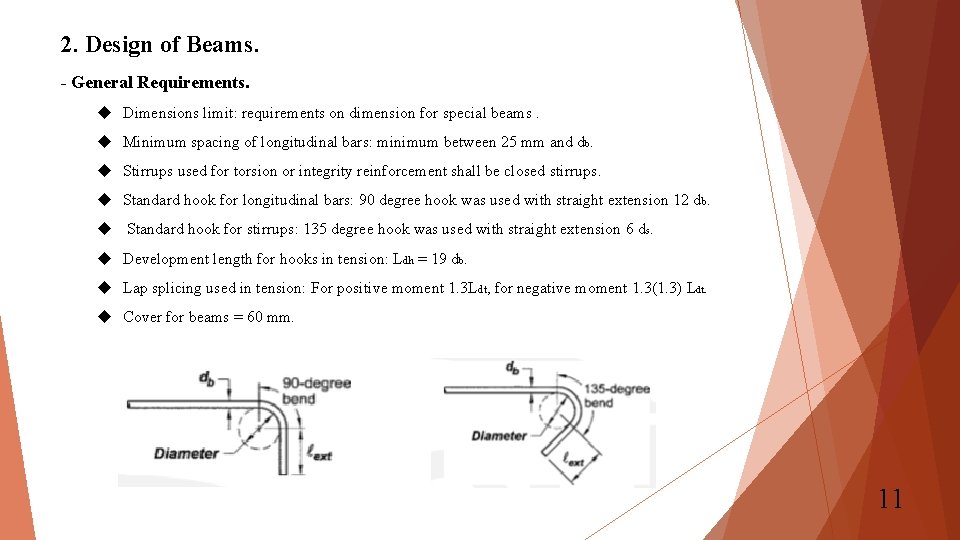
2. Design of Beams. - General Requirements. Dimensions limit: requirements on dimension for special beams. Minimum spacing of longitudinal bars: minimum between 25 mm and db. Stirrups used for torsion or integrity reinforcement shall be closed stirrups. Standard hook for longitudinal bars: 90 degree hook was used with straight extension 12 db. Standard hook for stirrups: 135 degree hook was used with straight extension 6 ds. Development length for hooks in tension: Ldh = 19 db. Lap splicing used in tension: For positive moment 1. 3 Ldt, for negative moment 1. 3(1. 3) Ldt. Cover for beams = 60 mm. 11
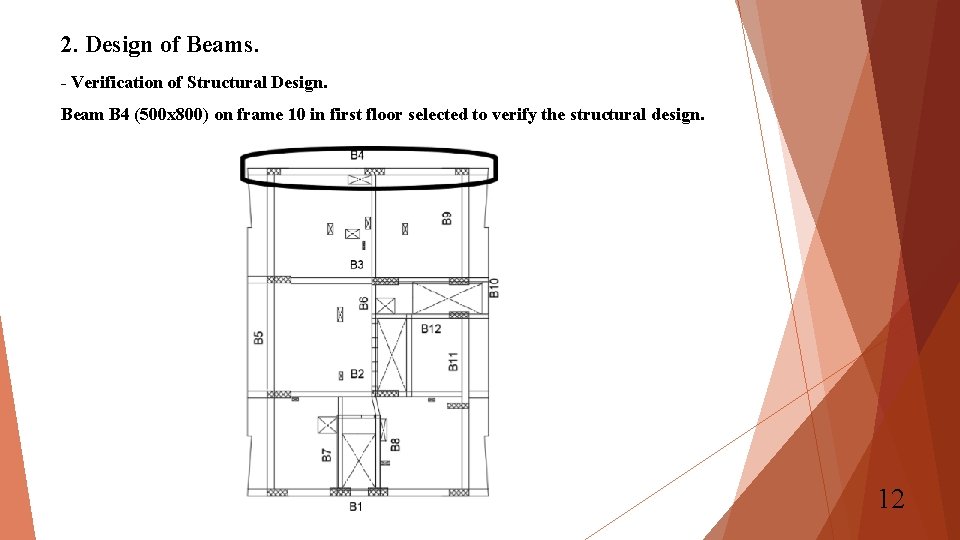
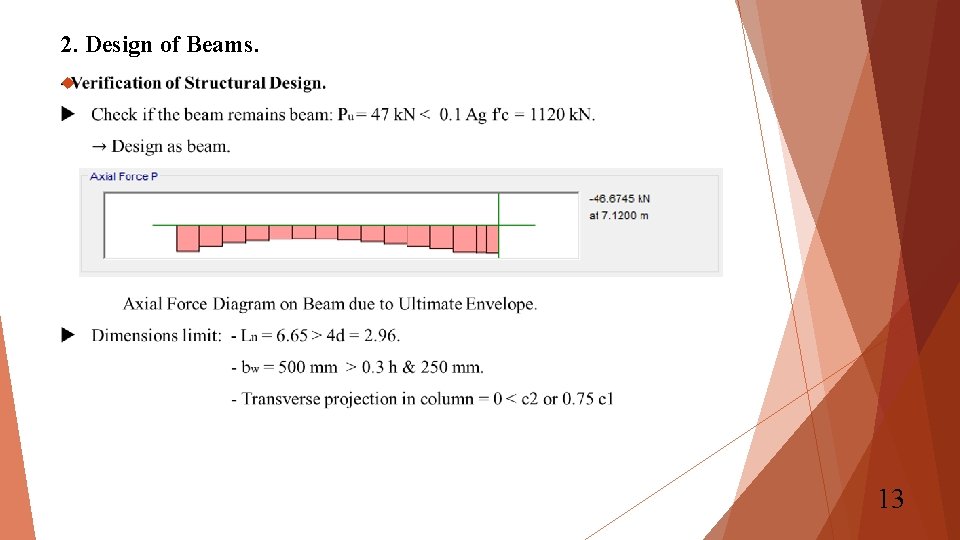
2. Design of Beams. - Verification of Structural Design. Beam B 4 (500 x 800) on frame 10 in first floor selected to verify the structural design. 12
2. Design of Beams. 13
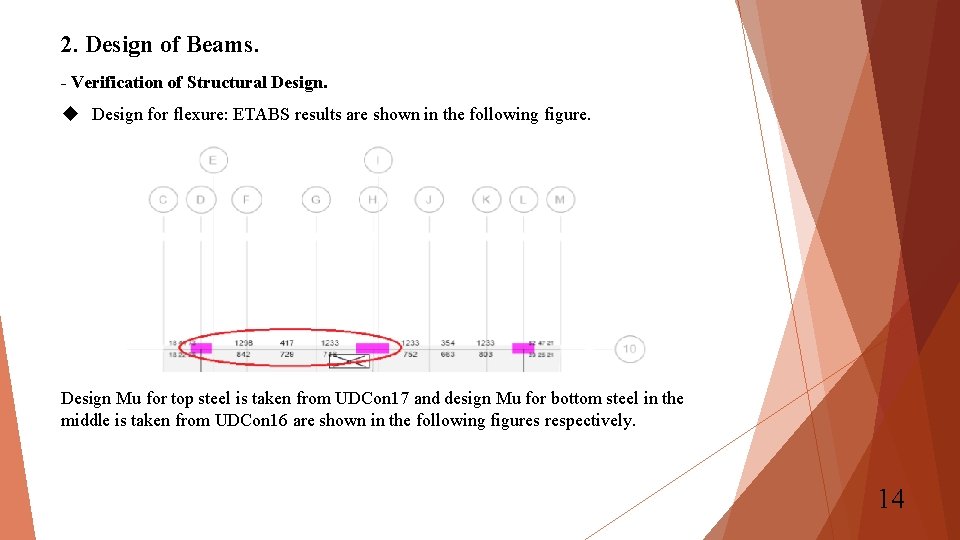
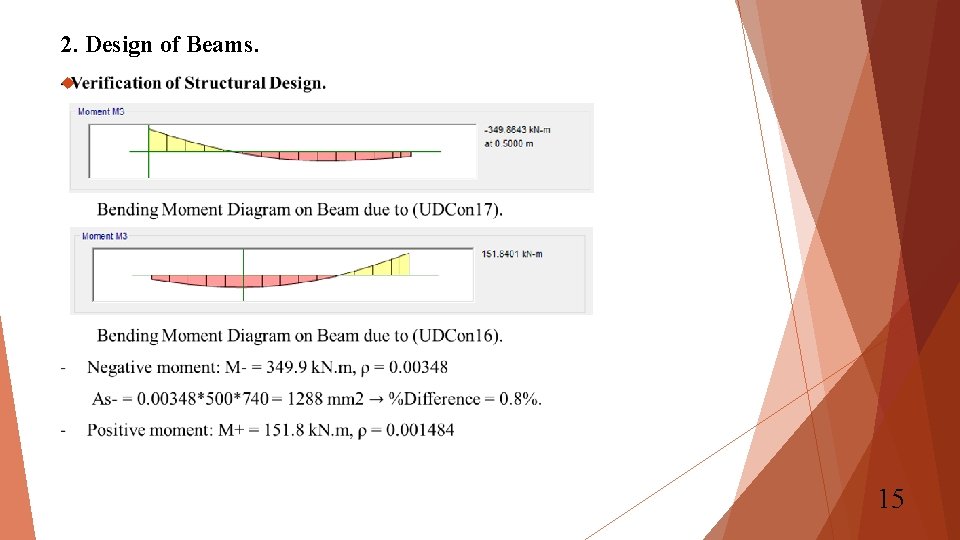
2. Design of Beams. - Verification of Structural Design for flexure: ETABS results are shown in the following figure. Design Mu for top steel is taken from UDCon 17 and design Mu for bottom steel in the middle is taken from UDCon 16 are shown in the following figures respectively. 14
2. Design of Beams. 15
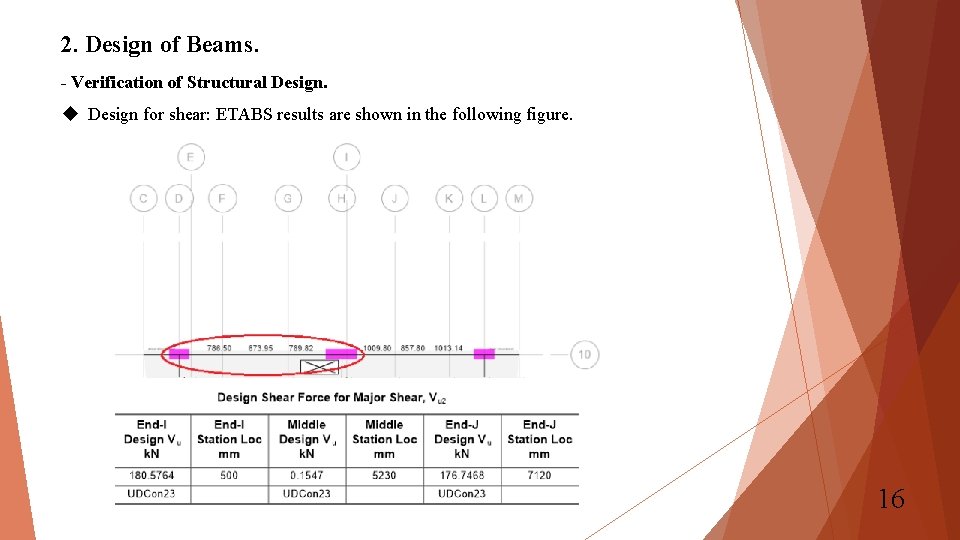
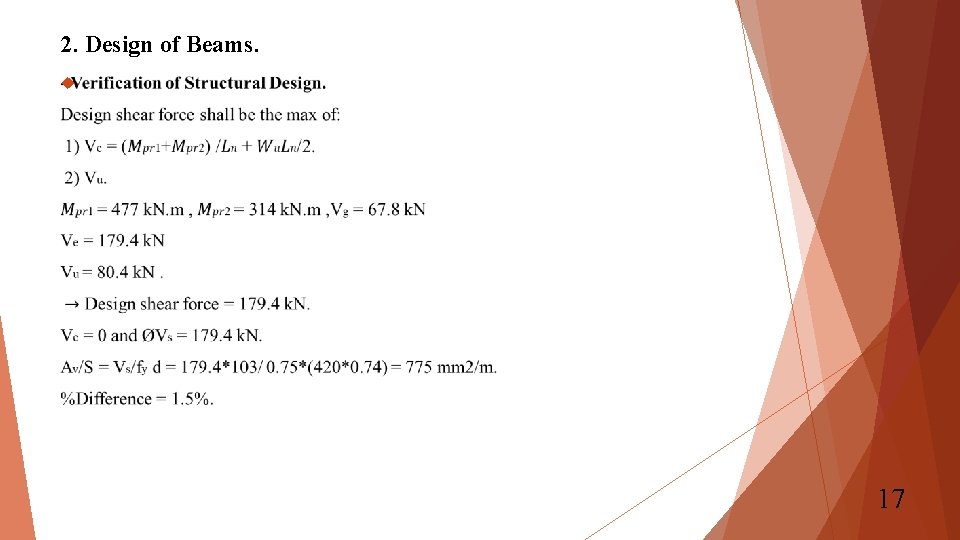
2. Design of Beams. - Verification of Structural Design for shear: ETABS results are shown in the following figure. 16
2. Design of Beams. 17
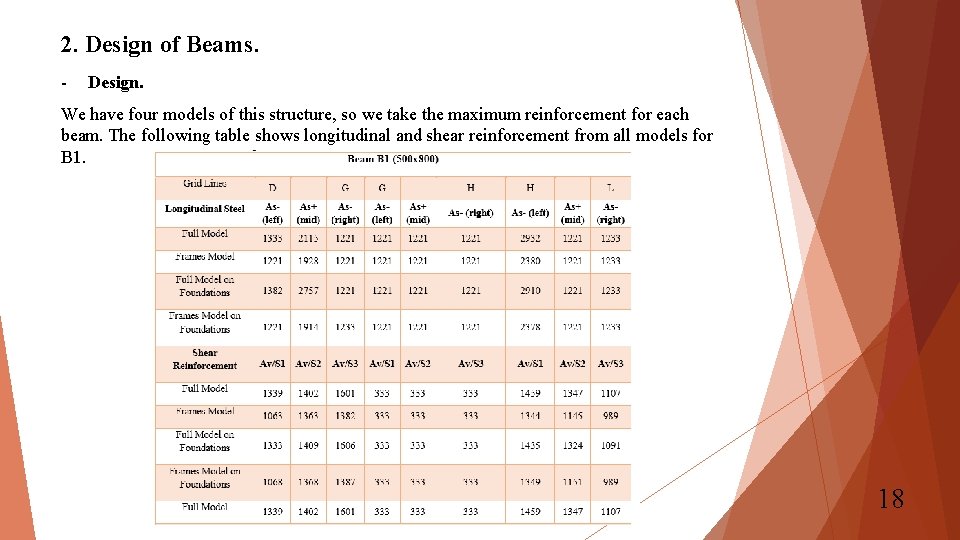
2. Design of Beams. - Design. We have four models of this structure, so we take the maximum reinforcement for each beam. The following table shows longitudinal and shear reinforcement from all models for B 1. 18
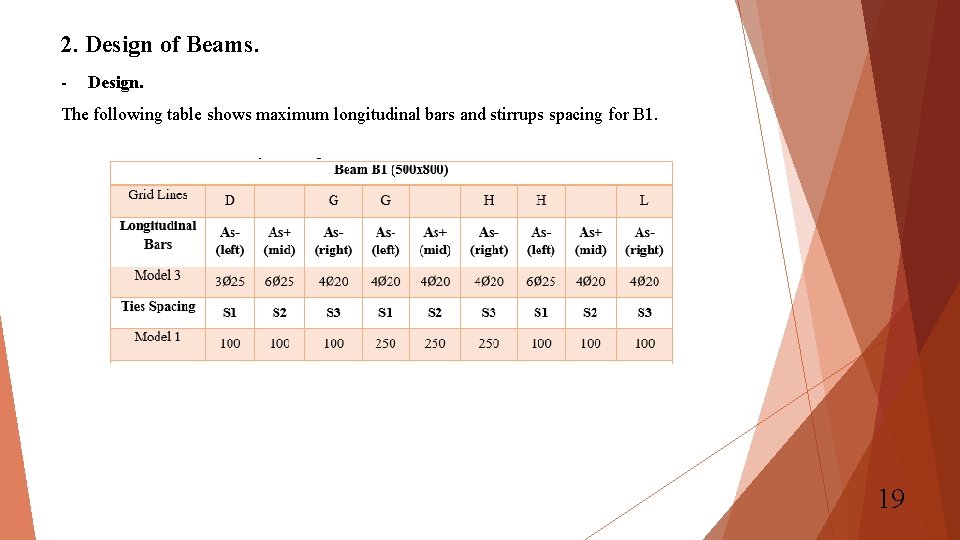
2. Design of Beams. - Design. The following table shows maximum longitudinal bars and stirrups spacing for B 1. 19
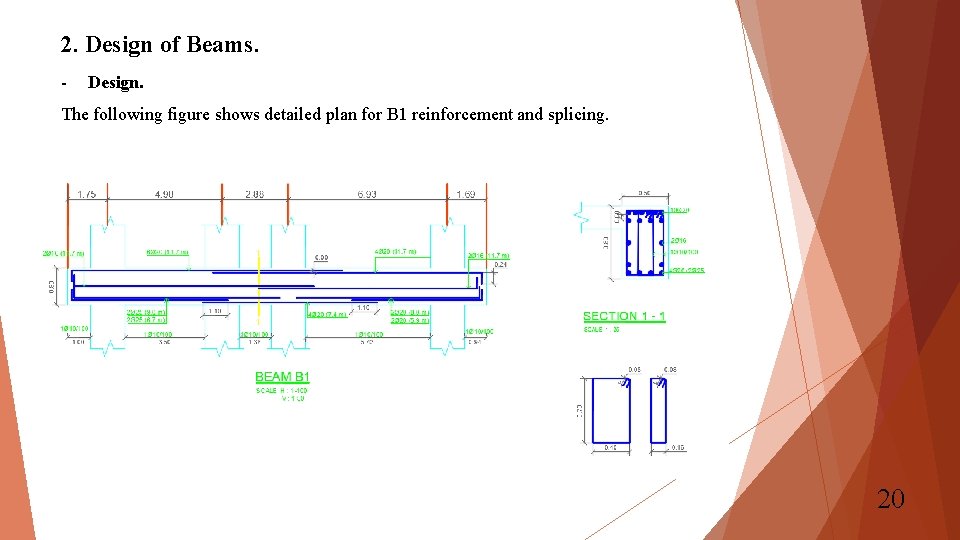
2. Design of Beams. - Design. The following figure shows detailed plan for B 1 reinforcement and splicing. 20
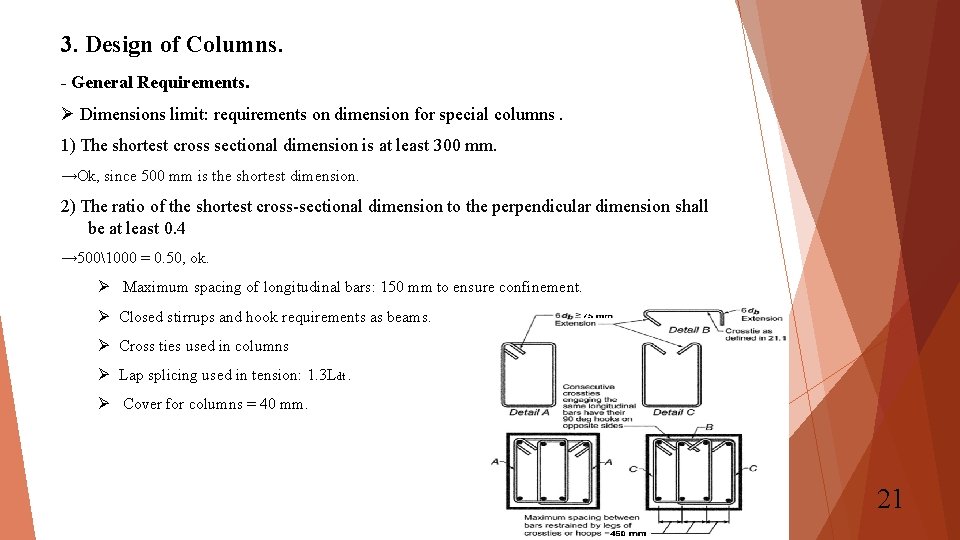
3. Design of Columns. - General Requirements. Ø Dimensions limit: requirements on dimension for special columns. 1) The shortest cross sectional dimension is at least 300 mm. →Ok, since 500 mm is the shortest dimension. 2) The ratio of the shortest cross-sectional dimension to the perpendicular dimension shall be at least 0. 4 → 5001000 = 0. 50, ok. Ø Maximum spacing of longitudinal bars: 150 mm to ensure confinement. Ø Closed stirrups and hook requirements as beams. Ø Cross ties used in columns Ø Lap splicing used in tension: 1. 3 Ldt. Ø Cover for columns = 40 mm. 21
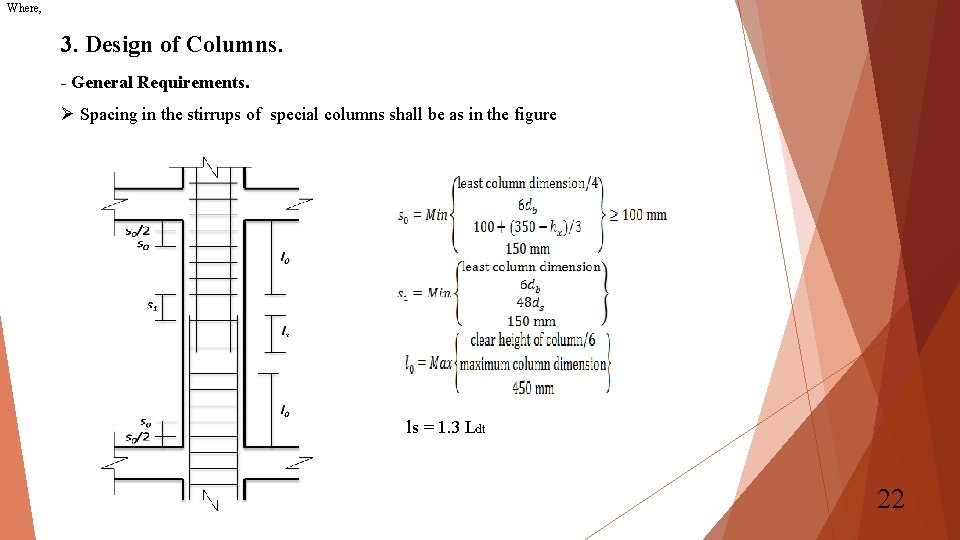
Where, 3. Design of Columns. - General Requirements. Ø Spacing in the stirrups of special columns shall be as in the figure ls = 1. 3 Ldt 22
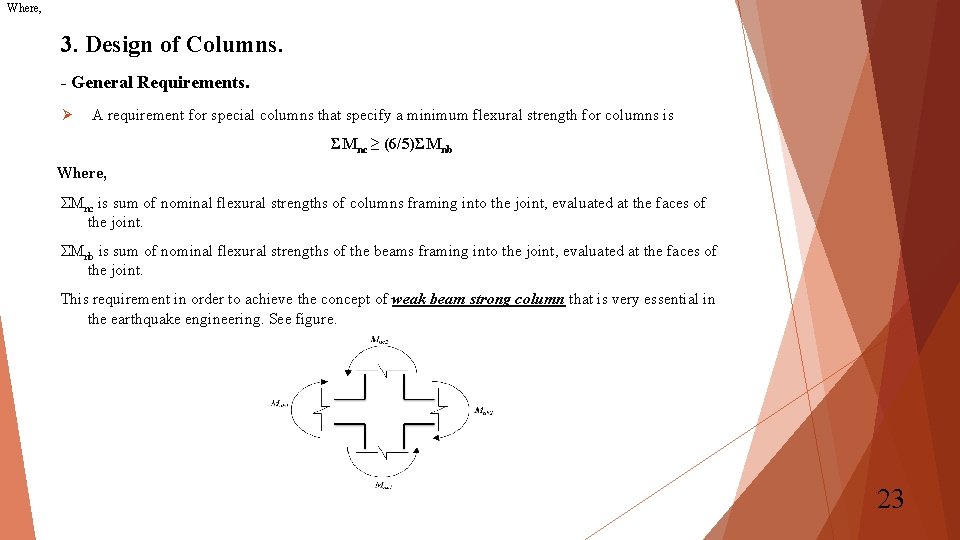
Where, 3. Design of Columns. - General Requirements. Ø A requirement for special columns that specify a minimum flexural strength for columns is ΣMnc ≥ (6/5)ΣMnb Where, ΣMnc is sum of nominal flexural strengths of columns framing into the joint, evaluated at the faces of the joint. ΣMnb is sum of nominal flexural strengths of the beams framing into the joint, evaluated at the faces of the joint. This requirement in order to achieve the concept of weak beam strong column that is very essential in the earthquake engineering. See figure. 23
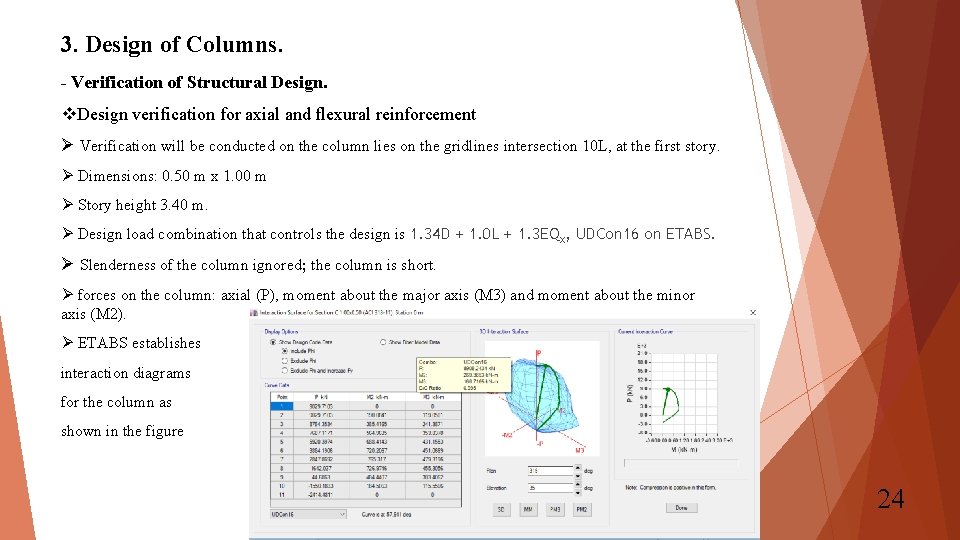
3. Design of Columns. - Verification of Structural Design. v. Design verification for axial and flexural reinforcement Ø Verification will be conducted on the column lies on the gridlines intersection 10 L, at the first story. Ø Dimensions: 0. 50 m x 1. 00 m Ø Story height 3. 40 m. Ø Design load combination that controls the design is 1. 34 D + 1. 0 L + 1. 3 EQx, UDCon 16 on ETABS. Ø Slenderness of the column ignored; the column is short. Ø forces on the column: axial (P), moment about the major axis (M 3) and moment about the minor axis (M 2). Ø ETABS establishes interaction diagrams for the column as shown in the figure 24
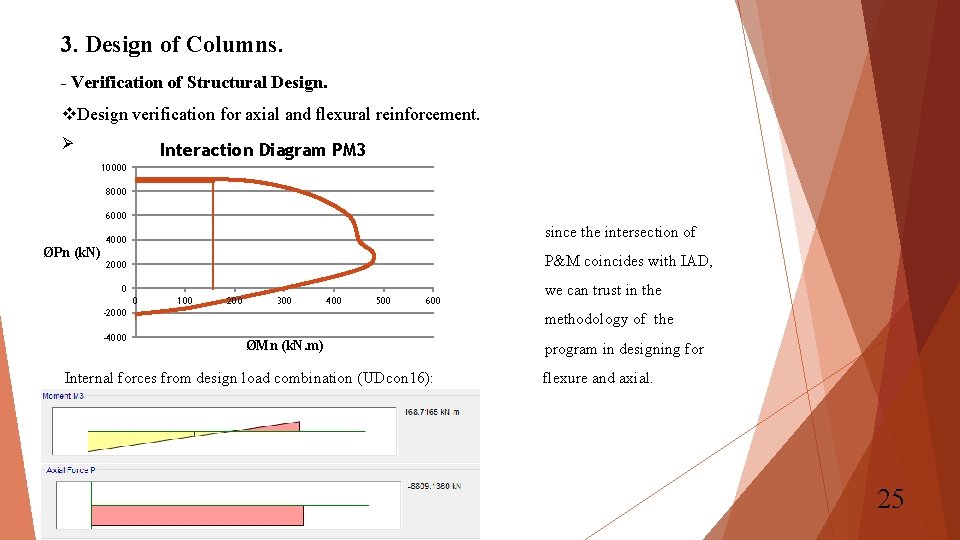
3. Design of Columns. - Verification of Structural Design. v. Design verification for axial and flexural reinforcement. Ø Interaction Diagram PM 3 10000 8000 6000 ØPn (k. N) since the intersection of 4000 P&M coincides with IAD, 2000 0 0 100 200 300 400 500 600 -2000 -4000 we can trust in the methodology of the ØMn (k. N. m) Internal forces from design load combination (UDcon 16): program in designing for flexure and axial. 25
3. Design of Columns. - Verification of Structural Design. v. Design verification for shear reinforcement. Ø Verification will be conducted on the column lies on the gridlines intersection 10 H, at the top roof story. Ø Dimensions: 0. 50 m x 1. 50 m Ø Story height 3. 65 m. Ø Design load combination that controls the shear design is 1. 34 D + 1. 0 L + 1. 3 EQx, UDCon 16 on ETABS. Ø Slenderness of the column ignored; the column is short. Ø For design, shear (V) used for design is the maximum of: - Vu : shear from the ultimate combination. - Ve : the design shear force including seismic effect. 26
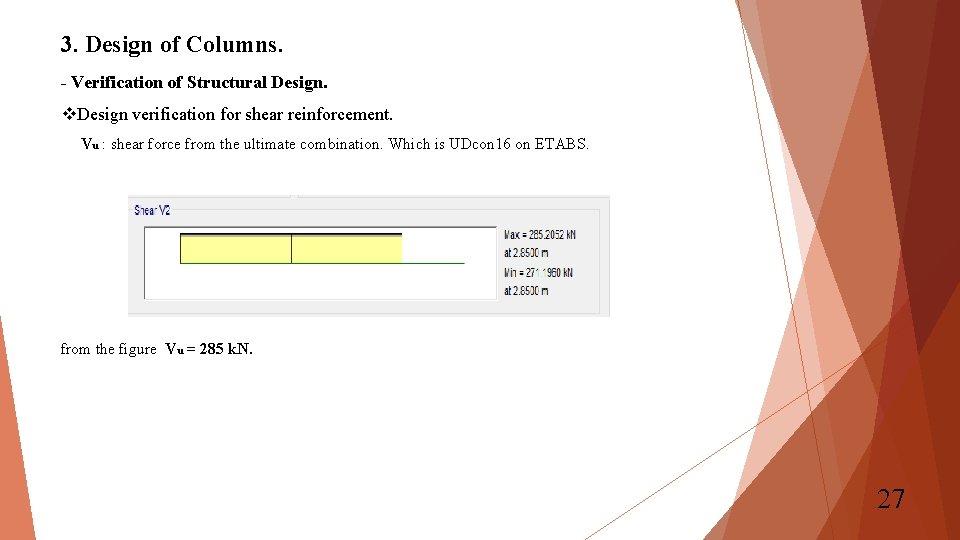
3. Design of Columns. - Verification of Structural Design. v. Design verification for shear reinforcement. Vu : shear force from the ultimate combination. Which is UDcon 16 on ETABS. from the figure Vu = 285 k. N. 27
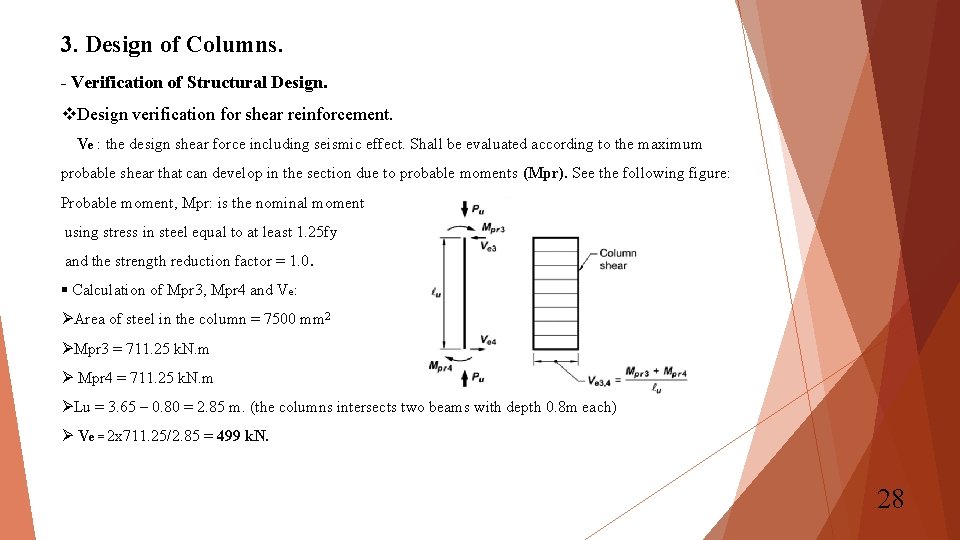
3. Design of Columns. - Verification of Structural Design. v. Design verification for shear reinforcement. Ve : the design shear force including seismic effect. Shall be evaluated according to the maximum probable shear that can develop in the section due to probable moments (Mpr). See the following figure: Probable moment, Mpr: is the nominal moment using stress in steel equal to at least 1. 25 fy and the strength reduction factor = 1. 0. § Calculation of Mpr 3, Mpr 4 and Ve: ØArea of steel in the column = 7500 mm 2 ØMpr 3 = 711. 25 k. N. m Ø Mpr 4 = 711. 25 k. N. m ØLu = 3. 65 – 0. 80 = 2. 85 m. (the columns intersects two beams with depth 0. 8 m each) Ø Ve = 2 x 711. 25/2. 85 = 499 k. N. 28
3. Design of Columns. - Verification of Structural Design. v. Design verification for shear reinforcement. Design shear force = max. of {Vu = 285 k. N, Ve = 499 k. N} = 499 k. N. Consequently, the required design shear strength may be expressed as: Vn = V c + V s The design shear above must be resisted by the nominal shear strength of the member, Vn, which consists of concrete contribution (Vc) and steel contribution (Vs). However, the contribution of the concrete shall be ignored under the following two conditions when they occur simultaneously: (a) The earthquake-induced shear force Ve represents at least one-half or more of the maximum required shear strength within those lengths. 499 > 0. 5*285=142. 5 k. N. (b) The factored axial compressive force Pu including earthquake effects is less than Agf’c/20. Check: Agfc′/20 = 500 x 1500 x 35 /20 = 1312. 50 k. N > Pu on column = 477 k. N. →from (a) and (b), Vc = 0. 29
3. Design of Columns. - Verification of Structural Design. v. Design verification for shear reinforcement. § Calculation of shear reinforcement (Av/s): §Vs = Vn – Vc §Vs = 499 /0. 75 – 0 = 655 k. N. §Av/S = 1. 10 mm 2/mm §ETABS result for Av/S = 1. 132 mm 2/mm §Difference percentage = 3% <10%, acceptable. 30
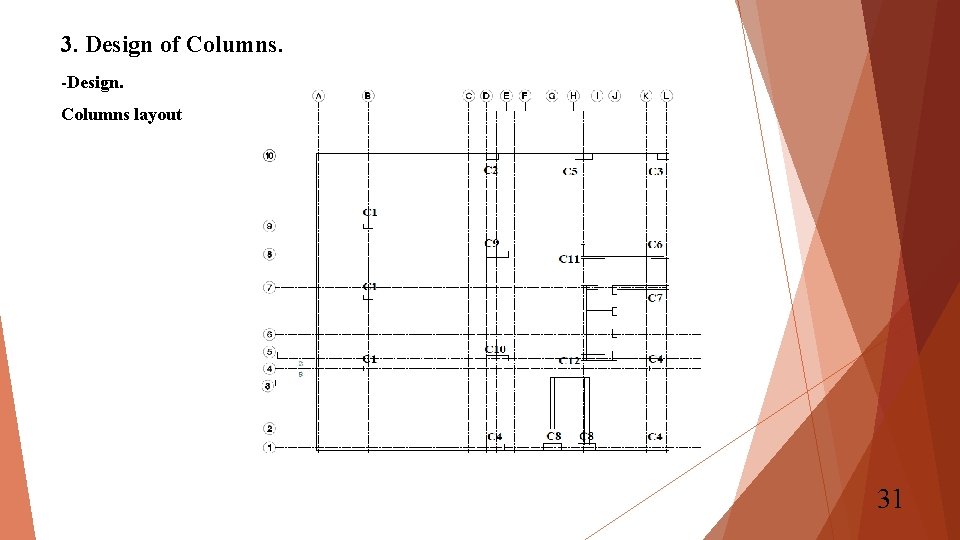
3. Design of Columns. -Design. Columns layout 31
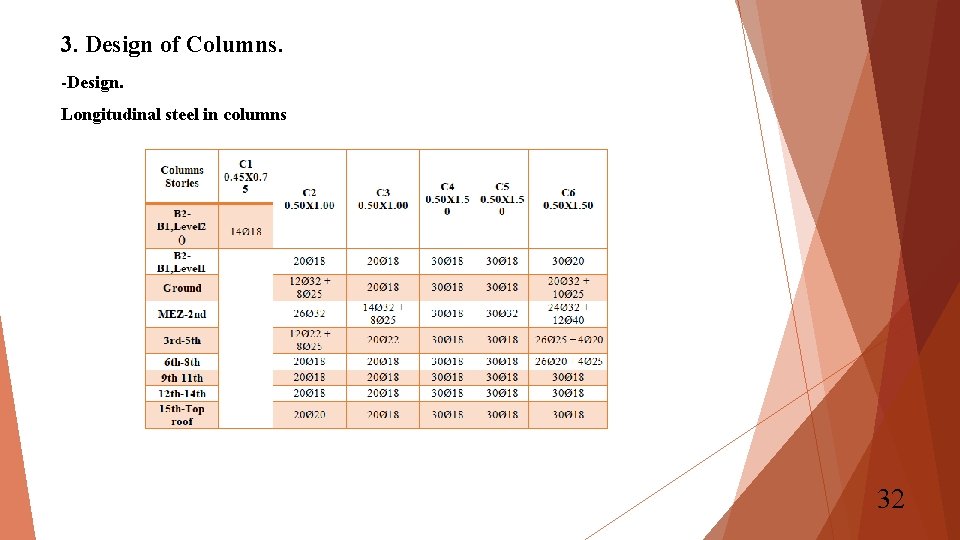
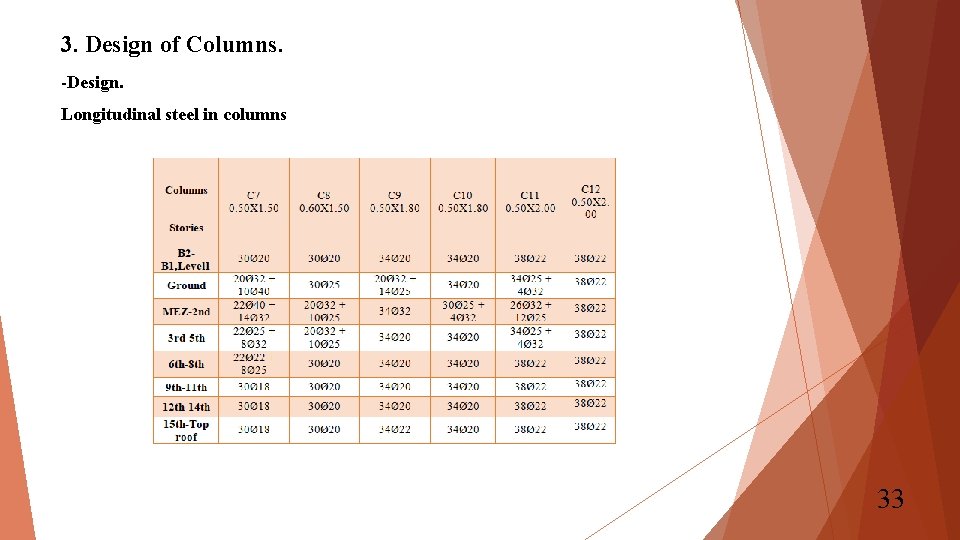
3. Design of Columns. -Design. Longitudinal steel in columns 32
3. Design of Columns. -Design. Longitudinal steel in columns 33
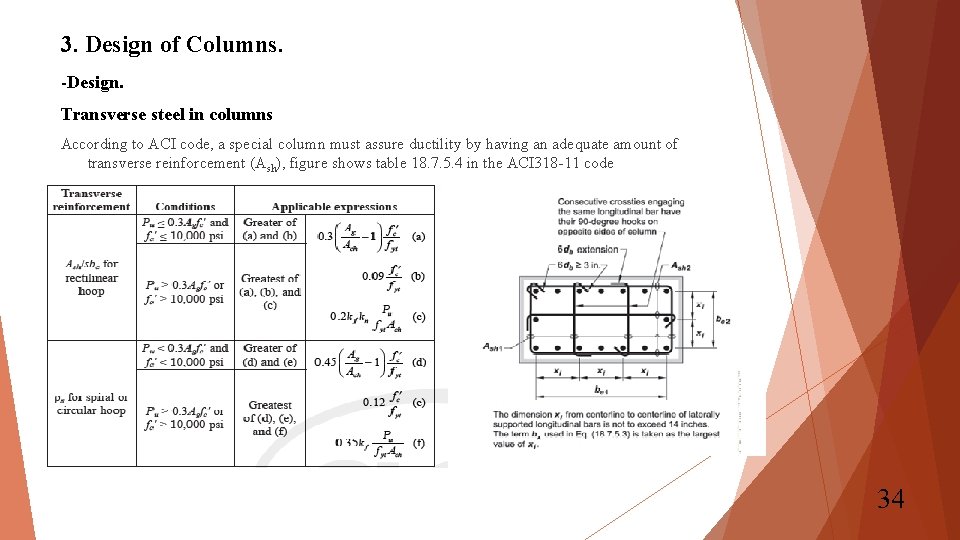
3. Design of Columns. -Design. Transverse steel in columns According to ACI code, a special column must assure ductility by having an adequate amount of transverse reinforcement (Ash), figure shows table 18. 7. 5. 4 in the ACI 318 -11 code 34
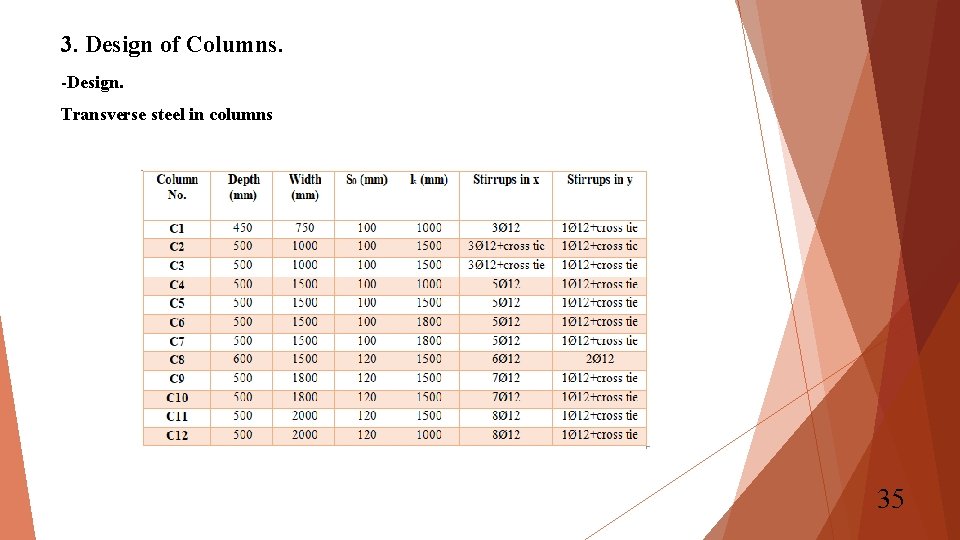
3. Design of Columns. -Design. Transverse steel in columns 35
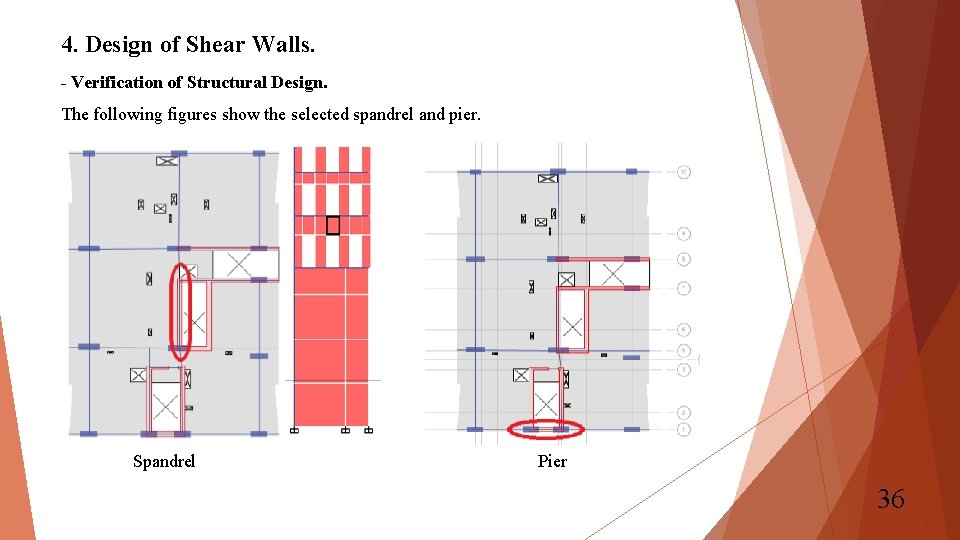
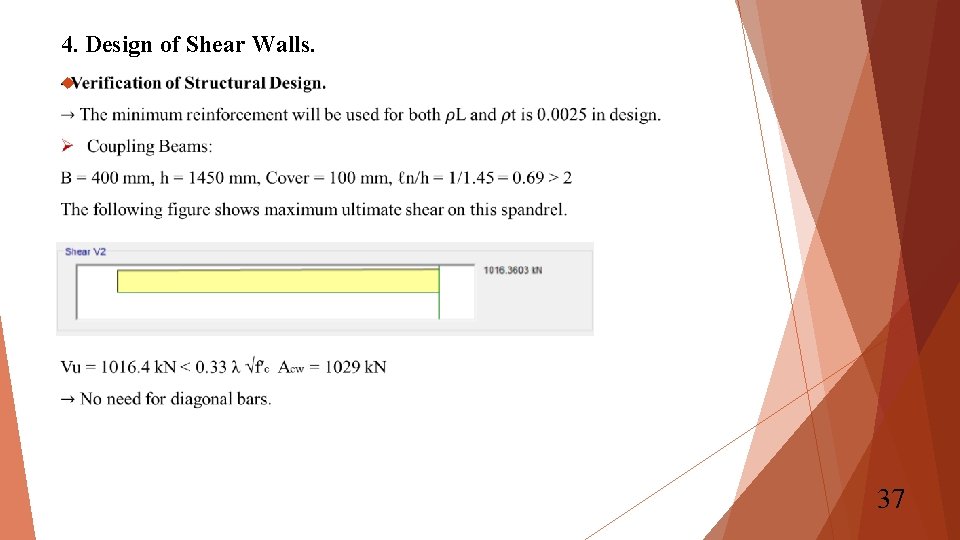
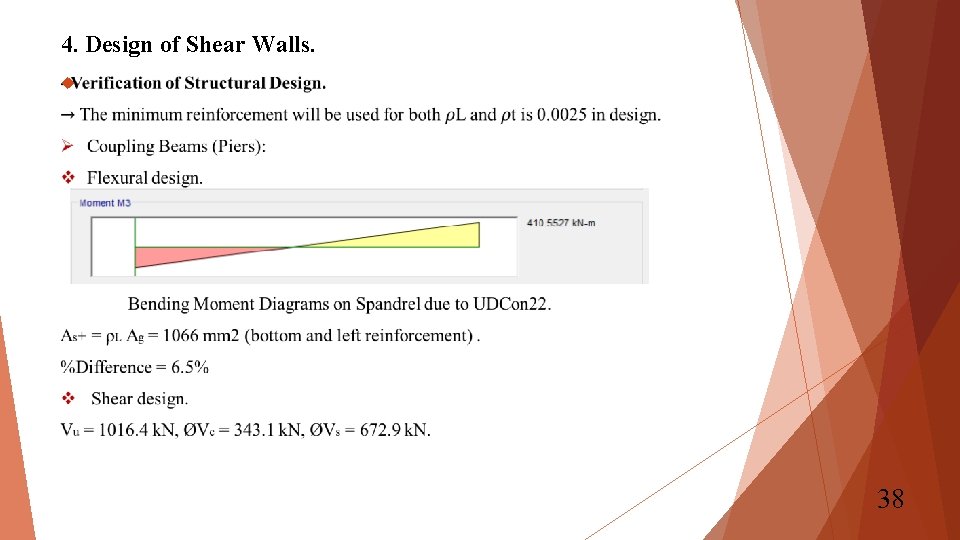
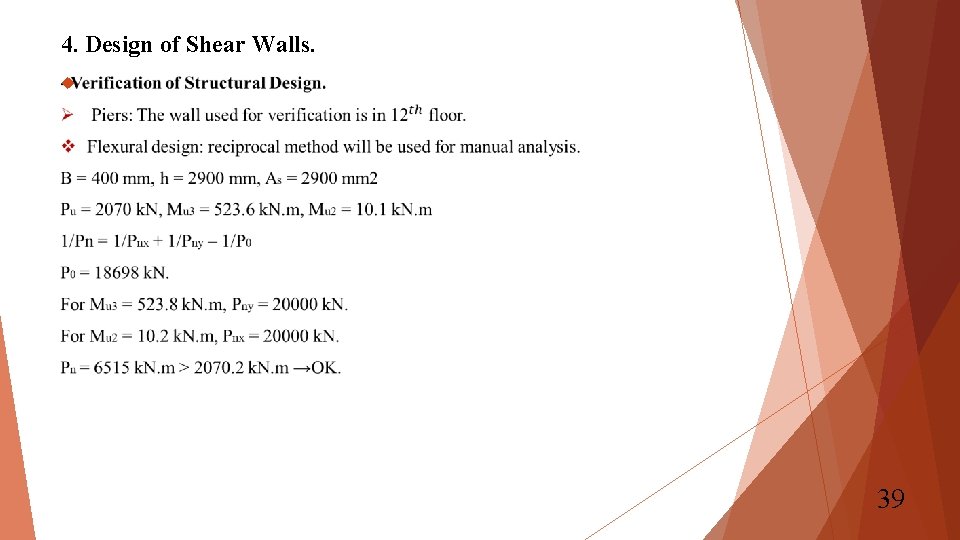
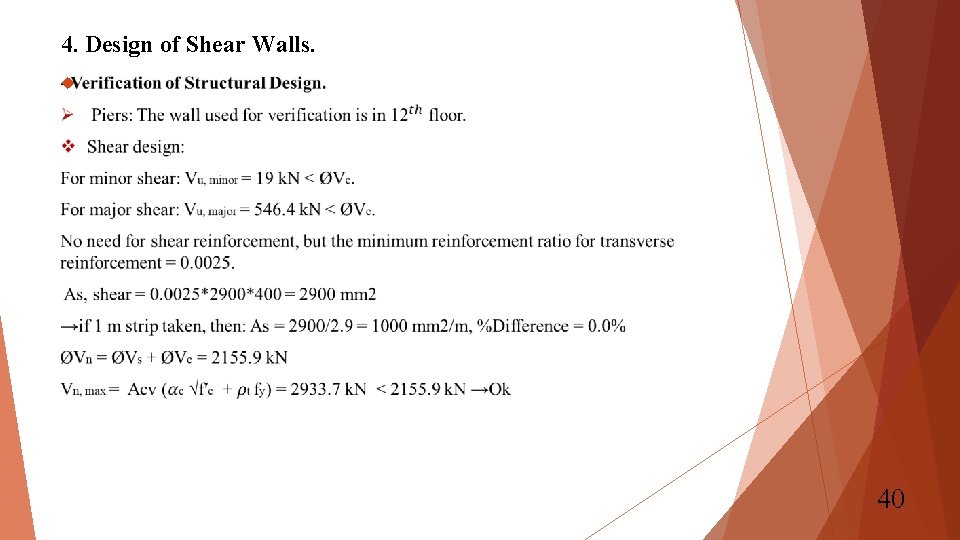
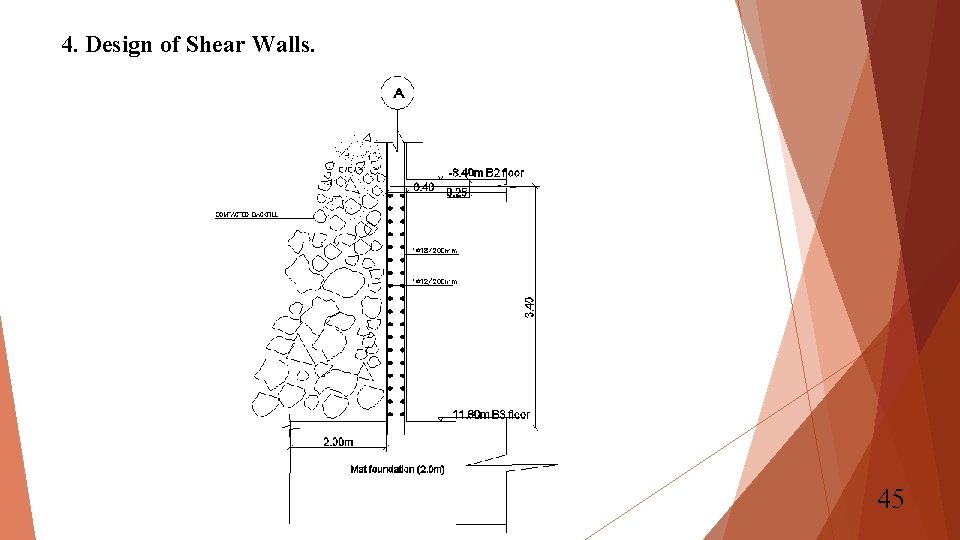
4. Design of Shear Walls. - Verification of Structural Design. The following figures show the selected spandrel and pier. Spandrel Pier 36
4. Design of Shear Walls. 37
4. Design of Shear Walls. 38
4. Design of Shear Walls. 39
4. Design of Shear Walls. 40
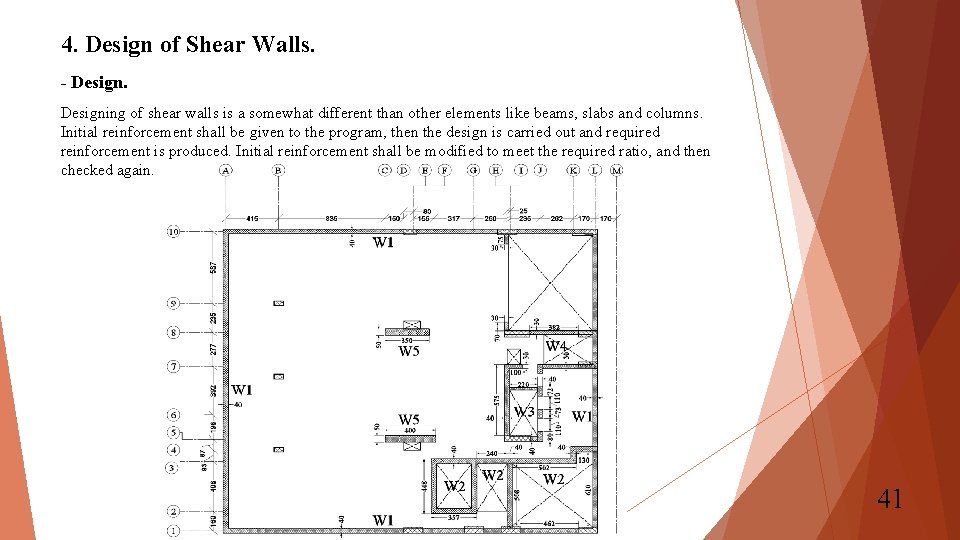
4. Design of Shear Walls. - Designing of shear walls is a somewhat different than other elements like beams, slabs and columns. Initial reinforcement shall be given to the program, then the design is carried out and required reinforcement is produced. Initial reinforcement shall be modified to meet the required ratio, and then checked again. 41
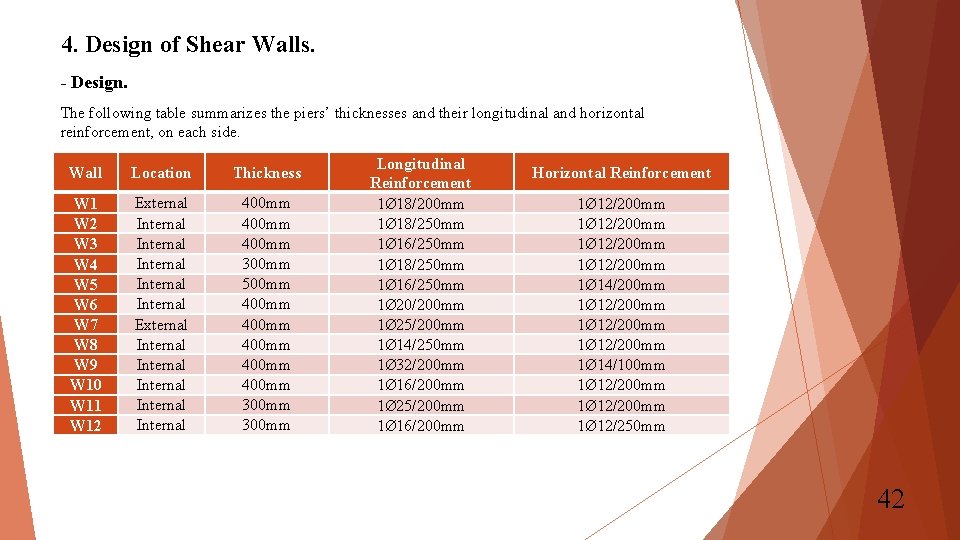
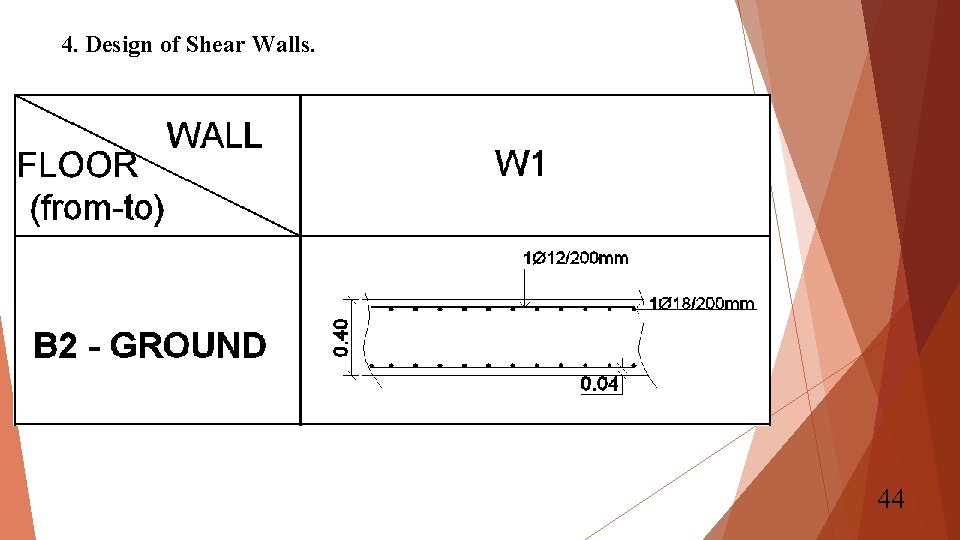
4. Design of Shear Walls. - Design. The following table summarizes the piers’ thicknesses and their longitudinal and horizontal reinforcement, on each side. Wall Location Thickness W 1 W 2 W 3 W 4 W 5 W 6 W 7 W 8 W 9 W 10 W 11 W 12 External Internal Internal Internal 400 mm 300 mm 500 mm 400 mm 400 mm 300 mm Longitudinal Reinforcement 1Ø 18/200 mm 1Ø 18/250 mm 1Ø 16/250 mm 1Ø 20/200 mm 1Ø 25/200 mm 1Ø 14/250 mm 1Ø 32/200 mm 1Ø 16/200 mm 1Ø 25/200 mm 1Ø 16/200 mm Horizontal Reinforcement 1Ø 12/200 mm 1Ø 14/200 mm 1Ø 12/200 mm 1Ø 14/100 mm 1Ø 12/200 mm 1Ø 12/250 mm 42
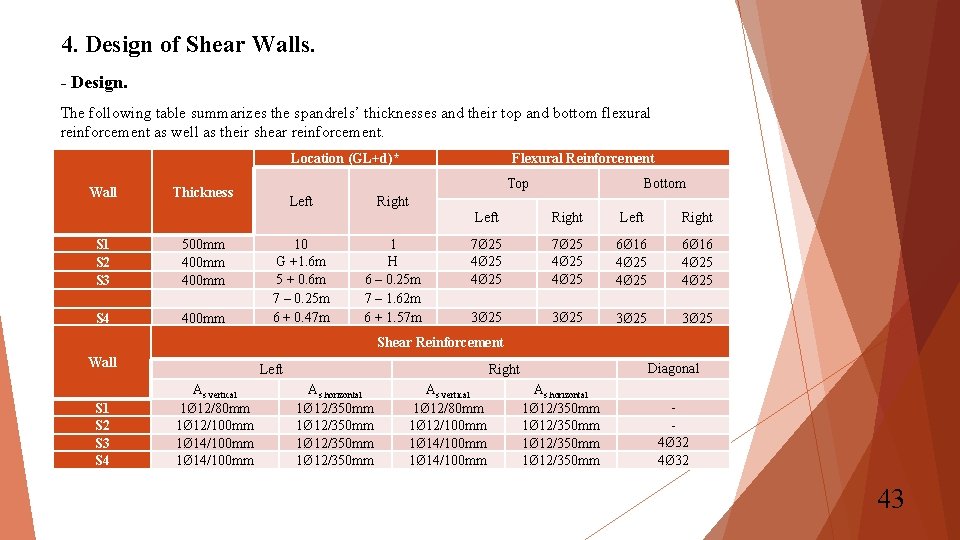
4. Design of Shear Walls. - Design. The following table summarizes the spandrels’ thicknesses and their top and bottom flexural reinforcement as well as their shear reinforcement. Location (GL+d)* Wall Top Thickness S 1 S 2 S 3 500 mm 400 mm S 4 400 mm Flexural Reinforcement Left 10 G +1. 6 m 5 + 0. 6 m 7 – 0. 25 m 6 + 0. 47 m Bottom Right 1 H 6 – 0. 25 m 7 – 1. 62 m 6 + 1. 57 m Left Right 7Ø 25 4Ø 25 6Ø 16 4Ø 25 3Ø 25 Shear Reinforcement Wall S 1 S 2 S 3 S 4 Left As vertical 1Ø 12/80 mm 1Ø 12/100 mm 1Ø 14/100 mm Diagonal Right As horizontal 1Ø 12/350 mm As vertical 1Ø 12/80 mm 1Ø 12/100 mm 1Ø 14/100 mm As horizontal 1Ø 12/350 mm 4Ø 32 43
4. Design of Shear Walls. 44
4. Design of Shear Walls. 45
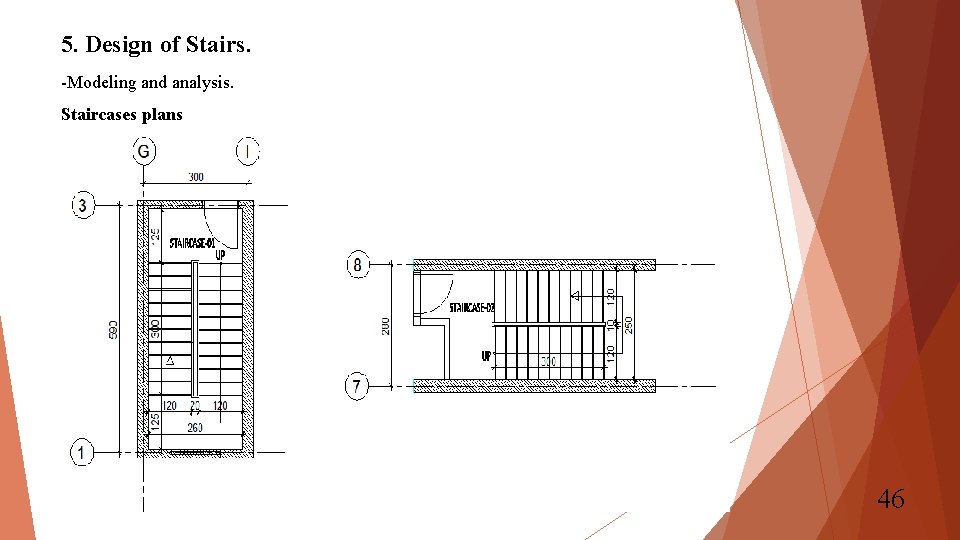
5. Design of Stairs. -Modeling and analysis. Staircases plans 46
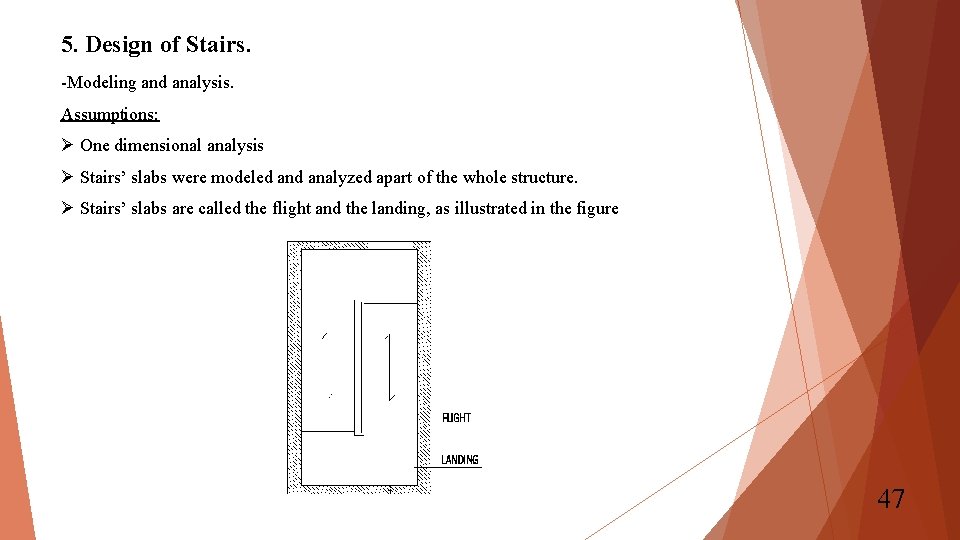
5. Design of Stairs. -Modeling and analysis. Assumptions: Ø One dimensional analysis Ø Stairs’ slabs were modeled analyzed apart of the whole structure. Ø Stairs’ slabs are called the flight and the landing, as illustrated in the figure 47
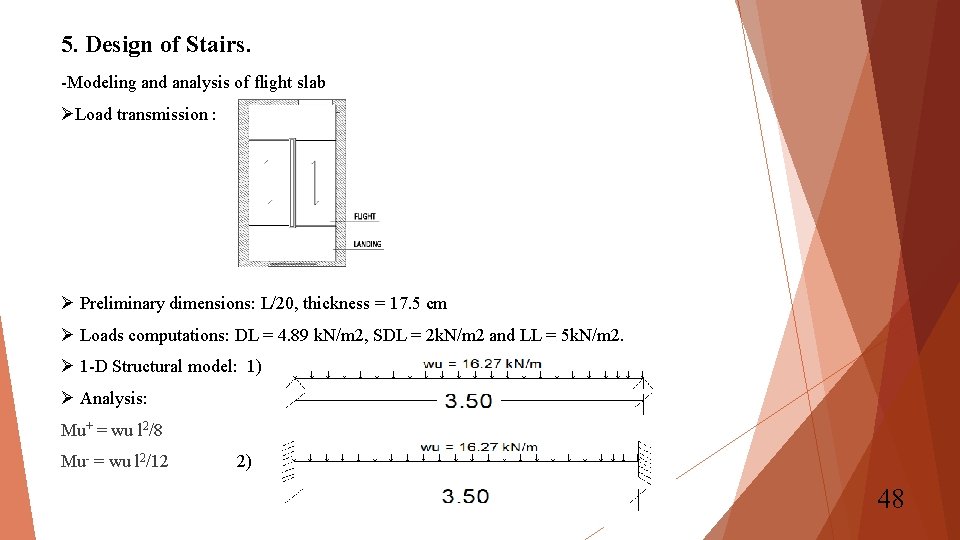
5. Design of Stairs. -Modeling and analysis of flight slab ØLoad transmission : Ø Preliminary dimensions: L/20, thickness = 17. 5 cm Ø Loads computations: DL = 4. 89 k. N/m 2, SDL = 2 k. N/m 2 and LL = 5 k. N/m 2. Ø 1 -D Structural model: 1) Ø Analysis: Mu+ = wu l 2/8 Mu- = wu l 2/12 2) 48
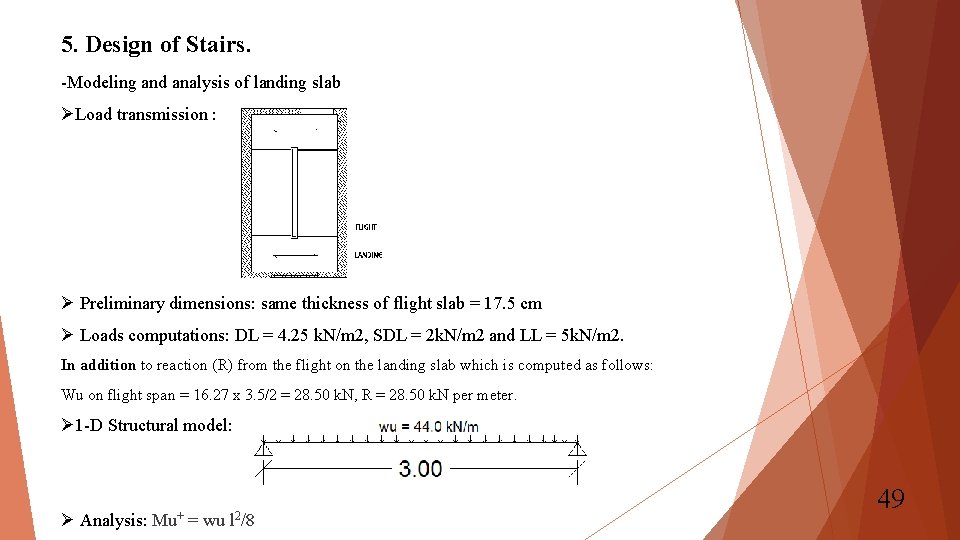
5. Design of Stairs. -Modeling and analysis of landing slab ØLoad transmission : Ø Preliminary dimensions: same thickness of flight slab = 17. 5 cm Ø Loads computations: DL = 4. 25 k. N/m 2, SDL = 2 k. N/m 2 and LL = 5 k. N/m 2. In addition to reaction (R) from the flight on the landing slab which is computed as follows: Wu on flight span = 16. 27 x 3. 5/2 = 28. 50 k. N, R = 28. 50 k. N per meter. Ø 1 -D Structural model: Ø Analysis: Mu+ = wu l 2/8 49
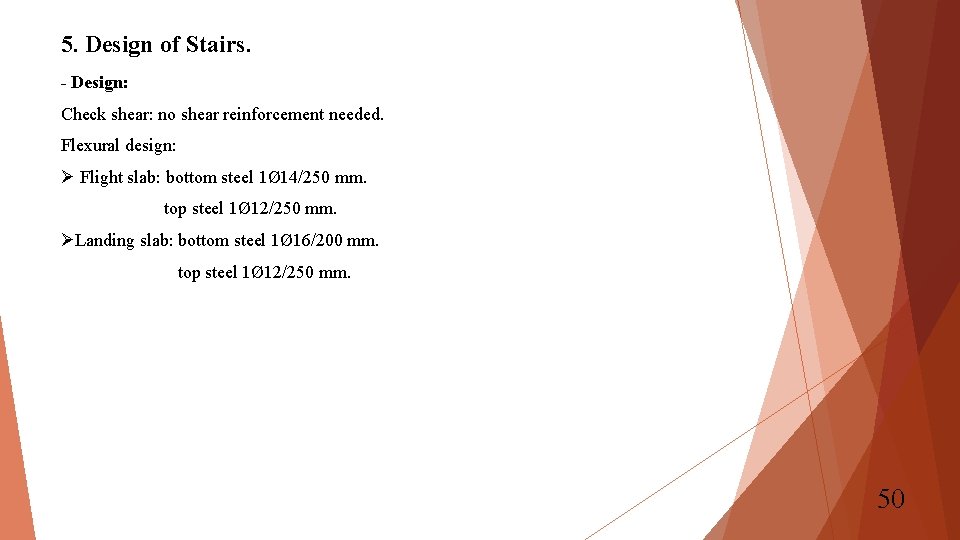
5. Design of Stairs. - Design: Check shear: no shear reinforcement needed. Flexural design: Ø Flight slab: bottom steel 1Ø 14/250 mm. top steel 1Ø 12/250 mm. ØLanding slab: bottom steel 1Ø 16/200 mm. top steel 1Ø 12/250 mm. 50
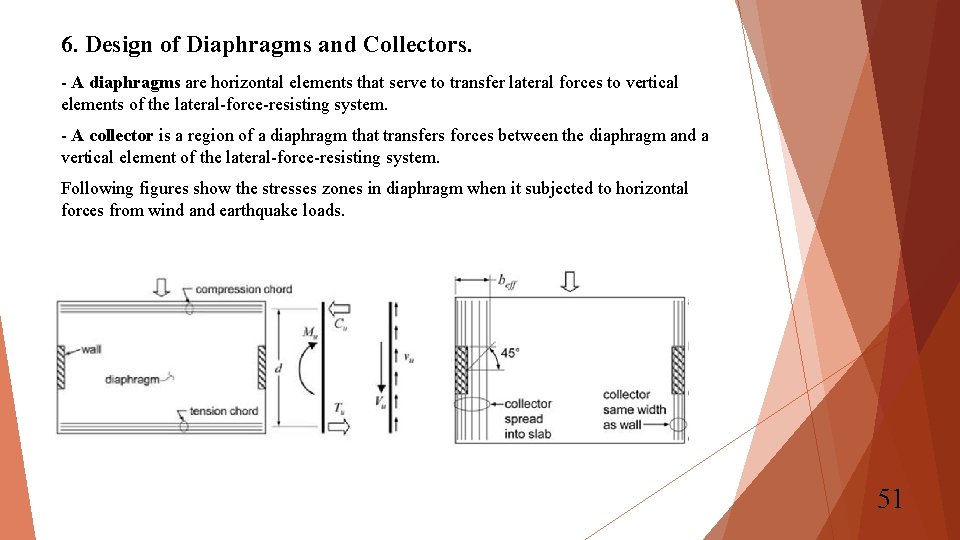
6. Design of Diaphragms and Collectors. - A diaphragms are horizontal elements that serve to transfer lateral forces to vertical elements of the lateral-force-resisting system. - A collector is a region of a diaphragm that transfers forces between the diaphragm and a vertical element of the lateral-force-resisting system. Following figures show the stresses zones in diaphragm when it subjected to horizontal forces from wind and earthquake loads. 51
6. Design of Diaphragms and Collectors. This system (Flat plate) to simplify the understanding of the diaphragm actions in horizontal forces. But, the system used in this structure is two way solid slab with drop beams between all columns and shear walls which means the compression and tension chords and collector zones are concentrated in beams as axial forces. So, these beams shall be designed for these axial forces. Collector zone can be formed in diaphragm, but it will be consider in beams only with allow to some cracks developed. 52
7. Design of Foundation. - Preliminary Dimensions: As it is already known, the bearing capacity depends on depth of foundation and dimensions of footing, and since the mat is 11. 80 m underground, the bearing capacity aforementioned in section 1. 8 does not apply here. In order to calculate the bearing capacity, the dimensions of the mat will be assumed as the dimensions of the building plus 1. 8 m for each side on X-axis and 2. 1 m for each side on Y-axis (33 x 29). Flat plate mat will be used, with area = 957 m 2. Thickness = 2. 00 m 53
7. Design of Foundation. - Bearing Capacity: As per section 1. 8, Ø=30°, c = 15 k. N/m 2 and qall =480 k. N/m 2 for a square footing with dimensions of 2 x 2 m, Df = 2 m and F. S = 5. Using the general bearing capacity equation: qult = c. Nc. Fcs. Fcd. Fci + q. Nq. Fqs. Fqd. Fqi + 0. 5γBNγFγs. Fγd. Fγi By substituting the variables in the equation, qult = 13050 k. N/m 2. qall = 13050/5 = 2600 k. N/m 2, but this value is too high and will be reduced to 1000 k. N/m 2. 54
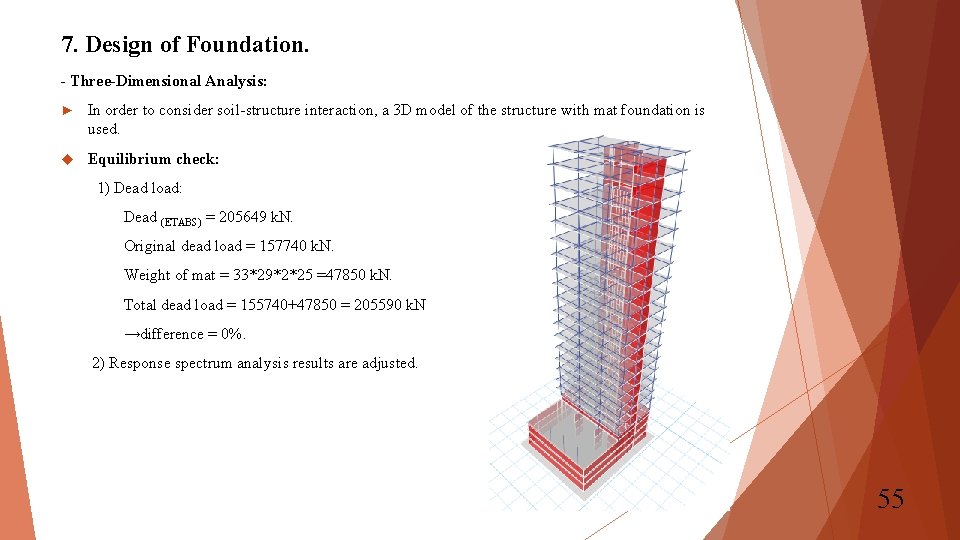
7. Design of Foundation. - Three-Dimensional Analysis: ► In order to consider soil-structure interaction, a 3 D model of the structure with mat foundation is used. Equilibrium check: 1) Dead load: Dead (ETABS) = 205649 k. N. Original dead load = 157740 k. N. Weight of mat = 33*29*2*25 =47850 k. N. Total dead load = 155740+47850 = 205590 k. N →difference = 0%. 2) Response spectrum analysis results are adjusted. 55
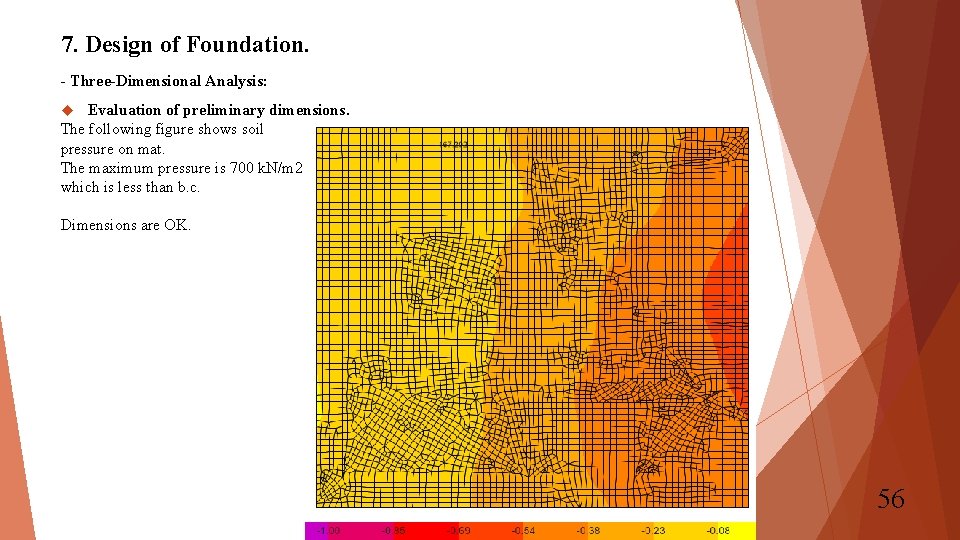
7. Design of Foundation. - Three-Dimensional Analysis: Evaluation of preliminary dimensions. The following figure shows soil pressure on mat. The maximum pressure is 700 k. N/m 2 which is less than b. c. Dimensions are OK. 56
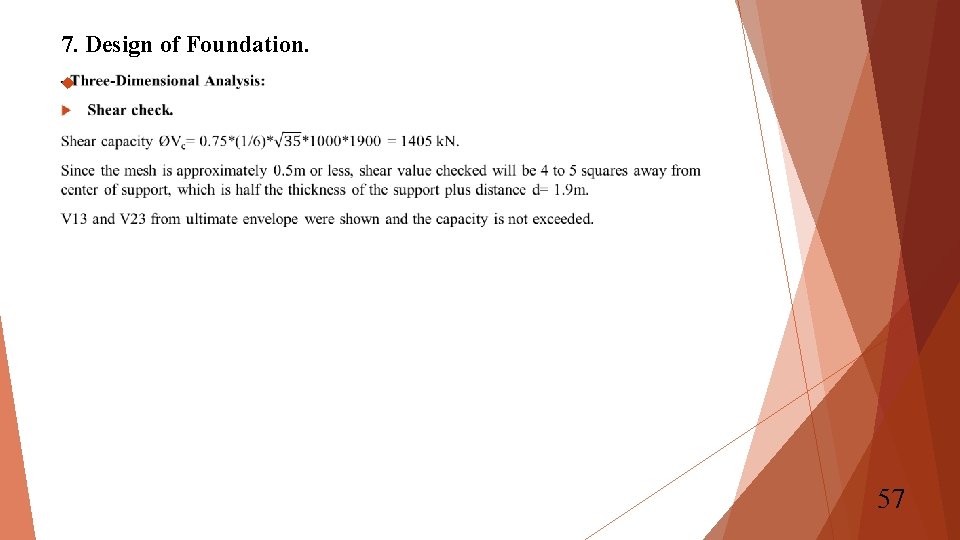
7. Design of Foundation. 57
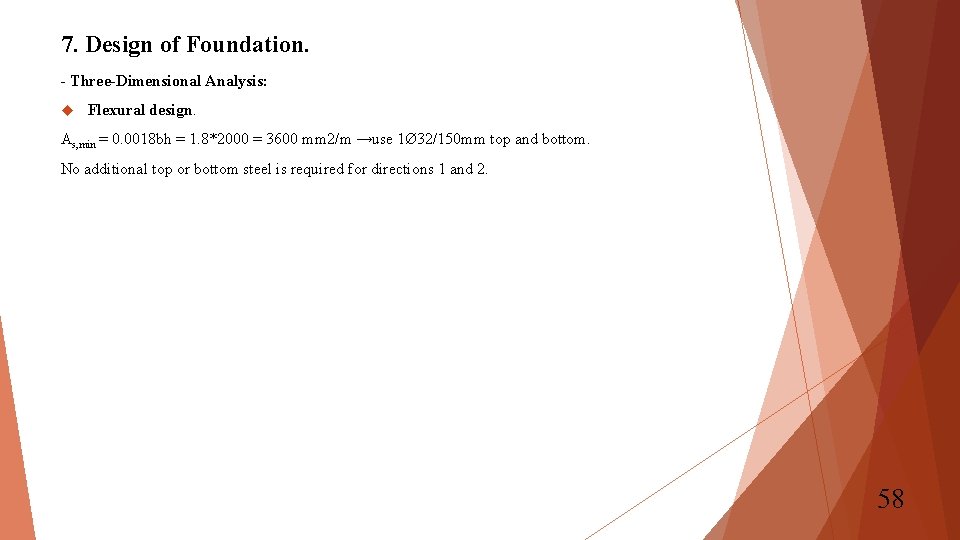
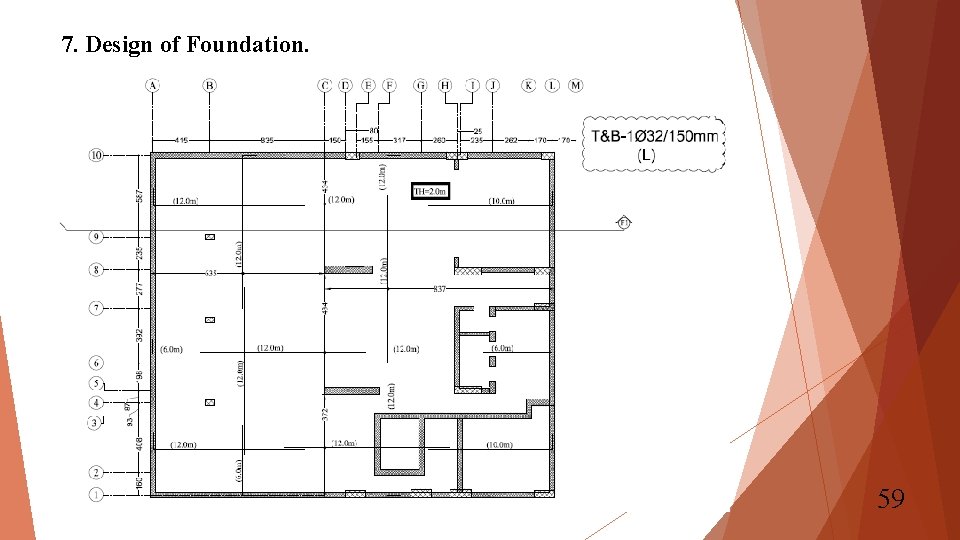
7. Design of Foundation. - Three-Dimensional Analysis: Flexural design. As, min = 0. 0018 bh = 1. 8*2000 = 3600 mm 2/m →use 1Ø 32/150 mm top and bottom. No additional top or bottom steel is required for directions 1 and 2. 58
7. Design of Foundation. 59

Thank You 60
- Slides: 60