
Structural Design Criteria Graded Discussion E Anderssen LBNL

Structural Design Criteria Graded Discussion E Anderssen, LBNL FNAL, BNL, LBNL logo area Design criteria meeting 2017 -12 -08
Outline § § § Graded approach for all materials in MQXF Conceptual flow chart Overview of Design Criteria (Failure Criteria) Discussion of thresholds vs loads Mitigation strategies Flesh out the graded criteria and associated analysis techniques logo area ~December 1 st, 2017 E Anderssen 2
Graded Approach: Assess Material Properties § The graded approach starts with knowing material properties well enough to proceed § Yield criteria are the starting points, but need to also know if material is ‘brittle’ in operation § If KIc is under 50 MPa-m 1/2 material may be fracture dominated § If Material undergoes Ductile-Brittle Transition, assess above § Do not treat weldments here—use B&PVC Div. II § Ratio of Yield to Ultimate, ductility below some threshold, are old ways of assessing brittleness/toughness, KIc should be used. § Charpy is prevalent in weld studies, but is a relative measure—cannot be tied to actual toughness in a universal way, but maybe required by code § Most Stainless Steels have KIc greater than 120 MPa-m 1/2 § Can directly use simple yield criteria § Should look into the more exotic materials like Nitronic… § Aluminum and Iron have KIc less than 30 MPa-m 1/2 § Can say already that components with these materials need LEFM analysis logo area E Anderssen 3
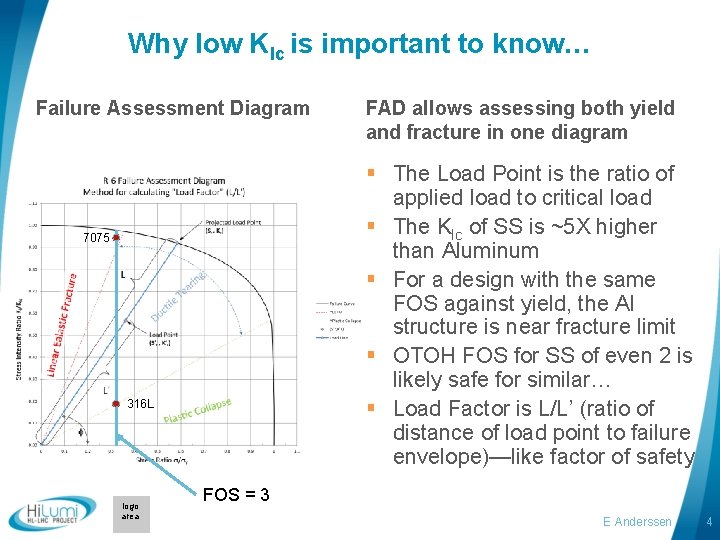
Why low KIc is important to know… Failure Assessment Diagram § The Load Point is the ratio of applied load to critical load § The KIc of SS is ~5 X higher than Aluminum § For a design with the same FOS against yield, the Al structure is near fracture limit § OTOH FOS for SS of even 2 is likely safe for similar… § Load Factor is L/L’ (ratio of distance of load point to failure envelope)—like factor of safety 7075 316 L logo area FAD allows assessing both yield and fracture in one diagram FOS = 3 E Anderssen 4
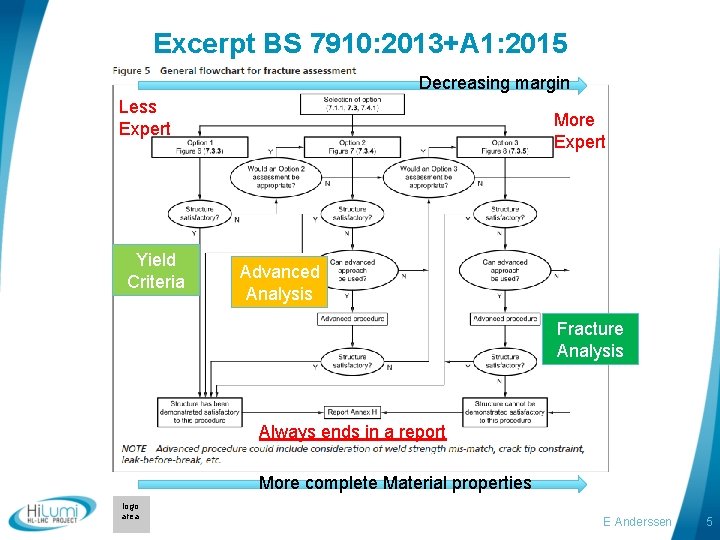
Excerpt BS 7910: 2013+A 1: 2015 Decreasing margin Less Expert Yield Criteria More Expert Advanced Analysis Fracture Analysis Always ends in a report More complete Material properties logo area E Anderssen 5
Presently think 3 levels of analysis works… § For simple yield (Von-Mises or other energy method), FOS of 3 for peak stress (even singularity) is proposed § The ‘Advanced Analysis’ is the next level includes: § ‘linearizing stress’ to assess if intersection is below yield (using same model) § Running sub-model of high stress region § Addition of mitigating features (fillets, chamfers, etc) § Still Aim for FOS = 3 § May need to addenda to the ‘Advanced Analysis’ level § Consider parts we specifically load to FOS = 2 or higher, like Axial Rods, etc § Some parts may not matter if they ‘fail’… Needs an ‘advanced’ engineering note explaining why that’s so… logo area E Anderssen 6
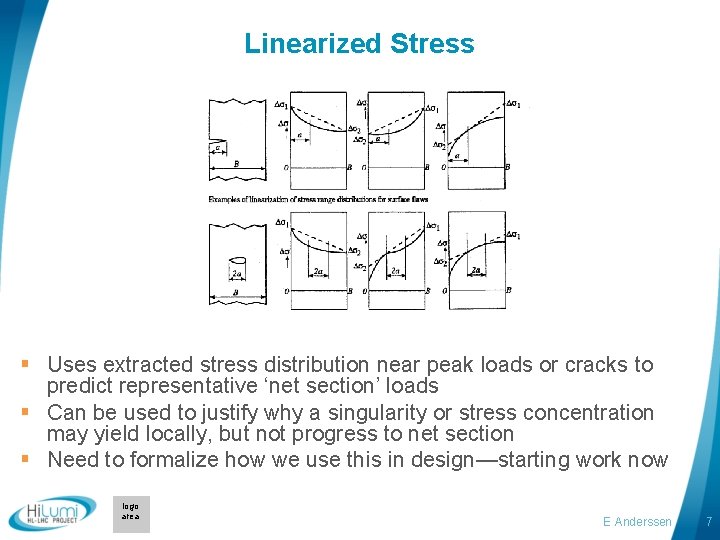
Linearized Stress § Uses extracted stress distribution near peak loads or cracks to predict representative ‘net section’ loads § Can be used to justify why a singularity or stress concentration may yield locally, but not progress to net section § Need to formalize how we use this in design—starting work now logo area E Anderssen 7
Failure Criteria § Consider failure at 0. 2% offset, use A-basis properties (95% confidence limit for test data) § This is already quite conservative § Design against yield, not ultimate § For metals, prefer Von-Mises § Tresca or Max Principle (stress or strain) often used for brittle materials, but plan to use LEFM for these § Distortion energy methods are most common and propose to use § Don’t have any materials that respond to hydrostatic pressure (unless Nb 3 Sn does…) § Similar methods (Tsai-Hill) exist for laminates § These are against mixed mode failure considering failure criterial for both fiber and matrix § LEFM will be used for brittle materials § Will not take benefit of elasto-plastic criteria (less conservative) logo area E Anderssen 8
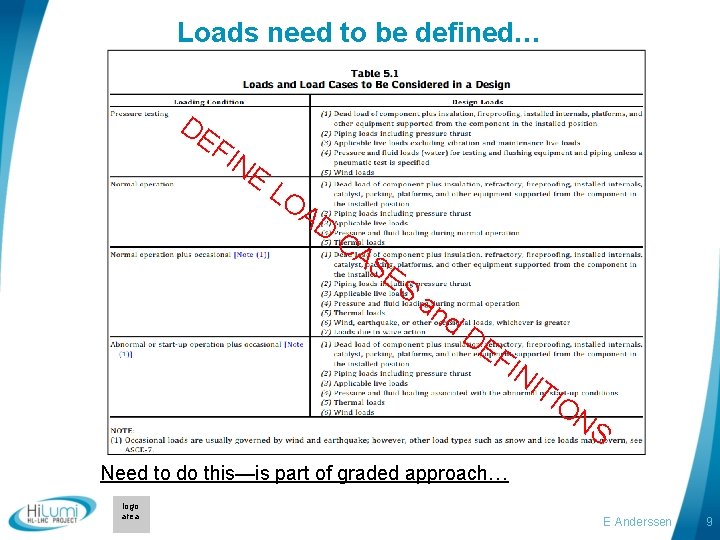
Loads need to be defined… DE FI NE LO AD CA SE S an d DE FI NI TI ON S Need to do this—is part of graded approach… logo area E Anderssen 9
Factor of Safety vs Load Likelihood… § One time loads, e. g. during pre-loading that are well defined and true peaks can have different assessment thresholds than static/operational loads § Might consider Load Factor of 1. 1 for preload, but require 1. 5 for operational loads § FOS of 3 is for static, operational loads § What should we accept, or how should we grade against fault or other overload conditions § Similar discussion for known cases of highly loaded SS structures (Axial Rods) logo area E Anderssen 10
Mitigation Strategies § Peak stresses are usually near singularities § Addition of design features can reduce peak stress § May not need to… § Need to formalize notion of plastic truncation or load redistribution § We know from experience that some of these don’t matter—need to explain why formally § Will likely see how this works by evaluating actual parts and documenting § Can likely find common thread/method after some test case analyses. logo area E Anderssen 11
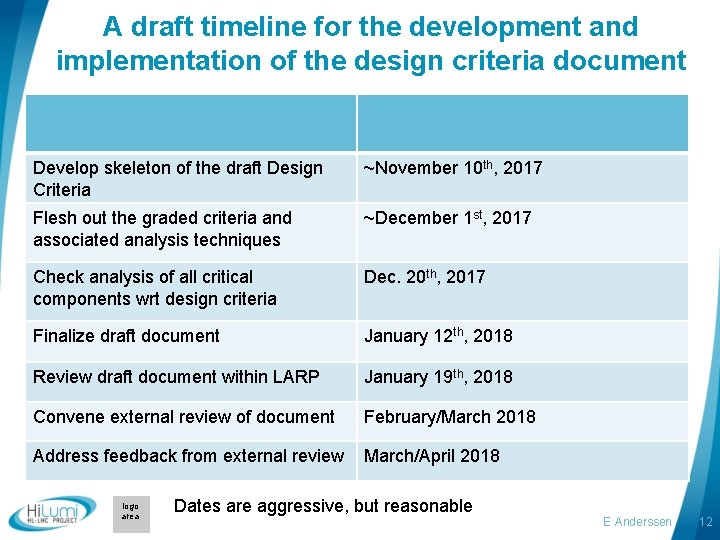
A draft timeline for the development and implementation of the design criteria document Develop skeleton of the draft Design Criteria ~November 10 th, 2017 Flesh out the graded criteria and associated analysis techniques ~December 1 st, 2017 Check analysis of all critical components wrt design criteria Dec. 20 th, 2017 Finalize draft document January 12 th, 2018 Review draft document within LARP January 19 th, 2018 Convene external review of document February/March 2018 Address feedback from external review March/April 2018 logo area Dates are aggressive, but reasonable E Anderssen 12
- Slides: 12