
Structural Design Criteria Example Application Heng Pan LBNL

Structural Design Criteria Example Application Heng Pan LBNL Structural and Electrical Design Criteria Review of the MQXFA Magnets Fermilab, April 23 -24, 2018
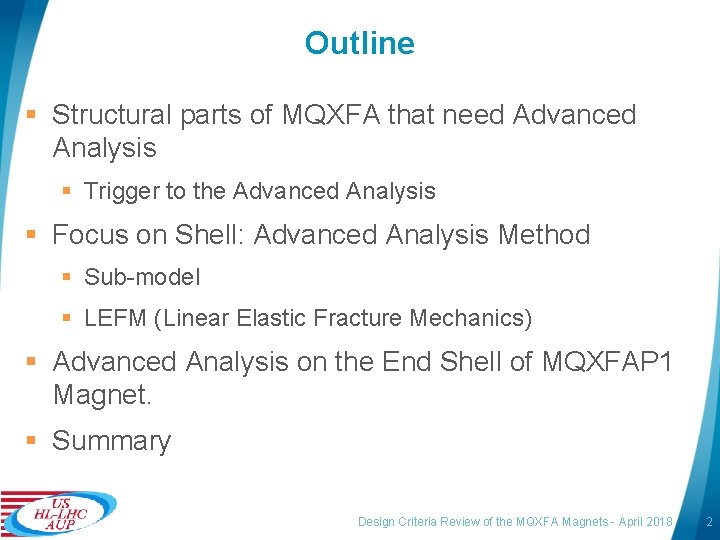
Outline § Structural parts of MQXFA that need Advanced Analysis § Trigger to the Advanced Analysis § Focus on Shell: Advanced Analysis Method § Sub-model § LEFM (Linear Elastic Fracture Mechanics) § Advanced Analysis on the End Shell of MQXFAP 1 Magnet. § Summary Design Criteria Review of the MQXFA Magnets - April 2018 2
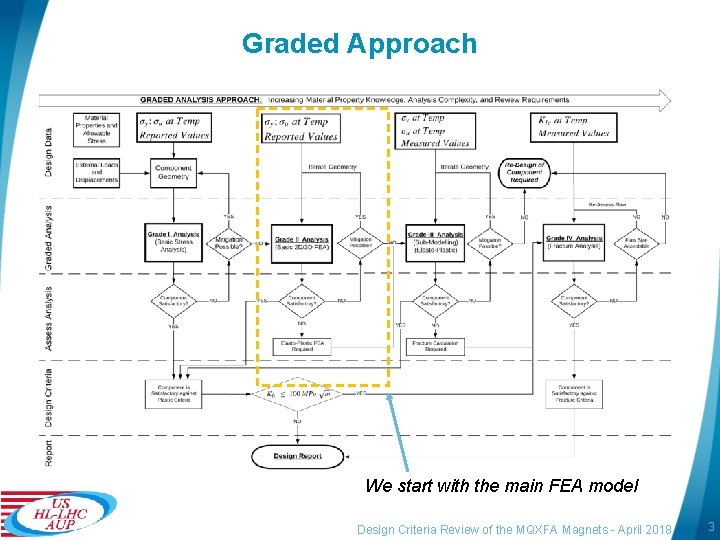
Graded Approach We start with the main FEA model Design Criteria Review of the MQXFA Magnets - April 2018 3
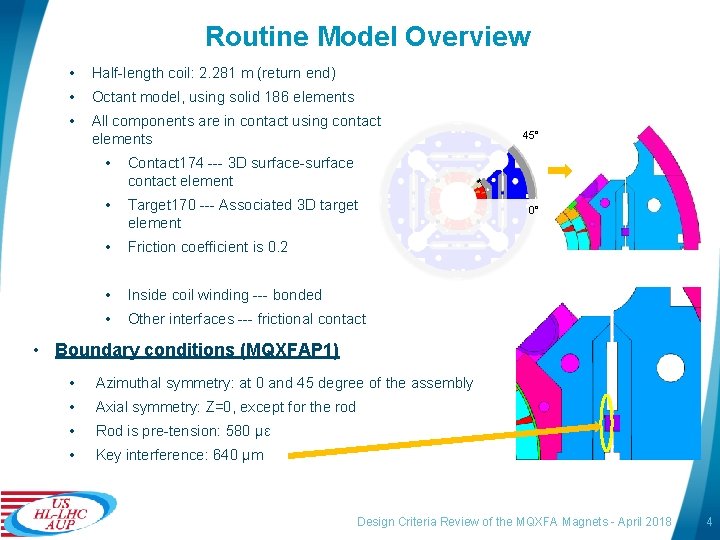
Routine Model Overview • Half-length coil: 2. 281 m (return end) • Octant model, using solid 186 elements • All components are in contact using contact elements • Contact 174 --- 3 D surface-surface contact element • Target 170 --- Associated 3 D target element • Friction coefficient is 0. 2 • Inside coil winding --- bonded • Other interfaces --- frictional contact 45° 0° • Boundary conditions (MQXFAP 1) • Azimuthal symmetry: at 0 and 45 degree of the assembly • Axial symmetry: Z=0, except for the rod • Rod is pre-tension: 580 με • Key interference: 640 μm Design Criteria Review of the MQXFA Magnets - April 2018 4
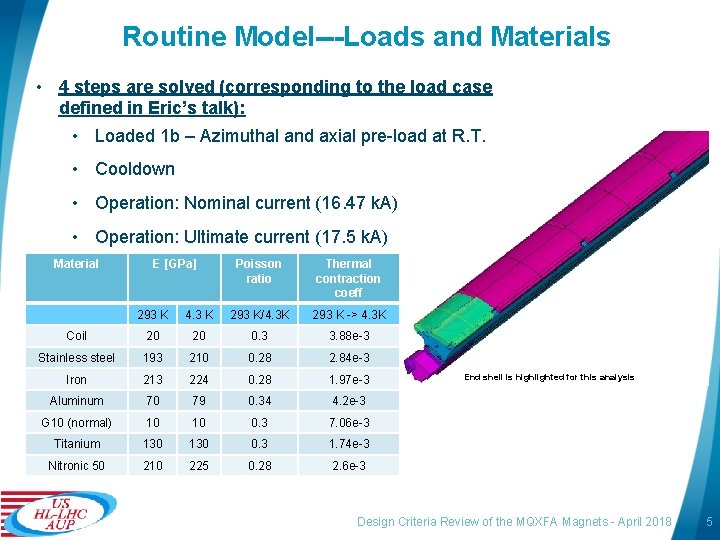
Routine Model---Loads and Materials • 4 steps are solved (corresponding to the load case defined in Eric’s talk): • Loaded 1 b – Azimuthal and axial pre-load at R. T. • Cooldown • Operation: Nominal current (16. 47 k. A) • Operation: Ultimate current (17. 5 k. A) Material E [GPa] Poisson ratio Thermal contraction coeff 293 K 4. 3 K 293 K/4. 3 K 293 K -> 4. 3 K Coil 20 20 0. 3 3. 88 e-3 Stainless steel 193 210 0. 28 2. 84 e-3 Iron 213 224 0. 28 1. 97 e-3 Aluminum 70 79 0. 34 4. 2 e-3 G 10 (normal) 10 10 0. 3 7. 06 e-3 Titanium 130 0. 3 1. 74 e-3 Nitronic 50 210 225 0. 28 2. 6 e-3 End shell is highlighted for this analysis Design Criteria Review of the MQXFA Magnets - April 2018 5
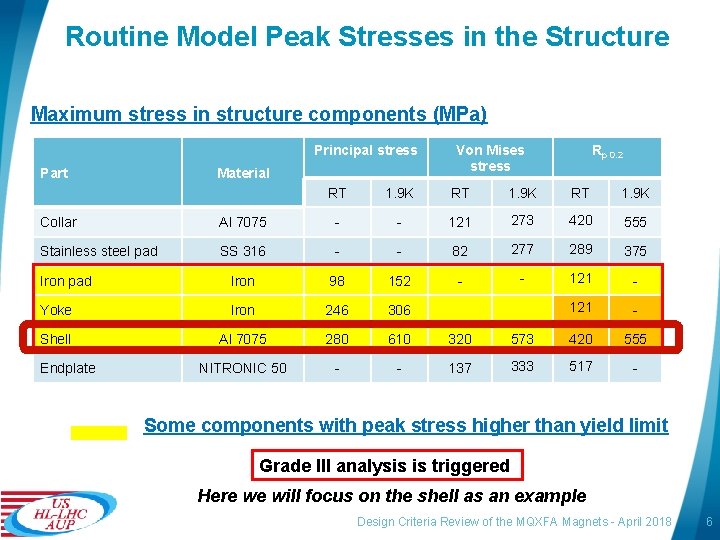
Routine Model Peak Stresses in the Structure Maximum stress in structure components (MPa) Principal stress Part Material Von Mises stress Rp 0. 2 RT 1. 9 K Collar Al 7075 - - 121 273 420 555 Stainless steel pad SS 316 - - 82 277 289 375 Iron pad Iron 98 152 - - 121 - Yoke Iron 246 306 121 - Shell Al 7075 280 610 320 573 420 555 NITRONIC 50 - - 137 333 517 - Endplate Some components with peak stress higher than yield limit Grade III analysis is triggered Here we will focus on the shell as an example Design Criteria Review of the MQXFA Magnets - April 2018 6
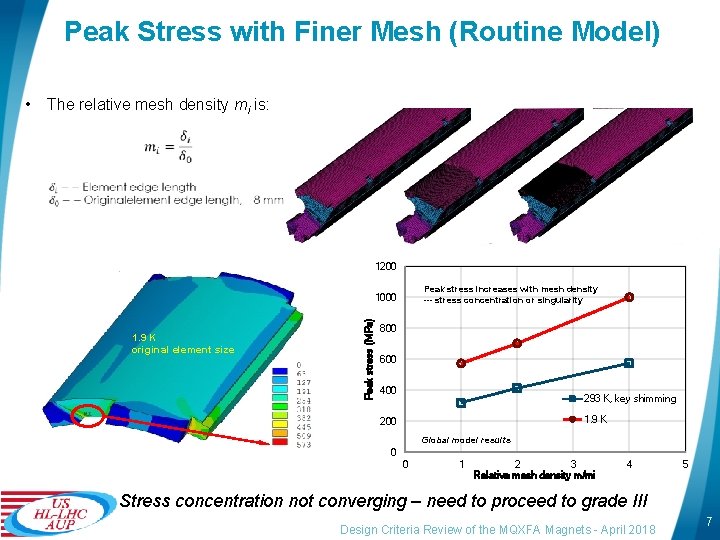
Peak Stress with Finer Mesh (Routine Model) The relative mesh density mi is: 1200 Peak stress increases with mesh density --- stress concentration or singularity 1000 1. 9 K original element size Peak stress (MPa) • 800 600 400 293 K, key shimming 1. 9 K 200 Global model results 0 0 1 2 3 Relative mesh density m/mi 4 5 Stress concentration not converging – need to proceed to grade III Design Criteria Review of the MQXFA Magnets - April 2018 7
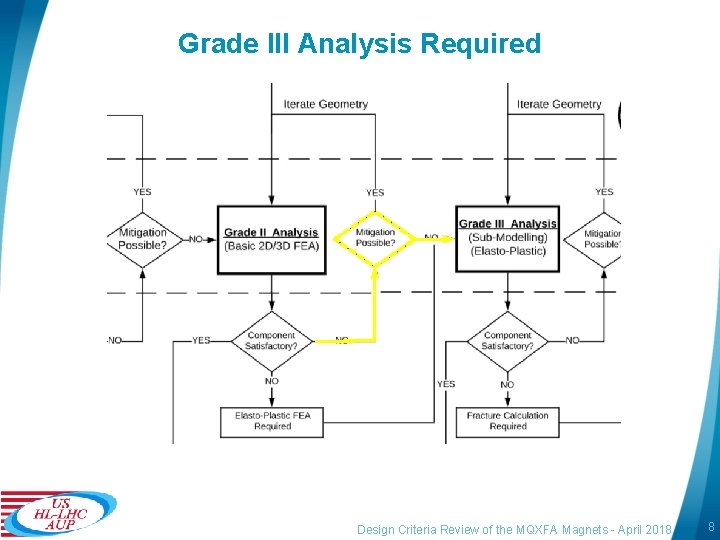
Grade III Analysis Required Design Criteria Review of the MQXFA Magnets - April 2018 8
Before continuing with Shell analysis… Advanced Analysis Overview • Sub-model • Fracture Calculation --- Linear Elastic Fracture Mechanics
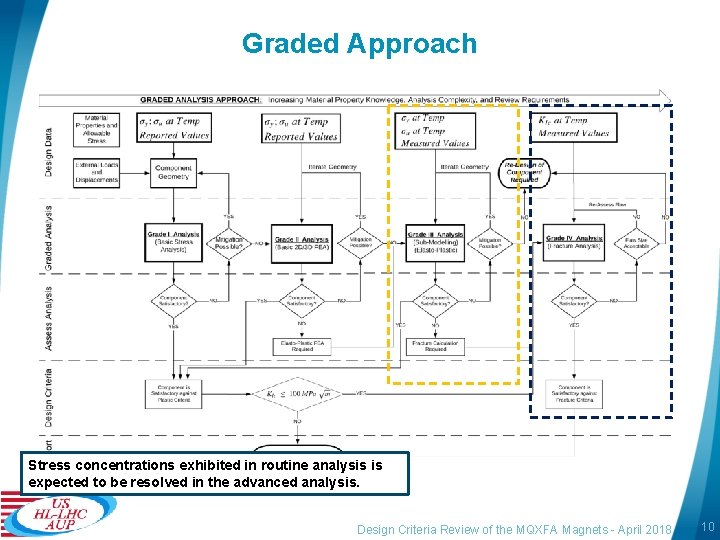
Graded Approach Stress concentrations exhibited in routine analysis is expected to be resolved in the advanced analysis. Design Criteria Review of the MQXFA Magnets - April 2018 10
Grade III Sub-model • Sub-model will be performed when components exhibiting stress concentrations that cannot be readily resolved via routine mesh refinement studies in original routine model. • Sub-model is a separate model of the local region (area or volume) encompassing the stress concentration zone identified in the original model; • The fundamental basis is St. Venant’s principle: • if an actual distribution of forces is replaced by a statically equivalent system, the distribution of stress and strain is altered only near the regions of load application. • The sub-model boundary stresses must be compared with the original model stresses to verify that St. Venant’s principle is valid. 11
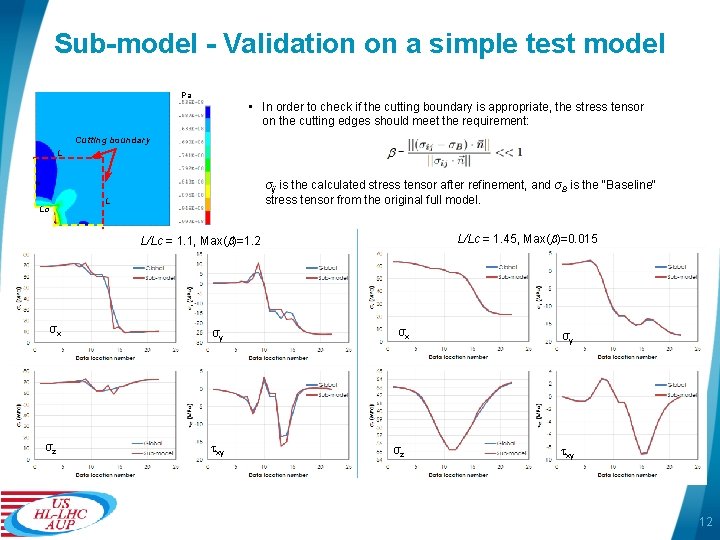
Sub-model - Validation on a simple test model Pa • In order to check if the cutting boundary is appropriate, the stress tensor on the cutting edges should meet the requirement: Cutting boundary L σij is the calculated stress tensor after refinement, and σB is the "Baseline" stress tensor from the original full model. L Lc L/Lc = 1. 45, Max( )=0. 015 L/Lc = 1. 1, Max( )=1. 2 σx σz σy xy 12
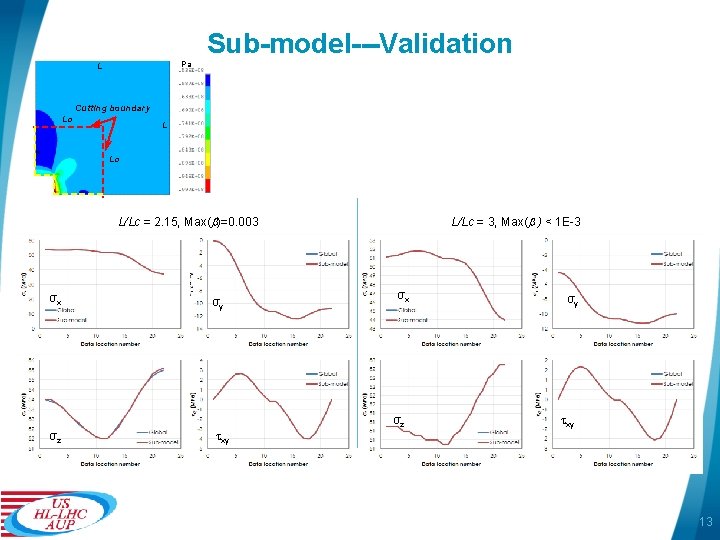
Sub-model---Validation Pa L Cutting boundary Lc L/Lc = 3, Max( ) < 1 E-3 L/Lc = 2. 15, Max( )=0. 003 σx σy σx σz σz xy σy xy 13
Fracture Analysis § Design Criteria Review of the MQXFA Magnets - April 2018 14
End Shell Optimization with the Grade III and IV Analysis
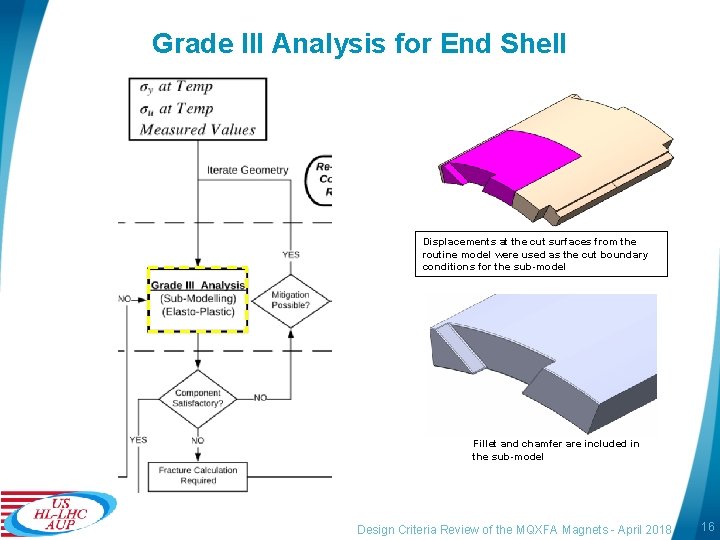
Grade III Analysis for End Shell Displacements at the cut surfaces from the routine model were used as the cut boundary conditions for the sub-model Fillet and chamfer are included in the sub-model Design Criteria Review of the MQXFA Magnets - April 2018 16
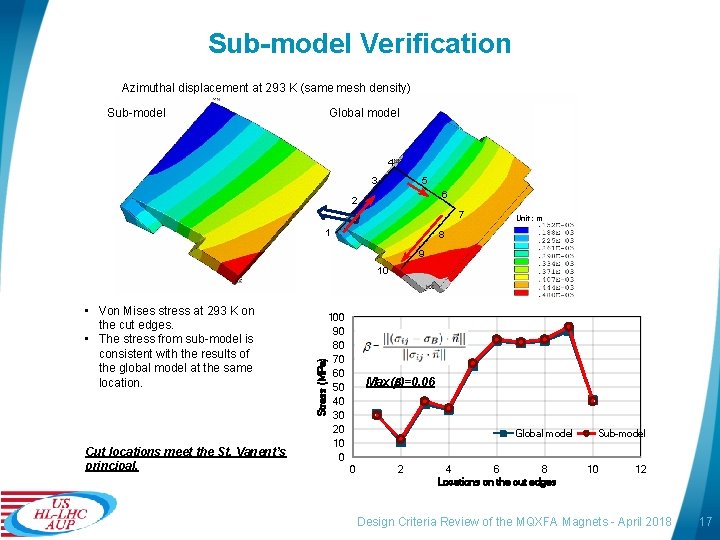
Sub-model Verification Azimuthal displacement at 293 K (same mesh density) Sub-model Global model 4 3 5 6 2 7 1 Unit: m 8 9 • Von Mises stress at 293 K on the cut edges. • The stress from sub-model is consistent with the results of the global model at the same location. Cut locations meet the St. Vanent’s principal. Stress (MPa) 10 100 90 80 70 60 50 40 30 20 10 0 Max( )=0. 06 Global model 0 2 4 6 8 Locations on the cut edges Sub-model 10 12 Design Criteria Review of the MQXFA Magnets - April 2018 17
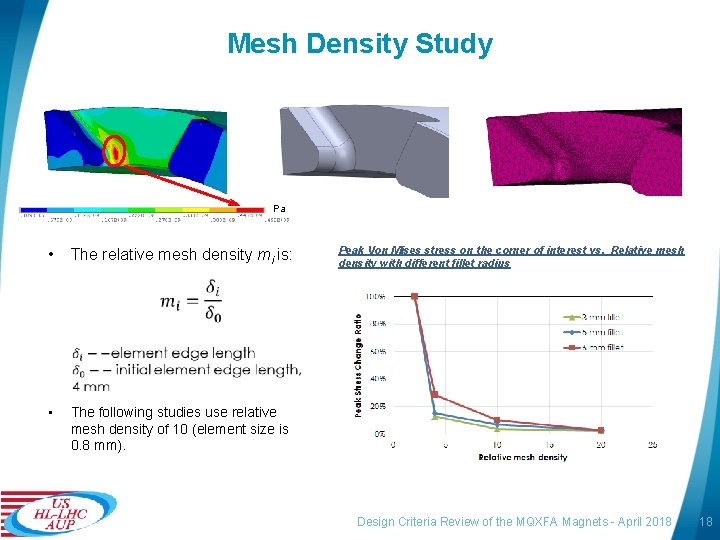
Mesh Density Study Pa • The relative mesh density mi is: • The following studies use relative mesh density of 10 (element size is 0. 8 mm). Peak Von Mises stress on the corner of interest vs. Relative mesh density with different fillet radius 1. 9 K Design Criteria Review of the MQXFA Magnets - April 2018 18
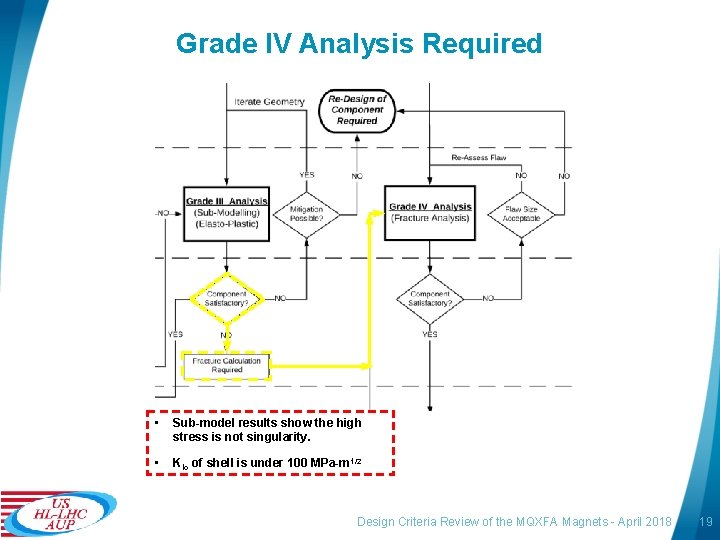
Grade IV Analysis Required • Sub-model results show the high stress is not singularity. • KIc of shell is under 100 MPa-m 1/2 Design Criteria Review of the MQXFA Magnets - April 2018 19
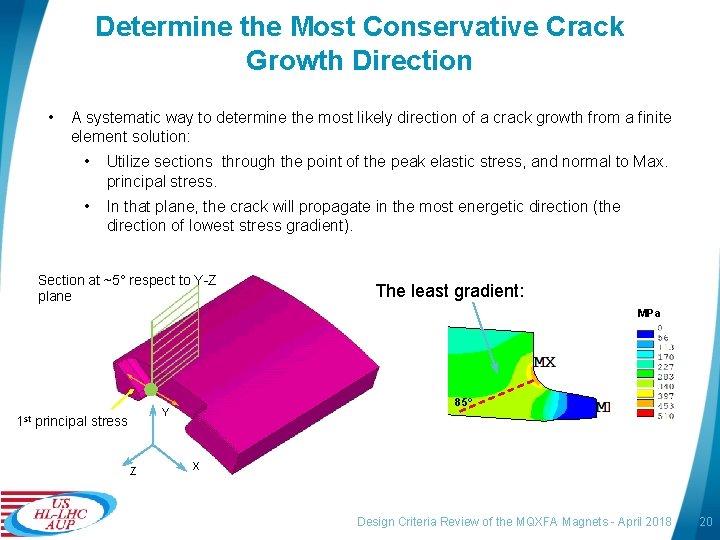
Determine the Most Conservative Crack Growth Direction • A systematic way to determine the most likely direction of a crack growth from a finite element solution: • Utilize sections through the point of the peak elastic stress, and normal to Max. principal stress. • In that plane, the crack will propagate in the most energetic direction (the direction of lowest stress gradient). Section at ~5° respect to Y-Z plane The least gradient: MPa 85° Y 1 st principal stress Z X Design Criteria Review of the MQXFA Magnets - April 2018 20
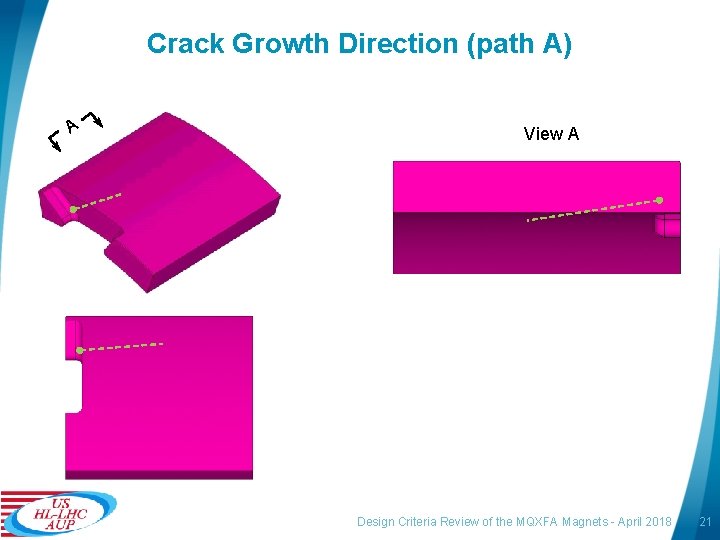
Crack Growth Direction (path A) A View A Design Criteria Review of the MQXFA Magnets - April 2018 21
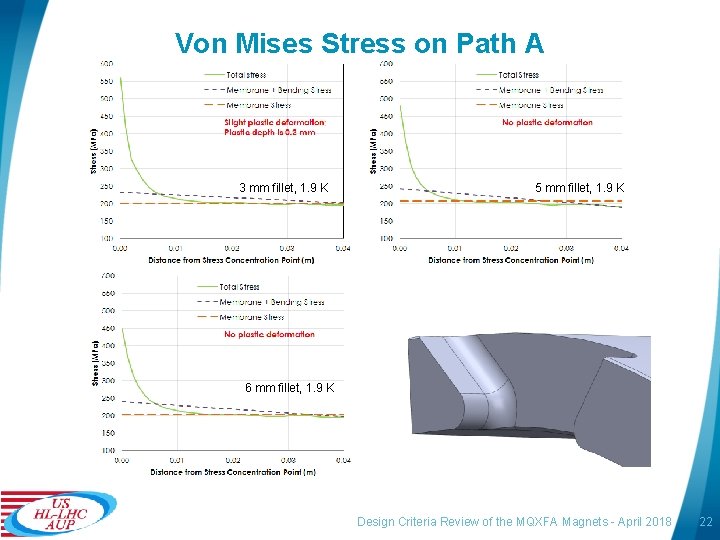
Von Mises Stress on Path A 3 mm fillet, 1. 9 K 5 mm fillet, 1. 9 K 6 mm fillet, 1. 9 K Design Criteria Review of the MQXFA Magnets - April 2018 22
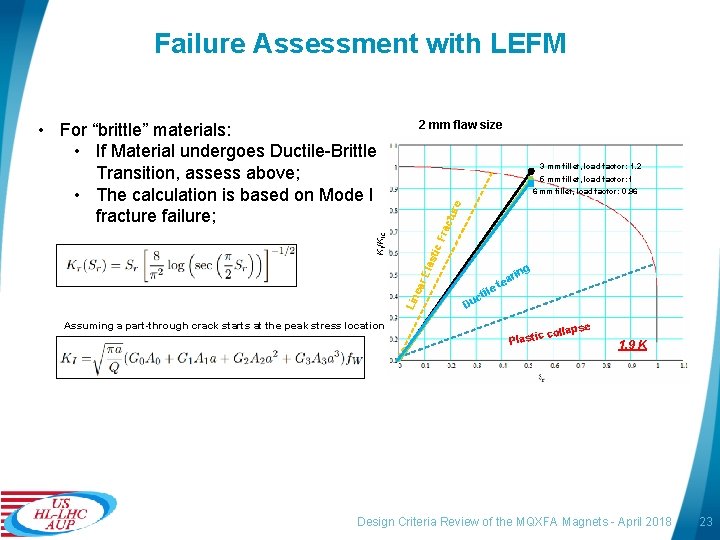
Failure Assessment with LEFM 2 mm flaw size 3 mm fillet, load factor: 1. 2 Ela stic Fra ctu re 5 mm fillet, load factor: 1 6 mm fillet, load factor: 0. 96 Lin ear KI/KIC • For “brittle” materials: • If Material undergoes Ductile-Brittle Transition, assess above; • The calculation is based on Mode I fracture failure; Assuming a part-through crack starts at the peak stress location g rin le cti Du tea Plastic collap se 1. 9 K Design Criteria Review of the MQXFA Magnets - April 2018 23
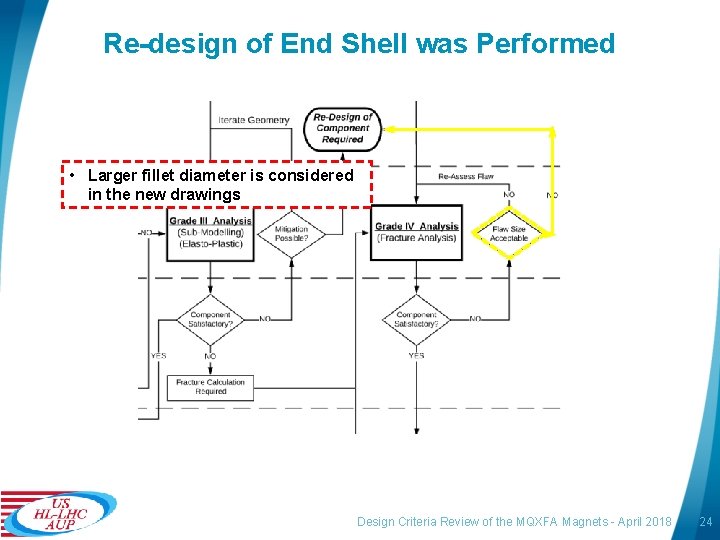
Re-design of End Shell was Performed • Larger fillet diameter is considered in the new drawings Design Criteria Review of the MQXFA Magnets - April 2018 24
Summary
Summary • A graded structural analysis process for MQXFA magnet has been established • A series of advanced analysis techniques are employed and validated in this example • The end shell has been analyzed and modified to achieve the design criteria • The process will be used to evaluate other structural parts which present stresses under various load conditions Design Criteria Review of the MQXFA Magnets - April 2018 26
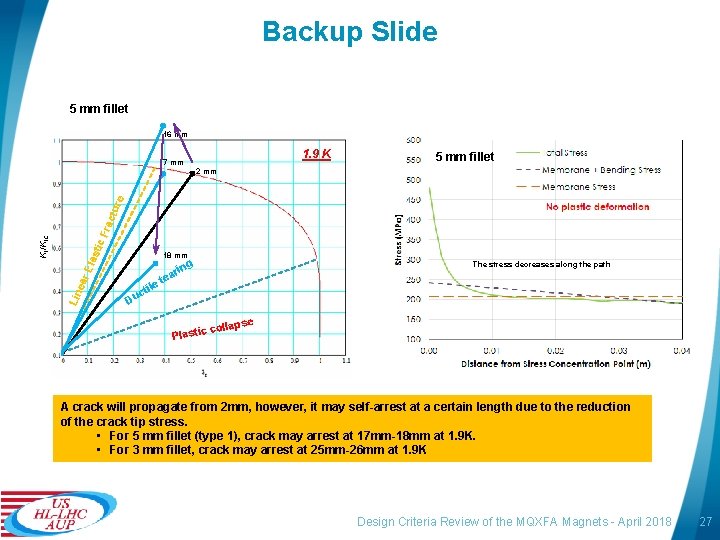
Backup Slide 5 mm fillet 16 mm 1. 9 K 5 mm fillet 2 mm Fra Ela stic Lin ear KI/KIC ctu re 17 mm 18 mm ng The stress decreases along the path ri ea t e til c Du e ollaps c Plastic A crack will propagate from 2 mm, however, it may self-arrest at a certain length due to the reduction of the crack tip stress. • For 5 mm fillet (type 1), crack may arrest at 17 mm-18 mm at 1. 9 K. • For 3 mm fillet, crack may arrest at 25 mm-26 mm at 1. 9 K Design Criteria Review of the MQXFA Magnets - April 2018 27
- Slides: 27