
Structural Design Criteria Discussion E Anderssen S Prestemon

- Slides: 16
Structural Design Criteria Discussion E Anderssen, S Prestemon, D Cheng, H Pan logo area Design criteria meeting 2017 -10 -28
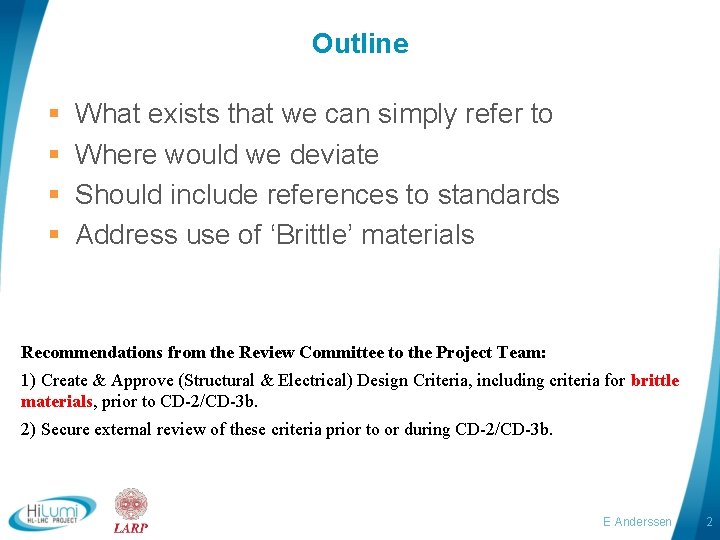
Outline § § What exists that we can simply refer to Where would we deviate Should include references to standards Address use of ‘Brittle’ materials Recommendations from the Review Committee to the Project Team: 1) Create & Approve (Structural & Electrical) Design Criteria, including criteria for brittle materials, prior to CD-2/CD-3 b. 2) Secure external review of these criteria prior to or during CD-2/CD-3 b. logo area E Anderssen 2
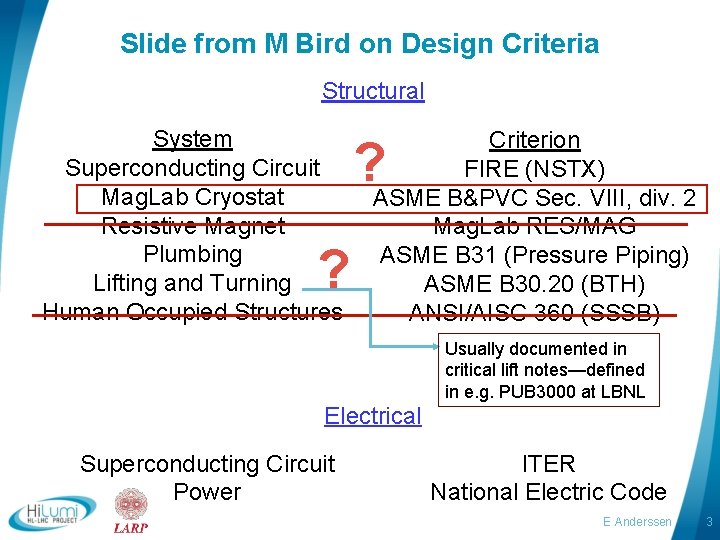
Slide from M Bird on Design Criteria Structural System Superconducting Circuit Mag. Lab Cryostat Resistive Magnet Plumbing Lifting and Turning Human Occupied Structures ? Criterion FIRE (NSTX) ASME B&PVC Sec. VIII, div. 2 Mag. Lab RES/MAG ASME B 31 (Pressure Piping) ASME B 30. 20 (BTH) ANSI/AISC 360 (SSSB) ? Usually documented in critical lift notes—defined in e. g. PUB 3000 at LBNL Electrical Superconducting Circuit Power logo area ITER National Electric Code E Anderssen 3
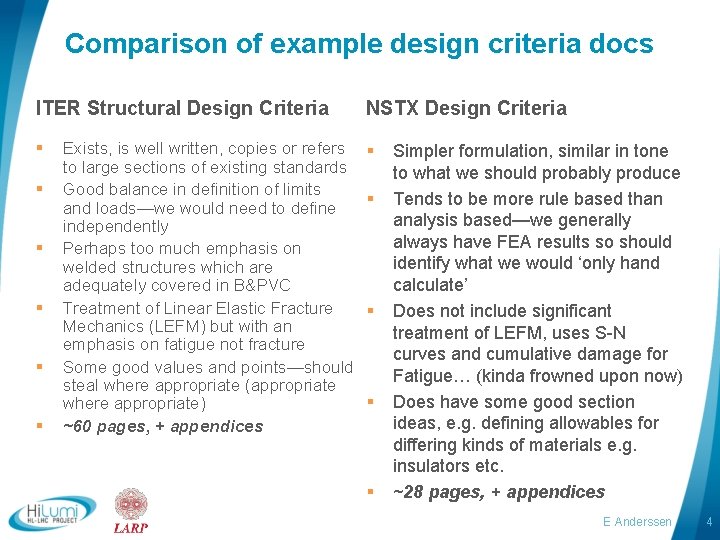
Comparison of example design criteria docs ITER Structural Design Criteria NSTX Design Criteria § § § § Exists, is well written, copies or refers to large sections of existing standards Good balance in definition of limits and loads—we would need to define independently Perhaps too much emphasis on welded structures which are adequately covered in B&PVC Treatment of Linear Elastic Fracture Mechanics (LEFM) but with an emphasis on fatigue not fracture Some good values and points—should steal where appropriate (appropriate where appropriate) ~60 pages, + appendices logo area § § Simpler formulation, similar in tone to what we should probably produce Tends to be more rule based than analysis based—we generally always have FEA results so should identify what we would ‘only hand calculate’ Does not include significant treatment of LEFM, uses S-N curves and cumulative damage for Fatigue… (kinda frowned upon now) Does have some good section ideas, e. g. defining allowables for differing kinds of materials e. g. insulators etc. ~28 pages, + appendices E Anderssen 4
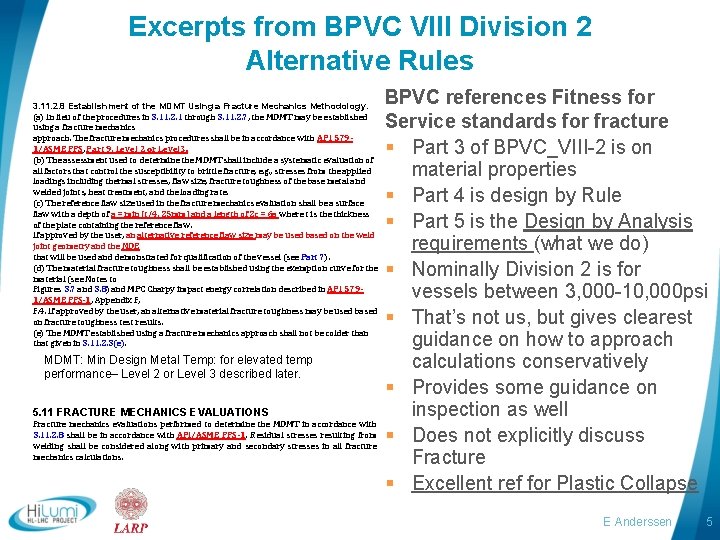
Excerpts from BPVC VIII Division 2 Alternative Rules 3. 11. 2. 8 Establishment of the MDMT Using a Fracture Mechanics Methodology. (a) In lieu of the procedures in 3. 11. 2. 1 through 3. 11. 2. 7, the MDMT may be established using a fracture mechanics approach. The fracture mechanics procedures shall be in accordance with API 5791/ASME FFS, Part 9, Level 2 or Level 3. (b) The assessment used to determine the MDMT shall include a systematic evaluation of all factors that control the susceptibility to brittle fracture, e. g. , stresses from the applied loadings including thermal stresses, flaw size, fracture toughness of the base metal and welded joints, heat treatment, and the loading rate. (c) The reference flaw size used in the fracture mechanics evaluation shall be a surface flaw with a depth of a = min [t/4, 25 mm] and a length of 2 c = 6 a where t is the thickness of the plate containing the reference flaw. If approved by the user, an alternative reference flaw size may be used based on the weld joint geometry and the NDE that will be used and demonstrated for qualification of the vessel (see Part 7). (d) The material fracture toughness shall be established using the exemption curve for the material (see Notes to Figures 3. 7 and 3. 8) and MPC Charpy impact energy correlation described in API 5791/ASME FFS-1, Appendix F, F. 4. If approved by the user, an alternative material fracture toughness may be used based on fracture toughness test results. (e) The MDMT established using a fracture mechanics approach shall not be colder than that given in 3. 11. 2. 3(e). MDMT: Min Design Metal Temp: for elevated temp performance– Level 2 or Level 3 described later. 5. 11 FRACTURE MECHANICS EVALUATIONS Fracture mechanics evaluations performed to determine the MDMT in accordance with 3. 11. 2. 8 shall be in accordance with API/ASME FFS-1. Residual stresses resulting from welding shall be considered along with primary and secondary stresses in all fracture mechanics calculations. logo area BPVC references Fitness for Service standards for fracture § Part 3 of BPVC_VIII-2 is on material properties § Part 4 is design by Rule § Part 5 is the Design by Analysis requirements (what we do) § Nominally Division 2 is for vessels between 3, 000 -10, 000 psi § That’s not us, but gives clearest guidance on how to approach calculations conservatively § Provides some guidance on inspection as well § Does not explicitly discuss Fracture § Excellent ref for Plastic Collapse E Anderssen 5
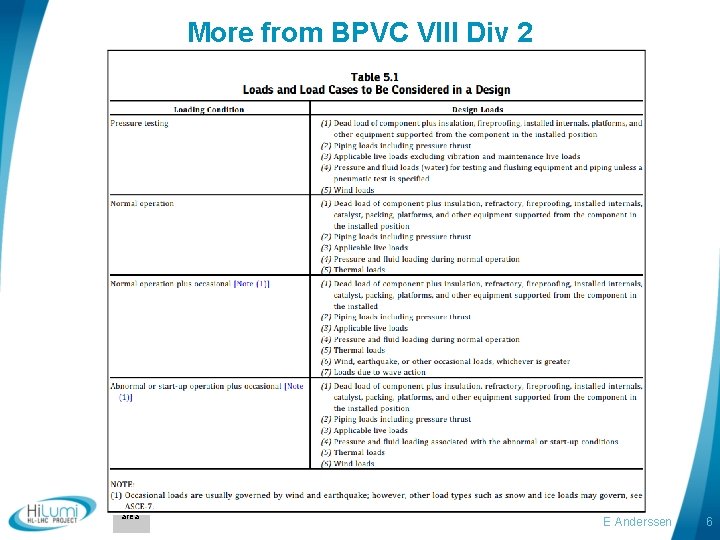
More from BPVC VIII Div 2 logo area E Anderssen 6
Fitness for Service § Devised by energy sector to assess damaged equipment (and considers defects from mfg) § Aimed at extending life or allowing use § Similar discipline to Damage Tolerant Design used in aerospace § Based on inspection and evaluation § Graded approach, from ‘hand calculations’ to FEA, simple LEFM to EPFM—in order of complexity § Each grade uses more of the ‘strength criteria’ of the material or structure—allowing higher useful loads § Each grade decreases conservatism § It is up to us to establish the thresholds between each of the steps of the graded approach § This is where our design criteria document is useful and important… logo area E Anderssen 7
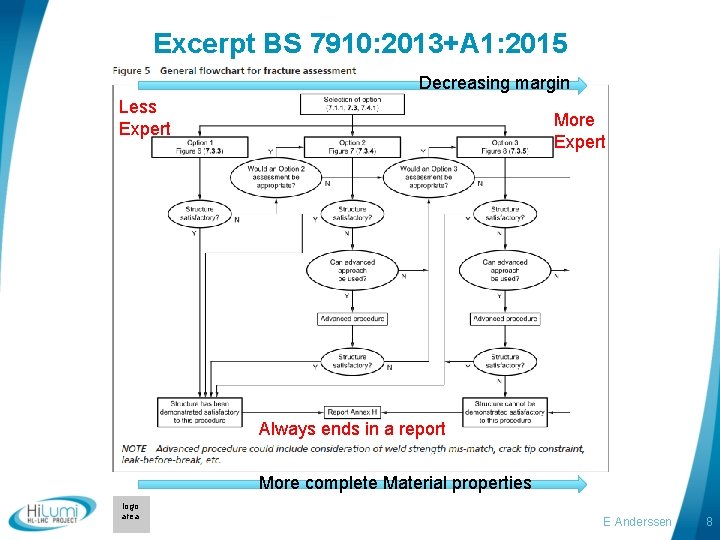
Excerpt BS 7910: 2013+A 1: 2015 Decreasing margin Less Expert More Expert Always ends in a report More complete Material properties logo area E Anderssen 8
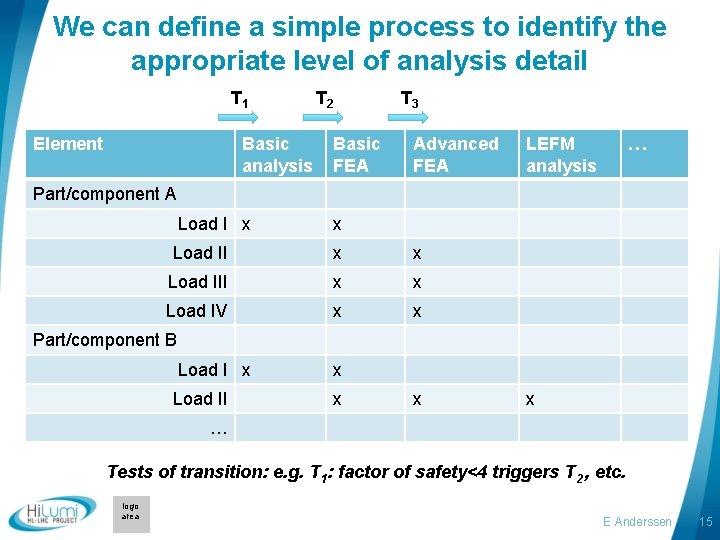
Graded Approach can start simple § Options 1 can be as simple as Fo. S > 4 Done § Move to option 2 if simple change can’t meet criteria in option 1 § Move to next level if say Fo. S < 2, require more analysis, maybe test data, etc § LEFM is just one of the levels § It should be stated that some auxiliary checks should be defined e. g. if X property is lower than some threshold, do some analysis § Ratio of Yield to Ultimate, ductility below some threshold, etc. § This is why some replication of the various standards is useful in a design criteria document so that its distilled and more accessible to engineers on the project(s) § None of the divisions of the standards is less than 700 pages long, and not easy to access. logo area E Anderssen 9
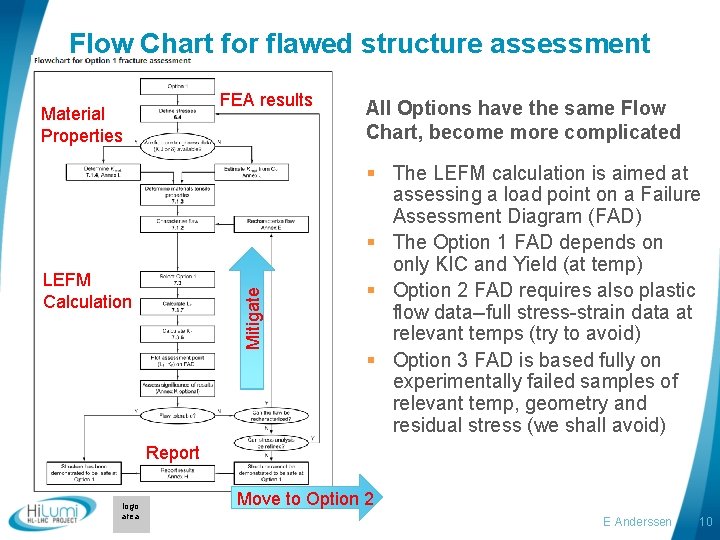
Flow Chart for flawed structure assessment FEA results Material Properties Mitigate LEFM Calculation All Options have the same Flow Chart, become more complicated § The LEFM calculation is aimed at assessing a load point on a Failure Assessment Diagram (FAD) § The Option 1 FAD depends on only KIC and Yield (at temp) § Option 2 FAD requires also plastic flow data--full stress-strain data at relevant temps (try to avoid) § Option 3 FAD is based fully on experimentally failed samples of relevant temp, geometry and residual stress (we shall avoid) Report logo area Move to Option 2 E Anderssen 10
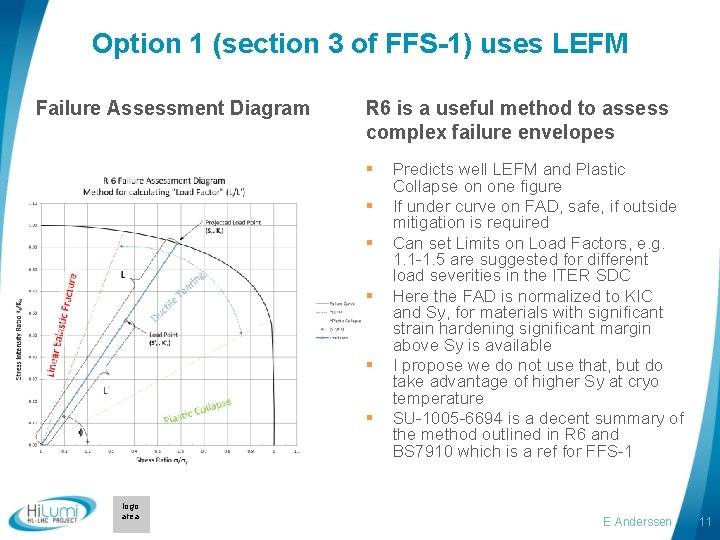
Option 1 (section 3 of FFS-1) uses LEFM Failure Assessment Diagram R 6 is a useful method to assess complex failure envelopes § § § logo area Predicts well LEFM and Plastic Collapse on one figure If under curve on FAD, safe, if outside mitigation is required Can set Limits on Load Factors, e. g. 1. 1 -1. 5 are suggested for different load severities in the ITER SDC Here the FAD is normalized to KIC and Sy, for materials with significant strain hardening significant margin above Sy is available I propose we do not use that, but do take advantage of higher Sy at cryo temperature SU-1005 -6694 is a decent summary of the method outlined in R 6 and BS 7910 which is a ref for FFS-1 E Anderssen 11
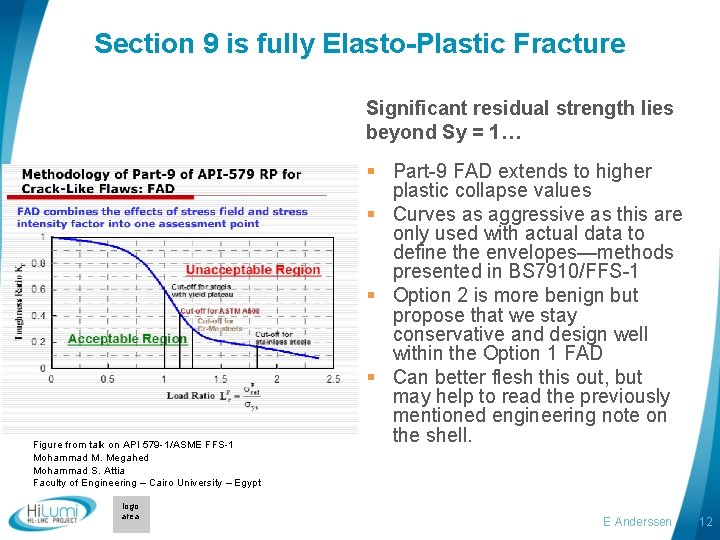
Section 9 is fully Elasto-Plastic Fracture Significant residual strength lies beyond Sy = 1… Figure from talk on API 579 -1/ASME FFS-1 Mohammad M. Megahed Mohammad S. Attia Faculty of Engineering – Cairo University – Egypt logo area § Part-9 FAD extends to higher plastic collapse values § Curves as aggressive as this are only used with actual data to define the envelopes—methods presented in BS 7910/FFS-1 § Option 2 is more benign but propose that we stay conservative and design well within the Option 1 FAD § Can better flesh this out, but may help to read the previously mentioned engineering note on the shell. E Anderssen 12
Conclusion § Fitness for Services methodology seems a well structured approach to build design criteria § The R 6 FAD is a method that should allow us to adequately assess ‘brittle’ materials for use in magnet structures § Should extend to other ‘brittle’ materials such as insulators, coils, G 11, etc Need to investigate further failure criteria in composites (Mil HDBK 17) § Should re-write SU-1005 -6694 to be more consistent with FFS-1 (also need to get KIC data for shell at cold) logo area E Anderssen 13
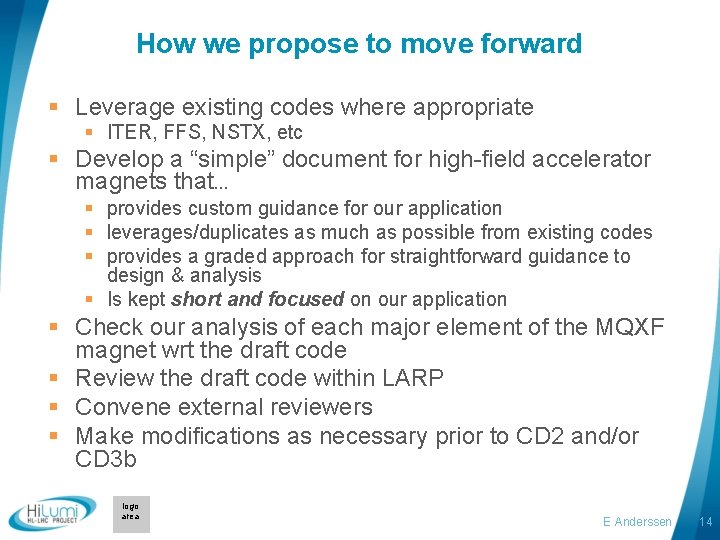
How we propose to move forward § Leverage existing codes where appropriate § ITER, FFS, NSTX, etc § Develop a “simple” document for high-field accelerator magnets that… § provides custom guidance for our application § leverages/duplicates as much as possible from existing codes § provides a graded approach for straightforward guidance to design & analysis § Is kept short and focused on our application § Check our analysis of each major element of the MQXF magnet wrt the draft code § Review the draft code within LARP § Convene external reviewers § Make modifications as necessary prior to CD 2 and/or CD 3 b logo area E Anderssen 14
We can define a simple process to identify the appropriate level of analysis detail T 1 Element Basic analysis T 2 Basic FEA T 3 Advanced FEA LEFM analysis … Part/component A Load I x x Load III x x Load IV x x Part/component B Load I x x Load II x x x … Tests of transition: e. g. T 1: factor of safety<4 triggers T 2 , etc. logo area E Anderssen 15
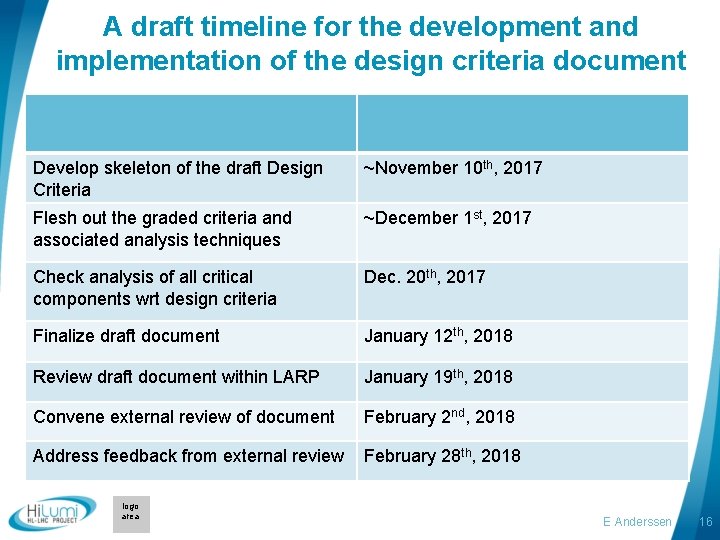
A draft timeline for the development and implementation of the design criteria document Develop skeleton of the draft Design Criteria ~November 10 th, 2017 Flesh out the graded criteria and associated analysis techniques ~December 1 st, 2017 Check analysis of all critical components wrt design criteria Dec. 20 th, 2017 Finalize draft document January 12 th, 2018 Review draft document within LARP January 19 th, 2018 Convene external review of document February 2 nd, 2018 Address feedback from external review February 28 th, 2018 logo area E Anderssen 16