
Structural Decomposition on Multiple Values CS 5010 Program
- Slides: 17
Structural Decomposition on Multiple Values CS 5010 Program Design Paradigms “Bootcamp” Lesson 2. 2 © Mitchell Wand, 2012 -2014 This work is licensed under a Creative Commons Attribution-Non. Commercial 4. 0 International License. 1
You can only do structural decomposition on one thing at a time. • If you need to do structural decomposition on more than one argument, decompose one argument first and pass the results on to a suitable help function or functions. There's one small exception to this; see slides 10 -11 below. 2
Structural Decomposition on more than one value: example #1 You. Tube link 3
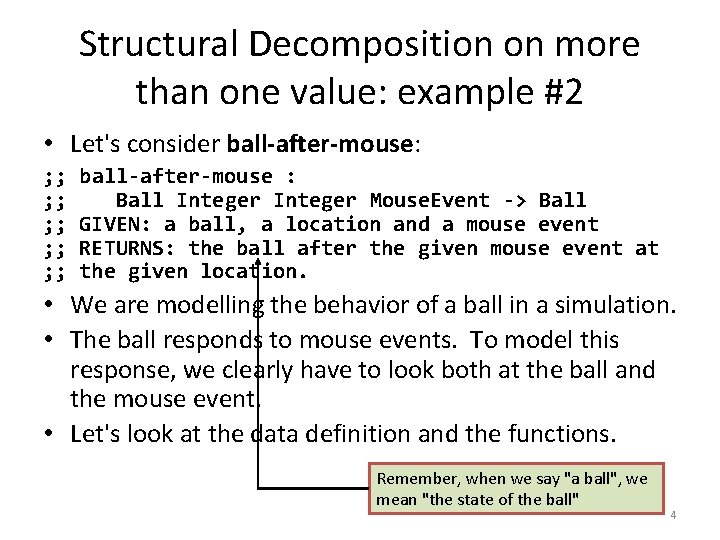
Structural Decomposition on more than one value: example #2 • Let's consider ball-after-mouse: ; ; ; ; ; ball-after-mouse : Ball Integer Mouse. Event -> Ball GIVEN: a ball, a location and a mouse event RETURNS: the ball after the given mouse event at the given location. • We are modelling the behavior of a ball in a simulation. • The ball responds to mouse events. To model this response, we clearly have to look both at the ball and the mouse event. • Let's look at the data definition and the functions. Remember, when we say "a ball", we mean "the state of the ball" 4
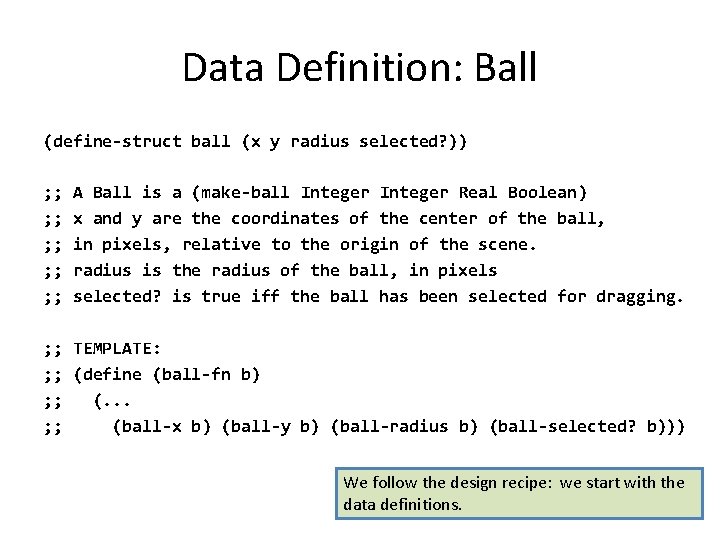
Data Definition: Ball (define-struct ball (x y radius selected? )) ; ; ; ; ; A Ball is a (make-ball Integer Real Boolean) x and y are the coordinates of the center of the ball, in pixels, relative to the origin of the scene. radius is the radius of the ball, in pixels selected? is true iff the ball has been selected for dragging. ; ; TEMPLATE: ; ; (define (ball-fn b) ; ; (. . . ; ; (ball-x b) (ball-y b) (ball-radius b) (ball-selected? b))) We follow the design recipe: we start with the data definitions.
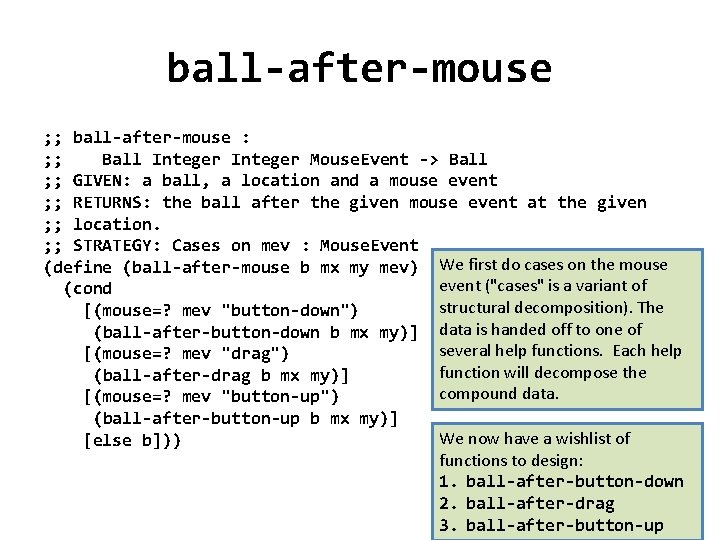
ball-after-mouse ; ; ball-after-mouse : ; ; Ball Integer Mouse. Event -> Ball ; ; GIVEN: a ball, a location and a mouse event ; ; RETURNS: the ball after the given mouse event at the given ; ; location. ; ; STRATEGY: Cases on mev : Mouse. Event (define (ball-after-mouse b mx my mev) We first do cases on the mouse event ("cases" is a variant of (cond structural decomposition). The [(mouse=? mev "button-down") (ball-after-button-down b mx my)] data is handed off to one of several help functions. Each help [(mouse=? mev "drag") function will decompose the (ball-after-drag b mx my)] compound data. [(mouse=? mev "button-up") (ball-after-button-up b mx my)] We now have a wishlist of [else b])) functions to design: 1. ball-after-button-down 2. ball-after-drag 3. ball-after-button-up
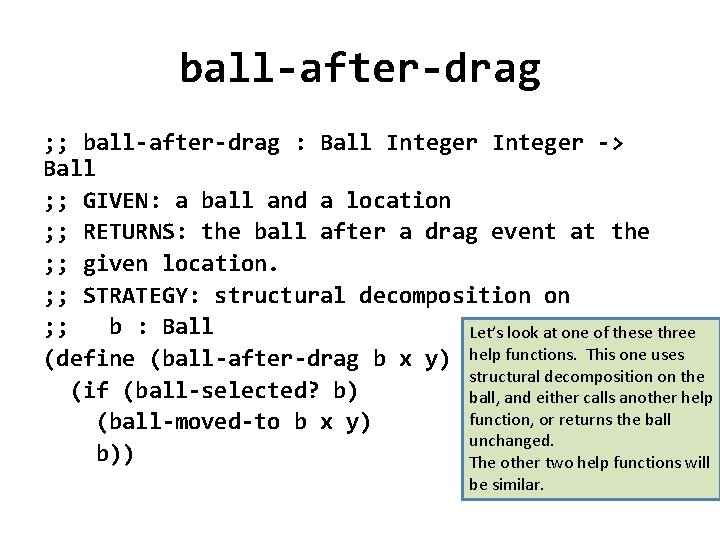
ball-after-drag ; ; ball-after-drag : Ball Integer -> Ball ; ; GIVEN: a ball and a location ; ; RETURNS: the ball after a drag event at the ; ; given location. ; ; STRATEGY: structural decomposition on ; ; b : Ball Let’s look at one of these three (define (ball-after-drag b x y) help functions. This one uses structural decomposition on the (if (ball-selected? b) ball, and either calls another help function, or returns the ball (ball-moved-to b x y) unchanged. b)) The other two help functions will be similar.
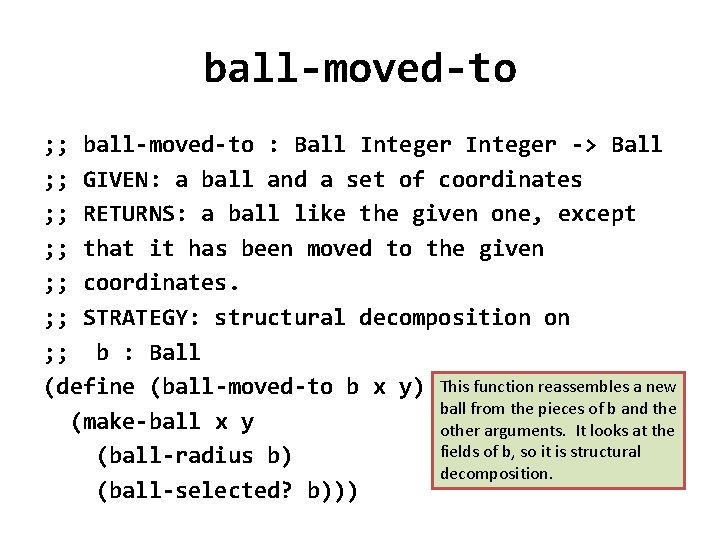
ball-moved-to ; ; ball-moved-to : Ball Integer -> Ball ; ; GIVEN: a ball and a set of coordinates ; ; RETURNS: a ball like the given one, except ; ; that it has been moved to the given ; ; coordinates. ; ; STRATEGY: structural decomposition on ; ; b : Ball (define (ball-moved-to b x y) This function reassembles a new ball from the pieces of b and the (make-ball x y other arguments. It looks at the fields of b, so it is structural (ball-radius b) decomposition. (ball-selected? b)))
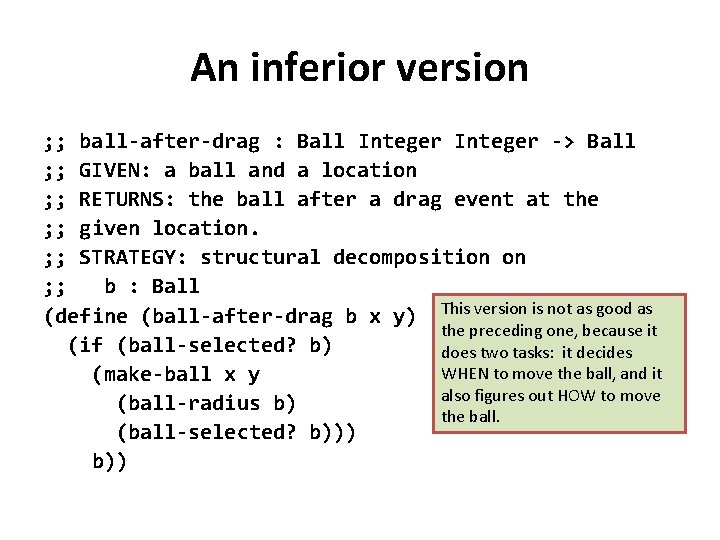
An inferior version ; ; ball-after-drag : Ball Integer -> Ball ; ; GIVEN: a ball and a location ; ; RETURNS: the ball after a drag event at the ; ; given location. ; ; STRATEGY: structural decomposition on ; ; b : Ball (define (ball-after-drag b x y) This version is not as good as the preceding one, because it (if (ball-selected? b) does two tasks: it decides WHEN to move the ball, and it (make-ball x y also figures out HOW to move (ball-radius b) the ball. (ball-selected? b))) b))
Exception • You can do structural decomposition on more than one compound if you really need to. 10
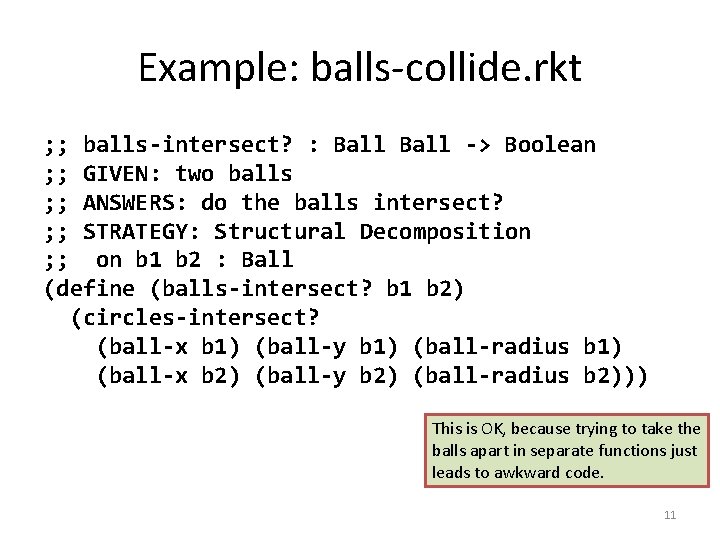
Example: balls-collide. rkt ; ; balls-intersect? : Ball -> Boolean ; ; GIVEN: two balls ; ; ANSWERS: do the balls intersect? ; ; STRATEGY: Structural Decomposition ; ; on b 1 b 2 : Ball (define (balls-intersect? b 1 b 2) (circles-intersect? (ball-x b 1) (ball-y b 1) (ball-radius b 1) (ball-x b 2) (ball-y b 2) (ball-radius b 2))) This is OK, because trying to take the balls apart in separate functions just leads to awkward code. 11
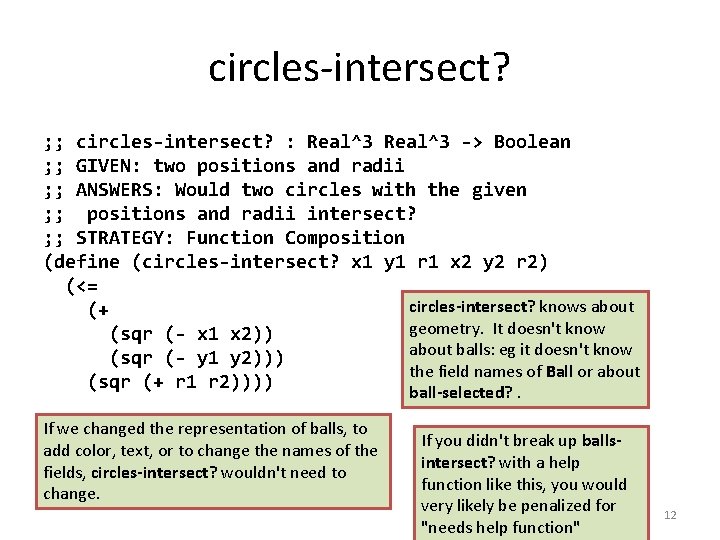
circles-intersect? ; ; circles-intersect? : Real^3 -> Boolean ; ; GIVEN: two positions and radii ; ; ANSWERS: Would two circles with the given ; ; positions and radii intersect? ; ; STRATEGY: Function Composition (define (circles-intersect? x 1 y 1 r 1 x 2 y 2 r 2) (<= circles-intersect? knows about (+ geometry. It doesn't know (sqr (- x 1 x 2)) about balls: eg it doesn't know (sqr (- y 1 y 2))) the field names of Ball or about (sqr (+ r 1 r 2)))) ball-selected? . If we changed the representation of balls, to add color, text, or to change the names of the fields, circles-intersect? wouldn't need to change. If you didn't break up ballsintersect? with a help function like this, you would very likely be penalized for "needs help function" 12
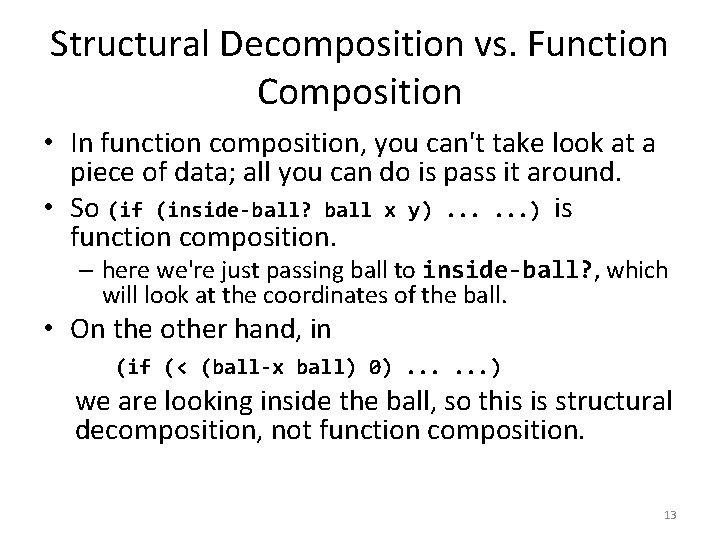
Structural Decomposition vs. Function Composition • In function composition, you can't take look at a piece of data; all you can do is pass it around. • So (if (inside-ball? ball x y). . . ) is function composition. – here we're just passing ball to inside-ball? , which will look at the coordinates of the ball. • On the other hand, in (if (< (ball-x ball) 0). . . ) we are looking inside the ball, so this is structural decomposition, not function composition. 13
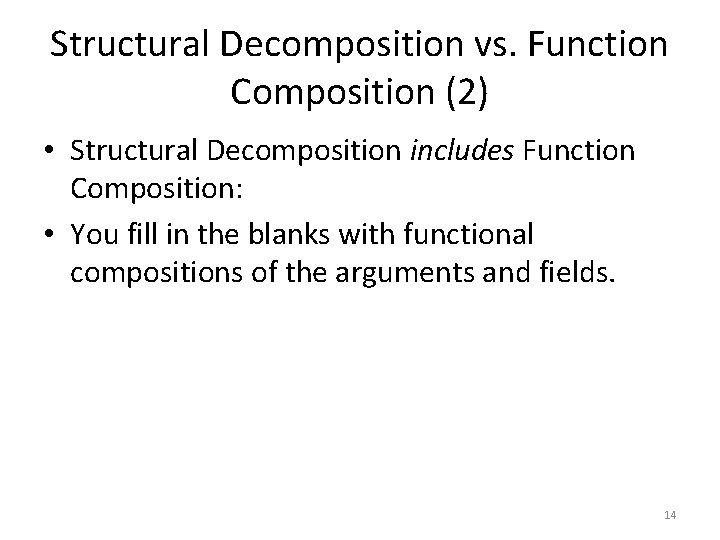
Structural Decomposition vs. Function Composition (2) • Structural Decomposition includes Function Composition: • You fill in the blanks with functional compositions of the arguments and fields. 14
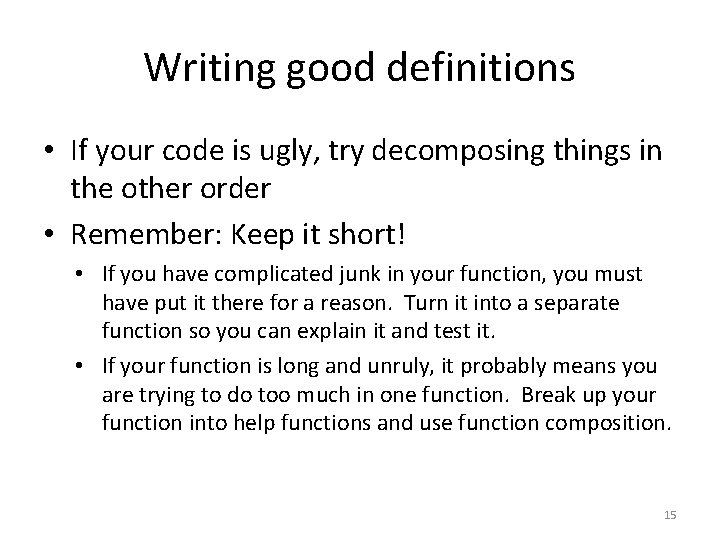
Writing good definitions • If your code is ugly, try decomposing things in the other order • Remember: Keep it short! • If you have complicated junk in your function, you must have put it there for a reason. Turn it into a separate function so you can explain it and test it. • If your function is long and unruly, it probably means you are trying to do too much in one function. Break up your function into help functions and use function composition. 15
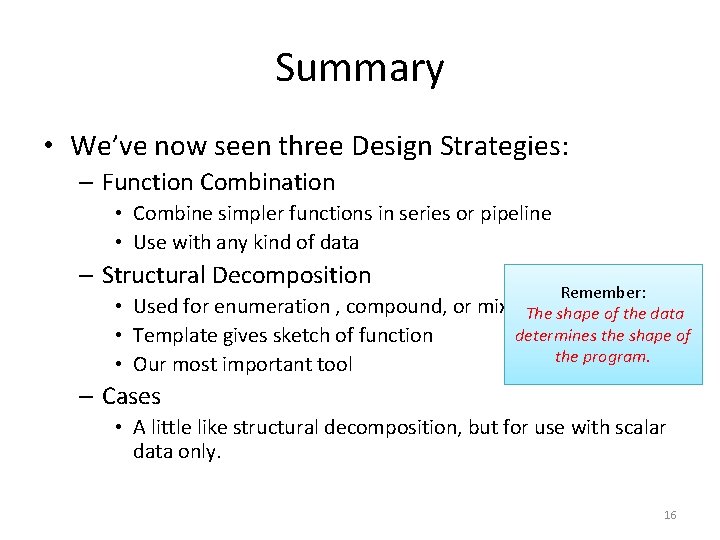
Summary • We’ve now seen three Design Strategies: – Function Combination • Combine simpler functions in series or pipeline • Use with any kind of data – Structural Decomposition • • • Remember: Used for enumeration , compound, or mixed. The data shape of the data determines the shape of Template gives sketch of function the program. Our most important tool – Cases • A little like structural decomposition, but for use with scalar data only. 16
Next Steps • If you have questions or comments about this lesson, post them on the discussion board. • Go on to the next lesson. 17