
Structural Coverage Measurement of structural coverage of code




- Slides: 13
Structural Coverage
• Measurement of structural coverage of code is a means of assessing the thoroughness of testing. • Such metrics do not constitute testing techniques, but a measure of the effectiveness of testing techniques.
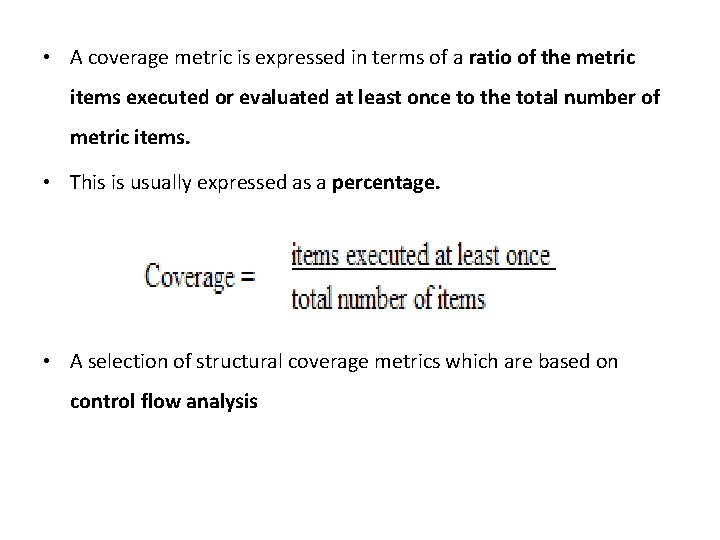
• A coverage metric is expressed in terms of a ratio of the metric items executed or evaluated at least once to the total number of metric items. • This is usually expressed as a percentage. • A selection of structural coverage metrics which are based on control flow analysis
• A metric should also be achievable. • It should be possible and practical to achieve 100% coverage (or very close to 100% coverage) of a metric. • Any value less than 100% requires investigation to determine why less than 100% has been achieved. – If it is the result of a problem in the code, the problem should be fixed and tests run again. – If it is the result of a problem in the test data, the problem should be fixed and tests run again. – If it is because 100% coverage is infeasible, then the reasons for infeasibility must be ascertained and justified.
• Test data required to achieve 100% coverage therefore has to be maintainable. • An ideal criteria against which a coverage metric should be assessed is its effectiveness at detecting faults in software. • The effectiveness is assumed to be a function ofthoroughness. The thoroughness with which test data designed to fulfill a metric actually exercises the code is assessed.
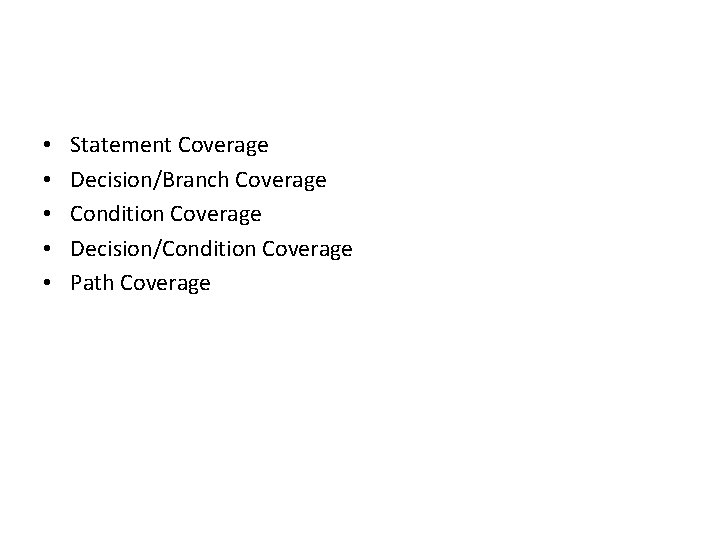
• • • Statement Coverage Decision/Branch Coverage Condition Coverage Decision/Condition Coverage Path Coverage
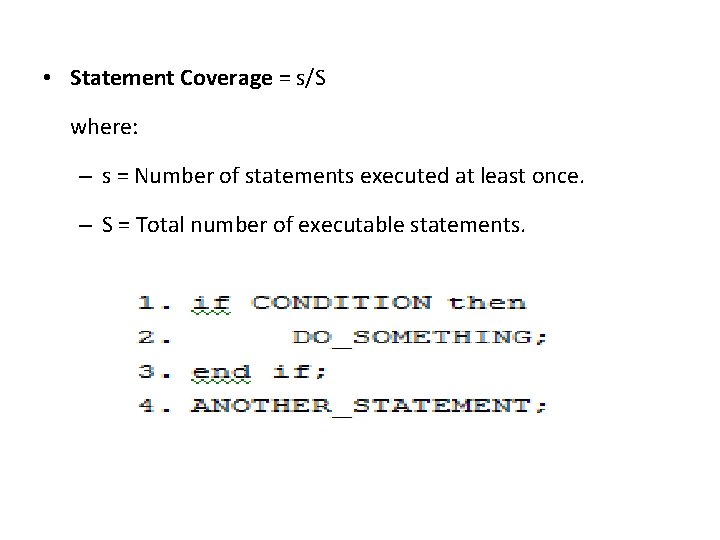
• Statement Coverage = s/S where: – s = Number of statements executed at least once. – S = Total number of executable statements.
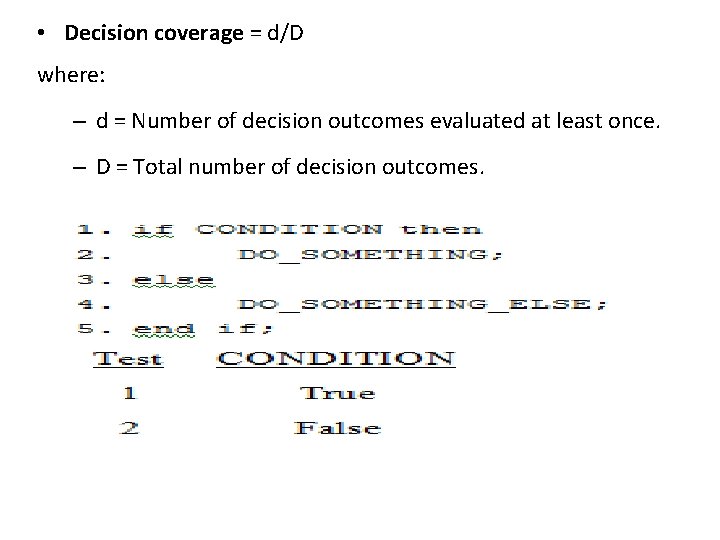
• Decision coverage = d/D where: – d = Number of decision outcomes evaluated at least once. – D = Total number of decision outcomes.
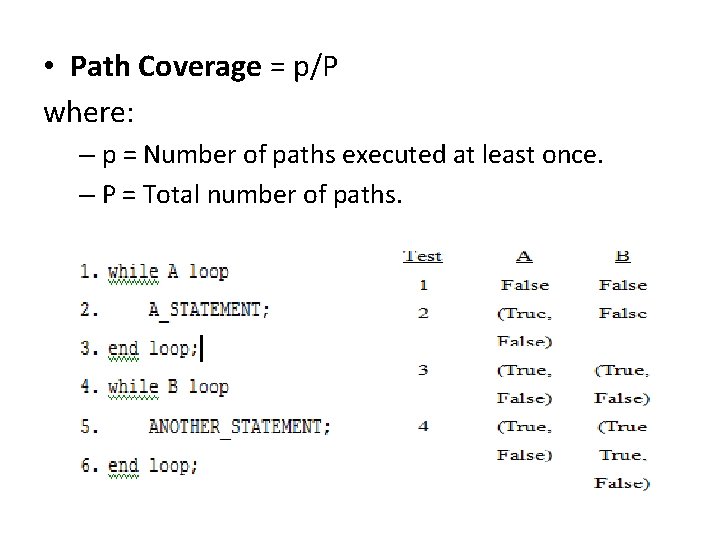
• Path Coverage = p/P where: – p = Number of paths executed at least once. – P = Total number of paths.
• Condition Operand Coverage = c/C where: – c = Number of condition operand values evaluated at least once. – C = Total number of condition operand values.