
Structural Condition Assessment of Reinforced Base Course Pavement
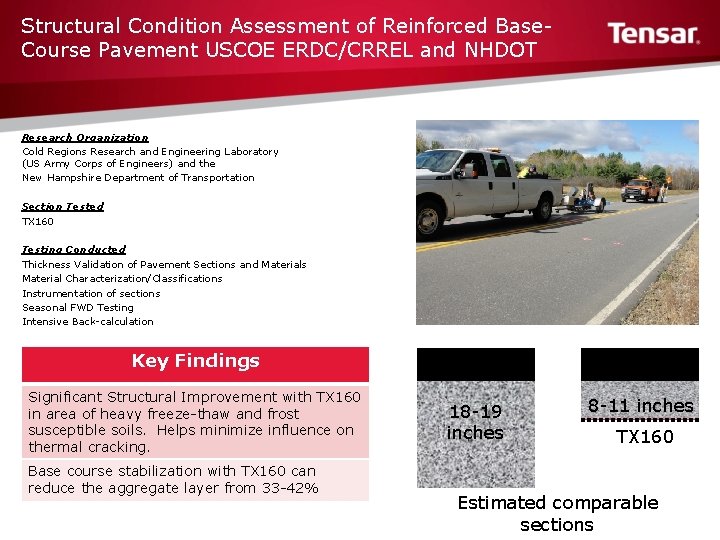
Structural Condition Assessment of Reinforced Base. Course Pavement USCOE ERDC/CRREL and NHDOT Research Organization Cold Regions Research and Engineering Laboratory (US Army Corps of Engineers) and the New Hampshire Department of Transportation Section Tested TX 160 Testing Conducted Thickness Validation of Pavement Sections and Materials Material Characterization/Classifications Instrumentation of sections Seasonal FWD Testing Intensive Back-calculation Key Findings Significant Structural Improvement with TX 160 in area of heavy freeze-thaw and frost susceptible soils. Helps minimize influence on thermal cracking. Base course stabilization with TX 160 can reduce the aggregate layer from 33 -42% 18 -19 inches 8 -11 inches TX 160 Estimated comparable sections
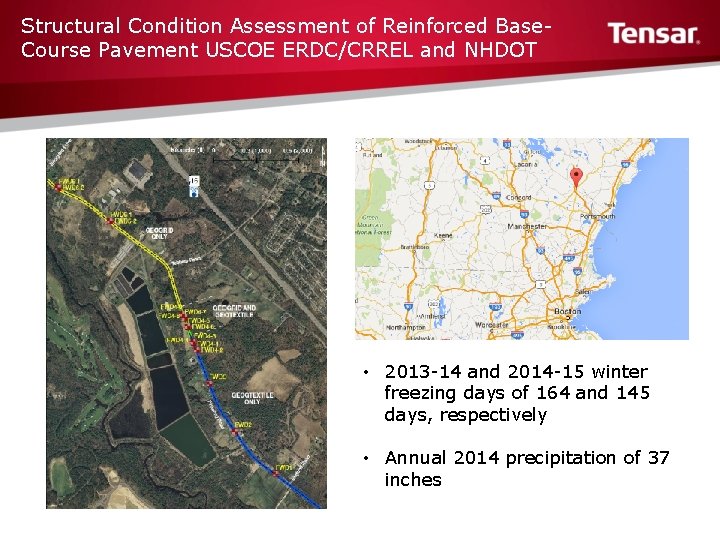
Structural Condition Assessment of Reinforced Base. Course Pavement USCOE ERDC/CRREL and NHDOT • 2013 -14 and 2014 -15 winter freezing days of 164 and 145 days, respectively • Annual 2014 precipitation of 37 inches
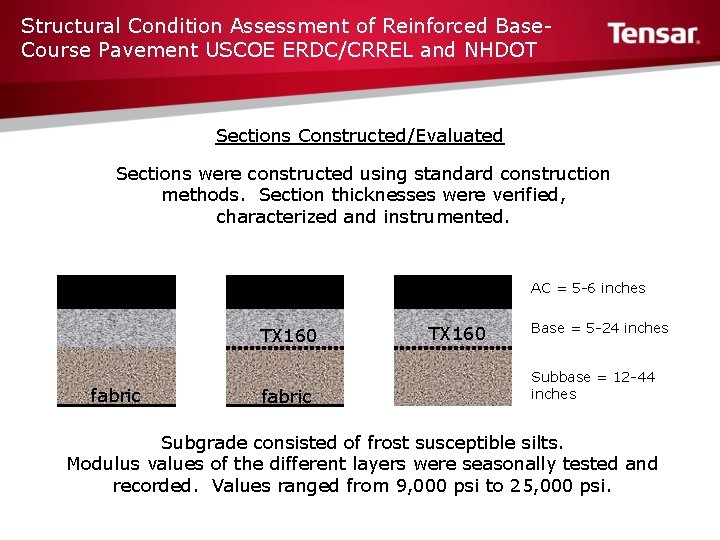
Structural Condition Assessment of Reinforced Base. Course Pavement USCOE ERDC/CRREL and NHDOT Sections Constructed/Evaluated Sections were constructed using standard construction methods. Section thicknesses were verified, characterized and instrumented. AC = 5 -6 inches TX 160 fabric TX 160 Base = 5 -24 inches Subbase = 12 -44 inches Subgrade consisted of frost susceptible silts. Modulus values of the different layers were seasonally tested and recorded. Values ranged from 9, 000 psi to 25, 000 psi.
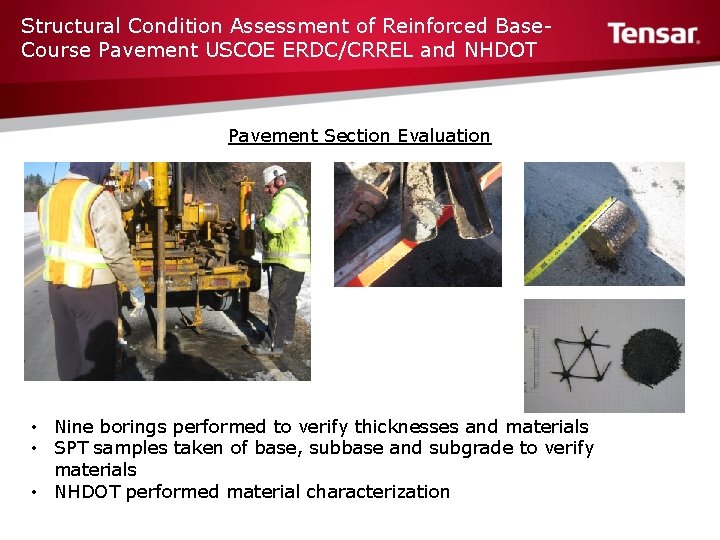
Structural Condition Assessment of Reinforced Base. Course Pavement USCOE ERDC/CRREL and NHDOT Pavement Section Evaluation • Nine borings performed to verify thicknesses and materials • SPT samples taken of base, subbase and subgrade to verify materials • NHDOT performed material characterization
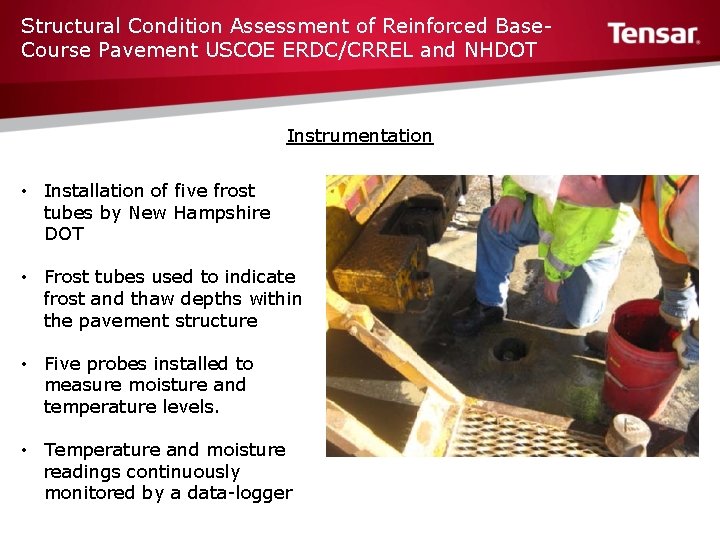
Structural Condition Assessment of Reinforced Base. Course Pavement USCOE ERDC/CRREL and NHDOT Instrumentation • Installation of five frost tubes by New Hampshire DOT • Frost tubes used to indicate frost and thaw depths within the pavement structure • Five probes installed to measure moisture and temperature levels. • Temperature and moisture readings continuously monitored by a data-logger
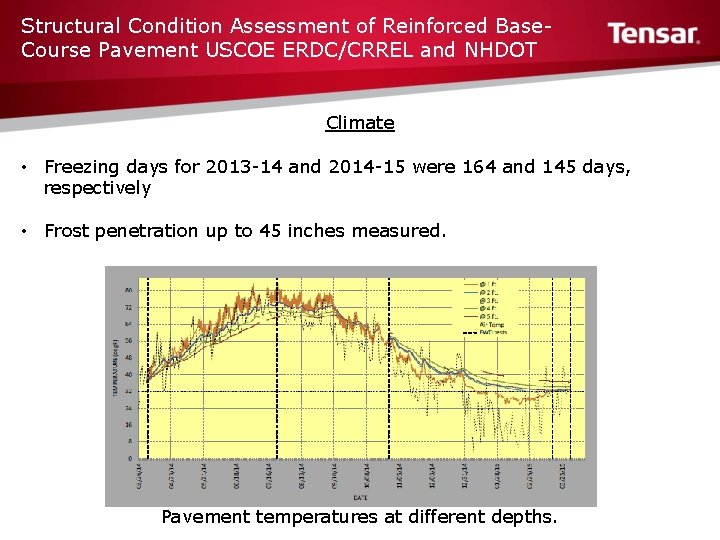
Structural Condition Assessment of Reinforced Base. Course Pavement USCOE ERDC/CRREL and NHDOT Climate • Freezing days for 2013 -14 and 2014 -15 were 164 and 145 days, respectively • Frost penetration up to 45 inches measured. Pavement temperatures at different depths.
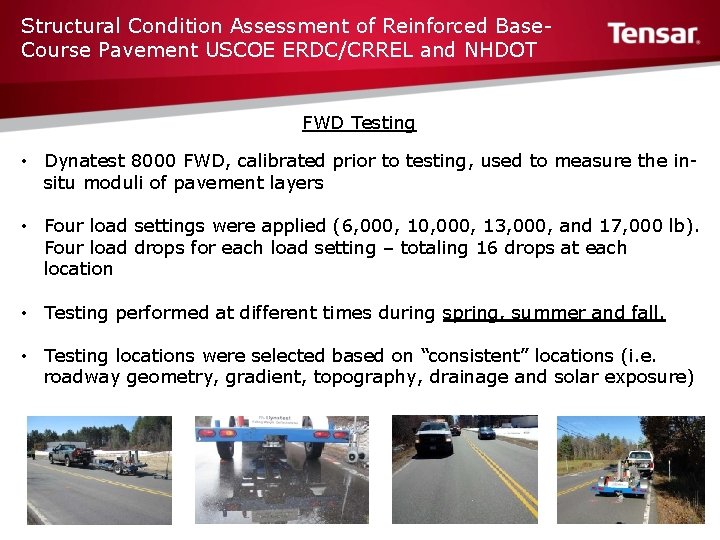
Structural Condition Assessment of Reinforced Base. Course Pavement USCOE ERDC/CRREL and NHDOT FWD Testing • Dynatest 8000 FWD, calibrated prior to testing, used to measure the insitu moduli of pavement layers • Four load settings were applied (6, 000, 10, 000, 13, 000, and 17, 000 lb). Four load drops for each load setting – totaling 16 drops at each location • Testing performed at different times during spring, summer and fall. • Testing locations were selected based on “consistent” locations (i. e. roadway geometry, gradient, topography, drainage and solar exposure)
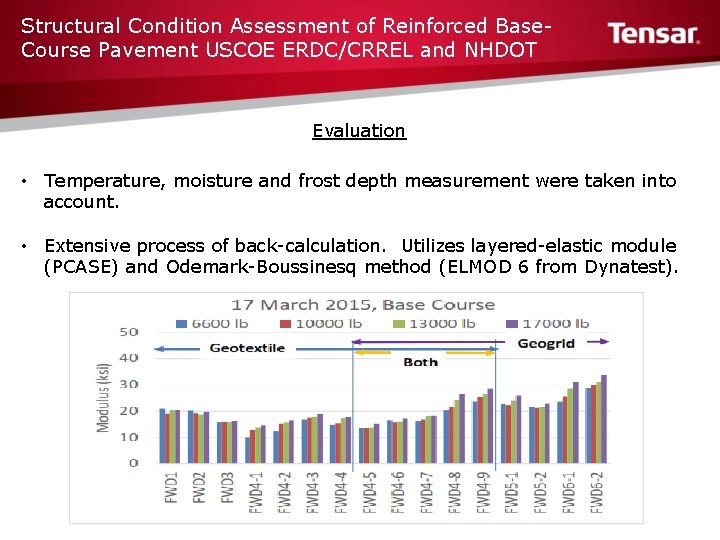
Structural Condition Assessment of Reinforced Base. Course Pavement USCOE ERDC/CRREL and NHDOT Evaluation • Temperature, moisture and frost depth measurement were taken into account. • Extensive process of back-calculation. Utilizes layered-elastic module (PCASE) and Odemark-Boussinesq method (ELMOD 6 from Dynatest).
Structural Condition Assessment of Reinforced Base. Course Pavement USCOE ERDC/CRREL and NHDOT Results • 8 -11 inches of base course, stabilized with Tensar TX 160, is equal to 18 -19 inches of unstabilized base course. • Base course could be reduced 33%-42% with TX 160 geogrid. “In this case, a reinforced base course with a Tri. Ax TX 160 geogrid in this location and under these conditions indicated a significant performance increase. In these test sections, the reinforced base-course sections with a Tri. Ax TX 160 geogrid provided a reduction of thickness between 1. 5– 1. 7 times that of the non-reinforced ones due to the (added) stiffness of the grid mesh. ” page 45
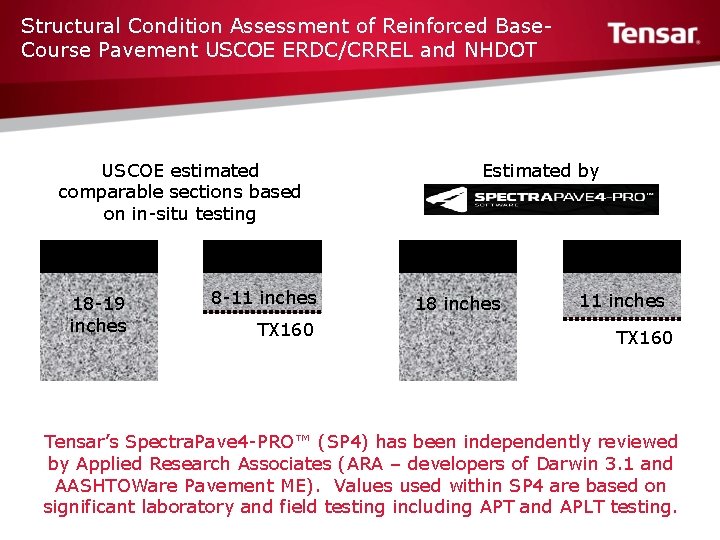
Structural Condition Assessment of Reinforced Base. Course Pavement USCOE ERDC/CRREL and NHDOT USCOE estimated comparable sections based on in-situ testing 18 -19 inches 8 -11 inches TX 160 Estimated by 18 inches 11 inches TX 160 Tensar’s Spectra. Pave 4 -PRO™ (SP 4) has been independently reviewed by Applied Research Associates (ARA – developers of Darwin 3. 1 and AASHTOWare Pavement ME). Values used within SP 4 are based on significant laboratory and field testing including APT and APLT testing.
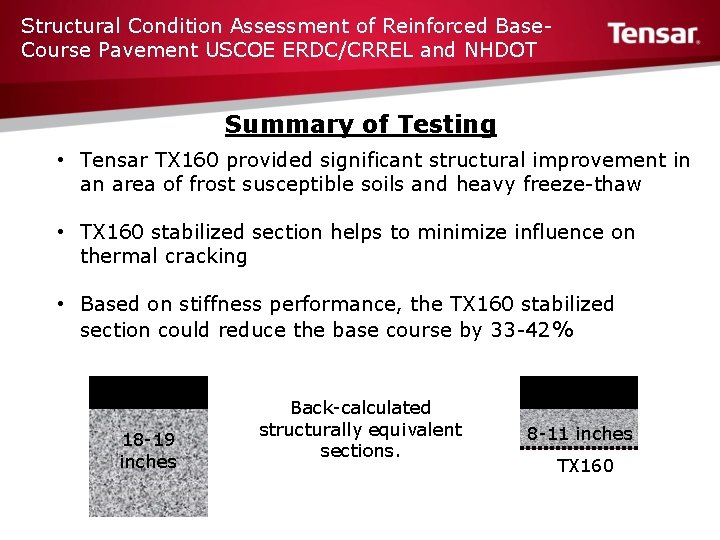
Structural Condition Assessment of Reinforced Base. Course Pavement USCOE ERDC/CRREL and NHDOT Summary of Testing • Tensar TX 160 provided significant structural improvement in an area of frost susceptible soils and heavy freeze-thaw • TX 160 stabilized section helps to minimize influence on thermal cracking • Based on stiffness performance, the TX 160 stabilized section could reduce the base course by 33 -42% 18 -19 inches Back-calculated structurally equivalent sections. 8 -11 inches TX 160
- Slides: 11