
Structural Biology What does 3 D tell us
Structural Biology: What does 3 D tell us? Stephen J Everse University of Vermont
The life of a bio-chemist!! • Training – Ph. D & Postdoc with Russell F. Doolittle, UCSD • structure of fragment D of fibrinogen • structures of double-D of fibrin – Joined the faculty at UVM in 1998 • Structural biologist (crystallographer) • Current projects – factor Va – thioredoxin reductase – transferrin
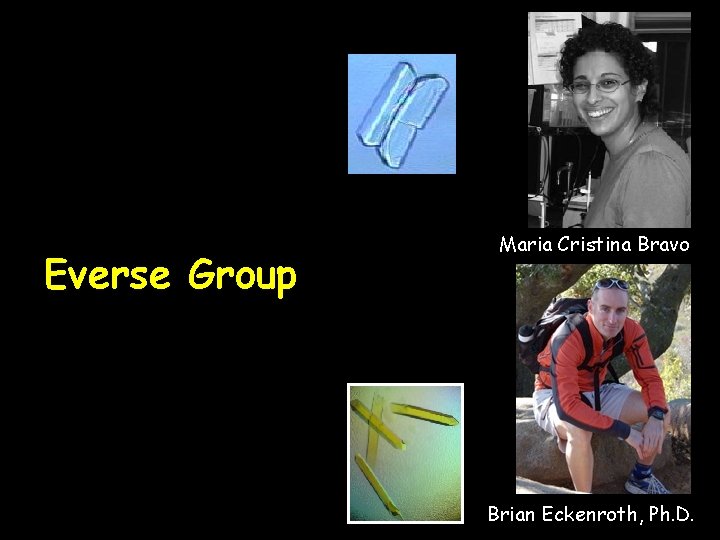
Everse Group Maria Cristina Bravo Brian Eckenroth, Ph. D.
Fundamental Questions l How do protein cofactors modulate enzymes? l What determines and mediates protein-protein and protein-membrane interactions? l How is a protein’s function defined by structure? l How does structure prescribe the binding affinity of a metal?
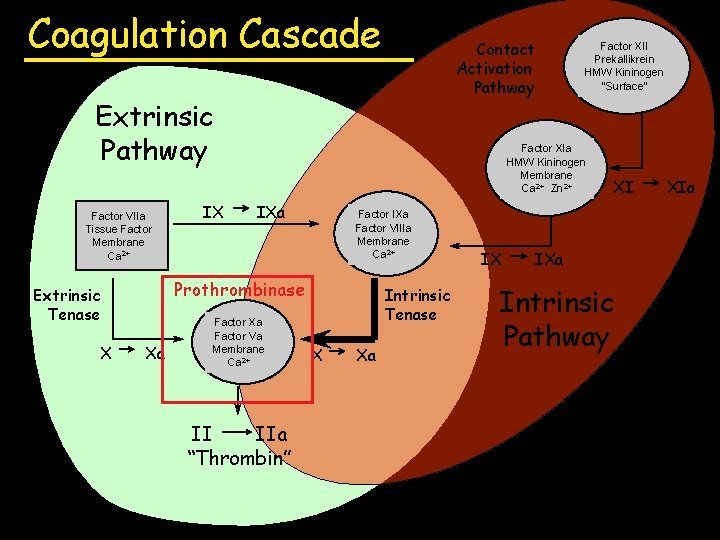
Coagulation Cascade Contact Activation Pathway Extrinsic Pathway Factor VIIa Tissue Factor Membrane Ca 2+ Factor XIa HMW Kininogen Membrane Ca 2+ Zn 2+ IXa Factor VIIIa Membrane Ca 2+ Prothrombinase Extrinsic Tenase X IX Xa Factor XII Prekallikrein HMW Kininogen “Surface” Factor Xa Factor Va Membrane Ca 2+ II IIa “Thrombin” Intrinsic Tenase X Xa IX XI IXa Intrinsic Pathway XIa

Prothrombinase Components “Prothrombinase” Ca 2+FXa FVa HC Ca 2+ FXa Relative Rate of Prothrombin Activation 1 Ca 2+FXa 20 FVa LC Ca 2+ Prothrombin -Thrombin Ca 2+FXa FVa Ca HC 2+ FVa LC W. Gould @2000 300, 000
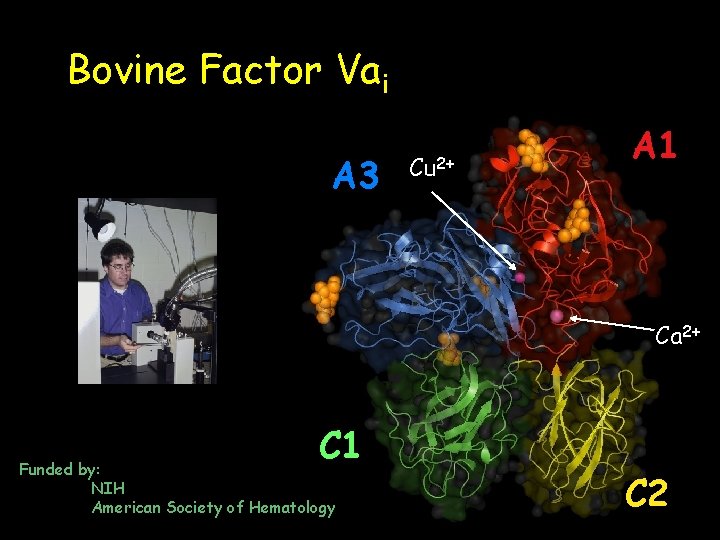
Bovine Factor Vai A 3 Cu 2+ A 1 Ca 2+ C 1 Funded by: NIH American Society of Hematology C 2
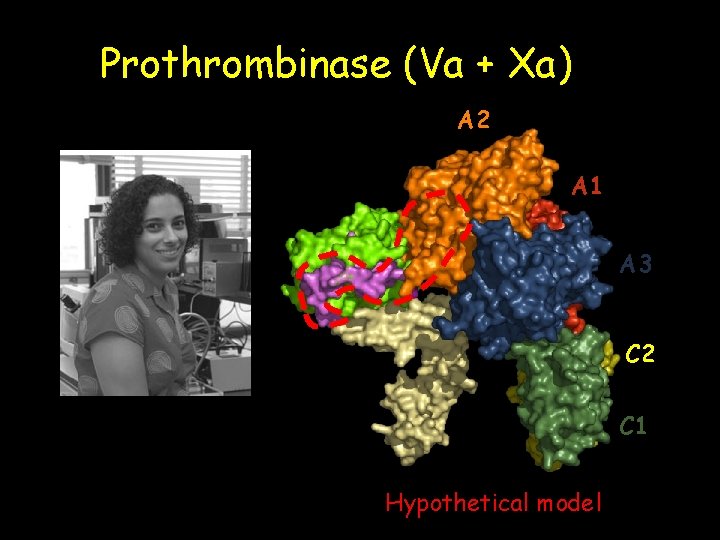
Prothrombinase (Va + Xa) A 2 A 1 A 3 C 2 C 1 Hypothetical model
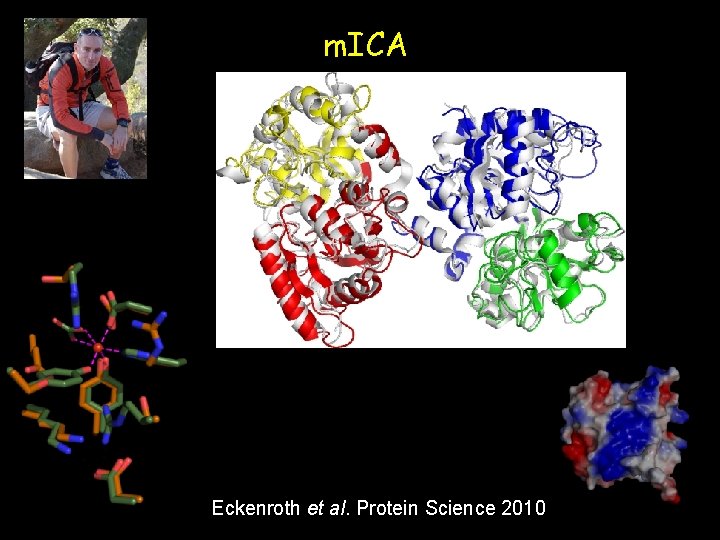
m. ICA Eckenroth et al. Protein Science 2010
Outline • Determining a 3 D structure – X-ray crystallography • Structural elements • Modeling a 3 D structure
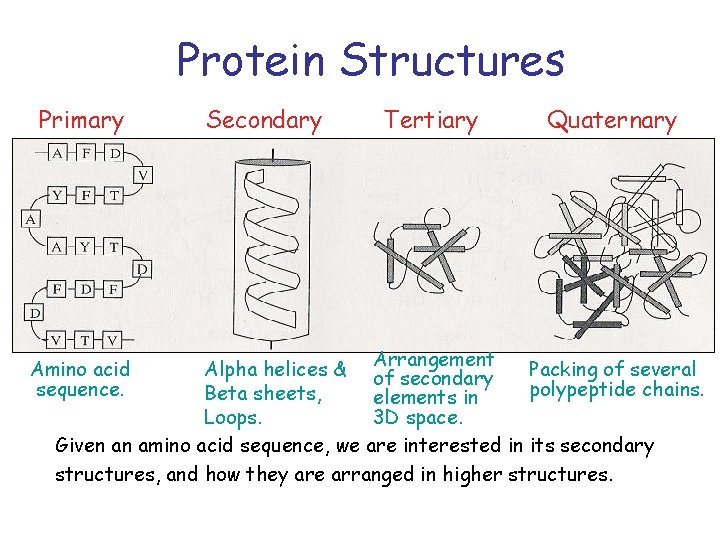
Protein Structures Primary Secondary Tertiary Quaternary Arrangement Alpha helices & of secondary Packing of several polypeptide chains. Beta sheets, elements in 3 D space. Loops. Given an amino acid sequence, we are interested in its secondary structures, and how they are arranged in higher structures. Amino acid sequence.
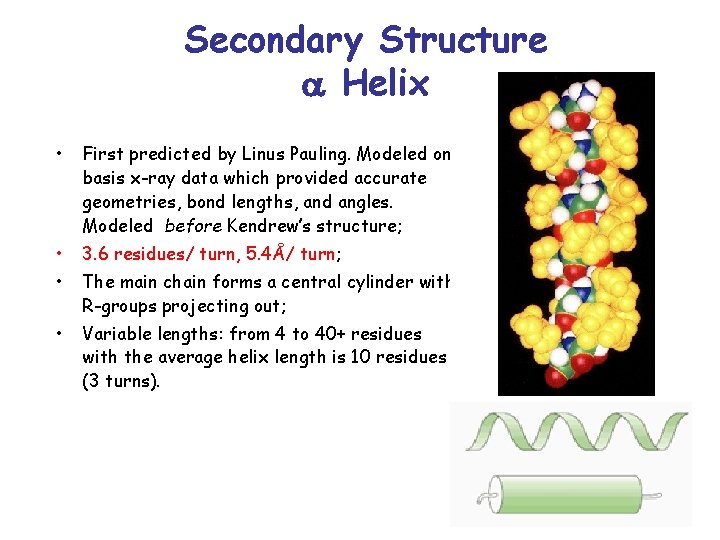
Secondary Structure Helix • First predicted by Linus Pauling. Modeled on basis x-ray data which provided accurate geometries, bond lengths, and angles. Modeled before Kendrew’s structure; • 3. 6 residues/ turn, 5. 4Å/ turn; • The main chain forms a central cylinder with R-groups projecting out; • Variable lengths: from 4 to 40+ residues with the average helix length is 10 residues (3 turns).
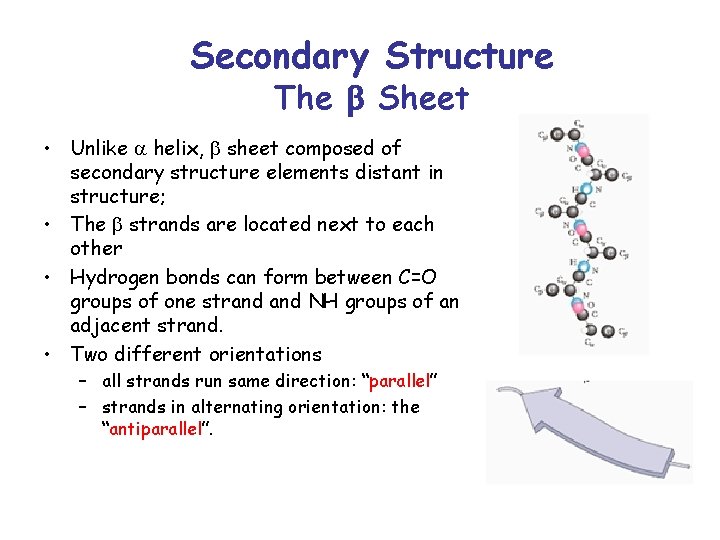
Secondary Structure The b Sheet • Unlike a helix, b sheet composed of secondary structure elements distant in structure; • The b strands are located next to each other • Hydrogen bonds can form between C=O groups of one strand NH groups of an adjacent strand. • Two different orientations – all strands run same direction: “parallel” – strands in alternating orientation: the “antiparallel”.
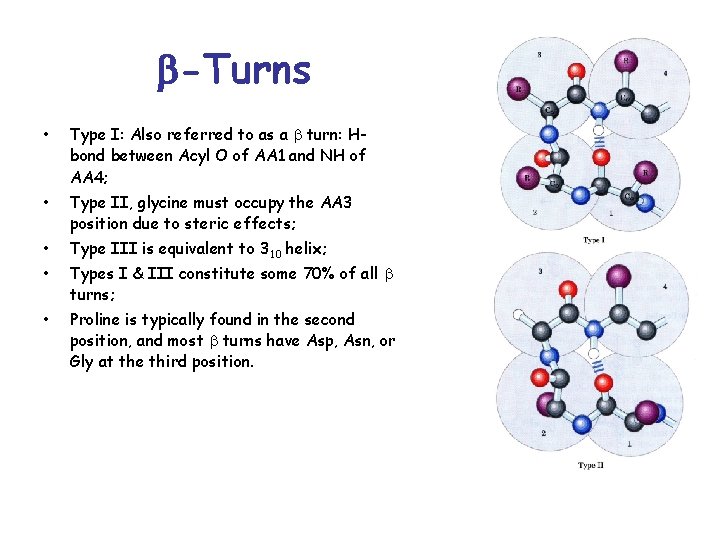
b-Turns • Type I: Also referred to as a b turn: Hbond between Acyl O of AA 1 and NH of AA 4; • Type II, glycine must occupy the AA 3 position due to steric effects; • Type III is equivalent to 310 helix; • • Types I & III constitute some 70% of all b turns; Proline is typically found in the second position, and most b turns have Asp, Asn, or Gly at the third position.
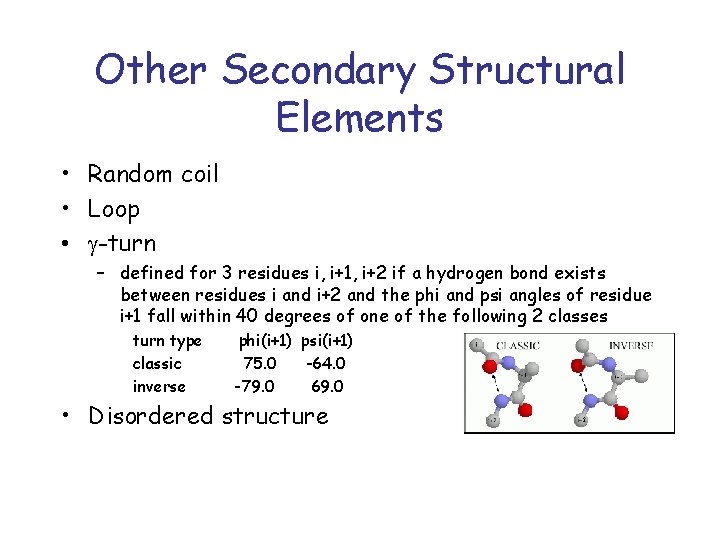
Other Secondary Structural Elements • Random coil • Loop • -turn – defined for 3 residues i, i+1, i+2 if a hydrogen bond exists between residues i and i+2 and the phi and psi angles of residue i+1 fall within 40 degrees of one of the following 2 classes turn type classic inverse phi(i+1) psi(i+1) 75. 0 -64. 0 -79. 0 69. 0 • Disordered structure
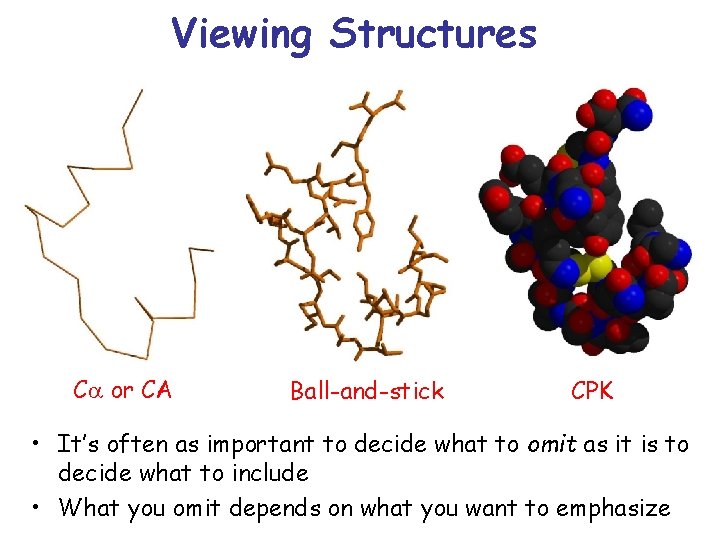
Viewing Structures Ca or CA Ball-and-stick CPK • It’s often as important to decide what to omit as it is to decide what to include • What you omit depends on what you want to emphasize
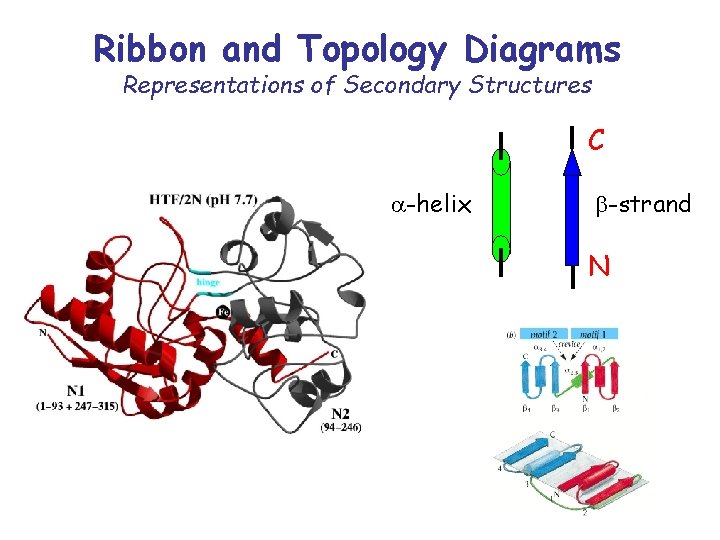
Ribbon and Topology Diagrams Representations of Secondary Structures C a-helix b-strand N
Tools for Viewing Structures • Jmol – http: //jmol. sourceforge. net • Py. MOL – http: //pymol. sourceforge. net • Swiss PDB viewer – http: //www. expasy. ch/spdbv • Mage/Ki. NG – http: //kinemage. biochem. duke. edu/software/mage. php – http: //kinemage. biochem. duke. edu/software/king. php • Rasmol – http: //www. umass. edu/microbio/rasmol/
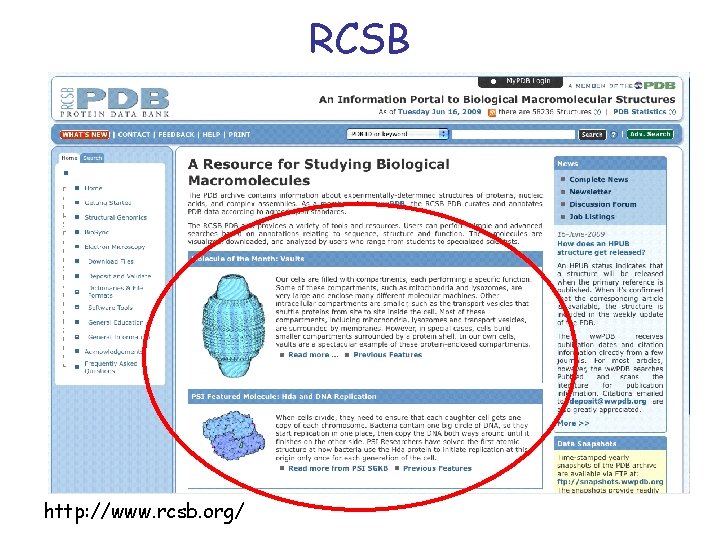
RCSB http: //www. rcsb. org/
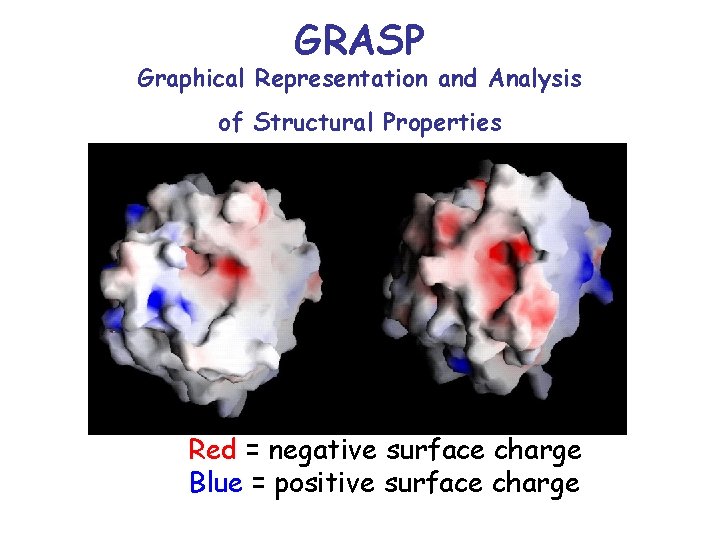
GRASP Graphical Representation and Analysis of Structural Properties Red = negative surface charge Blue = positive surface charge
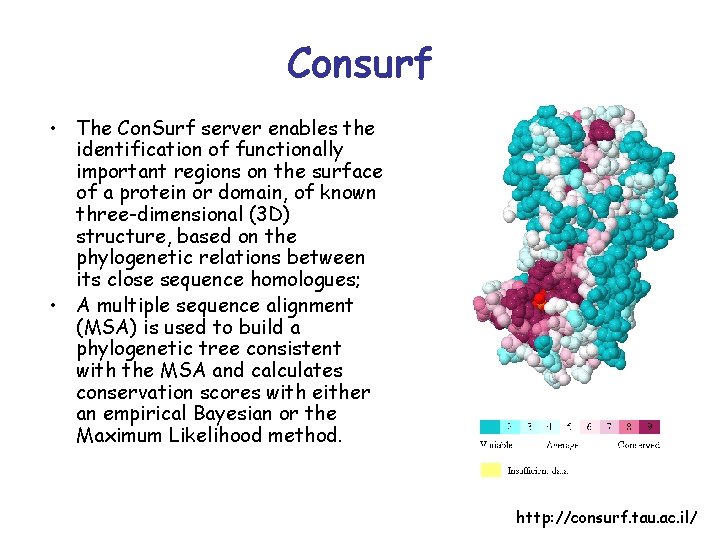
Consurf • The Con. Surf server enables the identification of functionally important regions on the surface of a protein or domain, of known three-dimensional (3 D) structure, based on the phylogenetic relations between its close sequence homologues; • A multiple sequence alignment (MSA) is used to build a phylogenetic tree consistent with the MSA and calculates conservation scores with either an empirical Bayesian or the Maximum Likelihood method. http: //consurf. tau. ac. il/
How do we show 3 -D? • Stereo pairs – Rely on the way the brain processes leftand right-eye images – If we allow our eyes to go slightly walleyed or crossed, the image appears three -dimensional • Dynamics: rotation of flat image • Perspective
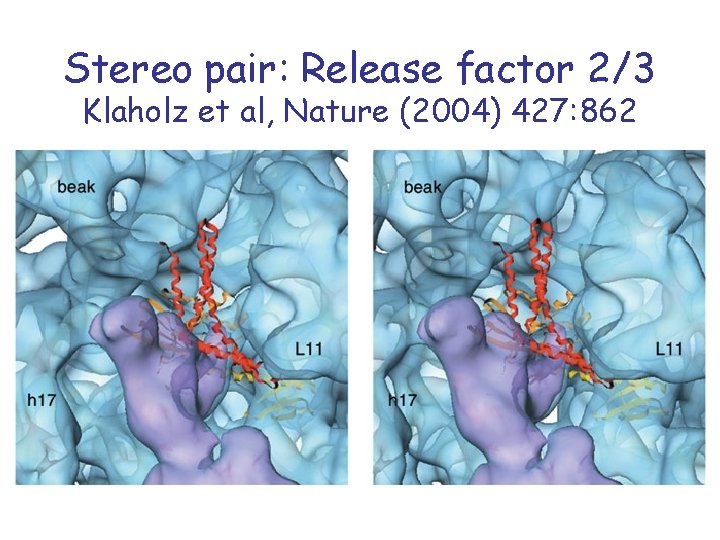
Stereo pair: Release factor 2/3 Klaholz et al, Nature (2004) 427: 862
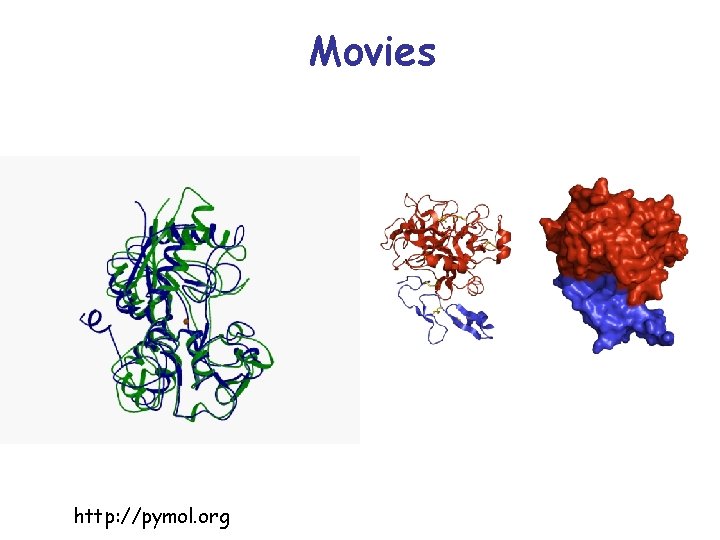
Movies http: //pymol. org
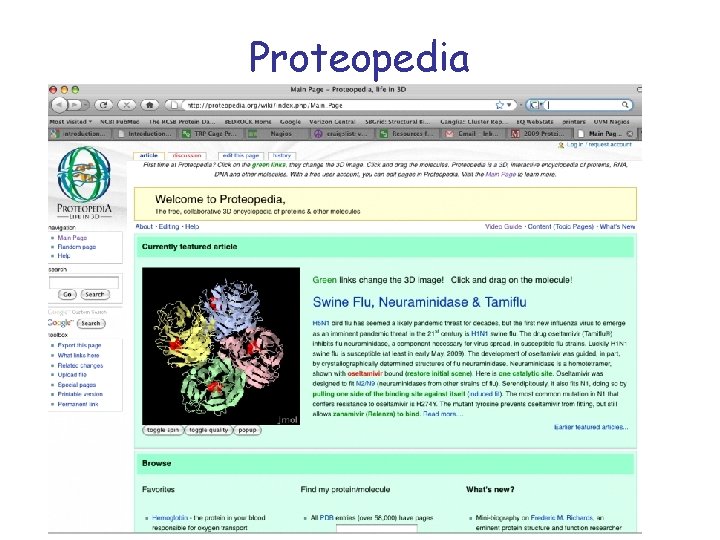
Proteopedia
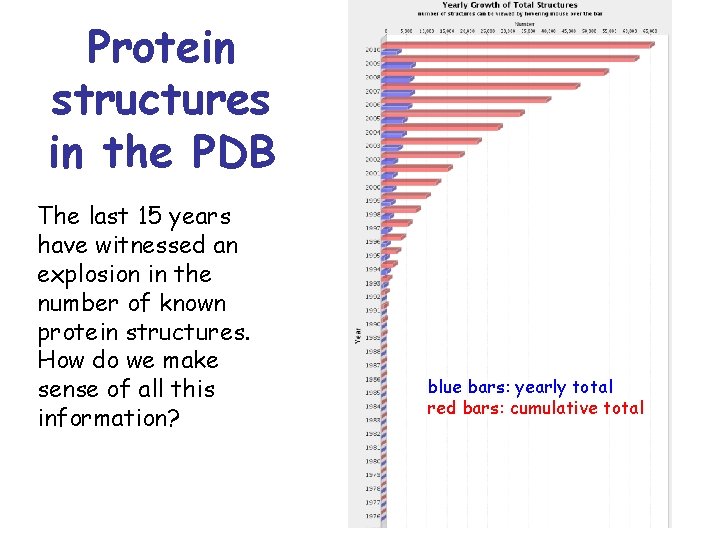
Protein structures in the PDB The last 15 years have witnessed an explosion in the number of known protein structures. How do we make sense of all this information? blue bars: yearly total red bars: cumulative total
Classification of Protein Structures The explosion of protein structures has led to the development of hierarchical systems for comparing and classifying them. Effective protein classification systems allow us to address several fundamental and important questions: If two proteins have similar structures, are they related by common ancestry, or did they converge on a common theme from two different starting points? How likely is that two proteins with similar structures have the same function? Put another way, if I have experimental knowledge of, or can somehow predict, a protein’s structure, I can fit into known classification systems. How much do I then know about that protein? Do I know what other proteins it is homologous to? Do I know what its function is?
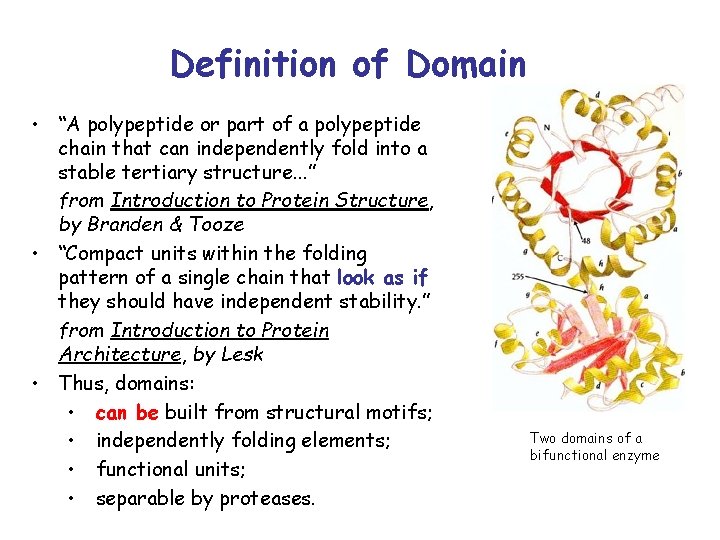
Definition of Domain • “A polypeptide or part of a polypeptide chain that can independently fold into a stable tertiary structure. . . ” from Introduction to Protein Structure, by Branden & Tooze • “Compact units within the folding pattern of a single chain that look as if they should have independent stability. ” from Introduction to Protein Architecture, by Lesk • Thus, domains: • can be built from structural motifs; • independently folding elements; • functional units; • separable by proteases. Two domains of a bifunctional enzyme
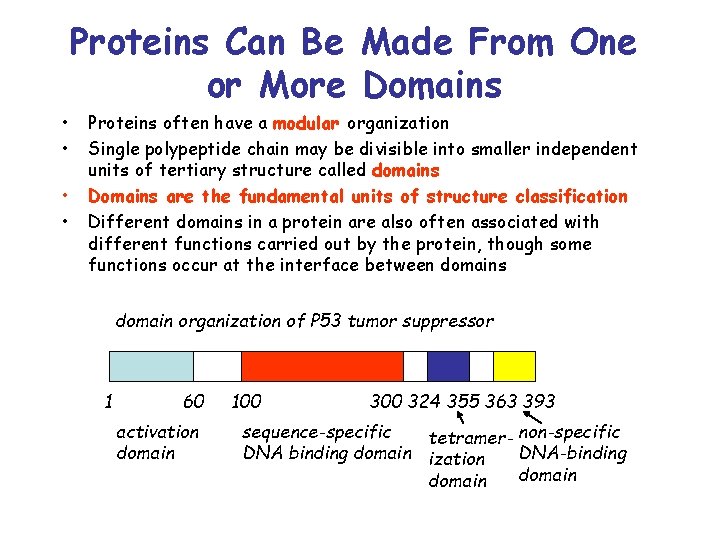
Proteins Can Be Made From One or More Domains • • Proteins often have a modular organization Single polypeptide chain may be divisible into smaller independent units of tertiary structure called domains Domains are the fundamental units of structure classification Different domains in a protein are also often associated with different functions carried out by the protein, though some functions occur at the interface between domains domain organization of P 53 tumor suppressor 1 60 activation domain 100 324 355 363 393 sequence-specific tetramer- non-specific DNA binding domain ization DNA-binding domain
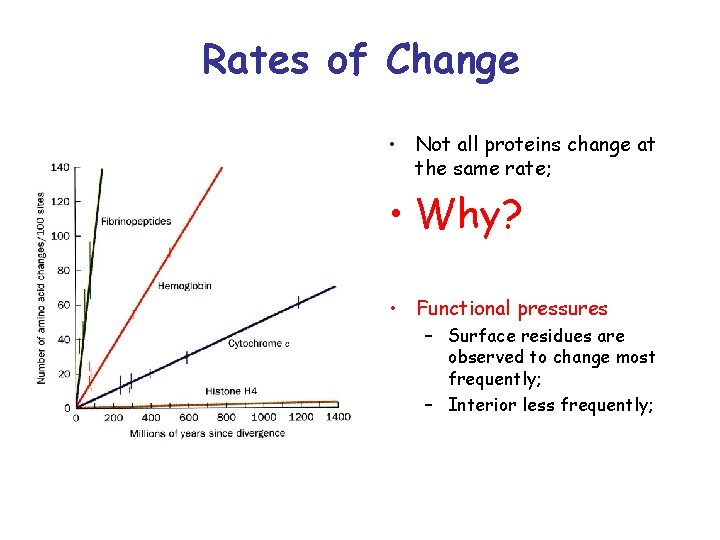
Rates of Change • Not all proteins change at the same rate; • Why? • Functional pressures – Surface residues are observed to change most frequently; – Interior less frequently;
Sequence Structure Function Many sequences can give same structure Ø Side chain pattern more important than sequence When homology is high (>50%), likely to have same structure and function (Structural Genomics) Ø Cores conserved Ø Surfaces and loops more variable *3 -D shape more conserved than sequence* *There a limited number of structural frameworks* W. Chazin © 2003
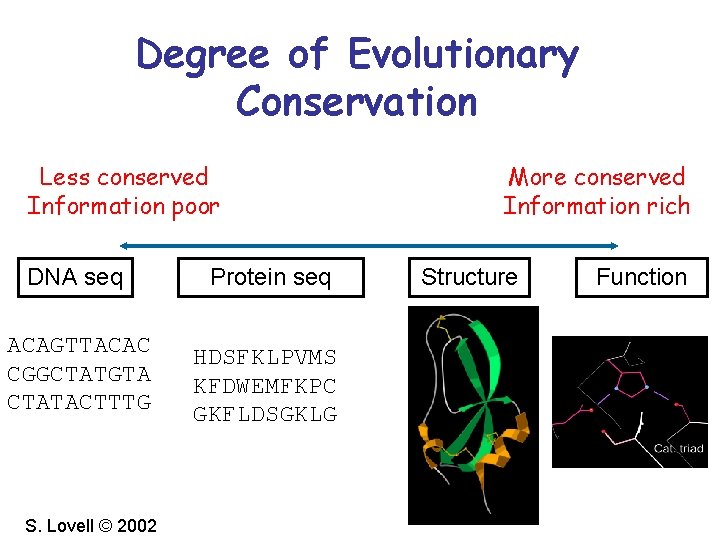
Degree of Evolutionary Conservation Less conserved Information poor DNA seq Protein seq ACAGTTACAC CGGCTATGTA CTATACTTTG HDSFKLPVMS KFDWEMFKPC GKFLDSGKLG S. Lovell © 2002 More conserved Information rich Structure Function
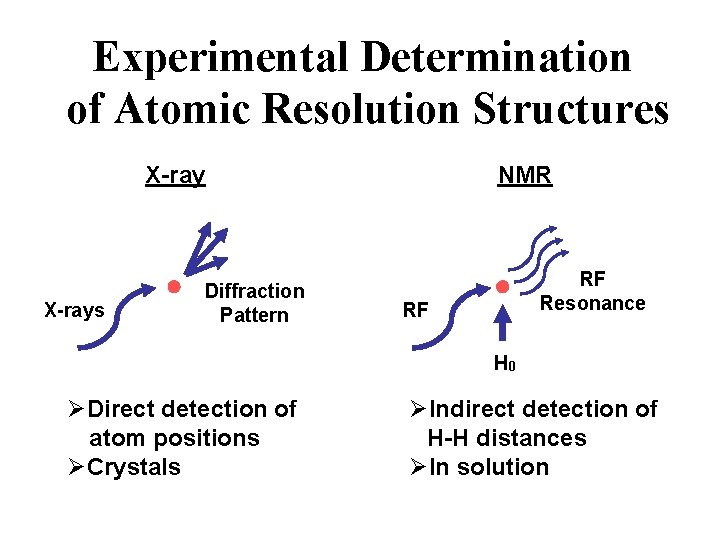
How is a 3 D structure determined ? 1. Experimental methods (Best approach): • X-rays crystallography - stable fold, good quality crystals. • NMR - stable fold, not suitable for large molecule. 2. In-silico methods (partial solutions based on similarity): • Sequence or profile alignment - uses similar sequences, limited use of 3 D information. • Threading - needs 3 D structure, combinatorial complexity. • Ab-initio structure prediction - not always successful.
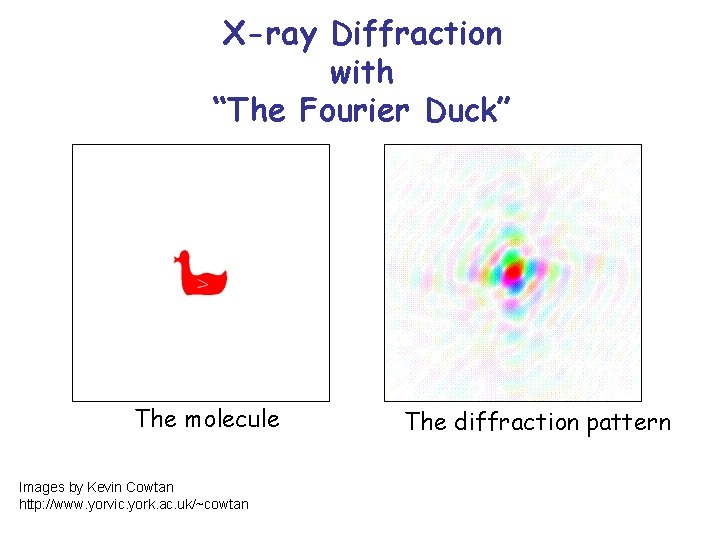
Experimental Determination of Atomic Resolution Structures X-rays Diffraction Pattern NMR RF Resonance RF H 0 ØDirect detection of atom positions ØCrystals ØIndirect detection of H-H distances ØIn solution
Resolving Power Signal • d • Position Resolving Power: The ability to see two points that are separated by a given distance as distinct Resolution of two points separated by a distance d requires radiation with a wavelength on the order of d or shorter: wavelength Mark Rould © 2007
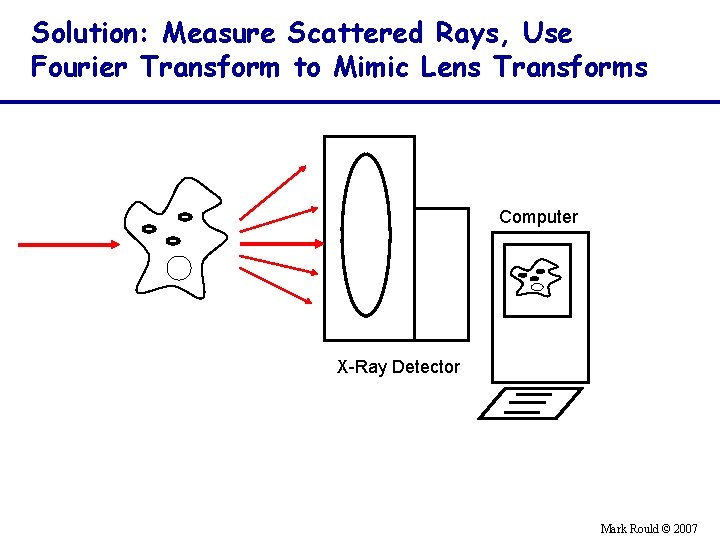
X-ray Microscopes? nair nglass • Lenses require a difference in refractive index between the air and lens material in order to 'bend' and redirect light (or any other form of electromagnetic radiation. ) • The refractive index for x-rays is almost exactly 1. 00 for all materials. ∆ There are no lenses for xrays. Mark Rould © 2007
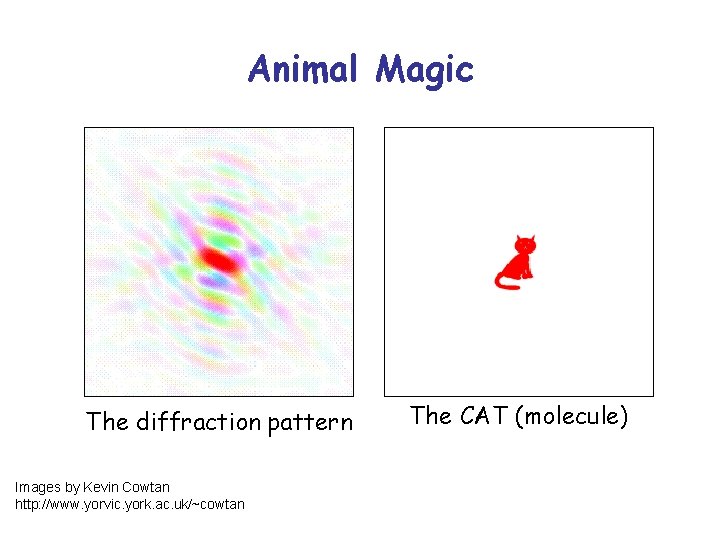
Light Scattering and Lenses are Described by Fourier Transforms Scattering = Fourier Transform of specimen Lens applies a second Fourier Transform to the scattered rays to give the image Since X-rays cannot be focused by lenses and refractive index of X-rays in all materials is very close to 1. 0 how do we get an atomic image? Mark Rould © 2007
X-ray Diffraction with “The Fourier Duck” The molecule Images by Kevin Cowtan http: //www. yorvic. york. ac. uk/~cowtan The diffraction pattern
Animal Magic The diffraction pattern Images by Kevin Cowtan http: //www. yorvic. york. ac. uk/~cowtan The CAT (molecule)
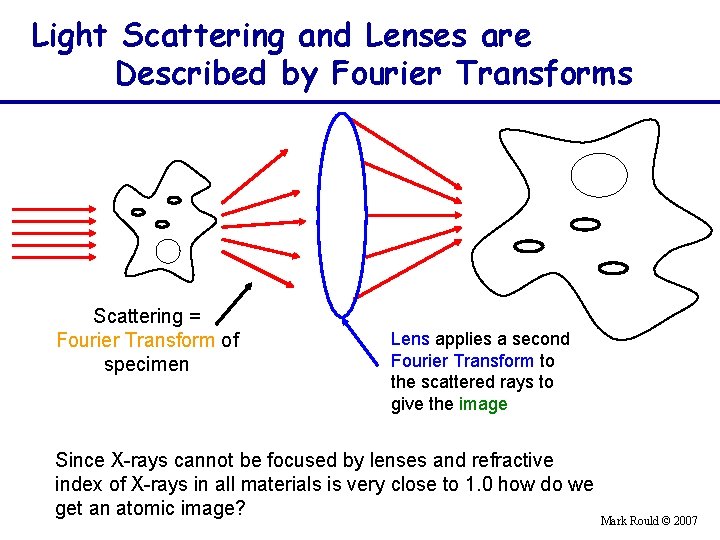
Solution: Measure Scattered Rays, Use Fourier Transform to Mimic Lens Transforms Computer X-Ray Detector Mark Rould © 2007
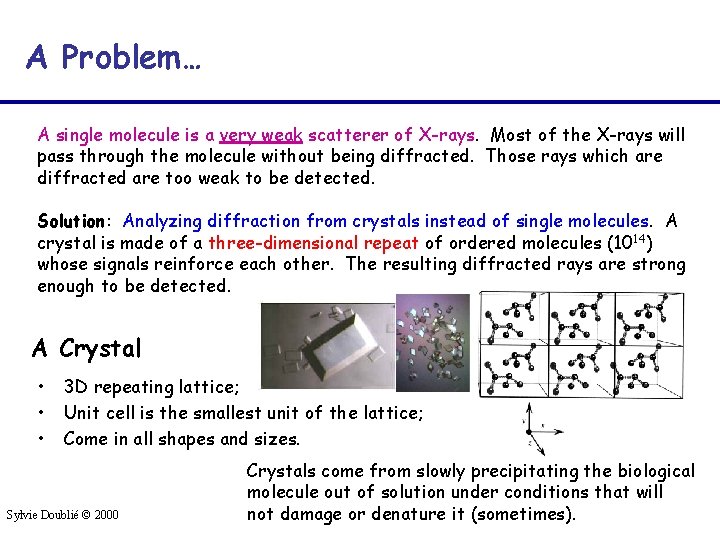
A Problem… A single molecule is a very weak scatterer of X-rays. Most of the X-rays will pass through the molecule without being diffracted. Those rays which are diffracted are too weak to be detected. Solution: Analyzing diffraction from crystals instead of single molecules. A crystal is made of a three-dimensional repeat of ordered molecules (1014) whose signals reinforce each other. The resulting diffracted rays are strong enough to be detected. A Crystal • • • 3 D repeating lattice; Unit cell is the smallest unit of the lattice; Come in all shapes and sizes. Sylvie Doublié © 2000 Crystals come from slowly precipitating the biological molecule out of solution under conditions that will not damage or denature it (sometimes).
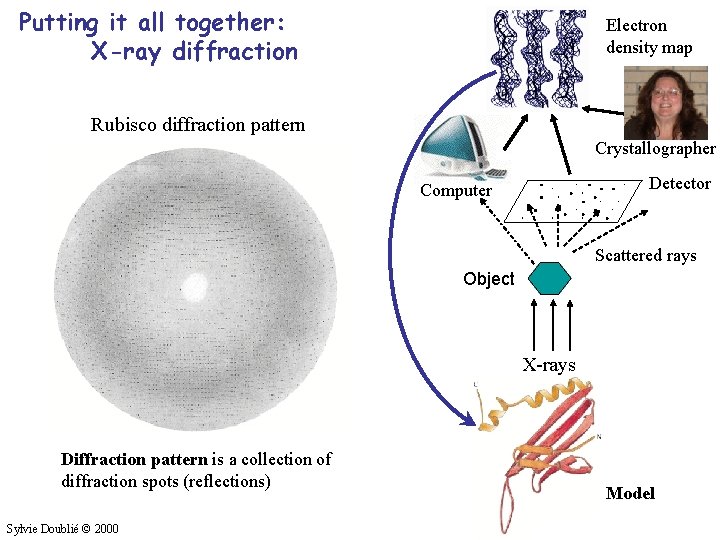
Putting it all together: X-ray diffraction Electron density map Rubisco diffraction pattern Crystallographer Detector Computer Scattered rays Object X-rays Diffraction pattern is a collection of diffraction spots (reflections) Sylvie Doublié © 2000 Model
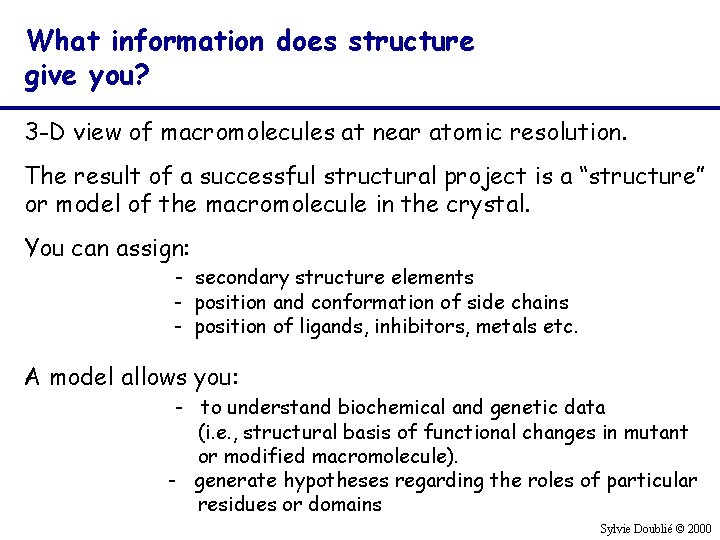
What information does structure give you? 3 -D view of macromolecules at near atomic resolution. The result of a successful structural project is a “structure” or model of the macromolecule in the crystal. You can assign: - secondary structure elements - position and conformation of side chains - position of ligands, inhibitors, metals etc. A model allows you: - to understand biochemical and genetic data (i. e. , structural basis of functional changes in mutant or modified macromolecule). - generate hypotheses regarding the roles of particular residues or domains Sylvie Doublié © 2000
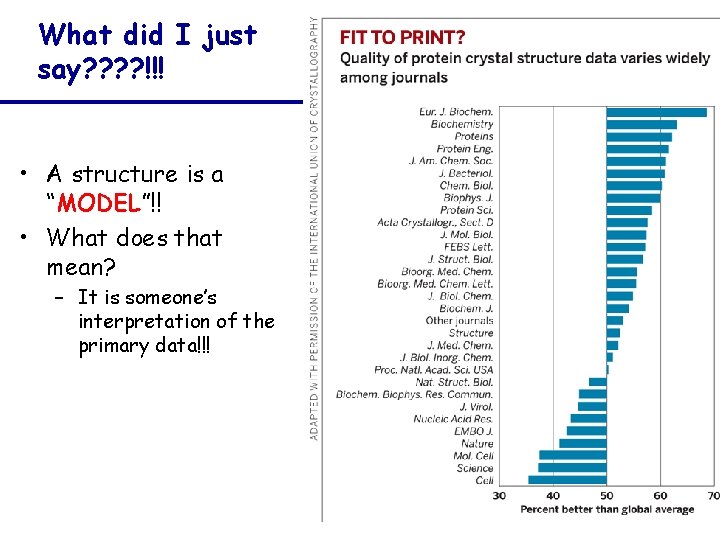
What did I just say? ? !!! • A structure is a “MODEL”!! • What does that mean? – It is someone’s interpretation of the primary data!!!
So what happens when we can’t get an NMR or X-ray structure?
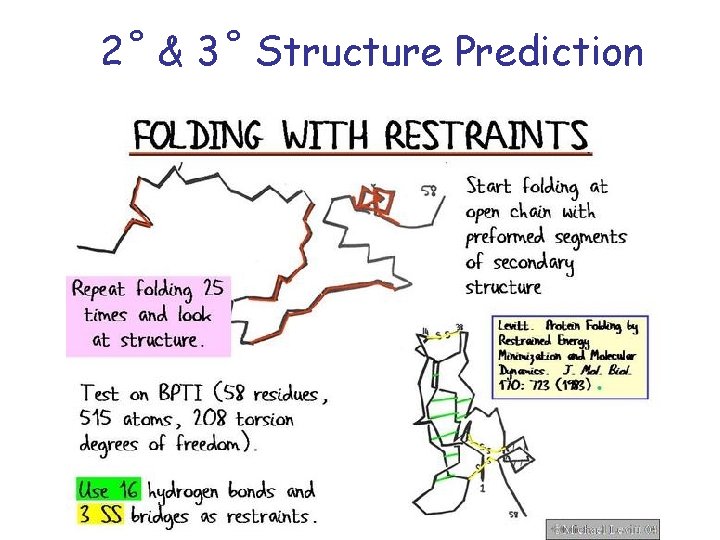
2˚ & 3˚ Structure Prediction
Secondary (2 o) Structure Table 10 - -
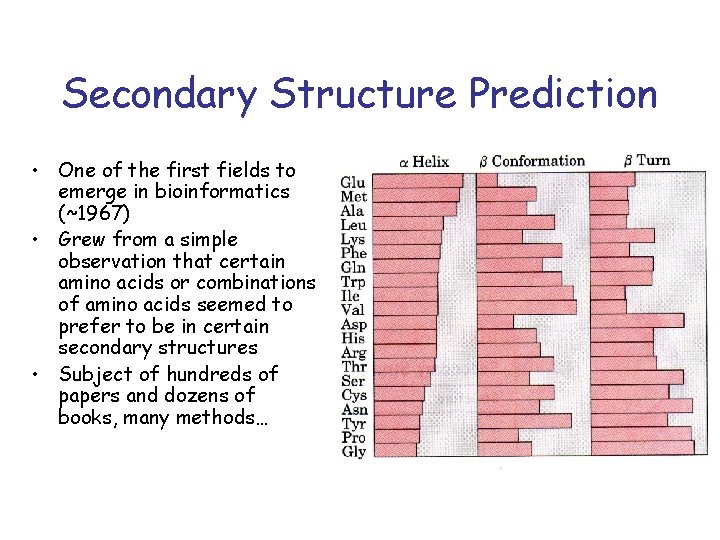
Secondary Structure Prediction • One of the first fields to emerge in bioinformatics (~1967) • Grew from a simple observation that certain amino acids or combinations of amino acids seemed to prefer to be in certain secondary structures • Subject of hundreds of papers and dozens of books, many methods…
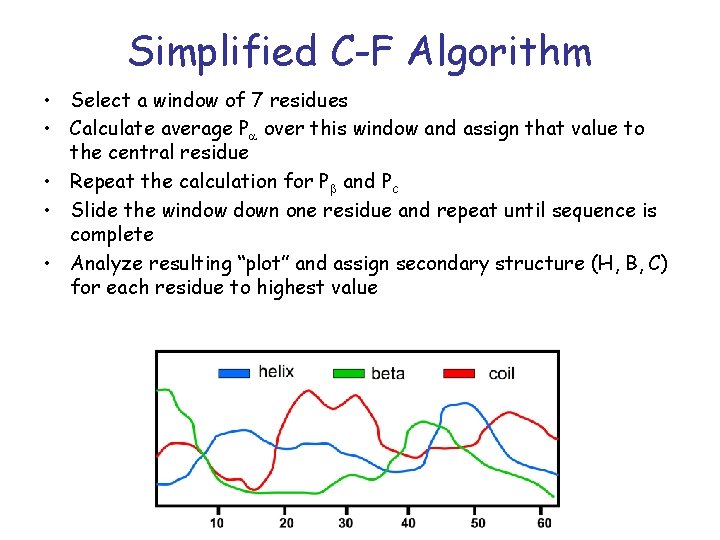
Simplified C-F Algorithm • Select a window of 7 residues • Calculate average Pa over this window and assign that value to the central residue • Repeat the calculation for Pb and Pc • Slide the window down one residue and repeat until sequence is complete • Analyze resulting “plot” and assign secondary structure (H, B, C) for each residue to highest value
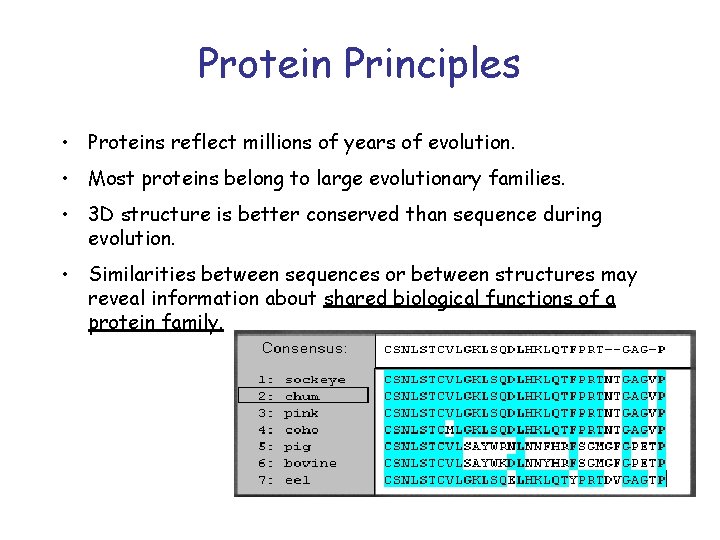
Protein Principles • Proteins reflect millions of years of evolution. • Most proteins belong to large evolutionary families. • 3 D structure is better conserved than sequence during evolution. • Similarities between sequences or between structures may reveal information about shared biological functions of a protein family.
The Ph. D Algorithm • Search the SWISS-PROT database and select high scoring homologues • Create a sequence “profile” from the resulting multiple alignment • Include global sequence info in the profile • Input the profile into a trained two-layer neural network to predict the structure and to “clean-up” the prediction http: //www. predictprotein. org/
Best of the Best • Predict. Protein-PHD (72%) – http: //www. predictprotein. org/ • Jpred (73 -75%) – http: //www. compbio. dundee. ac. uk/wwwjpred/index. html • SAM-T 08 (75%) – http: //compbio. soe. ucsc. edu/SAM_T 08/T 08 query. html • PSIpred (77%) – http: //bioinf. cs. ucl. ac. uk/psipred/psiform. html
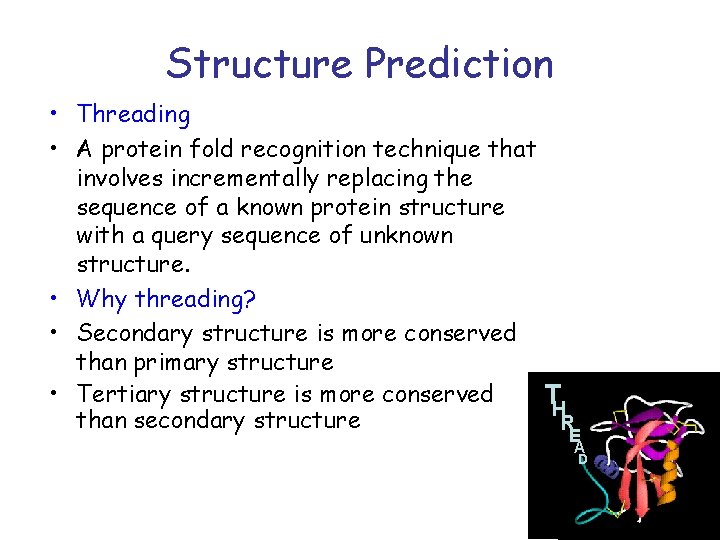
Structure Prediction • Threading • A protein fold recognition technique that involves incrementally replacing the sequence of a known protein structure with a query sequence of unknown structure. • Why threading? • Secondary structure is more conserved than primary structure • Tertiary structure is more conserved TH than secondary structure R E A D
3 D Threading Servers Generate 3 D models or coordinates of possible models based on input sequence • Predict. Protein-PHDacc – http: //www. predictprotein. org • Pred. Acc – http: //mobyle. rpbs. univ-paris-diderot. fr/cgibin/portal. py? form=Pred. Acc • Loopp (version 2) – http: //cbsuapps. tc. cornell. edu/loopp. aspx • Phyre – http: //www. sbg. bio. ic. ac. uk/~phyre/ • Swiss. Model – http: //swissmodel. expasy. org/ • All require email addresses since the process may take hours to complete
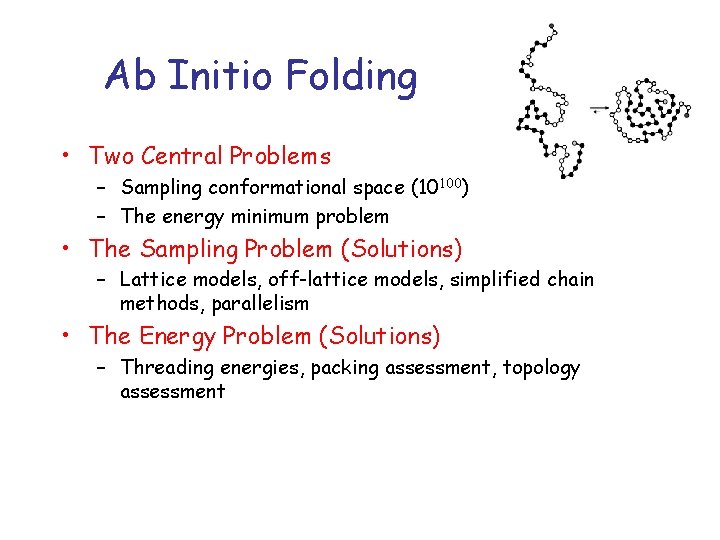
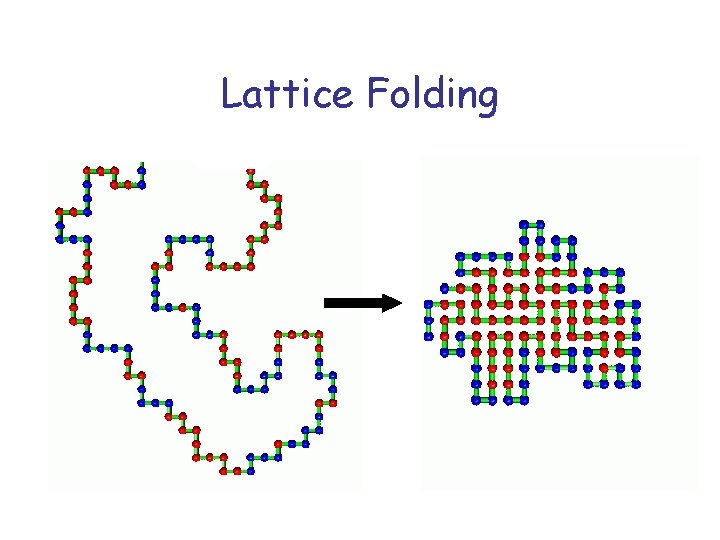
Ab Initio Folding • Two Central Problems – Sampling conformational space (10100) – The energy minimum problem • The Sampling Problem (Solutions) – Lattice models, off-lattice models, simplified chain methods, parallelism • The Energy Problem (Solutions) – Threading energies, packing assessment, topology assessment
Lattice Folding
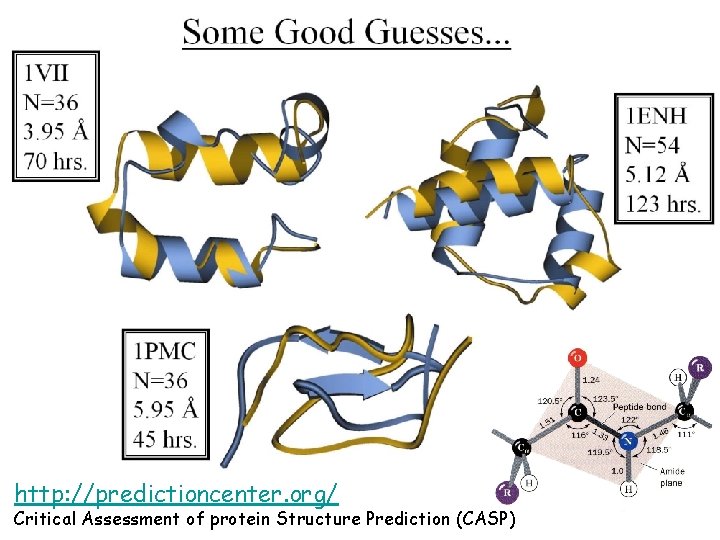
http: //predictioncenter. org/ Critical Assessment of protein Structure Prediction (CASP)
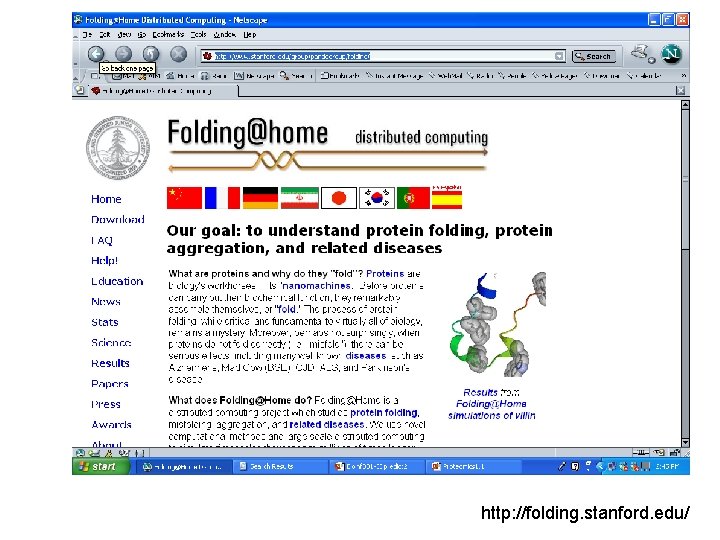
http: //folding. stanford. edu/

For the gamers out there… http: //fold. it/portal/
Print & Online Resources Crystallography Made Crystal Clear, by Gale Rhodes http: //www. usm. maine. edu/~rhodes/CMCC/index. html http: //ruppweb. dyndns. org/Xray/101 index. html Online tutorial with interactive applets and quizzes. http: //www. ysbl. york. ac. uk/~cowtan/fourier. html Nice pictures demonstrating Fourier transforms http: //ucxray. berkeley. edu/~jamesh/movies/ Cool movies demonstrating key points about diffraction, resolution, data quality, and refinement. http: //www-structmed. cimr. cam. ac. uk/course. html Notes from a macromolecular crystallography course taught in Cambridge

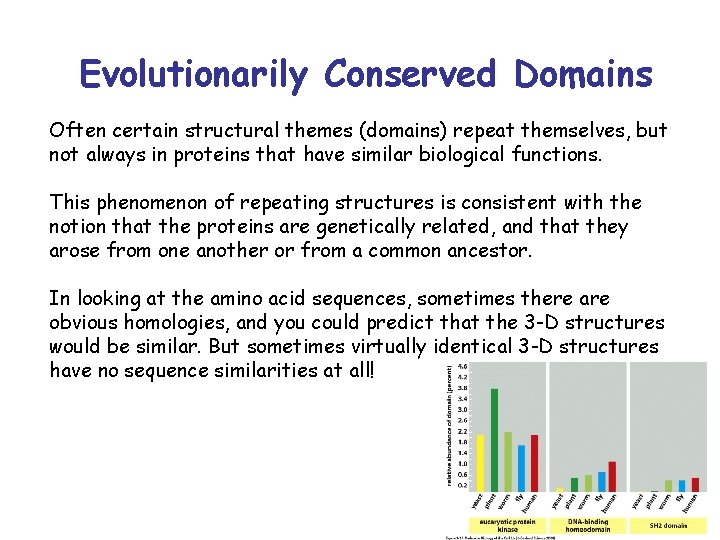
Evolutionarily Conserved Domains Often certain structural themes (domains) repeat themselves, but not always in proteins that have similar biological functions. This phenomenon of repeating structures is consistent with the notion that the proteins are genetically related, and that they arose from one another or from a common ancestor. In looking at the amino acid sequences, sometimes there are obvious homologies, and you could predict that the 3 -D structures would be similar. But sometimes virtually identical 3 -D structures have no sequence similarities at all!
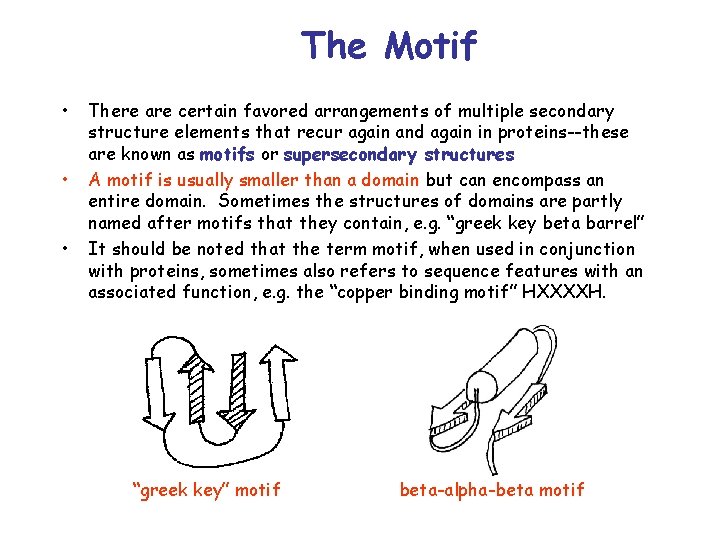
The Motif • • • There are certain favored arrangements of multiple secondary structure elements that recur again and again in proteins--these are known as motifs or supersecondary structures A motif is usually smaller than a domain but can encompass an entire domain. Sometimes the structures of domains are partly named after motifs that they contain, e. g. “greek key beta barrel” It should be noted that the term motif, when used in conjunction with proteins, sometimes also refers to sequence features with an associated function, e. g. the “copper binding motif” HXXXXH. “greek key” motif beta-alpha-beta motif
Limitations of Chou-Fasman • Does not take into account long range information (>3 residues away) • Does not take into account sequence content or probable structure class • Assumes simple additive probability (not true in nature) • Does not include related sequences or alignments in prediction process • Only about 55% accurate (on good days)
Prediction Performance
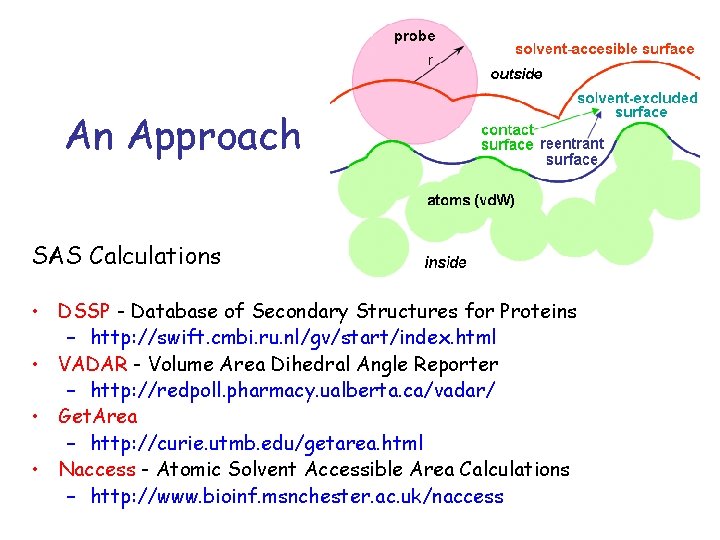
An Approach SAS Calculations • DSSP - Database of Secondary Structures for Proteins – http: //swift. cmbi. ru. nl/gv/start/index. html • VADAR - Volume Area Dihedral Angle Reporter – http: //redpoll. pharmacy. ualberta. ca/vadar/ • Get. Area – http: //curie. utmb. edu/getarea. html • Naccess - Atomic Solvent Accessible Area Calculations – http: //www. bioinf. msnchester. ac. uk/naccess
- Slides: 66