
Structural Bioinformatics Elodie Laine Master BIMBMC Semestre 3
Structural Bioinformatics Elodie Laine Master BIM-BMC Semestre 3, 2017 -2018 Laboratoire de Biologie Computationnelle et Quantitative (LCQB) e-documents: http: //www. lcqb. upmc. fr/laine/STRUCT e-mail: elodie. laine@upmc. fr
Introduction Elodie Laine – 19. 09. 2016
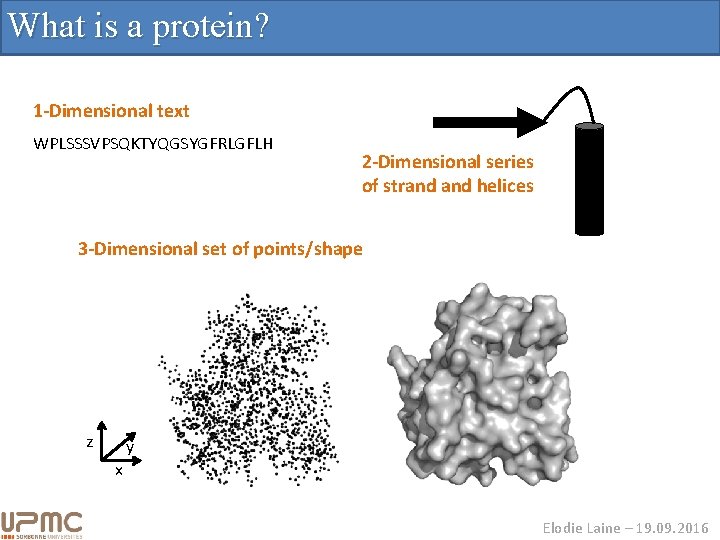
What is a protein? 1 -Dimensional text WPLSSSVPSQKTYQGSYGFRLGFLH 2 -Dimensional series of strand helices 3 -Dimensional set of points/shape z y x Elodie Laine – 19. 09. 2016
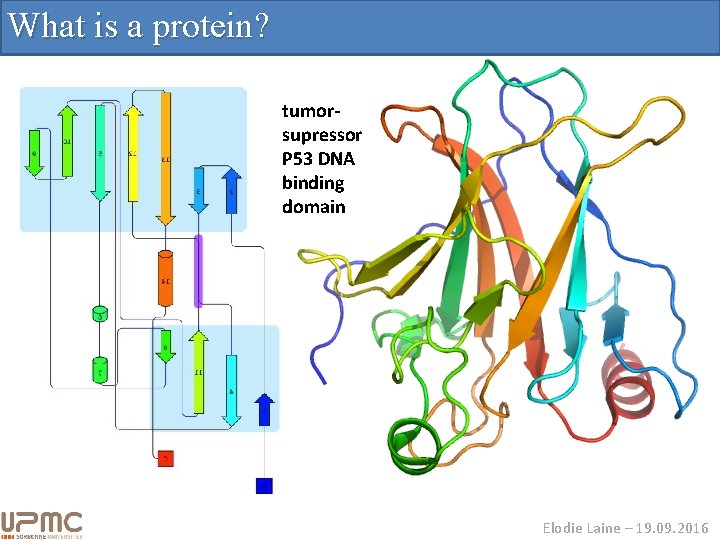
What is a protein? tumorsupressor P 53 DNA binding domain Elodie Laine – 19. 09. 2016
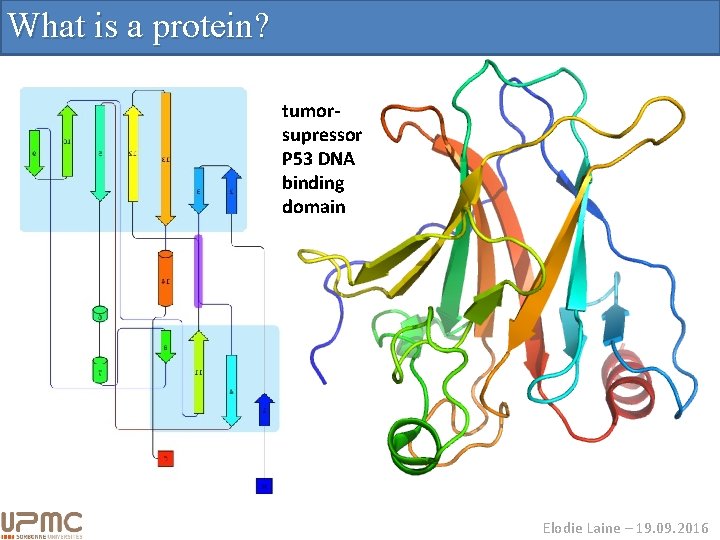
What is a protein? tumorsupressor P 53 DNA binding domain Elodie Laine – 19. 09. 2016
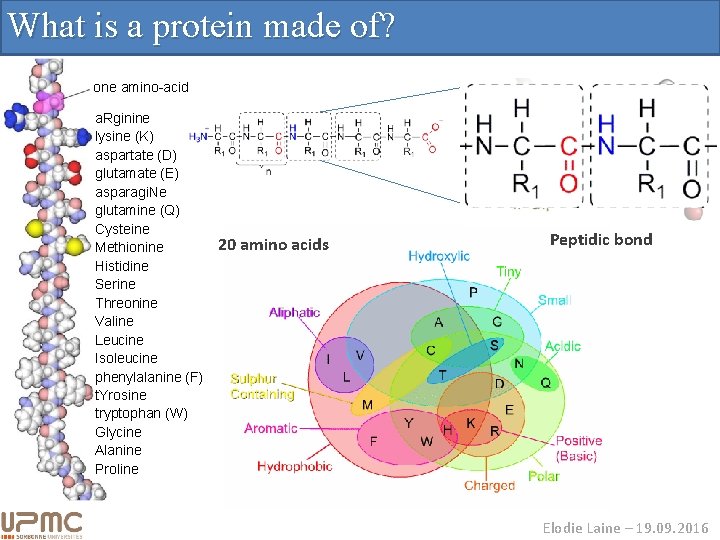
What is a protein made of? one amino-acid a. Rginine lysine (K) aspartate (D) glutamate (E) asparagi. Ne glutamine (Q) Cysteine Methionine Histidine Serine Threonine Valine Leucine Isoleucine phenylalanine (F) t. Yrosine tryptophan (W) Glycine Alanine Proline 20 amino acids Peptidic bond Elodie Laine – 19. 09. 2016
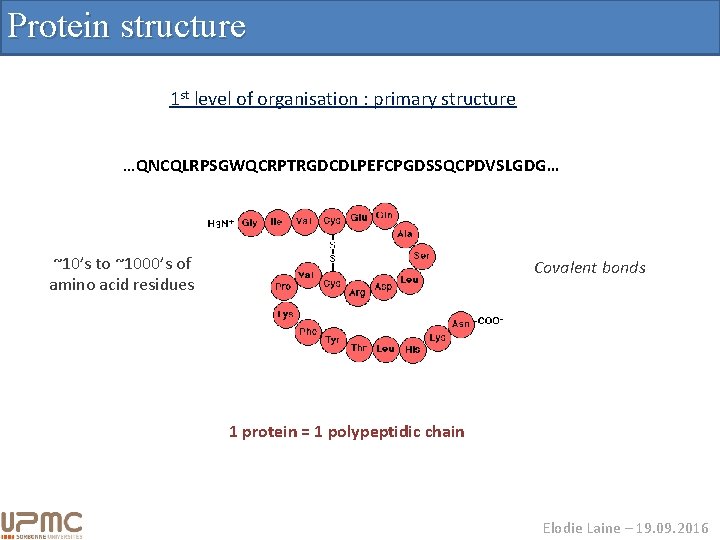
Protein structure 1 st level of organisation : primary structure …QNCQLRPSGWQCRPTRGDCDLPEFCPGDSSQCPDVSLGDG… ~10’s to ~1000’s of amino acid residues Covalent bonds 1 protein = 1 polypeptidic chain Elodie Laine – 19. 09. 2016
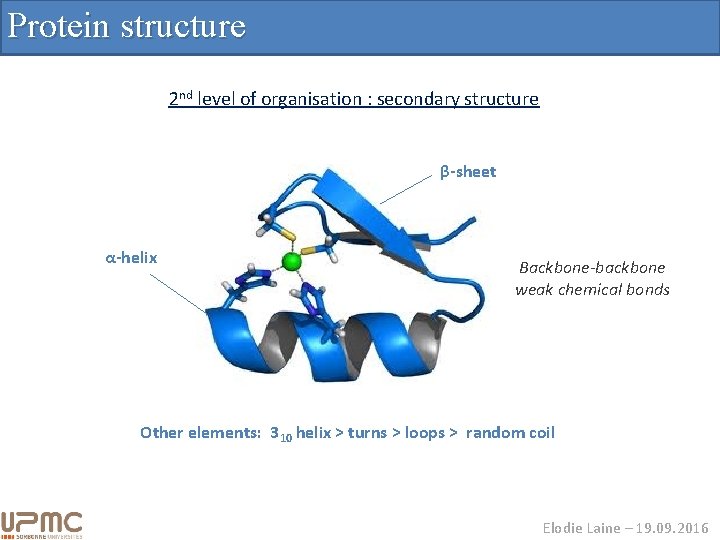
Protein structure 2 nd level of organisation : secondary structure β-sheet α-helix Backbone-backbone weak chemical bonds Other elements: 310 helix > turns > loops > random coil Elodie Laine – 19. 09. 2016
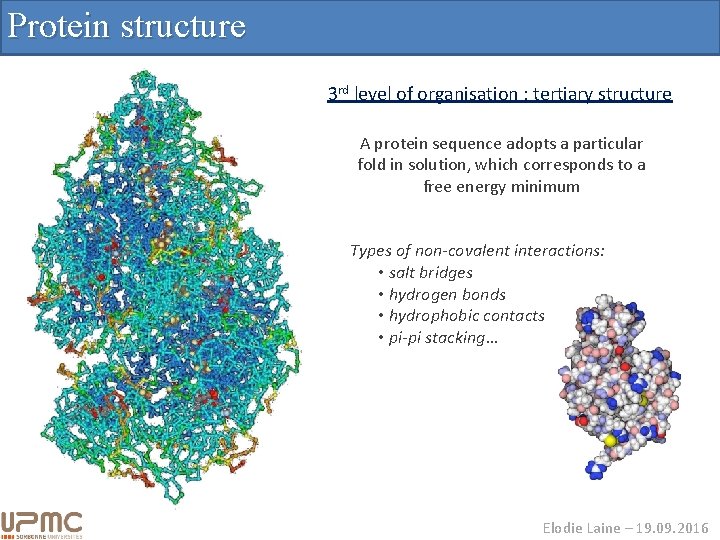
Protein structure 3 rd level of organisation : tertiary structure A protein sequence adopts a particular fold in solution, which corresponds to a free energy minimum Types of non-covalent interactions: • salt bridges • hydrogen bonds • hydrophobic contacts • pi-pi stacking… Elodie Laine – 19. 09. 2016
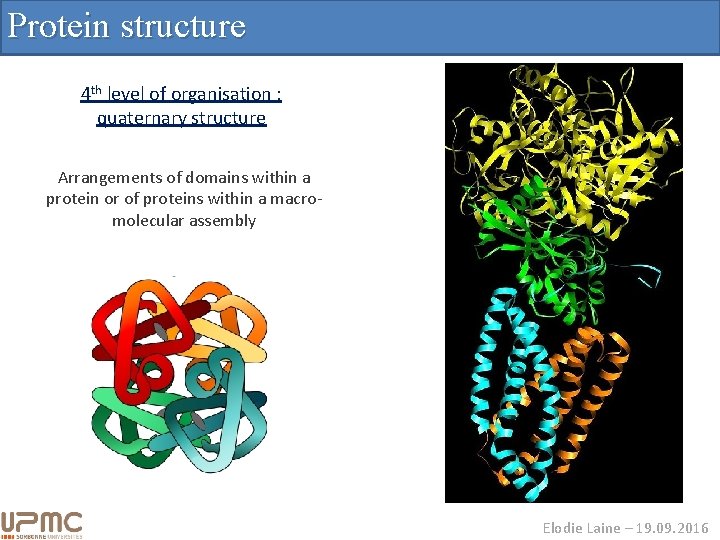
Protein structure 4 th level of organisation : quaternary structure Arrangements of domains within a protein or of proteins within a macromolecular assembly Elodie Laine – 19. 09. 2016
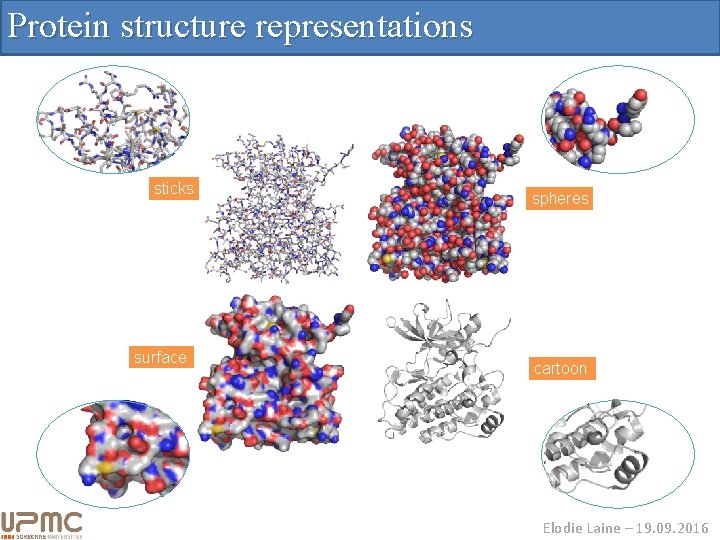
Protein structure representations sticks surface spheres cartoon Elodie Laine – 19. 09. 2016
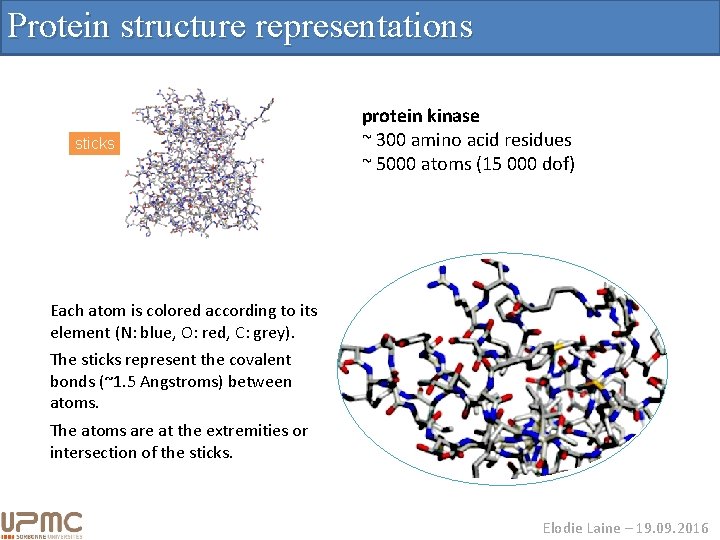
Protein structure representations sticks protein kinase ~ 300 amino acid residues ~ 5000 atoms (15 000 dof) Each atom is colored according to its element (N: blue, O: red, C: grey). The sticks represent the covalent bonds (~1. 5 Angstroms) between atoms. The atoms are at the extremities or intersection of the sticks. Elodie Laine – 19. 09. 2016
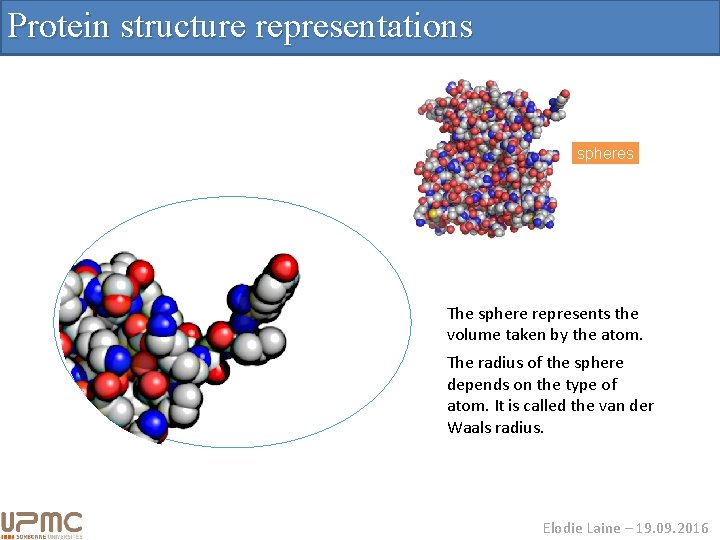
Protein structure representations spheres The sphere represents the volume taken by the atom. The radius of the sphere depends on the type of atom. It is called the van der Waals radius. Elodie Laine – 19. 09. 2016
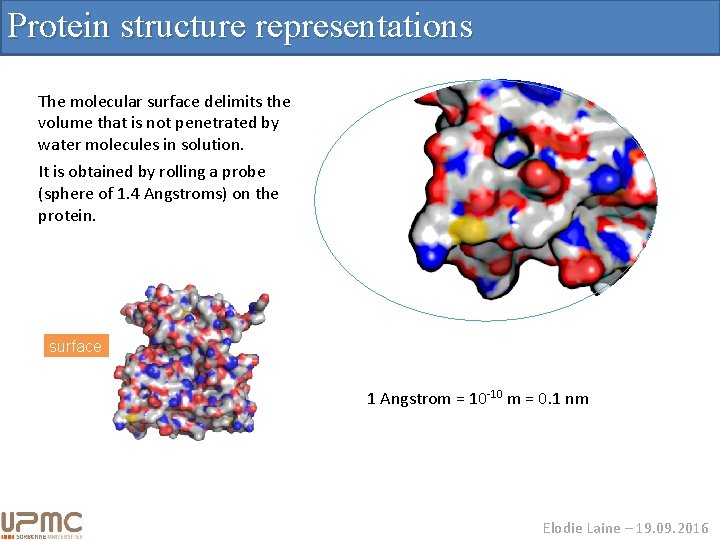
Protein structure representations The molecular surface delimits the volume that is not penetrated by water molecules in solution. It is obtained by rolling a probe (sphere of 1. 4 Angstroms) on the protein. surface 1 Angstrom = 10 -10 m = 0. 1 nm Elodie Laine – 19. 09. 2016
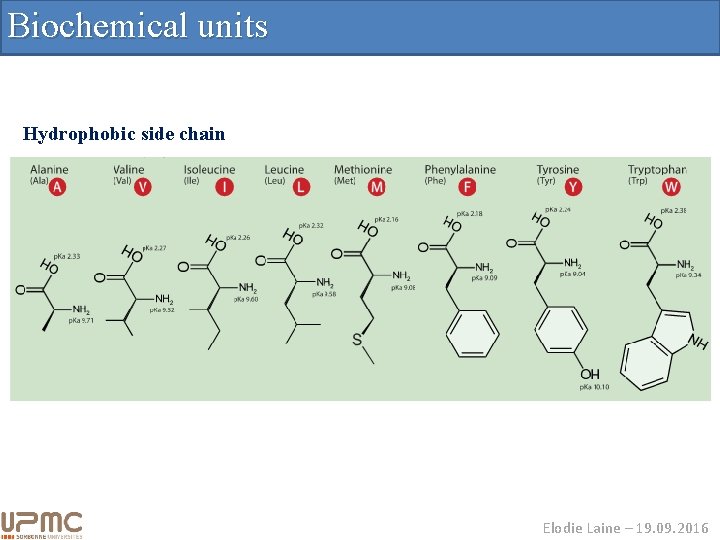
Biochemical units Hydrophobic side chain Elodie Laine – 19. 09. 2016
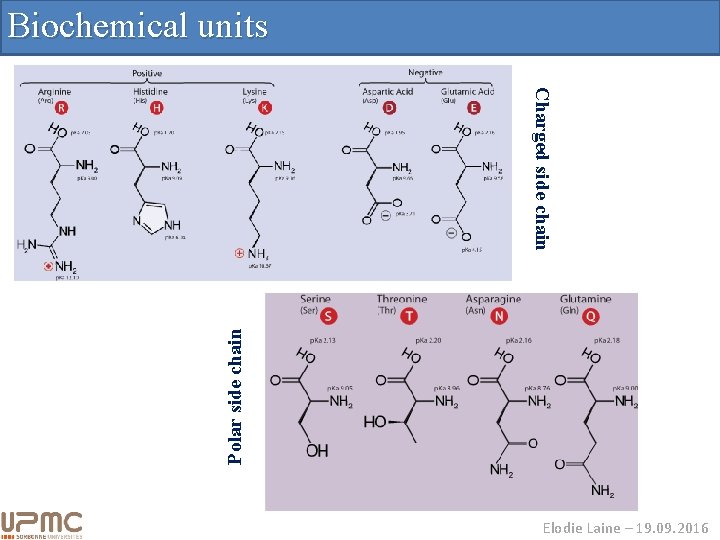
Biochemical units Polar side chain Charged side chain Elodie Laine – 19. 09. 2016
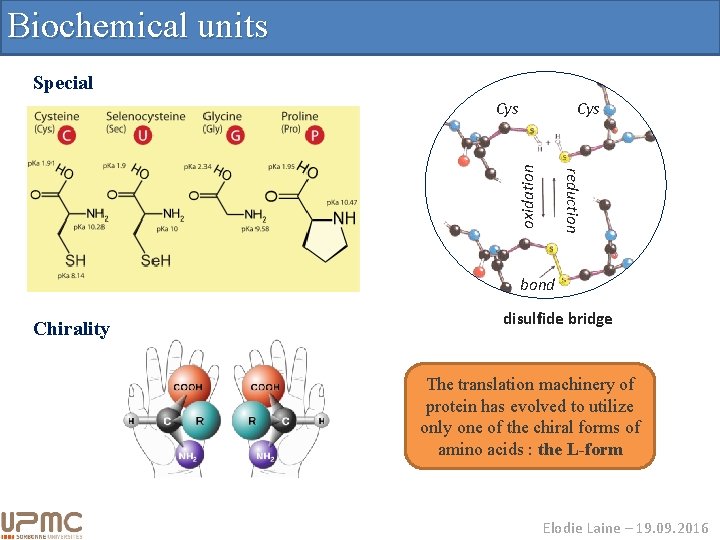
Biochemical units Special Cys reduction oxidation Cys bond Chirality disulfide bridge The translation machinery of protein has evolved to utilize only one of the chiral forms of amino acids : the L-form Elodie Laine – 19. 09. 2016
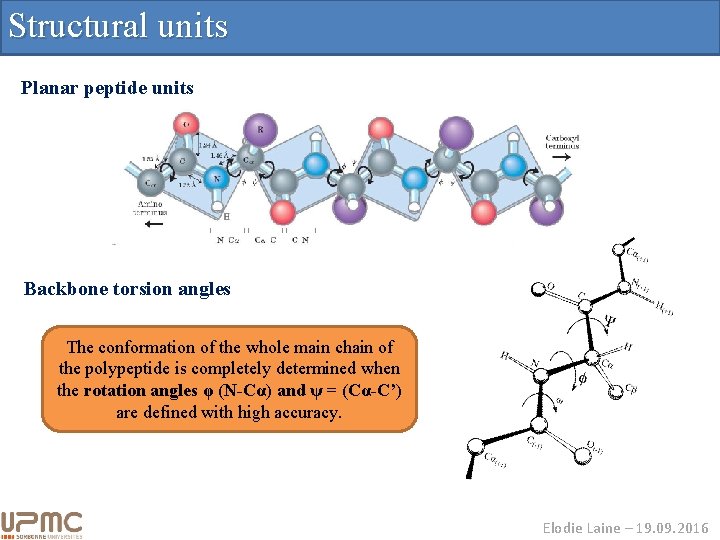
Structural units Planar peptide units Backbone torsion angles The conformation of the whole main chain of the polypeptide is completely determined when the rotation angles φ (N-Cα) and ψ = (Cα-C’) are defined with high accuracy. Elodie Laine – 19. 09. 2016
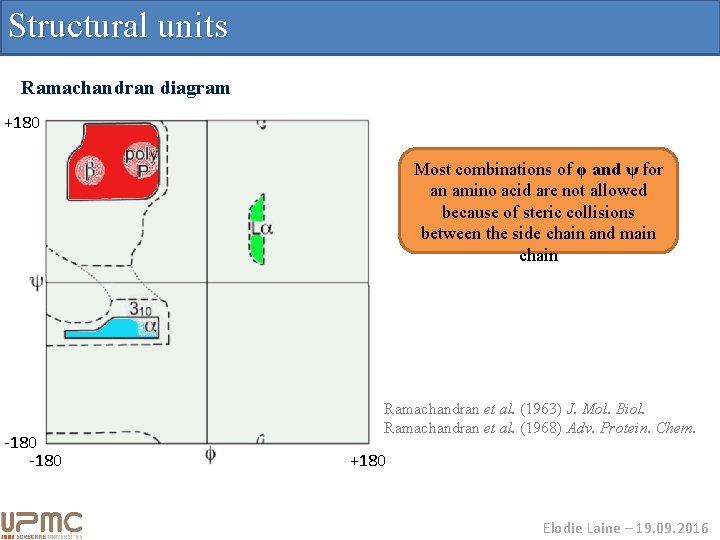
Structural units Ramachandran diagram +180 Most combinations of φ and ψ for an amino acid are not allowed because of steric collisions between the side chain and main chain -180 Ramachandran et al. (1963) J. Mol. Biol. Ramachandran et al. (1968) Adv. Protein. Chem. +180 Elodie Laine – 19. 09. 2016
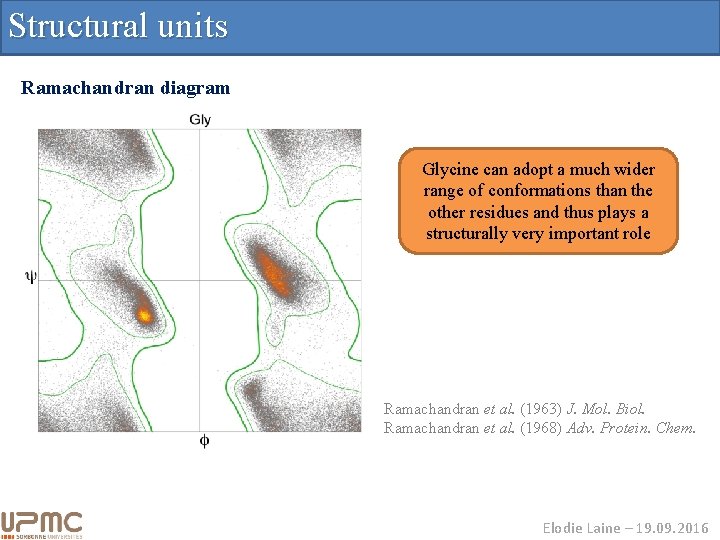
Structural units Ramachandran diagram Glycine can adopt a much wider range of conformations than the other residues and thus plays a structurally very important role Ramachandran et al. (1963) J. Mol. Biol. Ramachandran et al. (1968) Adv. Protein. Chem. Elodie Laine – 19. 09. 2016
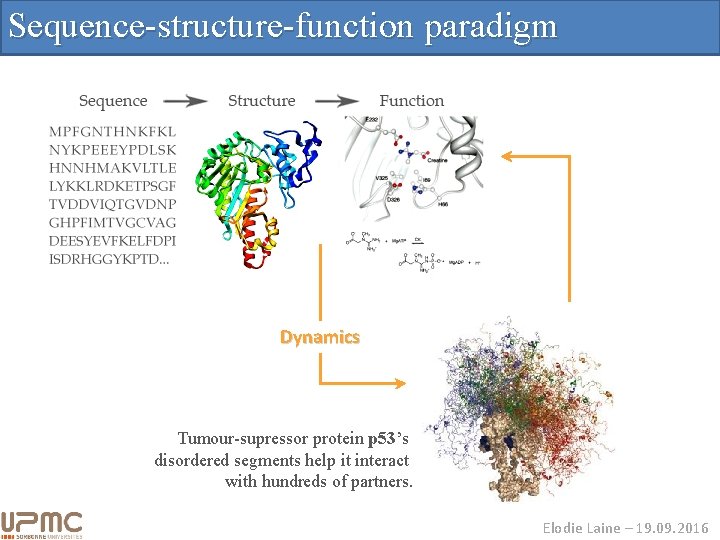
Sequence-structure-function paradigm Dynamics Tumour-supressor protein p 53’s disordered segments help it interact with hundreds of partners. Elodie Laine – 19. 09. 2016
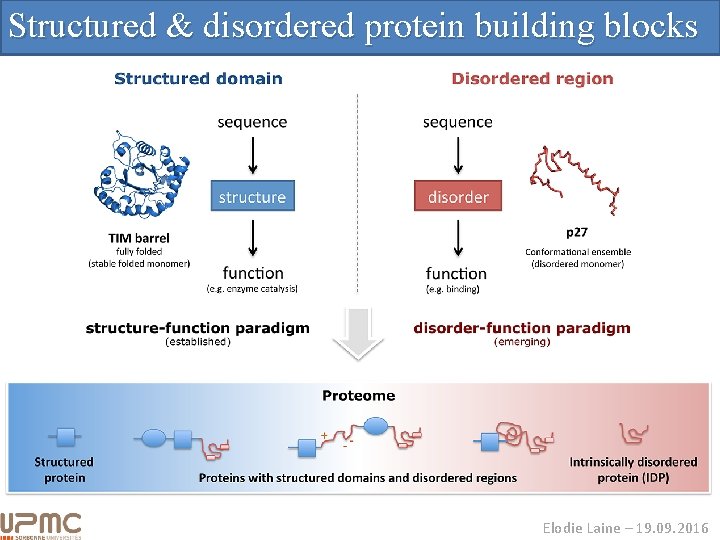
Structured & disordered protein building blocks Elodie Laine – 19. 09. 2016
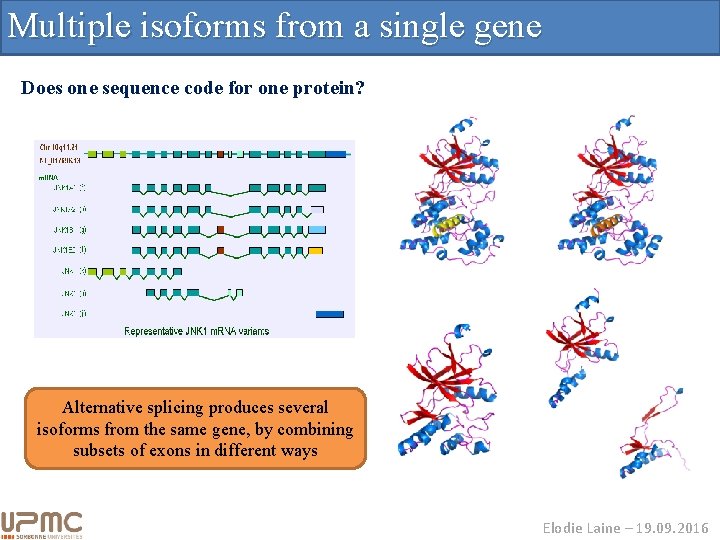
Multiple isoforms from a single gene Does one sequence code for one protein? Alternative splicing produces several isoforms from the same gene, by combining subsets of exons in different ways Elodie Laine – 19. 09. 2016
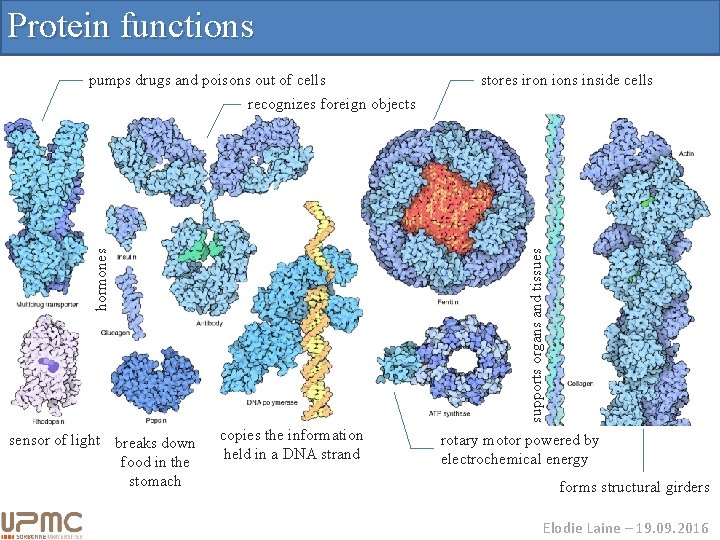
Protein functions hormones sensor of light breaks down food in the stomach stores iron ions inside cells supports organs and tissues pumps drugs and poisons out of cells recognizes foreign objects copies the information held in a DNA strand rotary motor powered by electrochemical energy forms structural girders Elodie Laine – 19. 09. 2016
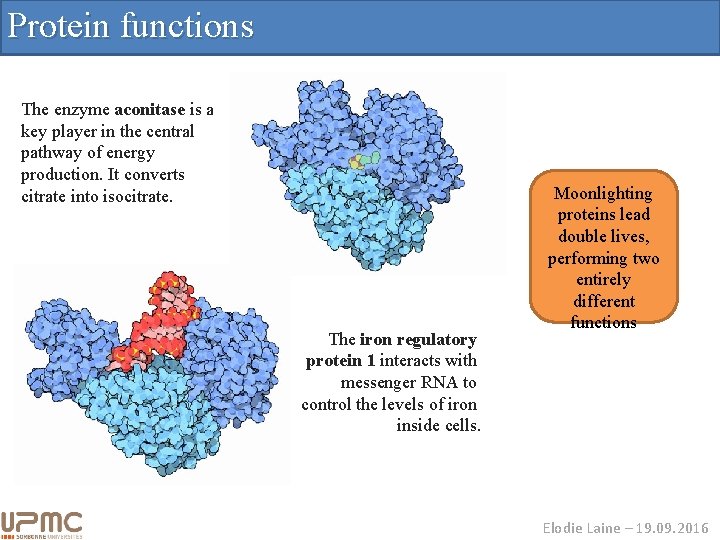
Protein functions The enzyme aconitase is a key player in the central pathway of energy production. It converts citrate into isocitrate. The iron regulatory protein 1 interacts with messenger RNA to control the levels of iron inside cells. Moonlighting proteins lead double lives, performing two entirely different functions Elodie Laine – 19. 09. 2016
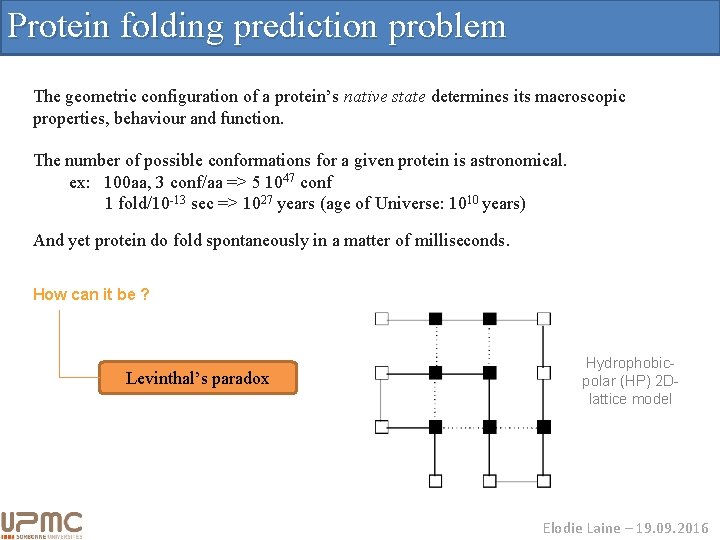
Protein folding prediction problem The geometric configuration of a protein’s native state determines its macroscopic properties, behaviour and function. The number of possible conformations for a given protein is astronomical. ex: 100 aa, 3 conf/aa => 5 1047 conf 1 fold/10 -13 sec => 1027 years (age of Universe: 1010 years) And yet protein do fold spontaneously in a matter of milliseconds. How can it be ? Levinthal’s paradox Hydrophobicpolar (HP) 2 Dlattice model Elodie Laine – 19. 09. 2016
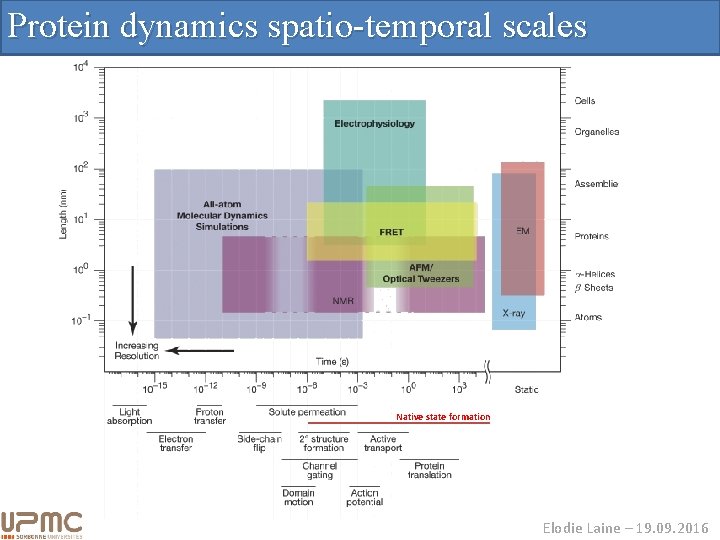
Protein dynamics spatio-temporal scales Native state formation Elodie Laine – 19. 09. 2016
Protein structures are about. . . v Chemistry Ø atoms, bonds, chirality, p. H. . . v Physics Ø forces, molecular mechanics. . . v Biology Ø functions, processes, cellular environment. . . v Mathematics Ø combinatorics (of interactions, of domains). . . v Informatics Ø automated algorithms, data analysis. . . Elodie Laine – 19. 09. 2016
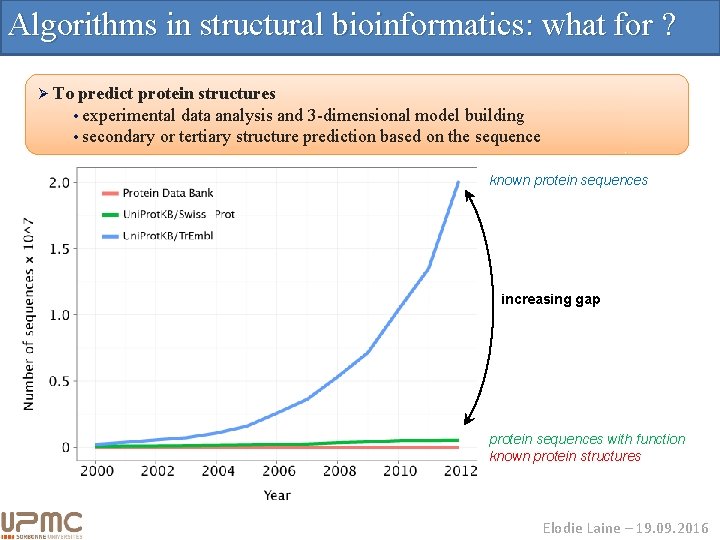
Algorithms in structural bioinformatics: what for ? Ø To predict protein structures • experimental data analysis and 3 -dimensional model building • secondary or tertiary structure prediction based on the sequence known protein sequences increasing gap protein sequences with function known protein structures Elodie Laine – 19. 09. 2016
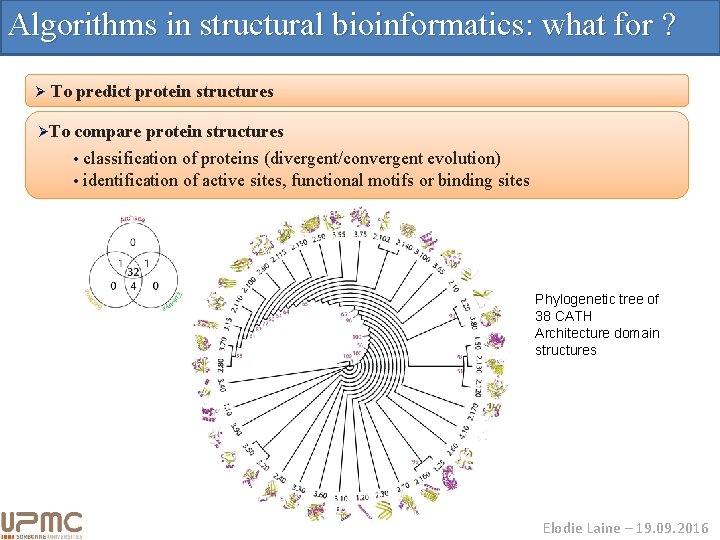
Algorithms in structural bioinformatics: what for ? Ø To predict protein structures ØTo compare protein structures • • classification of proteins (divergent/convergent evolution) identification of active sites, functional motifs or binding sites Phylogenetic tree of 38 CATH Architecture domain structures Elodie Laine – 19. 09. 2016
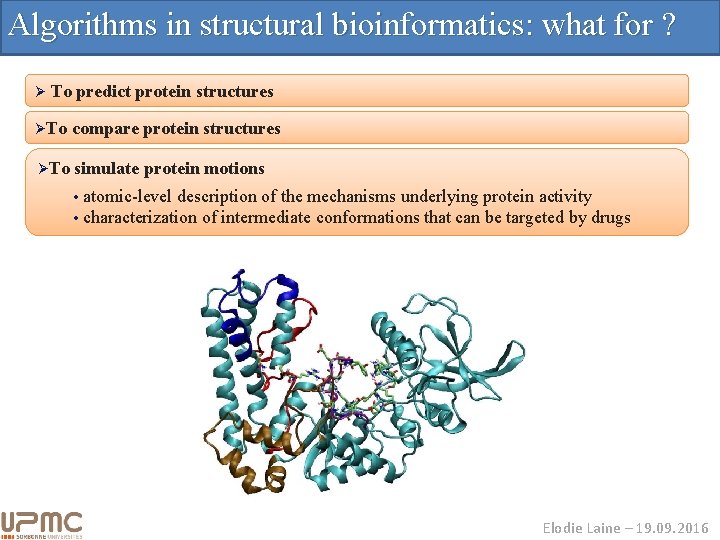
Algorithms in structural bioinformatics: what for ? Ø To predict protein structures ØTo compare protein structures ØTo simulate protein motions • • atomic-level description of the mechanisms underlying protein activity characterization of intermediate conformations that can be targeted by drugs Elodie Laine – 19. 09. 2016
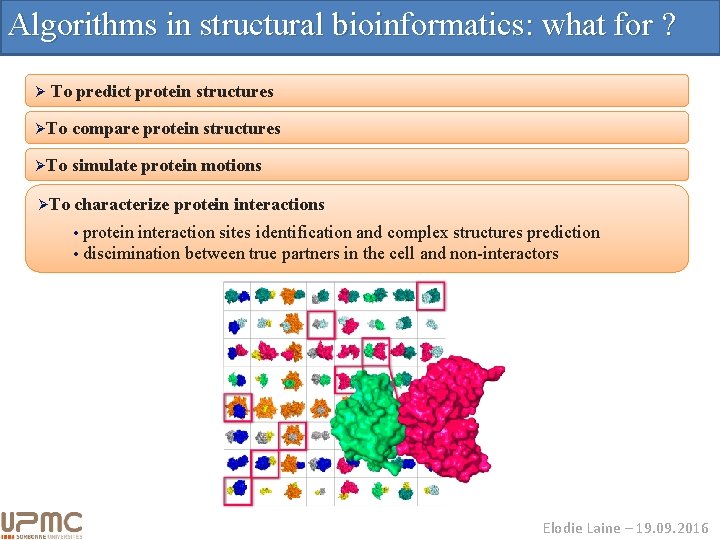
Algorithms in structural bioinformatics: what for ? Ø To predict protein structures ØTo compare protein structures ØTo simulate protein motions ØTo characterize protein interactions • • protein interaction sites identification and complex structures prediction discimination between true partners in the cell and non-interactors Elodie Laine – 19. 09. 2016
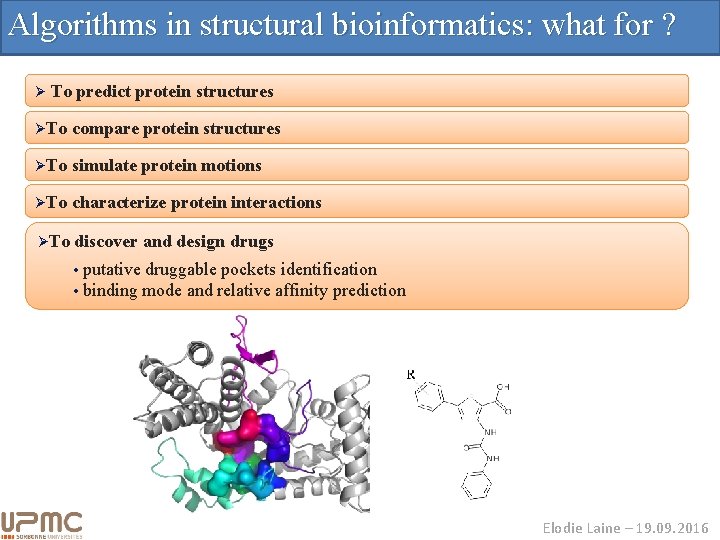
Algorithms in structural bioinformatics: what for ? Ø To predict protein structures ØTo compare protein structures ØTo simulate protein motions ØTo characterize protein interactions ØTo discover and design drugs • • putative druggable pockets identification binding mode and relative affinity prediction Elodie Laine – 19. 09. 2016
Conclusion • Proteins are composed of amino acid residues linked by a peptidic bond. There exist 20 types of amino acids with different physicochemical properties. • A protein is a polypeptidic chain. Four levels of organization determine the 3 D atomic coordinates of a protein structure. • Proteins fulfill various biological functions: structural, enzymatic, of transport… Some proteins can have multiple functions. • Proteins are dynamic and flexible objects which adapt their shape in response to environmental conditions. • Algorithm in structural bioinformatics can help predict and classify protein structures, describe their motions and interactions, design new drugs. Elodie Laine – 19. 09. 2016
- Slides: 34