
Structural and Process Measures to Enable Patient Blood
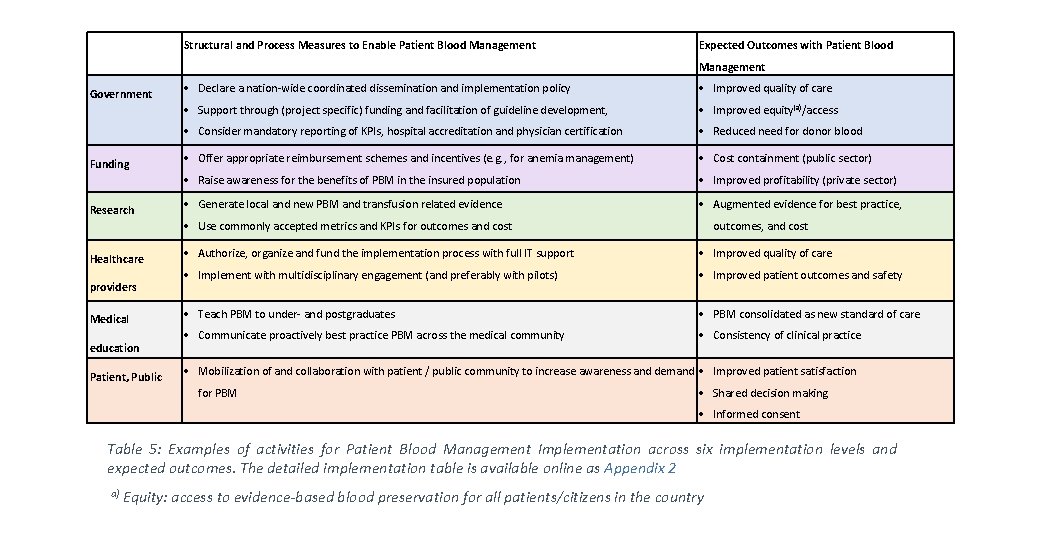
Structural and Process Measures to Enable Patient Blood Management Expected Outcomes with Patient Blood Management Government Funding Research Declare a nation-wide coordinated dissemination and implementation policy Improved quality of care Support through (project specific) funding and facilitation of guideline development, Improved equity(a)/access Consider mandatory reporting of KPIs, hospital accreditation and physician certification Reduced need for donor blood Offer appropriate reimbursement schemes and incentives (e. g. , for anemia management) Cost containment (public sector) Raise awareness for the benefits of PBM in the insured population Improved profitability (private sector) Generate local and new PBM and transfusion related evidence Augmented evidence for best practice, Use commonly accepted metrics and KPIs for outcomes and cost Healthcare providers Medical education Patient, Public outcomes, and cost Authorize, organize and fund the implementation process with full IT support Improved quality of care Implement with multidisciplinary engagement (and preferably with pilots) Improved patient outcomes and safety Teach PBM to under- and postgraduates PBM consolidated as new standard of care Communicate proactively best practice PBM across the medical community Consistency of clinical practice Mobilization of and collaboration with patient / public community to increase awareness and demand Improved patient satisfaction for PBM Shared decision making Informed consent Table 5: Examples of activities for Patient Blood Management Implementation across six implementation levels and expected outcomes. The detailed implementation table is available online as Appendix 2 a) Equity: access to evidence-based blood preservation for all patients/citizens in the country
- Slides: 1