
Structural Analysis 7 th Edition in SI Units



- Slides: 23
Structural Analysis 7 th Edition in SI Units Russell C. Hibbeler Chapter 10: Analysis of Statically Indeterminate Structures by the Force Method
Statically Indeterminate Structures Advantages & Disadvantages For a given loading, the max stress and deflection of an indeterminate structure are generally smaller than those of its statically determinate counterpart Statically indeterminate structure has a tendency to redistribute its load to its redundant supports in cases of faulty designs or overloading In these cases, the structure maintains its stability and collapse is prevented. This is particularly important when sudden lateral loads, such as wind or earthquake, are imposed on the structure
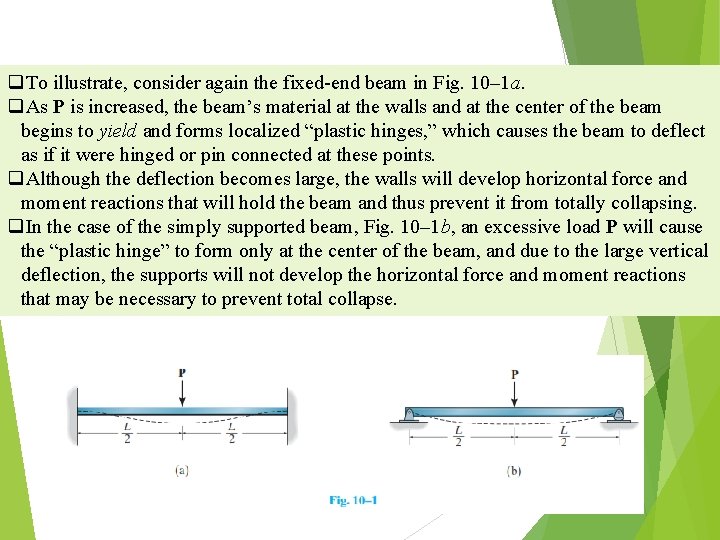
q. To illustrate, consider again the fixed-end beam in Fig. 10– 1 a. q. As P is increased, the beam’s material at the walls and at the center of the beam begins to yield and forms localized “plastic hinges, ” which causes the beam to deflect as if it were hinged or pin connected at these points. q. Although the deflection becomes large, the walls will develop horizontal force and moment reactions that will hold the beam and thus prevent it from totally collapsing. q. In the case of the simply supported beam, Fig. 10– 1 b, an excessive load P will cause the “plastic hinge” to form only at the center of the beam, and due to the large vertical deflection, the supports will not develop the horizontal force and moment reactions that may be necessary to prevent total collapse.
Statically Indeterminate Structures Advantages & Disadvantages Although statically indeterminate structure can support loading with thinner members & with increased stability compared to their statically determinate structures, the cost savings in material must be compared with the added cost to fabricate the structure since often it becomes more costly to construct the supports & joints of an indeterminate structure Differential displacement of the structures may occur Chapter 10: Analysis of Statically Indeterminate Structures by the Force Method Structural Analysis 7 th Edition © 2009 Pearson Education South Asia Pte Ltd
Statically Indeterminate Structures Method of Analysis When analyzing any indeterminate structure, it is necessary to satisfy equilibrium, compatibility, and force-displacement requirements for the structure. Equilibrium is satisfied when the reactive forces hold the structure at rest Compatibility is satisfied when the various segments of the structure fit together without intentional breaks or overlaps. The force-displacement requirements depend upon the way the material responds; in this text we have assumed linear elastic response. In general there are two different ways to satisfy these requirements when analyzing a statically indeterminate structure: 1. Force Method 2. Displacement Method
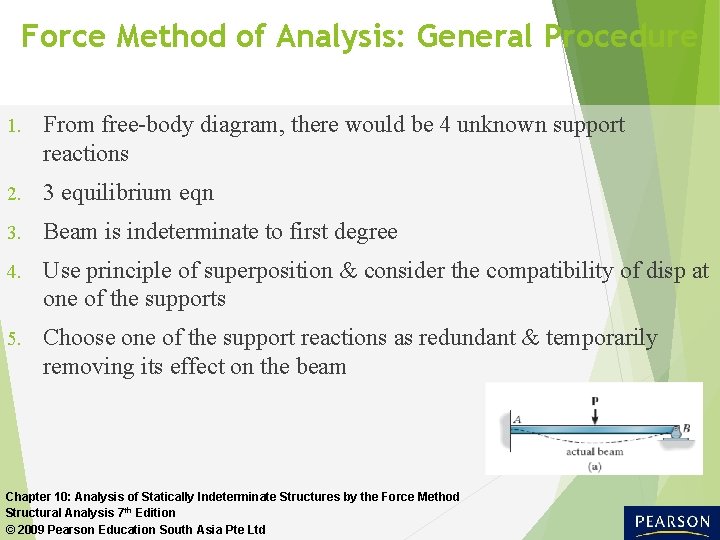
Force Method of Analysis: General Procedure 1. From free-body diagram, there would be 4 unknown support reactions 2. 3 equilibrium eqn 3. Beam is indeterminate to first degree 4. Use principle of superposition & consider the compatibility of disp at one of the supports 5. Choose one of the support reactions as redundant & temporarily removing its effect on the beam Chapter 10: Analysis of Statically Indeterminate Structures by the Force Method Structural Analysis 7 th Edition © 2009 Pearson Education South Asia Pte Ltd
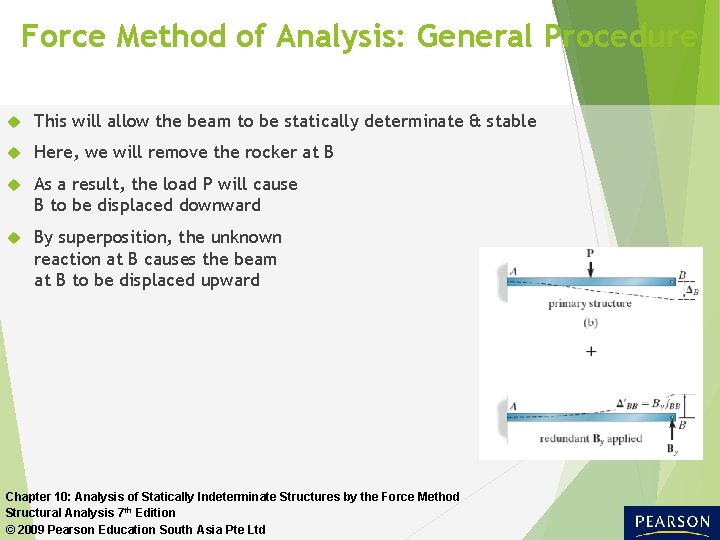
Force Method of Analysis: General Procedure This will allow the beam to be statically determinate & stable Here, we will remove the rocker at B As a result, the load P will cause B to be displaced downward By superposition, the unknown reaction at B causes the beam at B to be displaced upward Chapter 10: Analysis of Statically Indeterminate Structures by the Force Method Structural Analysis 7 th Edition © 2009 Pearson Education South Asia Pte Ltd
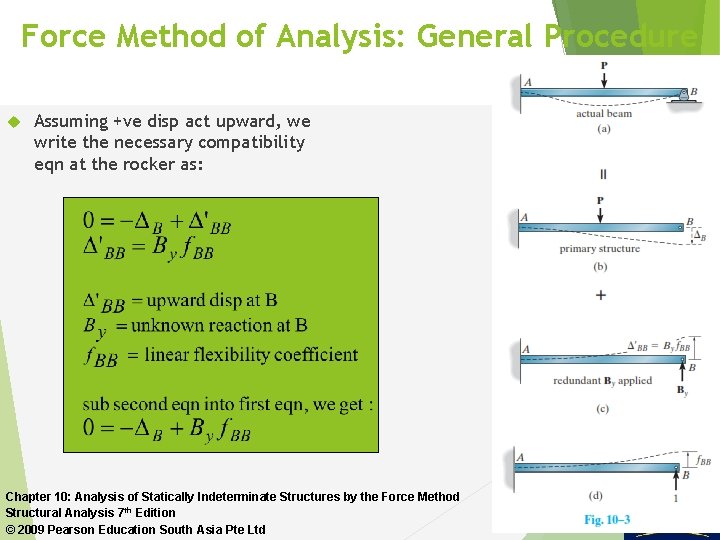
Force Method of Analysis: General Procedure Assuming +ve disp act upward, we write the necessary compatibility eqn at the rocker as: Chapter 10: Analysis of Statically Indeterminate Structures by the Force Method Structural Analysis 7 th Edition © 2009 Pearson Education South Asia Pte Ltd
Force Method of Analysis: General Procedure Calculate B and f. BB, then By can be obtained Reactions at wall A can then be determined from eqn of equilibrium The choice of redundant is arbitrary Chapter 10: Analysis of Statically Indeterminate Structures by the Force Method Structural Analysis 7 th Edition © 2009 Pearson Education South Asia Pte Ltd
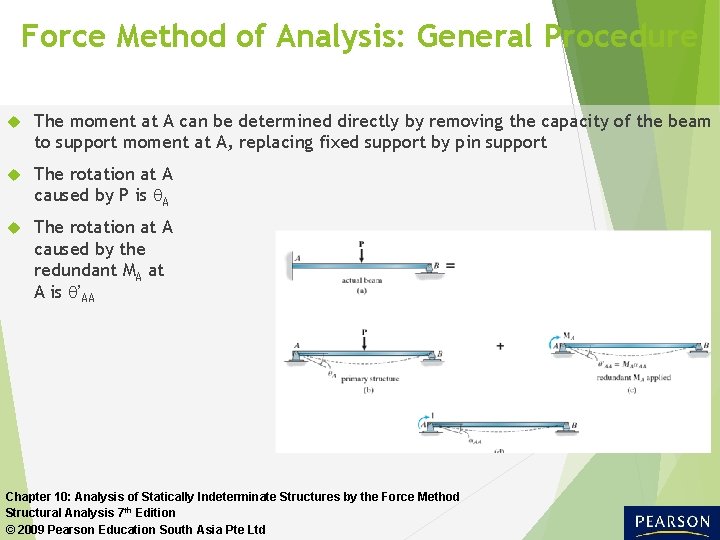
Force Method of Analysis: General Procedure The moment at A can be determined directly by removing the capacity of the beam to support moment at A, replacing fixed support by pin support The rotation at A caused by P is A The rotation at A caused by the redundant MA at A is ’AA Chapter 10: Analysis of Statically Indeterminate Structures by the Force Method Structural Analysis 7 th Edition © 2009 Pearson Education South Asia Pte Ltd
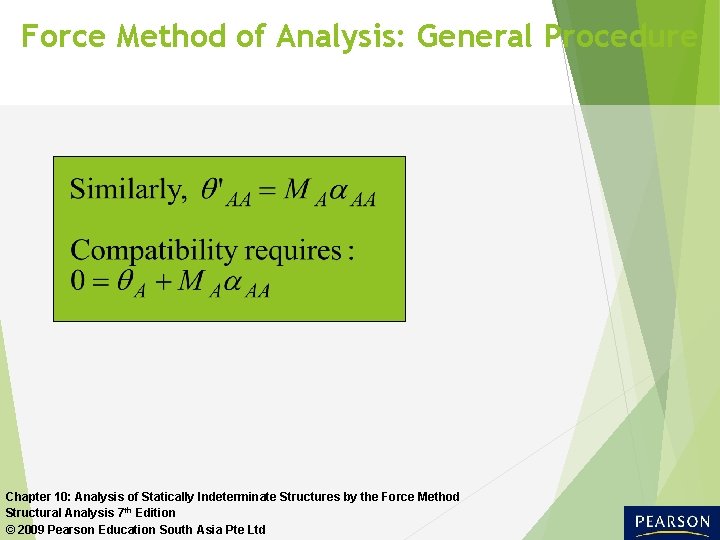
Force Method of Analysis: General Procedure Chapter 10: Analysis of Statically Indeterminate Structures by the Force Method Structural Analysis 7 th Edition © 2009 Pearson Education South Asia Pte Ltd
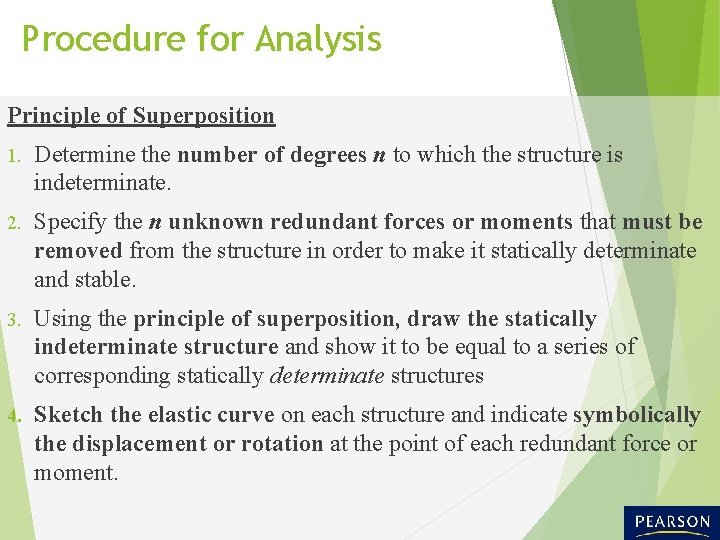
Procedure for Analysis Principle of Superposition 1. Determine the number of degrees n to which the structure is indeterminate. 2. Specify the n unknown redundant forces or moments that must be removed from the structure in order to make it statically determinate and stable. 3. Using the principle of superposition, draw the statically indeterminate structure and show it to be equal to a series of corresponding statically determinate structures 4. Sketch the elastic curve on each structure and indicate symbolically the displacement or rotation at the point of each redundant force or moment.
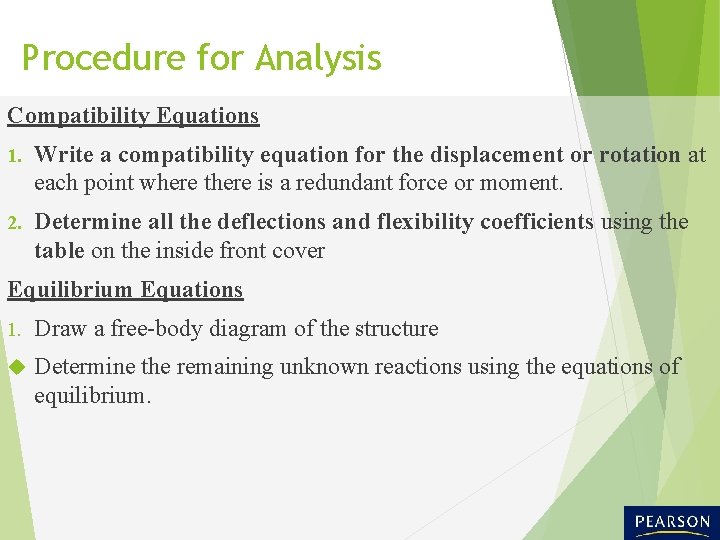
Procedure for Analysis Compatibility Equations 1. Write a compatibility equation for the displacement or rotation at each point where there is a redundant force or moment. 2. Determine all the deflections and flexibility coefficients using the table on the inside front cover Equilibrium Equations 1. Draw a free-body diagram of the structure Determine the remaining unknown reactions using the equations of equilibrium.
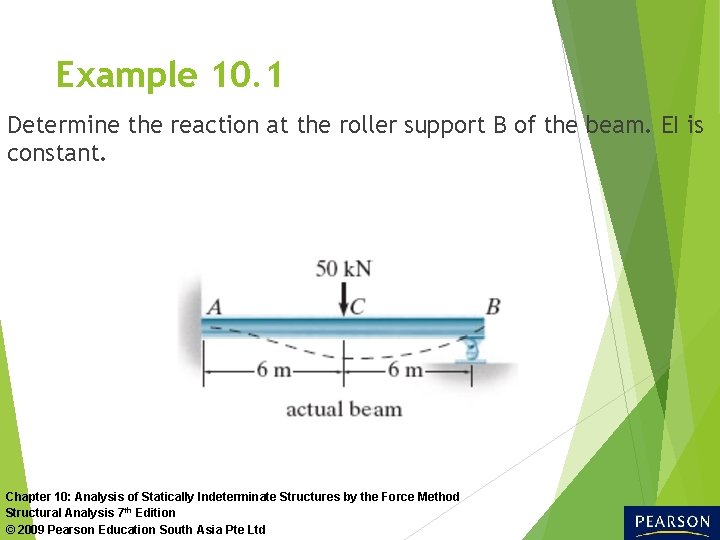
Example 10. 1 Determine the reaction at the roller support B of the beam. EI is constant. Chapter 10: Analysis of Statically Indeterminate Structures by the Force Method Structural Analysis 7 th Edition © 2009 Pearson Education South Asia Pte Ltd
Solution Principle of superposition By inspection, the beam is statically indeterminate to the first degree. The redundant will be taken as By. We assume By acts upward on the beam. Chapter 10: Analysis of Statically Indeterminate Structures by the Force Method Structural Analysis 7 th Edition © 2009 Pearson Education South Asia Pte Ltd
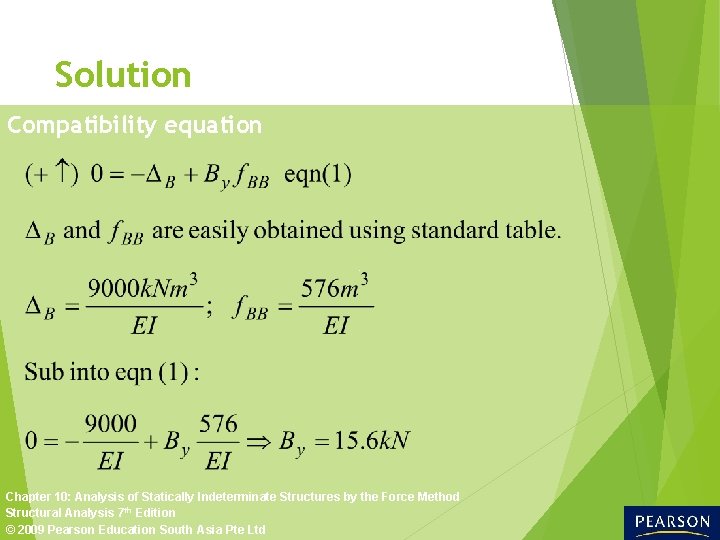
Solution Compatibility equation Chapter 10: Analysis of Statically Indeterminate Structures by the Force Method Structural Analysis 7 th Edition © 2009 Pearson Education South Asia Pte Ltd
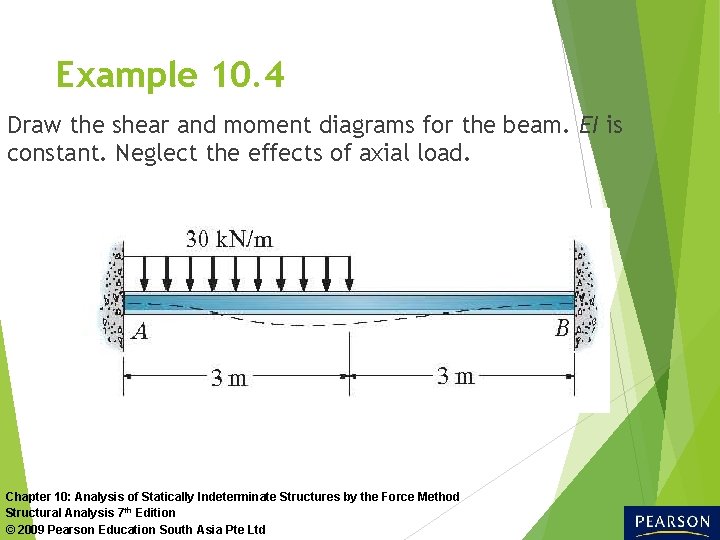
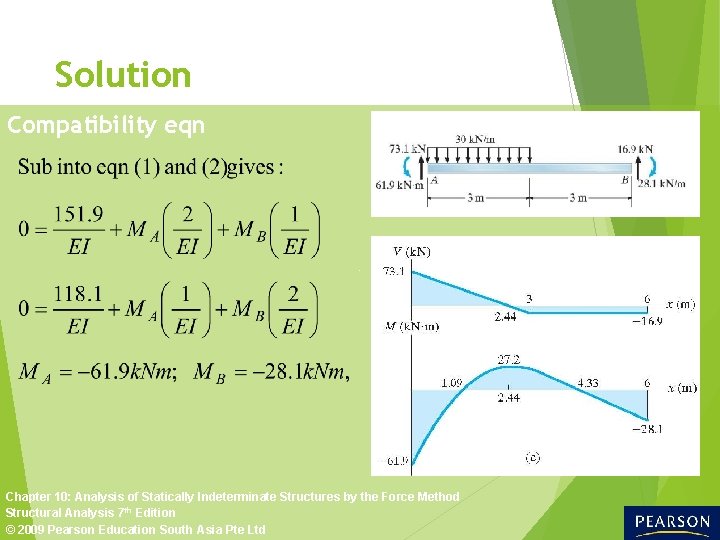
Example 10. 4 Draw the shear and moment diagrams for the beam. EI is constant. Neglect the effects of axial load. Chapter 10: Analysis of Statically Indeterminate Structures by the Force Method Structural Analysis 7 th Edition © 2009 Pearson Education South Asia Pte Ltd
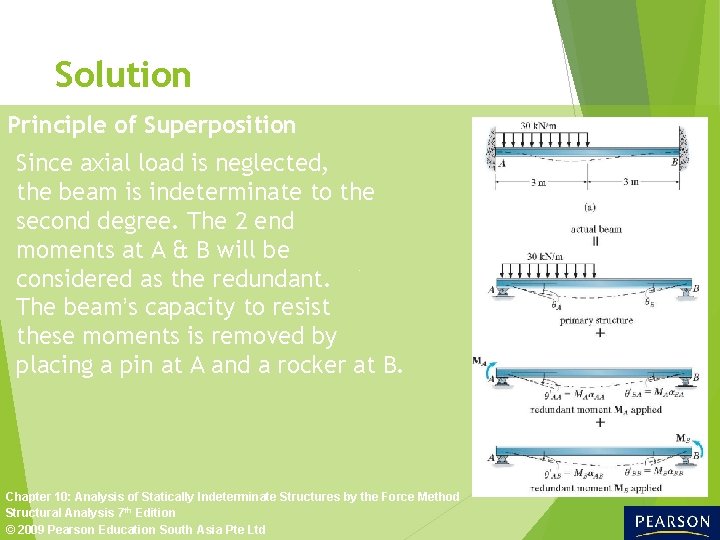
Solution Principle of Superposition Since axial load is neglected, the beam is indeterminate to the second degree. The 2 end moments at A & B will be considered as the redundant. The beam’s capacity to resist these moments is removed by placing a pin at A and a rocker at B. Chapter 10: Analysis of Statically Indeterminate Structures by the Force Method Structural Analysis 7 th Edition © 2009 Pearson Education South Asia Pte Ltd
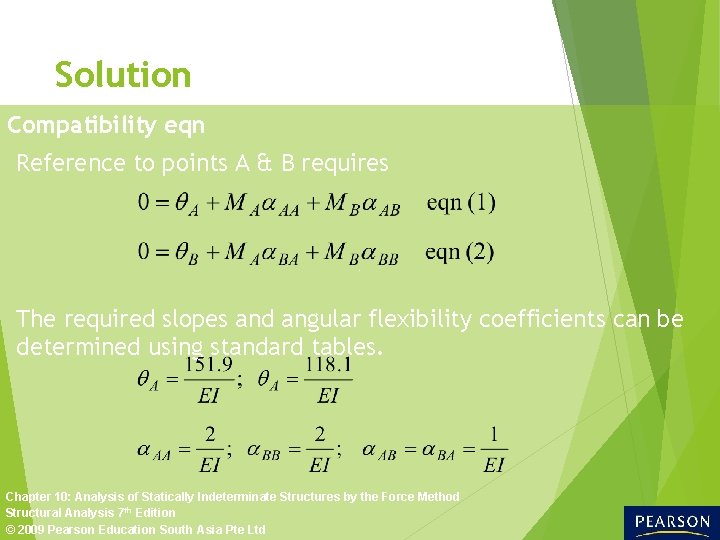
Solution Compatibility eqn Reference to points A & B requires The required slopes and angular flexibility coefficients can be determined using standard tables. Chapter 10: Analysis of Statically Indeterminate Structures by the Force Method Structural Analysis 7 th Edition © 2009 Pearson Education South Asia Pte Ltd
Solution Compatibility eqn Chapter 10: Analysis of Statically Indeterminate Structures by the Force Method Structural Analysis 7 th Edition © 2009 Pearson Education South Asia Pte Ltd
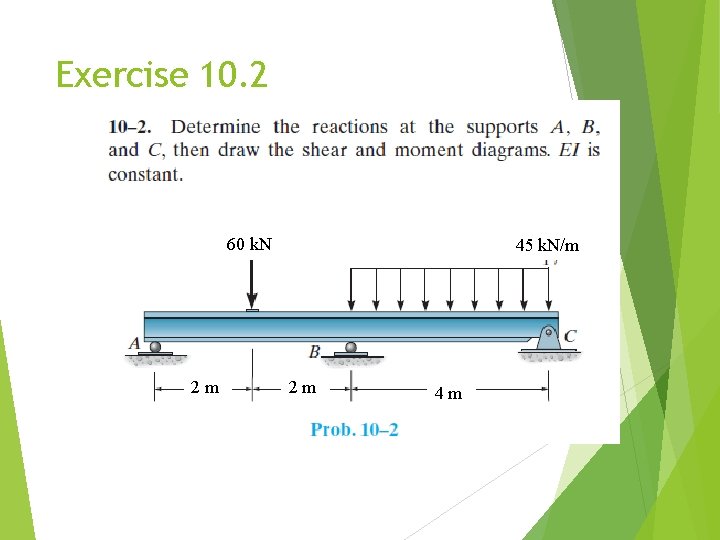
Exercise 10. 2 60 k. N 2 m 45 k. N/m 2 m 4 m
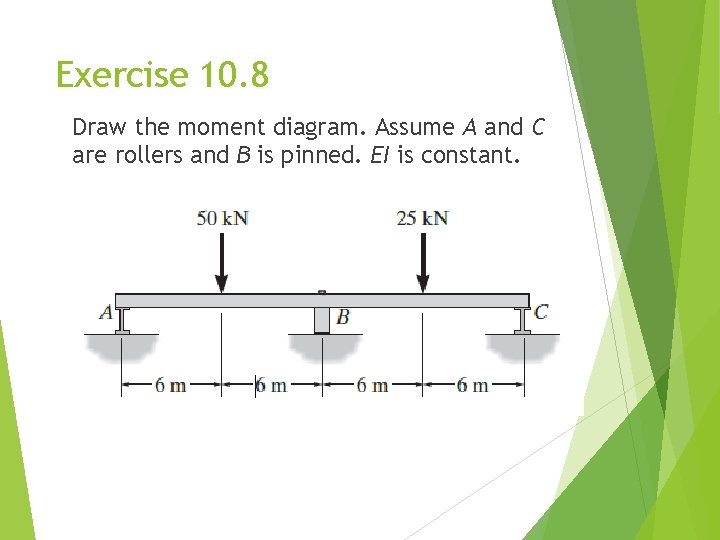
Exercise 10. 8 Draw the moment diagram. Assume A and C are rollers and B is pinned. EI is constant.
Thank you…