
Structs 112304 CS 150 Introduction to Computer Science

- Slides: 15
Structs 11/23/04 CS 150 Introduction to Computer Science 1 1
Last Time S Today we will o Look at a new way of storing data called structs (short for structures) 11/23/04 CS 150 Introduction to Computer Science 1 2
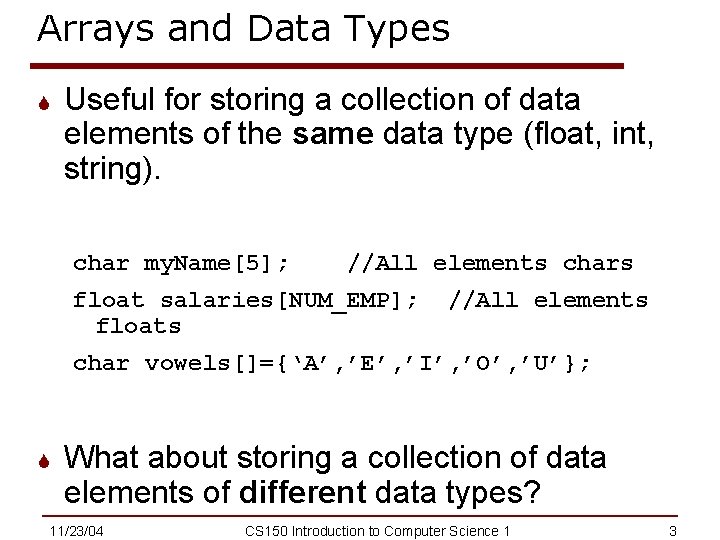
Arrays and Data Types S Useful for storing a collection of data elements of the same data type (float, int, string). char my. Name[5]; //All elements chars float salaries[NUM_EMP]; floats //All elements char vowels[]={‘A’, ’E’, ’I’, ’O’, ’U’}; S What about storing a collection of data elements of different data types? 11/23/04 CS 150 Introduction to Computer Science 1 3
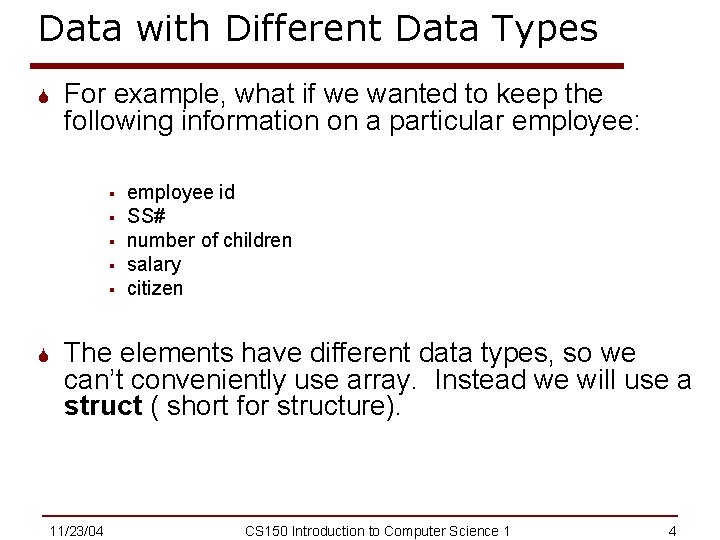
Data with Different Data Types S For example, what if we wanted to keep the following information on a particular employee: § § § S employee id SS# number of children salary citizen The elements have different data types, so we can’t conveniently use array. Instead we will use a struct ( short for structure). 11/23/04 CS 150 Introduction to Computer Science 1 4
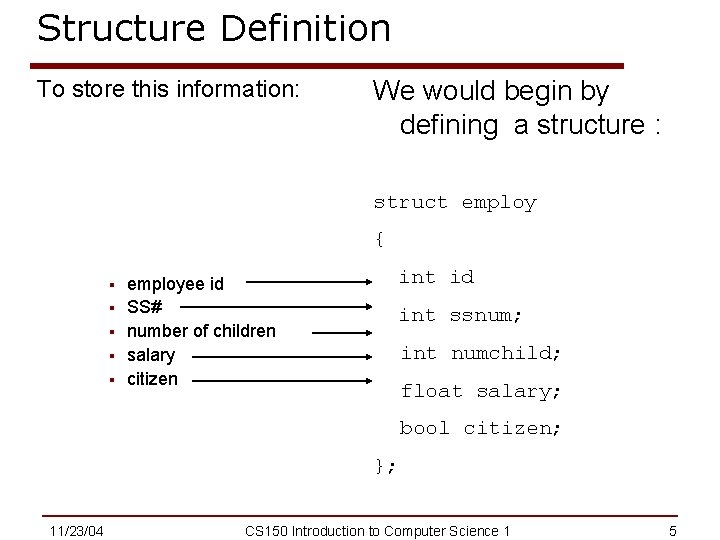
Structure Definition To store this information: We would begin by defining a structure : struct employ { § § § int id employee id SS# number of children salary citizen int ssnum; int numchild; float salary; bool citizen; }; 11/23/04 CS 150 Introduction to Computer Science 1 5
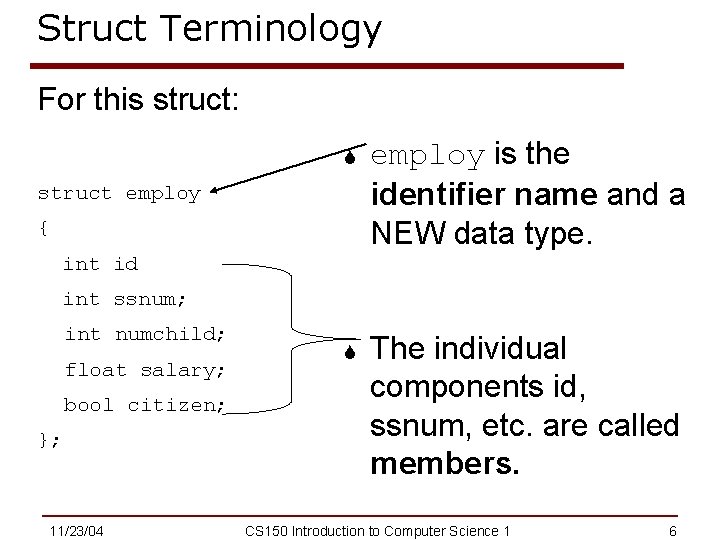
Struct Terminology For this struct: S employ is the identifier name and a NEW data type. S The individual components id, ssnum, etc. are called members. struct employ { int id int ssnum; int numchild; float salary; bool citizen; }; 11/23/04 CS 150 Introduction to Computer Science 1 6
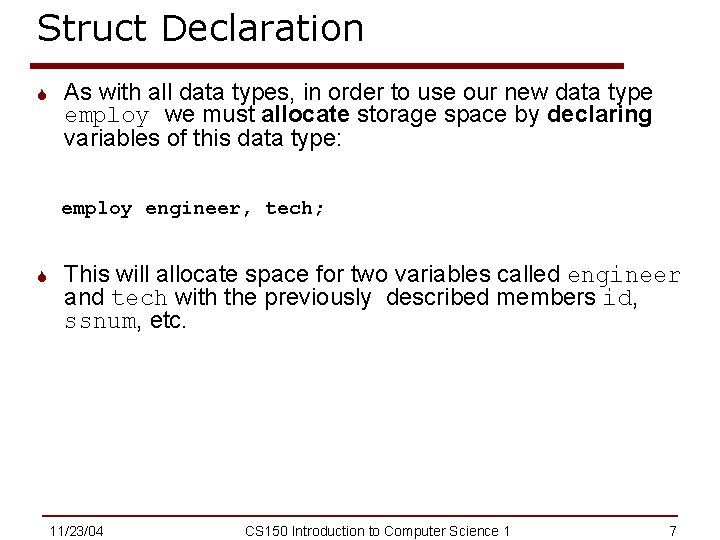
Struct Declaration S As with all data types, in order to use our new data type employ we must allocate storage space by declaring variables of this data type: employ engineer, tech; S This will allocate space for two variables called engineer and tech with the previously described members id, ssnum, etc. 11/23/04 CS 150 Introduction to Computer Science 1 7
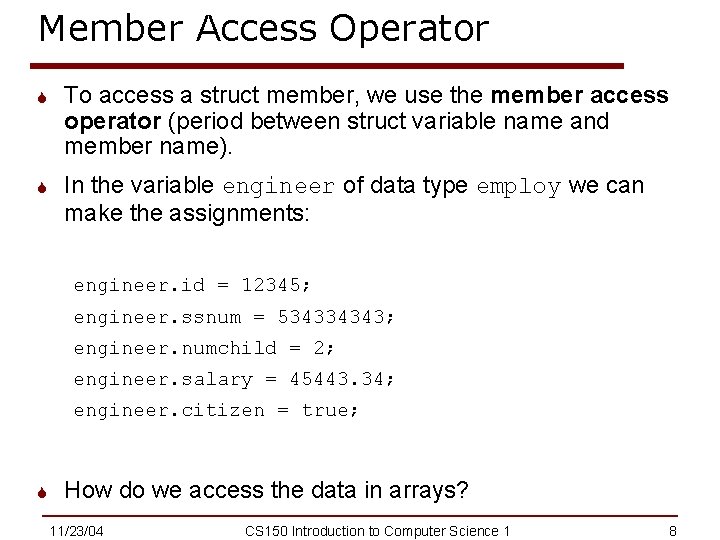
Member Access Operator S To access a struct member, we use the member access operator (period between struct variable name and member name). S In the variable engineer of data type employ we can make the assignments: engineer. id = 12345; engineer. ssnum = 534334343; engineer. numchild = 2; engineer. salary = 45443. 34; engineer. citizen = true; S How do we access the data in arrays? 11/23/04 CS 150 Introduction to Computer Science 1 8
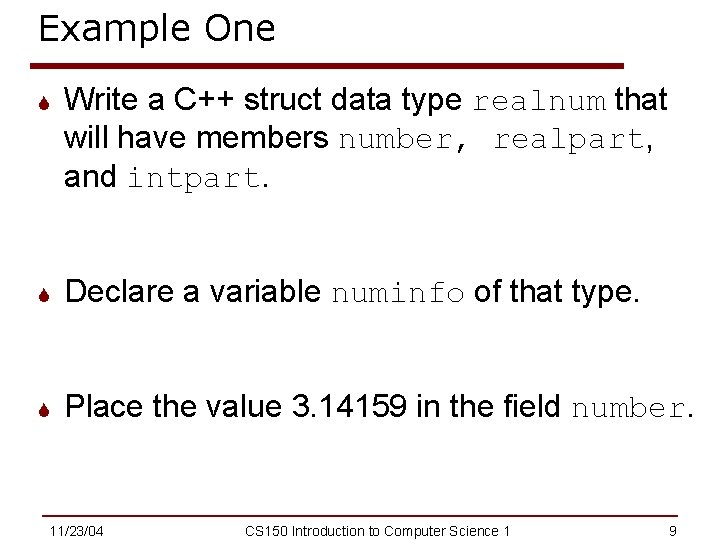
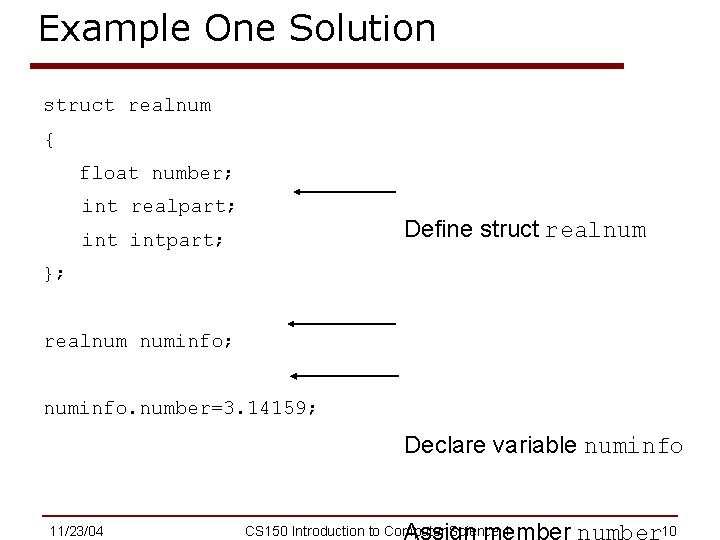
Example One S Write a C++ struct data type realnum that will have members number, realpart, and intpart. S Declare a variable numinfo of that type. S Place the value 3. 14159 in the field number. 11/23/04 CS 150 Introduction to Computer Science 1 9
Example One Solution struct realnum { float number; int realpart; Define struct realnum intpart; }; realnum numinfo; numinfo. number=3. 14159; Declare variable numinfo 11/23/04 Assign member number 10 CS 150 Introduction to Computer Science 1
Structs as function arguments S Structs can be passed to functions by reference or value in the same manner that other data types have been passed. S Generally, passing structs by reference is preferred since passing by value requires a local copy of the struct be created within the function’s variables. 11/23/04 CS 150 Introduction to Computer Science 1 11
Example Two S Write a C++ function split that accepts a variable of type realnum. S Assign the integer part of the number to the member variable intpart and the real part of the number to the member variable realpart. 11/23/04 CS 150 Introduction to Computer Science 1 12
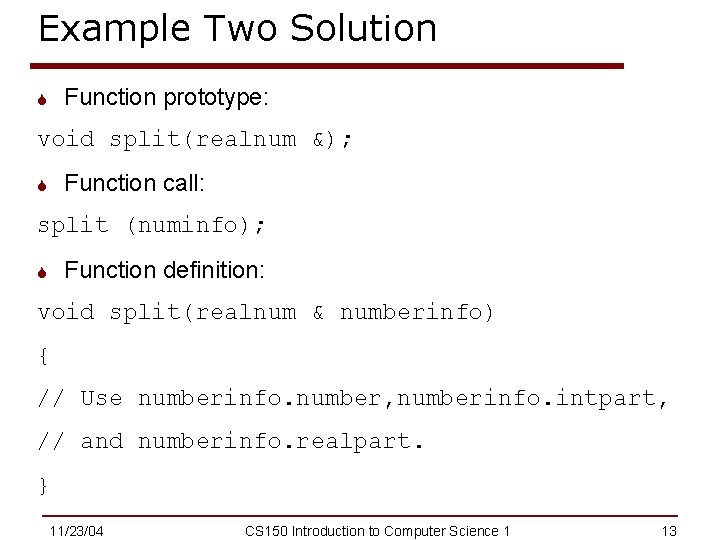
Example Two Solution Function prototype: S void split(realnum &); Function call: S split (numinfo); Function definition: S void split(realnum & numberinfo) { // Use numberinfo. number, numberinfo. intpart, // and numberinfo. realpart. } 11/23/04 CS 150 Introduction to Computer Science 1 13
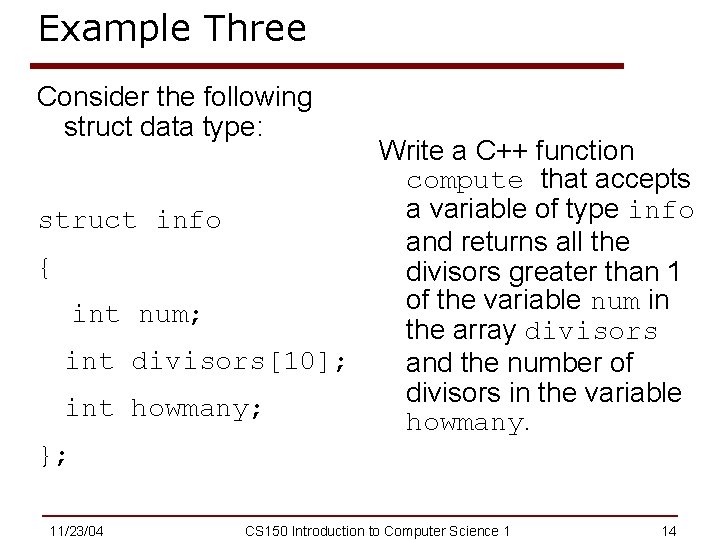
Example Three Consider the following struct data type: struct info { int num; int divisors[10]; int howmany; Write a C++ function compute that accepts a variable of type info and returns all the divisors greater than 1 of the variable num in the array divisors and the number of divisors in the variable howmany. }; 11/23/04 CS 150 Introduction to Computer Science 1 14
Summary S In today’s lecture we covered o structures 11/23/04 CS 150 Introduction to Computer Science 1 15