
struct Copy Operation structs in C 1 In


- Slides: 8
struct Copy Operation structs in C 1 In C, variables are copied in three situations: - when used as the right side of an assignment operation - when used as a parameter in a function call - when used as the return value from a function struct Location. Type { int X, Y; }; typedef struct Location. Type Location; . . . Location A; A. X = 1; A. Y = 5; Location B; B = A; // members of A are copied into the // corresponding members of B In most cases, the default copy mechanism for struct types is adequate. CS@VT June 2010 Computer Organization I © 2006 -10 Mc. Quain, Feng & Ribbens
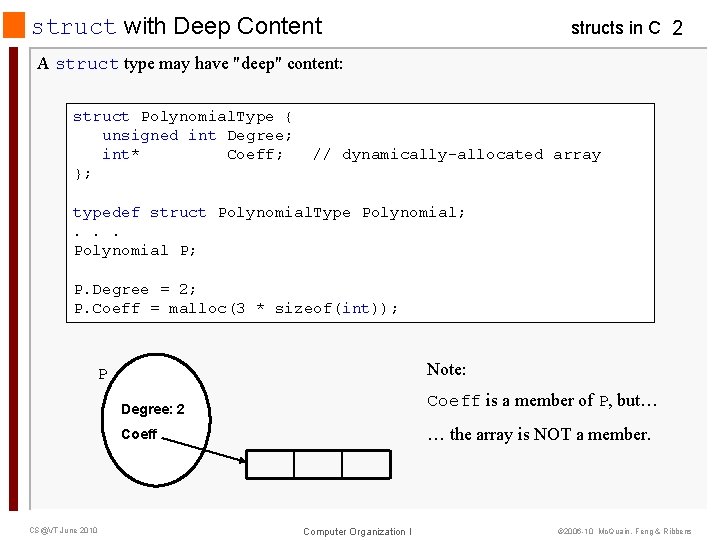
struct with Deep Content structs in C 2 A struct type may have "deep" content: struct Polynomial. Type { unsigned int Degree; int* Coeff; }; // dynamically-allocated array typedef struct Polynomial. Type Polynomial; . . . Polynomial P; P. Degree = 2; P. Coeff = malloc(3 * sizeof(int)); Note: P CS@VT June 2010 Degree: 2 Coeff is a member of P, but… Coeff … the array is NOT a member. Computer Organization I © 2006 -10 Mc. Quain, Feng & Ribbens
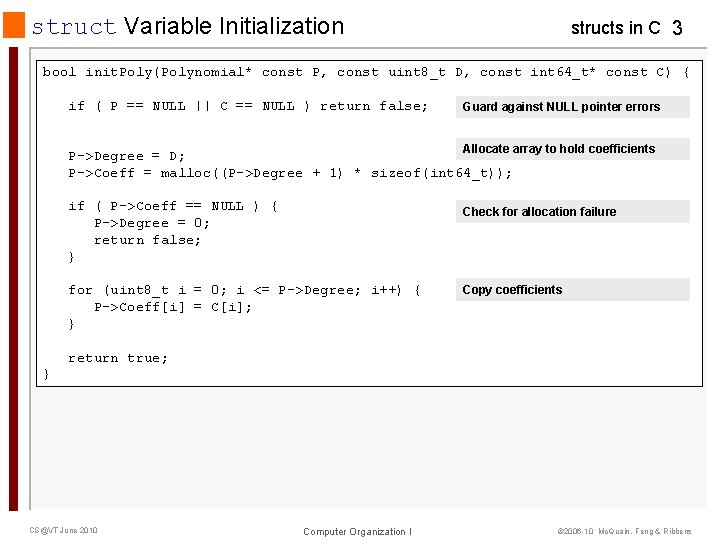
struct Variable Initialization structs in C 3 bool init. Poly(Polynomial* const P, const uint 8_t D, const int 64_t* const C) { if ( P == NULL || C == NULL ) return false; Guard against NULL pointer errors Allocate array to hold coefficients P->Degree = D; P->Coeff = malloc((P->Degree + 1) * sizeof(int 64_t)); if ( P->Coeff == NULL ) { P->Degree = 0; return false; } Check for allocation failure for (uint 8_t i = 0; i <= P->Degree; i++) { P->Coeff[i] = C[i]; } Copy coefficients return true; } CS@VT June 2010 Computer Organization I © 2006 -10 Mc. Quain, Feng & Ribbens
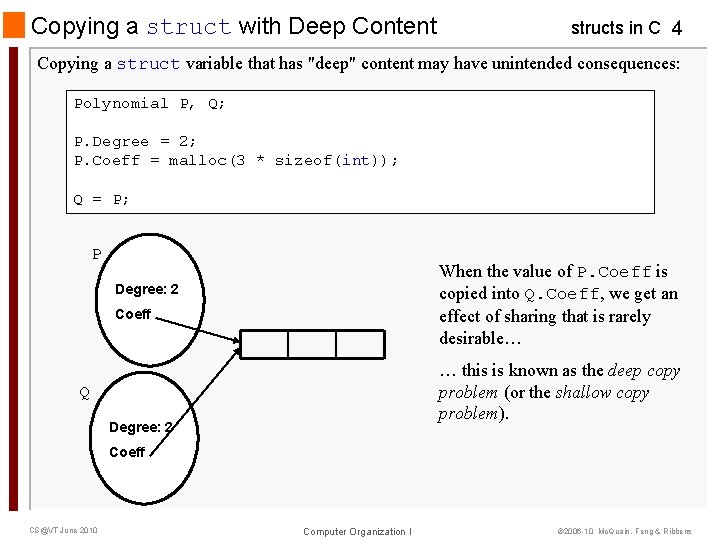
Copying a struct with Deep Content structs in C 4 Copying a struct variable that has "deep" content may have unintended consequences: Polynomial P, Q; P. Degree = 2; P. Coeff = malloc(3 * sizeof(int)); Q = P; P When the value of P. Coeff is copied into Q. Coeff, we get an effect of sharing that is rarely desirable… Degree: 2 Coeff … this is known as the deep copy problem (or the shallow copy problem). Q Degree: 2 Coeff CS@VT June 2010 Computer Organization I © 2006 -10 Mc. Quain, Feng & Ribbens
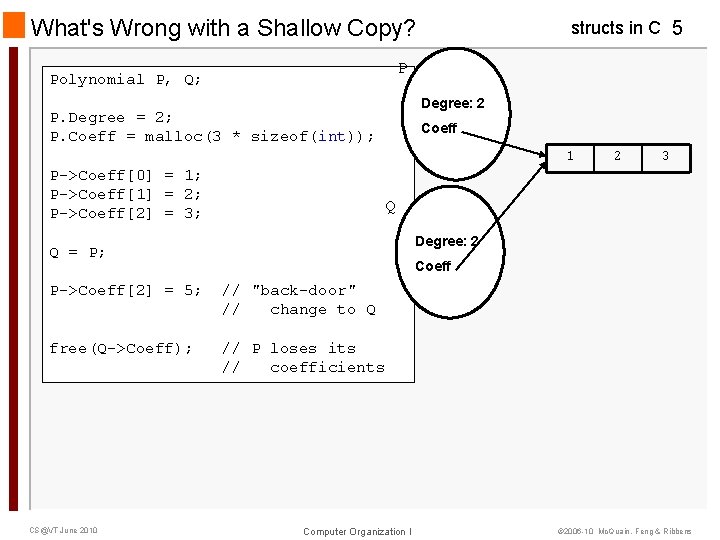
What's Wrong with a Shallow Copy? structs in C 5 P Polynomial P, Q; Degree: 2 P. Degree = 2; P. Coeff = malloc(3 * sizeof(int)); Coeff 1 P->Coeff[0] = 1; P->Coeff[1] = 2; P->Coeff[2] = 3; 3 Q Degree: 2 Q = P; Coeff P->Coeff[2] = 5; // "back-door" // change to Q free(Q->Coeff); // P loses its // coefficients CS@VT June 2010 2 Computer Organization I © 2006 -10 Mc. Quain, Feng & Ribbens
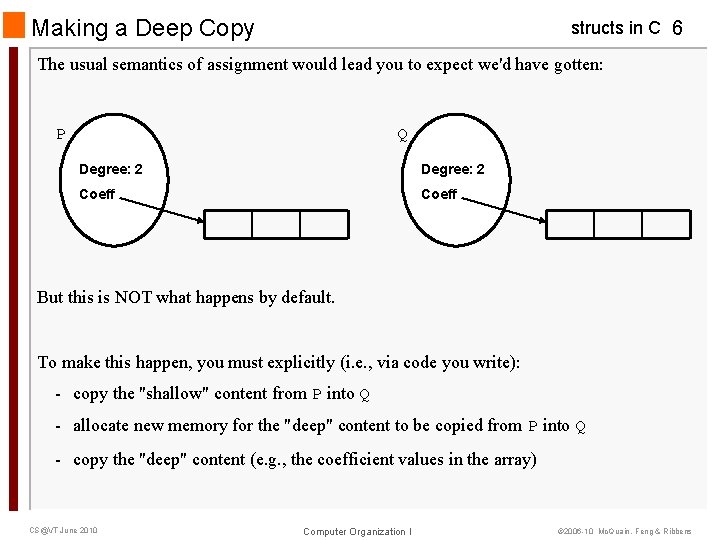
Making a Deep Copy structs in C 6 The usual semantics of assignment would lead you to expect we'd have gotten: P Q Degree: 2 Coeff But this is NOT what happens by default. To make this happen, you must explicitly (i. e. , via code you write): - copy the "shallow" content from P into Q - allocate new memory for the "deep" content to be copied from P into Q - copy the "deep" content (e. g. , the coefficient values in the array) CS@VT June 2010 Computer Organization I © 2006 -10 Mc. Quain, Feng & Ribbens
Implementing a Deep Copy structs in C 7 In C we handle deep copying by implementing an appropriate function: /** * Initializes *Target from *Source as described below. * * Pre: Target != NULL, * Source->C[i] initialized for i = 0: Source->Degree * Post: Target->Degree == Source->Degree * Target->Coeff != Source->Coeff * Target->Coeff[i] == Source->Coeff[i] for i = 0: Source->Degree * * Returns: false if *Target cannot be properly initialized, true otherwise */ bool copy. Poly(Polynomial* const Target, const Polynomial* const Source) {. . . } CS@VT June 2010 Computer Organization I © 2006 -10 Mc. Quain, Feng & Ribbens
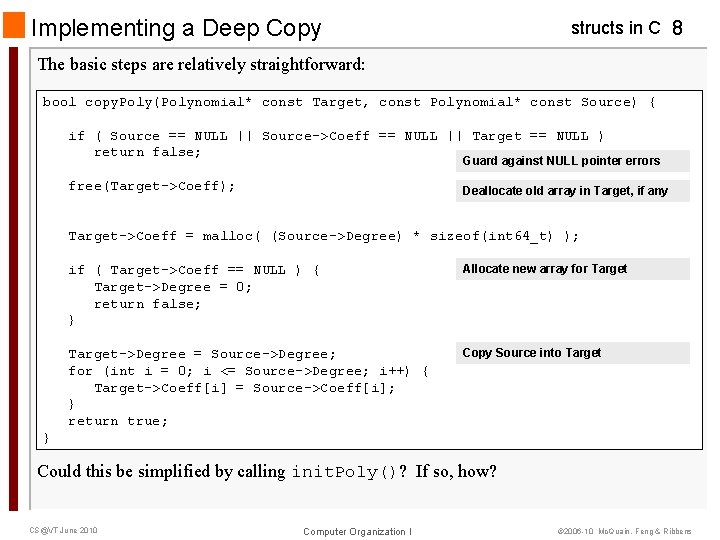
Implementing a Deep Copy structs in C 8 The basic steps are relatively straightforward: bool copy. Poly(Polynomial* const Target, const Polynomial* const Source) { if ( Source == NULL || Source->Coeff == NULL || Target == NULL ) return false; Guard against NULL pointer errors free(Target->Coeff); Deallocate old array in Target, if any Target->Coeff = malloc( (Source->Degree) * sizeof(int 64_t) ); if ( Target->Coeff == NULL ) { Target->Degree = 0; return false; } Allocate new array for Target->Degree = Source->Degree; for (int i = 0; i <= Source->Degree; i++) { Target->Coeff[i] = Source->Coeff[i]; } return true; Copy Source into Target } Could this be simplified by calling init. Poly()? If so, how? CS@VT June 2010 Computer Organization I © 2006 -10 Mc. Quain, Feng & Ribbens