
Strong Hadron Cooling for the Electron Ion Collider
- Slides: 24
Strong Hadron Cooling for the Electron Ion Collider Ferdinand Willeke, BNL APS Meeting, Boston, 1 August 2019
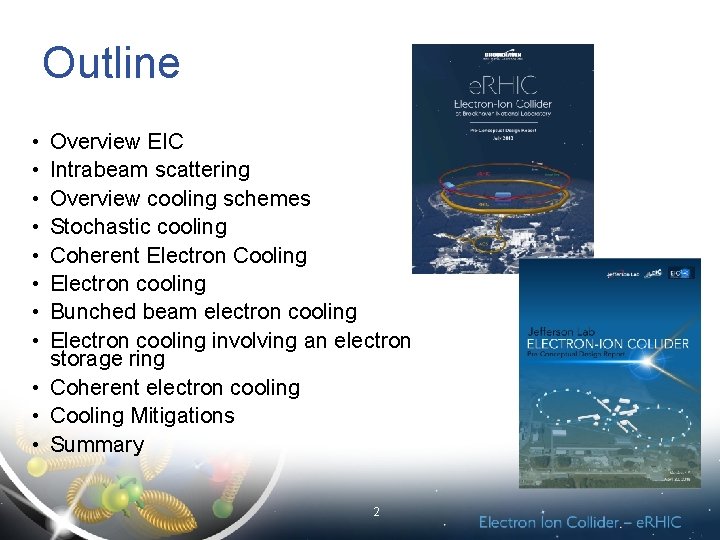
Outline • • Overview EIC Intrabeam scattering Overview cooling schemes Stochastic cooling Coherent Electron Cooling Electron cooling Bunched beam electron cooling Electron cooling involving an electron storage ring • Coherent electron cooling • Cooling Mitigations • Summary 2
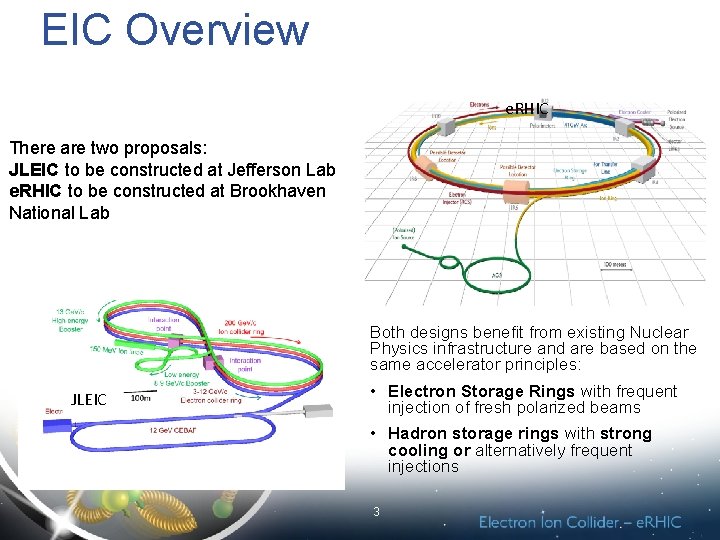
EIC Overview e. RHIC There are two proposals: JLEIC to be constructed at Jefferson Lab e. RHIC to be constructed at Brookhaven National Lab Both designs benefit from existing Nuclear Physics infrastructure and are based on the same accelerator principles: JLEIC • Electron Storage Rings with frequent injection of fresh polarized beams • Hadron storage rings with strong cooling or alternatively frequent injections 3
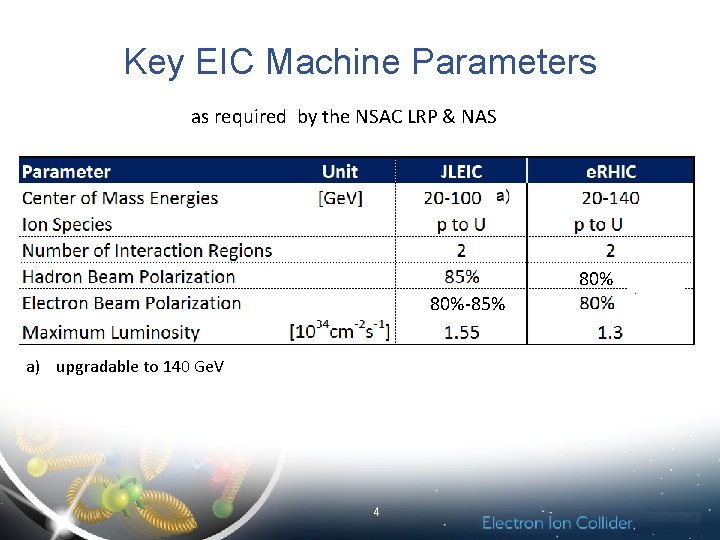
Key EIC Machine Parameters as required by the NSAC LRP & NAS 80%-85%f) a) upgradable to 140 Ge. V 4 80% b) c)
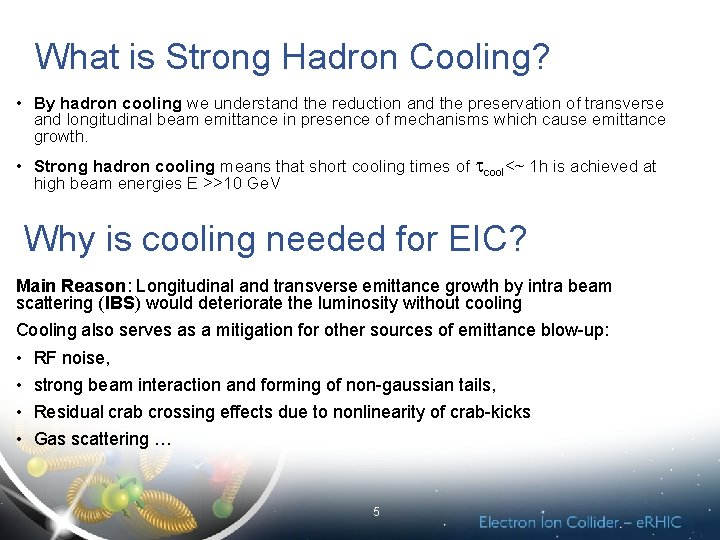
What is Strong Hadron Cooling? • By hadron cooling we understand the reduction and the preservation of transverse and longitudinal beam emittance in presence of mechanisms which cause emittance growth. • Strong hadron cooling means that short cooling times of tcool<~ 1 h is achieved at high beam energies E >>10 Ge. V Why is cooling needed for EIC? Main Reason: Longitudinal and transverse emittance growth by intra beam scattering (IBS) would deteriorate the luminosity without cooling Cooling also serves as a mitigation for other sources of emittance blow-up: • • RF noise, strong beam interaction and forming of non-gaussian tails, Residual crab crossing effects due to nonlinearity of crab-kicks Gas scattering … 5
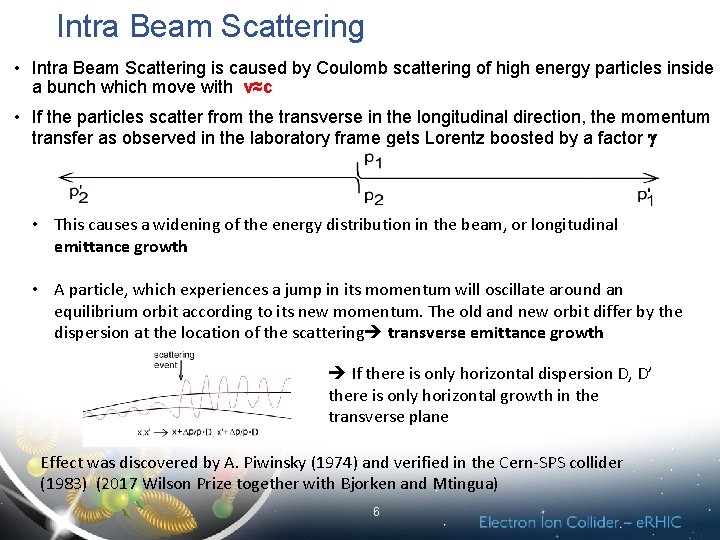
Intra Beam Scattering • Intra Beam Scattering is caused by Coulomb scattering of high energy particles inside a bunch which move with v≈c • If the particles scatter from the transverse in the longitudinal direction, the momentum transfer as observed in the laboratory frame gets Lorentz boosted by a factor g • This causes a widening of the energy distribution in the beam, or longitudinal emittance growth • A particle, which experiences a jump in its momentum will oscillate around an equilibrium orbit according to its new momentum. The old and new orbit differ by the dispersion at the location of the scattering transverse emittance growth If there is only horizontal dispersion D, D’ there is only horizontal growth in the transverse plane Effect was discovered by A. Piwinsky (1974) and verified in the Cern-SPS collider (1983) (2017 Wilson Prize together with Bjorken and Mtingua) 6
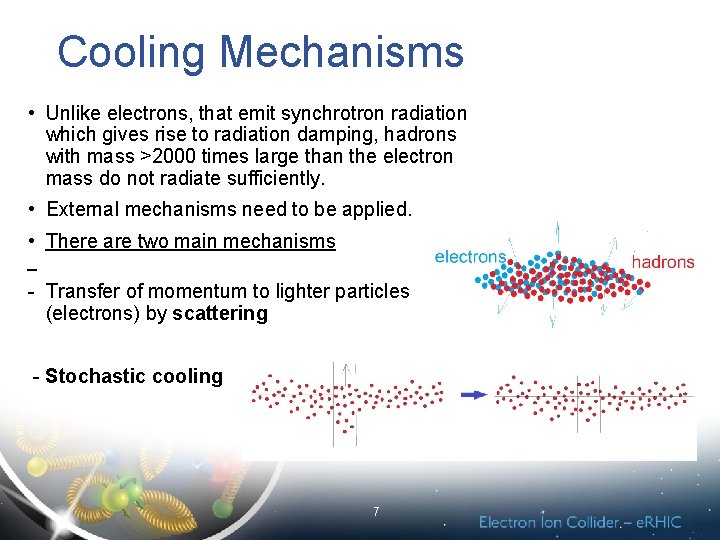
Cooling Mechanisms • Unlike electrons, that emit synchrotron radiation which gives rise to radiation damping, hadrons with mass >2000 times large than the electron mass do not radiate sufficiently. • External mechanisms need to be applied. • There are two main mechanisms - Transfer of momentum to lighter particles (electrons) by scattering - Stochastic cooling 7
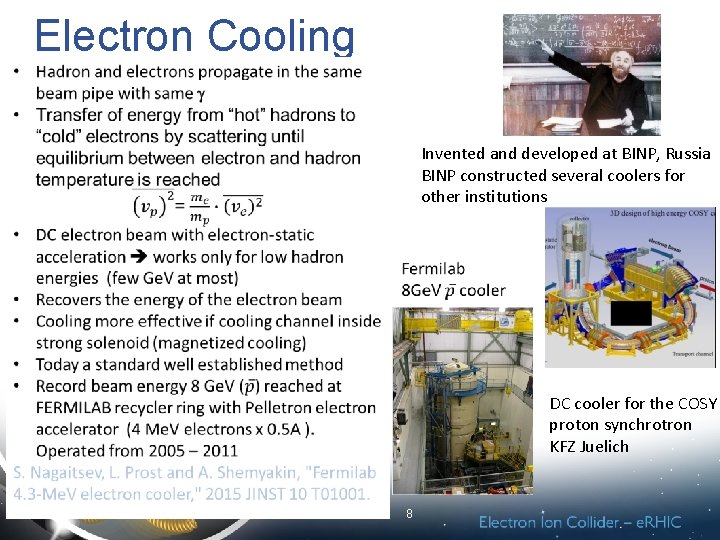
Electron Cooling Invented and developed at BINP, Russia BINP constructed several coolers for other institutions DC cooler for the COSY proton synchrotron KFZ Juelich 8
Bunched Beam Electron Cooling • Electron cooling mechanism should not depend on whether electrons are bunched or DC Bunched beam cooling allows to reach higher electron energy (proposed by Brinkmann et all, DESY) • However, energy of cooled hadron bunches limited due to g 2. 5 scaling (everything optimized) of the cooling time Need very large electron currents at high energy • generating electron beams in an ERL to recover the energy of the electron beam after cooling helps 9
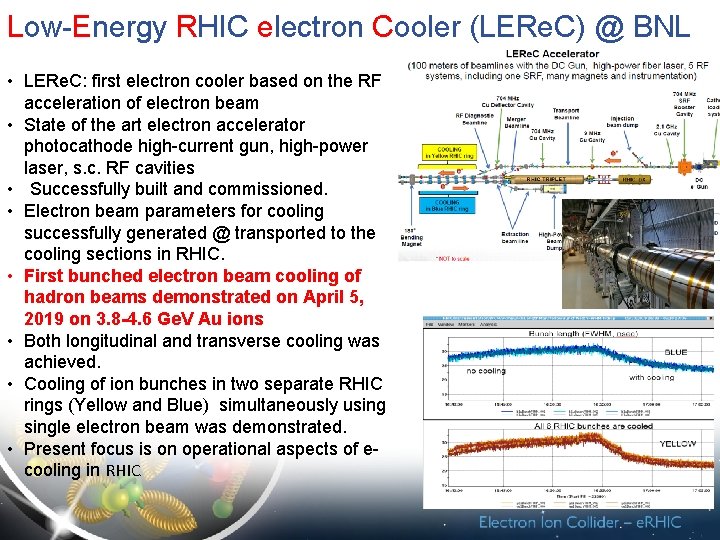
Low-Energy RHIC electron Cooler (LERe. C) @ BNL • LERe. C: first electron cooler based on the RF acceleration of electron beam • State of the art electron accelerator photocathode high-current gun, high-power laser, s. c. RF cavities • Successfully built and commissioned. • Electron beam parameters for cooling successfully generated @ transported to the cooling sections in RHIC. • First bunched electron beam cooling of hadron beams demonstrated on April 5, 2019 on 3. 8 -4. 6 Ge. V Au ions • Both longitudinal and transverse cooling was achieved. • Cooling of ion bunches in two separate RHIC rings (Yellow and Blue) simultaneously usingle electron beam was demonstrated. • Present focus is on operational aspects of ecooling in RHIC.
Electron Cooling for EIC Challenge: Large proton energies up to 300 Ge. V Electron cooling currents in the order of Ampere are required • There is no electron source which can deliver CW electron currents in the order of Ampere which have the beam brightness required for cooling of high energy proton beam (e. N≈mm, DE/E ≈10 -4) • The power needed to generate ampere beams of up to 150 Me. V would exceed what can be considered reasonable by several orders of magnitude. Superconducting Energy Recovery Linac techniques are need for accelerating the electrons. Two Possibilities: • Recirculating cooler rings coupled to an ERL JLEIC solution • Cooling electron beam is provided by storage ring (Coll. JLAB/BNL; considered as one of the back up solutions to mitigate the risk of the ambitious cooling plans) 11
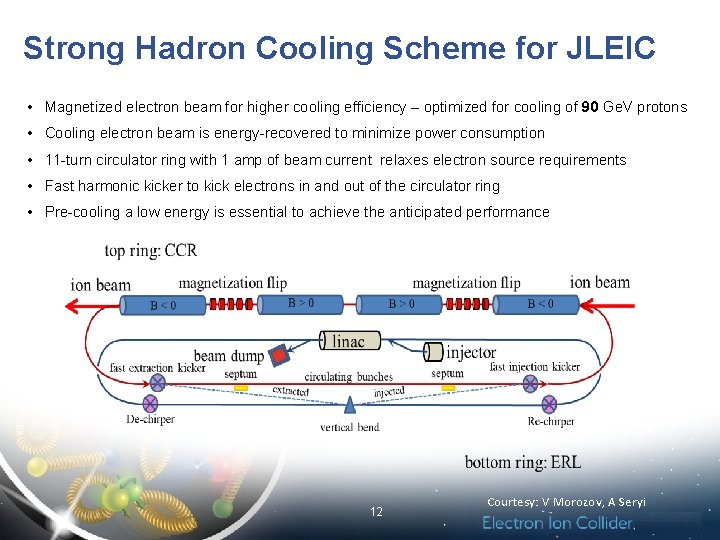
Strong Hadron Cooling Scheme for JLEIC • Magnetized electron beam for higher cooling efficiency – optimized for cooling of 90 Ge. V protons • Cooling electron beam is energy-recovered to minimize power consumption • 11 -turn circulator ring with 1 amp of beam current relaxes electron source requirements • Fast harmonic kicker to kick electrons in and out of the circulator ring • Pre-cooling a low energy is essential to achieve the anticipated performance 12 Courtesy: V Morozov, A Seryi
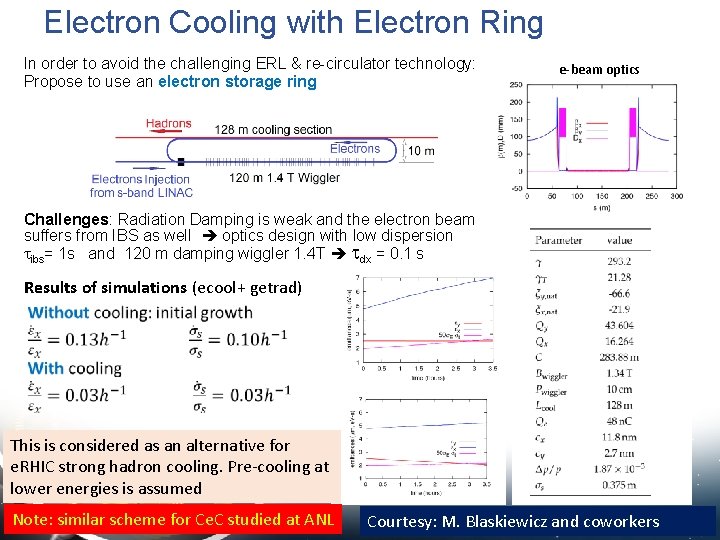
Electron Cooling with Electron Ring In order to avoid the challenging ERL & re-circulator technology: Propose to use an electron storage ring e-beam optics Challenges: Radiation Damping is weak and the electron beam suffers from IBS as well optics design with low dispersion tibs= 1 s and 120 m damping wiggler 1. 4 T tdx = 0. 1 s Results of simulations (ecool+ getrad) This is considered as an alternative for e. RHIC strong hadron cooling. Pre-cooling at lower energies is assumed Note: similar scheme for Ce. C studied at ANL 13 Courtesy: M. Blaskiewicz and coworkers
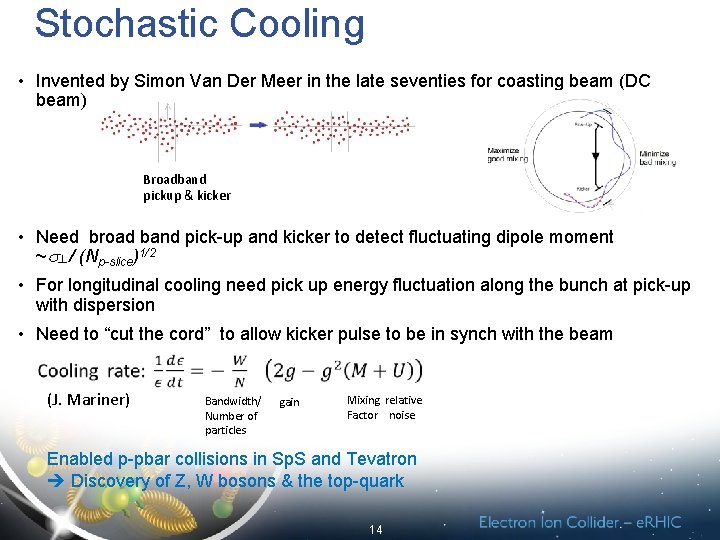
Stochastic Cooling • Invented by Simon Van Der Meer in the late seventies for coasting beam (DC beam) Broadband pickup & kicker • Need broad band pick-up and kicker to detect fluctuating dipole moment ~s┴ / (Np-slice)1/2 • For longitudinal cooling need pick up energy fluctuation along the bunch at pick-up with dispersion • Need to “cut the cord” to allow kicker pulse to be in synch with the beam (J. Mariner) Bandwidth/ Number of particles gain Mixing relative Factor noise Enabled p-pbar collisions in Sp. S and Tevatron Discovery of Z, W bosons & the top-quark 14
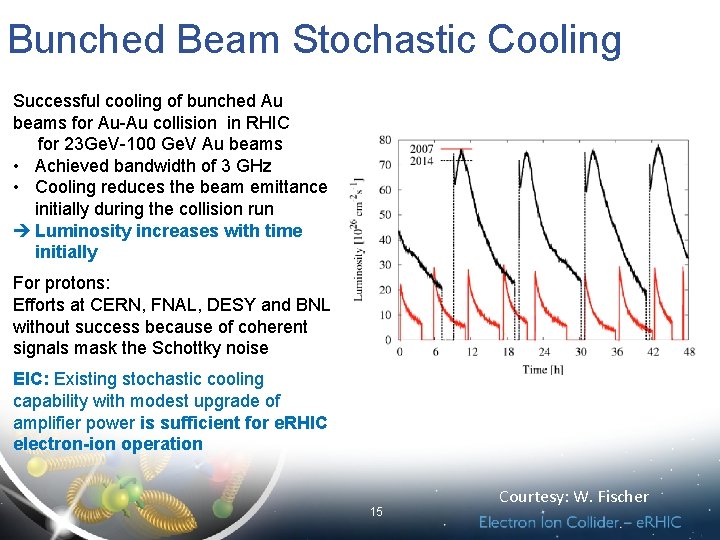
Bunched Beam Stochastic Cooling Successful cooling of bunched Au beams for Au-Au collision in RHIC for 23 Ge. V-100 Ge. V Au beams • Achieved bandwidth of 3 GHz • Cooling reduces the beam emittance initially during the collision run Luminosity increases with time initially For protons: Efforts at CERN, FNAL, DESY and BNL without success because of coherent signals mask the Schottky noise EIC: Existing stochastic cooling capability with modest upgrade of amplifier power is sufficient for e. RHIC electron-ion operation 15 Courtesy: W. Fischer
Extending the bandwidth of Stochastic cooling: Ce. C Replace Pick-ups, cables, electronic amplifiers and kicker plates by Electron beam and electron beam dynamical effects to amplify the cooling signals • Electrons receive kicks via to electro-magnetic forces due to fluctuation in the density distribution of the hadron beam after amplification • Hadrons receive kicks via to electro-magnetic forces due to density modulation in the density distribution of the hadron beam 16
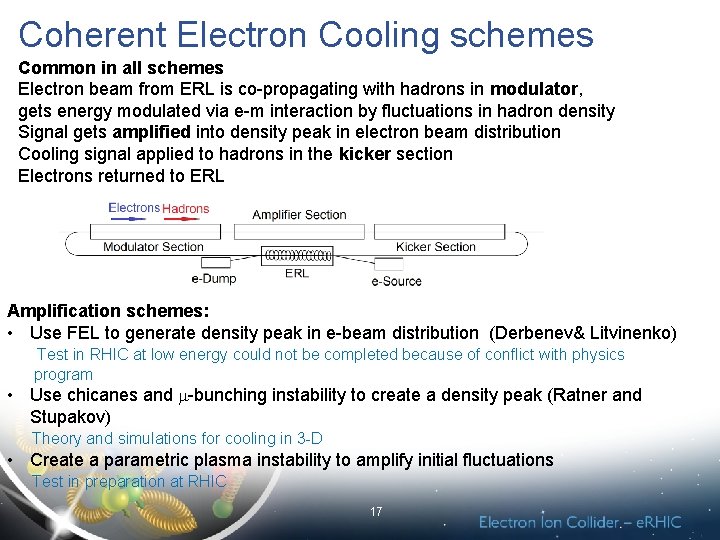
Coherent Electron Cooling schemes Common in all schemes Electron beam from ERL is co-propagating with hadrons in modulator, gets energy modulated via e-m interaction by fluctuations in hadron density Signal gets amplified into density peak in electron beam distribution Cooling signal applied to hadrons in the kicker section Electrons returned to ERL Amplification schemes: • Use FEL to generate density peak in e-beam distribution (Derbenev& Litvinenko) Test in RHIC at low energy could not be completed because of conflict with physics program • Use chicanes and m-bunching instability to create a density peak (Ratner and Stupakov) Theory and simulations for cooling in 3 -D • Create a parametric plasma instability to amplify initial fluctuations Test in preparation at RHIC 17
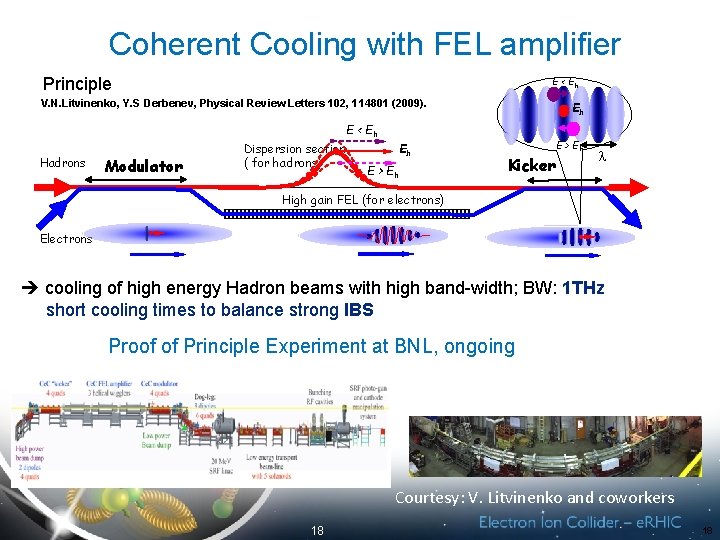
Coherent Cooling with FEL amplifier Principle E < Eh V. N. Litvinenko, Y. S Derbenev, Physical Review Letters 102, 114801 (2009). Eh E < Eh Hadrons Modulator Dispersion section ( for hadrons) Eh E > Eh Kicker E > Eh High gain FEL (for electrons) Electrons cooling of high energy Hadron beams with high band-width; BW: 1 THz short cooling times to balance strong IBS Proof of Principle Experiment at BNL, ongoing Courtesy: V. Litvinenko and coworkers 18 18
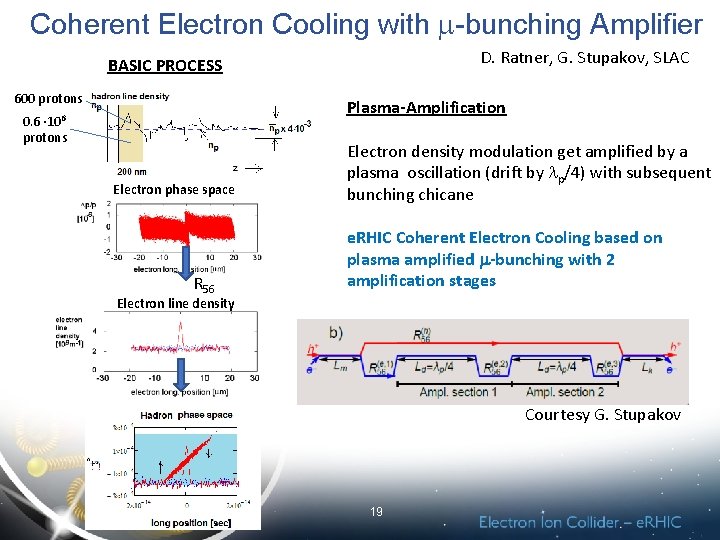
Coherent Electron Cooling with m-bunching Amplifier D. Ratner, G. Stupakov, SLAC BASIC PROCESS 600 protons Plasma-Amplification 0. 6 ∙ 106 protons Electron phase space R 56 Electron density modulation get amplified by a plasma oscillation (drift by p/4) with subsequent bunching chicane e. RHIC Coherent Electron Cooling based on plasma amplified m-bunching with 2 amplification stages Electron line density Courtesy G. Stupakov 19
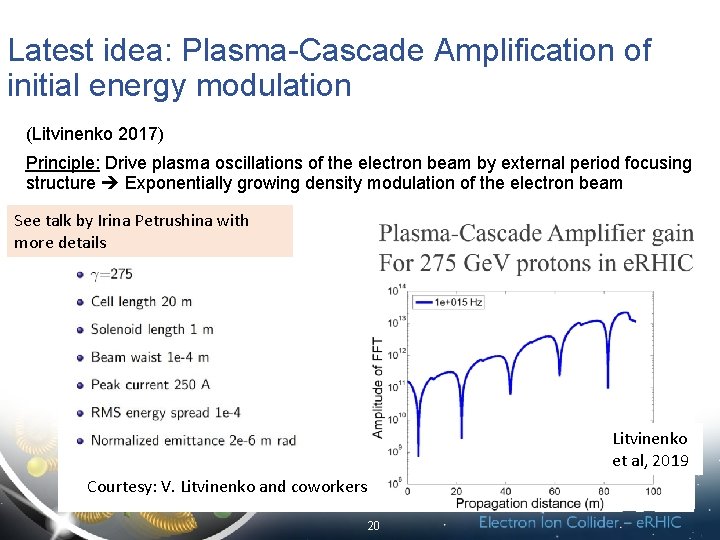
Latest idea: Plasma-Cascade Amplification of initial energy modulation (Litvinenko 2017) Principle: Drive plasma oscillations of the electron beam by external period focusing structure Exponentially growing density modulation of the electron beam See talk by Irina Petrushina with more details Litvinenko et al, 2019 Courtesy: V. Litvinenko and coworkers 20
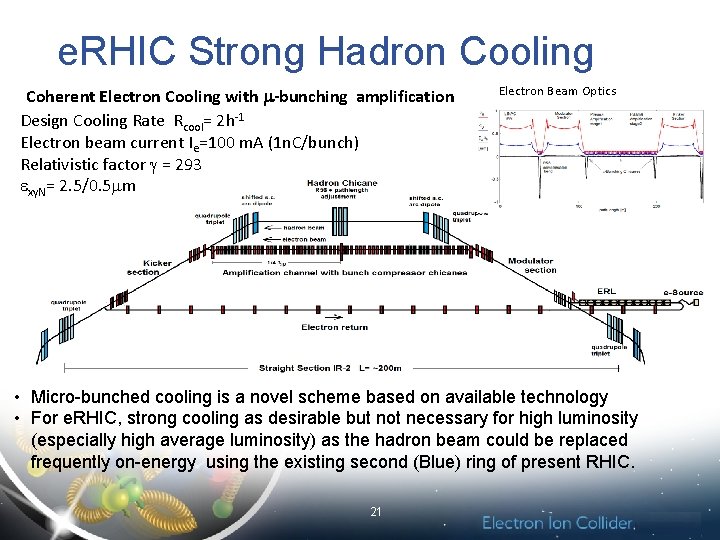
e. RHIC Strong Hadron Cooling Coherent Electron Cooling with m-bunching amplification Design Cooling Rate Rcool= 2 h-1 Electron beam current Ie=100 m. A (1 n. C/bunch) Relativistic factor g = 293 exy. N= 2. 5/0. 5 mm Electron Beam Optics • Micro-bunched cooling is a novel scheme based on available technology • For e. RHIC, strong cooling as desirable but not necessary for high luminosity (especially high average luminosity) as the hadron beam could be replaced frequently on-energy using the existing second (Blue) ring of present RHIC. 21
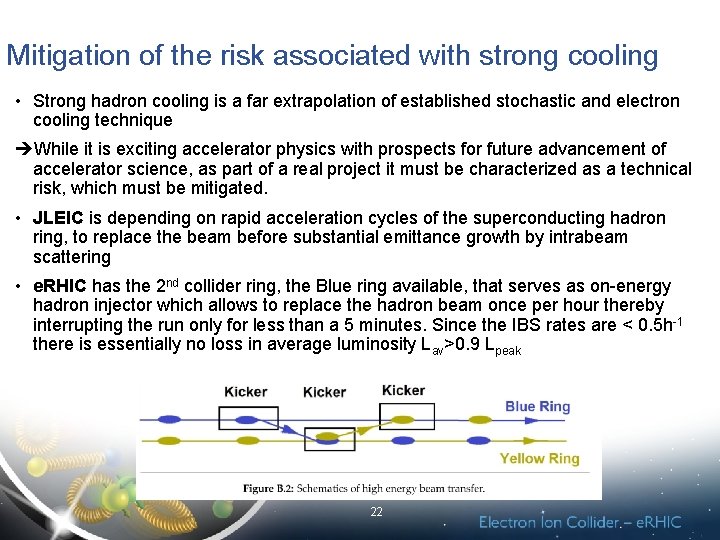
Mitigation of the risk associated with strong cooling • Strong hadron cooling is a far extrapolation of established stochastic and electron cooling technique While it is exciting accelerator physics with prospects for future advancement of accelerator science, as part of a real project it must be characterized as a technical risk, which must be mitigated. • JLEIC is depending on rapid acceleration cycles of the superconducting hadron ring, to replace the beam before substantial emittance growth by intrabeam scattering • e. RHIC has the 2 nd collider ring, the Blue ring available, that serves as on-energy hadron injector which allows to replace the hadron beam once per hour thereby interrupting the run only for less than a 5 minutes. Since the IBS rates are < 0. 5 h -1 there is essentially no loss in average luminosity Lav>0. 9 Lpeak 22
Summary • Electron Cooling is a standard, well developed hadron cooling method for proton energies <10 Ge. V • Strong Hadron cooling is an exciting field of accelerator science which has been continuously developed in the last 4 decades • If Strong Hadron Cooling is successful, that would be a major achievement in accelerator science with potential spin offs in other parts of the field • Stochastic hadron cooling has enabled important discoveries in particle physics (Z, W, top-quark) and greatly enhanced the data on quark-gluon plasma. • Available stochastic cooling technology will be sufficient for high luminosity electron ion (Z>>1) operation in the EIC • For the high energy proton beams of the EIC, both bunched beam cooling and coherent cooling are being proposed • They are both extensions of established cooling techniques to higher bandwidth and cooling rates. • The technical risk associated with strong hadron cooling needing more time for full development is well mitigated by frequent injection int the EIC hadron ring. 23
Acknowledgment This presentation was prepared using materials from Sergei Nagaitsev, FNAL Georg Hoffstaetter, Cornell Michael Blaskiewicz, BNL Alexei Fedotov and co-workers, BNL Vladimir Litvinenko and co-workers, BNL Andrei Seryi and Co-workers, JLAB G. Stupakov, SLAC D. Ratner, SLAC which is gratefully acknowledged 24