
STROKES A stroke is a unit of attention
- Slides: 20
STROKES “A stroke is a unit of attention which provides stimulation to an individual The recognition that one person gives to another Essential to a person's life Can vary from actual physical touch to praise (verbal or non-verbal ) Can be: Positive or negative Conditional or unconditional E. g. you walk down the street and see your neighbour. As you pass you smile and say “hello”. They smile and say “yes, great day? ” That’s a positive stroke you’ve given and received. If your neighbour ignored you then you felt left out or deprived or wonder what you have done to offend them. It is a negative stroke Any transaction is an exchange of strokes. This may be entirely nonverbal.
MOST OF US SUFFER FROM STROKE HUNGER!!!!!!
Positive Strokes- “I love you”, “ you did a good job”- Warm Fuzzies Negative Strokes- “I hate you”- cold Pricklies. When positive strokes are not given, we look for negative strokes rather than be without strokes at all!! Positive strokes – the receiver experiences it as being pleasant. Negative strokes – the receiver experiences it as being painful. For example if your neighbour replied “It was a nice day until I saw you!” then that’s an example of a negative stroke. But any kind of stroke is better than no stroke at all.
We should learn to open our hearts and ask for strokes. It makes life easier. Conditional strokes relate to what you do. Unconditional strokes relate to what you are. E. g. Conditional: “That painting you’ve done is a real mess” “That was a good piece of work” Unconditional: “Your humour always brightens things up” “I hate you and all which you represent” As infants we test out behaviours to find out which give us the strokes we need. If we receive strokes from a certain behaviour then we are likely to repeat it (and that can be where many of our learnt behaviours come from – albeit unconsciously learnt)
TIME STRUCTURING There are five ways people can structure their time to get strokes:
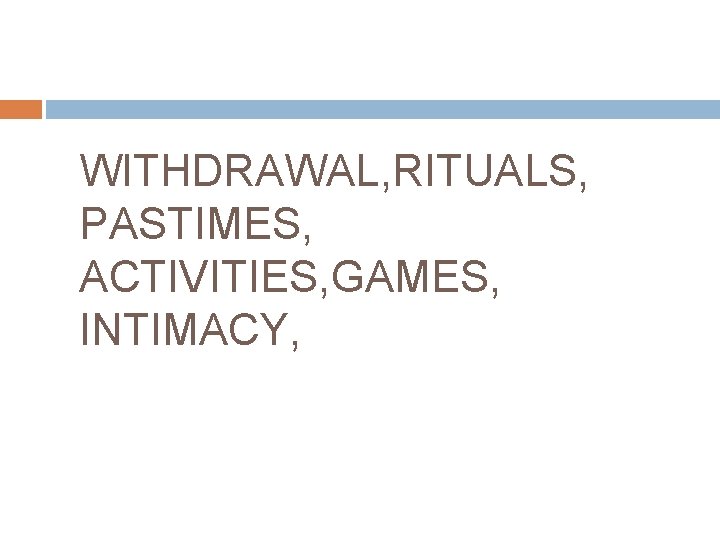
WITHDRAWAL, RITUALS, PASTIMES, ACTIVITIES, GAMES, INTIMACY,
WITHDRAWALS time alone, without direct contact with others. May be reading, writing, drawing, painting, being creative, meditating, listening to music. This can be isolating when it is the dominant or only way of getting strokes.
RITUAL routine social interactions; as if pre-programmed, usually occurring at the same time or in the same place; includes simple greetings; social acknowledgement with neighbours etc. It is low in intensity, generally predictable and not personally revealing. “Hello, how are you? ” “Fine. ” Cups of tea; waving when passing etc. This can provide basic safety and yet it is not essentially satisfying on its own. "Hi!" “How are you? " "Fine, thanks. " "Well, see you around. Bye!" This is a four-stroke ritual.
PASTIME A pre-set conversation around a certain subject. Past-timing proceeds in a familiar way e. g. chats about last night’s television program or football match. It’s generally positive contact, talking about something in the past that is safe, predictable and probably shared e. g. the weather; price rises. Can be regular and valued by both parties. It is not personally engaging or revealing and is often a way of sounding each other out. Pastimes are most evident at cocktail parties and family get-together.
ACTIVITY Doing things with others; sports, recreation, clubs, card or board games; doing up houses; going travelling; shopping etc -the focus is on the shared activity and companionship or competition. The degree of risk depends on the activity. Many couples and friendships depend on the companionship of shared activity.
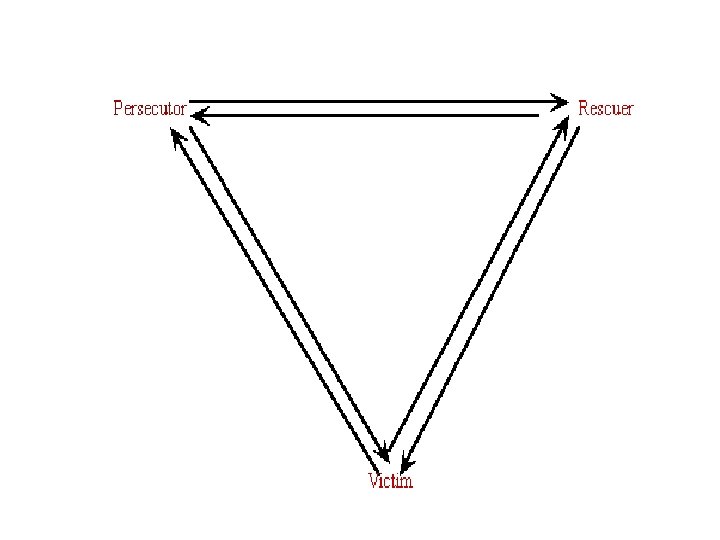
Games Dr. Eric Berne defined a psychological game like this " a recurring set of transactions often repetitive, superficially rational, with a concealed motivation; or, more colloquially, as a series of transactions with a snare, or gimmick Repetitive, devious series of transactions intended to get strokes. Unfortunately, the strokes obtained in games are mostly negative. Formulaic interactions with other(s) often prompted or underpinned by a level of emotional insecurity, fear or social anxiety; they are familiar ways of interacting with other(s) from well-worn positions, often replaying childhood strategies or situations. They always involve saying one thing and meaning something other underneath, perhaps where the words say one thing and the emotional tone conveys something else. It is easy to get ‘hooked’ into a game. No one quite speaks the whole truth- e. g. rather than risk being exposed or vulnerable one ‘goes along with’ or somehow partially hides one’s true feelings. These games or formulaic exchanges generally involve movement around what has been termed the DRAMA TRIANGLE from one of three familiar positions: Victim ---Persecutor---Rescuer etc or vice versa
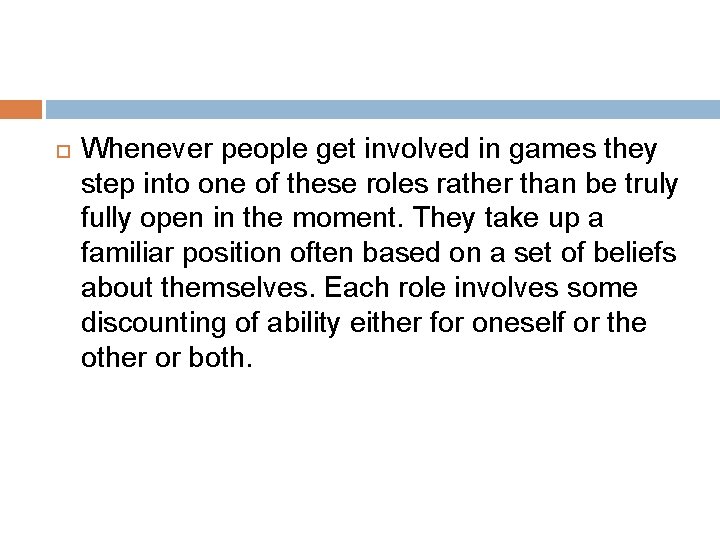
Whenever people get involved in games they step into one of these roles rather than be truly fully open in the moment. They take up a familiar position often based on a set of beliefs about themselves. Each role involves some discounting of ability either for oneself or the other or both.
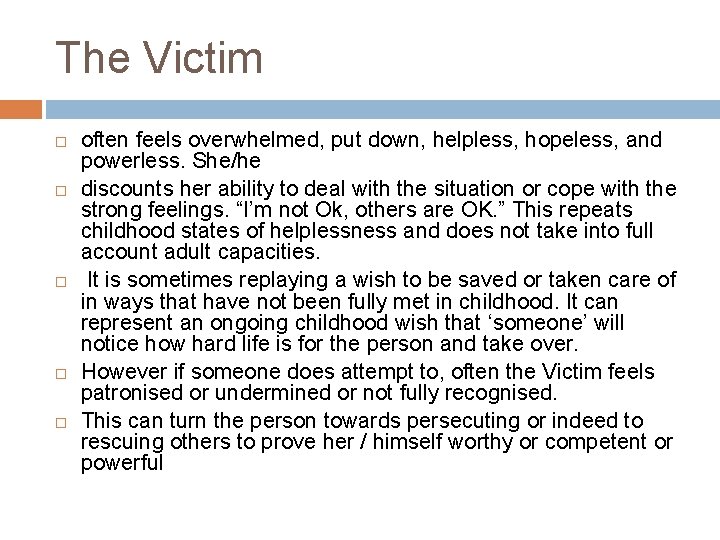
The Victim often feels overwhelmed, put down, helpless, hopeless, and powerless. She/he discounts her ability to deal with the situation or cope with the strong feelings. “I’m not Ok, others are OK. ” This repeats childhood states of helplessness and does not take into full account adult capacities. It is sometimes replaying a wish to be saved or taken care of in ways that have not been fully met in childhood. It can represent an ongoing childhood wish that ‘someone’ will notice how hard life is for the person and take over. However if someone does attempt to, often the Victim feels patronised or undermined or not fully recognised. This can turn the person towards persecuting or indeed to rescuing others to prove her / himself worthy or competent or powerful
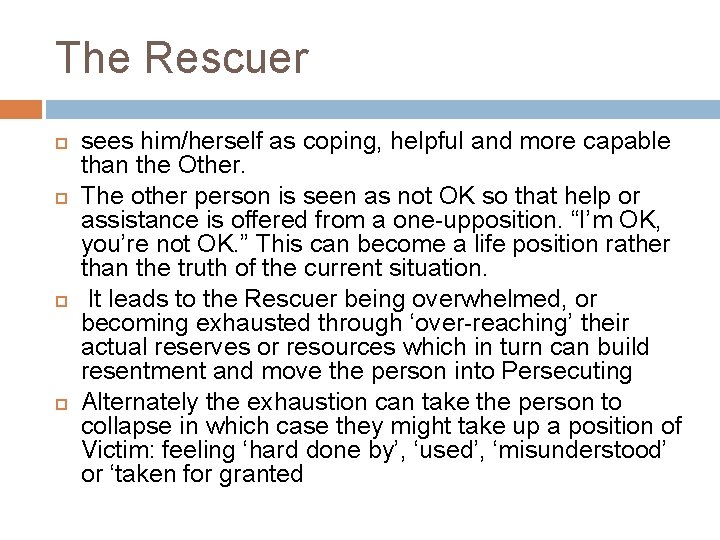
The Rescuer sees him/herself as coping, helpful and more capable than the Other. The other person is seen as not OK so that help or assistance is offered from a one-upposition. “I’m OK, you’re not OK. ” This can become a life position rather than the truth of the current situation. It leads to the Rescuer being overwhelmed, or becoming exhausted through ‘over-reaching’ their actual reserves or resources which in turn can build resentment and move the person into Persecuting Alternately the exhaustion can take the person to collapse in which case they might take up a position of Victim: feeling ‘hard done by’, ‘used’, ‘misunderstood’ or ‘taken for granted
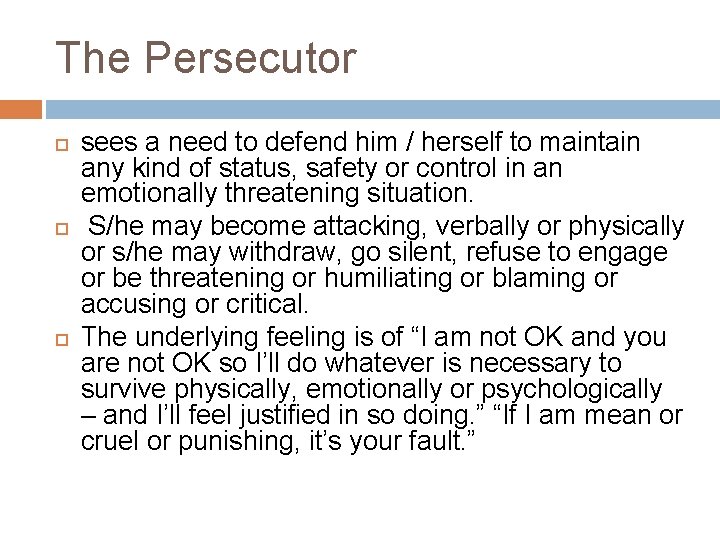
The Persecutor sees a need to defend him / herself to maintain any kind of status, safety or control in an emotionally threatening situation. S/he may become attacking, verbally or physically or s/he may withdraw, go silent, refuse to engage or be threatening or humiliating or blaming or accusing or critical. The underlying feeling is of “I am not OK and you are not OK so I’ll do whatever is necessary to survive physically, emotionally or psychologically – and I’ll feel justified in so doing. ” “If I am mean or cruel or punishing, it’s your fault. ”
Some of the games people play YDYB: Why Don't You, Yes But. Historically, the first game discovered. IFWY: If It Weren't For You WAHM: Why does this Always Happen to Me? (setting up a self-fulfilling prophecy. SWYMD: See What You Made Me Do UGMIT: You Got Me Into This
Pay-offs Each game has a payoff for those playing it, such as the aim of earning sympathy, satisfaction, vindication, or some other emotion that usually reinforces the life scrip There a number of payoffs of this game; every game pays off at three different levels: 1. The biological payoff of a game is strokes. Even though games end badly, all the players get a considerable number of strokes -- both positive and negative -- out of playing them. 2. The social payoff of a game is time-structuring. People are able to filled time which otherwise might have been dull and depressing with an exciting activity. 3. The existential payoff of a game is the way in which the game confirms the existential position of each player.
Types of games Based on the degree of acceptability and potential harm, games are classified as: First Degree Games which are socially acceptable in the players' social circle. Second Degree Games are games that the players would like to conceal, though they may not cause irreversible damage. Third Degree Games are games that could lead to drastic harm to one or more of the parties concerned.
Intimacy A direct and powerful exchange of strokes which people crave but seldom attain genuine open contact with another person involving the genuine expression of feelings, no secret messages or hidden inferences. This demands a willingness to be vulnerable, truthful, direct and clear whether with loving actions and words or hateful or angry feelings. Each person accepts his or her responsibility. This contact can be positive or negative- it is real; both people are available. It allows for genuine disagreement and real resolution that might include a respectful recognition and acceptance of difference by both parties.