
Stroke Education Program Definition of a Stroke A











- Slides: 40
Stroke Education Program
Definition of a Stroke A stroke is an injury caused by a change in the blood supply to the brain. Blood supplies a constant source of oxygen to the brain. Without oxygen, brain cells are damaged and will eventually die. The brain controls all of our body’s functions therefore if the brain is damaged, our body’s functions will be affected.
Types of Strokes • Ischemic • Hemorrhagic
Ischemic Strokes An ischemic stroke involves a blockage in a blood vessel. This can happen in two ways. 1) The blockage can occur gradually as plaque builds up on the walls of the blood vessel. 2) The blockage can occur suddenly when a clot is formed that prevents blood from flowing through. The clot may travel from other places in the body like the legs, for example.
Hemorrhagic Strokes A hemorrhagic stroke occurs when a blood vessel ruptures and there is bleeding of the brain.
Risk Factors for CVA • • • High blood pressure Diabetes Heart disease Carotid artery disease History of smoking Excess alcohol consumption • Prior Stroke • Illegal drug use (especially cocaine) • Obesity • Family history • Race (AA are at higher risk) • Gender (males are at higher risk) • Age
Stroke Prevention • • Stop smoking!!!! Exercise regularly Improve eating habits Take medication as prescribed • Reduce stress level • Maintain a healthy weight • Get regular medical check-ups
Basic Brain Facts • The right side of your brain controls the left side of your body • The left side of your brain controls the right side of your body • Impairments following a stroke depend on where in the brain the stroke occurred.
Strokes that occur on the left side of the brain He/she may experience the following: • Difficulty moving the right side of the body • Difficulty communicating daily wants and needs • Visual impairments • Behavioral changes • Sensory changes • Cognitive changes such as slowness in initiating activity and responding
Strokes that occur on the right side of the brain He/she may experience the following: • Difficulty moving the left side of the body • Difficulty knowing where things are in space (for example, over reaching for an object) • Difficulty attending/seeing things on the left side • Visual changes • Cognitive changes such as poor short term memory, attention and problem solving • Difficulty determining what has changed since the stroke and what the impact of those changes are (for example, if a patient can’t walk without assistance, it isn’t safe to try to go to the bathroom alone)
Strokes that occur in the brainstem He/she may experience the following: • More physical deficits than cognitive • Swallowing difficulty (dysphagia) • Difficulty breathing • Problems with balance and coordination • Reduced speech intelligibility • Dizziness, nausea and decreased level of arousal
Factors that influence recovery following a stroke • Time passed before medical intervention is initiated • What part of the brain was affected • The size of the area affected • The patient’s age • The patient’s fitness level before the stroke • Patient’s premorbid cognitive level
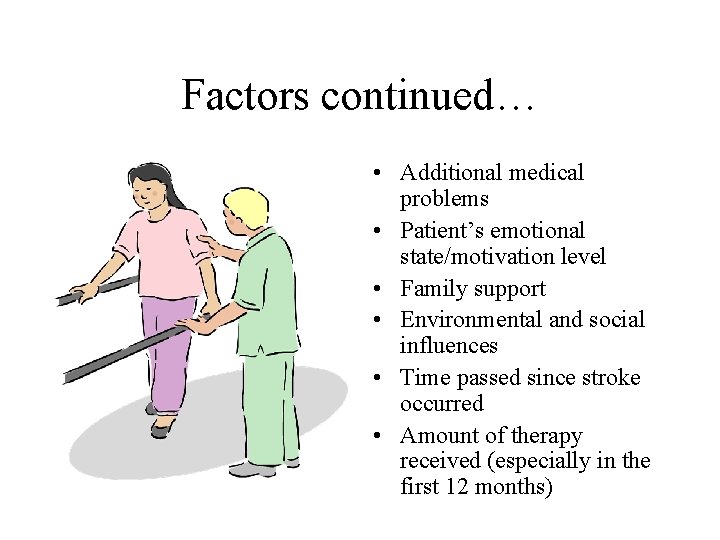
Factors continued… • Additional medical problems • Patient’s emotional state/motivation level • Family support • Environmental and social influences • Time passed since stroke occurred • Amount of therapy received (especially in the first 12 months)
Wake. Med Rehab’s Team approach The team consists of • Patient and family • Physician’s Assistant • Nurse • Case Manager • Physical Therapist • Occupational Therapist • Speech-Language Pathologist • Neuropsychologist • Therapeutic Recreational specialist • Dietician
Physical Therapy after a Stroke Several factors can contribute to movement problems • Impaired or absent sensation • Loss of range of motion at a joint • Weakness, paralysis or neglect of one side of the body • Loss of balance • Spasticity and tone (abnormal muscle tightness)
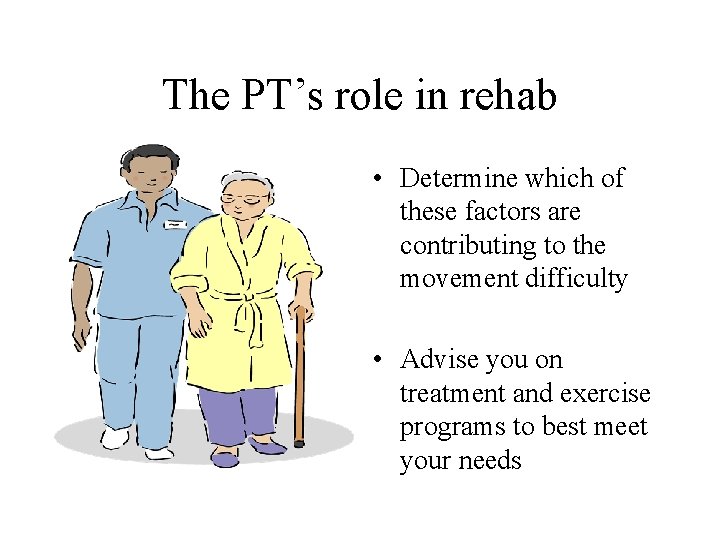
The PT’s role in rehab • Determine which of these factors are contributing to the movement difficulty • Advise you on treatment and exercise programs to best meet your needs
Your PT will also train you to help in the following areas: • • • Bed mobility- this includes rolling, sitting up and using balance on the edge of the bed Transferring – this includes moving to and from the wheelchair, bed and car Standing and walking Managing stairs, curbs and obstacles in the community Using a wheelchair
Physical Therapy Equipment Your physical therapist will also recommend appropriate equipment to help with mobility. Some common examples are: • Wheelchair • Walker • Ankle or foot brace
Recovery in Physical Therapy • Generally happens first in the joints nearest your trunk (such as the hip and shoulder) • Recovery also usually occurs in larger muscle groups first
The OT’s role in Rehab • OT's work on increasing the use of your affected side to accomplish everyday tasks such as basic self care, functional transfers, and the resumption of tasks that you find important in your life. • Help with Activities of Daily Living (ADLs) such as: Bathing Feeding Dressing Grooming Oral care Using the bathroom
Occupational Therapy Equipment • • • Bedside Commode Shower chair Adaptive feeding and dressing equipment Reachers Arm trays/troughs Person specific splints for positioning
Additional OT roles • Help patient regain movement and coordination of the affected side • Assess and treat visual impairments • Retrain cooking, cleaning and financial/medical management skills • Help improve safety awareness
Recovery in Occupational Therapy • Each stroke is different therefore it is difficult to predict the amount of recovery that will occur in the affected side. • Typically movement returns proximal to distal. This means that return starts at the shoulder, moves to the elbow then to the wrist and lastly to the hands and fingers.
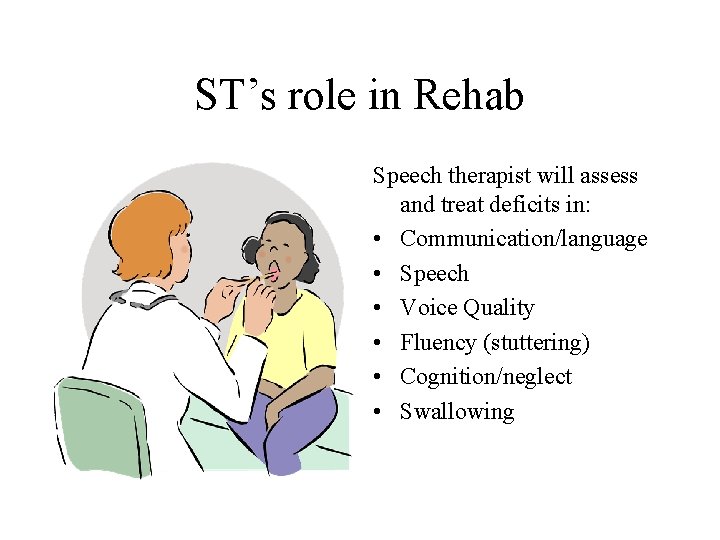
ST’s role in Rehab Speech therapist will assess and treat deficits in: • Communication/language • Speech • Voice Quality • Fluency (stuttering) • Cognition/neglect • Swallowing
Language Disorders • Receptive language: ability to understand speech, written word and gestures • Expressive language: ability to express one’s self through speech, writing and gestures
Motor Speech Disorders • Dysarthria- weakness in the muscles used for speech that results in slurred or difficult to understand speech • Apraxia- The muscles are not weak, however, the patient has difficulty with motor planning (brain can not communicate with the muscles)
Cognition Cognitive disorders can include impairments in the following areas: • Orientation (who, when, where, why) • Attention • Memory (usually with immediate or short term memory) • Problem solving • Reasoning • Insight/safety awareness
Swallowing Disorders Swallowing disorders can be divided into two categories: • Oral phase- chewing and moving the food around in the mouth • Pharyngeal phase- is the food going into the esophagus or the airway?
Recovery in Speech Therapy • It is important to know that speech, language and cognitive return following a stroke is usually slower than physical return.
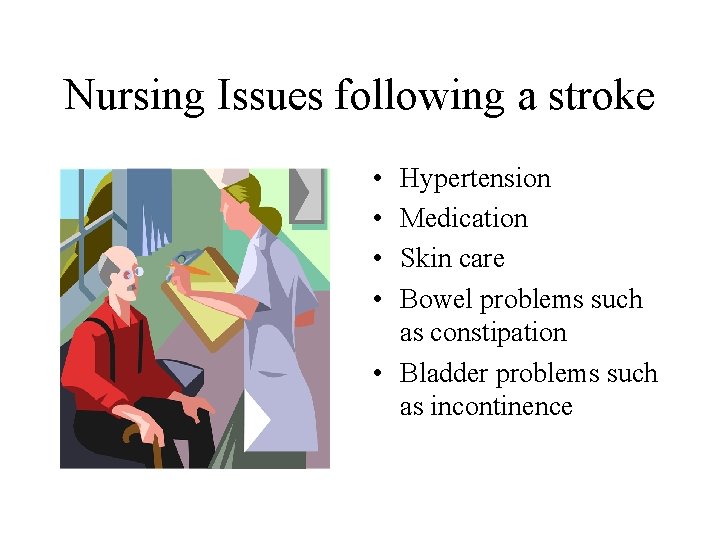
Nursing Issues following a stroke • • Hypertension Medication Skin care Bowel problems such as constipation • Bladder problems such as incontinence
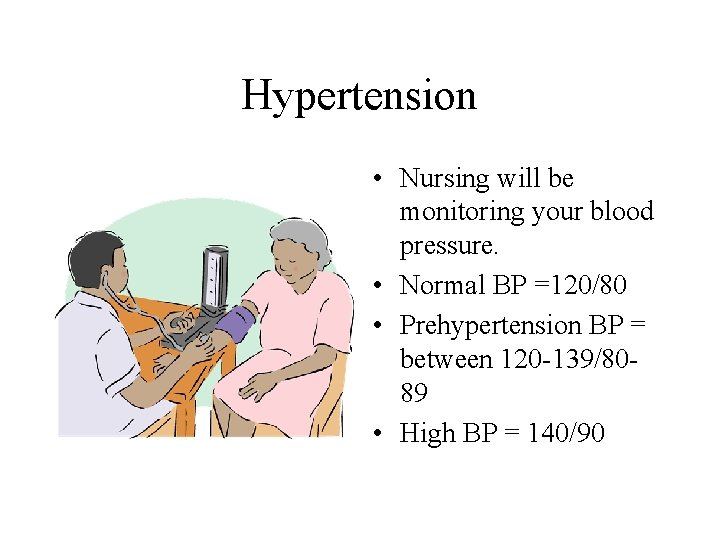
Hypertension • Nursing will be monitoring your blood pressure. • Normal BP =120/80 • Prehypertension BP = between 120 -139/8089 • High BP = 140/90
MEDICATION • Your blood pressure may be managed by medication prescribed by your doctor. • It is important to remember to take your medication as prescribed and not stop taking it just because you feel better.
MEDICATION • You may be taking blood thinners also known as anticoagulants. • Two examples are coumadin and heparin. These medications make it harder for clots to form. • Have blood test taken regularly so your doctor can tell how the medicine is working.
MEDICATIONS • Please remember to ask your nurse or MD questions about your medication that you do not understand.
SKIN CARE • After a stroke it may be difficult for your loved one to make changes in their position and keep the skin clean and dry on their own. • To prevent skin breakdown (decubitus ulcer) make sure that you have someone that will be able to help you reposition you frequently and assist with keeping your skin clean and dry.
Causes for constipation • Lack of exercise or moving around • Loss of appetite • Drinking too little water • Medications • Problems with intestinal motility
Prevention • Set regular times for bowel movements • Eat foods high in roughage and fiber (cereal, fruits and vegetables) • Drink eight 8 ounce glasses of liquid a day (unless restricted by doctor) • Drink hot water, prune juice or hot coffee with breakfast • Regular exercise
Incontinence Causes include: • Inability to feel the need to empty the bladder • Loss of bladder tone • Retention difficulty- unable to completely empty bladder
What you can do to help? • Go to the bathroom every two hours • Restrict the amount of fluid in the evening • Talk to your doctor about medications to help
Conclusion • Every person is different and no one can be sure how quickly or how far you or your family member will progress. • Rehab is often a long process. • Complete recovery is not always possible, however, living an enjoyable life is still within reach.