
strlen implementation strlen return length of string s
- Slides: 16
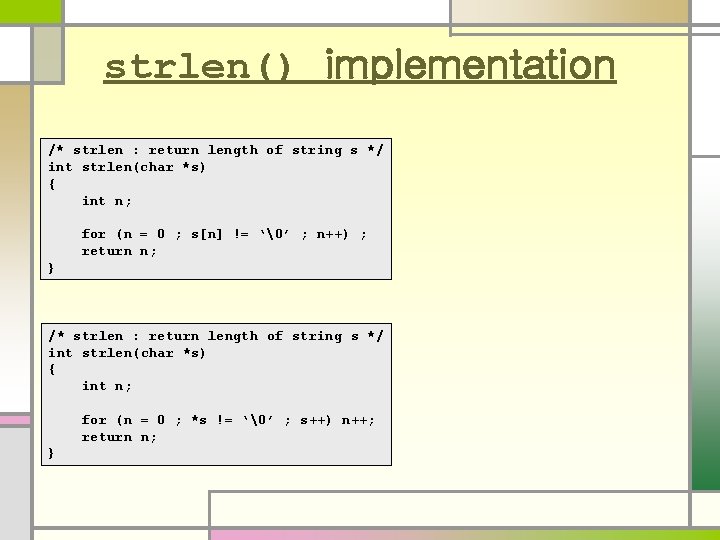
strlen() implementation /* strlen : return length of string s */ int strlen(char *s) { int n; for (n = 0 ; s[n] != ‘’ ; n++) ; return n; } /* strlen : return length of string s */ int strlen(char *s) { int n; for (n = 0 ; *s != ‘’ ; s++) n++; return n; }
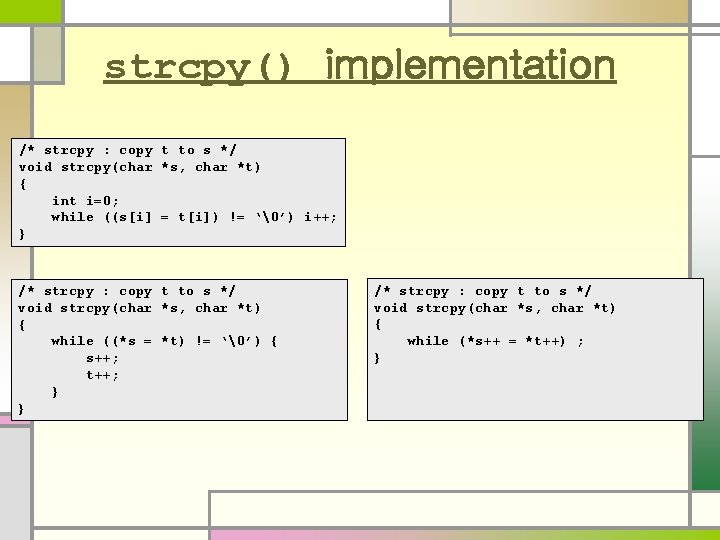
strcpy() implementation /* strcpy : copy t to s */ void strcpy(char *s, char *t) { int i=0; while ((s[i] = t[i]) != ‘’) i++; } /* strcpy : copy t to s */ void strcpy(char *s, char *t) { while ((*s = *t) != ‘’) { s++; t++; } } /* strcpy : copy t to s */ void strcpy(char *s, char *t) { while (*s++ = *t++) ; }
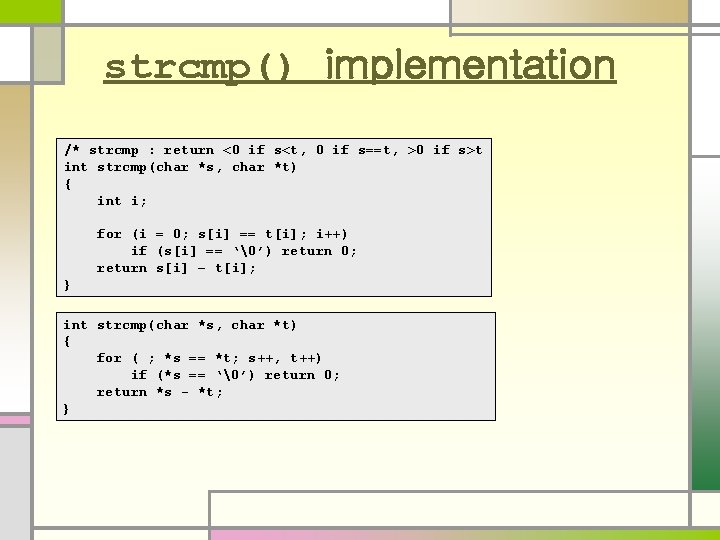
strcmp() implementation /* strcmp : return <0 if s<t, 0 if s==t, >0 if s>t int strcmp(char *s, char *t) { int i; for (i = 0; s[i] == t[i]; i++) if (s[i] == ‘’) return 0; return s[i] – t[i]; } int strcmp(char *s, char *t) { for ( ; *s == *t; s++, t++) if (*s == ‘’) return 0; return *s - *t; }
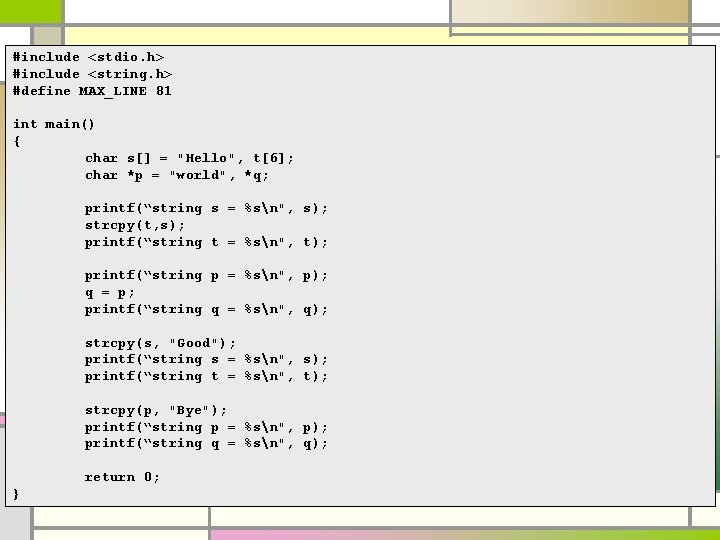
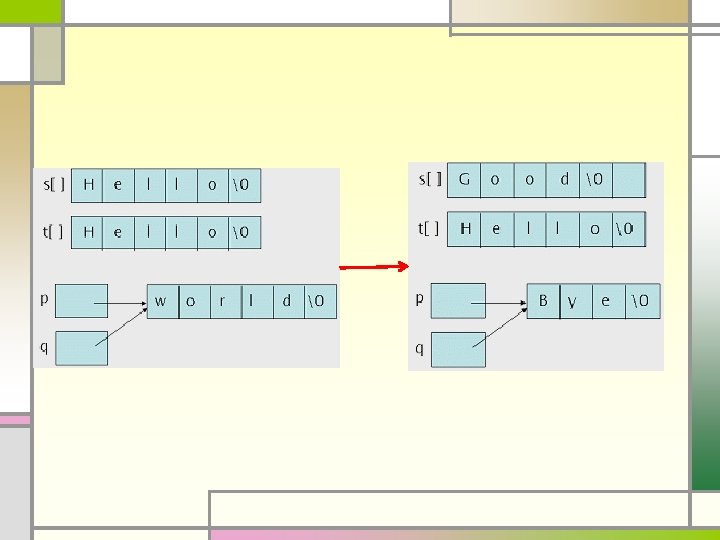
#include <stdio. h> #include <string. h> #define MAX_LINE 81 int main() { char s[] = "Hello", t[6]; char *p = "world", *q; printf(“string s = %sn", s); strcpy(t, s); printf(“string t = %sn", t); printf(“string p = %sn", p); q = p; printf(“string q = %sn", q); strcpy(s, "Good"); printf(“string s = %sn", s); printf(“string t = %sn", t); strcpy(p, "Bye"); printf(“string p = %sn", p); printf(“string q = %sn", q); return 0; }
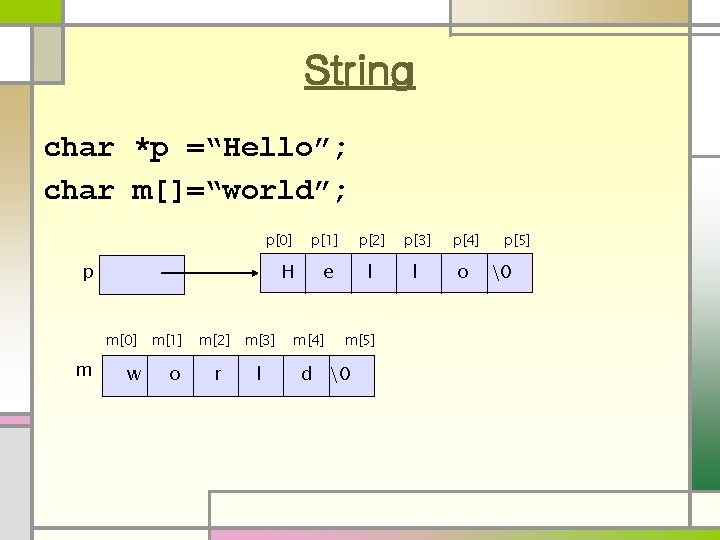
String char *p =“Hello”; char m[]=“world”; p[0] H p m m[0] m[1] w o m[2] m[3] r l p[1] p[2] p[3] p[4] e l l o m[4] m[5] d p[5]
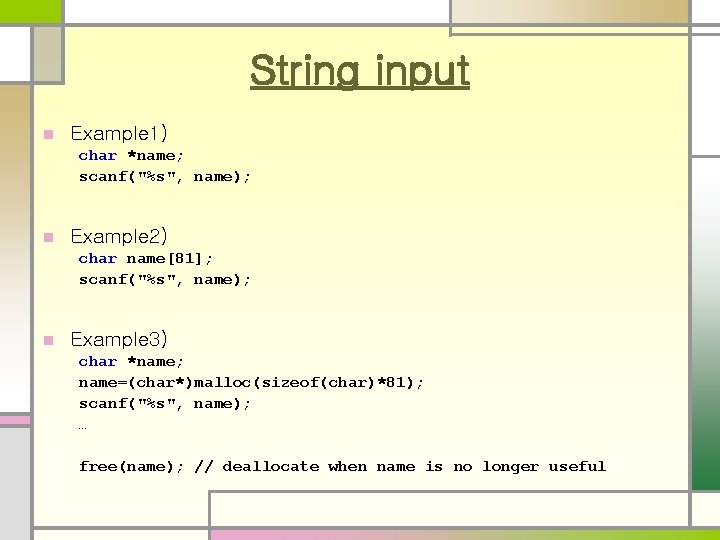
String input n Example 1) char *name; scanf("%s", name); n Example 2) char name[81]; scanf("%s", name); n Example 3) char *name; name=(char*)malloc(sizeof(char)*81); scanf("%s", name); … free(name); // deallocate when name is no longer useful
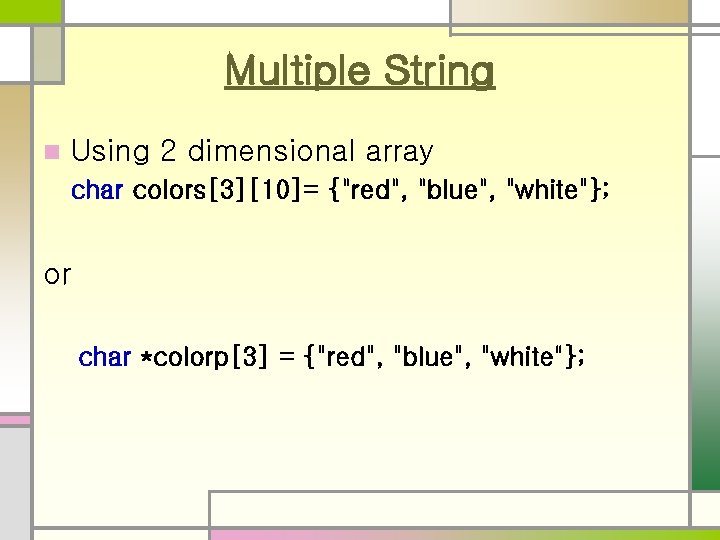
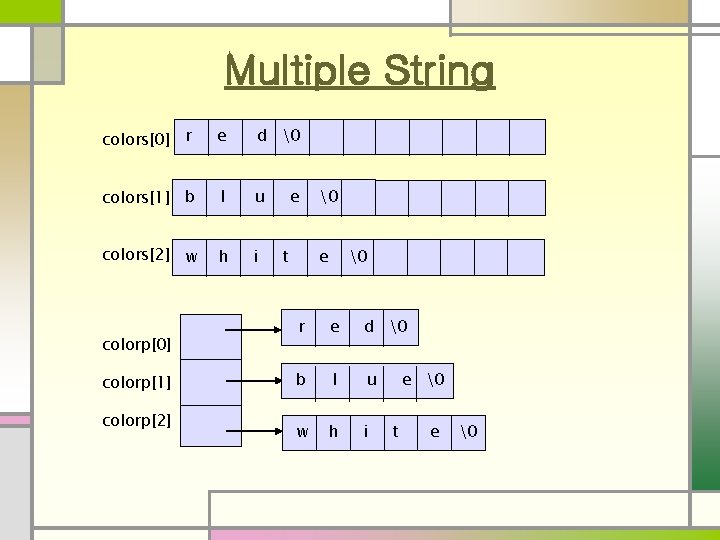
Multiple String n Using 2 dimensional array char colors[3][10]= {"red", "blue", "white"}; or char *colorp[3] = {"red", "blue", "white"};
Multiple String colors[0] r e d colors[1] b l u colors[2] w h i colorp[0] colorp[1] colorp[2] e t e r e d b l u w h i e t e
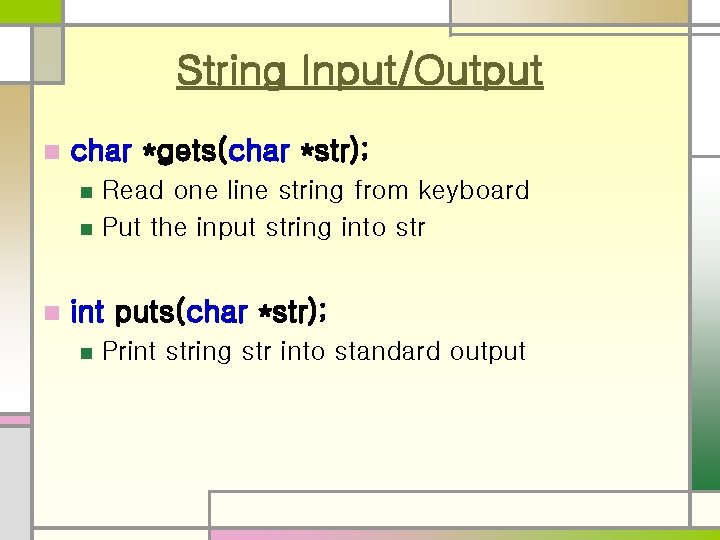
String Input/Output n char *gets(char *str); n n n Read one line string from keyboard Put the input string into str int puts(char *str); n Print string str into standard output
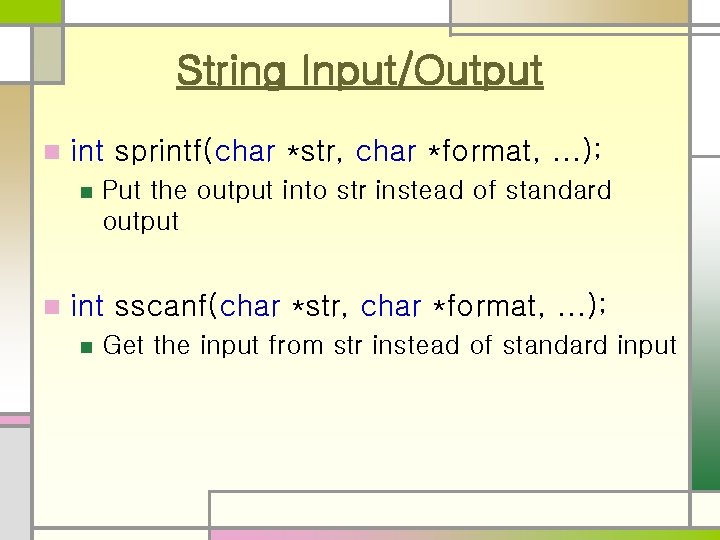
String Input/Output n int sprintf(char *str, char *format, . . . ); n n Put the output into str instead of standard output int sscanf(char *str, char *format, . . . ); n Get the input from str instead of standard input
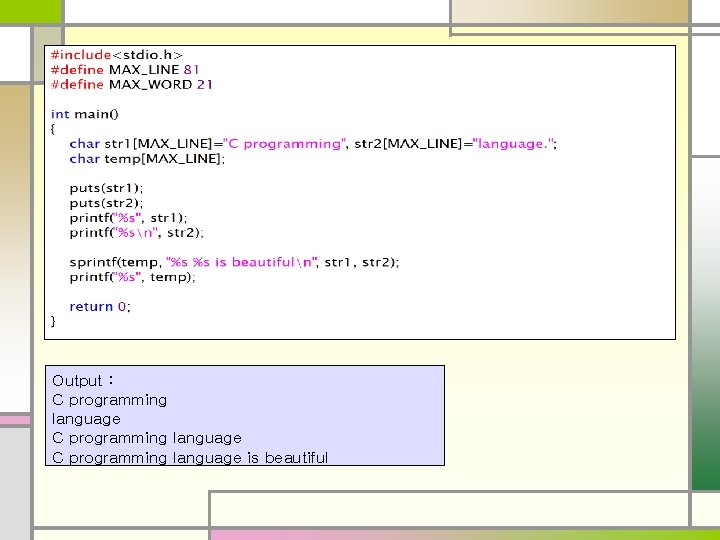
Output : C programming language is beautiful
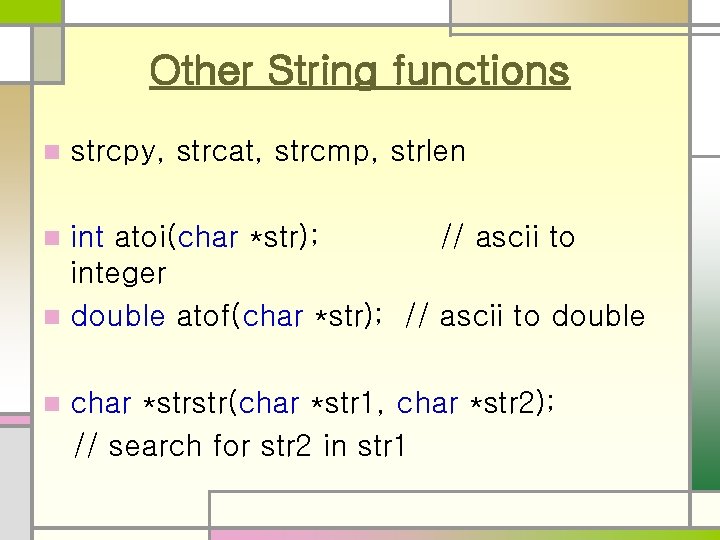
Other String functions n strcpy, strcat, strcmp, strlen int atoi(char *str); // ascii to integer n double atof(char *str); // ascii to double n n char *strstr(char *str 1, char *str 2); // search for str 2 in str 1
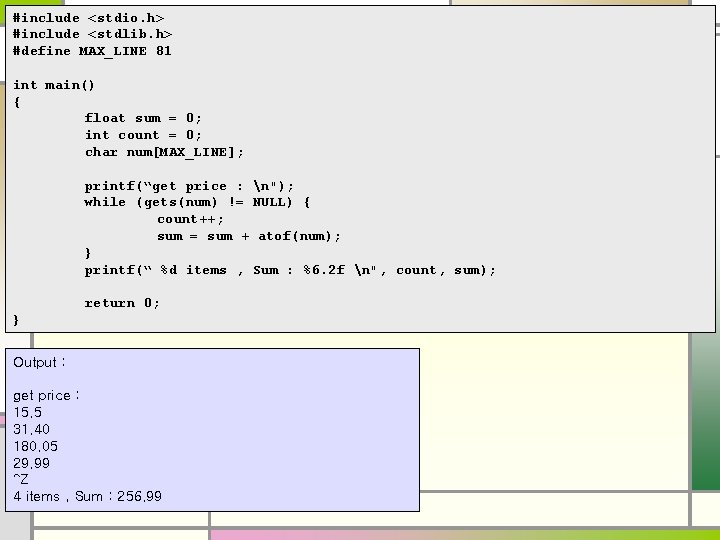
#include <stdio. h> #include <stdlib. h> #define MAX_LINE 81 int main() { float sum = 0; int count = 0; char num[MAX_LINE]; printf(“get price : n"); while (gets(num) != NULL) { count++; sum = sum + atof(num); } printf(“ %d items , Sum : %6. 2 f n", count, sum); return 0; } Output : get price : 15. 5 31. 40 180. 05 29. 99 ^Z 4 items , Sum : 256. 99
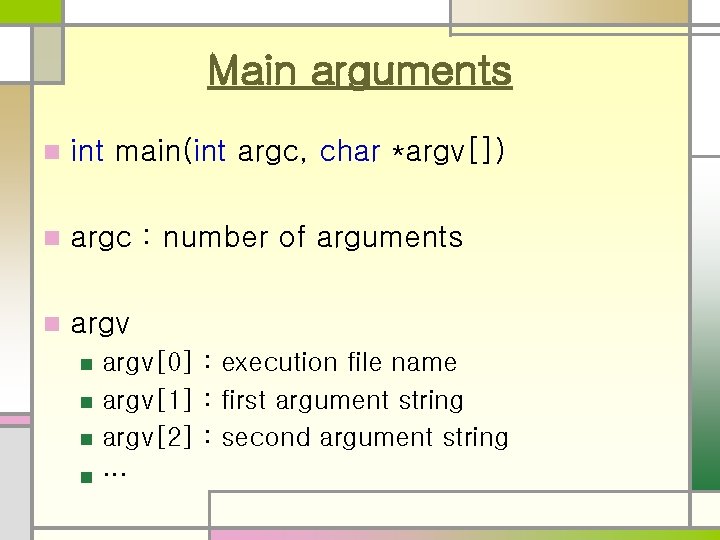
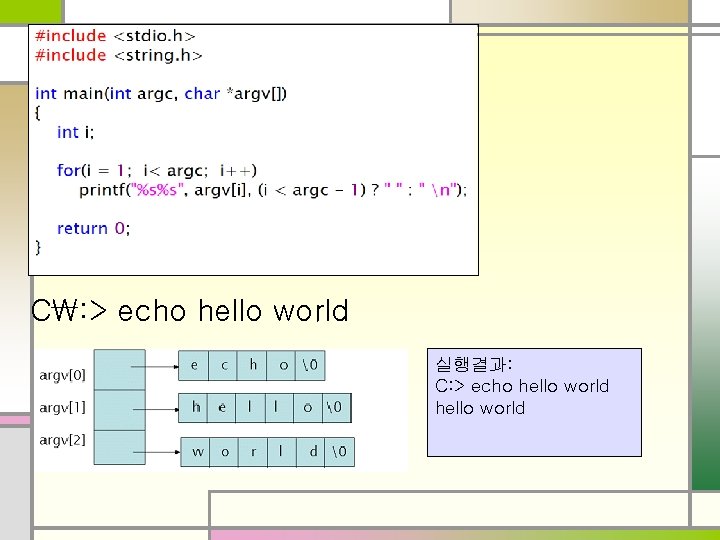
Main arguments n int main(int argc, char *argv[]) n argc : number of arguments n argv n n argv[0] : execution file name argv[1] : first argument string argv[2] : second argument string …
C: > echo hello world 실행결과: C: > echo hello world