
Strix Systems Competitive Review of Firetide Firetide Overview



- Slides: 17
Strix Systems Competitive Review of Firetide
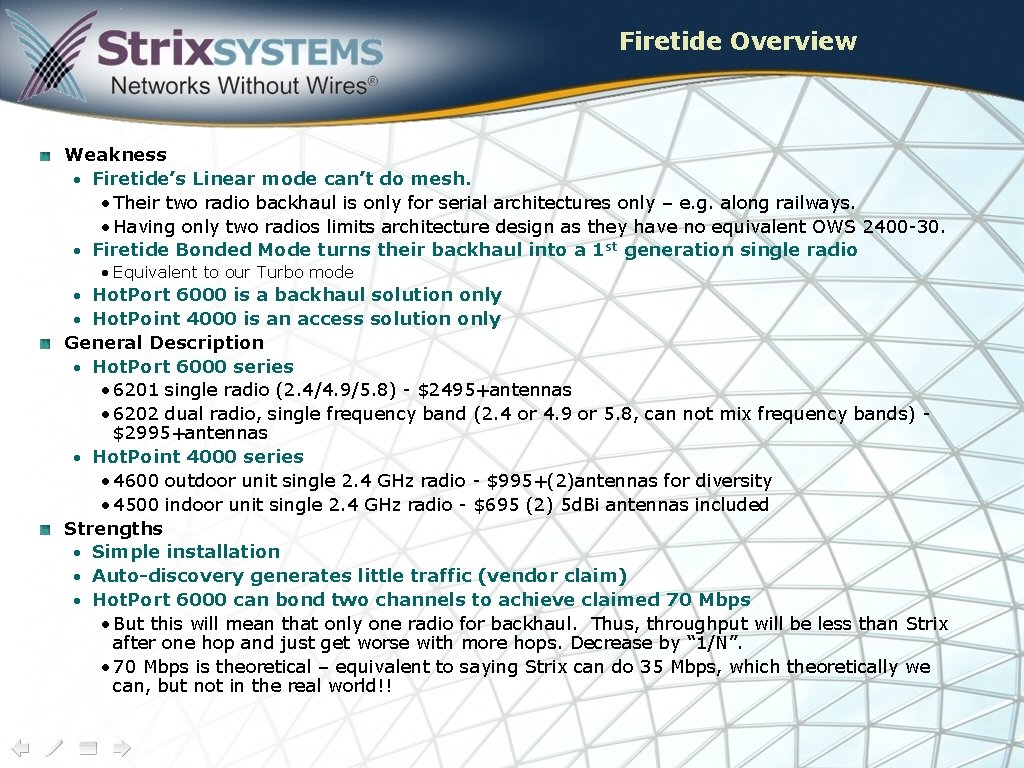
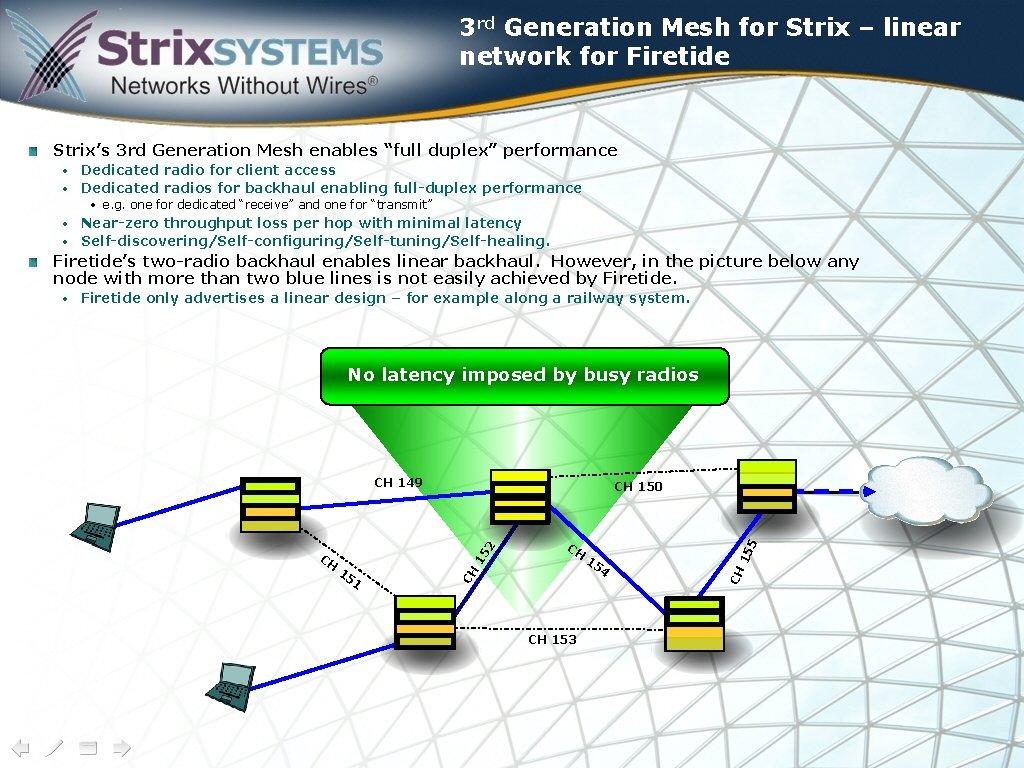
Firetide Overview Weakness • Firetide’s Linear mode can’t do mesh. • Their two radio backhaul is only for serial architectures only – e. g. along railways. • Having only two radios limits architecture design as they have no equivalent OWS 2400 -30. • Firetide Bonded Mode turns their backhaul into a 1 st generation single radio • Equivalent to our Turbo mode • Hot. Port 6000 is a backhaul solution only • Hot. Point 4000 is an access solution only General Description • Hot. Port 6000 series • 6201 single radio (2. 4/4. 9/5. 8) - $2495+antennas • 6202 dual radio, single frequency band (2. 4 or 4. 9 or 5. 8, can not mix frequency bands) $2995+antennas • Hot. Point 4000 series • 4600 outdoor unit single 2. 4 GHz radio - $995+(2)antennas for diversity • 4500 indoor unit single 2. 4 GHz radio - $695 (2) 5 d. Bi antennas included Strengths • Simple installation • Auto-discovery generates little traffic (vendor claim) • Hot. Port 6000 can bond two channels to achieve claimed 70 Mbps • But this will mean that only one radio for backhaul. Thus, throughput will be less than Strix after one hop and just get worse with more hops. Decrease by “ 1/N”. • 70 Mbps is theoretical – equivalent to saying Strix can do 35 Mbps, which theoretically we can, but not in the real world!!
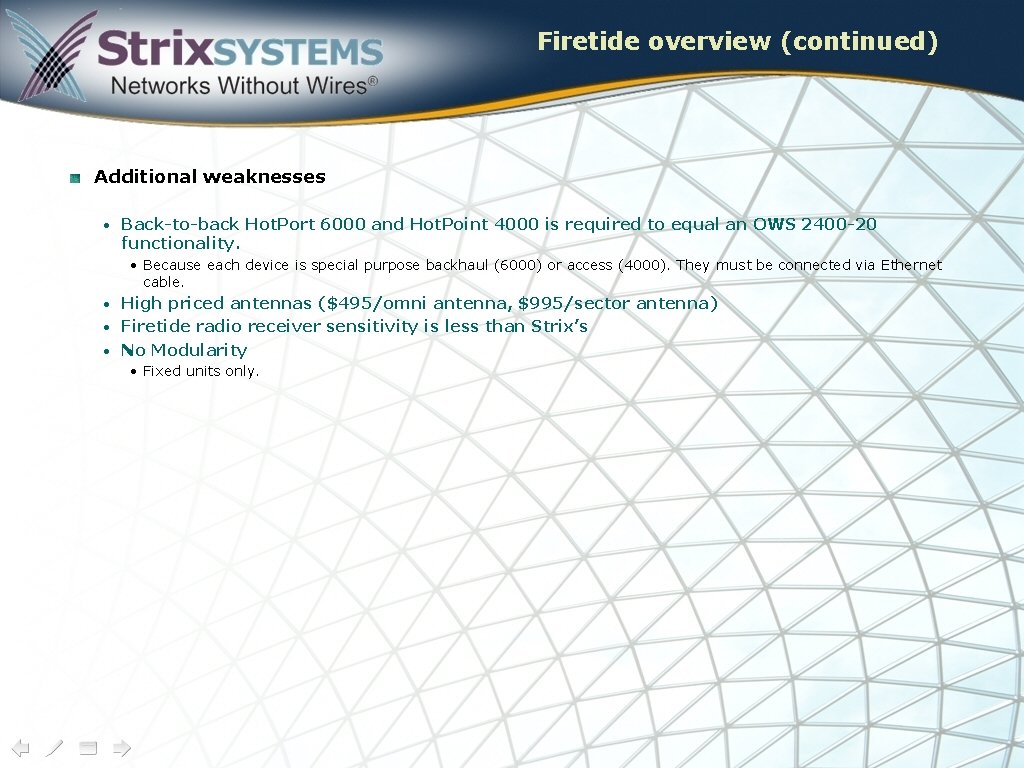
Firetide overview (continued) Additional weaknesses • Back-to-back Hot. Port 6000 and Hot. Point 4000 is required to equal an OWS 2400 -20 functionality. • Because each device is special purpose backhaul (6000) or access (4000). They must be connected via Ethernet cable. • High priced antennas ($495/omni antenna, $995/sector antenna) • Firetide radio receiver sensitivity is less than Strix’s • No Modularity • Fixed units only.
Firetide pricing for Mesh Node Unit 6201 – Hot. Port 6000 Wireless Mesh Nodes Description Single radio – either: (1) 2. 4 GHz, (2) 4. 9 GHz, or (3) 5. 15. 825 GHz radio with DFS. Note: Used for backhaul only, Ethernet intended client input. 6201 – Hot. Port 6000 Wireless Mesh Nodes Dual radio (both radios must operate in the same frequency band)– either: (1) 2. 4 GHz, (2) 4. 9 GHz, or (3) 5. 1 -5. 825 GHz radio with DFS. Note: Used for backhaul only, Ethernet intended client input. Connectronic’s Price $2495. 00 [odd note – two 5 d. Bi antennas included for network staging only. 8 d. Bi omni antenna is $495 additional cost. ] $2995. 00 [see note above for antennas]
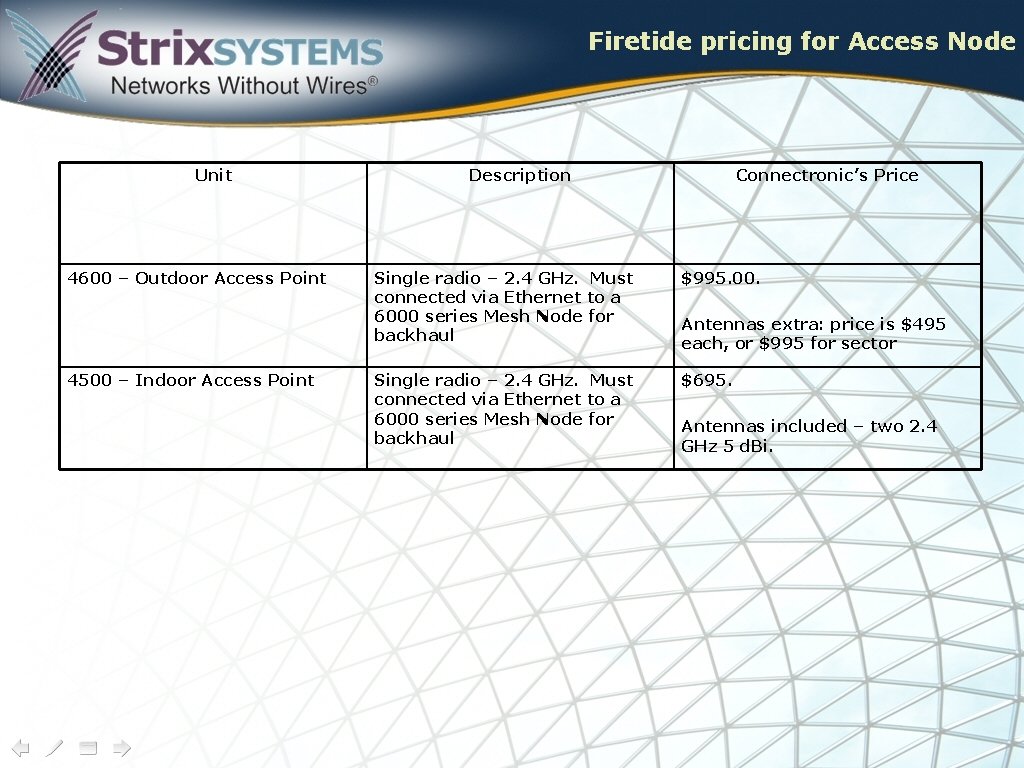
Firetide pricing for Access Node Unit 4600 – Outdoor Access Point 4500 – Indoor Access Point Description Connectronic’s Price Single radio – 2. 4 GHz. Must connected via Ethernet to a 6000 series Mesh Node for backhaul $995. 00. Single radio – 2. 4 GHz. Must connected via Ethernet to a 6000 series Mesh Node for backhaul $695. Antennas extra: price is $495 each, or $995 for sector Antennas included – two 2. 4 GHz 5 d. Bi.
3 rd Generation Mesh for Strix – linear network for Firetide Strix’s 3 rd Generation Mesh enables “full duplex” performance • Dedicated radio for client access • Dedicated radios for backhaul enabling full-duplex performance • e. g. one for dedicated “receive” and one for “transmit” • Near-zero throughput loss per hop with minimal latency • Self-discovering/Self-configuring/Self-tuning/Self-healing. Firetide’s two-radio backhaul enables linear backhaul. However, in the picture below any node with more than two blue lines is not easily achieved by Firetide. • Firetide only advertises a linear design – for example along a railway system. No latency imposed by busy radios CH 149 1 CH 153 5 15 15 4 CH 15 2 15 CH CH 150
Competitive Analysis
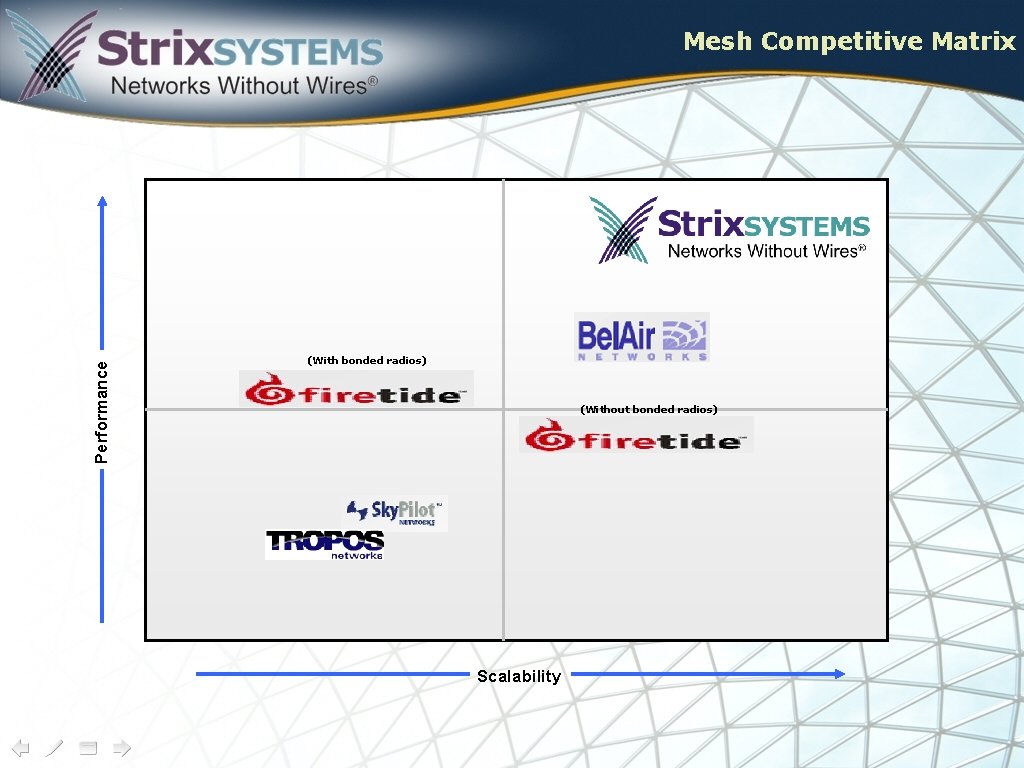
Performance Mesh Competitive Matrix (With bonded radios) (Without bonded radios) Scalability
Mesh Competitive Matrix
Independent Test By Iometrix Labs Strix and Firetide
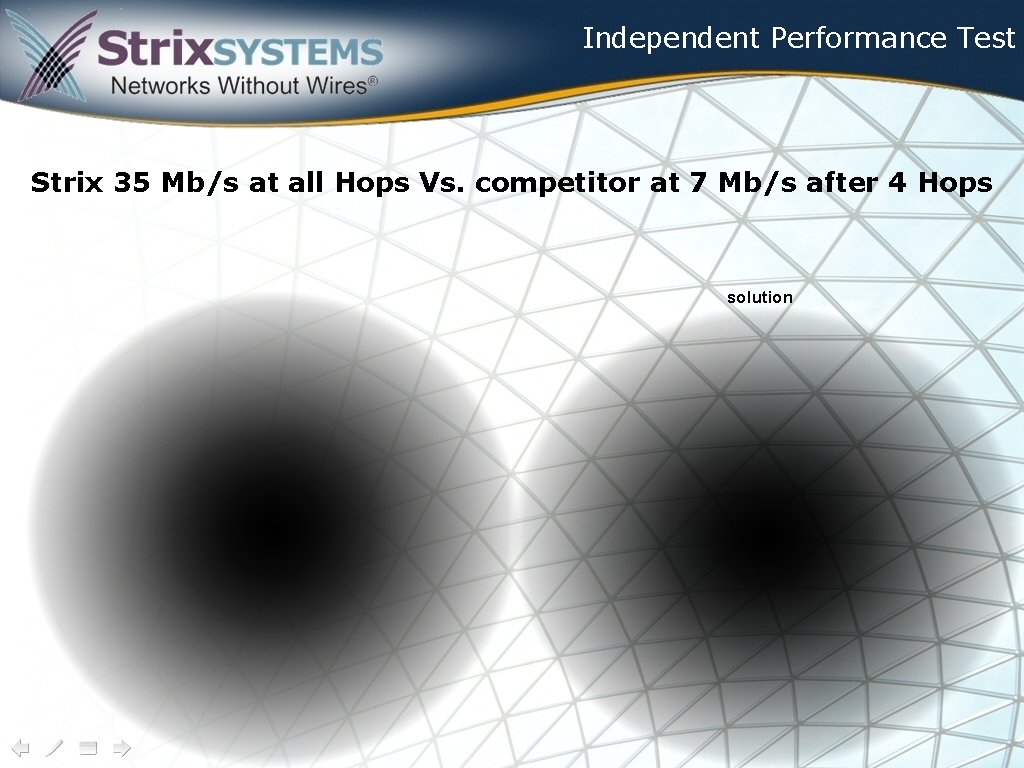
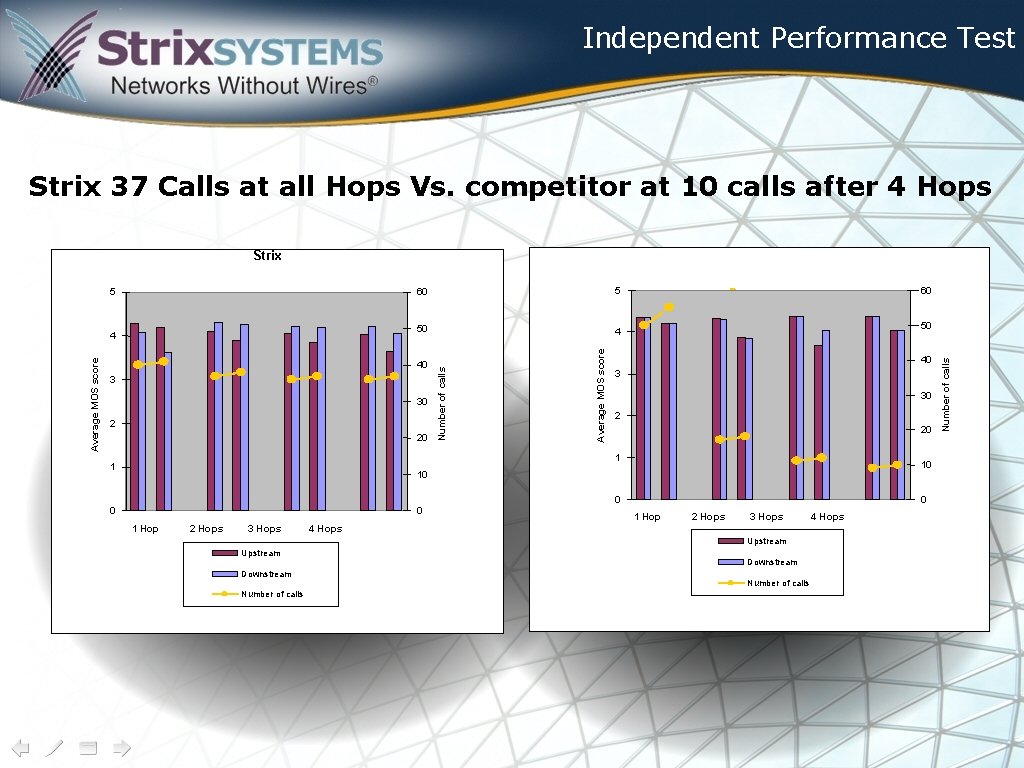
Independent Performance Test Iometrix’ Industry-first Wireless Mesh Test Revokes Widely Accepted Law “It’s not every day that a test produces data that reverses a widely accepted belief: Effective throughput on wireless mesh networks is supposed to taper off to little more than 7 Mbps when traffic is backhauled over four or more nodes. In Iometrix’ firstever series of independent IEEE 802. 11 mesh tests, Strix Systems showed that their outdoor hardened OWS 2400 nodes spiked with multiple radios raise that bar fivefold to a steady 35 Mbps. ” “Invitations to participate in this pioneering test were broadly distributed to vendors. But no more than half a dozen companies responded, amongst which Tropos who declined to submit their single radio solution citing reservations about our methodology, and Sky. Pilot who said they were unable to free up resources for this project. Only Bel. Air, Firetide and Strix Systems announced their intent to participate, but in the end, only the latter two stepped up to the plate. Bel. Air, in an about-face over a month into the preparatory phase of testing, withdrew its participation citing resource constraints. ”
Independent Performance Test Strix 35 Mb/s at all Hops Vs. competitor at 7 Mb/s after 4 Hops solution
Independent Performance Test Strix 37 Calls at all Hops Vs. competitor at 10 calls after 4 Hops Strix 50 4 40 3 30 2 20 60 50 40 3 30 2 20 1 1 10 10 0 1 Hop 2 Hops 3 Hops 4 Hops Upstream Downstream Number of calls 4 Hops Number of calls 5 Average MOS score 4 60 Number of calls 5
Strix Advantages Lower cost and ease of deployment: • Mounting and system provisioning • Auto backhaul, channel selection, power and self-tuning • About ½ the price of Bel. Air 200 similarly equipped Dedicated radio backhaul egress, backhaul ingress and client ingress Strix Dynamic Mesh Architecture is based on distributed Layer 2 Switching (100 Mbps), lower latency, largest sustained bandwidth across multiple hops, and largest network scalability Fast Roaming up to 180 mph and Mobile Node for any transportation / public safety solution. High speeds require Strix Mobile Node Up to 20 channels in the 5 GHz frequency useable for large scale mesh deployments Up to 6 Wi-Fi radios – 3 each 802. 11 A (4. 9 or 5 GHz), 802. 11 G/B Up to 768 users per unit and highest user density Up to 100 Mbps backhaul injection and distribution from wired head end unit 4. 9 GHz higher power DSRC –C mask up to 42 d. Bm EIRP
Strix Advantages Multi-use networks: • Combined 4. 9, 2. 4 and 5 GHz access and 5 GHz backhaul • 16 BSSIDs and 250 VLANs per radio, 4096 VLAN tags per system • Up to 2 RADIUS servers per BSSID and RADIUS proxy support Modular “in-field plug-in-ready” design. Interchangeable dual-radio boards for servicing unit, upgrading to new technologies or increasing user density Proven reliability in large-scale deployed networks worldwide – 40 square miles and larger Upgradeable to Wi. MAX, 802. 11 n and future technologies Flexible antenna use: • Mesh, Point to Multi-Point, Point to Point; Vertical, Horizontal or Multi-polarization; Sector, OMNI, and Directional Flexible installation: • Horizontal or vertical pole, light or traffic pole, wall mount Full Product Portfolio and centralized management • Outdoor (OWS), Indoor (IWS), and Edge (EWS) Strategic Investment by Samsung, leader in Wi. MAX solutions
Factors to consider: wireless mesh Throughput • Proven to be the highest throughput, lowest latency architecture • Supporting 802. 11 a, b, g, j up to 108 Mb/s • Backplane Sustaining over 100 Mb/s Latency • • One & Two radio systems have high latency issues Layer 2 switching faster than layer 3 routing Intelligent distributed processing finds fastest path Sustained performance over multiple wireless hops Scalability Need Any radio, Any Service, Any Configuration Supporting the greatest number of un-tethered nodes Providing the industry’s highest client capacity Separate radio for Client Access and Backhaul Supporting existing and new standards including 4. 9 Ghz and Wi. MAX. • Capable of supporting dozens of nodes with only one wired node • • • Resilience • • Automatic network configuration with secure acceptance into mesh Self-tuning and self-healing architectures optimizes networks performance Distributed network intelligence enables quick transitions Mesh fast re-route redirects traffic during congestion, power outage and natural disaster Management • Critical network awareness, configuration and rogue detection • Simple, powerful control over client and backhaul connectivity • Secure access point and client authentication and encryption
Factors to Consider Wireless Mesh Lower Cost of Initial Deployment Must be able to follow your initial deployment plan Require a flexible/modular architecture Consider future upgradeability Mitigate unplanned truck roles & service costs Lower Cost of Operation Need Simplified, but Powerful, Management Train employees & customers in less time Limit future forklift upgrades Plug-in new future technology