
Strings Chapter 6 Slightly modified by Recep Kaya
Strings Chapter 6 Slightly modified by Recep Kaya Göktaş in April 2015. Python for Informatics: Exploring Information www. pythonlearn. com

Unless otherwise noted, the content of this course material is licensed under a Creative Commons Attribution 3. 0 License. http: //creativecommons. org/licenses/by/3. 0/. Copyright 2010 - Charles Severance
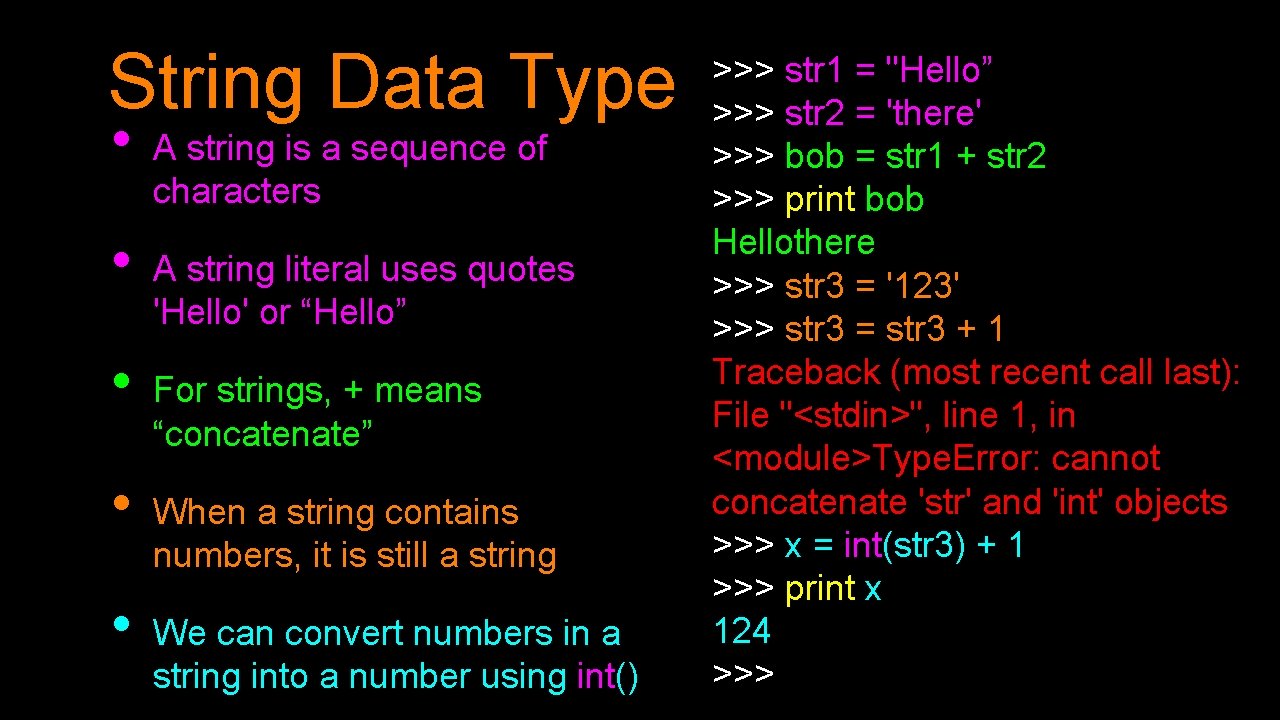
String Data Type • • • A string is a sequence of characters A string literal uses quotes 'Hello' or “Hello” For strings, + means “concatenate” When a string contains numbers, it is still a string We can convert numbers in a string into a number using int() >>> str 1 = "Hello” >>> str 2 = 'there' >>> bob = str 1 + str 2 >>> print bob Hellothere >>> str 3 = '123' >>> str 3 = str 3 + 1 Traceback (most recent call last): File "<stdin>", line 1, in <module>Type. Error: cannot concatenate 'str' and 'int' objects >>> x = int(str 3) + 1 >>> print x 124 >>>
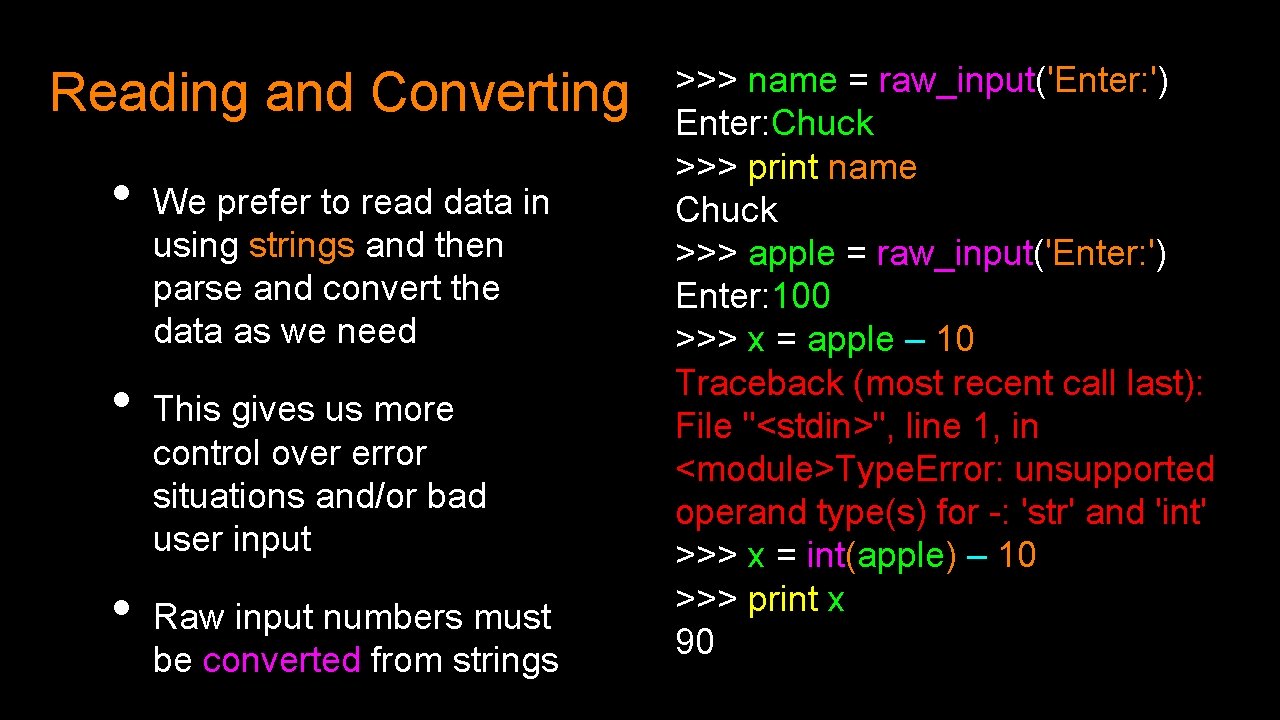
Reading and Converting • • • We prefer to read data in using strings and then parse and convert the data as we need This gives us more control over error situations and/or bad user input Raw input numbers must be converted from strings >>> name = raw_input('Enter: ') Enter: Chuck >>> print name Chuck >>> apple = raw_input('Enter: ') Enter: 100 >>> x = apple – 10 Traceback (most recent call last): File "<stdin>", line 1, in <module>Type. Error: unsupported operand type(s) for -: 'str' and 'int' >>> x = int(apple) – 10 >>> print x 90
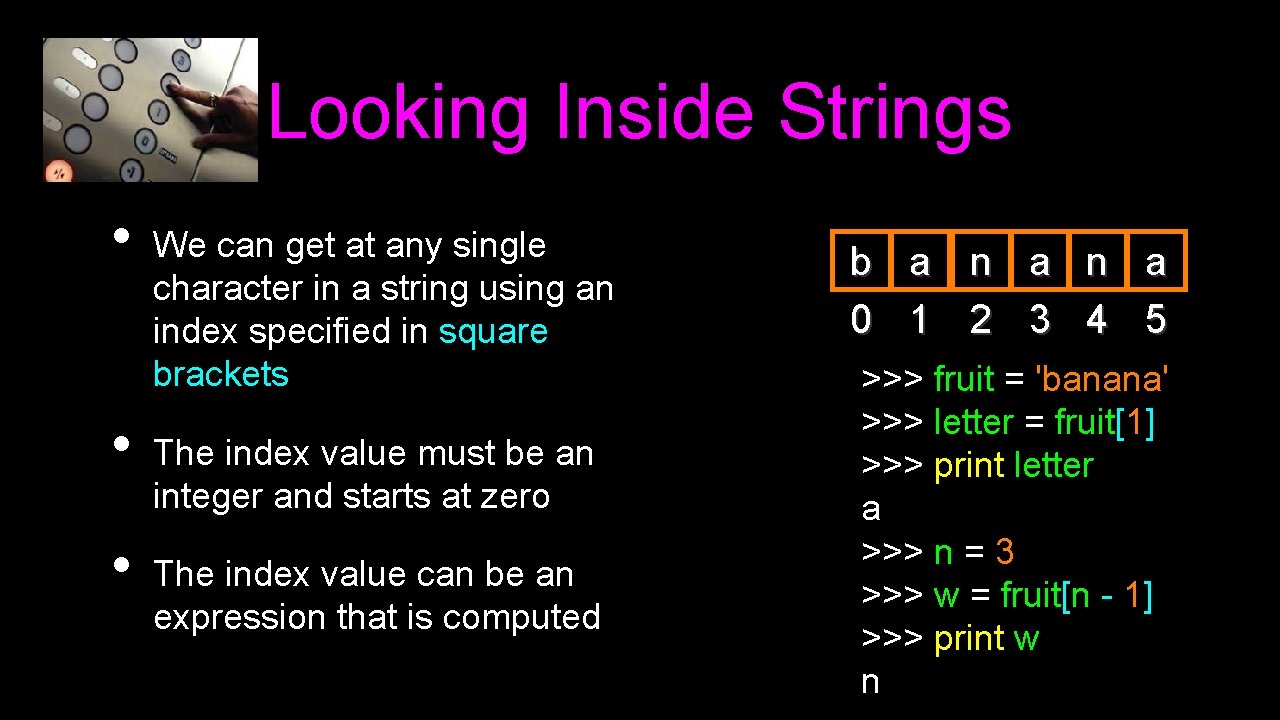
Looking Inside Strings • • • We can get at any single character in a string using an index specified in square brackets The index value must be an integer and starts at zero The index value can be an expression that is computed b a n a 0 1 2 3 4 5 >>> fruit = 'banana' >>> letter = fruit[1] >>> print letter a >>> n = 3 >>> w = fruit[n - 1] >>> print w n
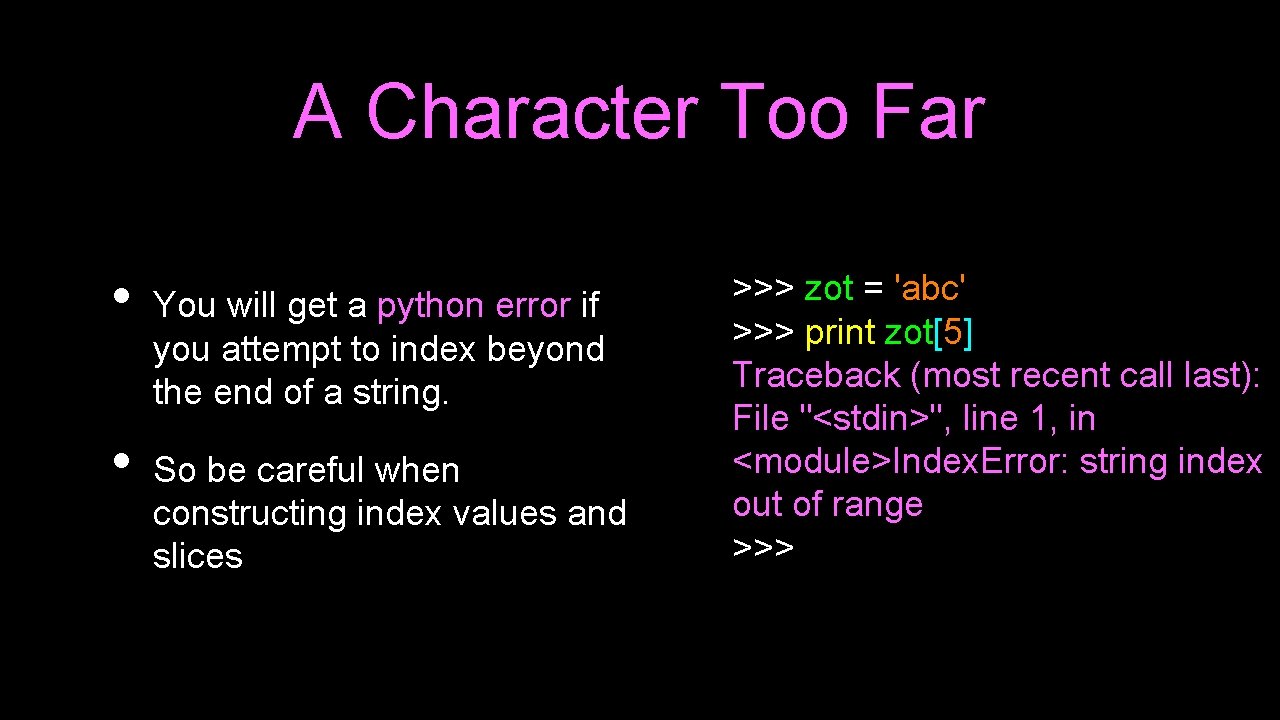
A Character Too Far • • You will get a python error if you attempt to index beyond the end of a string. So be careful when constructing index values and slices >>> zot = 'abc' >>> print zot[5] Traceback (most recent call last): File "<stdin>", line 1, in <module>Index. Error: string index out of range >>>
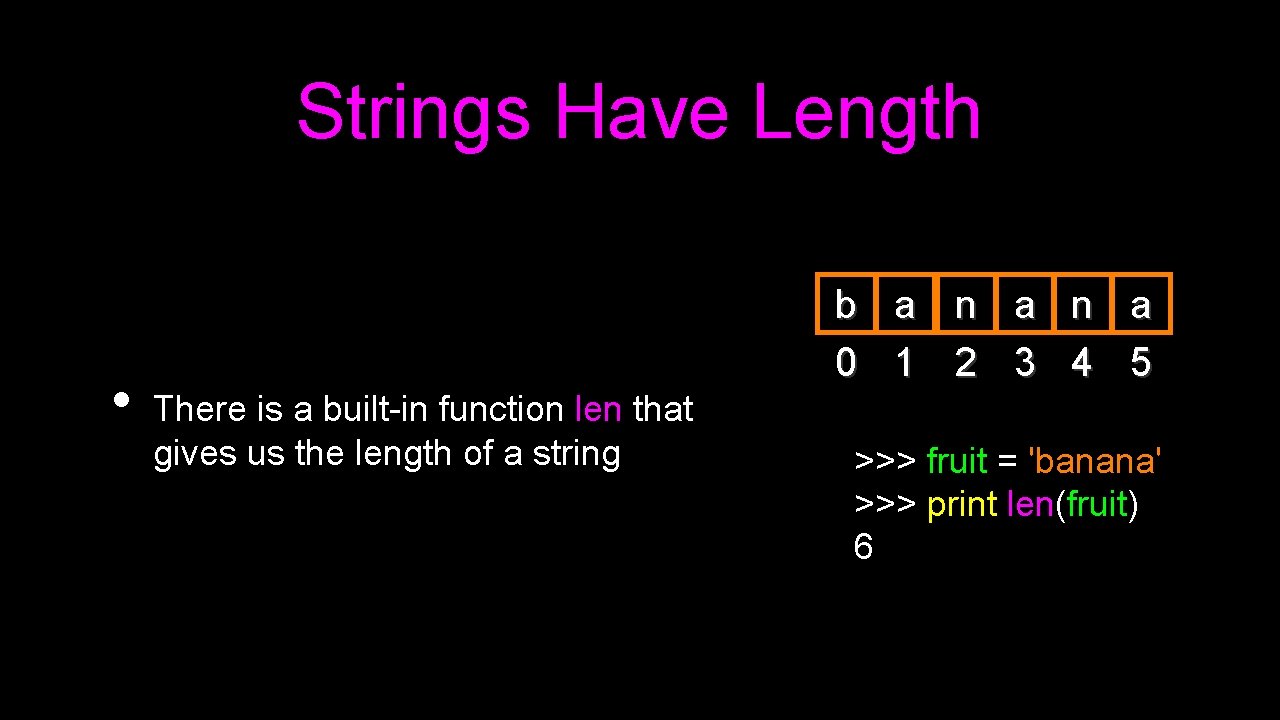
Strings Have Length • b a n a 0 1 2 3 4 5 There is a built-in function len that gives us the length of a string >>> fruit = 'banana' >>> print len(fruit) 6
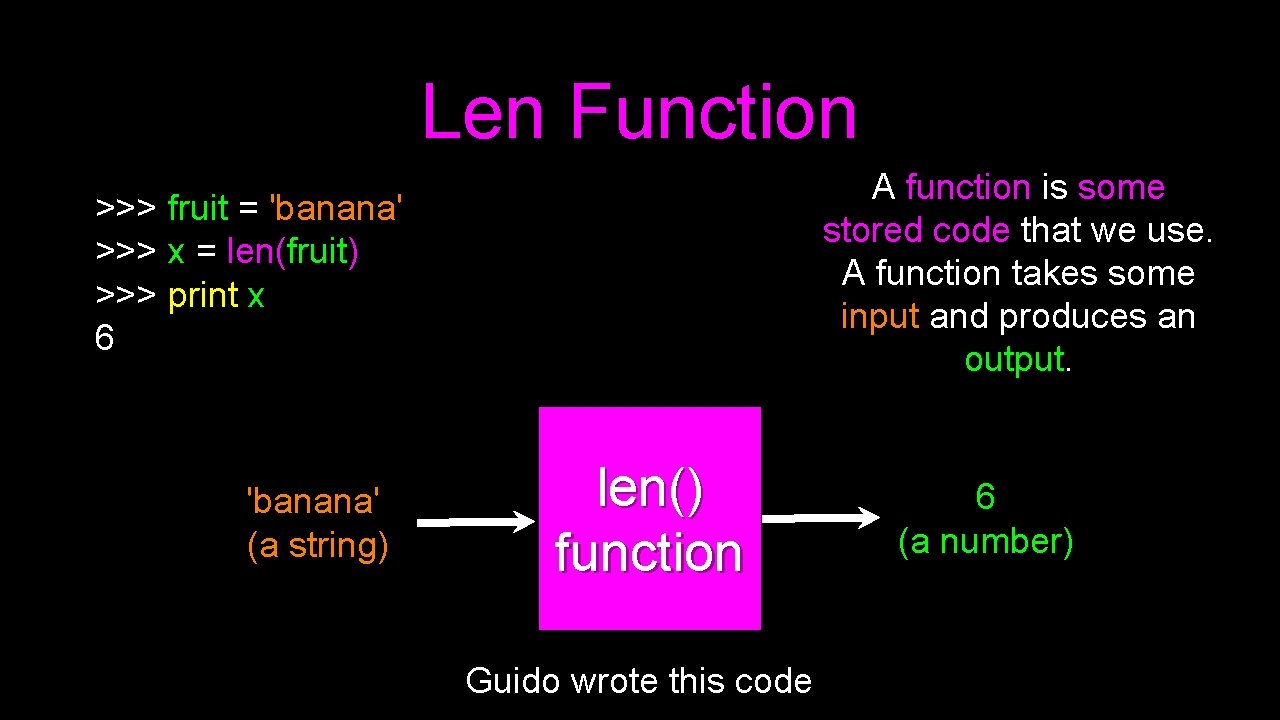
Len Function A function is some stored code that we use. A function takes some input and produces an output. >>> fruit = 'banana' >>> x = len(fruit) >>> print x 6 'banana' (a string) len() function Guido wrote this code 6 (a number)
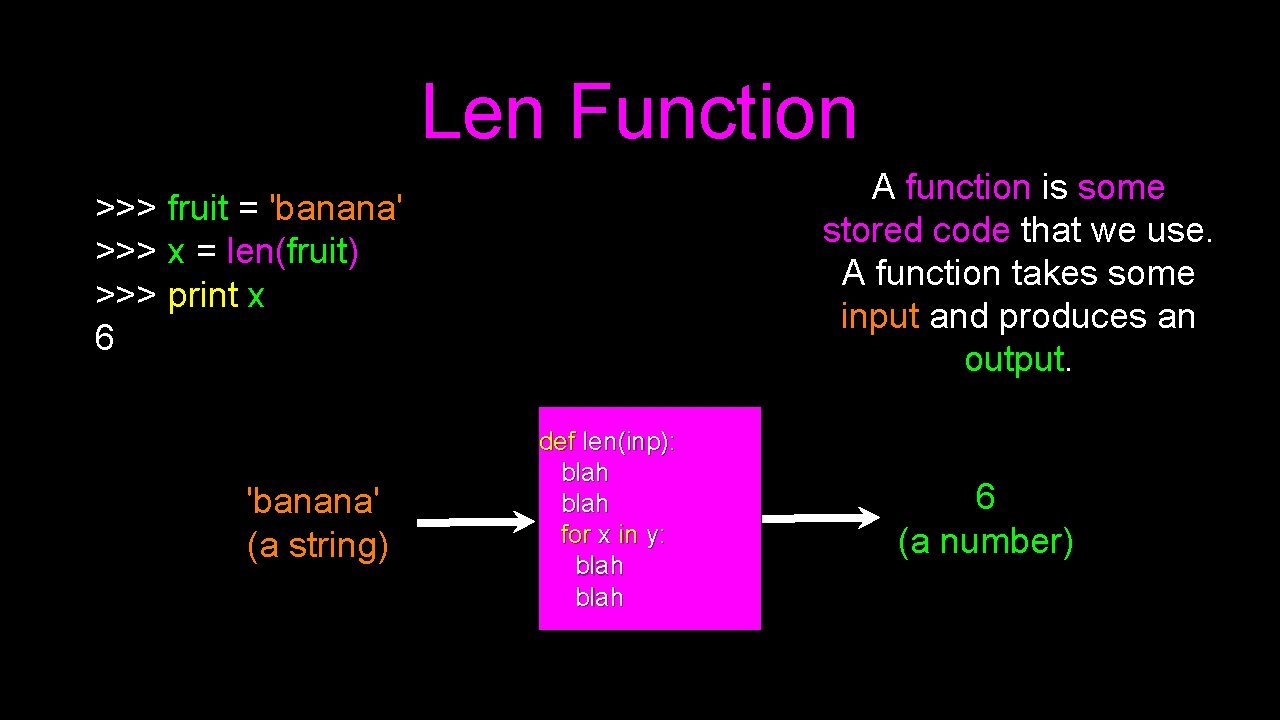
Len Function A function is some stored code that we use. A function takes some input and produces an output. >>> fruit = 'banana' >>> x = len(fruit) >>> print x 6 'banana' (a string) def len(inp): blah for x in y: blah 6 (a number)
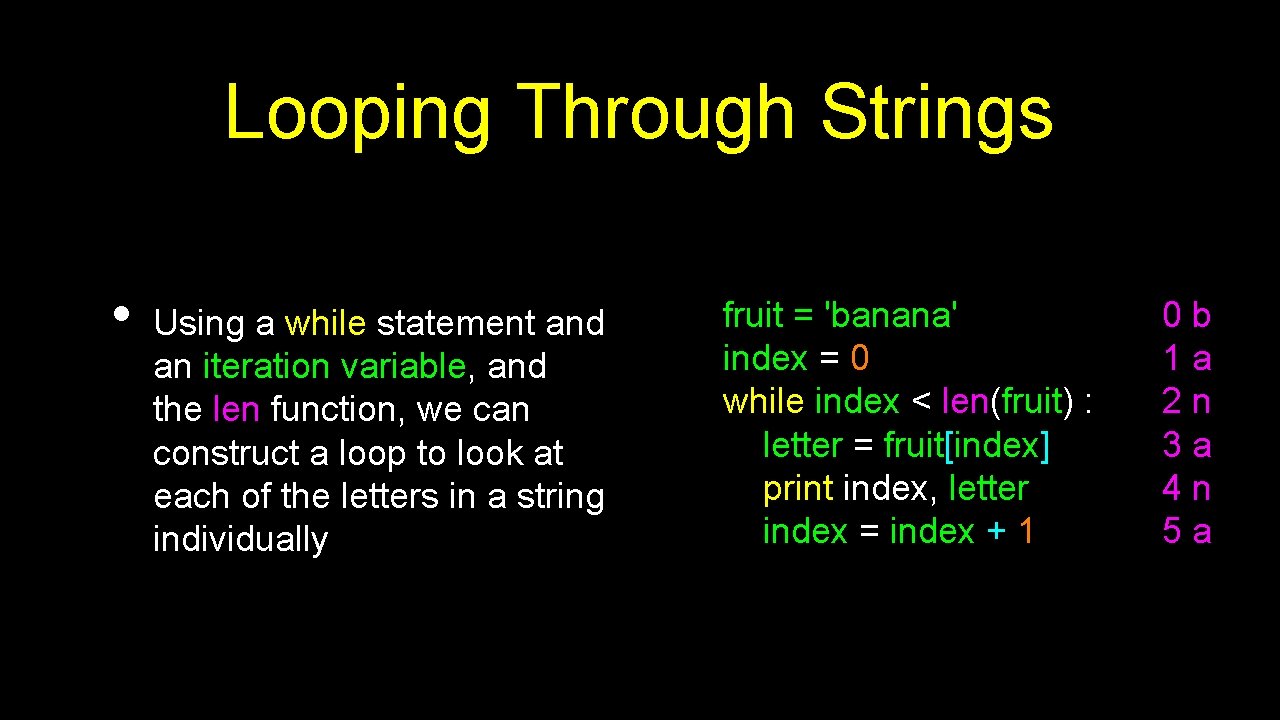
Looping Through Strings • Using a while statement and an iteration variable, and the len function, we can construct a loop to look at each of the letters in a string individually fruit = 'banana' index = 0 while index < len(fruit) : letter = fruit[index] print index, letter index = index + 1 0 b 1 a 2 n 3 a 4 n 5 a
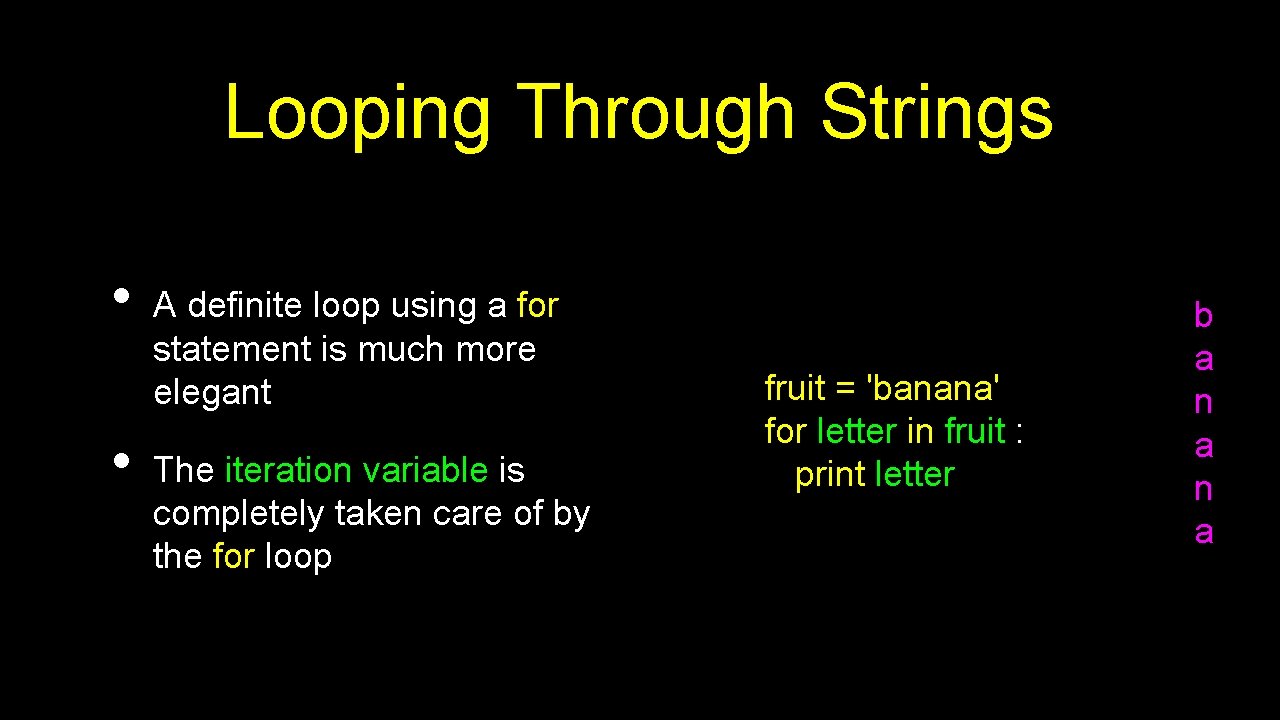
Looping Through Strings • • A definite loop using a for statement is much more elegant The iteration variable is completely taken care of by the for loop fruit = 'banana' for letter in fruit : print letter b a n a
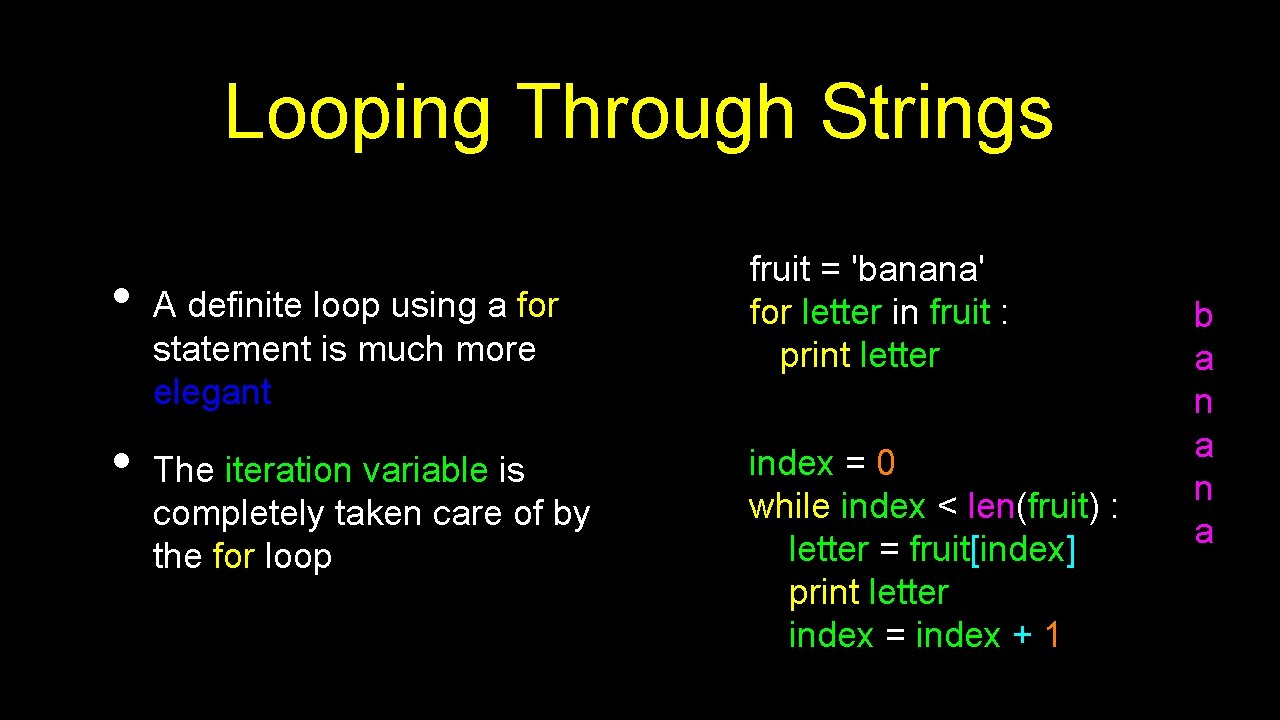
Looping Through Strings • • A definite loop using a for statement is much more elegant The iteration variable is completely taken care of by the for loop fruit = 'banana' for letter in fruit : print letter index = 0 while index < len(fruit) : letter = fruit[index] print letter index = index + 1 b a n a
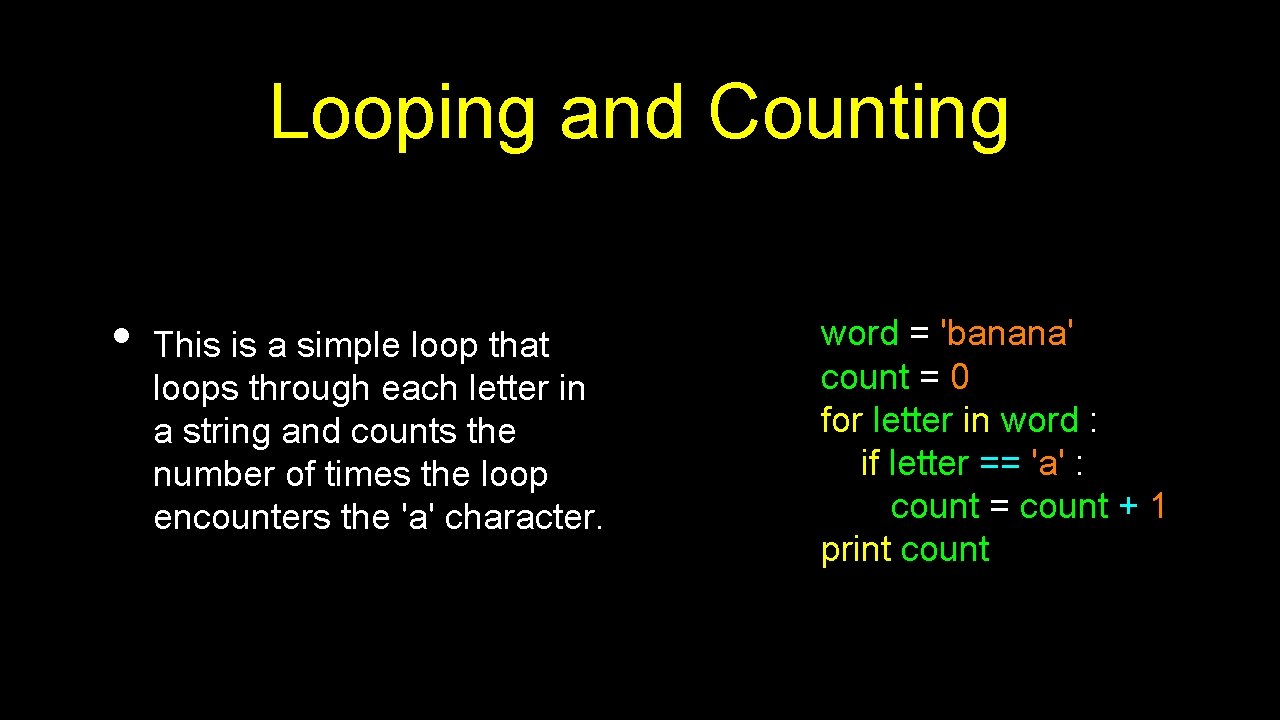
Looping and Counting • This is a simple loop that loops through each letter in a string and counts the number of times the loop encounters the 'a' character. word = 'banana' count = 0 for letter in word : if letter == 'a' : count = count + 1 print count
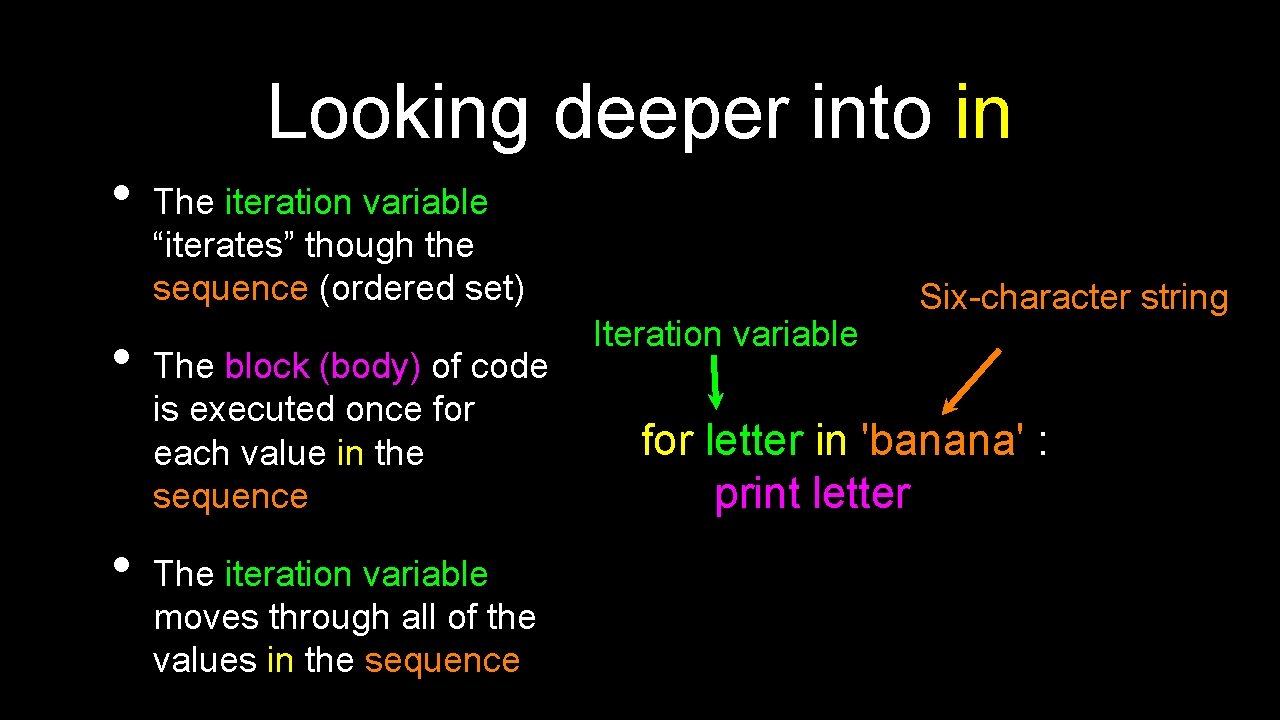
Looking deeper into in • • • The iteration variable “iterates” though the sequence (ordered set) The block (body) of code is executed once for each value in the sequence The iteration variable moves through all of the values in the sequence Iteration variable Six-character string for letter in 'banana' : print letter
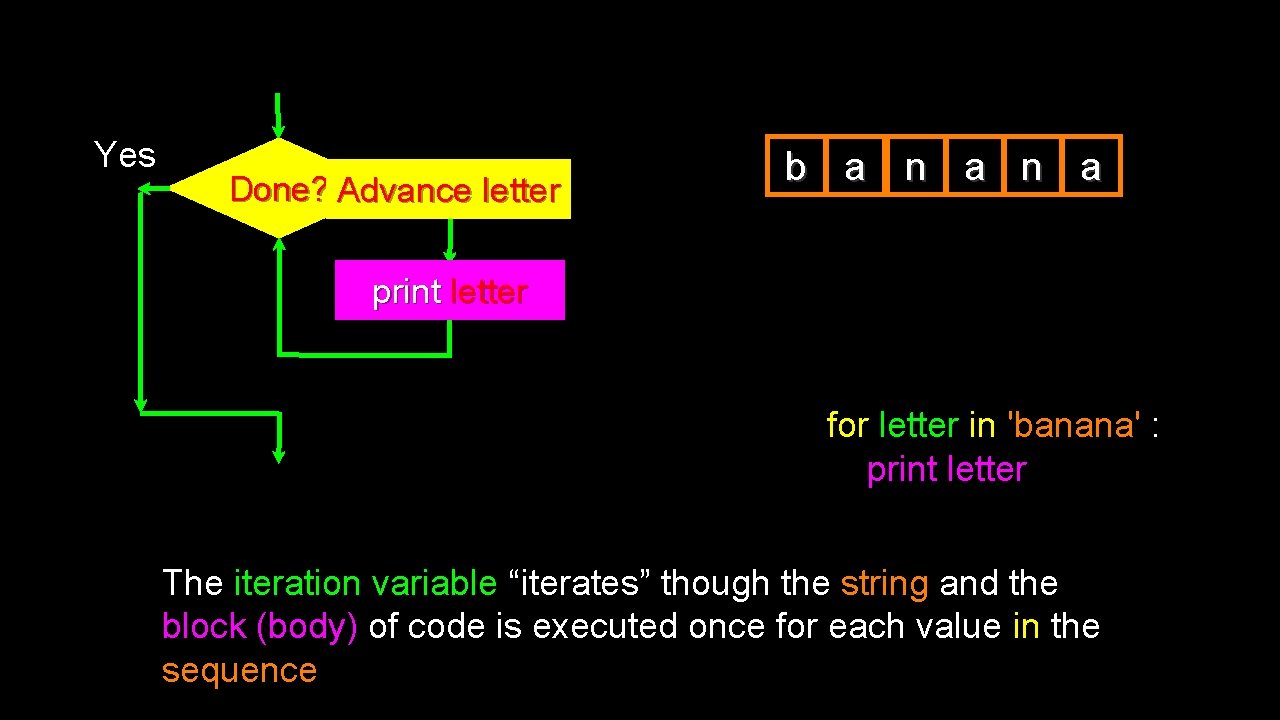
Yes Done? Advance letter b a n a print letter for letter in 'banana' : print letter The iteration variable “iterates” though the string and the block (body) of code is executed once for each value in the sequence
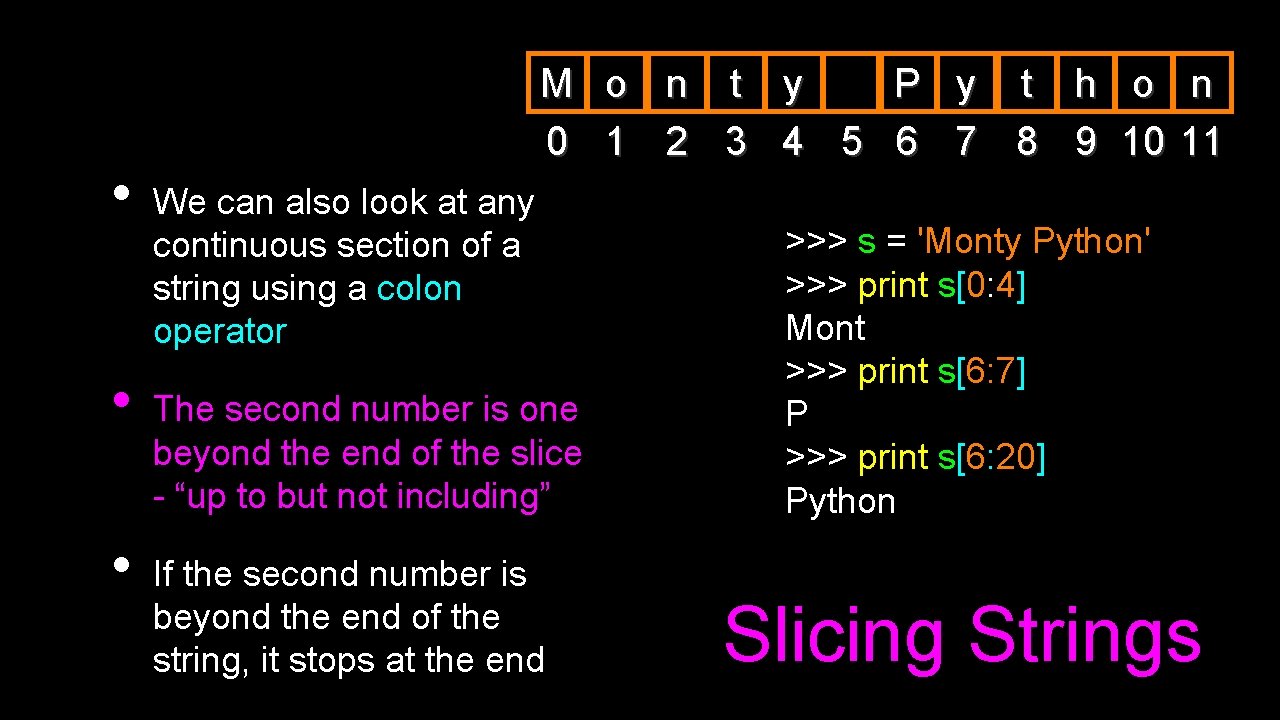
• • • M o n t y P y t h o n 0 1 2 3 4 5 6 7 8 9 10 11 We can also look at any continuous section of a string using a colon operator The second number is one beyond the end of the slice - “up to but not including” If the second number is beyond the end of the string, it stops at the end >>> s = 'Monty Python' >>> print s[0: 4] Mont >>> print s[6: 7] P >>> print s[6: 20] Python Slicing Strings
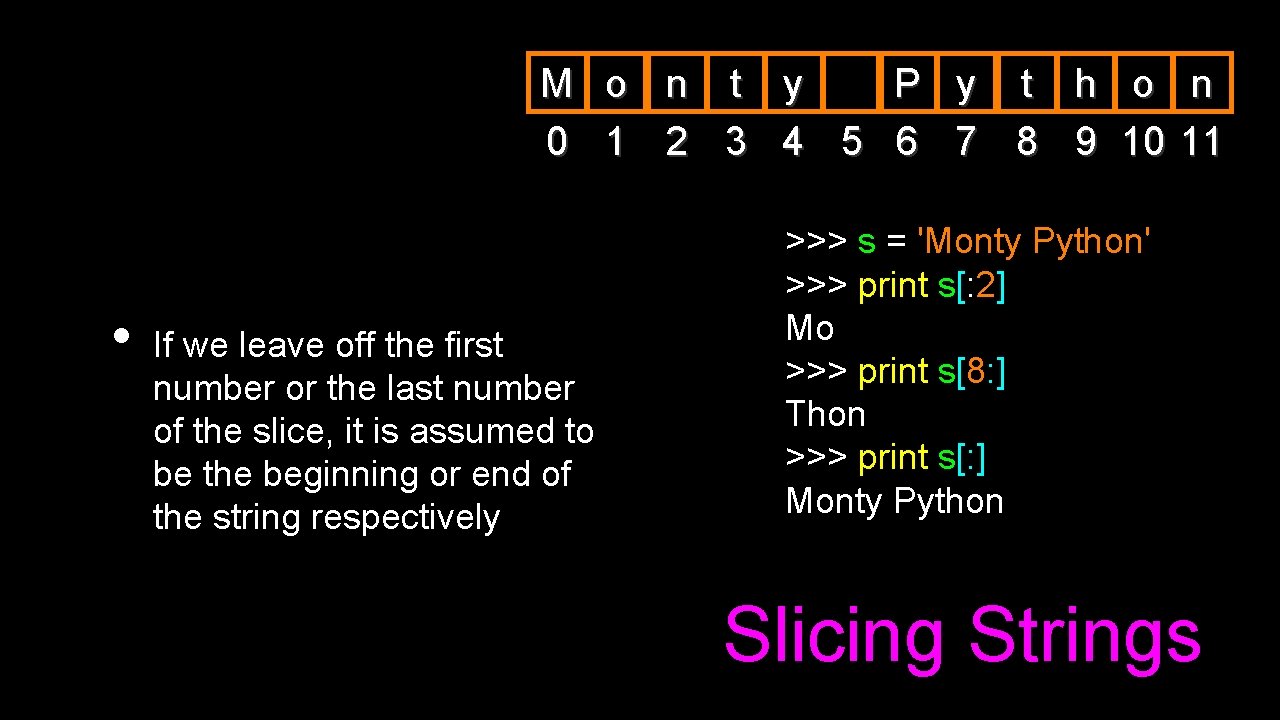
M o n t y P y t h o n 0 1 2 3 4 5 6 7 8 9 10 11 • If we leave off the first number or the last number of the slice, it is assumed to be the beginning or end of the string respectively >>> s = 'Monty Python' >>> print s[: 2] Mo >>> print s[8: ] Thon >>> print s[: ] Monty Python Slicing Strings
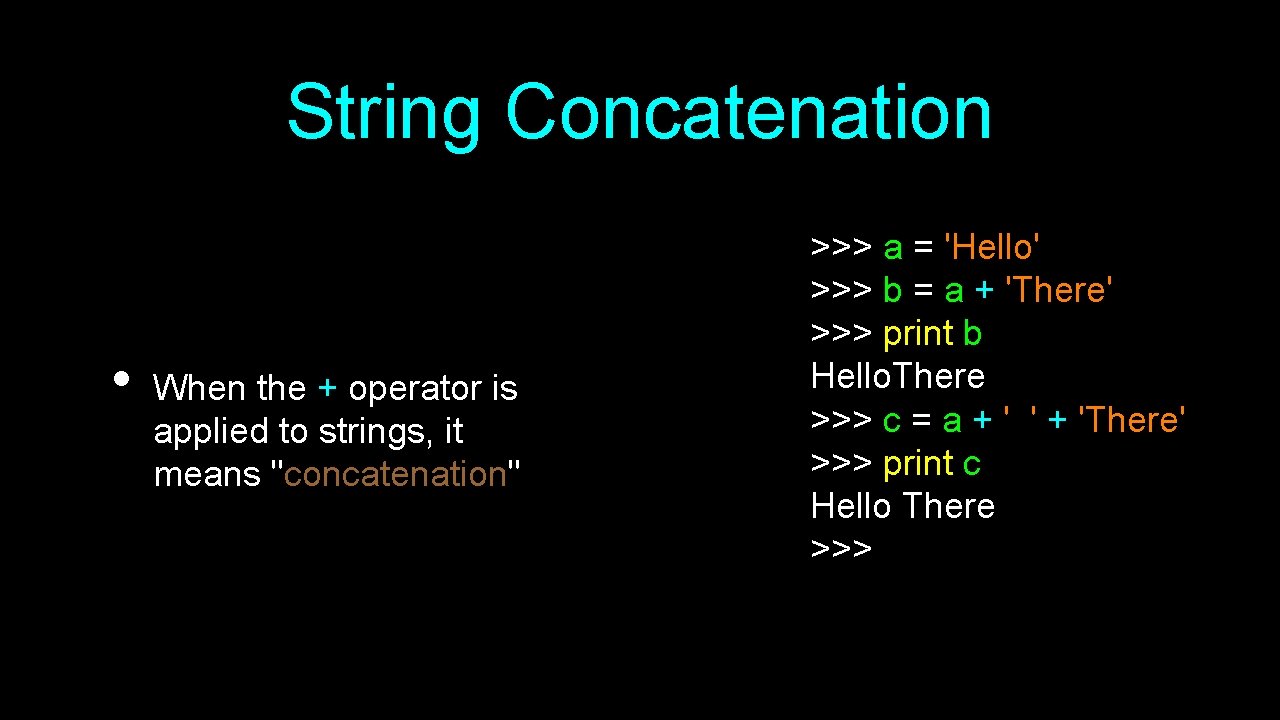
String Concatenation • When the + operator is applied to strings, it means "concatenation" >>> a = 'Hello' >>> b = a + 'There' >>> print b Hello. There >>> c = a + ' ' + 'There' >>> print c Hello There >>>
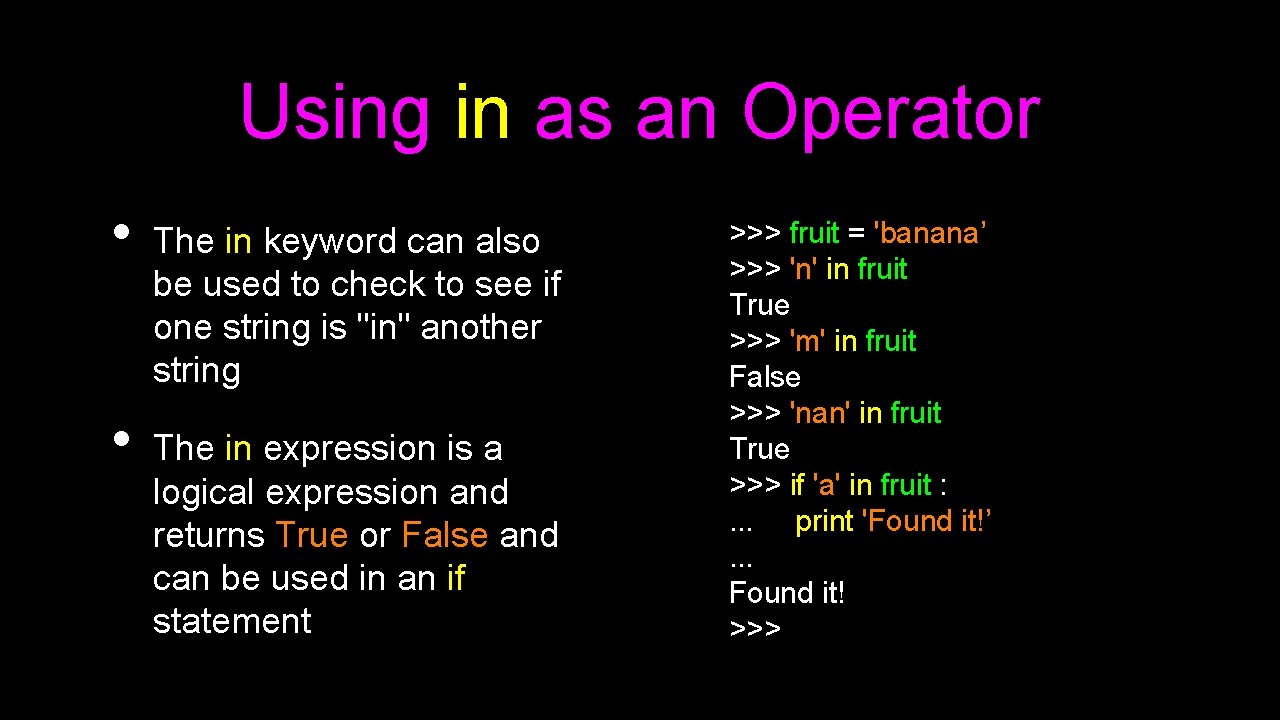
Using in as an Operator • • The in keyword can also be used to check to see if one string is "in" another string The in expression is a logical expression and returns True or False and can be used in an if statement >>> fruit = 'banana’ >>> 'n' in fruit True >>> 'm' in fruit False >>> 'nan' in fruit True >>> if 'a' in fruit : . . . print 'Found it!’. . . Found it! >>>
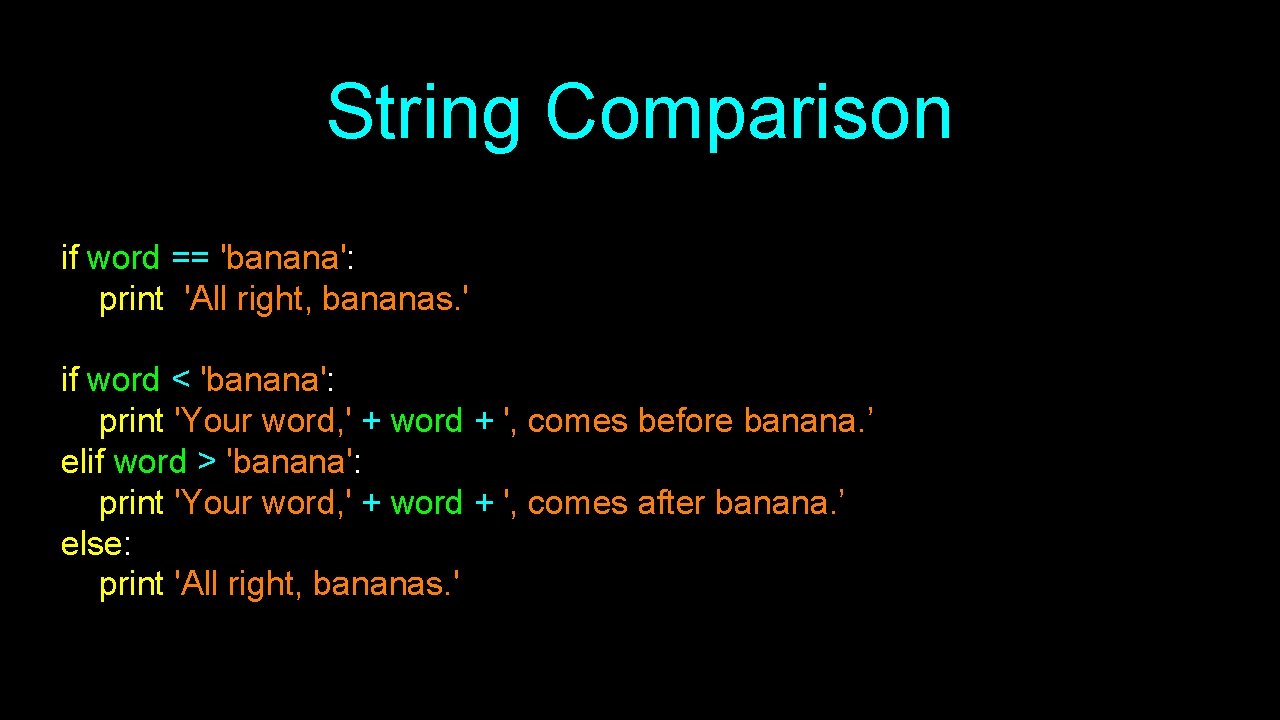
String Comparison if word == 'banana': print 'All right, bananas. ' if word < 'banana': print 'Your word, ' + word + ', comes before banana. ’ elif word > 'banana': print 'Your word, ' + word + ', comes after banana. ’ else: print 'All right, bananas. '
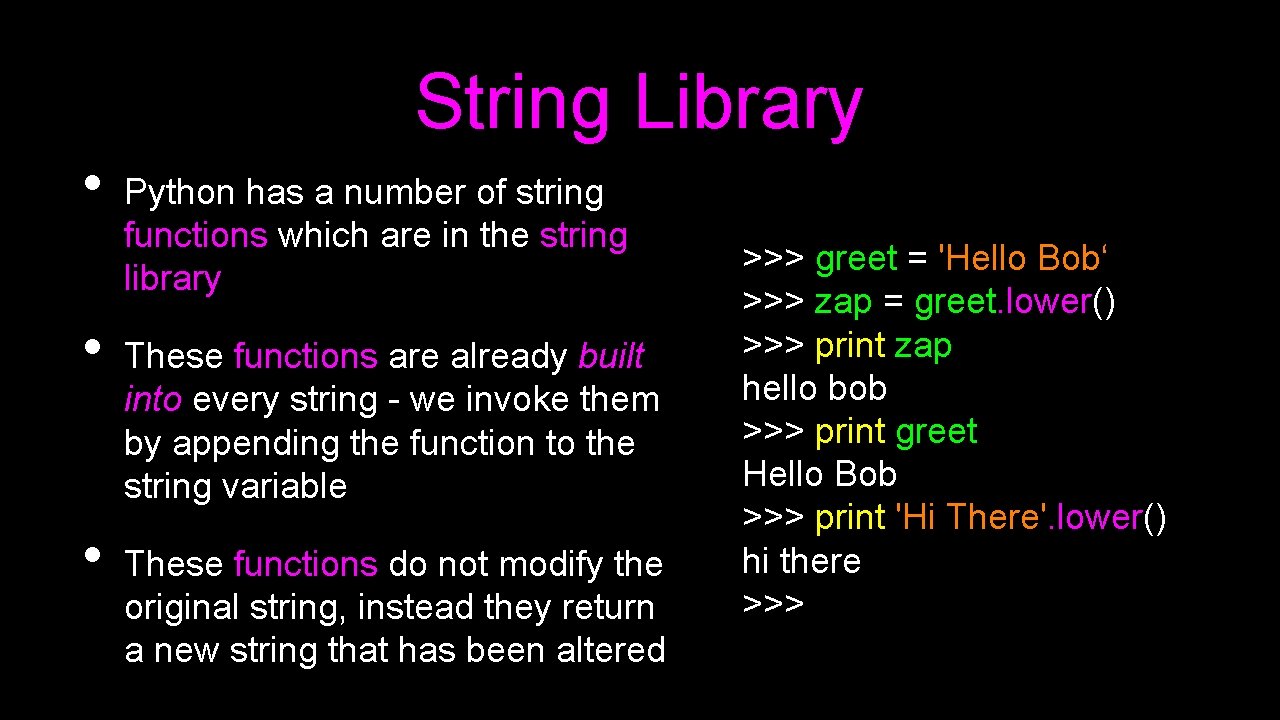
String Library • • • Python has a number of string functions which are in the string library These functions are already built into every string - we invoke them by appending the function to the string variable These functions do not modify the original string, instead they return a new string that has been altered >>> greet = 'Hello Bob‘ >>> zap = greet. lower() >>> print zap hello bob >>> print greet Hello Bob >>> print 'Hi There'. lower() hi there >>>
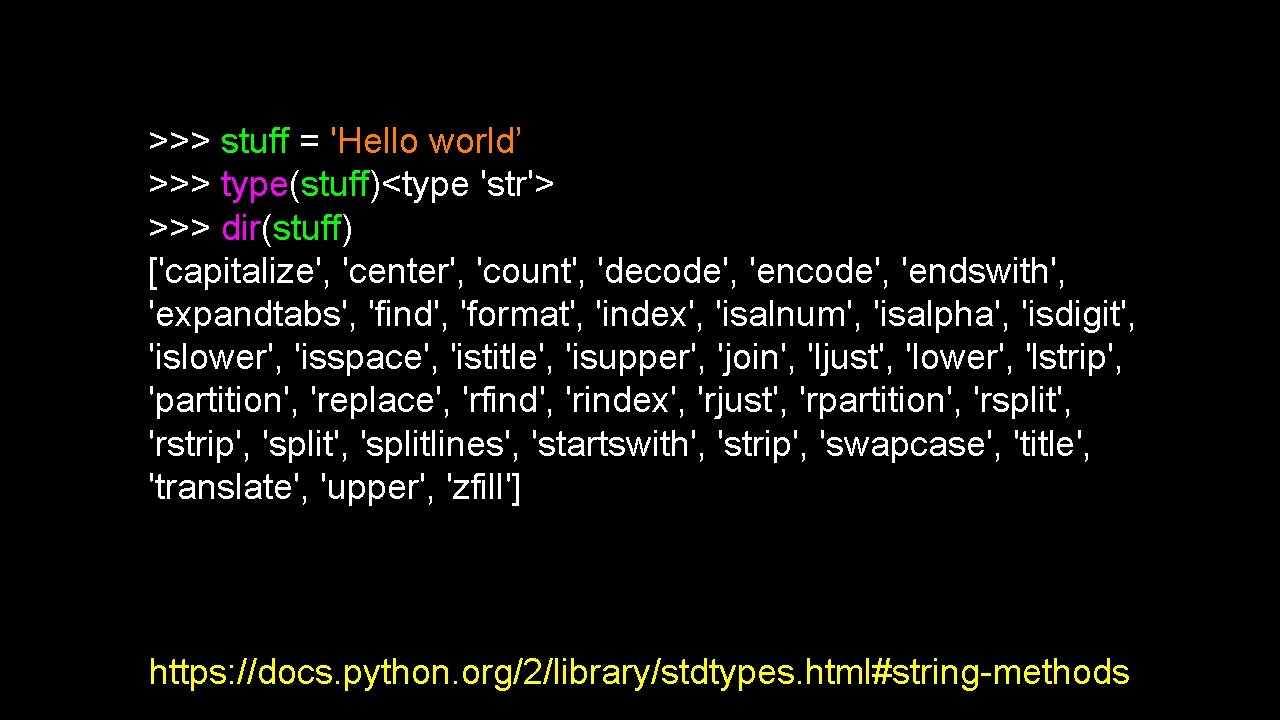
>>> stuff = 'Hello world’ >>> type(stuff)<type 'str'> >>> dir(stuff) ['capitalize', 'center', 'count', 'decode', 'endswith', 'expandtabs', 'find', 'format', 'index', 'isalnum', 'isalpha', 'isdigit', 'islower', 'isspace', 'istitle', 'isupper', 'join', 'ljust', 'lower', 'lstrip', 'partition', 'replace', 'rfind', 'rindex', 'rjust', 'rpartition', 'rsplit', 'rstrip', 'splitlines', 'startswith', 'strip', 'swapcase', 'title', 'translate', 'upper', 'zfill'] https: //docs. python. org/2/library/stdtypes. html#string-methods
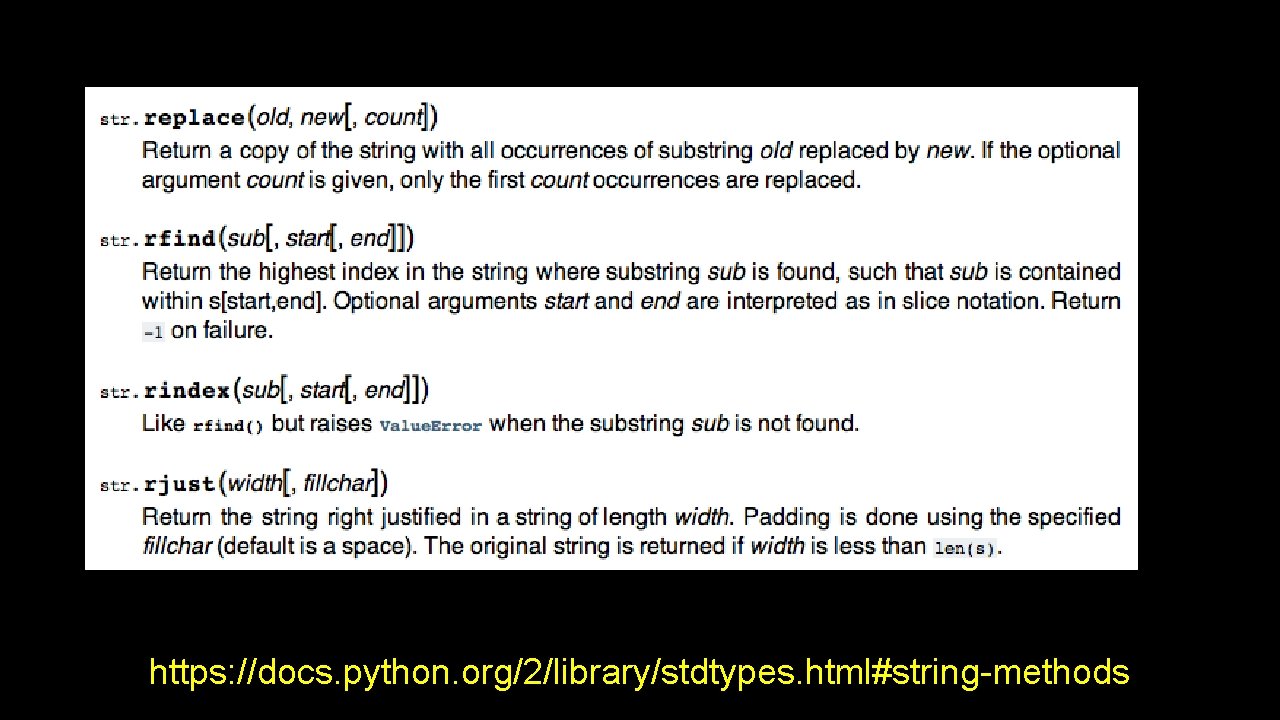
https: //docs. python. org/2/library/stdtypes. html#string-methods
![String Library str. capitalize() str. center(width[, fillchar]) str. endswith(suffix[, start[, end]]) str. find(sub[, start[,](http://slidetodoc.com/presentation_image_h2/0b9ebac6def69943d9e70a95da598ee0/image-24.jpg "String Library str. capitalize() str. center(width[, fillchar]) str. endswith(suffix[, start[, end]]) str. find(sub[, start[,")
String Library str. capitalize() str. center(width[, fillchar]) str. endswith(suffix[, start[, end]]) str. find(sub[, start[, end]]) str. lstrip([chars]) str. replace(old, new[, count]) str. lower() str. rstrip([chars]) str. upper() https: //docs. python. org/2/library/stdtypes. html#string-methods
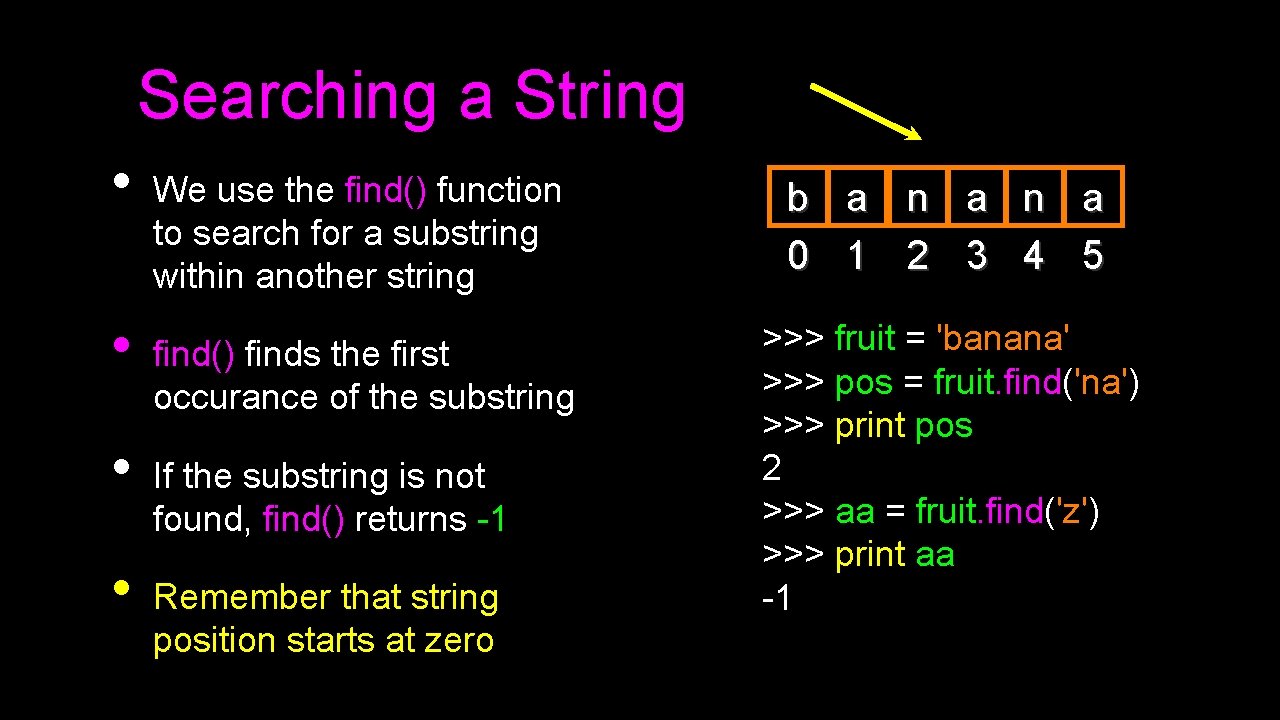
Searching a String • • We use the find() function to search for a substring within another string b a n a 0 1 2 3 4 5 find() finds the first occurance of the substring >>> fruit = 'banana' >>> pos = fruit. find('na') >>> print pos 2 >>> aa = fruit. find('z') >>> print aa -1 If the substring is not found, find() returns -1 Remember that string position starts at zero
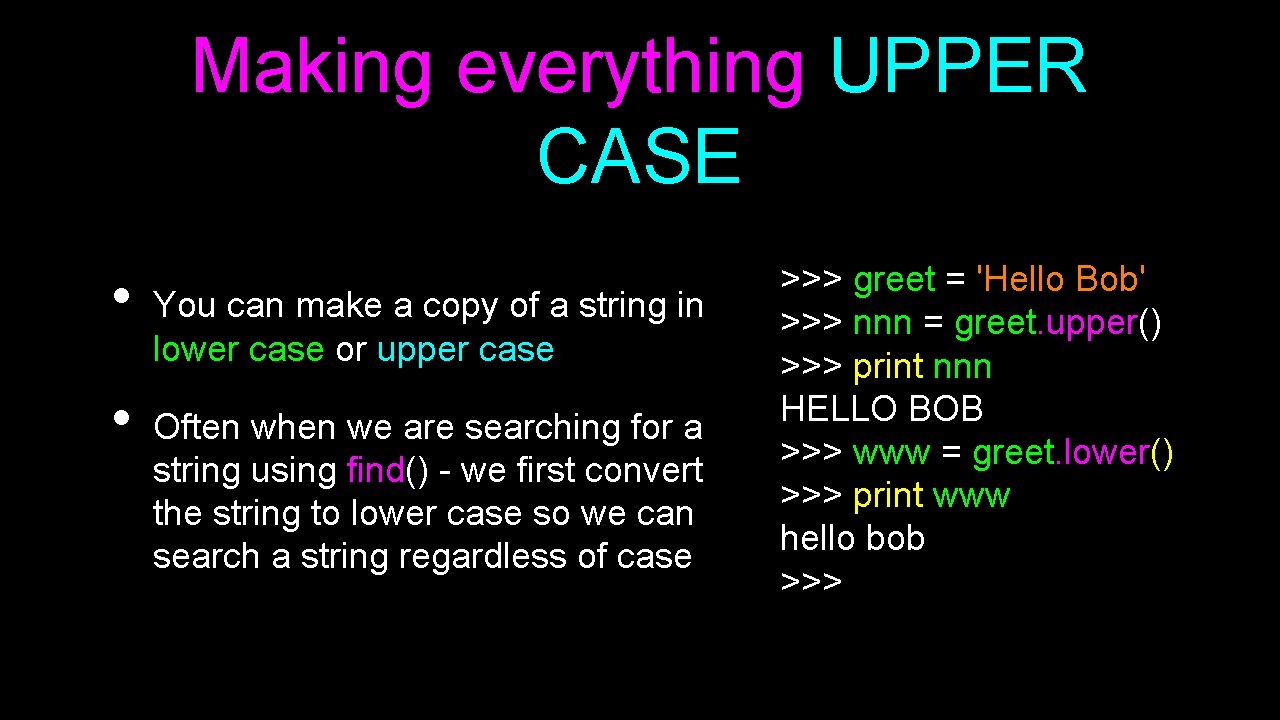
Making everything UPPER CASE • • You can make a copy of a string in lower case or upper case Often when we are searching for a string using find() - we first convert the string to lower case so we can search a string regardless of case >>> greet = 'Hello Bob' >>> nnn = greet. upper() >>> print nnn HELLO BOB >>> www = greet. lower() >>> print www hello bob >>>
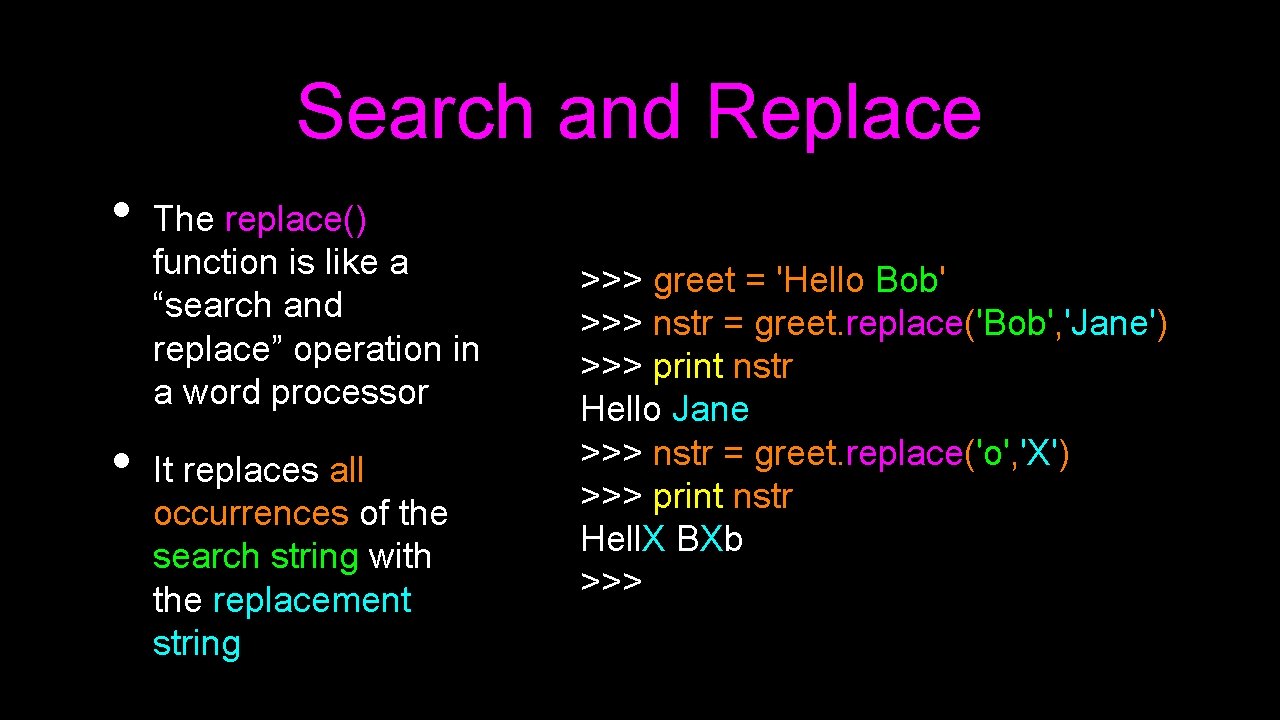
Search and Replace • • The replace() function is like a “search and replace” operation in a word processor It replaces all occurrences of the search string with the replacement string >>> greet = 'Hello Bob' >>> nstr = greet. replace('Bob', 'Jane') >>> print nstr Hello Jane >>> nstr = greet. replace('o', 'X') >>> print nstr Hell. X BXb >>>
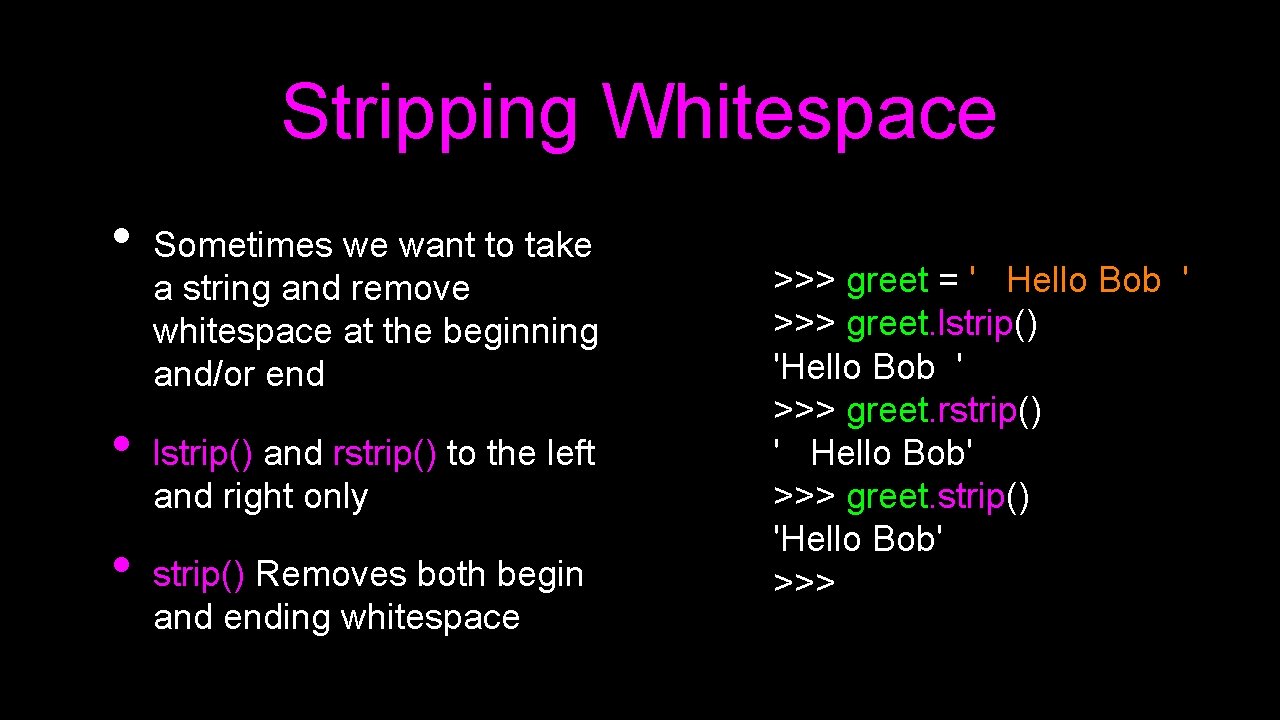
Stripping Whitespace • • • Sometimes we want to take a string and remove whitespace at the beginning and/or end lstrip() and rstrip() to the left and right only strip() Removes both begin and ending whitespace >>> greet = ' Hello Bob ' >>> greet. lstrip() 'Hello Bob ' >>> greet. rstrip() ' Hello Bob' >>> greet. strip() 'Hello Bob' >>>
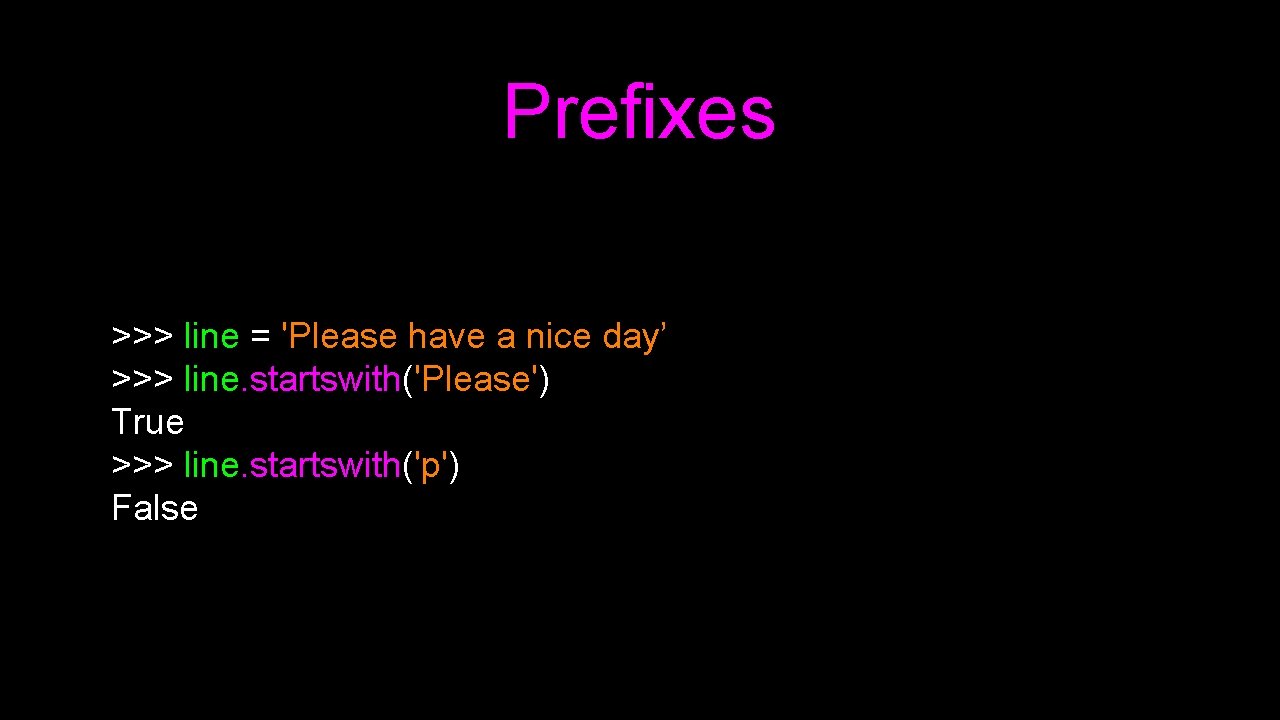
Prefixes >>> line = 'Please have a nice day’ >>> line. startswith('Please') True >>> line. startswith('p') False
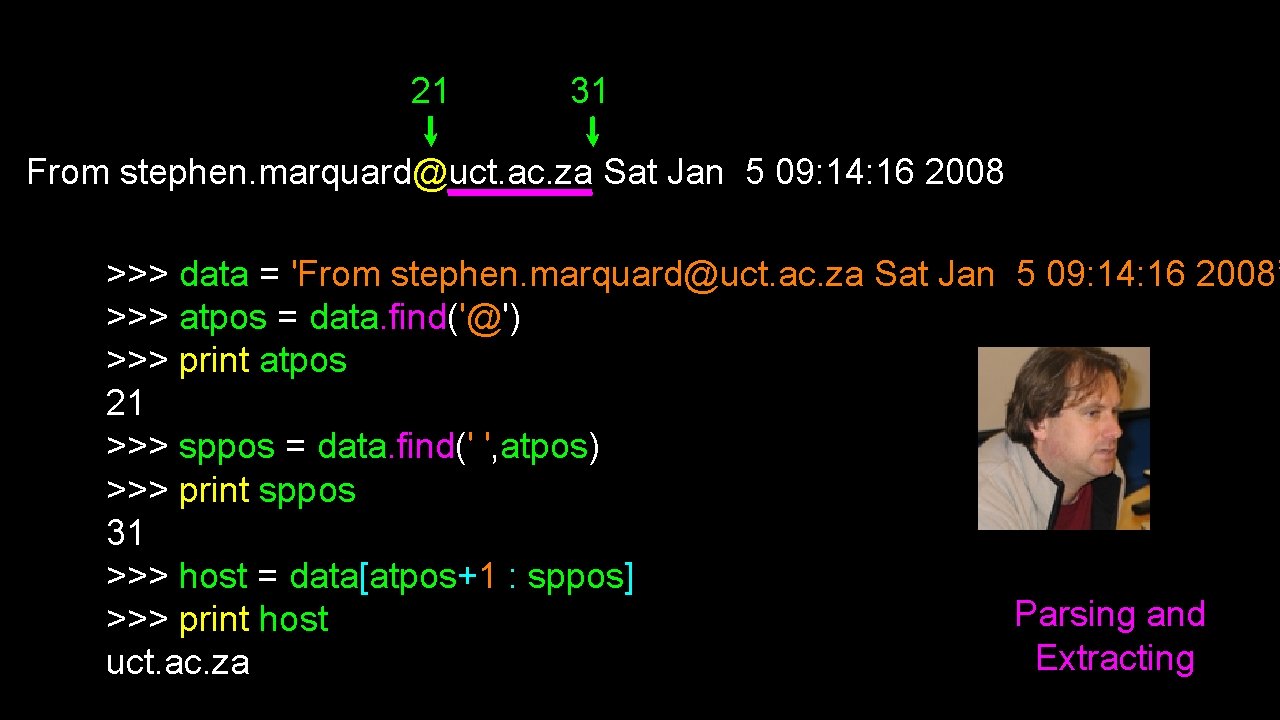
21 31 From stephen. marquard@uct. ac. za Sat Jan 5 09: 14: 16 2008 >>> data = 'From stephen. marquard@uct. ac. za Sat Jan 5 09: 14: 16 2008’ >>> atpos = data. find('@') >>> print atpos 21 >>> sppos = data. find(' ', atpos) >>> print sppos 31 >>> host = data[atpos+1 : sppos] Parsing and >>> print host Extracting uct. ac. za
![Summary • String type • Read/Convert • Indexing strings [] • Slicing strings [2:](http://slidetodoc.com/presentation_image_h2/0b9ebac6def69943d9e70a95da598ee0/image-31.jpg "Summary • String type • Read/Convert • Indexing strings [] • Slicing strings [2:")
Summary • String type • Read/Convert • Indexing strings [] • Slicing strings [2: 4] • Looping through strings with for and while • Concatenating strings with + • String operations
- Slides: 31