
String Processing CS 1111 Introduction to Programming Spring
![String Processing CS 1111 Introduction to Programming Spring 2019 [The Coder’s Apprentice, § 10]](https://slidetodoc.com/presentation_image_h2/4cbc8329d792622410428bacfeffc7f9/image-1.jpg "String Processing CS 1111 Introduction to Programming Spring 2019 [The Coder’s Apprentice, § 10]")
![Slicing Refer to a range of values s[start : stop] • Slice from start](https://slidetodoc.com/presentation_image_h2/4cbc8329d792622410428bacfeffc7f9/image-10.jpg "Slicing Refer to a range of values s[start : stop] • Slice from start")
- Slides: 25
String Processing CS 1111 Introduction to Programming Spring 2019 [The Coder’s Apprentice, § 10] CS 1111 – University of Virginia © Praphamontripong
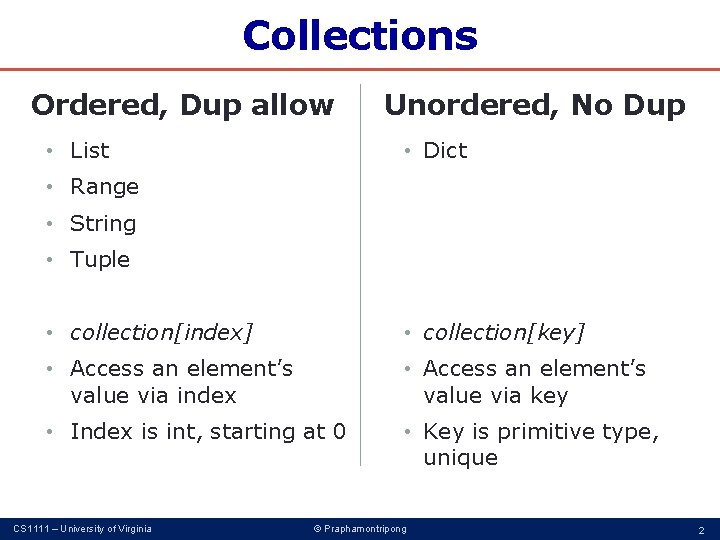
Collections Ordered, Dup allow • List Unordered, No Dup • Dict • Range • String • Tuple • collection[index] • collection[key] • Access an element’s value via index • Access an element’s value via key • Index is int, starting at 0 • Key is primitive type, unique CS 1111 – University of Virginia © Praphamontripong 2
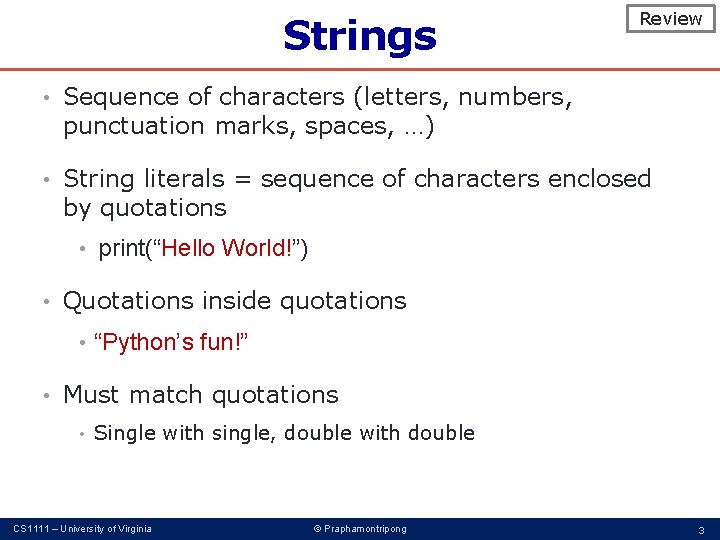
Strings Review • Sequence of characters (letters, numbers, punctuation marks, spaces, …) • String literals = sequence of characters enclosed by quotations • print(“Hello World!”) • Quotations inside quotations • “Python’s fun!” • Must match quotations • Single with single, double with double CS 1111 – University of Virginia © Praphamontripong 3
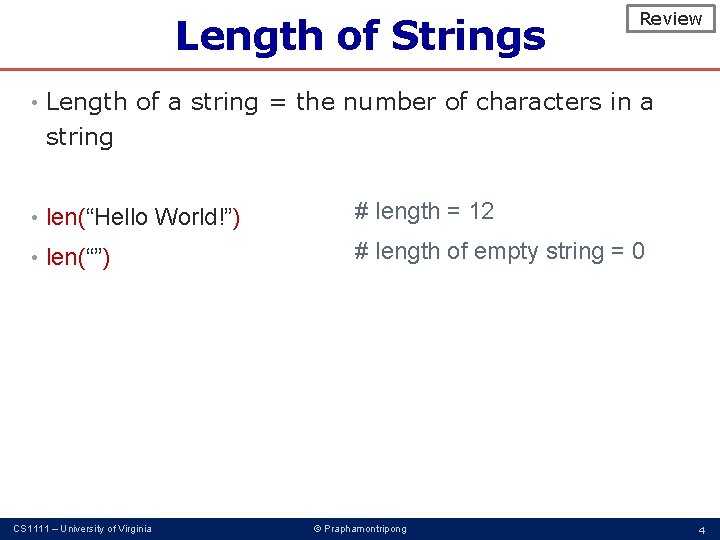
Length of Strings Review • Length of a string = the number of characters in a string • len(“Hello World!”) # length = 12 • len(“”) # length of empty string = 0 CS 1111 – University of Virginia © Praphamontripong 4
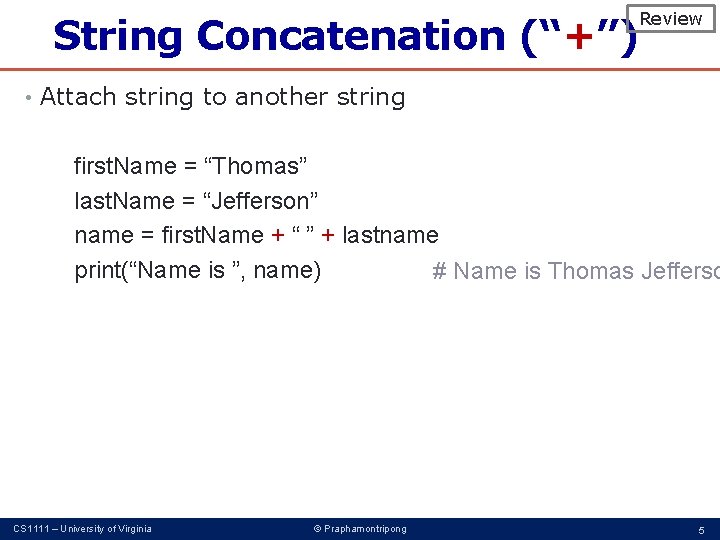
Review String Concatenation (“+”) • Attach string to another string first. Name = “Thomas” last. Name = “Jefferson” name = first. Name + “ ” + lastname print(“Name is ”, name) # Name is Thomas Jefferso CS 1111 – University of Virginia © Praphamontripong 5
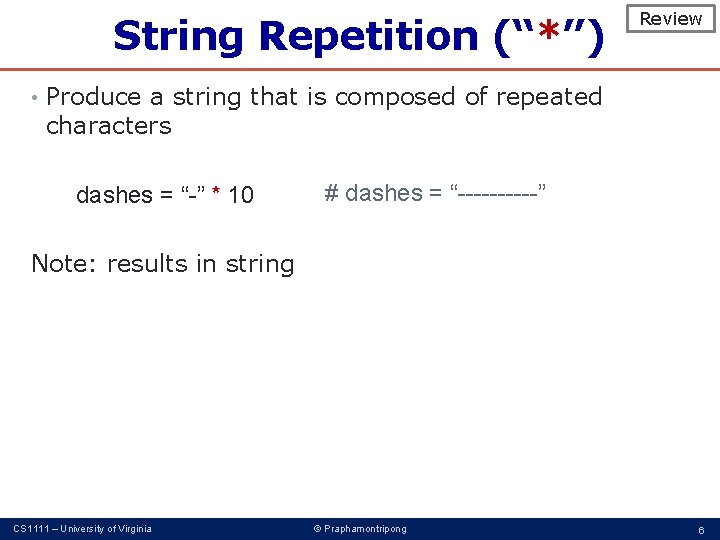
String Repetition (“*”) Review • Produce a string that is composed of repeated characters dashes = “-” * 10 # dashes = “-----” Note: results in string CS 1111 – University of Virginia © Praphamontripong 6
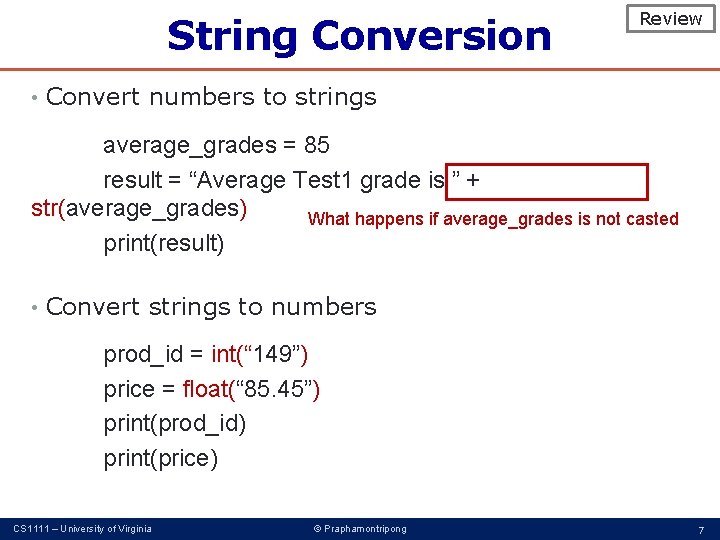
String Conversion Review • Convert numbers to strings average_grades = 85 result = “Average Test 1 grade is ” + str(average_grades) What happens if average_grades is not casted print(result) • Convert strings to numbers prod_id = int(“ 149”) price = float(“ 85. 45”) print(prod_id) print(price) CS 1111 – University of Virginia © Praphamontripong 7
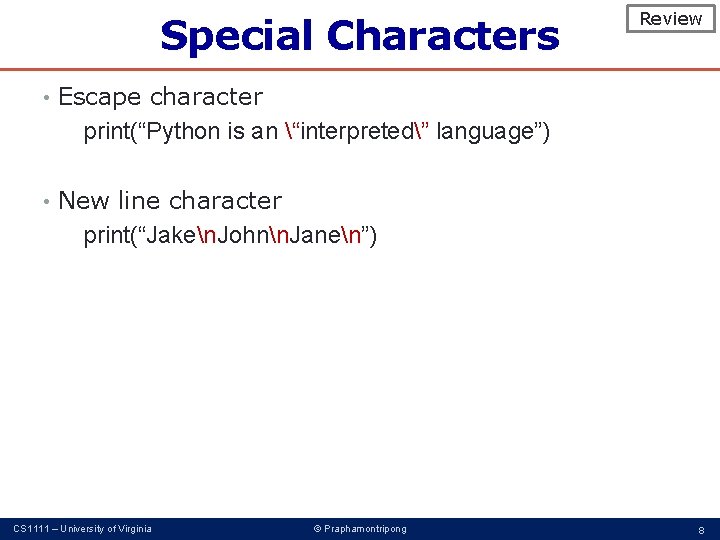
Special Characters Review • Escape character print(“Python is an “interpreted” language”) • New line character print(“Jaken. Johnn. Janen”) CS 1111 – University of Virginia © Praphamontripong 8
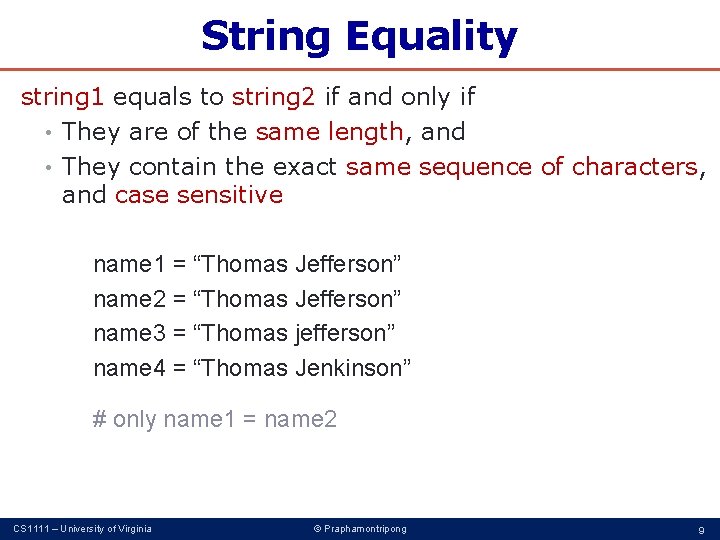
String Equality string 1 equals to string 2 if and only if • They are of the same length, and • They contain the exact same sequence of characters, and case sensitive name 1 = “Thomas Jefferson” name 2 = “Thomas Jefferson” name 3 = “Thomas jefferson” name 4 = “Thomas Jenkinson” # only name 1 = name 2 CS 1111 – University of Virginia © Praphamontripong 9
Slicing Refer to a range of values s[start : stop] • Slice from start index (inclusive) to stop index (exclusive) s[start : ] • Slice from start index (inclusive) to the end of the collection s[ : stop] • Slice from the beginning of the collection to the stop index (exclusive) s[start : stop : step] • Slice from start index (inclusive) to stop index (exclusive), skip step-1 then grab CS 1111 – University of Virginia © Praphamontripong 10
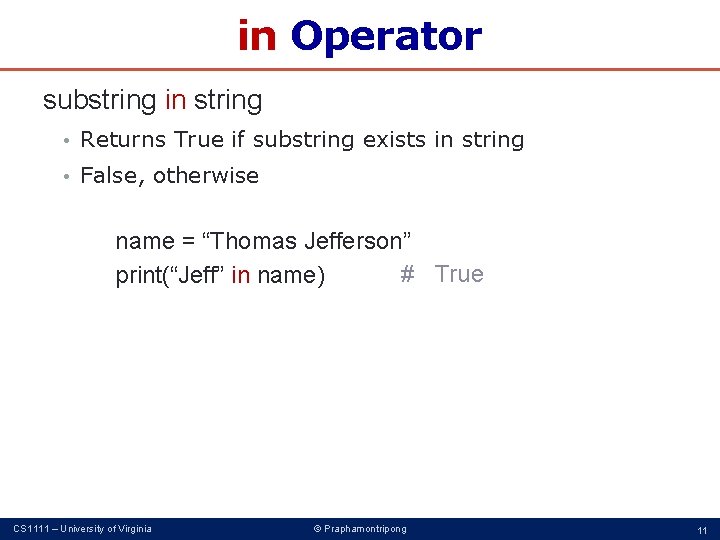
in Operator substring in string • Returns True if substring exists in string • False, otherwise name = “Thomas Jefferson” # True print(“Jeff” in name) CS 1111 – University of Virginia © Praphamontripong 11
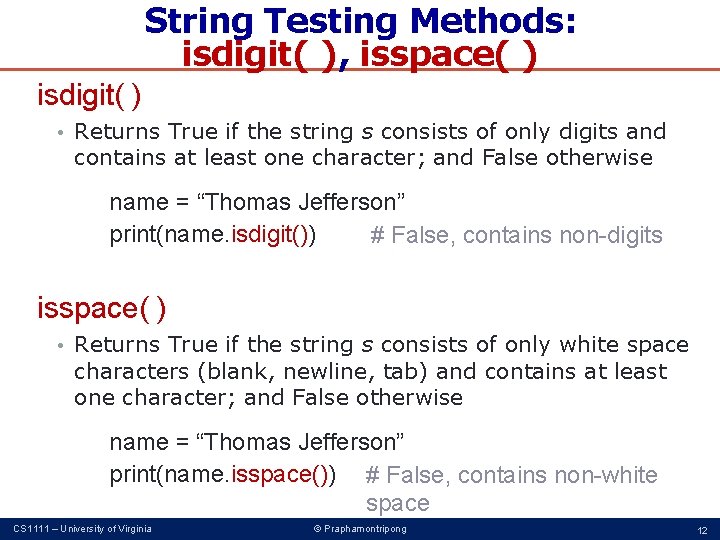
String Testing Methods: isdigit( ), isspace( ) isdigit( ) • Returns True if the string s consists of only digits and contains at least one character; and False otherwise name = “Thomas Jefferson” print(name. isdigit()) # False, contains non-digits isspace( ) • Returns True if the string s consists of only white space characters (blank, newline, tab) and contains at least one character; and False otherwise name = “Thomas Jefferson” print(name. isspace()) # False, contains non-white space CS 1111 – University of Virginia © Praphamontripong 12
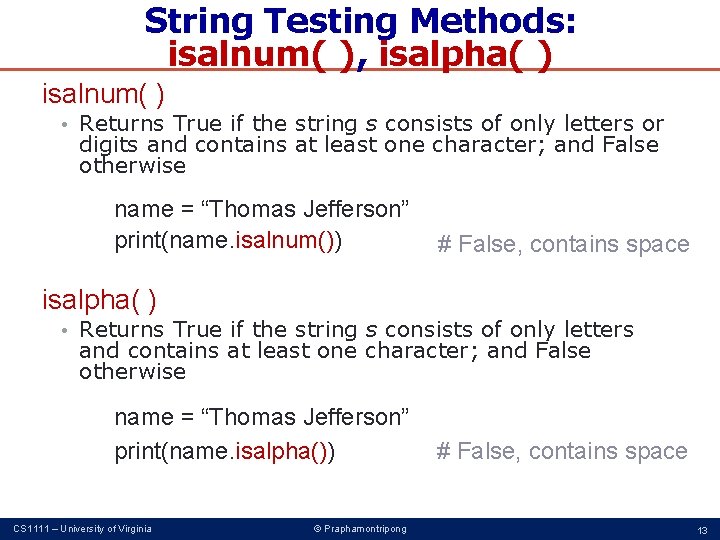
String Testing Methods: isalnum( ), isalpha( ) isalnum( ) • Returns True if the string s consists of only letters or digits and contains at least one character; and False otherwise name = “Thomas Jefferson” print(name. isalnum()) # False, contains space isalpha( ) • Returns True if the string s consists of only letters and contains at least one character; and False otherwise name = “Thomas Jefferson” print(name. isalpha()) CS 1111 – University of Virginia © Praphamontripong # False, contains space 13
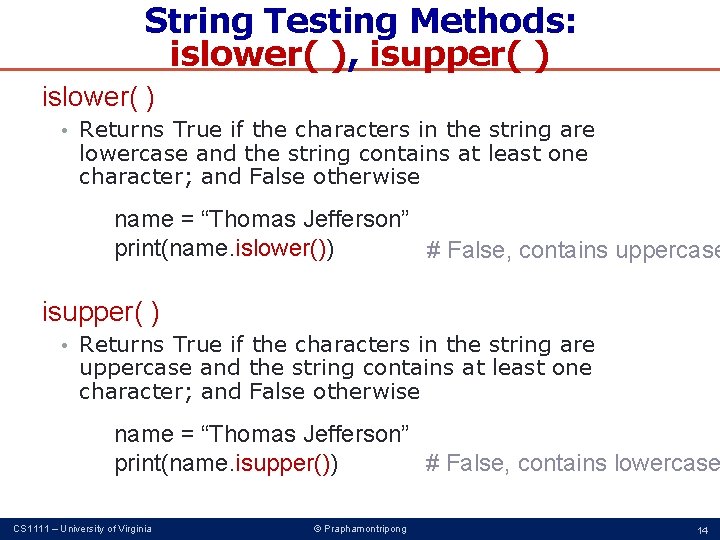
String Testing Methods: islower( ), isupper( ) islower( ) • Returns True if the characters in the string are lowercase and the string contains at least one character; and False otherwise name = “Thomas Jefferson” print(name. islower()) # False, contains uppercase isupper( ) • Returns True if the characters in the string are uppercase and the string contains at least one character; and False otherwise name = “Thomas Jefferson” # False, contains lowercase print(name. isupper()) CS 1111 – University of Virginia © Praphamontripong 14
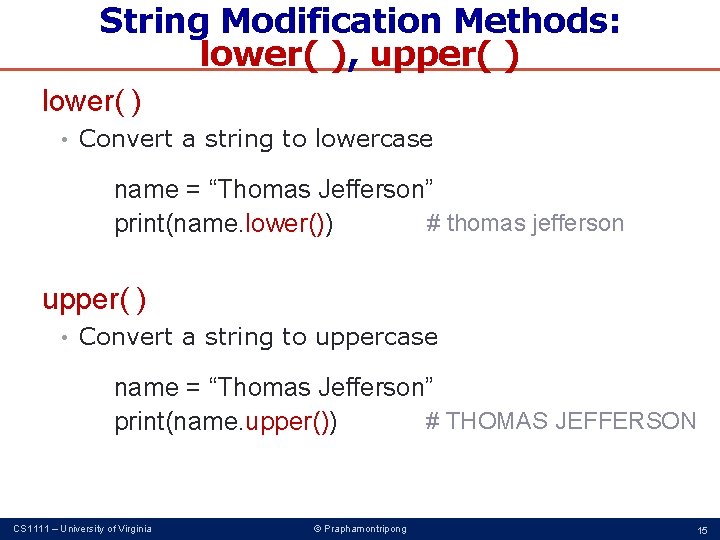
String Modification Methods: lower( ), upper( ) lower( ) • Convert a string to lowercase name = “Thomas Jefferson” # thomas jefferson print(name. lower()) upper( ) • Convert a string to uppercase name = “Thomas Jefferson” # THOMAS JEFFERSON print(name. upper()) CS 1111 – University of Virginia © Praphamontripong 15
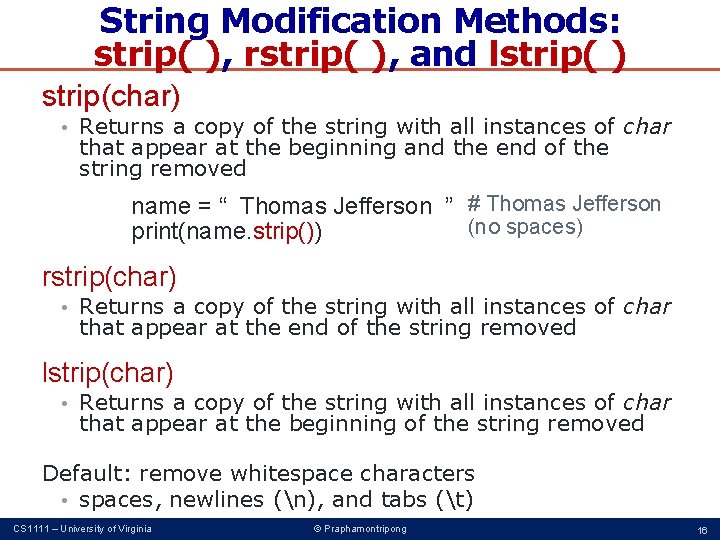
String Modification Methods: strip( ), rstrip( ), and lstrip( ) strip(char) • Returns a copy of the string with all instances of char that appear at the beginning and the end of the string removed name = “ Thomas Jefferson ” # Thomas Jefferson (no spaces) print(name. strip()) rstrip(char) • Returns a copy of the string with all instances of char that appear at the end of the string removed lstrip(char) • Returns a copy of the string with all instances of char that appear at the beginning of the string removed Default: remove whitespace characters • spaces, newlines (n), and tabs (t) CS 1111 – University of Virginia © Praphamontripong 16
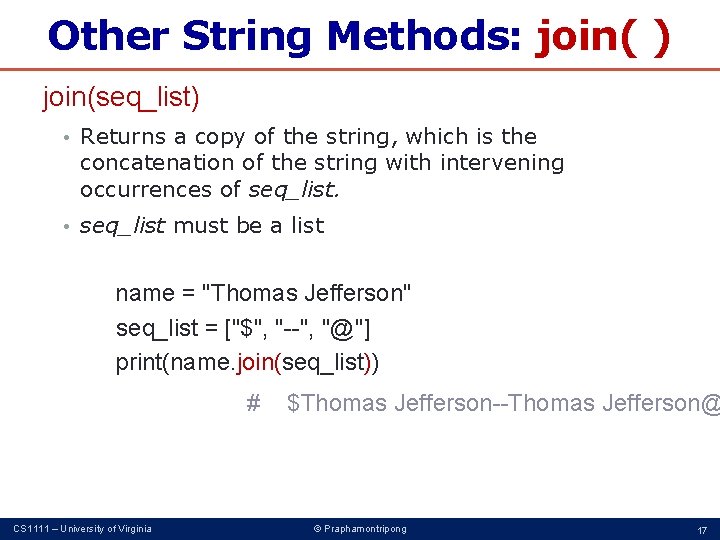
Other String Methods: join( ) join(seq_list) • Returns a copy of the string, which is the concatenation of the string with intervening occurrences of seq_list. • seq_list must be a list name = "Thomas Jefferson" seq_list = ["$", "--", "@"] print(name. join(seq_list)) # CS 1111 – University of Virginia $Thomas Jefferson--Thomas Jefferson@ © Praphamontripong 17
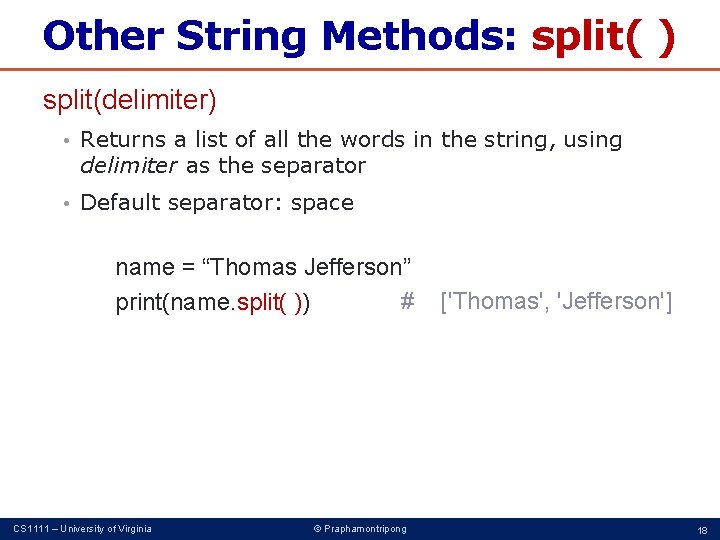
Other String Methods: split( ) split(delimiter) • Returns a list of all the words in the string, using delimiter as the separator • Default separator: space name = “Thomas Jefferson” # print(name. split( )) CS 1111 – University of Virginia © Praphamontripong ['Thomas', 'Jefferson'] 18
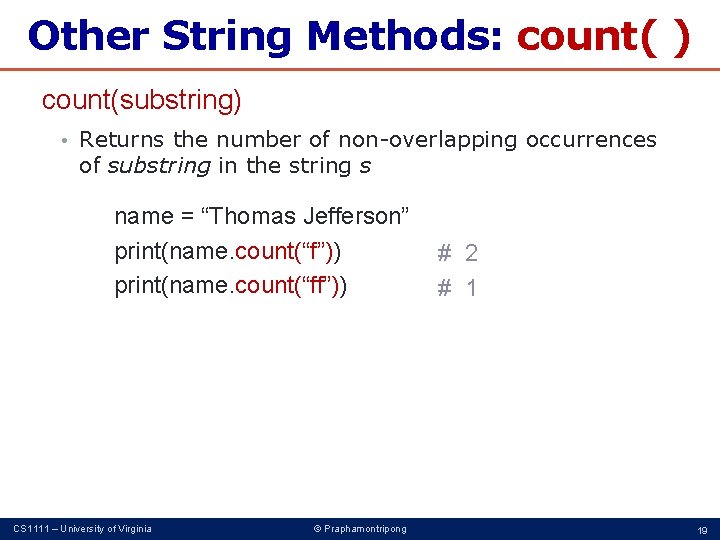
Other String Methods: count( ) count(substring) • Returns the number of non-overlapping occurrences of substring in the string s name = “Thomas Jefferson” print(name. count(“f”)) print(name. count(“ff”)) CS 1111 – University of Virginia © Praphamontripong # 2 # 1 19
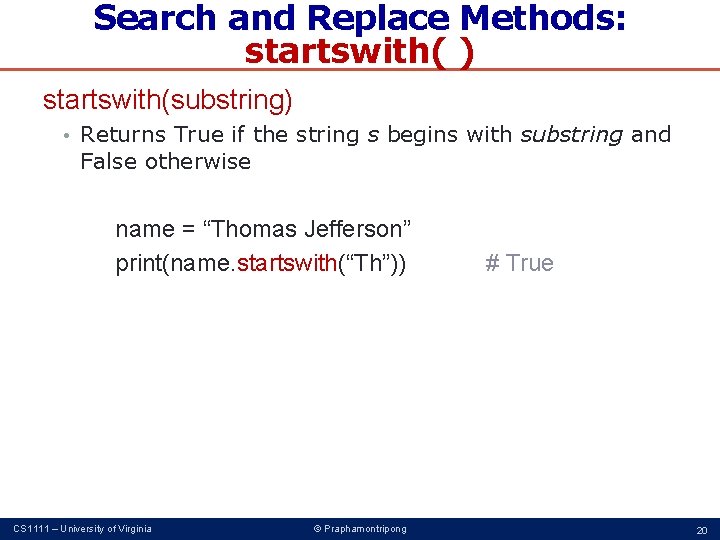
Search and Replace Methods: startswith( ) startswith(substring) • Returns True if the string s begins with substring and False otherwise name = “Thomas Jefferson” print(name. startswith(“Th”)) CS 1111 – University of Virginia © Praphamontripong # True 20
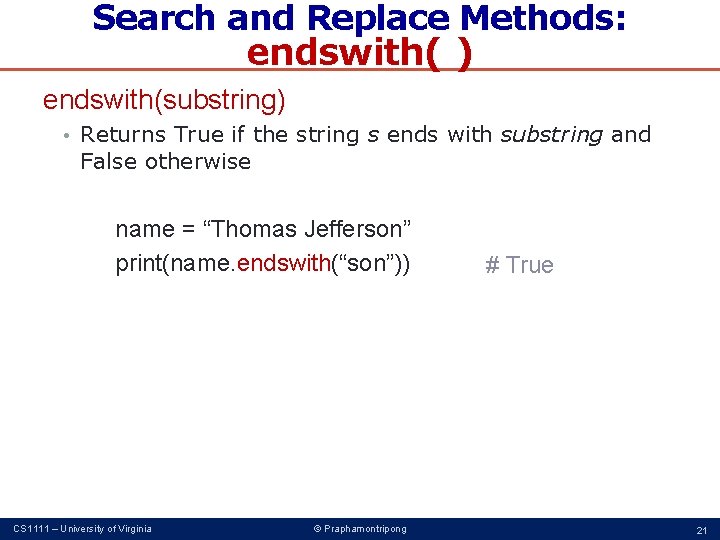
Search and Replace Methods: endswith( ) endswith(substring) • Returns True if the string s ends with substring and False otherwise name = “Thomas Jefferson” print(name. endswith(“son”)) CS 1111 – University of Virginia © Praphamontripong # True 21
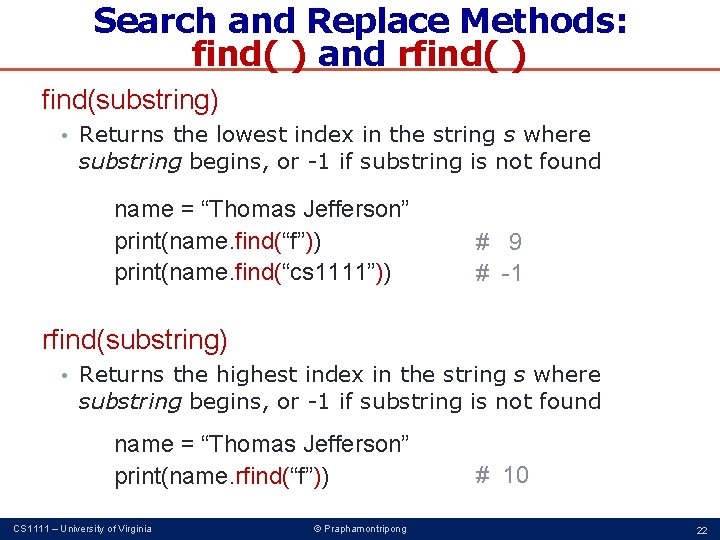
Search and Replace Methods: find( ) and rfind( ) find(substring) • Returns the lowest index in the string s where substring begins, or -1 if substring is not found name = “Thomas Jefferson” print(name. find(“f”)) print(name. find(“cs 1111”)) # 9 # -1 rfind(substring) • Returns the highest index in the string s where substring begins, or -1 if substring is not found name = “Thomas Jefferson” print(name. rfind(“f”)) CS 1111 – University of Virginia © Praphamontripong # 10 22
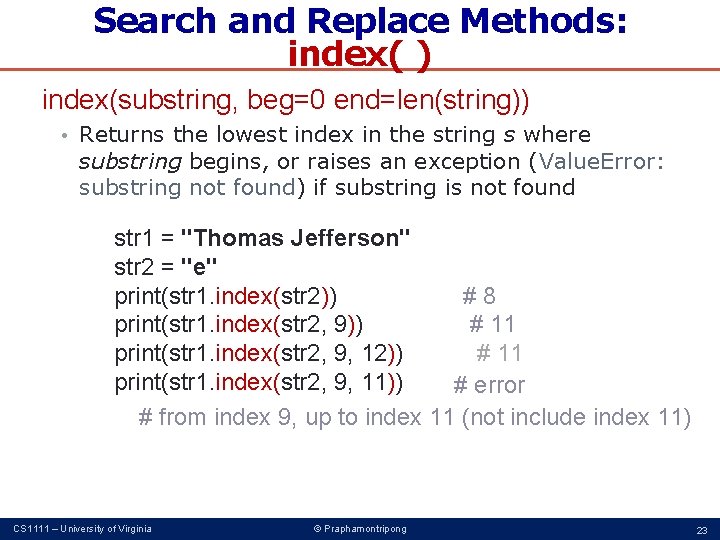
Search and Replace Methods: index( ) index(substring, beg=0 end=len(string)) • Returns the lowest index in the string s where substring begins, or raises an exception (Value. Error: substring not found) if substring is not found str 1 = "Thomas Jefferson" str 2 = "e" print(str 1. index(str 2)) #8 print(str 1. index(str 2, 9)) # 11 print(str 1. index(str 2, 9, 12)) # 11 print(str 1. index(str 2, 9, 11)) # error # from index 9, up to index 11 (not include index 11) CS 1111 – University of Virginia © Praphamontripong 23
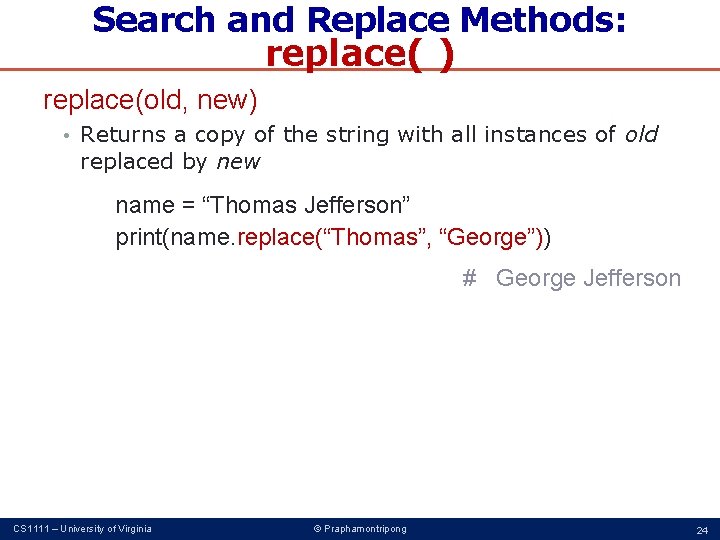
Search and Replace Methods: replace( ) replace(old, new) • Returns a copy of the string with all instances of old replaced by new name = “Thomas Jefferson” print(name. replace(“Thomas”, “George”)) # George Jefferson CS 1111 – University of Virginia © Praphamontripong 24
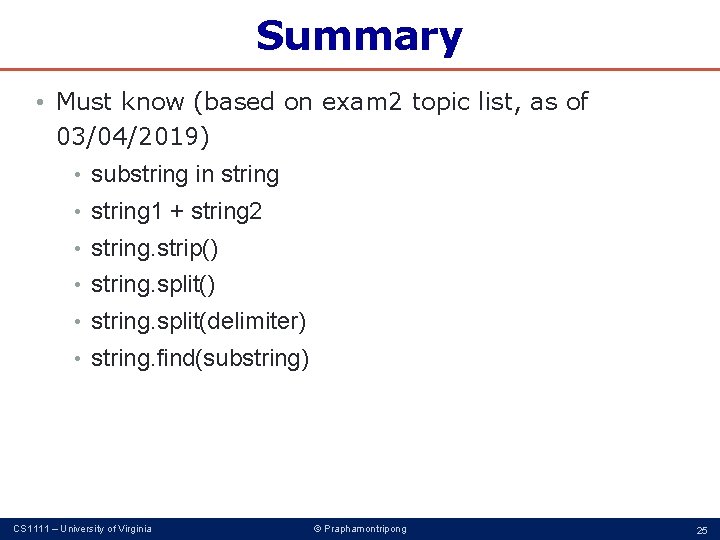
Summary • Must know (based on exam 2 topic list, as of 03/04/2019) • substring in string • string 1 + string 2 • string. strip() • string. split(delimiter) • string. find(substring) CS 1111 – University of Virginia © Praphamontripong 25