
String gauge theory duality and ferromagnetic spin chains
- Slides: 30
String / gauge theory duality and ferromagnetic spin chains M. Kruczenski Princeton Univ. In collaboration w/ Rob Myers, David Mateos, David Winters Arkady Tseytlin, Anton Ryzhov
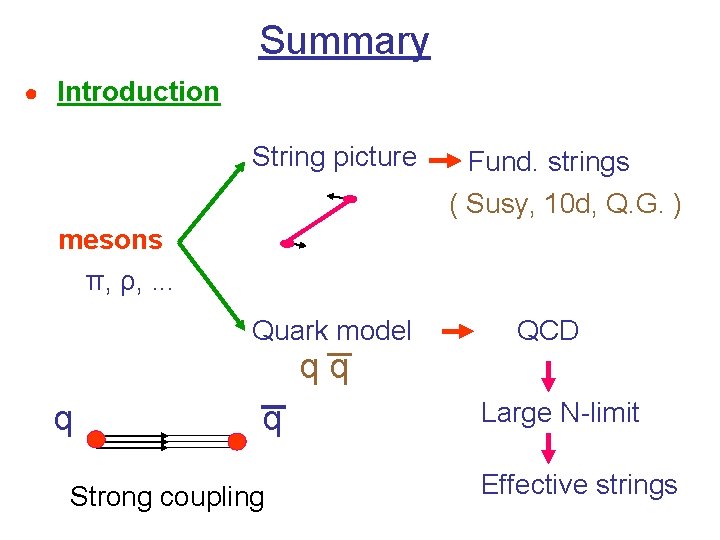
Summary ● Introduction String picture Fund. strings ( Susy, 10 d, Q. G. ) mesons π, ρ, . . . Quark model qq q q Strong coupling QCD Large N-limit Effective strings
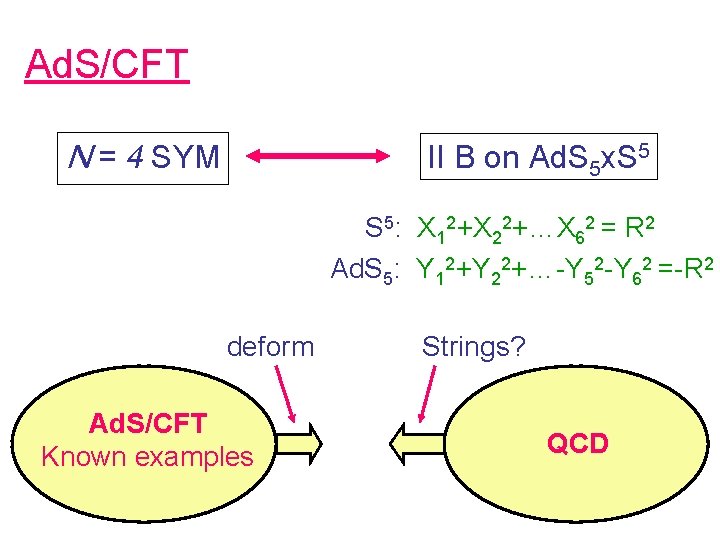
Ad. S/CFT N = 4 SYM II B on Ad. S 5 x. S 5: X 12+X 22+…X 62 = R 2 Ad. S 5: Y 12+Y 22+…-Y 52 -Y 62 =-R 2 deform Ad. S/CFT Known examples Strings? QCD
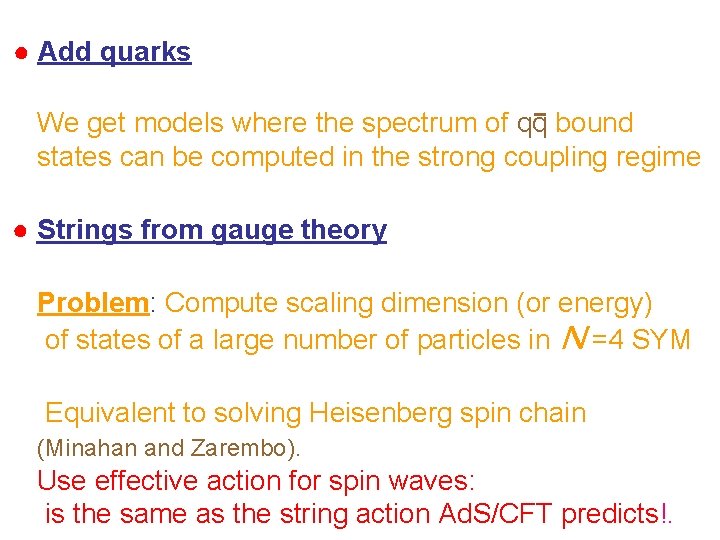
● Add quarks We get models where the spectrum of qq bound states can be computed in the strong coupling regime ● Strings from gauge theory Problem: Compute scaling dimension (or energy) of states of a large number of particles in N =4 SYM Equivalent to solving Heisenberg spin chain (Minahan and Zarembo). Use effective action for spin waves: is the same as the string action Ad. S/CFT predicts!.
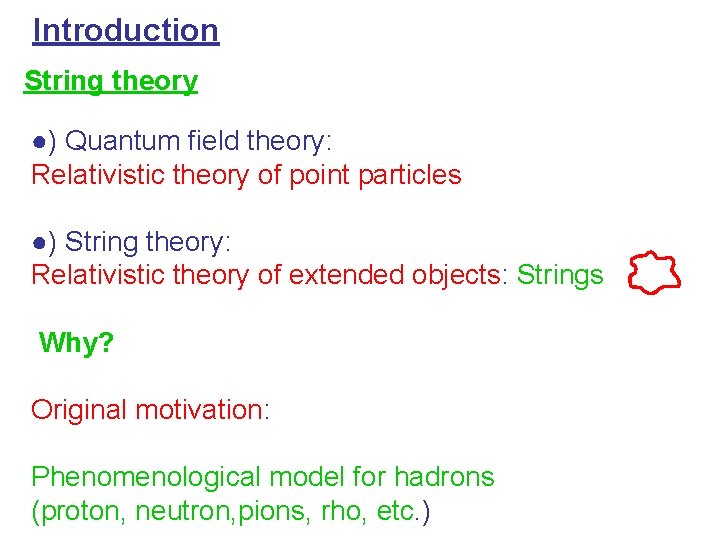
Introduction String theory ●) Quantum field theory: Relativistic theory of point particles ●) String theory: Relativistic theory of extended objects: Strings Why? Original motivation: Phenomenological model for hadrons (proton, neutron, pions, rho, etc. )
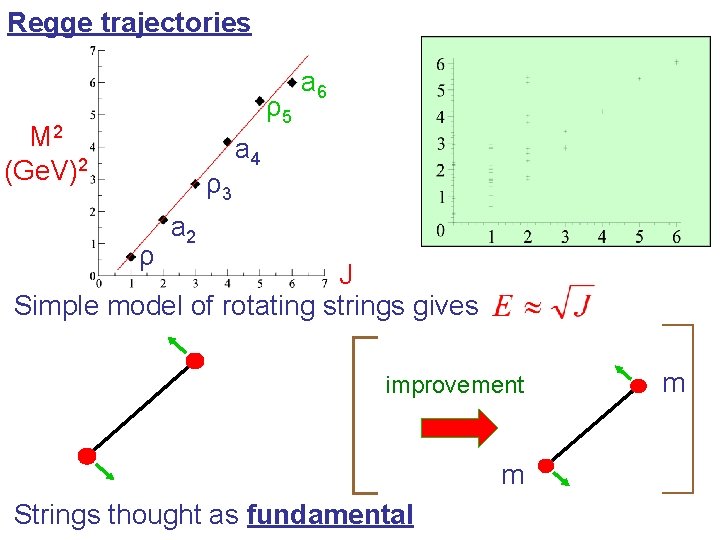
Regge trajectories ρ5 M 2 (Ge. V)2 ρ3 ρ a 6 a 4 a 2 J Simple model of rotating strings gives improvement m Strings thought as fundamental m
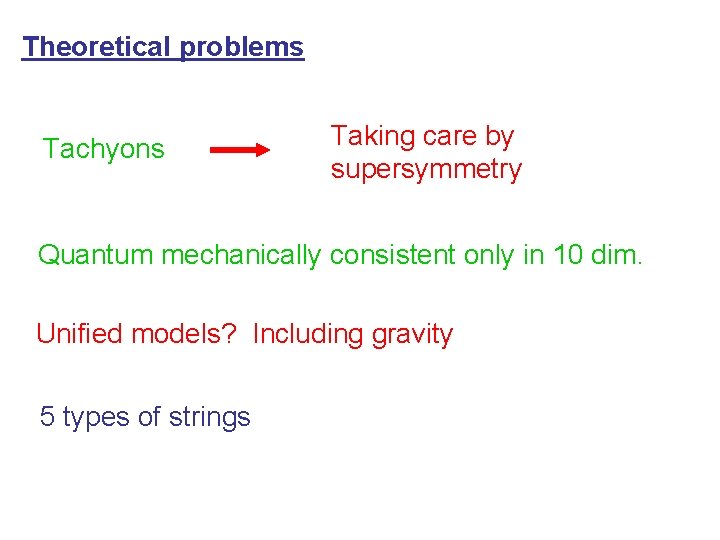
Theoretical problems Tachyons Taking care by supersymmetry Quantum mechanically consistent only in 10 dim. Unified models? Including gravity 5 types of strings
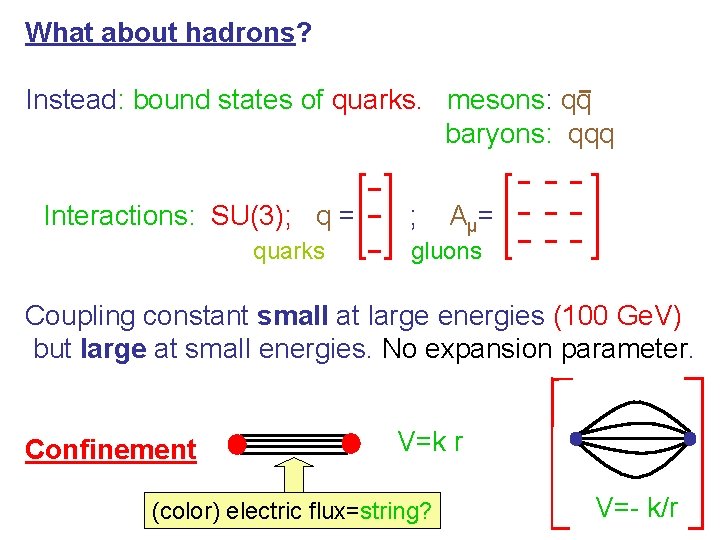
What about hadrons? Instead: bound states of quarks. mesons: qq baryons: qqq Interactions: SU(3); q = quarks ; A μ= gluons Coupling constant small at large energies (100 Ge. V) but large at small energies. No expansion parameter. Confinement V=k r (color) electric flux=string? V=- k/r
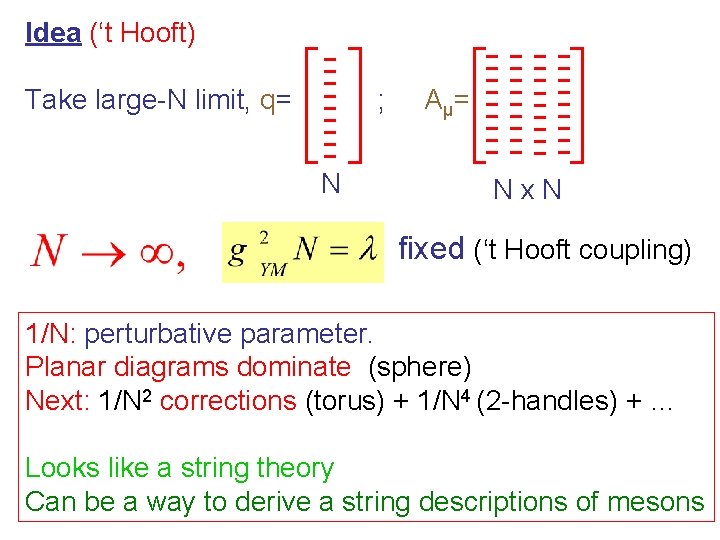
Idea (‘t Hooft) Take large-N limit, q= ; N A μ= Nx. N fixed (‘t Hooft coupling) 1/N: perturbative parameter. Planar diagrams dominate (sphere) Next: 1/N 2 corrections (torus) + 1/N 4 (2 -handles) + … Looks like a string theory Can be a way to derive a string descriptions of mesons
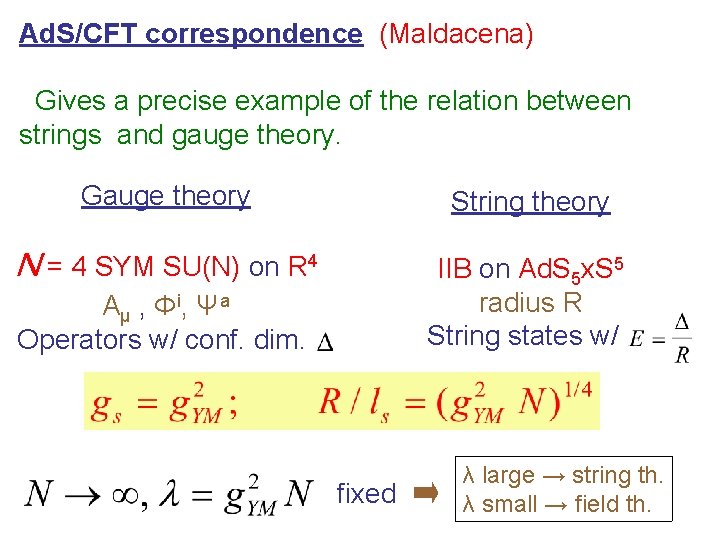
Ad. S/CFT correspondence (Maldacena) Gives a precise example of the relation between strings and gauge theory. Gauge theory String theory N = 4 SYM SU(N) on R 4 IIB on Ad. S 5 x. S 5 radius R String states w/ A μ , Φ i, Ψ a Operators w/ conf. dim. fixed λ large → string th. λ small → field th.
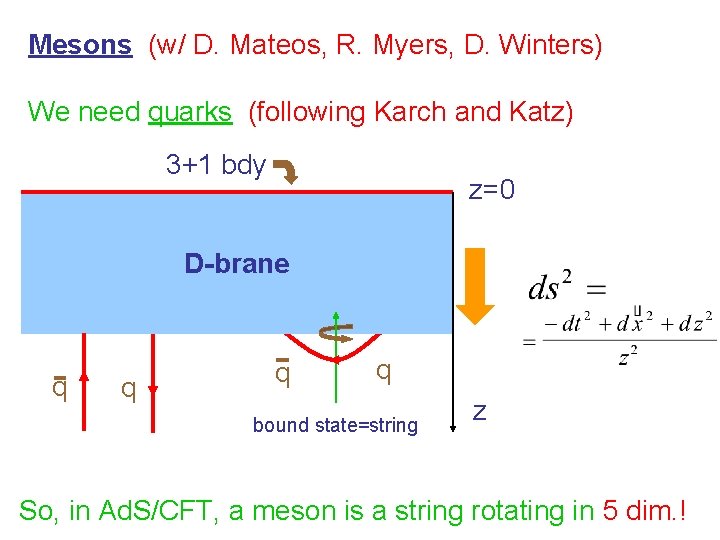
Mesons (w/ D. Mateos, R. Myers, D. Winters) We need quarks (following Karch and Katz) 3+1 bdy z=0 D-brane q q bound state=string z So, in Ad. S/CFT, a meson is a string rotating in 5 dim. !
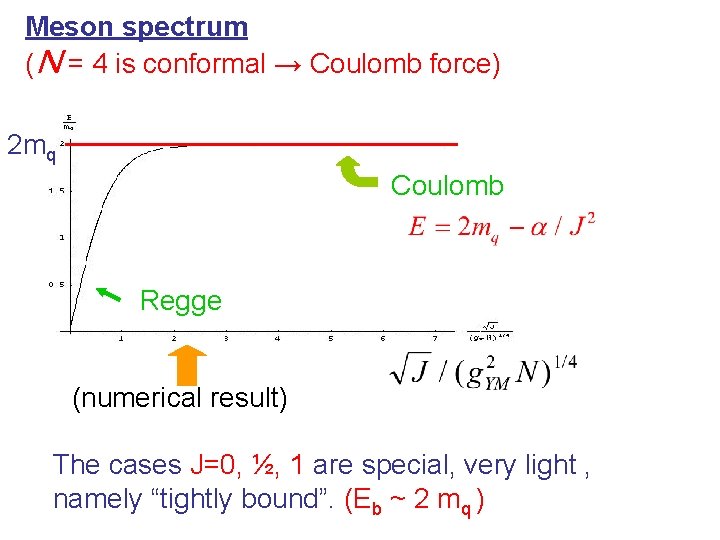
Meson spectrum (N = 4 is conformal → Coulomb force) 2 mq Coulomb Regge (numerical result) The cases J=0, ½, 1 are special, very light , namely “tightly bound”. (Eb ~ 2 mq )
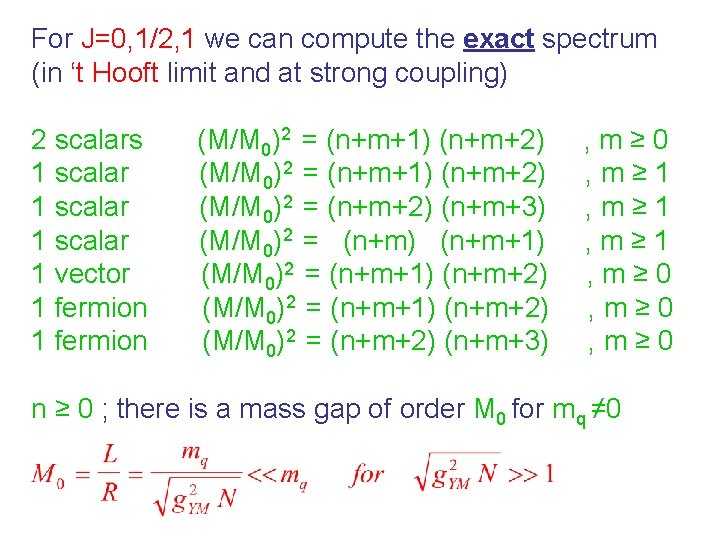
For J=0, 1/2, 1 we can compute the exact spectrum (in ‘t Hooft limit and at strong coupling) 2 scalars 1 scalar 1 vector 1 fermion (M/M 0)2 = (n+m+1) (n+m+2) (M/M 0)2 = (n+m+2) (n+m+3) (M/M 0)2 = (n+m) (n+m+1) (M/M 0)2 = (n+m+1) (n+m+2) (M/M 0)2 = (n+m+2) (n+m+3) , m≥ 0 , m≥ 1 , m≥ 0 n ≥ 0 ; there is a mass gap of order M 0 for mq ≠ 0
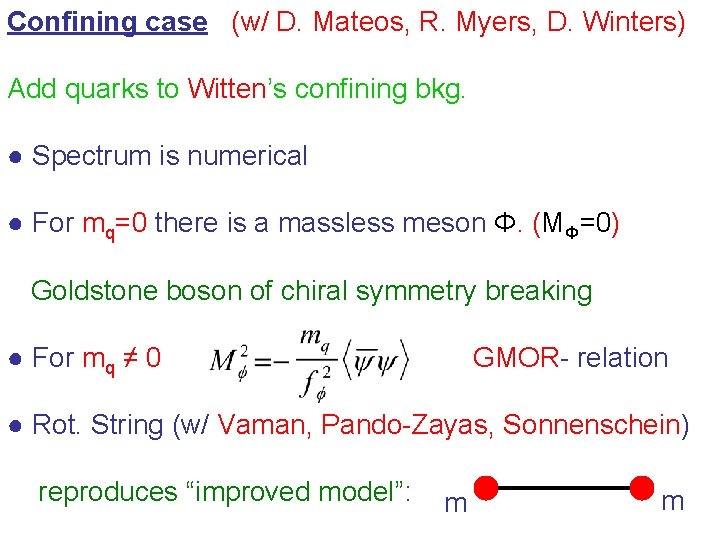
Confining case (w/ D. Mateos, R. Myers, D. Winters) Add quarks to Witten’s confining bkg. ● Spectrum is numerical ● For mq=0 there is a massless meson Φ. (MΦ=0) Goldstone boson of chiral symmetry breaking ● For mq ≠ 0 GMOR- relation ● Rot. String (w/ Vaman, Pando-Zayas, Sonnenschein) reproduces “improved model”: m m
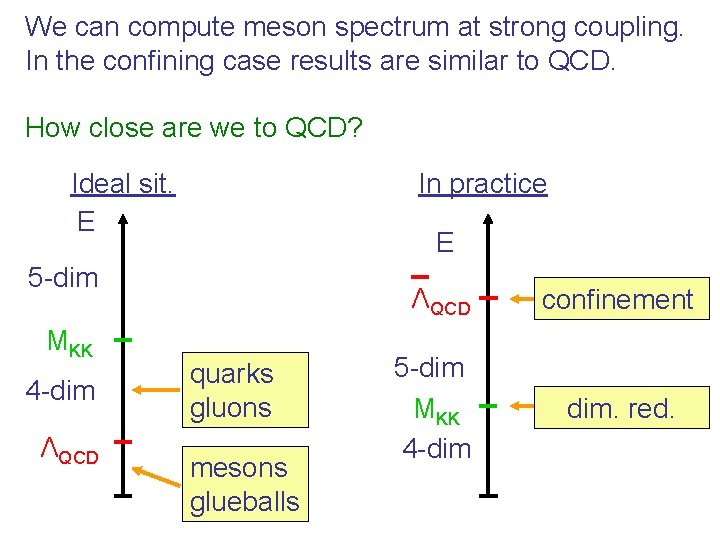
We can compute meson spectrum at strong coupling. In the confining case results are similar to QCD. How close are we to QCD? Ideal sit. E In practice E 5 -dim MKK 4 -dim ΛQCD quarks gluons mesons glueballs 5 -dim MKK 4 -dim confinement dim. red.
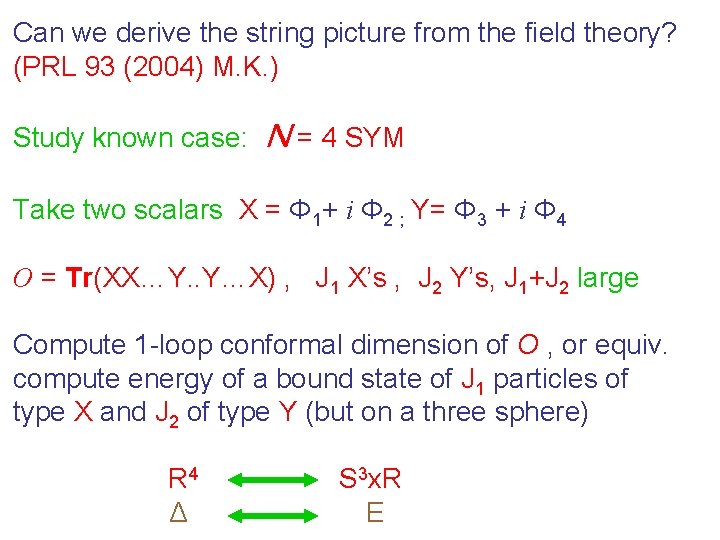
Can we derive the string picture from the field theory? (PRL 93 (2004) M. K. ) Study known case: N = 4 SYM Take two scalars X = Φ 1+ i Φ 2 ; Y= Φ 3 + i Φ 4 O = Tr(XX…Y. . Y…X) , J 1 X’s , J 2 Y’s, J 1+J 2 large Compute 1 -loop conformal dimension of O , or equiv. compute energy of a bound state of J 1 particles of type X and J 2 of type Y (but on a three sphere) R 4 Δ S 3 x. R E
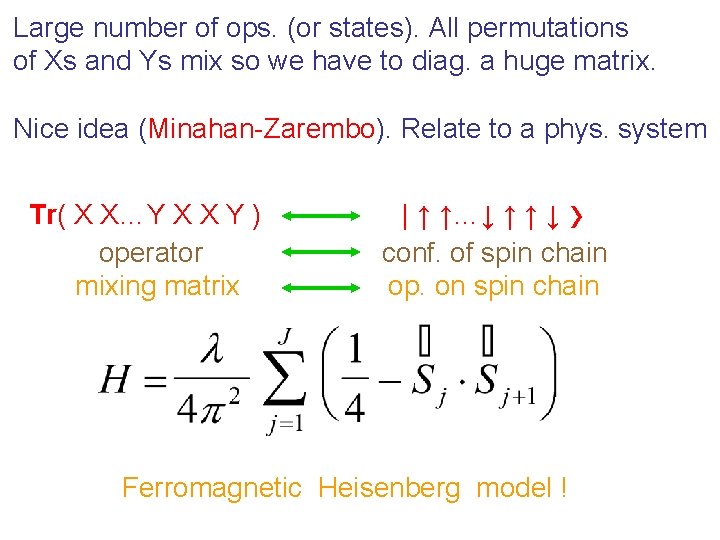
Large number of ops. (or states). All permutations of Xs and Ys mix so we have to diag. a huge matrix. Nice idea (Minahan-Zarembo). Relate to a phys. system Tr( X X…Y X X Y ) operator mixing matrix › | ↑ ↑…↓ ↑ ↑ ↓ conf. of spin chain op. on spin chain Ferromagnetic Heisenberg model !
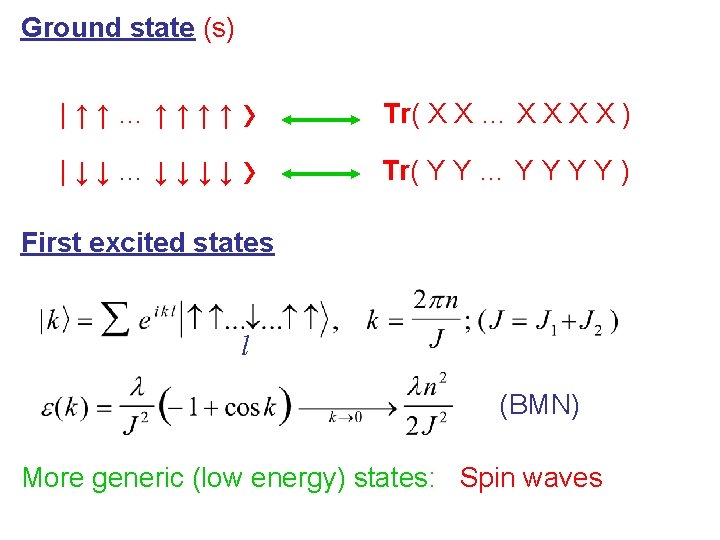
Ground state (s) › |↓↓…↓↓↓↓› |↑↑…↑↑↑↑ Tr( X X … X X ) Tr( Y Y … Y Y ) First excited states l (BMN) More generic (low energy) states: Spin waves
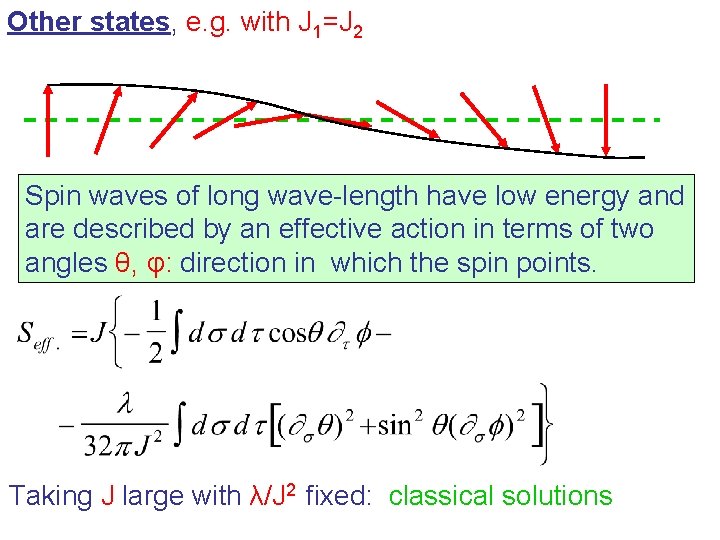
Other states, e. g. with J 1=J 2 Spin waves of long wave-length have low energy and are described by an effective action in terms of two angles θ, φ: direction in which the spin points. Taking J large with λ/J 2 fixed: classical solutions
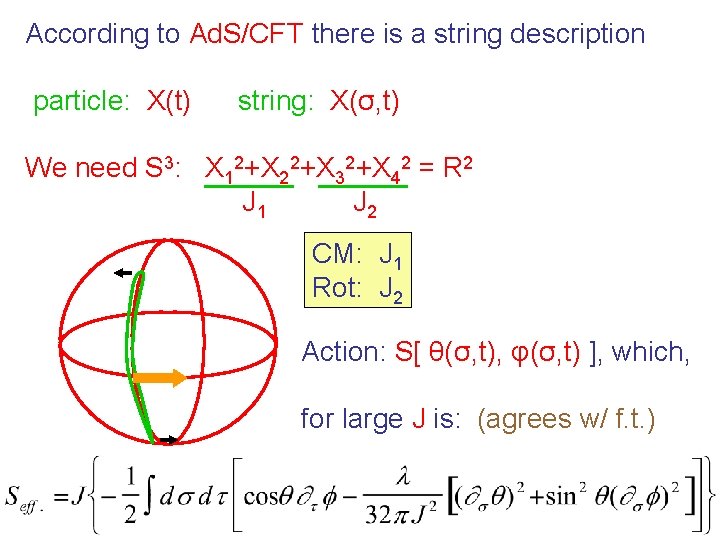
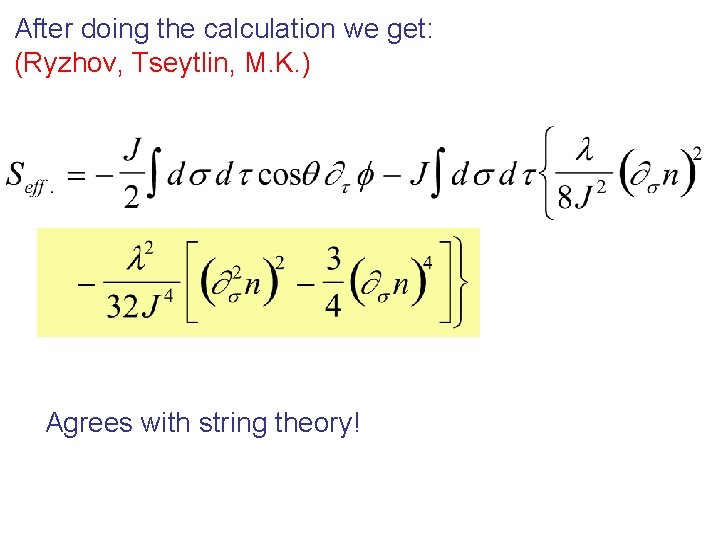
According to Ad. S/CFT there is a string description particle: X(t) string: X(σ, t) We need S 3: X 12+X 22+X 32+X 42 = R 2 J 1 J 2 CM: J 1 Rot: J 2 Action: S[ θ(σ, t), φ(σ, t) ], which, for large J is: (agrees w/ f. t. )
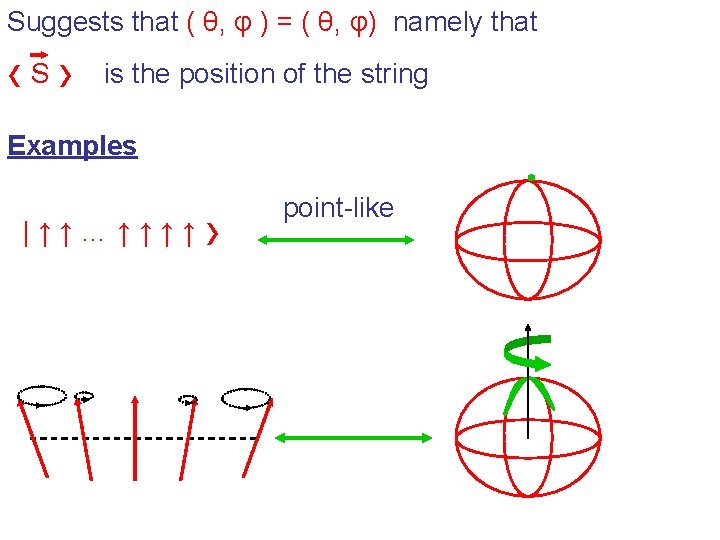
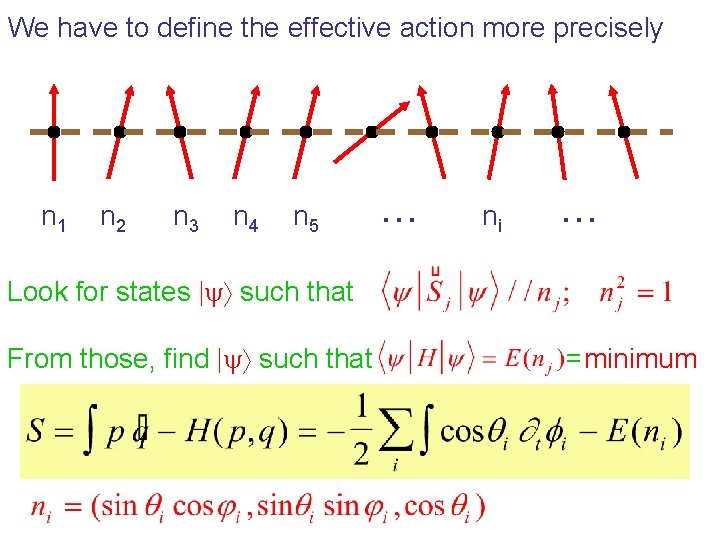
Suggests that ( θ, φ ) = ( θ, φ) namely that ‹S› is the position of the string Examples |↑↑…↑↑↑↑ › point-like
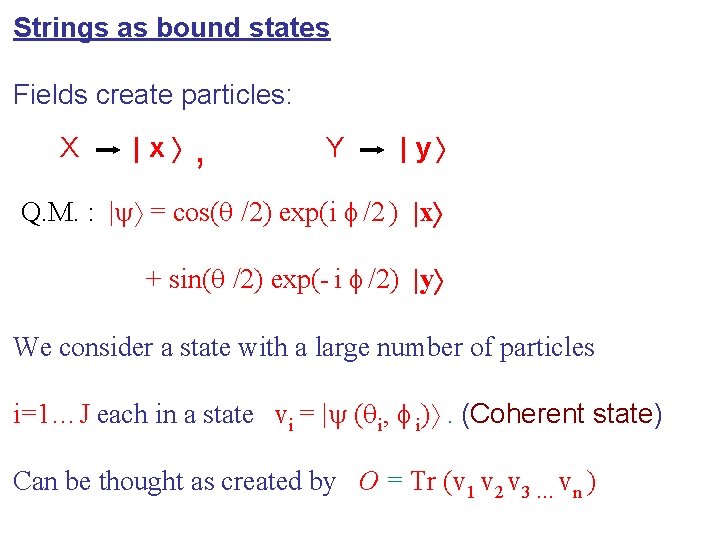
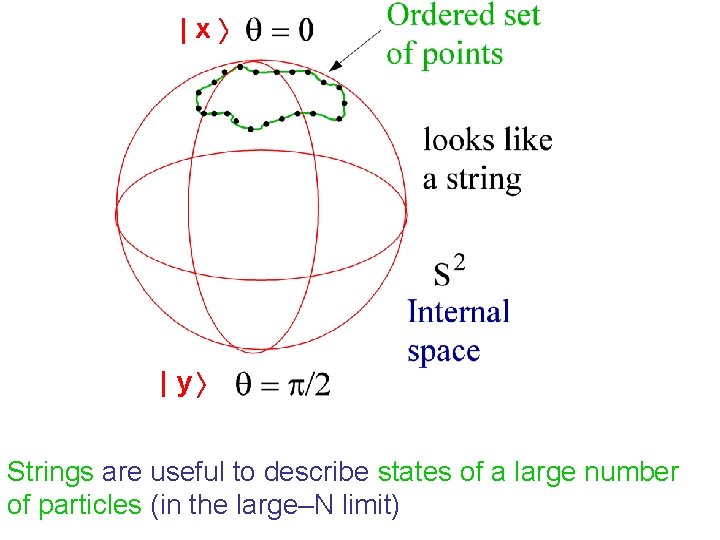
Strings as bound states Fields create particles: X |x , Y | y Q. M. : | = cos( /2) exp(i /2 ) |x + sin( /2) exp(- i /2) |y We consider a state with a large number of particles i=1…J each in a state vi = | ( i, i) . (Coherent state) Can be thought as created by O = Tr (v 1 v 2 v 3 … vn )
|x | y Strings are useful to describe states of a large number of particles (in the large–N limit)
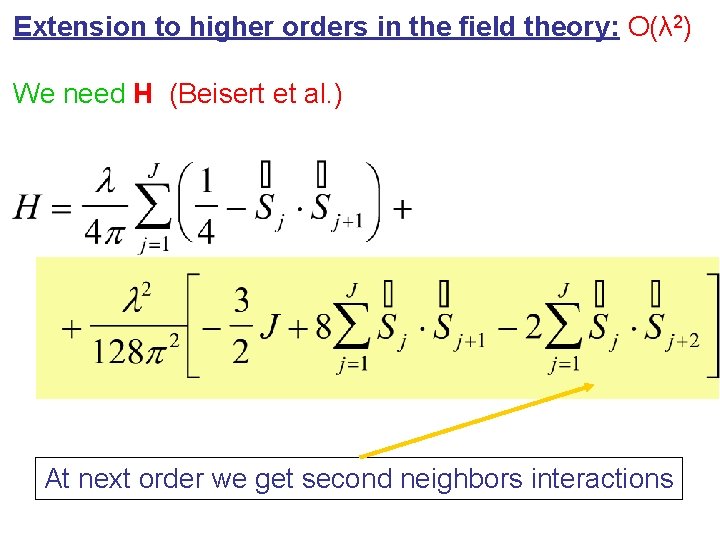
Extension to higher orders in the field theory: O(λ 2) We need H (Beisert et al. ) At next order we get second neighbors interactions
We have to define the effective action more precisely n 1 n 2 n 3 n 4 n 5 … ni … Look for states | such that From those, find | such that =minimum
After doing the calculation we get: (Ryzhov, Tseytlin, M. K. ) Agrees with string theory!
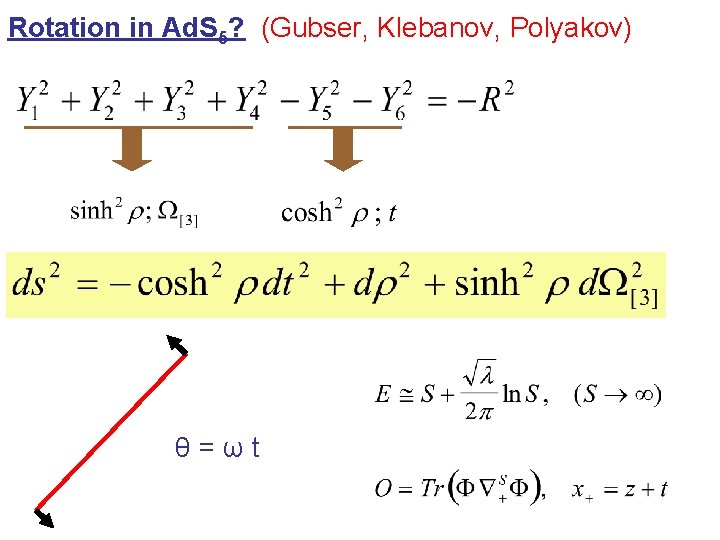
Rotation in Ad. S 5? (Gubser, Klebanov, Polyakov) θ=ωt
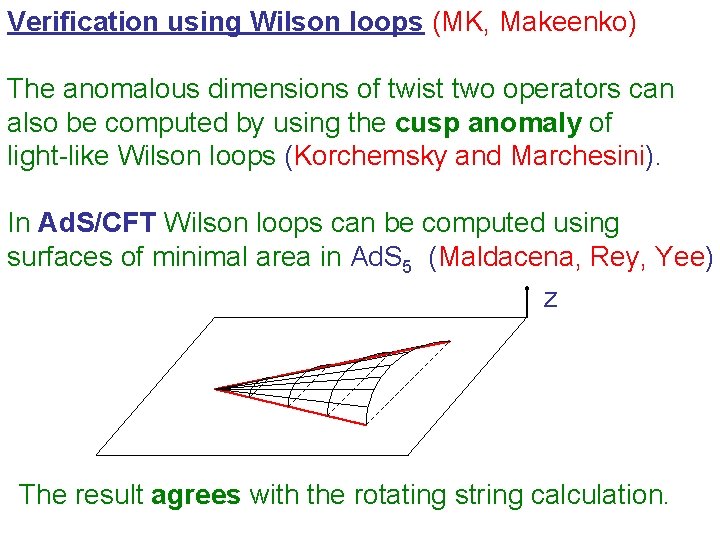
Verification using Wilson loops (MK, Makeenko) The anomalous dimensions of twist two operators can also be computed by using the cusp anomaly of light-like Wilson loops (Korchemsky and Marchesini). In Ad. S/CFT Wilson loops can be computed using surfaces of minimal area in Ad. S 5 (Maldacena, Rey, Yee) z The result agrees with the rotating string calculation.
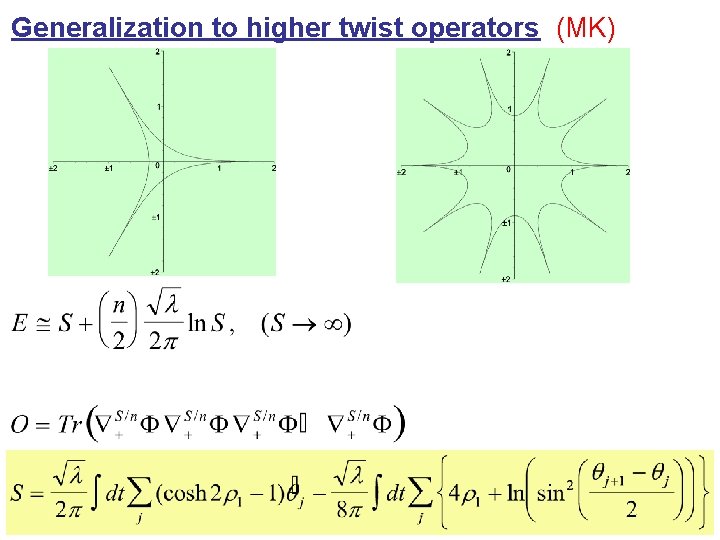
Generalization to higher twist operators (MK)
Conclusions Ad. S/CFT provides a unique possibility of analytically understanding the low energy limit of non-abelian gauge theories (confinement) Two results: ● Computed the masses of quark / anti-quark bound states at strong coupling. ● Showed a way in which strings directly emerge from the gauge theory.