
Stretching And Flexibility an introduction for the general
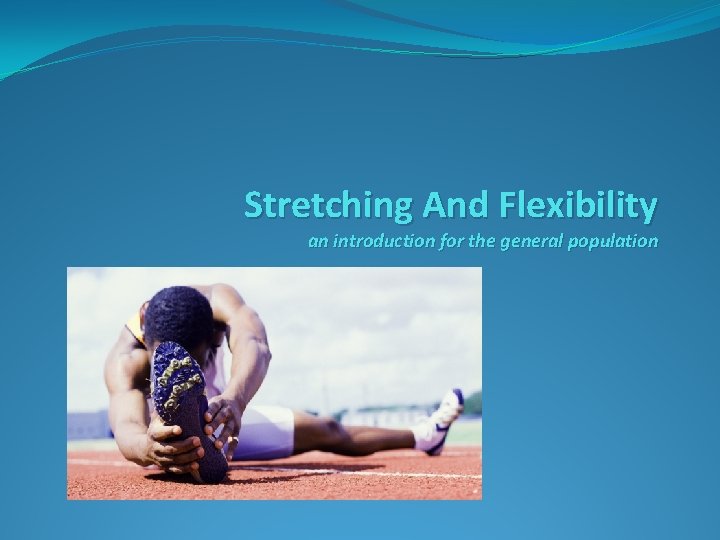
Stretching And Flexibility an introduction for the general population
Stretching and Flexibility �Ryan Kennedy �Rowan University Health Educator Health & Exercise Science �Health Promotion and Fitness Managment
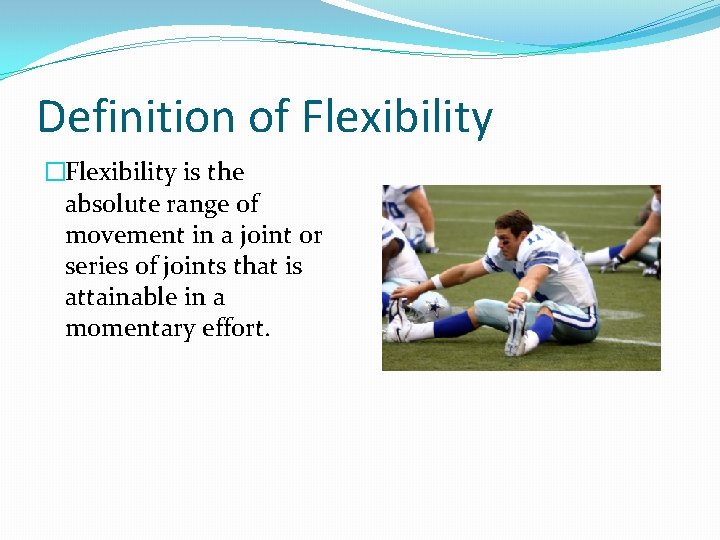
Definition of Flexibility �Flexibility is the absolute range of movement in a joint or series of joints that is attainable in a momentary effort.
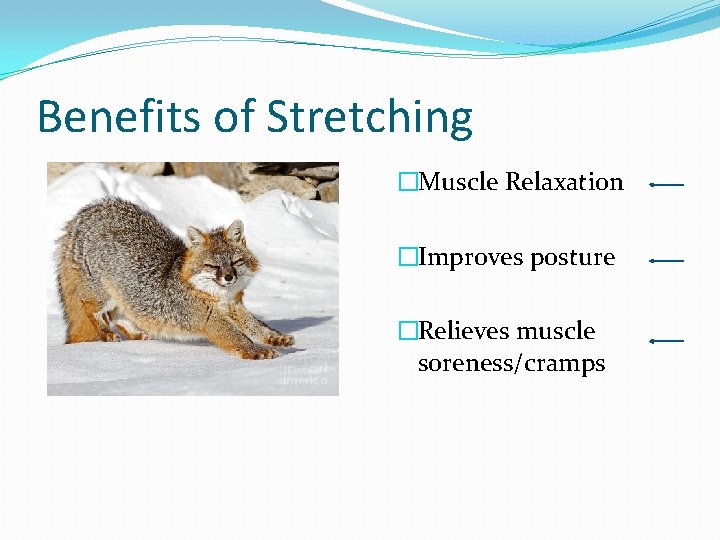
Benefits of Stretching �Muscle Relaxation �Improves posture �Relieves muscle soreness/cramps
Benefits of Stretching (contd) �Reduces injury risk �Stress reliever �Improves individuals level of fitness
Types of Stretching �Active: unassisted; the person stretching provides force of stretch �Passive: assisted; an independent force provides stretch Stretching Tip #6 Both a warm-up and cool down are vital to optimizing your work-out. Both are important for your flexibility and overall level of fitness, so don’t skimp out!
Ballistic �Stretches using momentum, such as bouncing Stretching Tip #4 Don’t forget to stretch both sides of the body! �Used mostly by athletes, and is very “sport specific” �Used very little by general population because of safety concerns
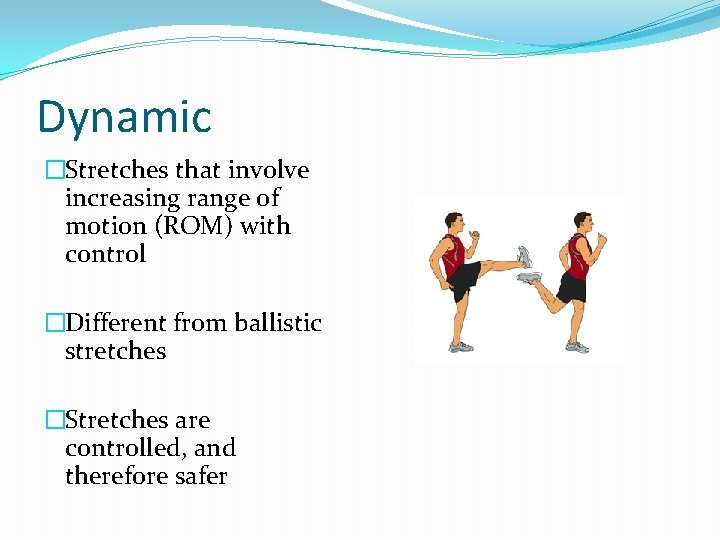
Dynamic �Stretches that involve increasing range of motion (ROM) with control �Different from ballistic stretches �Stretches are controlled, and therefore safer
Static �Stretches are slow and sustained �Generally held anywhere from ten to thirty seconds �Stretch is held just until the point of mild discomfort �Safest form of stretching; recommended for general population Stretching Tip #5 If your not sure what type of stretches you should be doing, try them all! See what works for your level of fitness and flexibility.
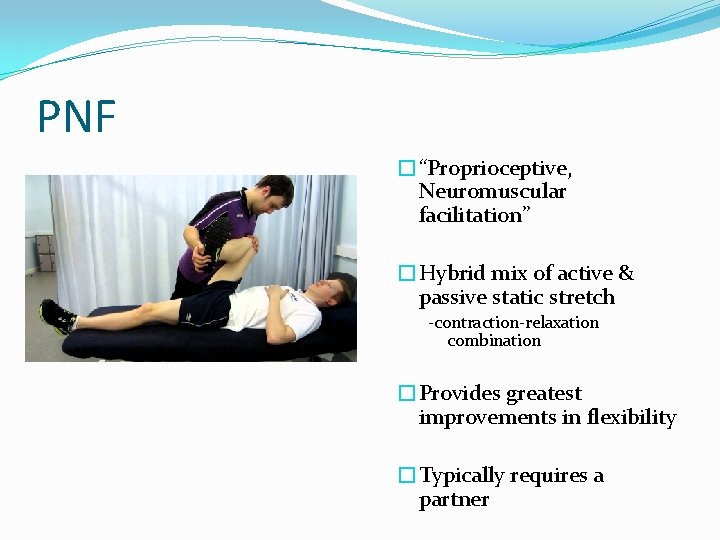
PNF �“Proprioceptive, Neuromuscular facilitation” �Hybrid mix of active & passive static stretch -contraction-relaxation combination �Provides greatest improvements in flexibility �Typically requires a partner
Instructional Guidelines Stretching Tip #7 The American College of Sports Medicine recommends stretching 2 -3 times a week, holding stretches for 10 -30 seconds each �Stretching should not just be apart of pre-workout “warm-up” or post work out “cool-down” �Flexibility is one of the five primary components of fitness �Many individuals place less of an importance on fitness compared to other components like strength or endurance
Instructional Guidelines (contd) �Flexibility improvements are typically experience fairly quickly �Upper body improvements are typically seen in one month or less; two months or less for lower body �Proper form and technique is essential. This is especially true with partner stretching Stretching Tip #9 Don’t try to stretch overstrained or ligaments; let them rest!
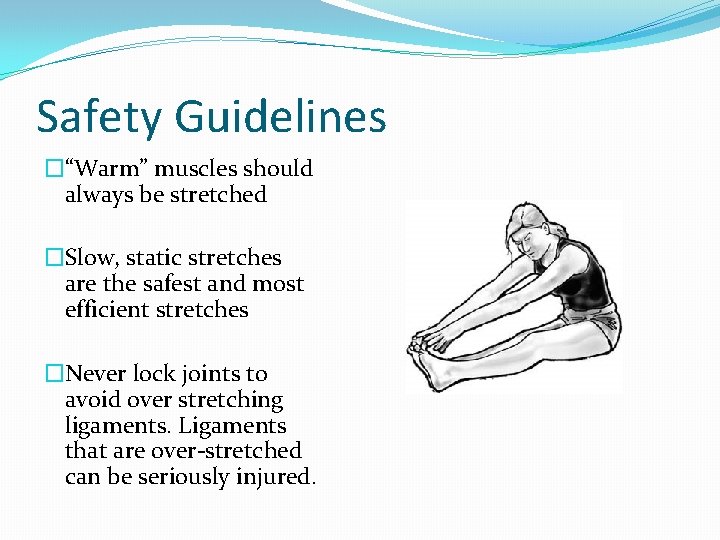
Safety Guidelines �“Warm” muscles should always be stretched �Slow, static stretches are the safest and most efficient stretches �Never lock joints to avoid over stretching ligaments. Ligaments that are over-stretched can be seriously injured.
Safety Guidelines (contd) � Never “force” a stretch; sensation during stretch should only be a mild tension/discomfort Stretching Tip #2 Take your time while stretching. Rushing through the process defeats the purpose! � Stretches should never “hurt” or cause any physical pain. If stretches are painful, they are being done incorrectly. � Avoid hyperextension of the spine. The spine can only hyperextend a few degrees comfortably. � Too much hyper-extension compresses the vertebral discs and can cause serious injury
Quality of Life �Stretching is vital to maintaining ones quality of life �This is especially true as we age; muscles begin to tighten and our joint ROM decreases. �Stretching has an antiaging effect on the body Stretching Tip #1 Results show quickly, but consistency is key. For optimal results, stick with it!
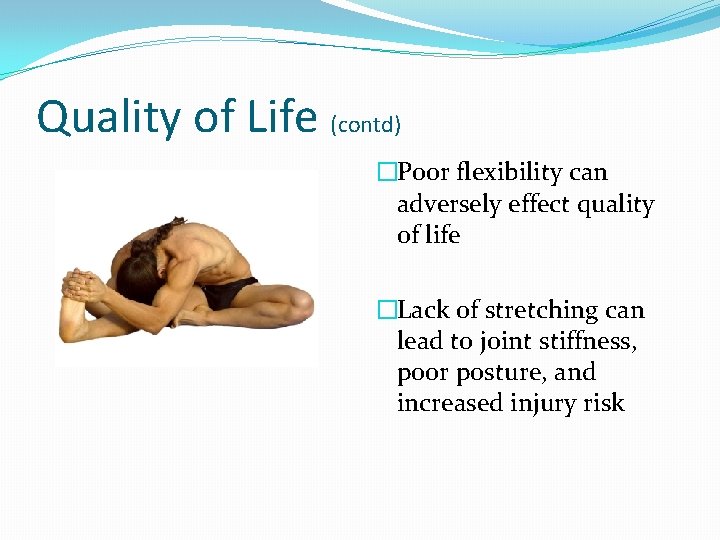
Quality of Life (contd) �Poor flexibility can adversely effect quality of life �Lack of stretching can lead to joint stiffness, poor posture, and increased injury risk
Reasons for decreased ROM �Postural stress �Repetitive joint motion �Weak core strength �Trauma Stretching Tip #8 Pre-determine what muscles you will stretch before you begin. Preparation is key!
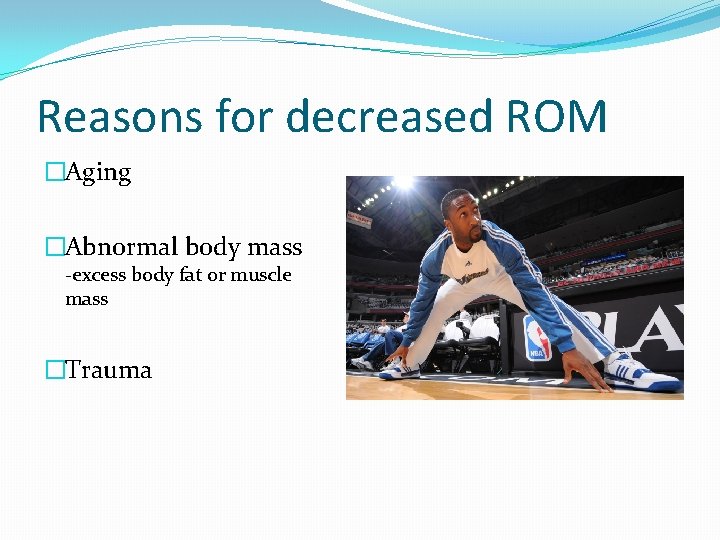
Reasons for decreased ROM �Aging �Abnormal body mass -excess body fat or muscle mass �Trauma
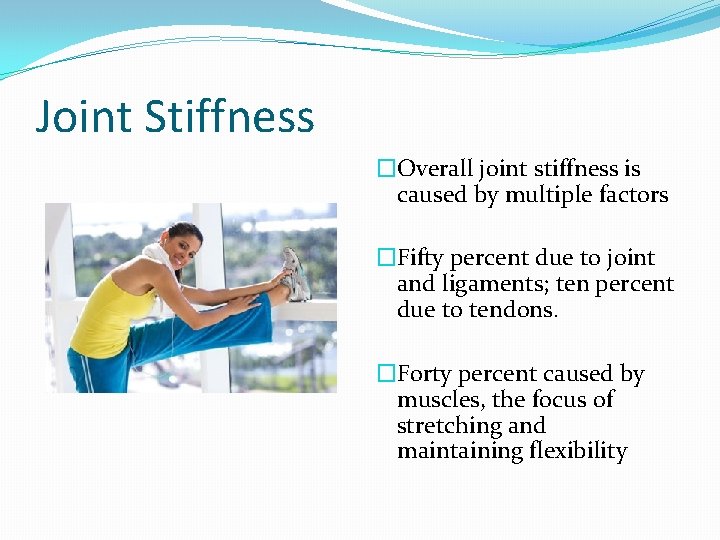
Joint Stiffness �Overall joint stiffness is caused by multiple factors �Fifty percent due to joint and ligaments; ten percent due to tendons. �Forty percent caused by muscles, the focus of stretching and maintaining flexibility
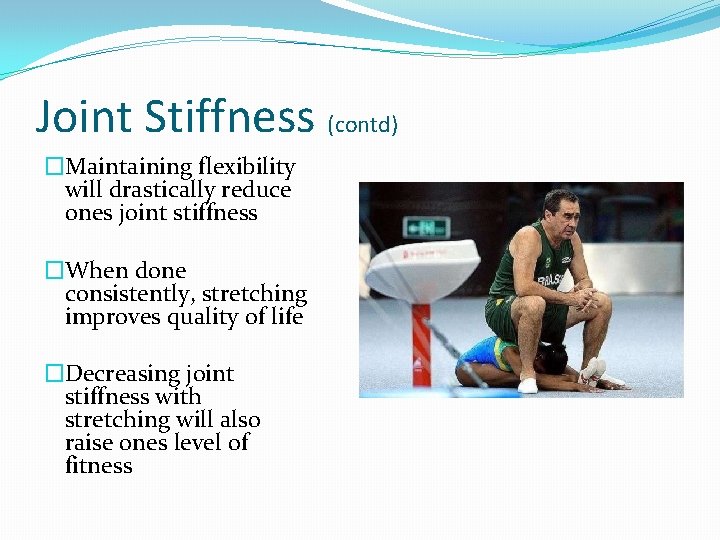
Joint Stiffness (contd) �Maintaining flexibility will drastically reduce ones joint stiffness �When done consistently, stretching improves quality of life �Decreasing joint stiffness with stretching will also raise ones level of fitness
- Slides: 20