
STRETCHES AND SHEARS Stretches D C D C

- Slides: 18
STRETCHES AND SHEARS
Stretches
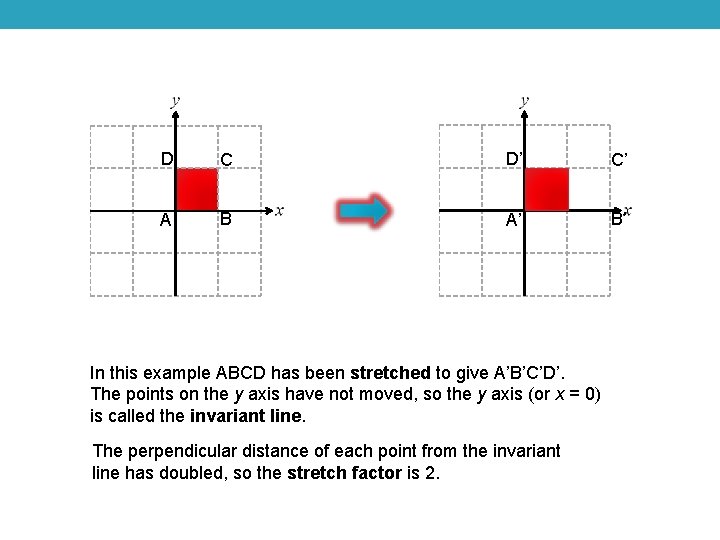
D C D’ C’ A B A’ B’ In this example ABCD has been stretched to give A’B’C’D’. The points on the y axis have not moved, so the y axis (or x = 0) is called the invariant line. The perpendicular distance of each point from the invariant line has doubled, so the stretch factor is 2.
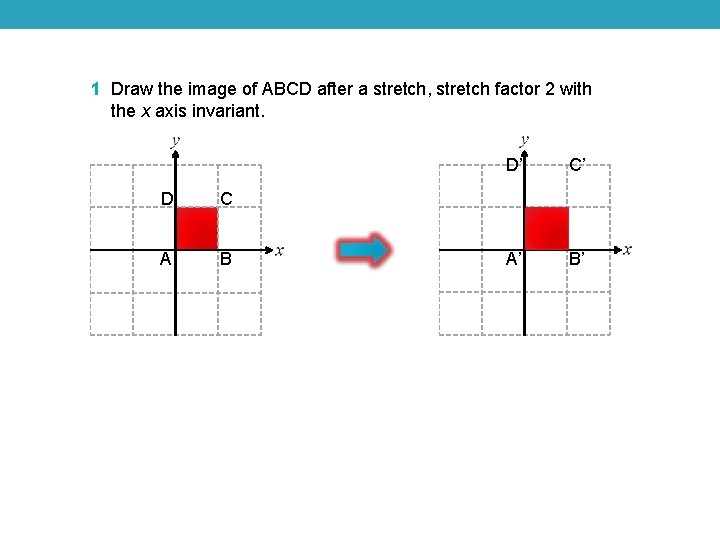
1 Draw the image of ABCD after a stretch, stretch factor 2 with the x axis invariant. D C A B D’ C’ A’ B’
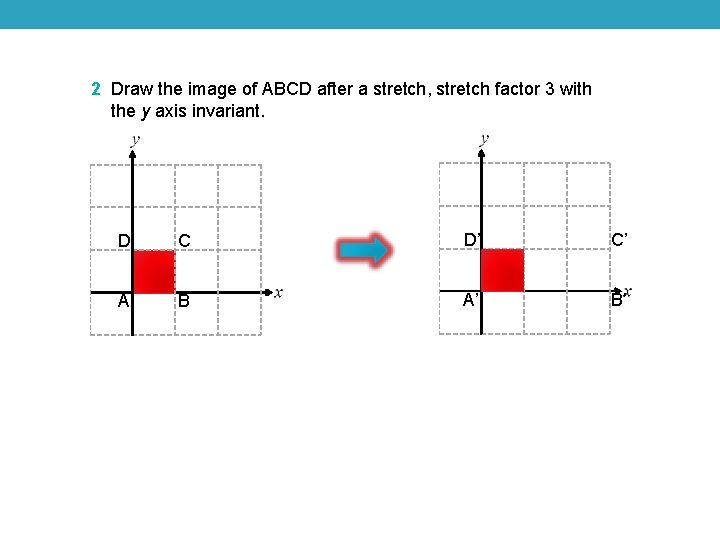
2 Draw the image of ABCD after a stretch, stretch factor 3 with the y axis invariant. D C D’ C’ A B A’ B’
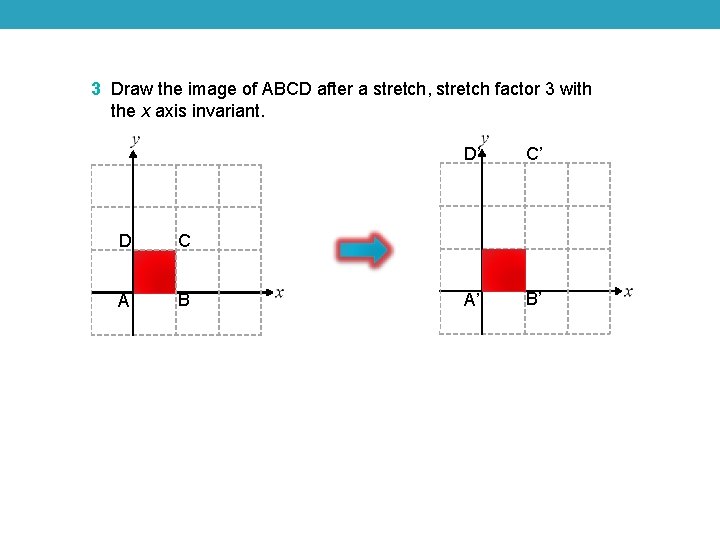
3 Draw the image of ABCD after a stretch, stretch factor 3 with the x axis invariant. D C A B D’ C’ A’ B’
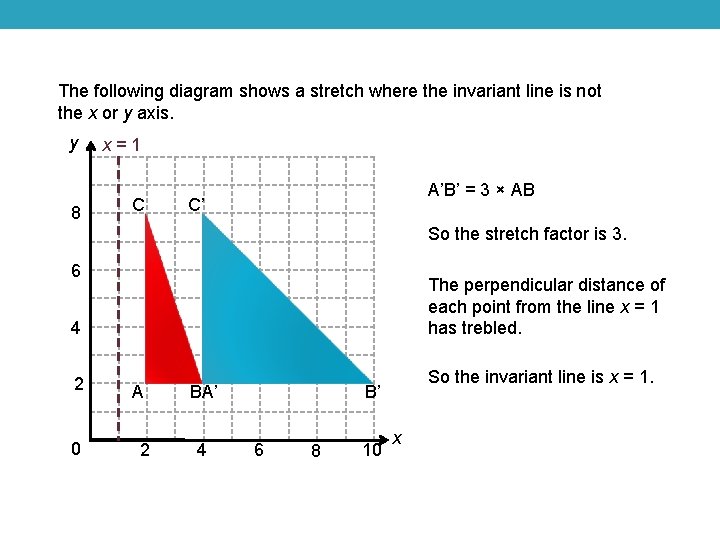
The following diagram shows a stretch where the invariant line is not the x or y axis. y x=1 8 C A’B’ = 3 × AB C’ So the stretch factor is 3. 6 4 The perpendicular distance of each point from the line x = 1 has trebled. 2 So the invariant line is x = 1. 0 A 2 BA’ 4 B’ 6 8 10 x
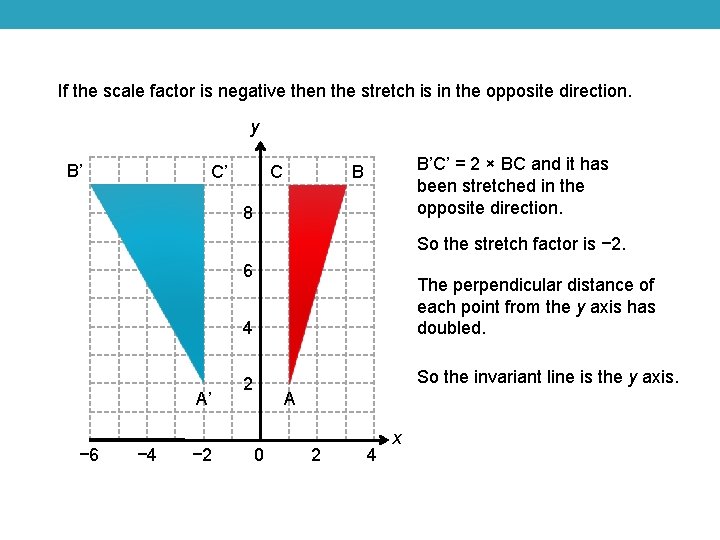
If the scale factor is negative then the stretch is in the opposite direction. y B’ C’ C B’C’ = 2 × BC and it has been stretched in the opposite direction. B 8 So the stretch factor is − 2. 6 A’ − 6 − 4 − 2 4 The perpendicular distance of each point from the y axis has doubled. 2 So the invariant line is the y axis. A 0 2 4 x
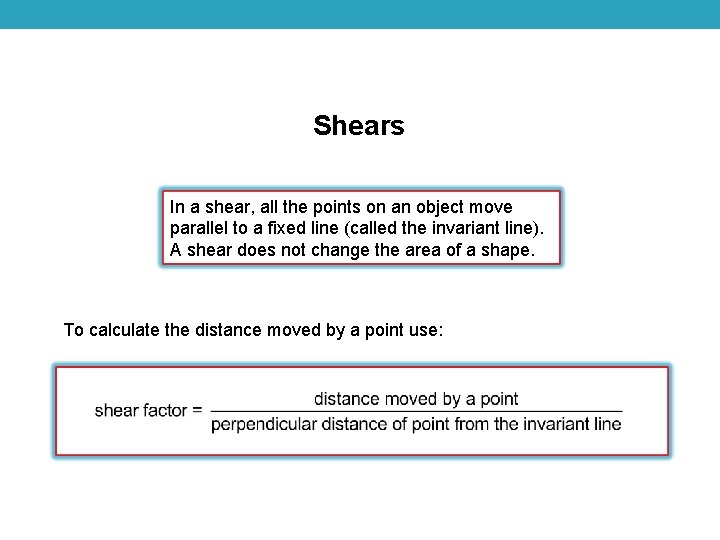
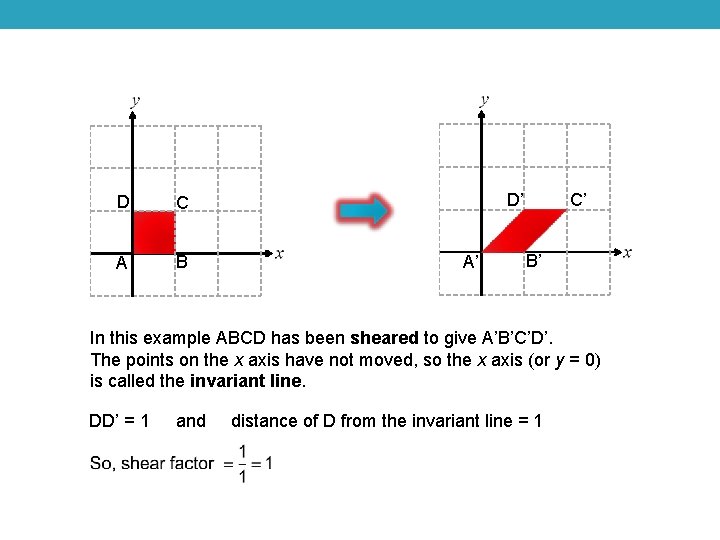
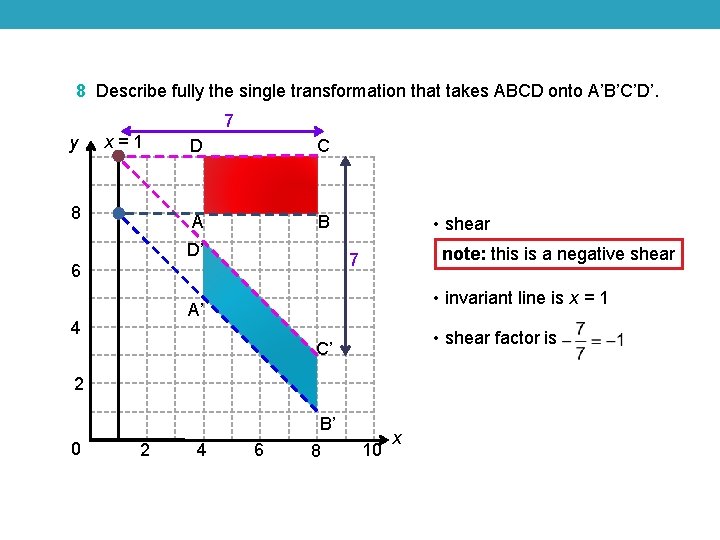
Shears In a shear, all the points on an object move parallel to a fixed line (called the invariant line). A shear does not change the area of a shape. To calculate the distance moved by a point use:
D C A B D’ A’ C’ B’ In this example ABCD has been sheared to give A’B’C’D’. The points on the x axis have not moved, so the x axis (or y = 0) is called the invariant line. DD’ = 1 and distance of D from the invariant line = 1
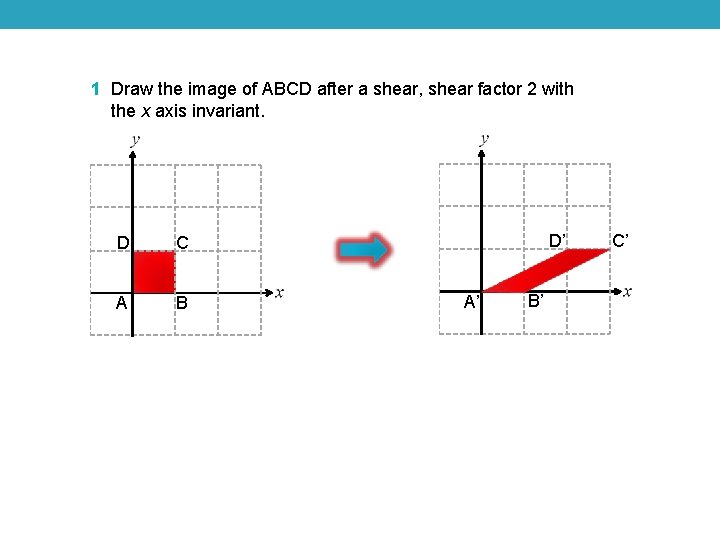
1 Draw the image of ABCD after a shear, shear factor 2 with the x axis invariant. D C A B D’ A’ B’ C’
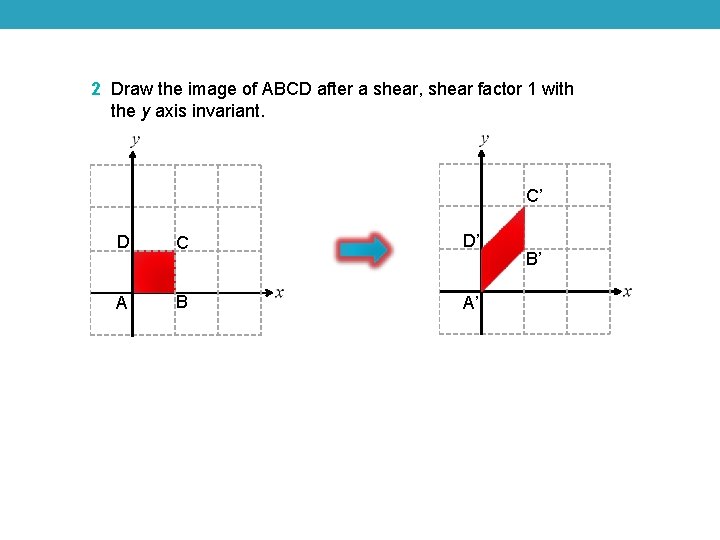
2 Draw the image of ABCD after a shear, shear factor 1 with the y axis invariant. C’ D C D’ A B A’ B’
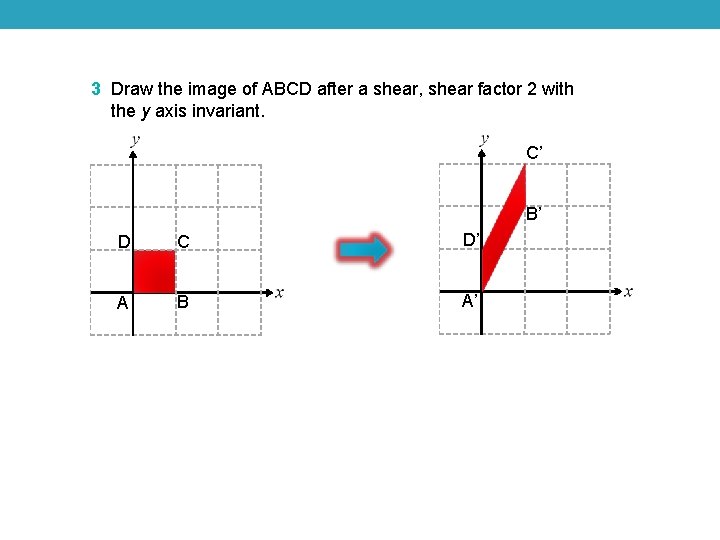
3 Draw the image of ABCD after a shear, shear factor 2 with the y axis invariant. C’ B’ D C D’ A B A’
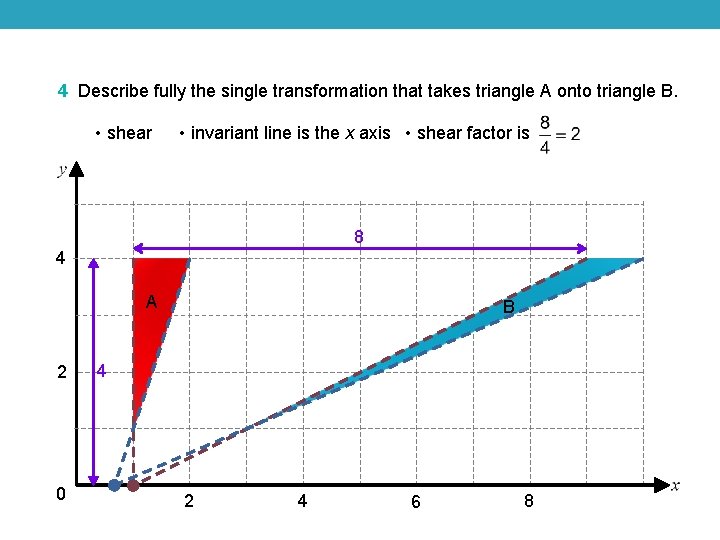
4 Describe fully the single transformation that takes triangle A onto triangle B. • shear • invariant line is the x axis • shear factor is 8 4 A 2 0 B 4 2 4 6 8
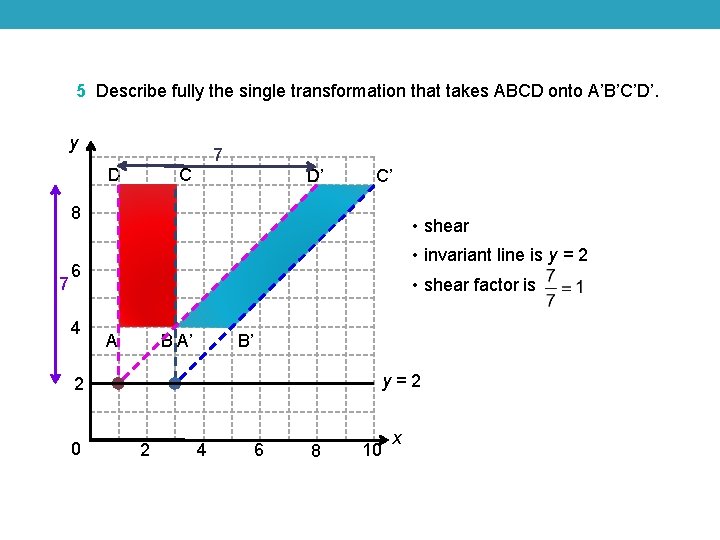
5 Describe fully the single transformation that takes ABCD onto A’B’C’D’. y 7 D C D’ C’ 8 7 • shear • invariant line is y = 2 6 4 • shear factor is A B A’ B’ y=2 2 0 2 4 6 8 10 x
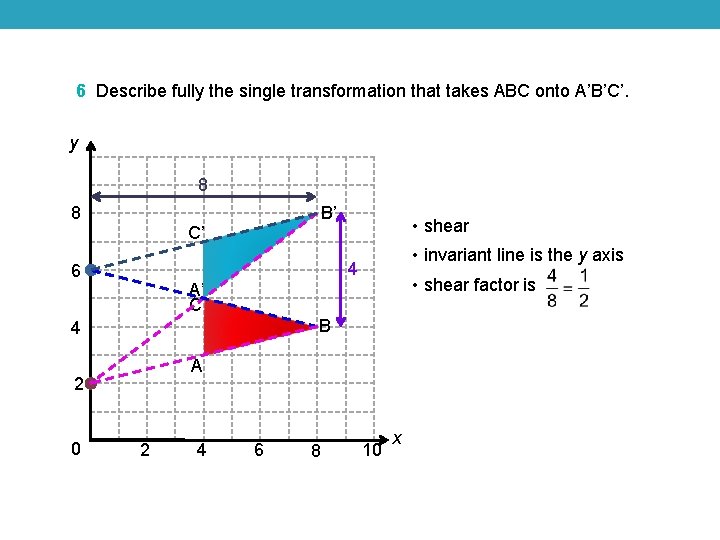
6 Describe fully the single transformation that takes ABC onto A’B’C’. y 8 8 B’ C’ • invariant line is the y axis 4 6 • shear factor is A’ C B 4 A 2 0 • shear 2 4 6 8 10 x
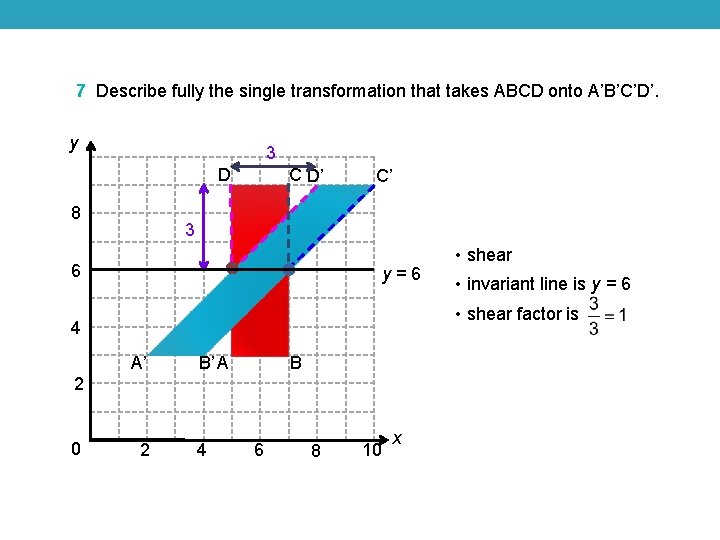
7 Describe fully the single transformation that takes ABCD onto A’B’C’D’. y 3 D 8 C D’ C’ 3 6 y=6 • invariant line is y = 6 • shear factor is 4 A’ B’ A B 2 0 • shear 2 4 6 8 10 x
8 Describe fully the single transformation that takes ABCD onto A’B’C’D’. 7 y x=1 8 D C A B D’ • shear note: this is a negative shear 7 6 • invariant line is x = 1 A’ 4 • shear factor is C’ 2 0 2 4 6 B’ 8 10 x