
Stretch Reflex Physiological Description RefereesPlayers Analogy Proprioception Awareness
- Slides: 29
Stretch Reflex Physiological Description & Referees-Players Analogy
Proprioception Awareness of 1. muscle length 2. musculo-skeletal interface (joint angle change) 3. speed of movement “Body Awareness in Space”
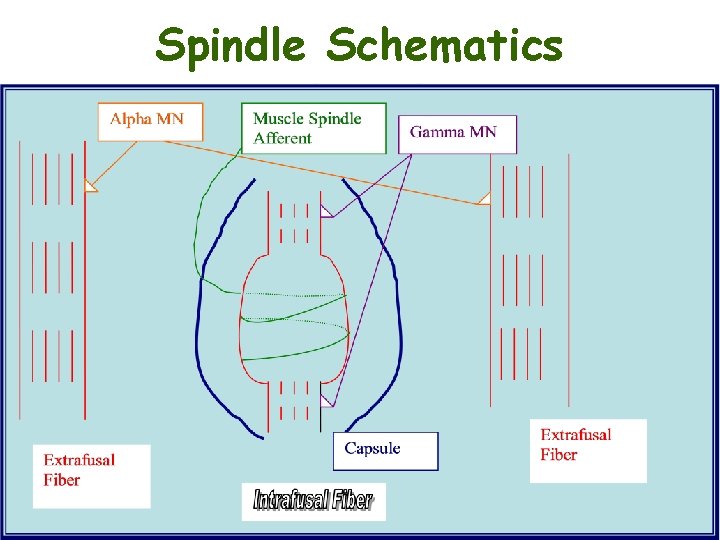
Muscle Spindles ü These sensory fibers lie between skeletal muscle (extrafusal) fibers ü Small fibers (intrafusal fibers) wind through muscles ü Intrafusal fibers stretch and stimulate gamma motor neurons ü Thus, muscle spindles provide the CNS with information about the length of the muscles and accommodate changes in length
Muscle Spindle When the spindles are stretched rapidly, the sensory feedback causes the CNS to stimulate alpha motor nerves. This process causes the stretched muscle to contract!!
Spindle Schematics
Functions of the. Myotatic Reflex Muscle tone Maintain posture Voluntary movement
Stretch (myotatic) reflex The myotatic reflex is activated from stimulation of the muscle spindle Information is sent to the CNS about the degree of stretch of the involved muscle and the needed motor units to contract in order to overcome stretch
Stretch (myotatic) reflex Simply, it is a 2 -neuron loop: • afferent and efferent neurons • The afferent neuron is connected to a muscle spindle, which detects stretch in the muscle • The efferent neuron is the motor neuron, which causes the muscle to twitch
Muscle Spindle Action Muscle spindles note the change in length (and speed) and send signals to the spinal cord This action stimulates the stretch reflex (myotatic reflex) which attempts to resist the change in muscle length by causing the stretched muscle to contract The more sudden the change in muscle length, the stronger the muscle contractions will be (plyometric training is based on this fact)
Monitored Stretch Components The stretch reflex has both a dynamic component and a static component • The static component persists as long as the muscle is being stretched • The dynamic component lasts for only a moment and is in response to the initial sudden increase in muscle length
Monitored Stretch Components The stretch reflex has two components because there are two kinds of intrafusal muscle fibers: • nuclear chain fibers, which are responsible for the static component; • nuclear bag fibers, which are responsible for the dynamic component.
Intrafusal Type determined by: 1. length/diameter: 2. central nuclei: 3. innervation : bag>chain bag> chain bag< chain (1: 1) (1: 5) Bag: monitor rate and degree of stretch Chain: monitors degree of stretch
AFFERENTS 1. Annulospiral endings: on central portion of the nuclei bags and chain (primary afferents) 2. Flower spray endings: on extended portion of nuclei chains (secondary afferents)
Stretch Receptors Two stretch receptors are sensitive to different time scales The first is a Ia fiber; the classification is based on diameter and conduction velocity The Ia fiber fires when the muscle is stretching, but it is rapidly adapting. As soon as the muscle stops changing length, the Ia adapts to the new length and stops firing
Stretch Receptors The second type of stretch receptor is a II fiber It is slowly adapting It also responds when the muscle is stretching, but it maintains a firing rate after the muscle has stopped moving (essentially, it is non-adapting)
Muscle Spindle Sensitivity How can the muscle spindle remain sensitive to stretch at short lengths? Like any muscle fiber, it can contract When it contracts, the entire spindle shortens, and the sensitivity is intact
Muscle Spindle Sensitivity Small motor neurons in the ventral horn innervate the intrafusal muscle fibers and cause them to contract via the gamma motor neurons The neurons are excited every time the alpha motor neurons fire, so that as the extrafusal fibers contract, the intrafusals contract also
Stretching Reasons for holding a stretch for a prolonged period of time: • The muscle spindle habituates (becomes accustomed to the new length) and reduces its signaling • Stretch receptors are trained to allow greater lengthening of the muscles
Stretching When a muscle is ballistically stretched, it responds with an amount and rate of contraction which vary directly with the stretch When a muscle is statically stretched, this reflex is inhibited
GAMMA SYSTEM Intrafusal fibers are sometimes referred to as the gamma system Afferent nerves – 2 types Gamma efferent nerves -1 type
GAMMA EFFERENT • Innervates ends of intrafusal fibers (contractile apparatus) • Slower conduction velocity than the alpha motor neurons sense movement before their contractile ends are stimulated to contract (to compensate for change in muscle length)
CO ACTIVATION Both alpha and gamma motoneurons are stimulated Gamma loop is initiated ( helps to inhibit antagonistic muscle action)
GAMMA BIAS If high sensitivity of the spindle afferent to the external stretch Muscle contraction is maintained at varying levels of force precision control Ö At prefered extrafusal length • minimal spindle firing • unconscious control less jerky
Inverse Stretch Reflex The inverse stretch reflex is also known as the inverse myotatic reflex, the Golgi tendon reflex and the clasp -knife reflex The reflex responds to tension in a muscle tendon which is sensed by Golgi tendon organs
Inverse Stretch Reflex The inverse stretch reflex is bisynaptic Therefore slower than the stretch reflex The inverse stretch reflex can override the stretch reflex: • Protective • Automatic maintenance of posture
Referees and Players The intrafusal fibers are the referees The extrafusal fibers are the players
Referees’ Roles The referees: • Monitor player safety and the players playing by the rules of the game • If the players exceed safety components, the referee whistles play to stop • An adjustment is made for safety and proper game play
Players’ Roles Produce the action (force) Determine movement within the game Do not monitor the rules of the game, but determine game play Keep up the movement until fatigued or ordered to stop by authorities (CNS: spinal cord)
Questions to ponder. . . Why does the knee “jerk” when the patellar tendon is whacked? How could a depth jump (pre stretch) cause one to jump higher? How can someone kick at another person’s head, but come just an inch short?