
Stretch and Challenge 7 strategies to grow students

- Slides: 8
Stretch and Challenge 7 strategies to grow students who can think for themselves from tomorrow morning
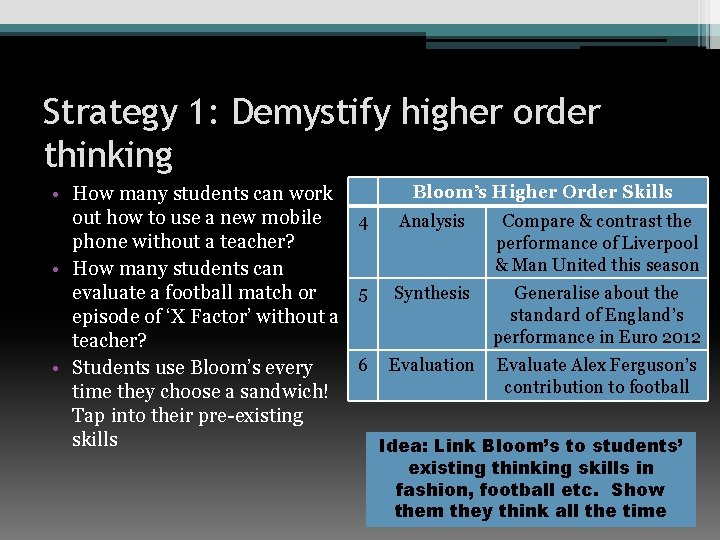
Strategy 1: Demystify higher order thinking Bloom’s Higher Order Skills • How many students can work out how to use a new mobile 4 Analysis Compare & contrast the phone without a teacher? performance of Liverpool & Man United this season • How many students can evaluate a football match or 5 Synthesis Generalise about the standard of England’s episode of ‘X Factor’ without a performance in Euro 2012 teacher? 6 Evaluation Evaluate Alex Ferguson’s • Students use Bloom’s every contribution to football time they choose a sandwich! Tap into their pre-existing skills Idea: Link Bloom’s to students’ existing thinking skills in fashion, football etc. Show them they think all the time
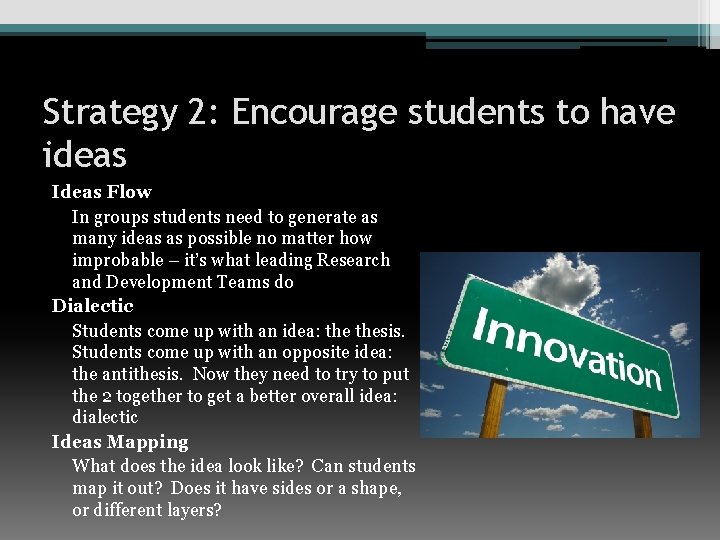
Strategy 2: Encourage students to have ideas Ideas Flow In groups students need to generate as many ideas as possible no matter how improbable – it’s what leading Research and Development Teams do Dialectic Students come up with an idea: thesis. Students come up with an opposite idea: the antithesis. Now they need to try to put the 2 together to get a better overall idea: dialectic Ideas Mapping What does the idea look like? Can students map it out? Does it have sides or a shape, or different layers?
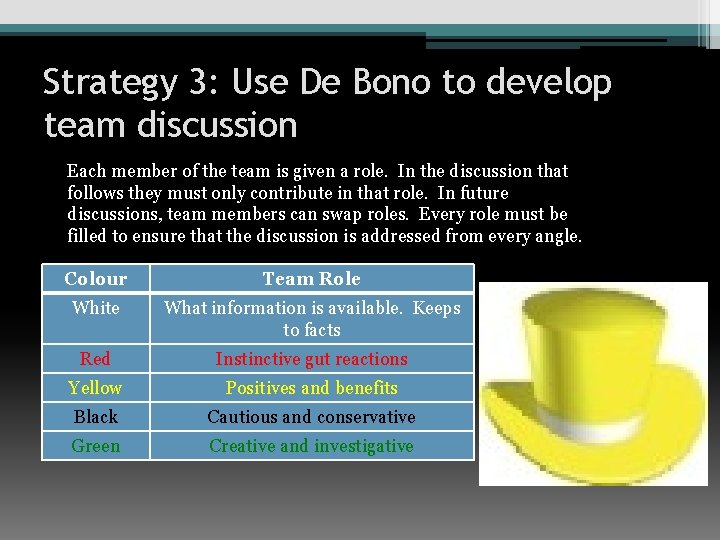
Strategy 3: Use De Bono to develop team discussion Each member of the team is given a role. In the discussion that follows they must only contribute in that role. In future discussions, team members can swap roles. Every role must be filled to ensure that the discussion is addressed from every angle. Colour Team Role White What information is available. Keeps to facts Red Instinctive gut reactions Yellow Positives and benefits Black Cautious and conservative Green Creative and investigative
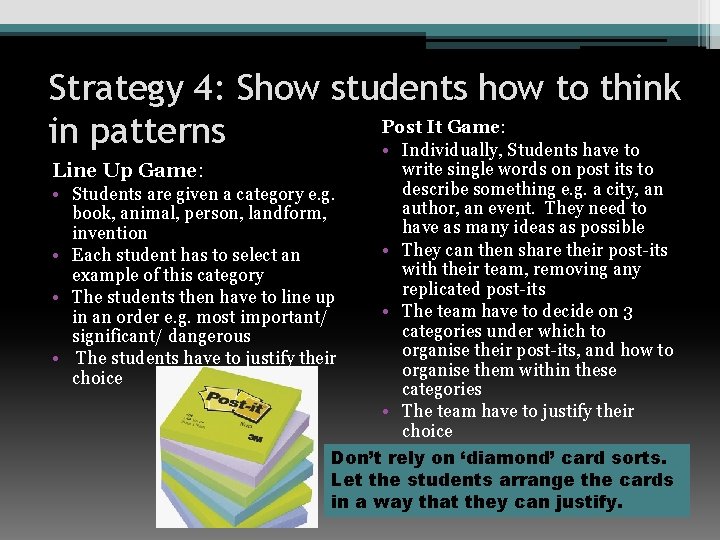
Strategy 4: Show students how to think Post It Game: in patterns • Individually, Students have to Line Up Game: • Students are given a category e. g. book, animal, person, landform, invention • Each student has to select an example of this category • The students then have to line up in an order e. g. most important/ significant/ dangerous • The students have to justify their choice write single words on post its to describe something e. g. a city, an author, an event. They need to have as many ideas as possible • They can then share their post-its with their team, removing any replicated post-its • The team have to decide on 3 categories under which to organise their post-its, and how to organise them within these categories • The team have to justify their choice Don’t rely on ‘diamond’ card sorts. Let the students arrange the cards in a way that they can justify.
Strategy 5: Enable students to think ‘out of the box’ PMI: Students are given an idea: what if humans could fly, what if we banned cars, what if school was voluntary. They need to come up with as many pluses, minuses, and interesting thoughts on this idea as possible. This could be played as two or more teams Odd One Out: Students are given 3 subjects e. g. Germany, Britain and France, or Red, Blue and Green. They have to find as many odd ones out as possible between 3. Again, this could be played as two or more teams
Strategy 6: Get students to think critically Devil’s Advocate Students have 1 minute to argue one side of a case. They then have to argue the opposite side Counter-intuitive arguing Students need to try to argue from the opposite side, or turn an argument on its head. Can they think sideways, or diagonally?
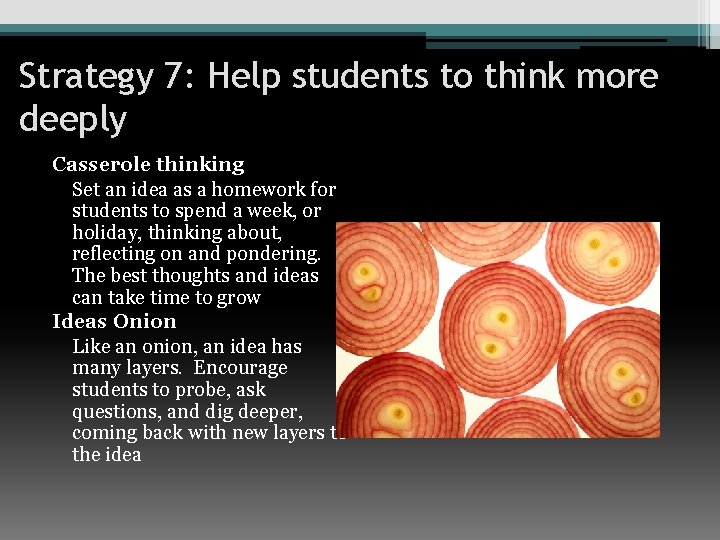
Strategy 7: Help students to think more deeply Casserole thinking Set an idea as a homework for students to spend a week, or holiday, thinking about, reflecting on and pondering. The best thoughts and ideas can take time to grow Ideas Onion Like an onion, an idea has many layers. Encourage students to probe, ask questions, and dig deeper, coming back with new layers to the idea