
Stress Testing in HBOS Treasury Colin Burke Credit
Stress Testing in HBOS Treasury Colin Burke, Credit Modelling
Contents • Treasury’s Portfolio • Forming PDs • Current stress testing approach • Risk Platform Project • Stress Testing EPE – an example 2
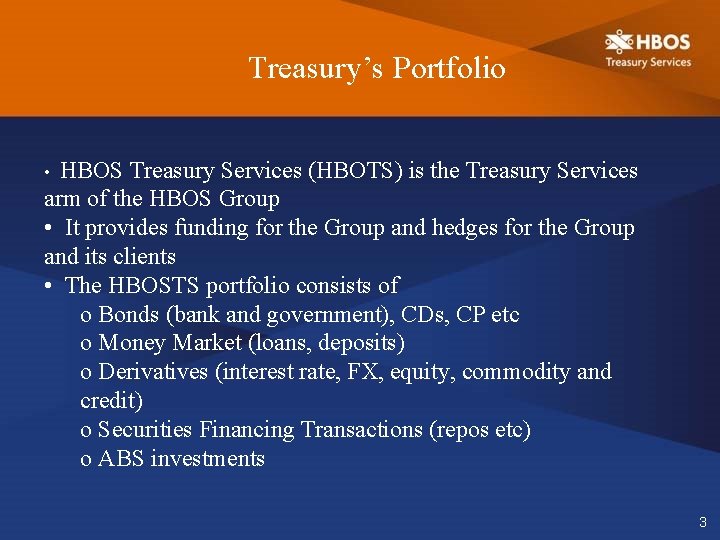
Treasury’s Portfolio HBOS Treasury Services (HBOTS) is the Treasury Services arm of the HBOS Group • It provides funding for the Group and hedges for the Group and its clients • The HBOSTS portfolio consists of o Bonds (bank and government), CDs, CP etc o Money Market (loans, deposits) o Derivatives (interest rate, FX, equity, commodity and credit) o Securities Financing Transactions (repos etc) o ABS investments • 3
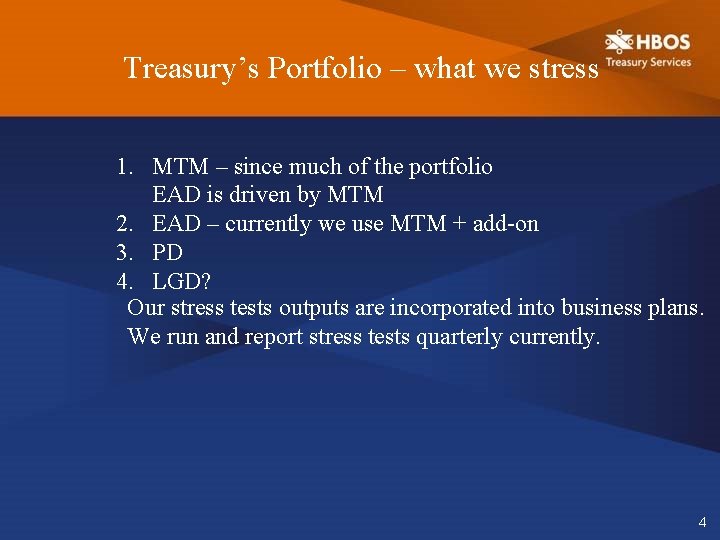
Treasury’s Portfolio – what we stress 1. MTM – since much of the portfolio EAD is driven by MTM 2. EAD – currently we use MTM + add-on 3. PD 4. LGD? Our stress tests outputs are incorporated into business plans. We run and report stress tests quarterly currently. 4

Or, to put it another way… 5
Stress Test Classifications 1. Those part of the ICAAP process (formed by Group) 2. Those formed by Treasury a) Economic b) Historic c) User defined 6
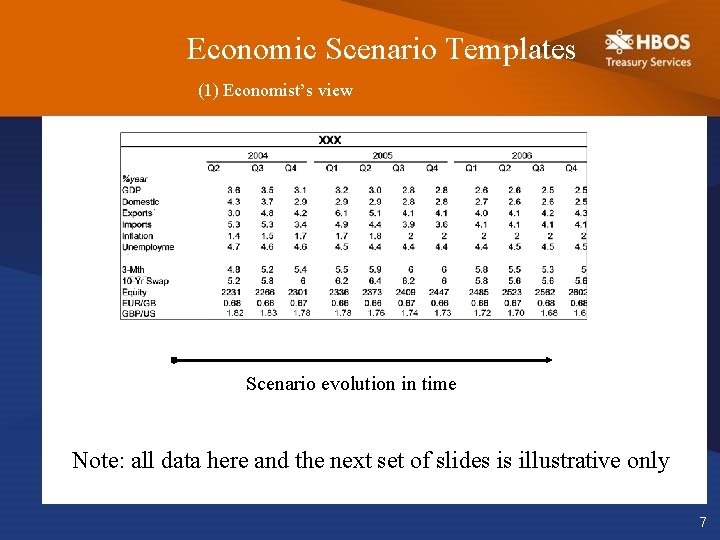
Economic Scenario Templates (1) Economist’s view Scenario evolution in time Note: all data here and the next set of slides is illustrative only 7
Credit and Market Check Point 1. 2. 3. 4. To summarise, the points up to forming a stressed MTM are identical for credit risk and market risk But note credit and market risk then differ: Market risk: • Aggregate to book, desk or position level Credit risk: • Aggregate to netting pool level • Also need to consider default rates and collateral effects 8
Systems Approach – Short term • Main Credit system is MLC. Contains counterparty credit limits, exposures, and RWA calculations. • This becomes the credit core of the stress testing system: • Calculates stressed RWA, EL etc • Shows which exposure limits are broken under a stress event 9
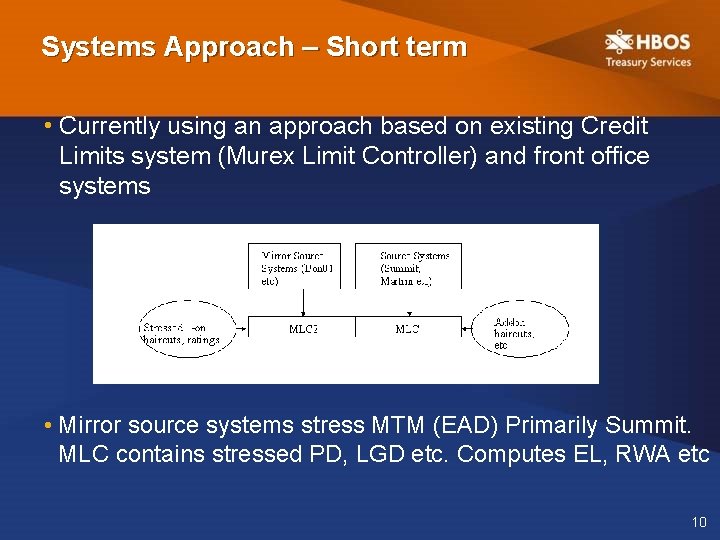
Systems Approach – Short term • Currently using an approach based on existing Credit Limits system (Murex Limit Controller) and front office systems • Mirror source systems stress MTM (EAD) Primarily Summit. MLC contains stressed PD, LGD etc. Computes EL, RWA etc 10
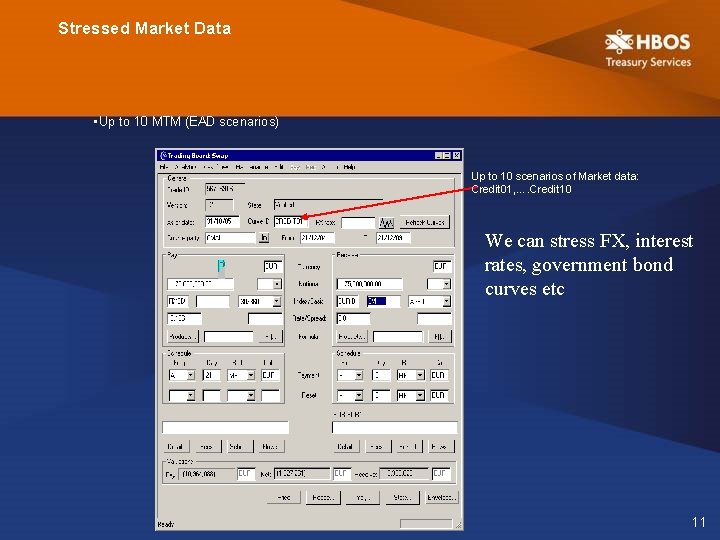
Stressed Market Data • Up to 10 MTM (EAD scenarios) Up to 10 scenarios of Market data: Credit 01, …. Credit 10 We can stress FX, interest rates, government bond curves etc 11
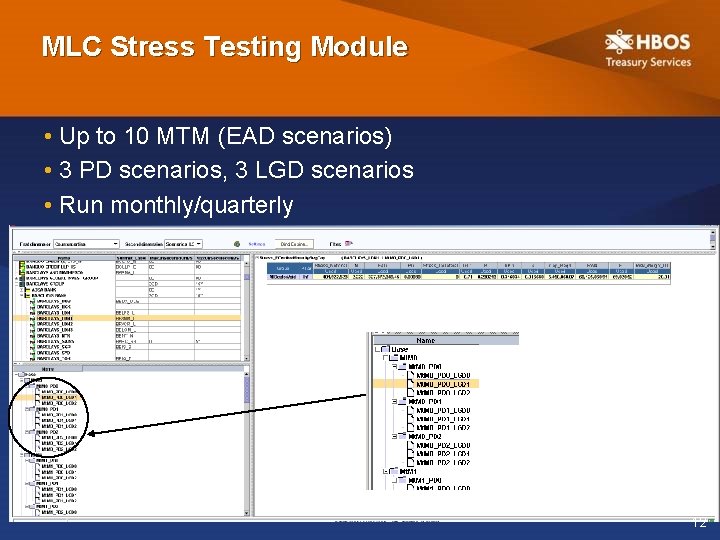
MLC Stress Testing Module • Up to 10 MTM (EAD scenarios) • 3 PD scenarios, 3 LGD scenarios • Run monthly/quarterly 12
Systems Approach – Short term • Phase 1: Effect on EL and RWA • System specified • Summit enhancement delivered • MLC enhancement delivered • Phase 2: Effect on limits • No extra Summit work needed • MLC work scheduled for 2007 13
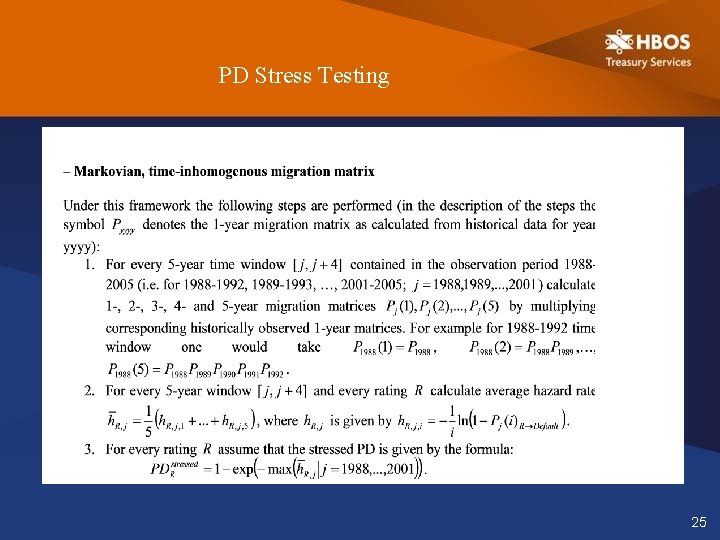
Stressing PDs 1. How do we form our base case PDs? 2. What is already included in the base case? 3. Rating migration and stressed PDs 14

Default Rates – procyclicality (aside on cohort formation and tracking) 15
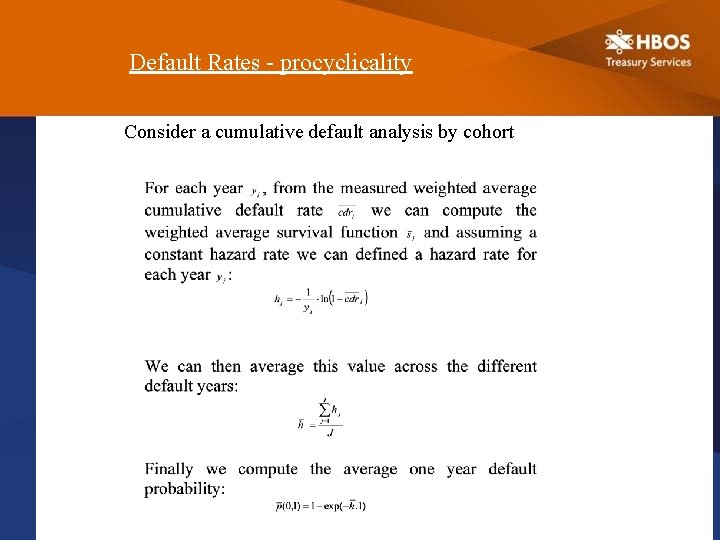
Default Rates - procyclicality Consider a cumulative default analysis by cohort 16

1. 2. Make PD’s long term estimates Capture rating migration in PD estimation where appropriate 17

PD Estimation 1 - year view. Small sample of defaults: (i) No defaults in some bands (ii) Rank orders wrong Average of cumulative default rate. (i) Defaults in Aa 1 etc (migration had occurred) (ii) Rank orders correct (iii) Almost log-linear with rating 18

Stress testing, procyclicality and low default portfolios. Need to be careful about double counting rating migration 19
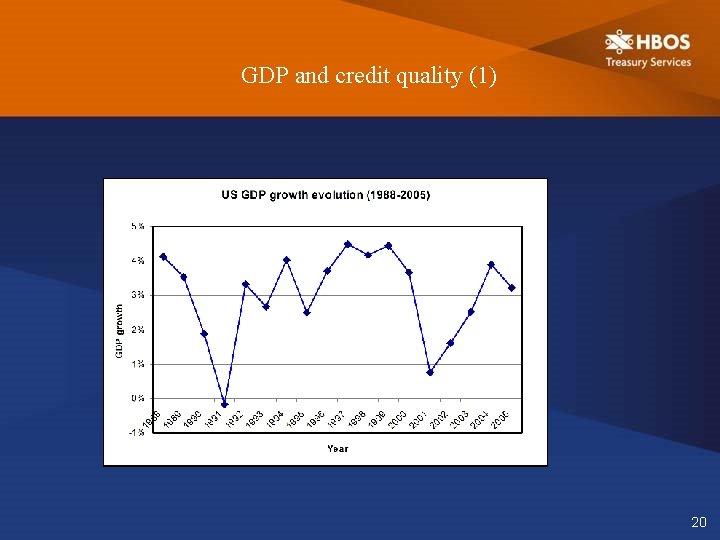
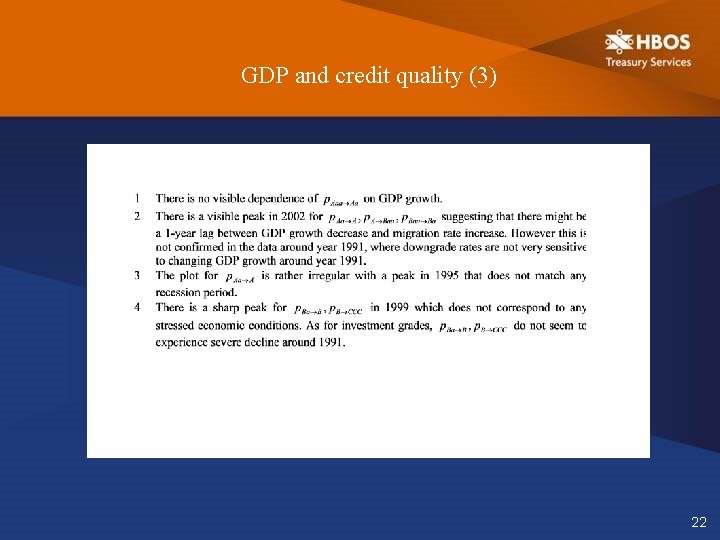
GDP and credit quality (1) 20
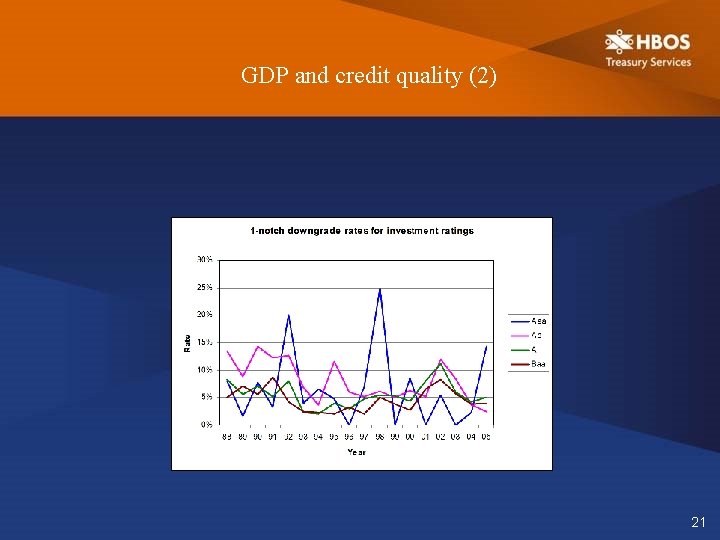
GDP and credit quality (2) 21
GDP and credit quality (3) 22

GDP and credit quality (4) 23

24
PD Stress Testing 25
Strategic Solution: Risk Platform Project (i) Scope: • Market Risk: deliver a platform for CAD 2 • Credit Risk: deliver a platform for credit exposures, economic capital and stress testing. • An economic capital model is only as good as its inputs: PD, LGD, exposures, correlations • • • => stress testing functionality for credit risk => credit exposure in IMM (derivatives and SFT) => back testing of IMM exposures => credit economic capital for derivative and non-derivative trades Provide an EPE platform 26

Risk Platform Project (ii) • System selection process o Request for Proposals (RFPs) were issued on February 23 rd 2005 with a requested reply date of March 24 th 2005 o Sun. Gard's Adaptiv and FAME market data platforms have been selected as those whose functionality most closely matches the business requirements. o Following agreement of the risk engine and market data solutions a seven week proof of concept started on the 24 th of August 2005. Included comparison to HBOSTS own calculations, theoretical review, technology review etc 27
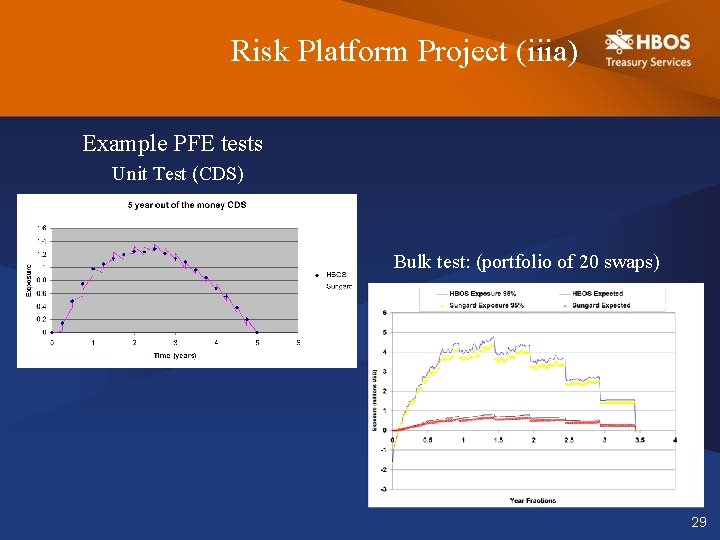
Risk Platform Project (iii) • Project Definition Report produced in early 2006 defining project between HBOSTS and Sungard and lists key required enhancements • Key enhancements for credit risk fall under following headings: o Credit Exposure (IMM) o Stress and Back Testing o Economic Capital (see later) • Project has begun. For Credit Risk initial work is the testing of credit exposure o MTM: unit and bulk tests (comparison with front office system) o PFE/EPE: unit and bulk tests (comparison with our own models) 28
Risk Platform Project (iiia) Example PFE tests Unit Test (CDS) Bulk test: (portfolio of 20 swaps) 29
Risk Platform Project (iv) • Sungard System Components o FAME ü– cleans market data o Panorama ü Bootstraps yield curves ü Market Risk Calcs: CAD 2 calculation (Va. R) etc ü Stress Testing for Credit and Market Risk ü Calibrates stochastic models for Adaptiv Analytics ü Calculates and allocates EC (including use of EPE profiles from Adaptiv Analytics) o Adaptiv Analytics ü Calculates PFE, Expected Exposure, EPE etc ü Includes correlation, netting and collateral effects 30

Risk Platform Project (v) Bloomberg Reuters etc Front Office Systems Trade data FAME Cleaned market data Panorama Trade data Market data Stochastic Parameters PFE/EPE Adaptiv Analytics 31
Economic Capital Enhancements (i) • Key enhancements for economic capital include: o Using Adaptiv Panorama to form credit worthiness factor models (no reliance on vendors proprietary approaches). This gives default correlation. o Economic Capital engine in Panorama will give time of default. A multi -period model. o Economic Capital allocated on basis of Expected Shortfall. Total Capital calculated as CVa. R. Can allocate in different parts of loss distribution 32
Stress Tests in an EPE Framework 1. Similar goals as before except now calculate exposure as EPE rather than MTM + add-on 33
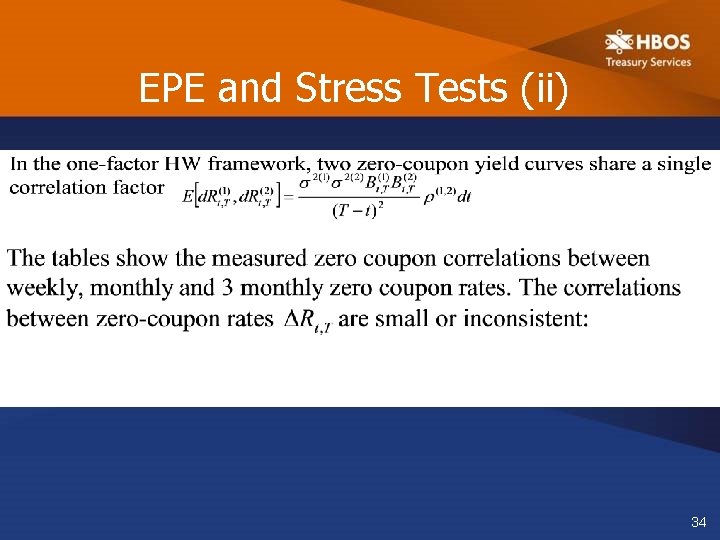
EPE and Stress Tests (ii) 34
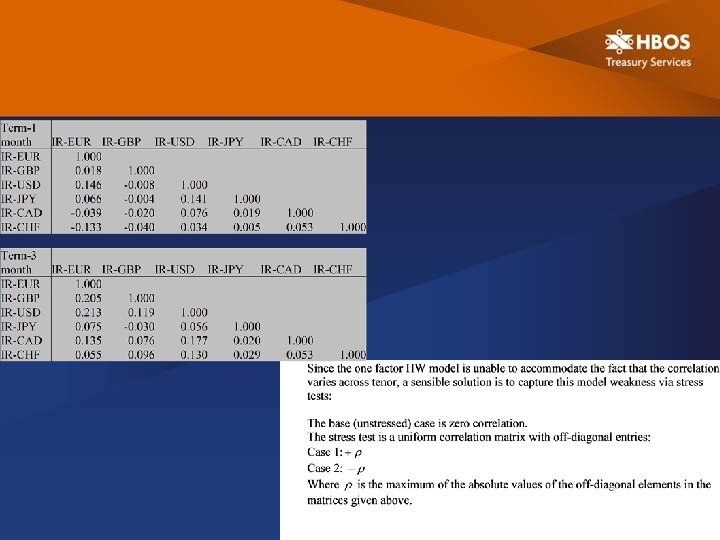
35
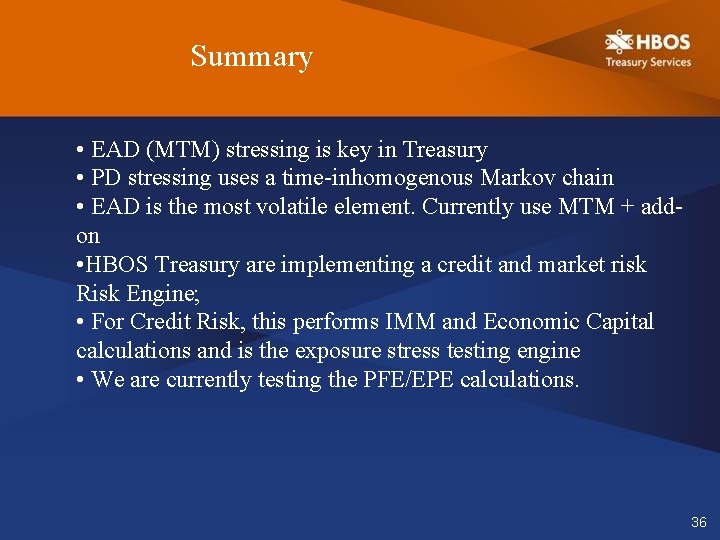
Summary • EAD (MTM) stressing is key in Treasury • PD stressing uses a time-inhomogenous Markov chain • EAD is the most volatile element. Currently use MTM + addon • HBOS Treasury are implementing a credit and market risk Risk Engine; • For Credit Risk, this performs IMM and Economic Capital calculations and is the exposure stress testing engine • We are currently testing the PFE/EPE calculations. 36
- Slides: 36