
Stress testing for Credit Risk Dzintars Ermi Head



- Slides: 25
Stress testing for Credit Risk Dzintars Ermiņš Head of Credit Risk Analyses Hansabanka
Agenda • Introduction – Baltics and Hansabank • • • 2 Stress-testing structure Examples of company based stress-testing Examples of industry based stress-testing Examples of portfolio based stress testing PD’s and LGD based stress testing Conclusions
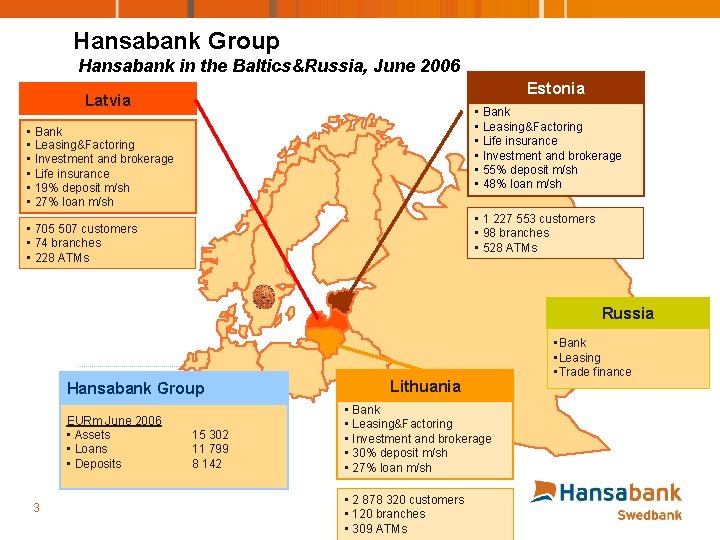
Hansabank Group Hansabank in the Baltics&Russia, June 2006 Estonia Latvia • Bank • Leasing&Factoring • Life insurance • Investment and brokerage • 55% deposit m/sh • 48% loan m/sh • Bank • Leasing&Factoring • Investment and brokerage • Life insurance • 19% deposit m/sh • 27% loan m/sh • 1 227 553 customers • 98 branches • 528 ATMs • 705 507 customers • 74 branches • 228 ATMs Russia Hansabank Group EURm June 2006 • Assets • Loans • Deposits 3 15 302 11 799 8 142 Lithuania • Bank • Leasing&Factoring • Investment and brokerage • 30% deposit m/sh • 27% loan m/sh • 2 878 320 customers • 120 branches • 309 ATMs • Bank • Leasing • Trade finance
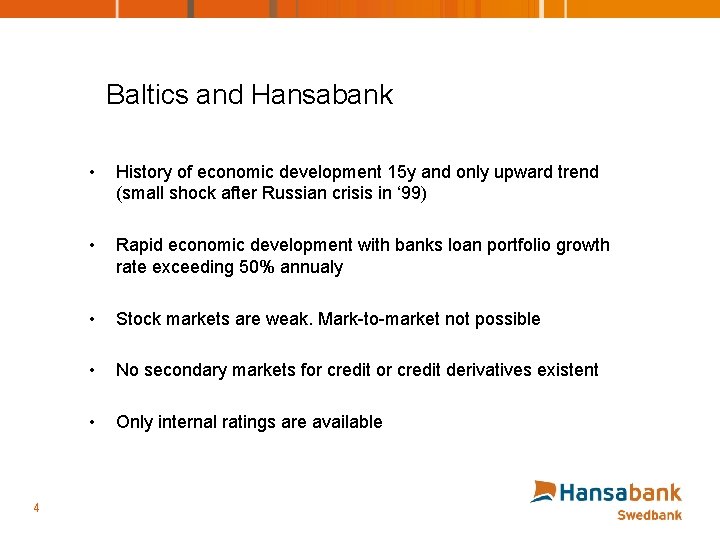
Baltics and Hansabank 4 • History of economic development 15 y and only upward trend (small shock after Russian crisis in ‘ 99) • Rapid economic development with banks loan portfolio growth rate exceeding 50% annualy • Stock markets are weak. Mark-to-market not possible • No secondary markets for credit derivatives existent • Only internal ratings are available
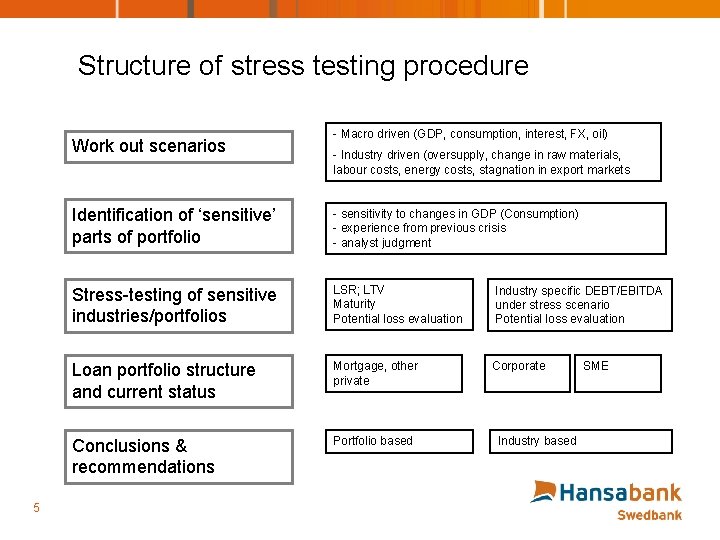
Structure of stress testing procedure Work out scenarios 5 - Macro driven (GDP, consumption, interest, FX, oil) - Industry driven (oversupply, change in raw materials, labour costs, energy costs, stagnation in export markets Identification of ‘sensitive’ parts of portfolio - sensitivity to changes in GDP (Consumption) - experience from previous crisis - analyst judgment Stress-testing of sensitive industries/portfolios LSR; LTV Maturity Potential loss evaluation Industry specific DEBT/EBITDA under stress scenario Potential loss evaluation Loan portfolio structure and current status Mortgage, other private Corporate Conclusions & recommendations Portfolio based Industry based SME
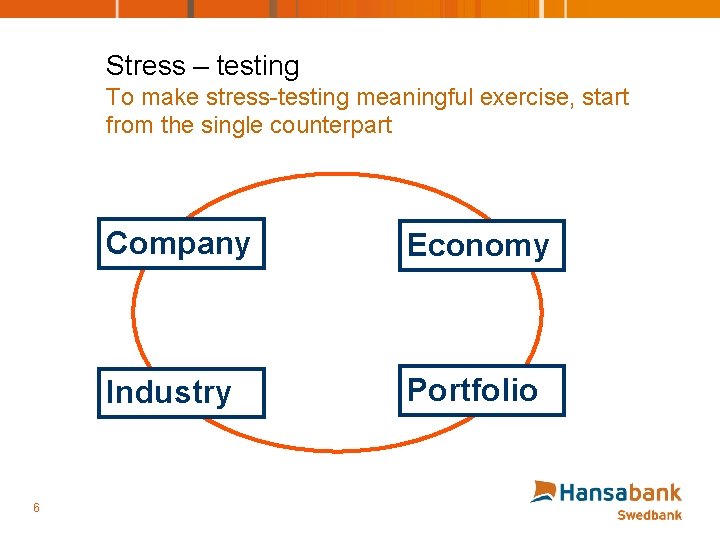
Stress – testing To make stress-testing meaningful exercise, start from the single counterpart 6 Company Economy Industry Portfolio
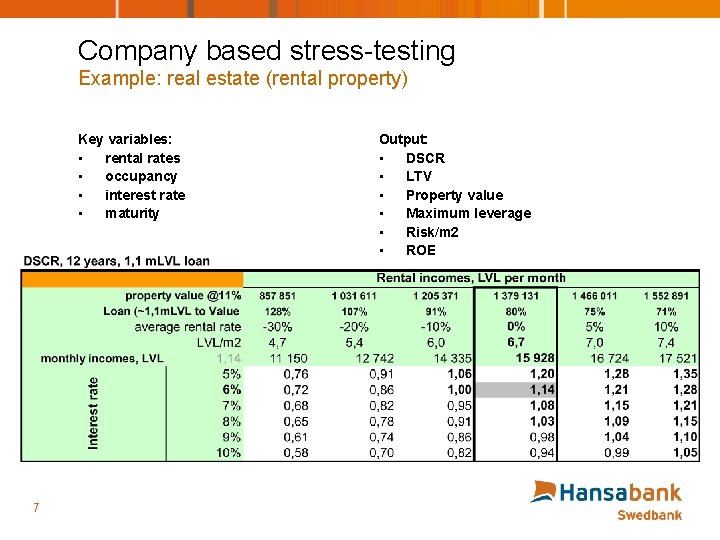
Company based stress-testing Example: real estate (rental property) Key variables: • rental rates • occupancy • interest rate • maturity 7 Output: • DSCR • LTV • Property value • Maximum leverage • Risk/m 2 • ROE
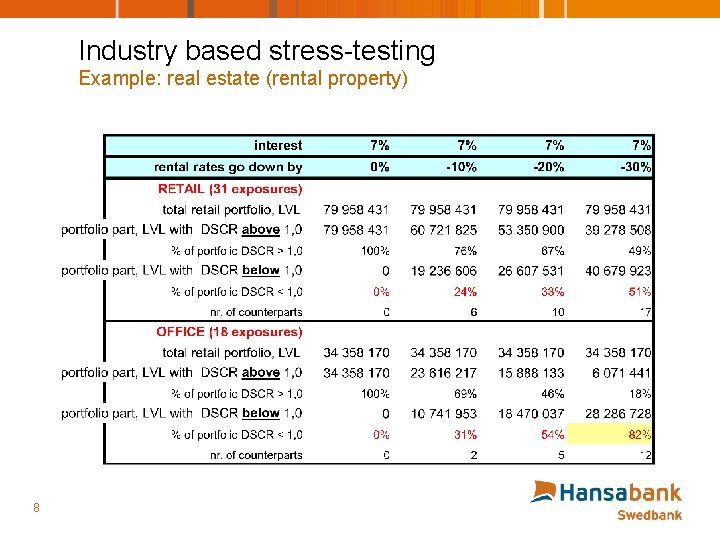
Industry based stress-testing Example: real estate (rental property) 8
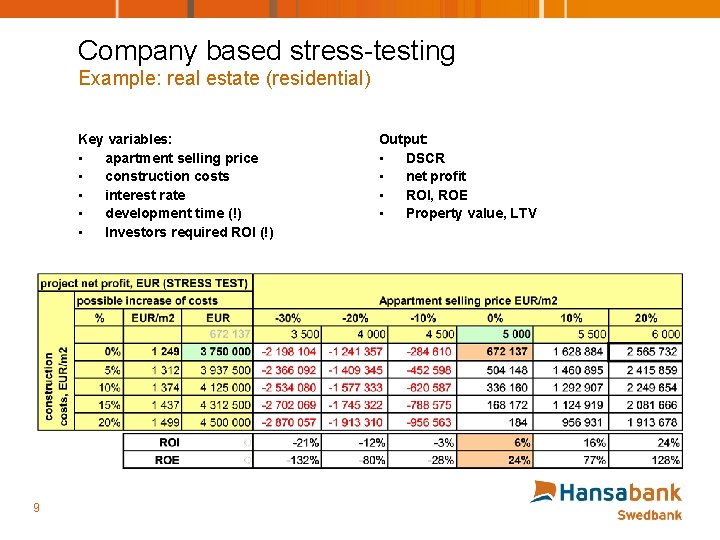
Company based stress-testing Example: real estate (residential) Key variables: • apartment selling price • construction costs • interest rate • development time (!) • Investors required ROI (!) 9 Output: • DSCR • net profit • ROI, ROE • Property value, LTV
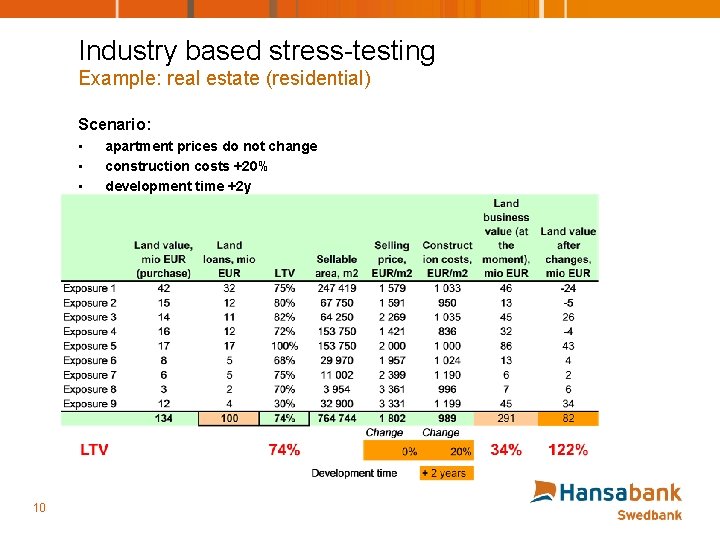
Industry based stress-testing Example: real estate (residential) Scenario: • • • 10 apartment prices do not change construction costs +20% development time +2 y
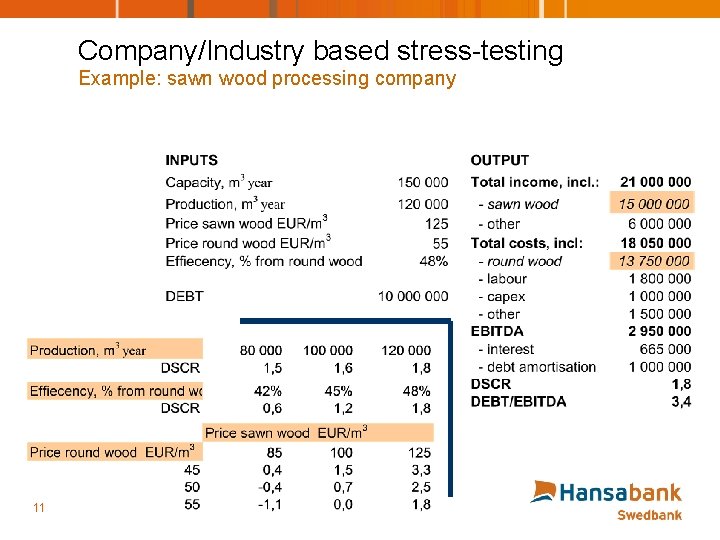
Company/Industry based stress-testing Example: sawn wood processing company 11
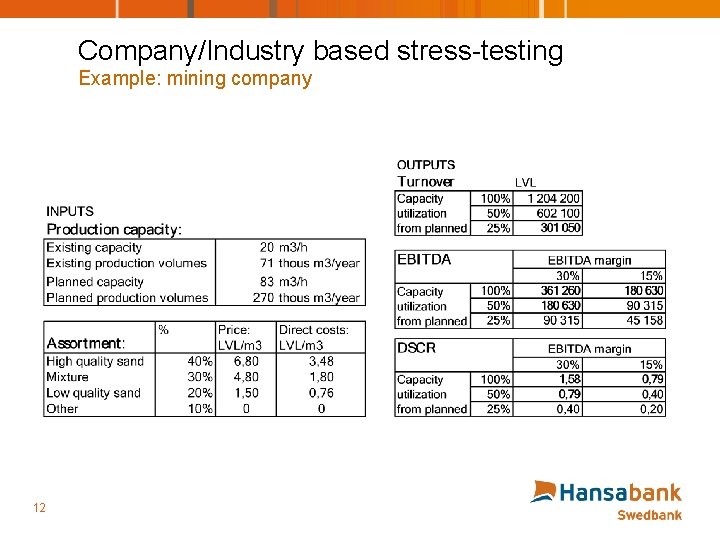
Company/Industry based stress-testing Example: mining company 12
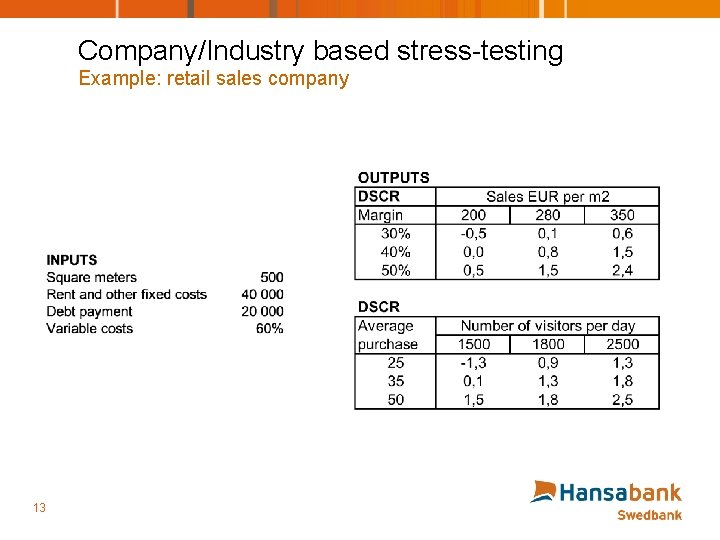
Company/Industry based stress-testing Example: retail sales company 13
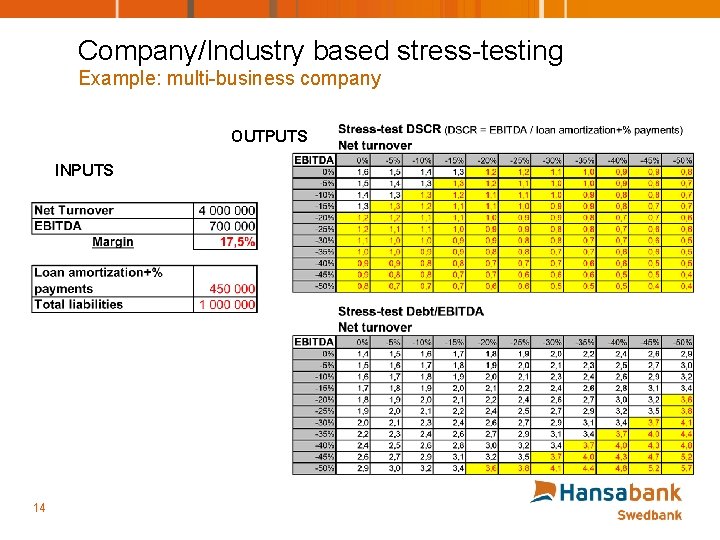
Company/Industry based stress-testing Example: multi-business company OUTPUTS INPUTS 14
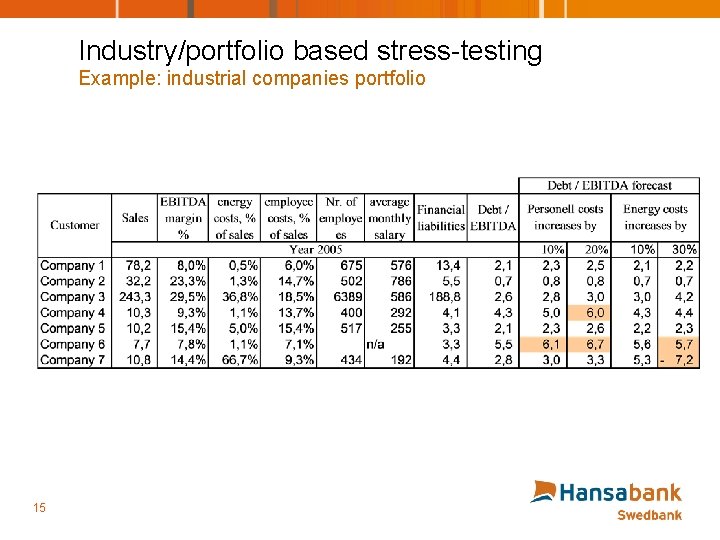
Industry/portfolio based stress-testing Example: industrial companies portfolio 15
Industry/Portfolio based stress-testing Example: EBITDA based • Stress-testing based on DEBT/EBITDA ratios • Forecasted (analyst opinion) or from financial reports • Industry specific EBITDA shocks (expert opinion or previous experience) • Hurdle rate DEBT/EBITDA > 5. 5 (DSCR > 1 for real estate) 16
Industry/Portfolio based stress-testing Example: EBITDA based 17
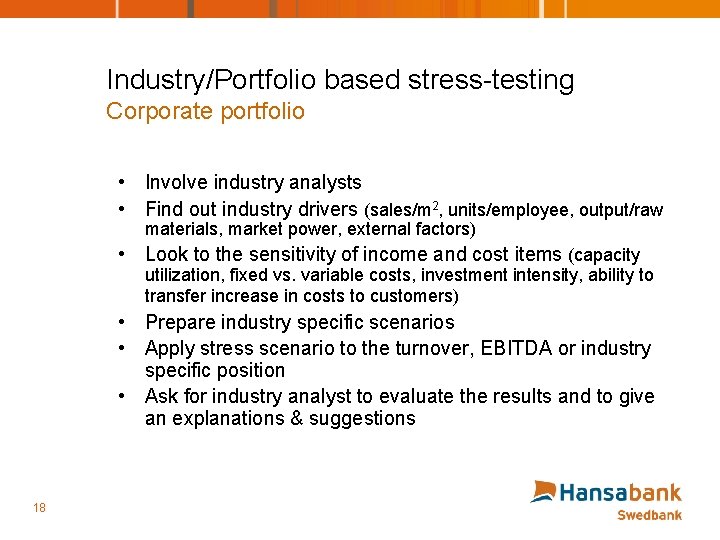
Industry/Portfolio based stress-testing Corporate portfolio • Involve industry analysts • Find out industry drivers (sales/m 2, units/employee, output/raw materials, market power, external factors) • Look to the sensitivity of income and cost items (capacity utilization, fixed vs. variable costs, investment intensity, ability to transfer increase in costs to customers) • Prepare industry specific scenarios • Apply stress scenario to the turnover, EBITDA or industry specific position • Ask for industry analyst to evaluate the results and to give an explanations & suggestions 18
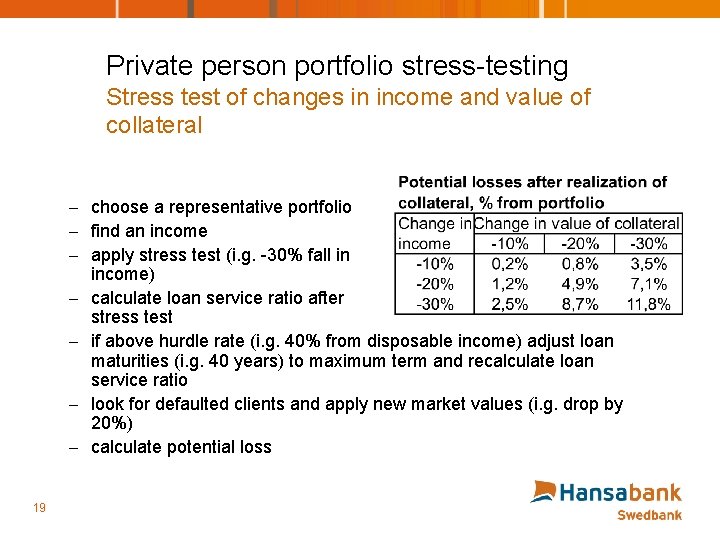
Private person portfolio stress-testing Stress test of changes in income and value of collateral – choose a representative portfolio – find an income – apply stress test (i. g. -30% fall in income) – calculate loan service ratio after stress test – if above hurdle rate (i. g. 40% from disposable income) adjust loan maturities (i. g. 40 years) to maximum term and recalculate loan service ratio – look for defaulted clients and apply new market values (i. g. drop by 20%) – calculate potential loss 19
Private person portfolio stress-testing Stress test of changes in income and value of collateral • Opportunities – Obvious and easily understandable results – Goes in line with every day decision making practice – Straight-forward conclusions • Potential hurdles to overcome – – – huge number of single counterparts (representative portfolio) incomes (account activity, tax office, credit bureaus, other) co-borrowers (spouse, family, relatives) cross-defaults revolving and other products without amortization (harmonized vs. interest only) – updated collateral values (mortgages, cars, guarantees) – information quality and availability (internal/external) 20
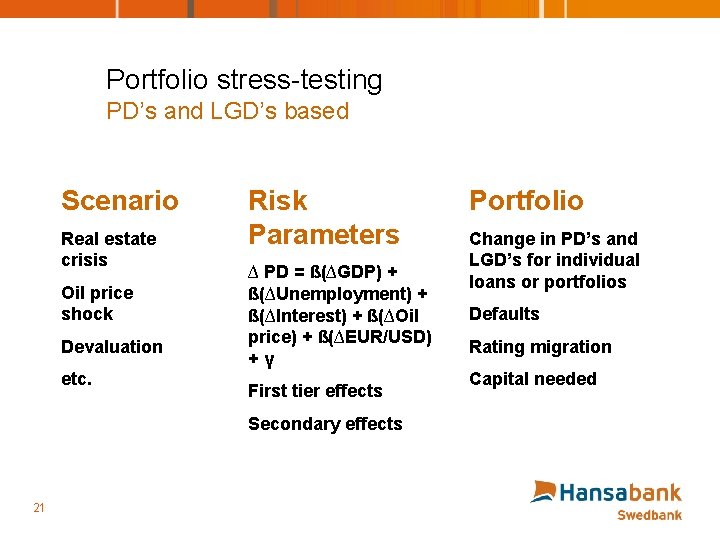
Portfolio stress-testing PD’s and LGD’s based Scenario Real estate crisis Oil price shock Devaluation etc. Risk Parameters ∆ PD = ß(∆GDP) + ß(∆Unemployment) + ß(∆Interest) + ß(∆Oil price) + ß(∆EUR/USD) +γ First tier effects Secondary effects 21 Portfolio Change in PD’s and LGD’s for individual loans or portfolios Defaults Rating migration Capital needed
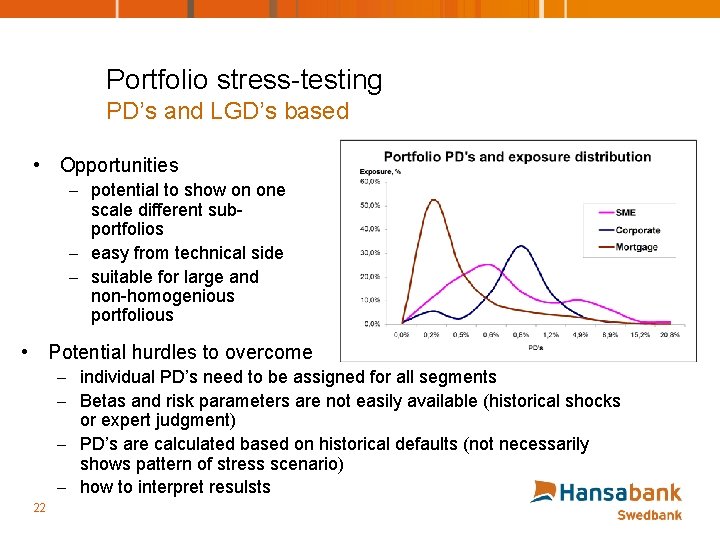
Portfolio stress-testing PD’s and LGD’s based • Opportunities – potential to show on one scale different subportfolios – easy from technical side – suitable for large and non-homogenious portfolious • Potential hurdles to overcome – individual PD’s need to be assigned for all segments – Betas and risk parameters are not easily available (historical shocks or expert judgment) – PD’s are calculated based on historical defaults (not necessarily shows pattern of stress scenario) – how to interpret resulsts 22
Stress-testing for Credit Risk Conclusions • Use bottom-to-top approach whenever possible. Macro view is more easy to handle and good for capital calculations, while do not gives answers to question ‘what to do next? ’ • For real credit risk knowledge ask from industry analysts. • Think as a businessmen not as a banker • Keep simple and do not loose common sense. Over sophistication could lead to ‘black box’ effect • Do not outsource stress-testing to statisticians / modelers 23
Stress-testing for Credit Risk Conclusions • Stress-test is an excellent tool to find ‘hidden risks’ in portfolio (not shown by other tools as back-testing, overdue, ratings, provisions, write-offs ao. ) • Stress-tests and ‘B scenario analyses’ should not be done solely for Regulator or management board. Stress-testing culture need to be a natural part of routine process of credit issuing/evaluation process • Real stress-testing need to be done at origination phase 24
Thank you!