
Stress Study Guide Good vs Bad stress Autonomic
Stress Study Guide • Good vs. Bad stress • Autonomic Nervous System • Mind/Body connection • Most common stressors • Immune system • Fight or Flight • A/B Personality Types • Psychosomatic symptoms vs. Hypochondriac symptoms • What are they and why do people get different symptoms? • Self-efficacy • Locus of Control • Emotion vs. Problem-Focused Coping (control and change – yourself or the situation) • Coping with stress – healthy and non-healthy methods • Biofeedback • Meditation • GAS (General Adaptation Syndrome: Alarm, Resistance, Exhaustion) • Effects of exercise • Dealing with conflict: approach/avoidance • PTSD
“To be totally without stress is to be dead. ” - Hans Selye
n Negative “bad” stress vs. Positive “good” stress – how can that be? Review: Autonomic Nervous System n

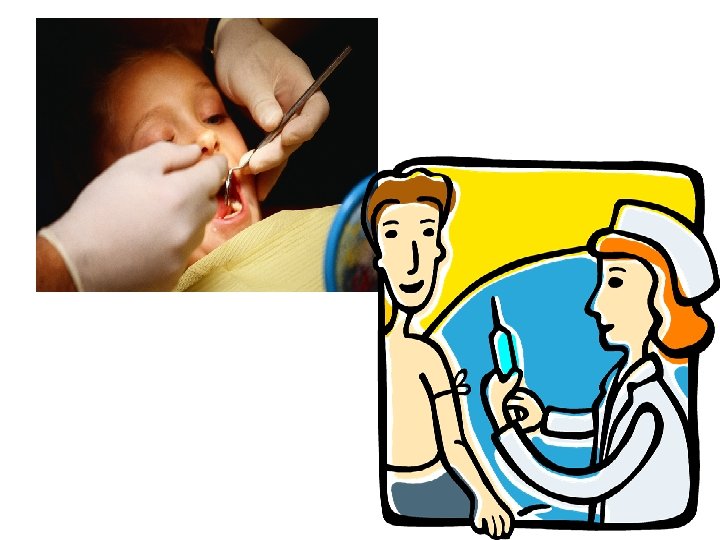
Stress is any time your body has to adjust to any kind of change. Ex. n Stress causes a significant overload to the MIND and BODY. n #1 stressor: n #2 stressor: n
People who report a high level of stress are twice as likely to get a cold. n Being “stressed out” is bad for your body! n Hormones are produced when you “stress out” – these hormones suppress the IMMUNE SYSTEM, thus making the body more susceptible to diseases, viruses and infections. Ex. Woman’s husband dies…. n
Immune System: the body’s defense and surveillance network of cells and chemicals that fight off bacteria, viruses and other foreign or toxic substances.
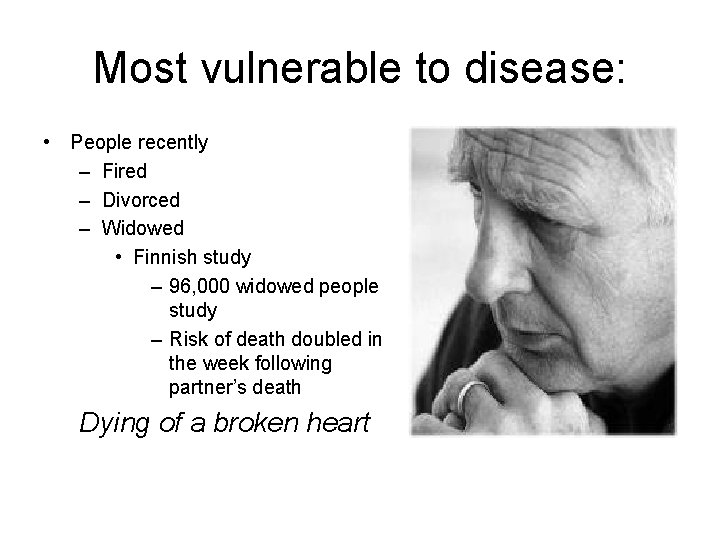
Most vulnerable to disease: • People recently – Fired – Divorced – Widowed • Finnish study – 96, 000 widowed people study – Risk of death doubled in the week following partner’s death Dying of a broken heart

Stress, Health and Coping FIGHT OR FLIGHT RESPONSE § Primitive physiological responses (sweat, heart rate increase etc. ) that arouse and prepare the body (muscles and brain) for action. It’s triggered by physical or psychological situations that are new, threatening or challenging. § This response provides the body with increased energy to deal with perceived threatening situations whether real or imagined. § The number of fight or flight we experience depends on our levels of stress.
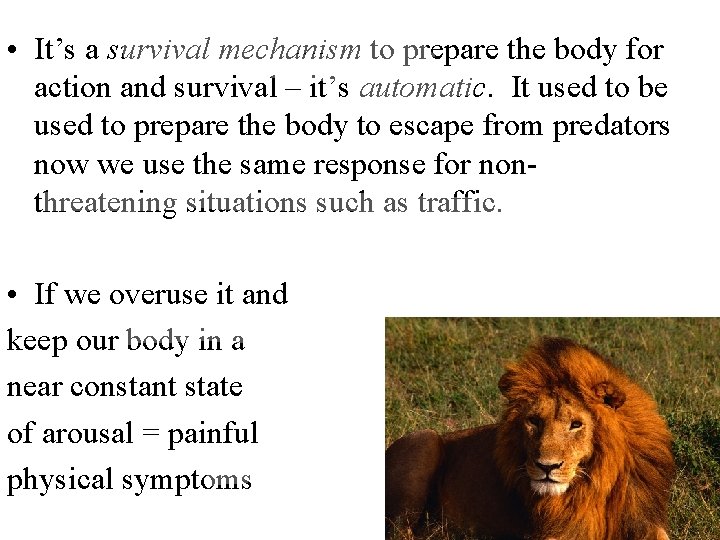
• It’s a survival mechanism to prepare the body for action and survival – it’s automatic. It used to be used to prepare the body to escape from predators now we use the same response for nonthreatening situations such as traffic. • If we overuse it and keep our body in a near constant state of arousal = painful physical symptoms
Biggest problem with stress: l l l Your body can’t distinguish between physical stress and mental stress. So your body is ready to FIGHT or FLEE even when that’s not what you need to do This activation is hard on your body and you’re more likely to get sick if it continues
Are there gender differences? Yes! ¡ Sources are often different l l ¡ Married men show better mental health than married women Caring for children is more stressful than almost any job New research: men are more likely to have “fight or flight” reaction, while women have “tend and befriend” reaction (seek social support) l l Women: emotional coping Men: problem-solving strategies
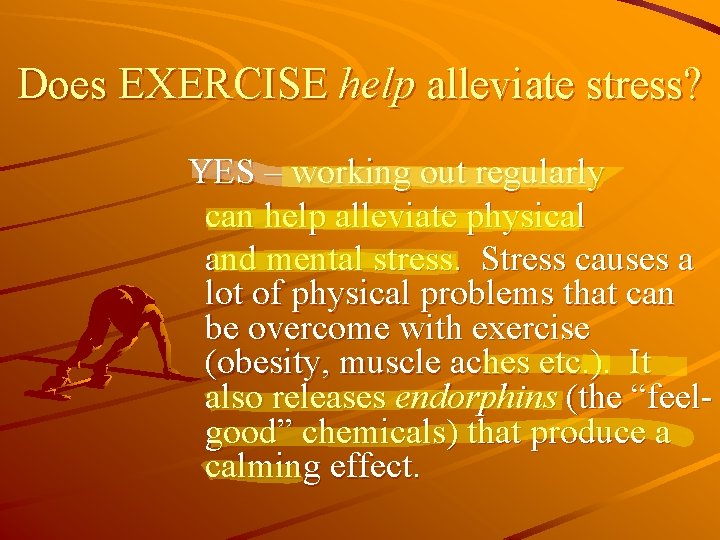
Does EXERCISE help alleviate stress? YES – working out regularly can help alleviate physical and mental stress. Stress causes a lot of physical problems that can be overcome with exercise (obesity, muscle aches etc. ). It also releases endorphins (the “feelgood” chemicals) that produce a calming effect.
2 Types of Personality
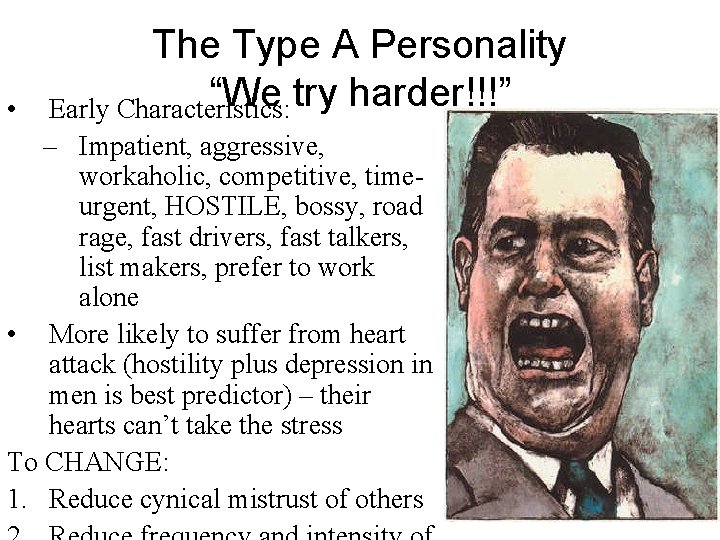
• The Type A Personality “We try harder!!!” Early Characteristics: – Impatient, aggressive, workaholic, competitive, timeurgent, HOSTILE, bossy, road rage, fast drivers, fast talkers, list makers, prefer to work alone • More likely to suffer from heart attack (hostility plus depression in men is best predictor) – their hearts can’t take the stress To CHANGE: 1. Reduce cynical mistrust of others
Cardiologists Meyer Friedman and Roy Rosenhan • Mid-1950’s, San Francisco • Noticed that the chairs in their waiting rooms were all worn out along the front edges but almost like new otherwise • Thought their patients might be the type of people who often sit on the edges of their chairs • Realized other characteristics of male heart patients: – Competitive and ambitious – Speak rapidly and interrupt others – Frequently hostile and angry
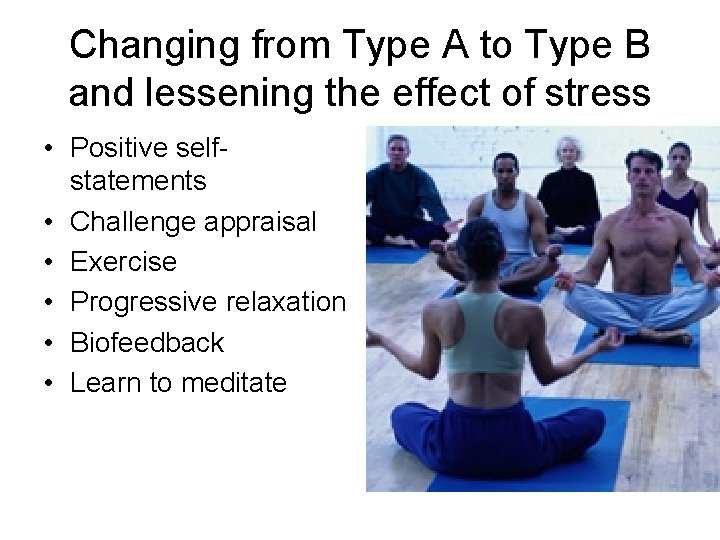
Changing from Type A to Type B and lessening the effect of stress • Positive selfstatements • Challenge appraisal • Exercise • Progressive relaxation • Biofeedback • Learn to meditate
Some other Type A thoughts: • Not just hostility but also MISTRUST of other people – a CYNICISM • Can it be genetic? • Is it a result of failure to resolve Erikson’s first stage: trust vs. mistrust? • More research needed to find link between personality and biology • Take a test to see if you’re a “Type A”
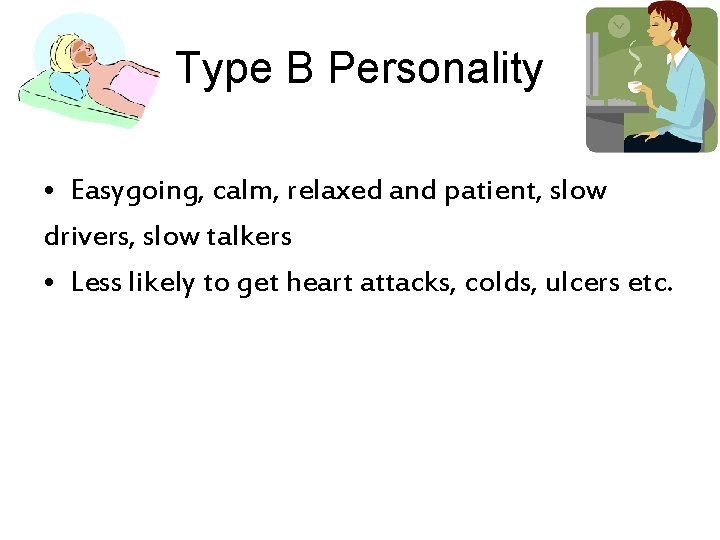
Type B Personality • Easygoing, calm, relaxed and patient, slow drivers, slow talkers • Less likely to get heart attacks, colds, ulcers etc.
§ Executives more likely to be type A or B? § New: Type A/B § Gender adjectives for both….
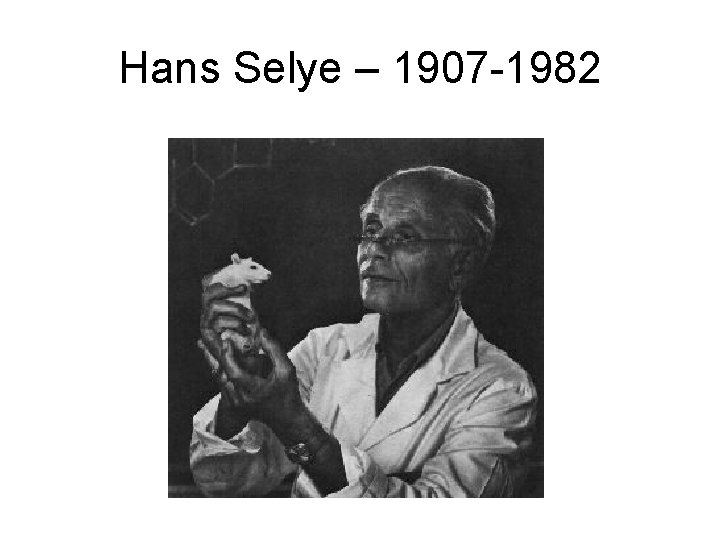
Hans Selye – 1907 -1982
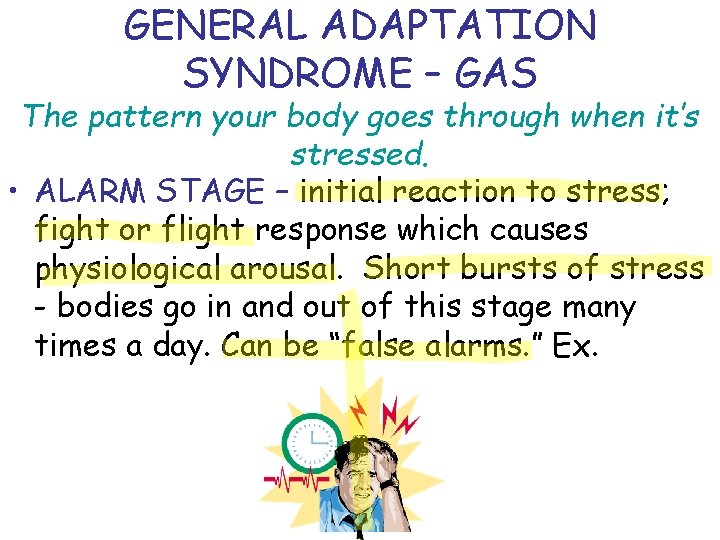
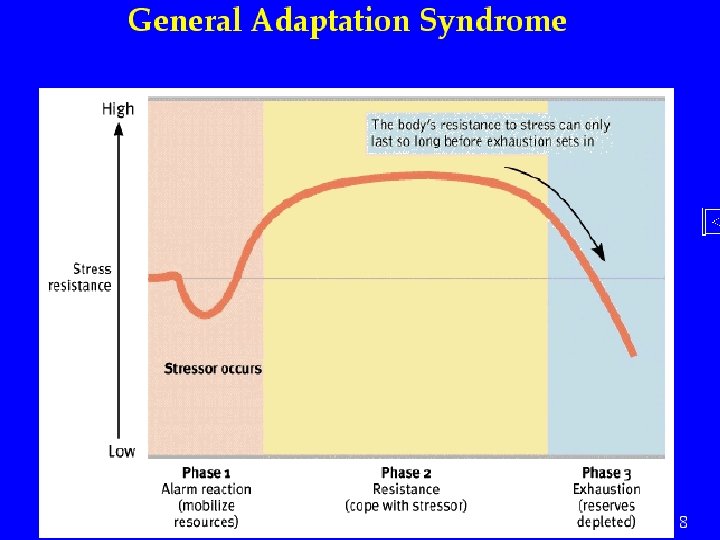
GENERAL ADAPTATION SYNDROME – GAS The pattern your body goes through when it’s stressed. • ALARM STAGE – initial reaction to stress; fight or flight response which causes physiological arousal. Short bursts of stress - bodies go in and out of this stage many times a day. Can be “false alarms. ” Ex.

• RESISTANCE STAGE – “eye of the storm” body’s reaction to continued stress – bodily responses return to normal levels – to do this, since the body is stressed, the body has to use up great stores of energy. Body seems to be functioning normally but actually it has to work 2 x as hard to do this. • EXHAUSTION STAGE – Body’s reaction to long-term, continuous stress: actual breakdown in internal organs or weakening of the infection-fighting immune system. Body gets tired of constant state of arousal. During this stage, for example, stomach pains turn into ulcers. PAY BACK! Ex.
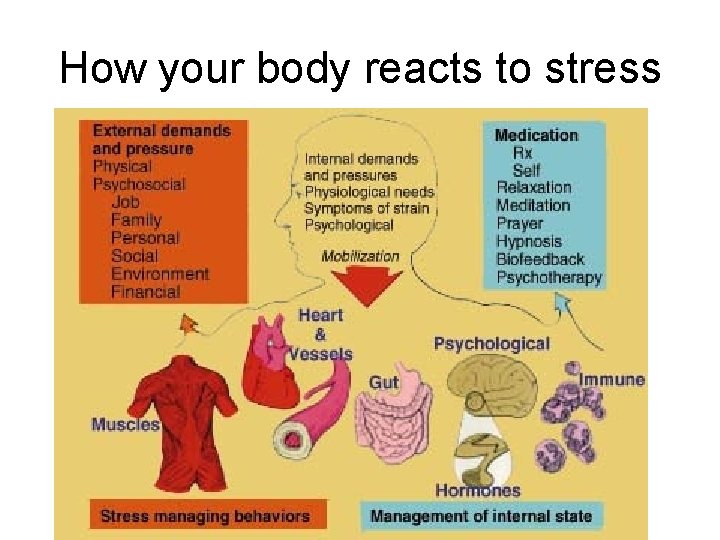
How your body reacts to stress
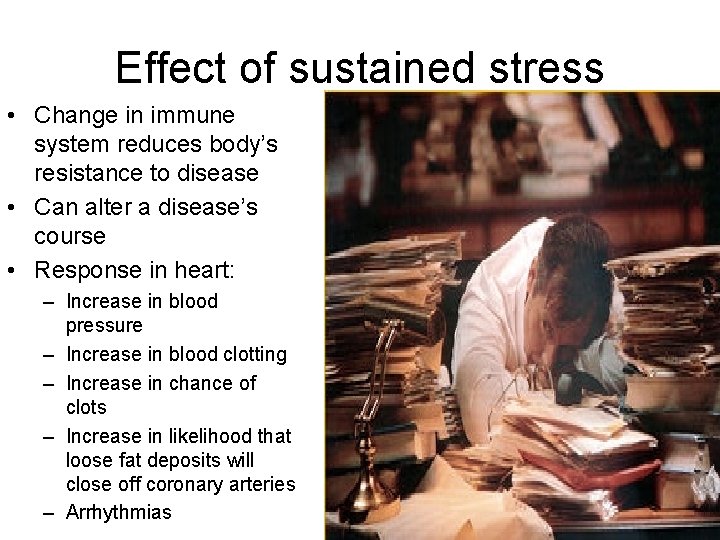
Effect of sustained stress • Change in immune system reduces body’s resistance to disease • Can alter a disease’s course • Response in heart: – Increase in blood pressure – Increase in blood clotting – Increase in chance of clots – Increase in likelihood that loose fat deposits will close off coronary arteries – Arrhythmias
Life expectancy in Russia: 1990 -93 • Following collapse of Russian socialism: – Mushrooming rates of divorce, murder, suicide, stress-related diseases – Life expectancy for Russian men plummeted • From 64 years to 58. 9 years • Contrast: – Monks with a relatively peaceful life • Lowest rate of heart attacks
PHYSIOLOGICAL RESPONSES PSYCHOSOMATIC SYMPTOMS psycho= mind; somatic = body Real physical symptoms that are caused by psychological factors such as stress. 70 -90% health problems! Real tissue damage (unlike hypochondriac – imagined physical ailments)

Common psychosomatic symptoms n n n n Headaches Stomach problems Intestinal difficulties Fatigue without physical exertion Insomnia Skin problems or rashes Asthma and allergy flareups n n n n Outbreaks of herpes (facial or genital) High blood pressure Cardiovascular difficulties Pains in neck, shoulders, back Grinding teeth during sleep Recurring colds of flu Eating problems
• Prolonged stress can produce physical deterioration and psychosomatic symptoms (not the same as hypochondriacal symptoms when a person misinterprets physical sensations as symptoms of disease!).
Why does one person have some psychosomatic symptoms and someone else have different ones? (And some people don’t have any!)
§ § § 1. 2. 3. 4. 5. Whatever part of our body is genetically vulnerable will be attacked (different for different people). The parts of our bodies that are targeted or weakened will be especially vulnerable during stress. When and why stressors surface: *Inherited predisposition *Nutrition *Lifestyle Stressful situation Appraisal of situation as a threat
Psychosomatic symptoms are a clear demonstration of the “Mind-Body connection”
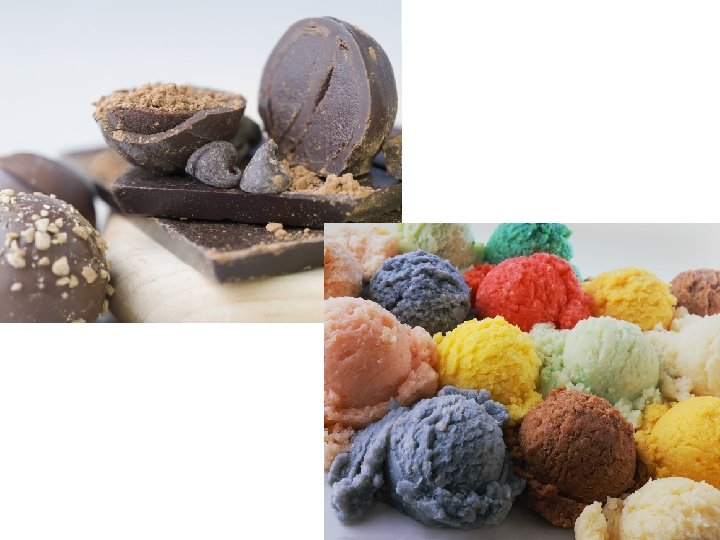
Dealing with Conflict l Having to choose between two (or more) possibilities Approach-approach – l Avoidance-avoidance – l Both possibilities are disagreeable Approach-avoidance – l Both possibilities are appealing Situation has good and bad possibilities Having to choose can be very stressful
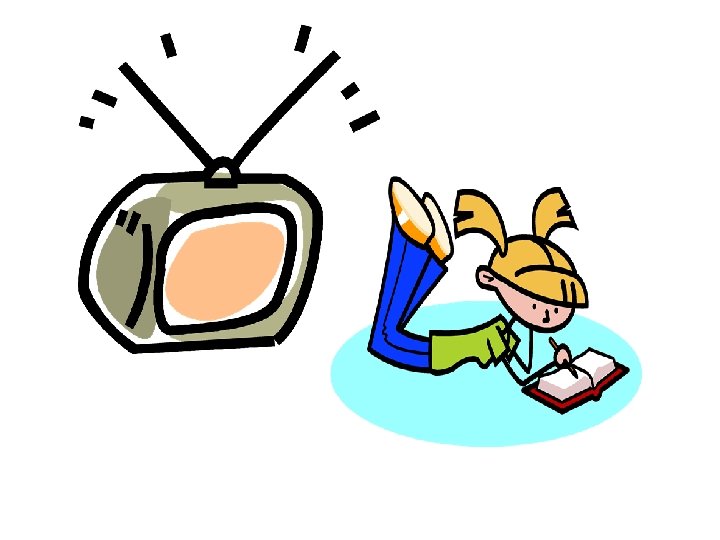
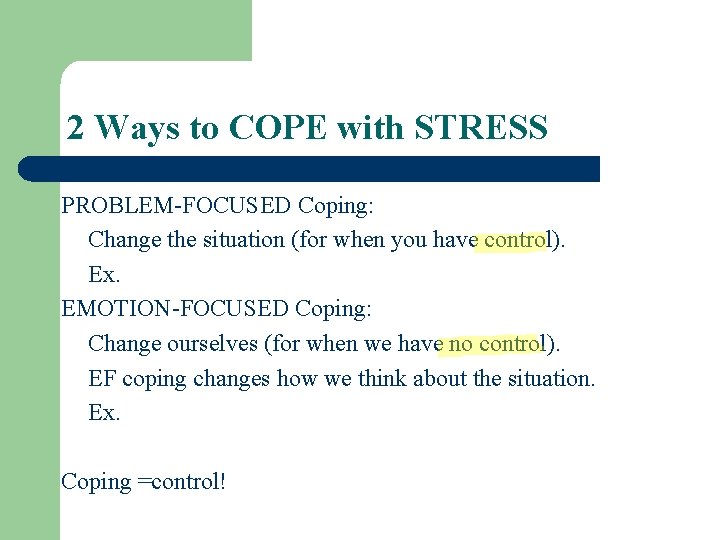
2 Ways to COPE with STRESS PROBLEM-FOCUSED Coping: Change the situation (for when you have control). Ex. EMOTION-FOCUSED Coping: Change ourselves (for when we have no control). EF coping changes how we think about the situation. Ex. Coping =control!
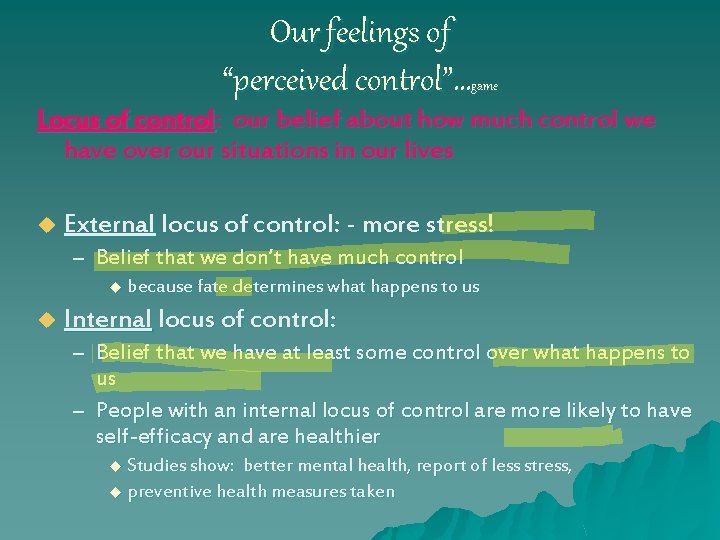
Which one we use depends on the situation and how much control we have (or think we have). Control – sometimes you can only change yourself and sometimes you should change the situation. Coping = less control = more stress
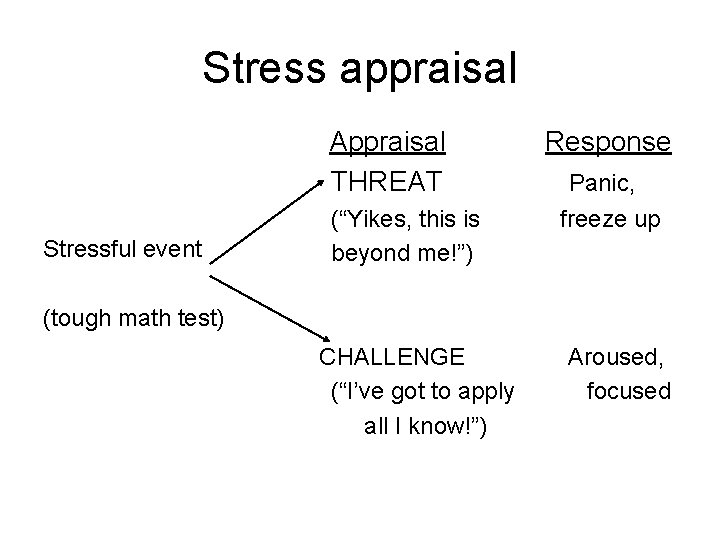
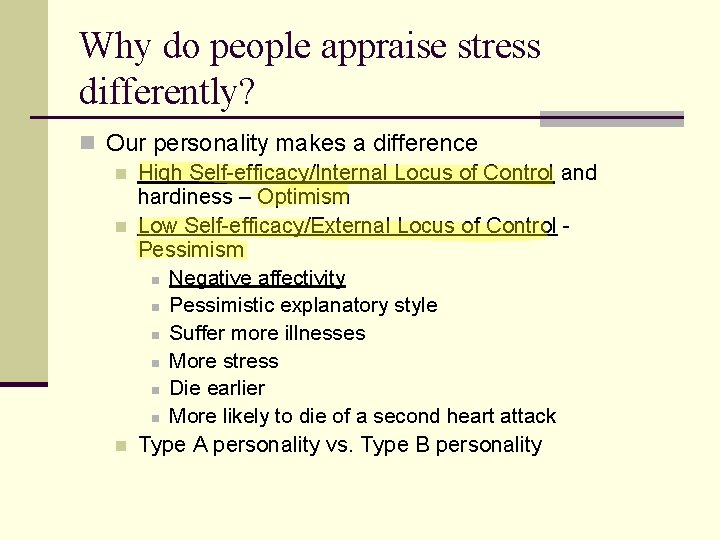
So the good (or bad ) news may be: *How stressed we are depends on how we appraise events. *
Stress appraisal Appraisal THREAT Stressful event (“Yikes, this is beyond me!”) Response Panic, freeze up (tough math test) CHALLENGE (“I’ve got to apply all I know!”) Aroused, focused
One of life’s best coping mechanisms is to know the difference between an inconvenience and a problem. If you break your neck, if you have nothing to eat, if your house is on fire – then you’ve got a problem. Everything else is an inconvenience. Life is inconvenient. Life is lumpy. A lump in the oatmeal, a lump in the throat and a lump in the breast are not the same kind of lump. One needs to learn the difference. - Robert Fulghum
Our feelings of “perceived control”… game Locus of control: our belief about how much control we have over our situations in our lives u External locus of control: - more stress! – Belief that we don’t have much control u because fate determines what happens to us u Internal locus of control: – Belief that we have at least some control over what happens to us – People with an internal locus of control are more likely to have self-efficacy and are healthier u Studies show: better mental health, report of less stress, u preventive health measures taken
Why do people appraise stress differently? n Our personality makes a difference n High Self-efficacy/Internal Locus of Control and hardiness – Optimism n Low Self-efficacy/External Locus of Control Pessimism n Negative affectivity n Pessimistic explanatory style n Suffer more illnesses n More stress n Die earlier n More likely to die of a second heart attack n Type A personality vs. Type B personality
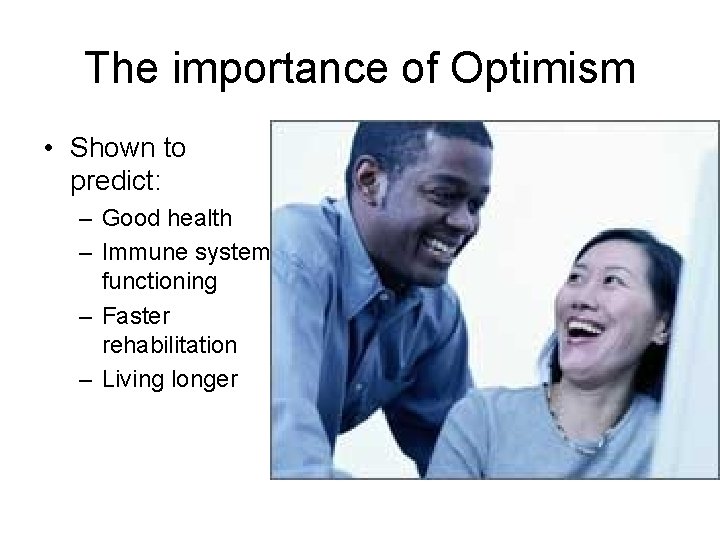
The importance of Optimism • Shown to predict: – Good health – Immune system functioning – Faster rehabilitation – Living longer
Biofeedback
Posttraumatic Stress Disorder (PTSD) • Severe psychological symptoms suffered after experiencing a traumatic event – Recurring and disturbing “real” memories – Recurring nightmares – Intense fear and anxiety
MODEL OF STRESS Include stressors, perceptions, physical and psychological reaction and coping responses. 1. Brainstorm examples of stressors that are common among students (arguments with parents etc. ) 2. After a long list has been developed your group must: A Decide on the 6 that occur most frequently. B Come up with a list of perceptual statements or self-statements commonly used by students when dealing with stress (“I can’t deal with this anymore”) and pick most common statements. C Decide what kinds of physical and psychological stress reactions are most common (headaches etc. ) D Frequently used coping methods (shopping, drinking) and circle non-healthy methods and come up with alternative and healthier methods.
- Slides: 48