
STRESS STRESS Learning Objectives What is stress n
STRESS

STRESS Learning Objectives: What is stress n Identifying our stressors n How our body and mind responds to stress n What are our vulnerabilities n How we can better manage our stress n
STRESS n What is it? Stress is the body’s and mind’s response to a demand. This demand is called a stressor.

Types of stressors: Environmental Stressors Biological Stressors Conditions or events in n Conditions that make your physical environment. it difficult for your body to take part in n Examples: Pollution, daily activities. poverty, crowding, noise, natural disasters, messy n Examples: Illness, disability, injury. work area. n

Types of stressors continued. . . Thinking Stressors Any type of mental challenge, concern or worry. n Examples: School, work, kids, bills, relationships. n Behavioral Stressors Unhealthy behaviors or habits. n Examples: Not getting enough sleep, being late, using alcohol or tobacco, drugs, arguing. n
Types of stressors continued. . . Life Change Stressors n Any major life change, positive or negative. n Examples: Getting married, divorced, death of loved one, going away to college. What are your stressors?
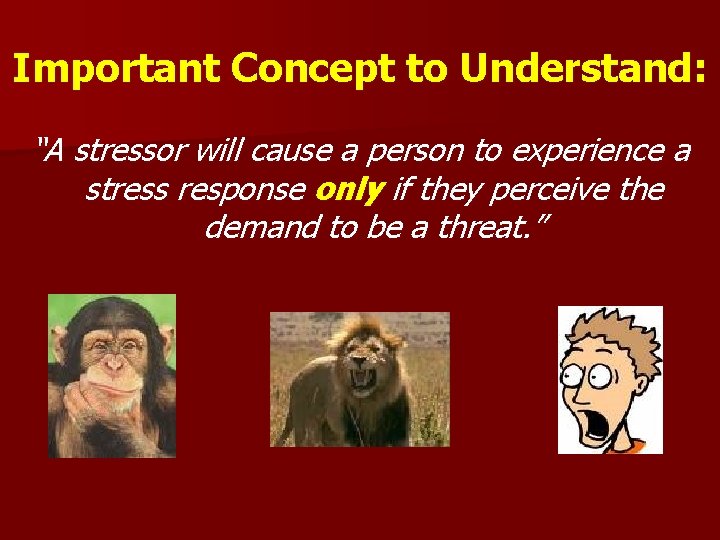
Important Concept to Understand: “A stressor will cause a person to experience a stress response only if they perceive the demand to be a threat. ”

Emotional and Behavioral Response to Stress “The way you respond to a stressor depends on whether you consider the stressor to be positive or negative. ” Example: Giving a presentation in front of the class. n Eustress – positive stress – good stress that helps us - alert, focused, motivated, energized, confident n Distress – negative stress - nervous, forgetful, frightened, confused, unsure
How the Body and Mind Reacts to Stress Your body reacts to stress in three phases: Alarm Stage – “Fight or Flight Response” – the body physically responds to the demand Resistance Stage – Body continues responding until the stress is resolved, or the body settles down to recuperate. Exhaustion Stage – Stress persists, the body soon becomes exhausted. Disease or disorders may occur.
If the stress continues. . . n Resistance stage - If the stress continues, your body becomes more resistant to disease and injury. You can cope with added stress, but for only a limited time. n Exhaustion stage You can no longer take anymore of the stressor, especially if several stressors occur at once. Body physically and mentally gives in.
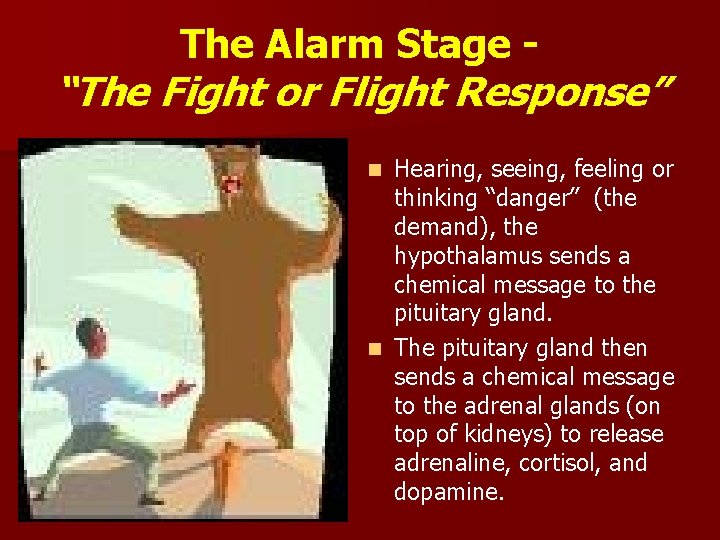
The Alarm Stage - “The Fight or Flight Response” Hearing, seeing, feeling or thinking “danger” (the demand), the hypothalamus sends a chemical message to the pituitary gland. n The pituitary gland then sends a chemical message to the adrenal glands (on top of kidneys) to release adrenaline, cortisol, and dopamine. n
“The Fight or Flight Response” The adrenaline in the bloodstream causes the following actions to occur immediately with in the body. Some or all may occur. n n n n Increase alertness (more blood to brain) Heart rate speeds up Blood pressure increases Breathing accelerates Sweating increases Mouth becomes dry Muscles tense Digestion slows n n n Body cells release energy faster (blood sugar rises) Stomach acid increases Hearing ability increases Blood clotting ability increases Blood vessels carry less blood to skin and digestive system Pupils dilate (to let more light in)
Long-Term Stress Can Make You Sick Stress-Related Diseases, Disorders and Conditions n n n Heart Disease Stroke High Blood pressure Increase blood cholesterol Asthma Headaches Insomnia Depression Erectile dysfunction Infertility Diabetes n n n n n Backaches Temporomandibular joint dysfunction (TMJ) Chronic fatigue Constipation Gastric (stomach) ulcers Anxiety disorders Decreased libido Acne, eczema, psoriasis Lower Immunity Arthritis
“Vulnerabilities” to Stress Vulnerabilities are lifestyle behaviors that may increase the likelihood of becoming stressed. n n n Not eating a balanced diet. Not getting 7 -8 hours of sleep 4+ nights per week. Not exercising (to a sweat) 3 -5 x per week. Drinking caffeinated beverages. Smoking Drinking alcohol n n n Not having a network of friends or family. Not sharing openly about feelings or worries. Not setting aside time for fun activities. Not giving or receiving affection. Not managing time well.
Managing Stress: Taking Care of the Basics Eat a well-balanced diet, lots of fruits and vegetables. Stay away from cookies, soda, candy, coffee. Exercise to a sweat 20 -30 minutes 3 -5 times each week. Have people in your life you can talk to. Get 8 -9 hours sleep each night. Put sleep before TV.
Positive Behaviors to Manage Stress Learn to say “no” Delegate responsibilities Manage your time Don’t take on too much Ask for help/assistance Acknowledges your weaknesses Take breaks from routine Breathe, breathe “Reframe” the stressor understand that some things are out of your control n Remind yourself of what you have, not what you don’t have n n n n n
Closing thoughts to ponder. . . A lecturer, when explaining stress management to an audience, raised a glass of water and asked, “How heavy is this glass of water? ” Answers called out ranged from a few ounces, to a couple of pounds. The lecturer replied, “The absolute weight doesn’t matter. It depends on how long you try to hold it. If I hold it for a minute, that’s not a problem. If I hold it for an hour, I’ll have an ache in my right arm. If I hold it for a day, you’ll have to call an ambulance. In each case, it’s the same weight, but the longer I hold it, the heavier it becomes. ”
He continued, “And that’s the way it is with stress management. If we carry our burdens all the time, sooner or later, as the burden becomes increasingly heavy, we won’t be able to carry on. ” “As with the glass of water, you have to put it down for a while and rest before holding it again. When we’re refreshed, we can carry on with the burden. ” “So, before you return home tonight, put the burden of work down. Don’t carry it home. You can pick it up tomorrow. Whatever burdens you’re carrying now, let them down for a moment if you can. ”
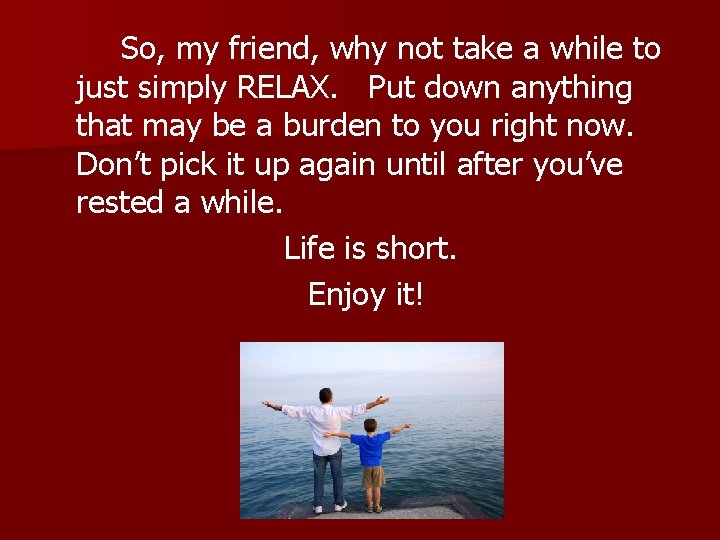
So, my friend, why not take a while to just simply RELAX. Put down anything that may be a burden to you right now. Don’t pick it up again until after you’ve rested a while. Life is short. Enjoy it!
- Slides: 19