
Stress Management for Life A ResearchBased Experiential Approach
Stress Management for Life A Research-Based, Experiential Approach, 4 e Olpin | Hessen 10 Spirituality © Cengage Learning 2016
Key Questions • What does spirituality have to do with managing my stress? • How can spirituality in my daily life help me cope with, or even prevent, stress? • Can I be spiritually healthy even though I don’t go to church? • Can prayer change anything? • How can I learn to forgive someone who has hurt me so I can get on with my life? © Cengage Learning 2016
Objectives • Describe the influence of spirituality on stress • Differentiate between the terms religiosity and spirituality • Discuss the research linking spirituality and health • Summarize the barriers to research on spirituality © Cengage Learning 2016
Objectives (cont’d. ) • Delineate five qualities of spiritual health • Develop a personal plan to reduce stress through spiritual balance © Cengage Learning 2016
Spirituality • Spirituality is at the heart of stress management • People with a deep sense of spirituality – Have a purpose, a sense of meaning in life, and a broader perspective – Are not defeated by crises • Spirituality buffers stress © Cengage Learning 2016
FYI: Spirituality in America • A large majority of Americans (78%) say they believe in God – 15% say they don’t believe in God, but do believe in a higher power • Today’s college students have very high levels of spiritual interest and involvement © Cengage Learning 2016
The Spiritual Quest • Americans are looking for answers and seeking guidance on human spirituality – People may be tired of seeking pleasure through material gain – Discussions of spirituality are no longer isolated in religious settings, but are part of current events and daily life © Cengage Learning 2016
Spirituality and Religiosity • Think of spirituality as having: – A vertical dimension, which involves a transcending relationship with a higher power – A horizontal dimension, which involves a sense of purpose and meaning in life • Think of religiosity as participation in or adherence to the beliefs and practices of an organized religion © Cengage Learning 2016
Research Highlight: Spiritual Changes in Undergraduate Students • Religious engagement among students declines somewhat during college • Spirituality shows substantial growth – Students become more caring, more tolerant, more connected with others, and more actively engaged in a spiritual quest – Spiritual growth enhances other outcomes, such as academic performance, psychological well-being, leadership development, and satisfaction with college © Cengage Learning 2016
Research Highlight: Spiritual Growth in Undergraduate Students • Spiritual growth is enhanced by: – Study abroad, interdisciplinary studies, and service learning – Engaging in “inner work” through meditation, self-reflection, and/or academic exploration • Spiritual growth is impeded by: – Engaging in activities that distract from the ordinary experience of campus life—such as watching television and playing video games © Cengage Learning 2016
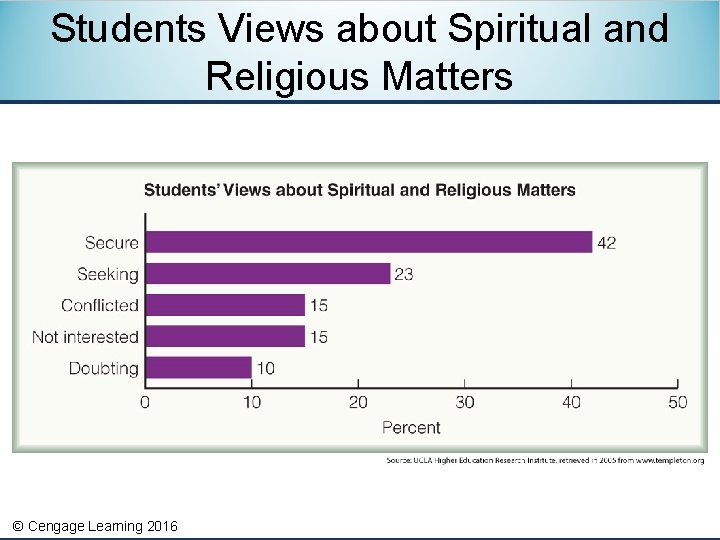
Students Views about Spiritual and Religious Matters © Cengage Learning 2016
Research on Spirituality • Key issues relate to research on spirituality – Definition of terms – Placebo effect – Lifestyle variables © Cengage Learning 2016
Culture Connection: A Native American Perspective • Man is like an island, a circle within circles – Man is separated from these outer circles by his mind, his beliefs, and the limitations put upon him by a life away from the Earth – Beyond man’s island of ego, his prison, lays the spirit-that-moves-in-all-things, the force that is found in all things – The power of the pure mind is what makes all spiritual communication pure and unrestricted • The logical mind is a barrier or filter © Cengage Learning 2016
Research on Spirituality – Terms • Defining terms – Spiritual health is not an exact science • As terminology becomes standardized, studies on spirituality will yield more relevant, applicable findings • Placebo power – Placebo describes the positive effects that are created when a person merely believes he or she will benefit from an intervention • About 35% of people are susceptible © Cengage Learning 2016
Research on Spirituality – Variables • Variables in religion, health, and lifestyle research • Alternative variable may determine results – Regular participation in religious activities and practices adds 7 to 14 years to the life span, BUT much of this benefit comes from the health-promoting practices of most religious groups © Cengage Learning 2016
Research on Spirituality – The Bottom Line • Great strides are being made in applying scientific research methodology to understanding the impact of spiritual and religious variables on health and stress management © Cengage Learning 2016
Five Qualities of Spiritual Health • A sense of meaning and purpose in life • Faith in God or a higher power—however you choose to define it • A feeling of connection to others and seeing oneself as part of something bigger • Compassion for others • Participation in religious behaviors or meaningful spirituals © Cengage Learning 2016
Meaning and Purpose • Without some purpose in life, we wander aimlessly and our enthusiasm for life can be lost – Learning that even the most difficult times in life can bring meaning can change the experience in a positive direction – Those who find meaning, even in their suffering, are able to find peace © Cengage Learning 2016
FYI: Survivor’s Story • Something as devastating as cancer can actually bring peace and improve quality of living © Cengage Learning 2016
Faith • Belief in a higher power is the cornerstone of every major religion • Faith is the belief in or commitment to something or someone seen or unseen that helps a person realize a purpose • Believing that we can release to a higher power some things that are beyond our control relieves stress – Provides a sense of tranquility and security © Cengage Learning 2016
Connectedness • The feeling of relatedness or attachment to others • A sense of relationship to all of life • A feeling of harmony with self and others • A feeling of oneness with the universe and/or a universal element or Universal Being © Cengage Learning 2016
Compassion for Others • Two important qualities of compassion have special relevance to stress management – Forgiveness: experience of psychological peace that occurs when injured people transform their grievances against others – Altruism: the act of helping or giving to others without thought of self-benefit; Random Acts of Kindness movement © Cengage Learning 2016
Culture Connection: Namaste • Namaste greeting – I honor the place in you where the entire universe resides – I honor the place in you where lies your love, your light, your truth, and your beauty – I honor the place in you, where, if you are in that place in you, and I am in that place in me, then there is only one of us © Cengage Learning 2016
Research Highlight: The Forgiveness Factor • Studies using positron emission tomography (PET) show that different parts of the brain are activated when we contemplate forgiveness rather than revenge or retaliation © Cengage Learning 2016
FYI: The World of Doing Good • More than 60 million Americans are involved in volunteer efforts • “We make a living by what we get, we make a life by what we give” – Winston Churchill © Cengage Learning 2016
Behaviors and Rituals • Religious behaviors and meaningful spirituals – Prayer – Nature – Ecospirituality © Cengage Learning 2016
Research Highlight: Prayer in the Coronary Care Unit • Randolph Byrd’s research suggests intercessory prayer may improve health outcomes © Cengage Learning 2016
An Action Plan for Stress Management through Spiritual Wellness • Define what spirituality means to you • Reflect on spiritual moments in your life • Based on your definition of spirituality, reflect on how spirituality relates to stress in your life © Cengage Learning 2016
FYI: Students and Prayer • 69% of college students say they pray: – 61% pray at least weekly, and 28% pray daily • They pray for: – Loved ones (68%), to express gratitude (59%), forgiveness (58%), and for help in solving problems (58%) © Cengage Learning 2016
Conclusion • The path to spiritual health is not prescribed – The right way is the one that works for you © Cengage Learning 2016
Lab 10. 1: Spiritual Wellness Assessment and Response • Take the Spiritual Wellness Assessment • Reflect on your response in the assessment as you consider – The activities that help you feel spiritually healthy – What makes up the core of your life – What is most important for your spiritual wellbeing and what is most important for your spiritual growth – What you can do to grow spiritually © Cengage Learning 2016
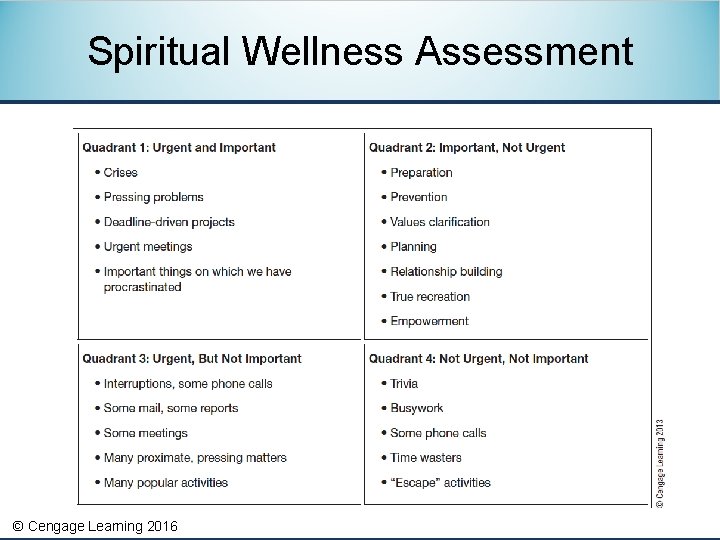
Spiritual Wellness Assessment © Cengage Learning 2016
- Slides: 32