
Stress Echo 2020 Pisa October 2016 Stress Echo
Stress Echo 2020, Pisa October 2016 Stress Echo Primer: before taking the test Eugenio Picano, MD CNR, Istituto di Fisiologia Clinica
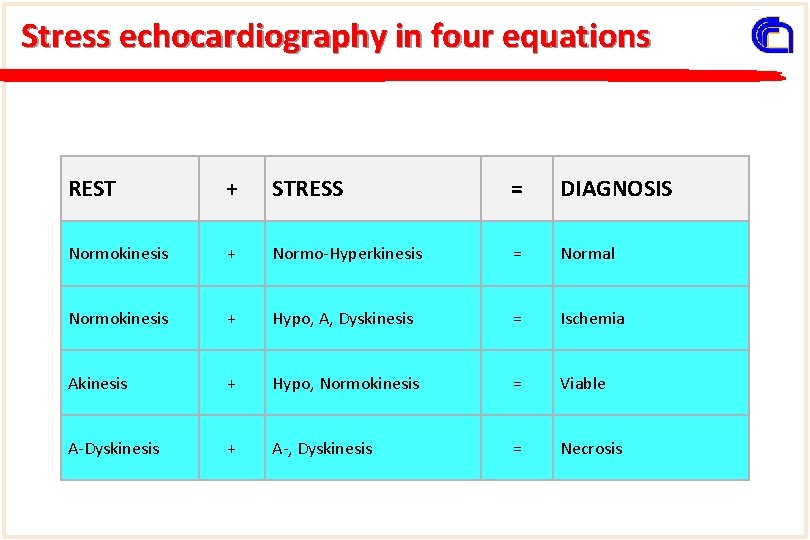
Stress echocardiography in four equations REST + STRESS = DIAGNOSIS Normokinesis + Normo-Hyperkinesis = Normal Normokinesis + Hypo, A, Dyskinesis = Ischemia Akinesis + Hypo, Normokinesis = Viable A-Dyskinesis + A-, Dyskinesis = Necrosis
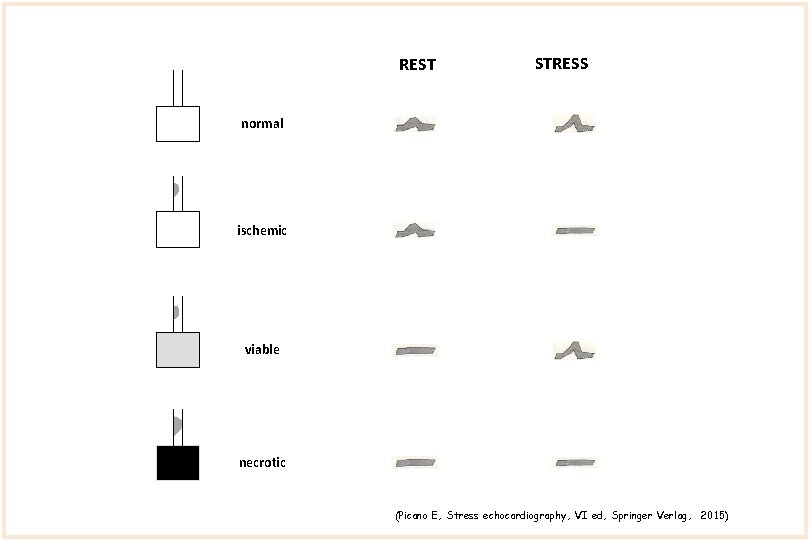
REST STRESS normal ischemic viable necrotic (Picano E, Stress echocardiography, VI ed, Springer Verlag, 2015)
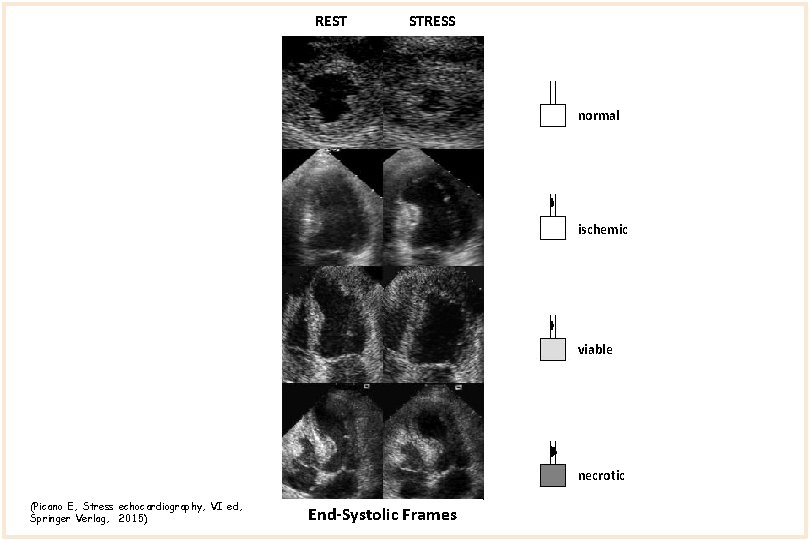
REST STRESS normal ischemic viable necrotic (Picano E, Stress echocardiography, VI ed, Springer Verlag, 2015) End-Systolic Frames
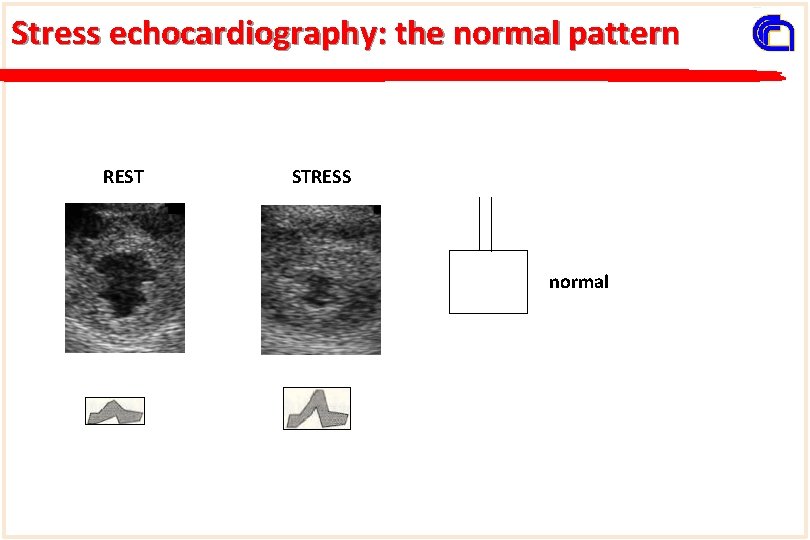
Stress echocardiography: the normal pattern REST STRESS normal
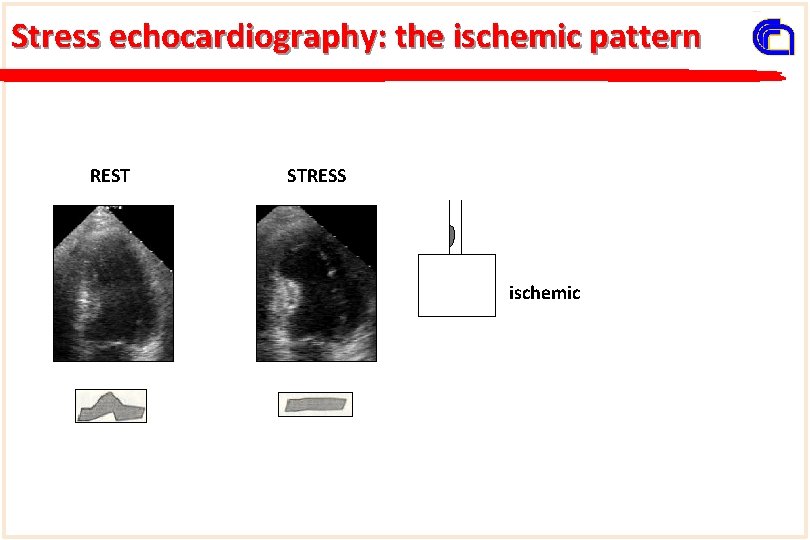
Stress echocardiography: the ischemic pattern REST STRESS ischemic
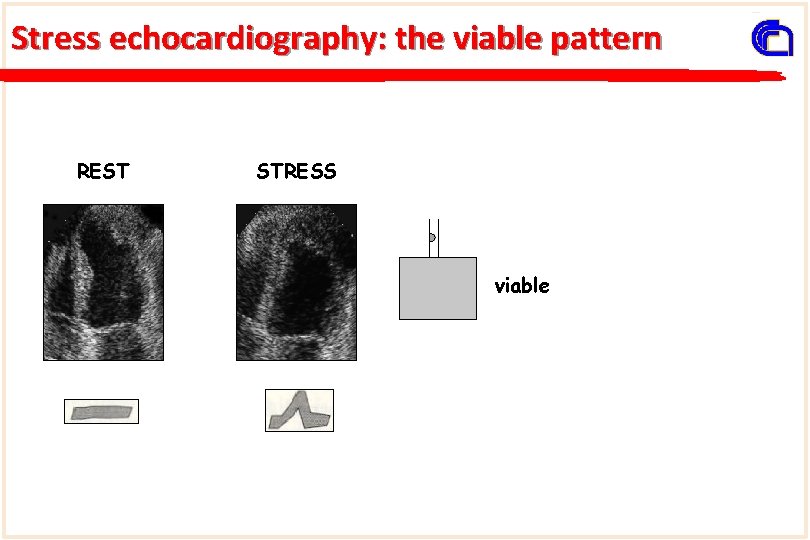
Stress echocardiography: the viable pattern REST STRESS viable
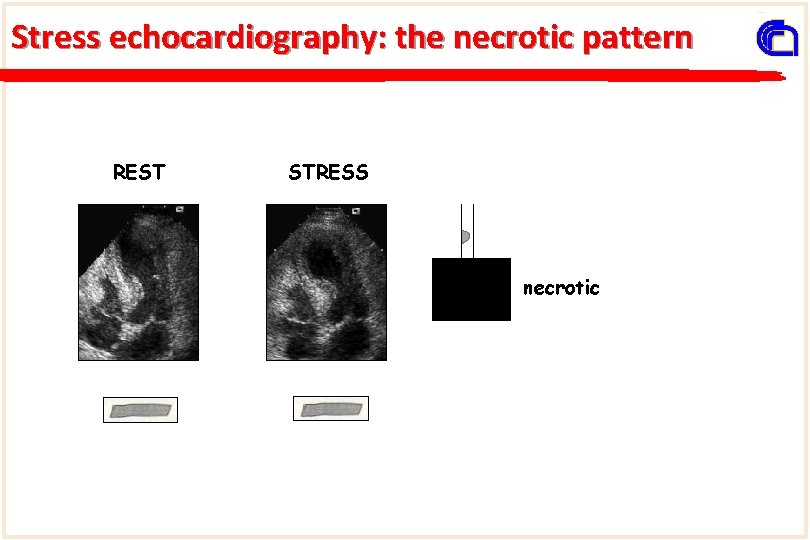
Stress echocardiography: the necrotic pattern REST STRESS necrotic
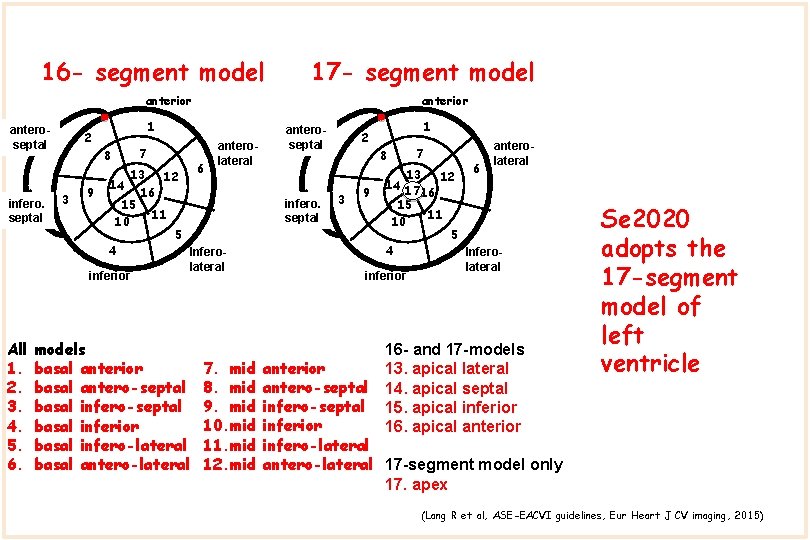
16 - segment model 17 - segment model anterior anteroseptal infero. septal All 1. 2. 3. 4. 5. 6. 1 2 8 3 anterior 7 anterolateral 6 13 12 14 16 9 15 11 10 5 4 Inferolateral inferior models basal anterior basal antero-septal basal inferior basal infero-lateral basal antero-lateral 7. mid 8. mid 9. mid 10. mid 11. mid 12. mid anteroseptal infero. septal 1 2 8 3 7 anterolateral 6 13 12 14 17 16 9 15 11 10 5 4 Inferolateral inferior 16 - and 17 -models 13. apical lateral 14. apical septal 15. apical inferior 16. apical anterior antero-septal inferior infero-lateral antero-lateral 17 -segment model only 17. apex Se 2020 adopts the 17 -segment model of left ventricle (Lang R et al, ASE-EACVI guidelines, Eur Heart J CV imaging, 2015)
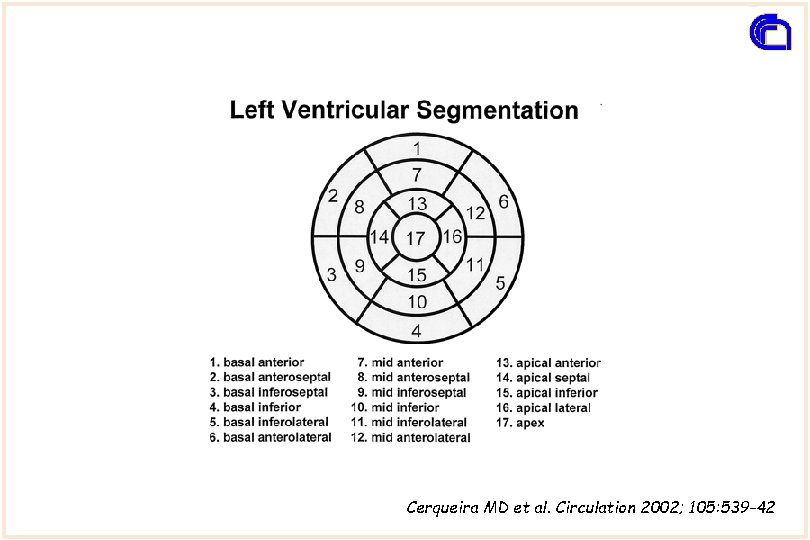
Cerqueira MD et al. Circulation 2002; 105: 539 -42
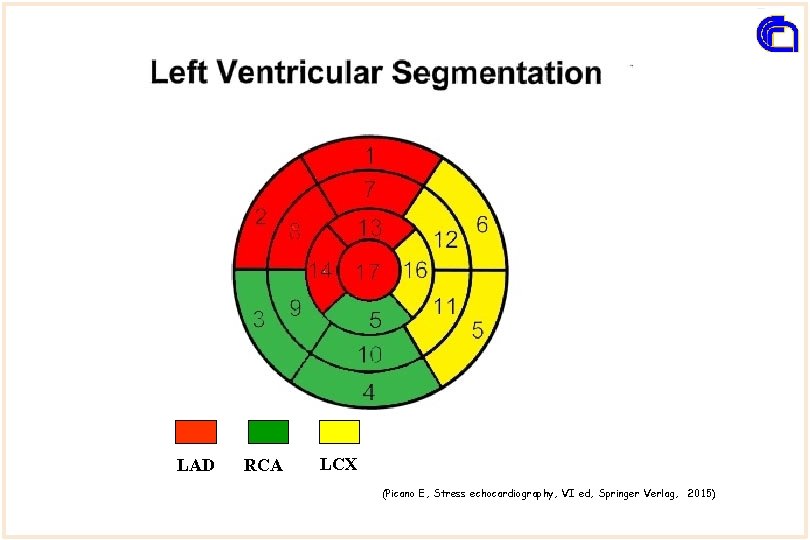
LAD RCA LCX (Picano E, Stress echocardiography, VI ed, Springer Verlag, 2015)
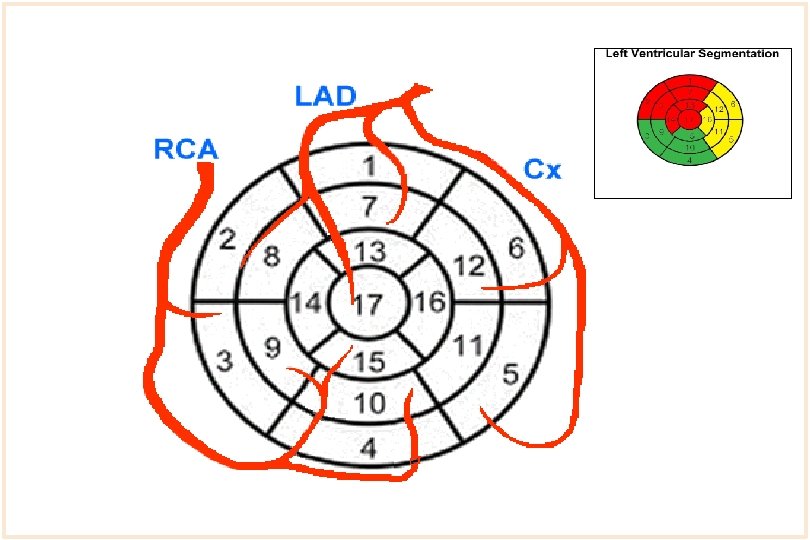
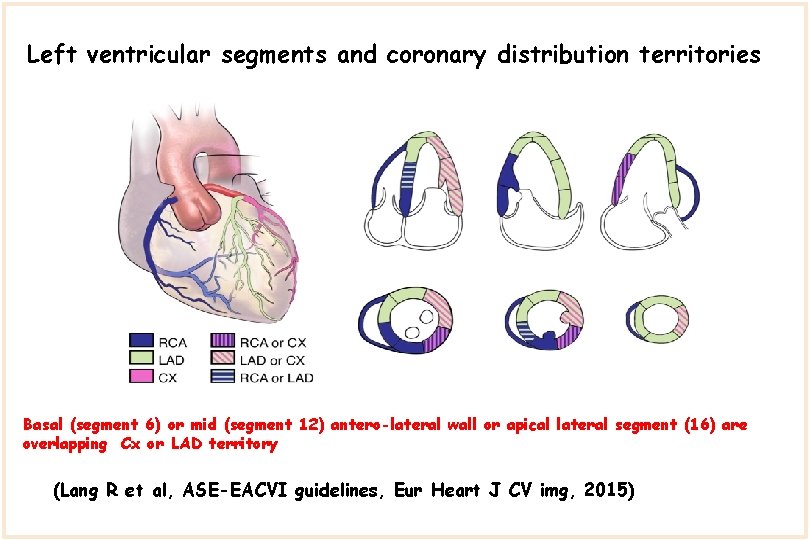
Left ventricular segments and coronary distribution territories Basal (segment 6) or mid (segment 12) antero-lateral wall or apical lateral segment (16) are overlapping Cx or LAD territory (Lang R et al, ASE-EACVI guidelines, Eur Heart J CV img, 2015)
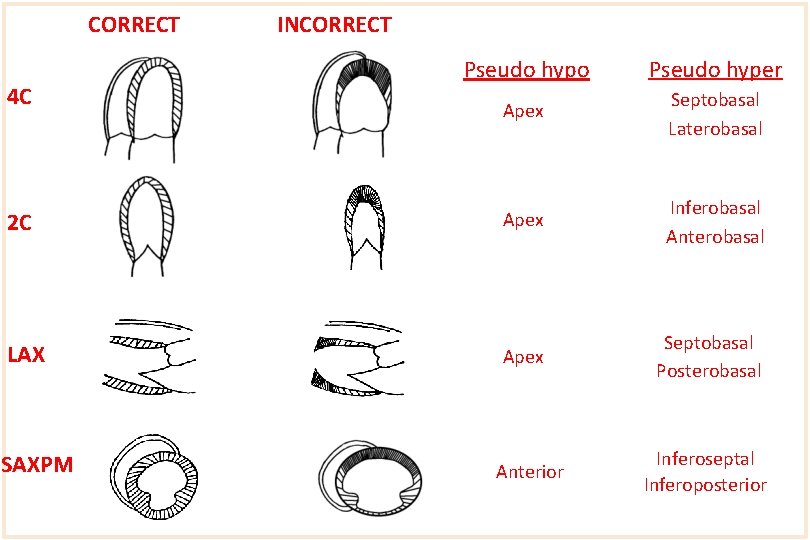
CORRECT INCORRECT Pseudo hypo Pseudo hyper Apex Septobasal Laterobasal 2 C Apex Inferobasal Anterobasal LAX Apex Septobasal Posterobasal 4 C SAXPM Anterior Inferoseptal Inferoposterior
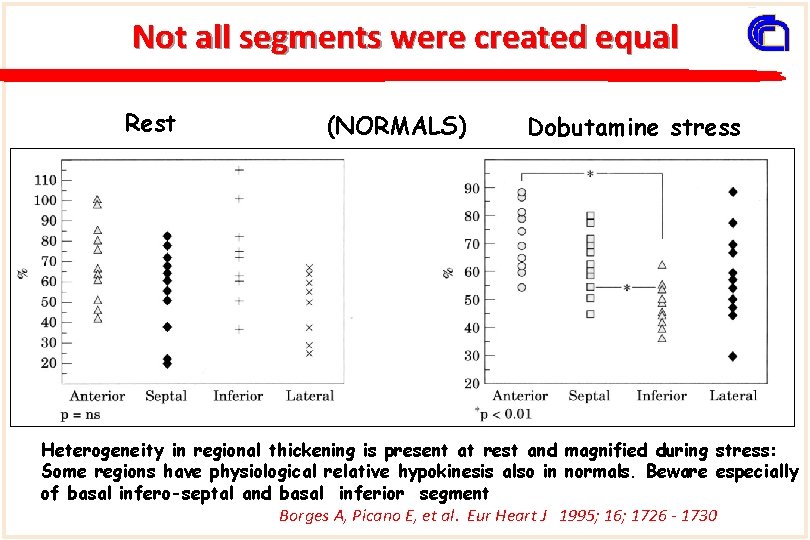
Not all segments were created equal Rest (NORMALS) Dobutamine stress Heterogeneity in regional thickening is present at rest and magnified during stress: Some regions have physiological relative hypokinesis also in normals. Beware especially of basal infero-septal and basal inferior segment Borges A, Picano E, et al. Eur Heart J 1995; 16; 1726 - 1730
Power to the People (stressism-leninism) Professional restrictions are absent and all who are willing to invest in the equipment can apply it. This total lack of controls and review, compounded by the performance of most such studies in the office or laboratory of the private cardiologist, strongly increases the possibility for abuse. E. H. Botvinick, J Nucl Cardiol, 1994; 1: S 147 -70
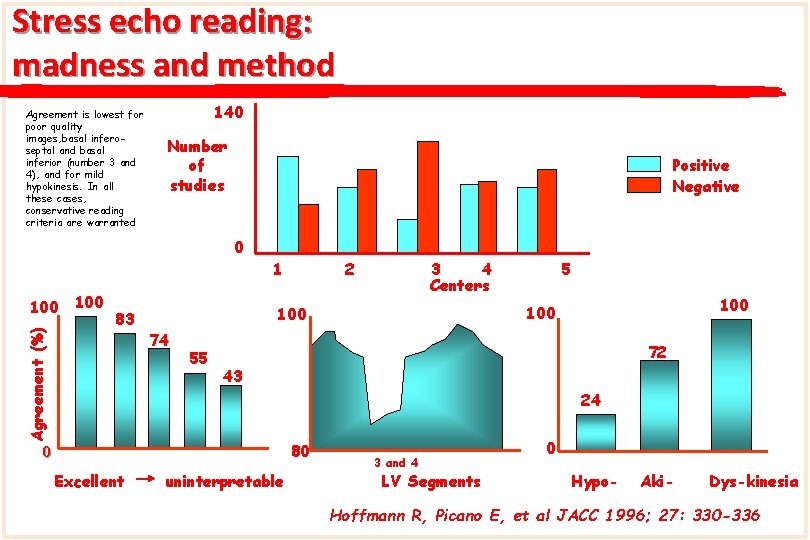
Stress echo reading: madness and method Agreement is lowest for poor quality images, basal inferoseptal and basal inferior (number 3 and 4), and for mild hypokinesis. In all these cases, conservative reading criteria are warranted 140 Number of studies Positive Negative 0 1 Agreement (%) 100 83 2 3 4 Centers 55 100 100 74 5 72 43 24 80 0 Excellent uninterpretable 3 and 4 LV Segments 0 Hypo- Aki- Dys-kinesia Hoffmann R, Picano E, et al JACC 1996; 27: 330 -336
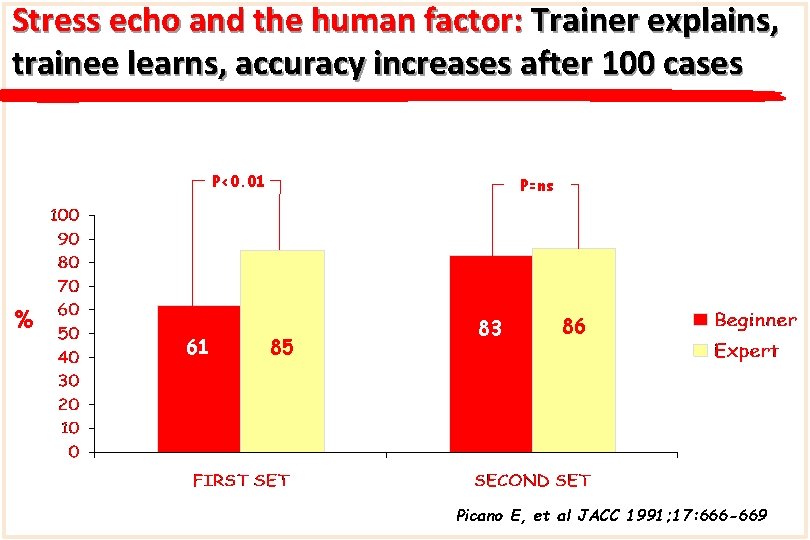
Stress echo and the human factor: Trainer explains, trainee learns, accuracy increases after 100 cases P<0. 01 % 61 P=ns 85 83 86 Picano E, et al JACC 1991; 17: 666 -669
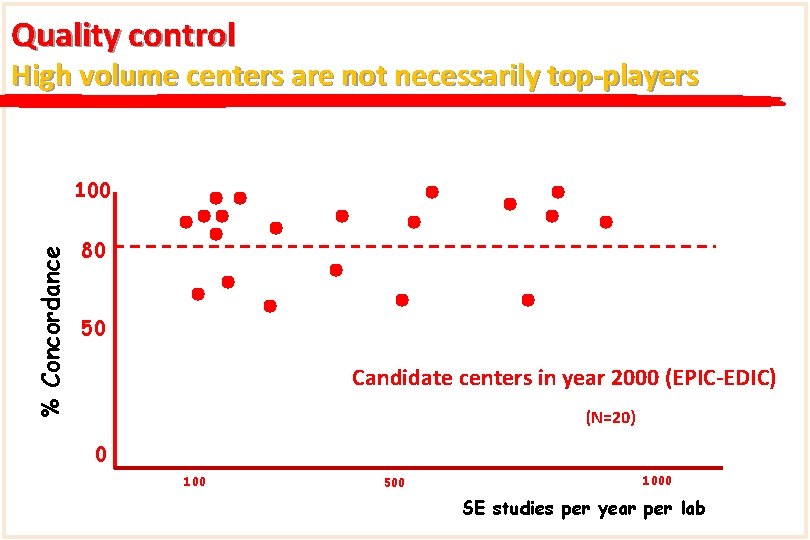
Quality control High volume centers are not necessarily top-players % Concordance 100 80 50 Candidate centers in year 2000 (EPIC-EDIC) (N=20) 0 100 500 1000 SE studies per year per lab
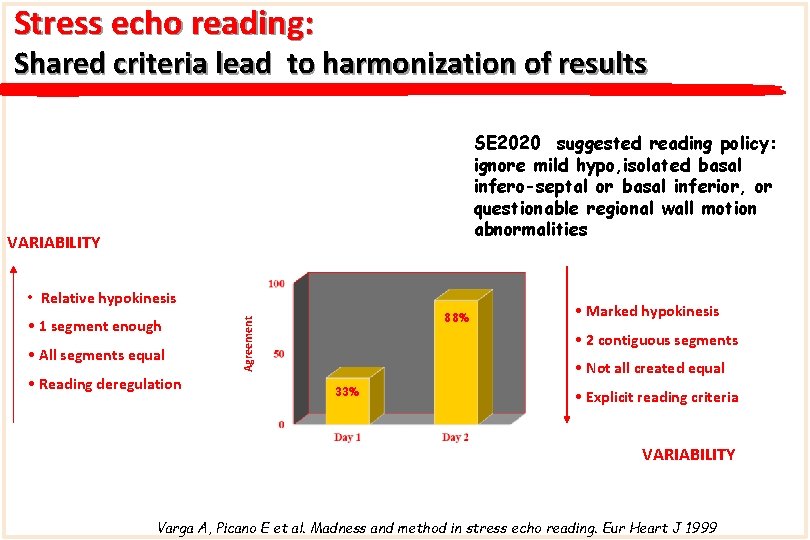
Stress echo reading: Shared criteria lead to harmonization of results SE 2020 suggested reading policy: ignore mild hypo, isolated basal infero-septal or basal inferior, or questionable regional wall motion abnormalities VARIABILITY • Relative hypokinesis • All segments equal • Reading deregulation Agreement • 1 segment enough 88% • Marked hypokinesis • 2 contiguous segments • Not all created equal 33% • Explicit reading criteria VARIABILITY Varga A, Picano E et al. Madness and method in stress echo reading. Eur Heart J 1999
Positivity criteria in the literature: Not good for SE 2020 • “Relative hypokinesis” is not a positivity criterion • “Lack of hyperkinesis” is not a positivity criterion • “Tardokinesis” is not a positivity criterion • Isolated hypokinesis of only 1 segment out of 17 • Mild hypokinesis of infero-basal septum • Mild hypokinesis of basal inferior wall • You judge what you see : what you don’t see, you cannot call • If you use overtly aggressive reading, every stress will turn out positive
Readers’ comments (October 2016) • “Some images are old ” (but interpretable) • “Not the same projection” (as it usually happens in real life) • “Low quality ” (in real life of high volume labs, 20 % of studies are readable but low quality: if you only select excellent images, you loose a lot of patients) • “This study is uninterpretable” (some segments are not interpretable, you have to read what you see) • “I am the Head of this, Chief of that, I am too old for being quality controlled by anybody” (you are never too old to be quality controlled, in science, in life and in stress echocardiography, and peers always see and judge you)
Is stress echo dirty? Only when it is done right
- Slides: 23